Buyer Fit Snapshot
| Best fit | custom poly mailers for accessories for packaging buyers comparing material specs, print proof, MOQ, unit cost, freight, and repeat-order risk where brand print, material, artwork control, and repeat-order consistency matter. |
|---|---|
| Quote inputs | Share finished size, material target, print colors, finish, packing count, annual reorder estimate, and delivery region. |
| Proofing check | Approve dieline scale, logo placement, barcode or warning zones, color tolerance, and any recyclable or compostable wording before bulk production. |
| Main risk | Vague material claims, crowded artwork, or missing packing details can create delays even when the unit price looks attractive. |
Fast answer: Custom Poly Mailers for Accessories: Cost, Fit, Brand should be specified like a repeatable production item. The safest quote includes material, print method, finish, artwork proof, carton packing, and reorder notes in one written spec.
What to confirm before approving the packaging proof
Check the product dimensions against the actual filled item, not only the sales mockup. Ask for tolerance on folds, seals, hang holes, label areas, and retail display edges. If the package carries a logo, QR code, warning copy, or legal claim, reserve that space before decorative graphics fill the panel.
How to compare quotes without losing quality
Compare board or film grade, print process, finish, sampling route, tooling charges, carton quantity, and freight assumptions side by side. A lower quote is only useful if the supplier can repeat the same color, closure quality, and packing count on the next order.
Custom Poly Mailers for accessories solve a very unglamorous problem: small products should not ship in packaging that eats margin for breakfast. A light item does not need a heavy box, and nobody wants to pay extra just to move a scarf, belt, hair clip, or jewelry pouch across the country. That is the whole appeal of custom poly mailers for accessories. They keep shipping lean, keep storage simple, and give the package a branded face instead of a sad anonymous bag.
The practical case is obvious. Custom Poly Mailers for accessories use less material than corrugated boxes, weigh less at checkout, and take up far less room on a shelf or packing table. The visual case matters too. A printed mailer feels more deliberate than a blank shipping envelope, and that first impression matters when the product is small enough that the package becomes part of the product story. No one gets excited by a dull bag with a label slapped on it. Customers notice that stuff.
There is still some discipline required. The best Custom Poly Mailers for accessories are chosen with the item in mind, not just the logo. Size, film thickness, closure style, and artwork coverage all affect the result. A soft scarf can travel very differently from a rigid sunglasses case. A pouch of earrings needs a different setup than a structured wallet. That gap is where most packaging mistakes begin.
A mailer that saves a few ounces and a few seconds per order can outperform a fancier carton if the accessory is already compact and durable.
What Are Custom Poly Mailers for Accessories?
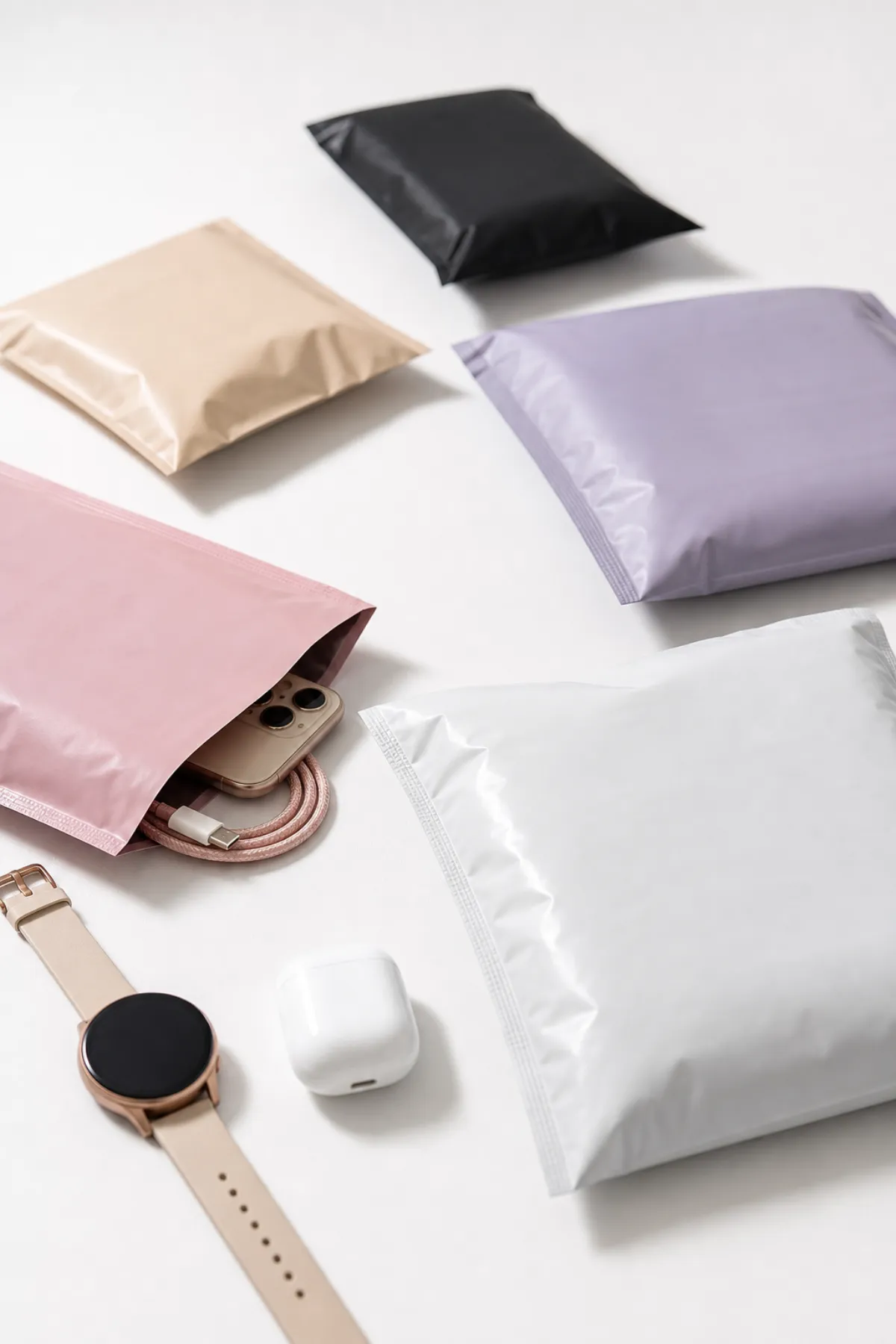
Custom poly mailers for accessories are flexible shipping bags made from polyethylene film, usually LDPE or a co-extruded blend, with a self-seal adhesive strip. Brands print them with a logo, pattern, or short message so the outside of the parcel feels branded instead of plain. For accessory sellers, they are one of the easiest ways to add package branding without turning fulfillment into a slow-motion headache.
The format fits accessories because accessories tend to be small, lightweight, and not especially crush-sensitive. A scarf folds down cleanly. A belt sits flat. Hair accessories, jewelry pouches, wallets, and sunglass cases all stay compact. Put those items in a box with void fill and the cost structure starts behaving like a bad joke. Custom poly mailers for accessories usually make more sense.
Warehouse operations also benefit. Flat mailers stack neatly, store in shallow space, and are easier to stage in bulk than cartons. If a team ships lots of one-item orders, that small operational difference becomes real money. Faster packing, less clutter, less tape. The basics add up.
The fit between product and package is the real reason this format works so well. Most accessories do not need wall-to-wall crush protection. They need enough structure to keep the item from wandering around, enough sealing strength to stay closed, and enough moisture resistance to survive a normal shipping route. That is a narrow job, which is exactly why custom poly mailers for accessories are so useful.
Some brands use them as part of a wider packaging system. Hero products may ship in custom printed boxes, while smaller orders move in custom poly mailers for accessories. That split keeps the packaging line cleaner and lets the business spend more where it actually matters. Not every item deserves the same box theater.
- Best fit: lightweight, soft, or semi-rigid accessories
- Common uses: jewelry, scarves, belts, sunglasses cases, wallets, hair accessories
- Main benefit: lower package weight and simpler packing
- Main branding value: a consistent arrival experience that looks intentional
The packaging team usually does not need a dramatic pitch deck. It needs a bag that fits, seals, and ships at a sane cost. For custom poly mailers for accessories, that means a limited size set, a sensible film gauge, and print that still looks sharp after it gets tossed around by the carrier.
How Custom Poly Mailers for Accessories Work
Most custom poly mailers for accessories use a single flexible film or a multi-layer co-extruded film. The outer layer carries the print and gives the bag its appearance. The inner layer supports seal quality and handling. The self-seal adhesive strip closes the mailer fast, which is why these bags show up everywhere in high-volume fulfillment. No tape gun. No carton folding. No ritual sacrifice to the packing gods.
The print side can be stripped down or highly designed. A one-color logo is the easy route. Full-bleed artwork wraps the entire mailer and creates a louder brand statement. Side-panel copy can carry a web address, return note, social handle, or care message. Every choice changes the cost, but it also changes how the customer experiences the package. Custom poly mailers for accessories can feel clean, playful, premium, or retail-ready depending on the art direction.
Protection needs a reality check. These mailers help block dust, light moisture, scuffing, and routine handling. That is enough for many soft accessories and plenty of items that are already in a pouch or sleeve. They are not hard-shell cartons, though. If the product can bend, chip, scratch, or dent easily, the mailer may need help from tissue, a rigid insert, or a small inner box.
In practice, the best custom poly mailers for accessories do three things at once: they protect the exterior surface, they keep pack-out fast, and they make the shipment look deliberate. That is why they work for fashion accessories, beauty-adjacent items, gift goods, and e-commerce brands that want branding without extra bulk.
For parcel testing, ask whether the supplier can reference ISTA methods. For material claims, compare the construction against EPA sustainable materials guidance. Those references do not replace hands-on testing, but they give the buying team something better than a glossy sample photo and a sales promise.
Speed is the other reason this format sticks around. Custom poly mailers for accessories are fast to pack because the adhesive strip seals with one motion. Over hundreds of orders, saving ten seconds per package is not a rounding error. That is a real workflow advantage, and it is one reason the format keeps earning shelf space in packaging closets.
Choosing Sizes, Materials, and Costs
Size is the first cost lever. A mailer that is too large wastes film and often pushes postage higher because the package occupies more dimensional space. A mailer that is too tight can stress the seal, crease the contents, or slow the packing line. For custom poly mailers for accessories, the safest move is to work from the product dimensions after folding, bagging, or boxing, then add only the clearance needed for easy insertion and closure.
Common accessory mailer sizes often land around 6 x 9 inches, 7.5 x 10.5 inches, 9 x 12 inches, and 10 x 13 inches, though the right pick depends on the item. A thin bracelet pouch does not need the same footprint as a scarf bundle or a structured wallet. That sounds obvious. Somehow oversized packaging still shows up in enough warehouses to keep this conversation alive.
Film thickness matters almost as much as size. Standard film is usually the cheapest route. Thicker gauges such as 2.5 mil, 3 mil, or 4 mil add puncture resistance and a more substantial feel. Recycled-content film may raise the unit price, but it can support sustainability messaging and match the rest of the brand story. Bubble-lined options and specialty finishes cost more still. With custom poly mailers for accessories, the right choice depends on whether the item needs extra protection, a better presentation, or both.
Print coverage is another major cost driver. A small front logo in one color will cost less than a full-bleed graphic on both sides. Matte and soft-touch finishes usually feel more premium, while gloss reads brighter and more retail-facing. Interior printing can look nice, but it adds complexity that many accessory brands do not need. Sharp package branding often starts with a clean exterior and stops there.
Brands comparing custom poly mailers for accessories with other packaging formats should look past the quote sheet. The real cost includes setup, freight, storage, labor, and the packaging used inside the mailer. A slightly more expensive mailer can still beat a cheaper box once tape, void fill, and extra pack time are counted. Cheap on paper is not the same as cheap in practice.
| Option | Typical unit price at 5,000 pcs | Best for | Tradeoffs |
|---|---|---|---|
| Blank stock poly mailer | $0.12-$0.20 | Internal shipping where branding is not a priority | Lowest visual impact; no package branding |
| One-color branded mailer | $0.18-$0.28 | Most custom poly mailers for accessories orders | Good balance of cost and presentation; setup fee may apply |
| Full-bleed printed mailer | $0.24-$0.42 | Fashion-forward accessories and gifting | Higher print cost; artwork must be tightly managed |
| Recycled-content mailer | $0.22-$0.38 | Brands with sustainability messaging | May have fewer finish options; confirm film performance |
| Mailer plus inner insert | $0.28-$0.50 | Fragile or premium accessory sets | More assembly time; stronger unboxing experience |
Those numbers are only a frame of reference. Quantity, freight, artwork, closure type, and finish will move them around. Still, the direction is useful: custom poly mailers for accessories are usually affordable enough to protect margin while still giving the package a real brand presence.
If your line also needs hang tags, tissue, or carton inserts, the broader catalog at Custom Packaging Products can help compare the full packaging stack. If you want to compare the shipping format itself, the material and sizing details on Custom Poly Mailers are useful before you request art proofing.
Another detail that gets ignored too often: landed cost. A lower quote can turn into a worse real-world cost if freight is expensive, if the minimum order quantity is too large for your sales pace, or if the mailer size causes postage to jump a bracket. With custom poly mailers for accessories, the smart buyer looks at the whole shipping picture, not just the print price on the bag.
Ordering Custom Poly Mailers for Accessories: Process and Timeline
The cleanest ordering process starts with the product, not the art file. List the accessory SKU, folded or bagged dimensions, weight, fragility, and whether it ships with tissue, a pouch, or a card insert. That gives the supplier a real brief for custom poly mailers for accessories instead of a vague request tied to a logo mockup.
After sizing is set, the proof should show more than a pretty render. Ask for a dieline or digital proof so logo placement, bleed, seal flap area, and any barcode or return-address placement can be checked before production begins. If the art is busy, check how it reads at arm’s length and under normal pack-line conditions. A polished proof can still turn into a crowded mailer in the real world.
The production flow is usually simple: artwork approval, print setup or plate setup, manufacturing, curing or drying if needed, inspection, packing, and shipment. Straightforward custom poly mailers for accessories jobs can move in a few weeks after approval. More complex work takes longer when the artwork is dense, the quantity is high, or the film uses a specialty finish. Timing depends on the supplier's queue as much as on the bag itself.
- Define the accessory: dimensions, weight, fragility, and pack-out method
- Choose the size: enough clearance for sealing, not so much room that the package looks loose
- Select the film: standard, thicker gauge, recycled content, or specialty finish
- Approve the proof: confirm artwork position, color handling, and flap placement
- Run a sample test: pack real units and move them through a normal shipping path
- Scale the order: only after fit, seal strength, and appearance are confirmed
A serious buyer should also ask about seal strength, puncture resistance, and print consistency. If the supplier can share a tensile or film-performance reference, good. If they can point to ISTA 3A testing, even better. For custom poly mailers for accessories, basic material data such as thickness and construction is usually more useful than a vague promise that the bag is tough.
Receiving is where a lot of teams get lazy. Open the cartons, test a few units with actual products, and confirm that the seal stays closed, the print survives normal rubbing, and the package survives a simple drop or corner-hit sequence. That kind of check matters for custom poly mailers for accessories because the product mix can vary from soft and forgiving to rigid and scratch-prone.
Lead time deserves a straight answer too. A short, simple project may move from proof approval to shipment without drama, but accessory brands that need layered artwork, recycled-content film, or multiple sizes should plan for more time. The safe habit is to ask for the supplier's full schedule before promising a customer ship date. A little caution here saves a lot of awkward expediting later.
Common Mistakes That Hurt Accessories Packaging
The first mistake is oversizing. A mailer that is too big does more than waste film. It lets the product slide around, makes the shipment look unfinished, and can bump the order into a higher dimensional weight bracket. For custom poly mailers for accessories, that empty space is expensive. Air is not a margin strategy.
The second mistake is treating branding like a sticker instead of a system. Tiny logos, weak contrast, or crowded artwork can make a custom bag feel generic. Good package branding usually comes from restraint: one clear visual, one clean message, one surface that lets the accessory remain the focus. Trying to decorate every square inch is a great way to make the mailer look busy and cheap.
The third mistake is ignoring the item's actual vulnerability. A soft scarf can travel comfortably in a mailer. A hard clasp, a sunglass frame, or a set of pins may need tissue wrap, a pouch, or a slim insert before going into custom poly mailers for accessories. If the product can scratch or bend under pressure, the outer mailer alone may not do the job.
The fourth mistake is assuming the adhesive strip will save sloppy packing. A weak seal, a rushed closure, or a flap that is not pressed firmly enough can create open seams in transit. That leads to returns, re-shipments, and irritated customers. A lot of accessory brands obsess over front artwork and ignore the back-end mechanics where the real failure starts.
The fifth mistake is forgetting the warehouse. Barcode placement, return handling, stackability, and storage orientation are not sexy topics, but they affect operations every day. A good retail packaging choice should look good and work in the packing line. Custom poly mailers for accessories need to do both if the business is shipping at any meaningful volume.
- Do not: choose the largest size "just in case"
- Do not: bury the logo under too much copy
- Do not: assume every accessory can travel unprotected
- Do not: skip the first-run fit test
- Do not: ignore storage and pack-line workflow
There is also a quieter trap: trying to make the mailer do the work of the entire brand. Custom poly mailers for accessories are useful, but they are not a cure-all. If the item, insert card, tissue, and labeling are disorganized, the outer package cannot rescue the experience. Good product packaging works when the inside and outside tell the same story.
Expert Tips to Improve Branding and Protection
Standardize around a small size family. That is one of the easiest ways to reduce packaging waste and simplify purchasing. Instead of scattering orders across too many SKUs, many brands can cover most accessory shipments with two or three sizes of custom poly mailers for accessories. That makes forecasting simpler and keeps the shelf from turning into a junk drawer with a procurement badge on it.
Choose the finish to match the brand tone. Matte usually reads quieter, more premium, and more fashion-forward. Gloss tends to feel brighter and more promotional. Neither is automatically better. The right choice depends on whether the accessory line wants a minimal studio feel or a more retail-forward look with extra visual pop. A strong packaging decision here can do more than a louder graphic.
Use the mailer as a frame, not a billboard. A front logo, a simple repeat pattern, or a concise brand message can look sharper than an overbuilt design that fights with the item inside. In package branding, less clutter often means more perceived quality. That is especially true for custom poly mailers for accessories, where customers often notice the feel before they read a single word.
Pair the mailer with one inexpensive interior element. Tissue wrap, a product label, a short insert card, or a branded pouch can lift the experience without much cost. The goal is not to overpack. The goal is to give the order one more sign that the brand pays attention. If the accessory is small but the margin is healthy, that extra detail is usually worth the few cents it costs.
Test the package in actual conditions, not just on a desk. Fill the mailer with the real accessory, shake it lightly, drop it from a low packing-table height, inspect the seal, and check whether corners crease or punch through. If possible, send a handful of test shipments through the full carrier path. Custom poly mailers for accessories should feel light, but they still need to survive ordinary handling.
Keep an eye on the paper parts of the system too. If you use inserts, labels, or tissue, ask for responsibly sourced paper and look for FSC-certified options where appropriate. The outer mailer may be plastic film, but the overall packaging story can still be cleaner than a box-heavy setup if the rest of the components are chosen with some care.
Small product lines sometimes split the difference. The hero items get custom printed boxes; the everyday shipper gets custom poly mailers for accessories. That mix can be smart because it reserves the higher-cost format for products that actually justify it. From a buyer's point of view, that is usually better than forcing every item into the same packaging rule and pretending it all makes sense.
Good packaging design does not start with decoration. It starts with fit, handling, and a clear decision about what the package is supposed to do.
Next Steps for Custom Poly Mailers for Accessories
If the goal is to improve shipping economics without making the brand feel cheaper, start with the basics. Audit the top accessory SKUs, measure the packed dimensions, and identify the three sizes that could cover most orders. That exercise alone usually exposes a pile of waste hiding in plain sight. For many teams, custom poly mailers for accessories get much easier to source once the SKU list is cleaned up.
Ask for both blank samples and printed proofs. The blank sample shows the seal, texture, film stiffness, and actual fit. The proof shows the art and color balance. Together, those two views tell you far more than a render ever will. If the package feels flimsy in hand, or if the logo disappears at arm's length, you want to know before the full run gets made. That is the difference between a controlled rollout and an expensive do-over.
Build a pilot with one design, one thickness, and one postage class. Track damage rates, pack time, and customer comments for a few weeks. That data tells you whether the brand should keep the setup, tighten the size, simplify the print, or add an internal insert for fragile items. Custom poly mailers for accessories reward this kind of disciplined testing because the format is simple enough to measure without a lab coat and a prayer.
Separate aesthetics from logistics. A mailer can look excellent and still be the wrong choice for a product that arrives with pressure marks, loose contents, or a postage tier that makes finance wince. The strongest decisions usually sit at the intersection of product type, shipping cost, and brand story. That is where custom poly mailers for accessories become more than packaging; they become part of the business model.
For brands still building a packaging program, the best next move is not to order a massive run. Compare options, test a small batch, and see how the package behaves in real shipping. The market rewards packaging that is efficient, recognizable, and honest about what it can protect. Custom poly mailers for accessories do exactly that when the size, film, and artwork are chosen with care.
If the accessory line keeps growing, keep the packaging decision tied to the product itself. Choose the mailer size around the item, choose the film around the handling risk, and choose the print around the brand message. That is how custom poly mailers for accessories stay cost-effective, protect the contents, and support the customer experience without pretending to be something they are not.
The simplest takeaway: measure the actual packed product, test one sample in real shipping conditions, and only then place the full order. That one step prevents most of the expensive mistakes, and it keeps custom poly mailers for accessories doing the job they were meant to do instead of creating a fancy new problem.
Frequently Asked Questions
What size custom poly mailers for accessories should I choose?
Measure the accessory after it is folded, bagged, or boxed if that is how you ship it, then add just enough room for easy insertion and sealing. The smallest mailer that fits comfortably is usually the best choice, because oversized mailers waste material and can raise shipping costs. For custom poly mailers for accessories, fit should feel snug without being tight.
Are custom poly mailers for accessories cheaper than boxes?
Usually yes. Poly mailers use less material, weigh less, and take up less storage space than corrugated boxes. The real comparison should include labor, void fill, and postage, not only the unit price of the packaging. For many brands, custom poly mailers for accessories win because they reduce both pack time and shipping weight.
How long do custom poly mailers for accessories take to produce?
Simple projects can move from proof approval to shipment in a few weeks, but timing depends on quantity, print complexity, and material choice. Always ask for the supplier's full schedule, including proofing, production, inspection, and freight time, before promising delivery dates to customers. With custom poly mailers for accessories, lead time is often more about the art and the order size than the base material.
Can custom poly mailers for accessories protect fragile items?
They work well for soft, light, and non-crush-sensitive accessories, but delicate or rigid items may need an insert, sleeve, or padded interior. If the product can bend, chip, or scratch easily, test the mailer with a real shipment path before using it at scale. Many custom poly mailers for accessories jobs still benefit from a small internal protective layer.
What should I print on custom poly mailers for accessories?
Start with the essentials: logo, brand name, and a clean visual pattern that matches the accessory line. If space allows, add a website, return-friendly message, or recycling note, but avoid clutter that hides the product presentation. The best custom poly mailers for accessories usually keep the design simple and unmistakable.

