Buyer Fit Snapshot
| Best fit | Custom Poly Mailers for Marketplaces projects where brand print, material claims, artwork control, MOQ, and repeat-order consistency need to be specified before quoting. |
|---|---|
| Quote inputs | Share finished size, material target, print colors, finish, packing count, annual reorder estimate, ship-to region, and any compliance wording. |
| Proofing check | Approve dieline scale, logo placement, barcode or warning zones, color tolerance, closure strength, and carton packing before bulk production. |
| Main risk | Vague material claims, crowded artwork, missing packing details, or unclear freight terms can make a low unit price expensive after revisions. |
Fast answer: Custom Poly Mailers for Marketplaces: Film, Print, MOQ, and Carton Packing should be specified like a repeatable production item. The safest quote records material, print method, finish, artwork proof, packing count, and reorder notes in one written spec.
Production checks before approval
Compare the actual filled-product size with the drawing, then confirm tolerance on folds, seals, hang holes, label areas, and retail display edges. Reserve space for logos, QR codes, warning copy, and material claims before decorative graphics fill the panel.
Quote comparison points
Review material grade, print process, finish, sampling route, tooling charges, carton quantity, and freight assumptions side by side. A quote is only useful when the supplier can repeat the same color, closure quality, and packing count on the next order.
Custom Poly Mailers for Marketplaces: A Practical Guide
A customer buys a $24 accessory and expects a clean arrival, not a tired plastic sleeve that looks like it lost a fight with the supply closet. That is exactly why Custom Poly Mailers for marketplaces matter. They give a small order a branded finish, keep shipping weight low, and move faster across a packing table than custom printed boxes. From a packaging buyer's point of view, the mailer is doing three jobs at once: protecting the product, carrying the brand, and cutting down labor.
That matters in crowded marketplaces where similar listings sit shoulder to shoulder and price differences are often tiny. A clean mailer can make an ordinary parcel feel like branded packaging instead of generic shipping material, and that shift carries more weight than a lot of sellers want to admit. If you are building a broader packaging program, it helps to compare mailers with other Custom Packaging Products so your product packaging stays consistent across SKUs. For many sellers, Custom Poly Mailers for marketplaces are the lowest-friction route to better presentation without adding the cost and bulk of rigid cartons.
There is a plain reason they keep showing up in marketplace operations. They are flexible, light, and quick to pack. They can carry a logo, a color block, a return address, handling instructions, or a short note that reinforces package branding after the order leaves your hands. Used well, Custom Poly Mailers for marketplaces make a low-ticket item feel considered, and that feeling often matters as much as the item itself. Not glamorous. Just effective.
What Custom Poly Mailers for Marketplaces Solve
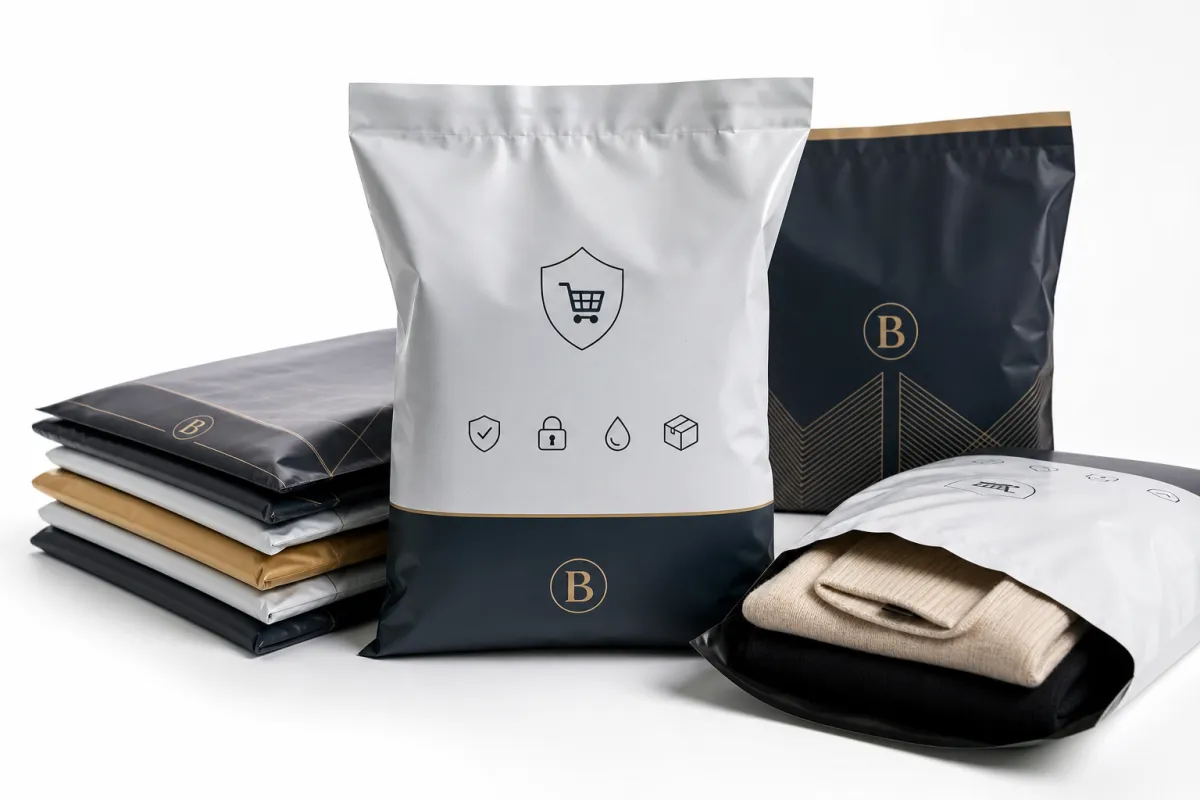
The real problem is not just shipping. It is presentation under pressure. A marketplace seller may move 50, 200, or 2,000 units a week, and every parcel still has to leave the table quickly while looking intentional. custom poly mailers for marketplaces solve that by combining enclosure, branding, and lower packaging weight in one piece. Drop in the item, peel the adhesive strip, seal the flap, and apply the label. That is a lot simpler than assembling custom printed boxes for apparel or soft goods that do not need rigid wall support.
In plain terms, a poly mailer is a flexible shipping bag made from plastic film. The custom version prints a seller's logo, color palette, product line, slogan, or handling text directly on the outside. That flexibility matters because marketplace buyers see the parcel before they see the product. When the outside looks deliberate, the whole order feels more valuable. Custom poly mailers for marketplaces are especially useful for apparel, socks, swimwear, small accessories, beauty items, and lightweight kits that do not need heavy cushioning.
Compared with cartons, the savings are not only about material. Less package volume can reduce dimensional weight charges on some carrier networks, and a lighter parcel can improve shipping economics across the board. In practice, that means custom poly mailers for marketplaces can help sellers keep price points competitive without wrecking the unboxing moment. They are not a replacement for every retail package, but for a lot of marketplace assortments, they fit better than a box.
Marketplace shoppers rarely separate the item from the outer packaging. If the mailer looks careless, the order feels cheaper before it is opened.
That is why packaging design matters even for something as plain as a mailer. A clean logo, a restrained pattern, or a sharp color choice can do more than decorate the parcel; it can make your listing easier to remember. For many sellers, custom poly mailers for marketplaces become a quiet form of retail Packaging That Works in transit instead of on a shelf.
There is also a trust angle. Clear brand marks can reduce confusion in shared fulfillment environments, and visible return information can make customers feel more comfortable. Custom poly mailers for marketplaces are not glamorous, but they help the package look like it came from a real brand instead of a generic reseller. That difference shows up in repeat purchase behavior more often than people expect. I've seen sellers lose more money to sloppy presentation than to a few extra cents in packaging cost.
How Custom Poly Mailers for Marketplaces Work in Fulfillment
The workflow is simple, which is part of the appeal. A picker or packer receives the order, places the item inside the mailer, removes the adhesive liner, seals the flap, applies the shipping label, and sends it onward through marketplace fulfillment or self-fulfillment. Because custom poly mailers for marketplaces conform to the product, they avoid the empty space boxes often create. That means less filler, less handling, and less chance that a soft item shifts during transit.
Most sellers use them for orders that are flat, flexible, or easy to compress without damage. Apparel is the obvious category, but accessories, textile goods, stationery bundles, and lightweight promotional kits also fit the format. custom poly mailers for marketplaces are less suitable for fragile goods, sharp-edged items, or anything that can be bent and permanently deformed. They protect against dust, moisture, and scuffing, but they are not a substitute for cushioning when impact resistance is needed. If the product needs a box, it needs a box. No amount of branding changes physics.
Printing options are broader than many buyers realize. You can keep the front simple with a logo and a color field, or use the full exterior for repeat patterns, product families, QR codes, and customer service details. A seller who uses custom poly mailers for marketplaces across multiple listings often benefits from a consistent design system rather than one-off artwork for each SKU. That is where package branding starts to look like a real asset instead of a one-time expense.
The packing speed advantage is real. If a team ships the same style all day, a self-seal mailer saves seconds on every order, and those seconds stack up fast across a week. Some operations also like tear-resistant film because it reduces rework at the packing station. With custom poly mailers for marketplaces, the right fit can cut the amount of tape, filler, and repacking labor needed for each parcel.
For sellers who want a broader view of packaging materials and distribution testing, the ISTA shipping test standards are a useful reference point. They are not a mailer spec sheet, but they are a reminder that packaging has to survive the trip, not just the purchase order. If you are assessing custom poly mailers for marketplaces for a higher-value line, that kind of testing mindset is worth borrowing. It keeps the conversation grounded in transport reality instead of pretty mockups.
Key Factors That Affect Cost, Quality, and Pricing
Pricing starts with a handful of variables that look simple on paper and get messy in real sourcing. Size, film thickness, print coverage, number of ink colors, closure style, and order quantity all affect the quote. The bigger the mailer, the more material it uses, and the more space it takes up in storage and transit. custom poly mailers for marketplaces are usually priced by those inputs first, then by whether the design is a one-color logo or a full-coverage wrap.
For a practical benchmark, smaller runs of custom poly mailers for marketplaces often land around $0.18-$0.28 per unit at 5,000 pieces for a simple one-color design, while larger formats or heavier gauges can move into the $0.22-$0.35 range. Full-coverage print, extra colors, or premium finishes can push pricing higher. Those are working ranges, not promises. Artwork complexity, supplier location, and freight terms can change the final number faster than buyers expect.
| Mailer Option | Typical Spec | Approx. Unit Price at 5,000 pcs | Best Use Case |
|---|---|---|---|
| Standard branded mailer | 2.5 mil film, one-color logo, self-seal flap | $0.18-$0.24 | High-volume apparel and lightweight accessories |
| Heavier-duty custom mailer | 3 mil film, stronger seams, one to two colors | $0.22-$0.32 | Orders with more abrasion risk or rougher handling |
| Full-coverage premium mailer | 3 mil film, multi-color print, all-over branding | $0.30-$0.50 | Giftable products, seasonal launches, high-margin lines |
That table is a planning tool, not a promise. Total landed cost matters more than the unit quote. If a slightly thicker mailer reduces tears, customer complaints, or repacking labor, it may cost less in the real world. custom poly mailers for marketplaces should be judged against return rates and labor time, not only against the invoice.
Material performance matters too. Ask whether the film has been measured for tensile strength under something like ASTM D882 and whether seam performance has been checked under realistic shipping conditions. Not every supplier publishes that data, and not every seller needs lab-level paperwork, but the question separates a casual quote from a serious packaging discussion. If your operation is chasing source reduction, the EPA guidance on reducing waste is useful because it reinforces a simple point: the best packaging is often the package you do not need to overbuild.
Storage footprint is another factor. A box of mailers takes less floor space than a pallet of cartons, yet the size still matters if you ship from a crowded back room or a third-party fulfillment center. Larger custom poly mailers for marketplaces can be awkward to stage, so some sellers choose one primary size plus a smaller backup size rather than ordering a broad spread of formats. That keeps inventory cleaner and reduces the chance of slow-moving stock sitting around. Nobody wants a graveyard of almost-right packaging taking over the shelf.
How to Choose the Right Custom Poly Mailers for Marketplaces
The first step is to measure what actually ships. Not the product alone. The packed item. That sounds obvious, and yet it is where many buyers go wrong. Folded apparel, for example, may fit on a shelf but still bulge once it includes a care insert or hang tag. The best custom poly mailers for marketplaces are the smallest ones that still close flat without stretching the seam or forcing the item into an awkward shape.
A simple selection process usually works best:
- List the top-selling SKUs and their packed dimensions.
- Measure the product with tissue, inserts, or inner sleeves included.
- Choose the smallest mailer that seals cleanly without compression damage.
- Test the mailer with a real pack-out, not just a loose sample item.
- Review print placement, label space, and return information before ordering.
That process also helps sellers match the mailer type to the product category. Soft goods can often use thinner film and simpler branding. Flat accessories may need a bit more depth, while bundled kits may require a wider mouth opening or an expanded side gusset. If your catalog also includes rigid items, compare your mailer plan with Custom Poly Mailers and your broader Custom Packaging Products so the whole line stays aligned. Good packaging design should make sense across the assortment, not just on one hero SKU.
Artwork deserves the same attention as dimensions. A logo that looks crisp on a screen can disappear once it is folded, stacked, or photographed under warehouse lighting. For custom poly mailers for marketplaces, keep the design readable from a few feet away. Strong contrast matters more than decorative detail, and a short branded message often works better than a crowded layout. That is especially true if the parcel will be seen in motion on a conveyor or on a porch camera. A tiny tagline nobody can read is just expensive noise.
Before signing off, ask for a proofing checklist that covers bleed, trim, panel placement, and color expectations. If the mailer includes handling instructions or customer service text, confirm that the small type will still be legible after printing. A good proof process for custom poly mailers for marketplaces catches the mistakes that are expensive to fix later: wrong dimensions, weak contrast, off-center logos, and text that sits too close to a seam.
Ordering Process and Timeline for Custom Poly Mailers
The ordering path is more linear than people expect, but every stage matters. It starts with a brief, then moves to a quote, artwork setup, proof approval, production, quality check, and freight. For custom poly mailers for marketplaces, the brief should include product dimensions, print colors, sealing preference, target quantity, and whether the run is for a launch, a seasonal promotion, or steady replenishment. If the brief is vague, the quote will be vague too. That is not a mystery. It is just how sourcing works.
Lead time depends on how ready the artwork is and how much revision is needed. A clean proof cycle can move quickly, while a messy one can add days before production even begins. In many cases, sample approval is possible in a short window, but the full production schedule for custom poly mailers for marketplaces often runs around 12-15 business days from proof approval for a straightforward job. Complex artwork, larger quantities, and overseas freight can stretch that timeline. If the order lands during a peak season, add more cushion. Holidays and promo spikes do not care about your spreadsheet.
That is why backward planning matters. If your marketplace promotion starts on a specific date, count back from the shipping deadline, not from the day you place the order. Give yourself room for sample review, artwork corrections, and possible freight delays. Sellers who order custom poly mailers for marketplaces only after inventory is already moving are usually the ones who end up paying rush charges or settling for a less ideal size.
A supplier should be willing to answer a few direct questions before you commit:
- What is the proof turnaround time?
- Can I review a physical sample or just a digital proof?
- What is the re-order lead time on the same artwork?
- How is color accuracy handled across repeat orders?
- What is the minimum quantity for each size or print version?
Those questions sound basic, but they tell you whether the vendor understands operational reality. The best custom poly mailers for marketplaces suppliers are not just selling bags; they are helping you avoid production surprises. If the seller is shipping higher-value items, ask whether the pack-out has been checked against ISTA methods or at least a similar in-house handling test. That small question can reveal whether the packaging was built for transport or merely designed to look good in a mockup.
Re-order planning matters too. Once a branded format is working, the real advantage comes from consistency. A repeat order with the same dimensions and artwork can often move faster because the supplier already has the specs in hand. That is one reason seasoned marketplace operators like custom poly mailers for marketplaces: they can be standardized, replenished, and packed without reinventing the workflow every month.
Common Mistakes with Custom Poly Mailers for Marketplaces
The most common mistake is picking a size that is too large. Oversized mailers create slack, make the order look loose, and waste material. The seller thinks the parcel will feel safer, but the opposite often happens: the product shifts, the presentation looks sloppy, and the final package does not feel intentional. With custom poly mailers for marketplaces, a good fit almost always beats a generous fit.
The next mistake is chasing visual impact without thinking about function. A metallic ink or an all-over pattern can look impressive on a digital proof, but if the design hides the logo once the parcel is folded or stacked, the branding work is not doing much. Strong package branding depends on visibility in real shipping conditions. That means warehouse lighting, conveyor belts, stacked cartons, and camera phones matter more than the mockup does.
There is also a temptation to overengineer. Some sellers specify premium finishes because they sound more elevated, then discover the finish adds cost without improving damage resistance or marketplace performance. custom poly mailers for marketplaces do not need to be ornate to work well. If the product is simple and the price point is modest, a clean mailer with good print contrast often delivers a better return than a flashy one that pushes the unit cost too high.
Weak seals and flimsy film are another problem. Tears at the side seam, adhesive failures, or pinholes in the film show up quickly once orders hit real volume. That is why sample packs are more than a formality. Pack a real unit, close the mailer, rub it against a table edge, and check the seal after a few minutes. The test does not need to be fancy to be useful. It just needs to reflect actual use. custom poly mailers for marketplaces should survive a busy week, not just a demo photo.
A final mistake is approving artwork too quickly. A tiny logo issue, a faint color mismatch, or a misplaced return detail becomes very visible once hundreds or thousands of units are in circulation. The supplier can reprint, but the cost is not only financial. It is delay, rework, and sometimes a full repack. From a packaging buyer's perspective, that is where process discipline pays for itself. custom poly mailers for marketplaces are a simple product, but the approval process should still be treated like production, not decoration.
Do not judge the mailer by the mockup alone. Judge it by a packed sample, a sealed seam, and how it looks after the label goes on.
That simple discipline is one reason good sourcing teams keep samples on hand and avoid rushing a run just because the artwork looks finished. The U.S. EPA's waste guidance points in the same direction: source reduction is usually better than fixing problems after the fact. With custom poly mailers for marketplaces, choosing the right size early often saves more than shaving a penny off the quote.
Expert Tips for Better ROI and Next Steps
If you want better return on investment, start by comparing your top three products side by side. Measure the packed dimensions, note the shipping method, and identify the one mailer size that covers the most orders with the least slack. That exercise often reveals that custom poly mailers for marketplaces do not need to be complicated. One strong baseline size can handle most volume, while a second size covers odd shapes or gift sets.
Next, order a small sample run and put it through a real packing test. Use the same folding method your team will use on the floor. Check seal strength, print legibility, surface scuffing, and how the mailer photographs after delivery. It is easy to overlook the last point, but customer photos matter. A mailer that still looks sharp after transit reinforces your product packaging and makes the brand appear more consistent. That is especially true for sellers who rely on repeat buyers and word-of-mouth.
It also helps to separate aesthetic value from operational value. A premium-looking mailer may be worth it for a high-margin or giftable item, but a volume SKU might need a simpler branded format that protects margin and keeps packing speed high. A lot of marketplace sellers use two approaches: a standard branded option for the busiest products and a more elevated version for limited drops or bundled sets. custom poly mailers for marketplaces give you room to do that without redesigning the whole line.
For a practical sourcing plan, keep it simple:
- Confirm the packed dimensions of your top SKU.
- Request samples in the closest possible size.
- Approve artwork only after a real pack-out test.
- Compare unit price, freight, and re-order timing together.
- Track returns and damage claims after launch.
That last step is the one many teams skip. If returns or repacks drop after the switch, the new mailer may be paying for itself even if the quote looks slightly higher. If they do not drop, you have a signal that the design or fit needs work. Either way, custom poly mailers for marketplaces should be evaluated as part of the full shipping system, not as a stand-alone print purchase.
My honest view: the best mailers are usually the ones that disappear into the workflow while still making the order feel branded. They close fast, protect the product, and look intentional in the customer's hand. If you are comparing options, request samples, approve the artwork carefully, and weigh custom poly mailers for marketplaces by fit, print quality, and total shipping impact rather than the quote alone. If you only do one thing, measure the packed SKU first and approve the art only after a real pack-out. That one habit saves a ridiculous amount of money.
How much do custom poly mailers for marketplaces usually cost?
Pricing depends on size, thickness, print coverage, ink colors, and order quantity. Smaller one-color runs usually cost less than full-coverage or multi-color designs, and heavier film raises the price. The smartest comparison is total landed cost, including freight, labor, and how often you need to reorder. For many sellers, custom poly mailers for marketplaces become more attractive once they reduce repacking and damage-related waste.
What size custom poly mailers for marketplaces should I choose?
Start with the packed product, not the product alone. Measure the item with inserts, tissue, or sleeves included, then choose the smallest mailer that seals flat without forcing the contents. Test the fit with a sample pack-out before placing a larger order. In most cases, custom poly mailers for marketplaces work best when the product sits snugly but not tightly.
Are custom poly mailers for marketplaces good for fragile products?
They are usually best for soft, flat, and non-fragile items such as apparel and accessories. Fragile products often need extra cushioning or a box inside the mailer. If the item can bend, crush, or scratch easily, test it carefully before using a mailer. custom poly mailers for marketplaces are a fit question first and a branding question second.
How long does production take for custom poly mailers for marketplaces?
Timing varies based on artwork readiness, revision cycles, sample approval, print complexity, and order size. For a straightforward run, production often takes about 12-15 business days after proof approval, but freight and peak-season demand can add time. Build extra room before launches or seasonal marketplace spikes. That buffer matters more than most buyers think, especially with custom poly mailers for marketplaces that need to arrive before inventory sells through.
Can I print returns info on custom poly mailers for marketplaces?
Yes. Many sellers add return instructions, QR codes, support details, or order handling notes. Keep the layout clean so the branding stays readable and the functional text does not get lost. Always review the final proof carefully, because small type can disappear if it sits too close to a seam or color block. Done well, custom poly mailers for marketplaces can handle both branding and practical customer information in the same print area.
Do custom poly mailers for marketplaces need special testing?
Not every order needs a formal lab program, but testing is smart when the item value goes up or the carrier mix gets rougher. A simple pack-out check, seal pull test, and transit simulation can reveal weak seams, poor fit, or print wear before the first big shipment goes out. That is a cheap insurance policy. Custom poly mailers for marketplaces should survive the actual route, not just the approval screen.
If you are choosing between sizes, finishes, or print layouts, request samples, compare real packed products, and judge custom poly mailers for marketplaces by fit, seal strength, print clarity, and total shipping impact rather than by the lowest quote alone.

