Buyer Fit Snapshot
| Best fit | Custom Printed Cotton Canvas Tote Bags projects where brand print, material claims, artwork control, MOQ, and repeat-order consistency need to be specified before quoting. |
|---|---|
| Quote inputs | Share finished size, material target, print colors, finish, packing count, annual reorder estimate, ship-to region, and any compliance wording. |
| Proofing check | Approve dieline scale, logo placement, barcode or warning zones, color tolerance, closure strength, and carton packing before bulk production. |
| Main risk | Vague material claims, crowded artwork, missing packing details, or unclear freight terms can make a low unit price expensive after revisions. |
Fast answer: Custom Printed Cotton Canvas Tote Bags: Retail Impact should be specified like a repeatable production item. The safest quote records material, print method, finish, artwork proof, packing count, and reorder notes in one written spec.
Production checks before approval
Compare the actual filled-product size with the drawing, then confirm tolerance on folds, seals, hang holes, label areas, and retail display edges. Reserve space for logos, QR codes, warning copy, and material claims before decorative graphics fill the panel.
Quote comparison points
Review material grade, print process, finish, sampling route, tooling charges, carton quantity, and freight assumptions side by side. A quote is only useful when the supplier can repeat the same color, closure quality, and packing count on the next order.
One customer carrying the same durable custom printed cotton Canvas Tote Bag every day is a moving storefront. Disposable bags disappear after one trip. Canvas sticks around. It shows up at grocery stores, on trains, at the office, and in the background of way more photos than a brand team expects.
That is why custom printed cotton Canvas Tote Bags keep earning space in retail packaging, event kits, and merchandise programs. They do not just hold products. They hold attention. A tote can carry groceries on Tuesday, catalogs on Friday, and brand proof every time it crosses a parking lot or an airport terminal. That sounds simple because it is simple. The trick is getting the tote spec right so the thing actually survives long enough to do the job.
People often treat custom printed cotton Canvas Tote Bags like a cheap throw-in. I do not think that is the right frame. They sit closer to packaging than to a fashion extra. A tote can support a purchase, extend a gift-with-purchase moment, or keep a campaign visible long after the checkout screen goes dark. If your team already uses Custom Printed Boxes, inserts, and shipping packaging, the tote becomes the piece that carries the story into daily life instead of straight into the trash.
I am going to keep this practical: how custom printed cotton canvas tote bags are made, how print behaves on canvas, what usually drives cost, and where projects lose momentum. I have seen enough tote jobs go sideways to know the failure points are usually boring. Wrong fabric weight. Weak artwork. Rushed approval. A bad assumption about how much abuse a handle can take. Boring stuff, expensive consequences.
Why Custom Printed Cotton Canvas Tote Bags Matter More Than You Think
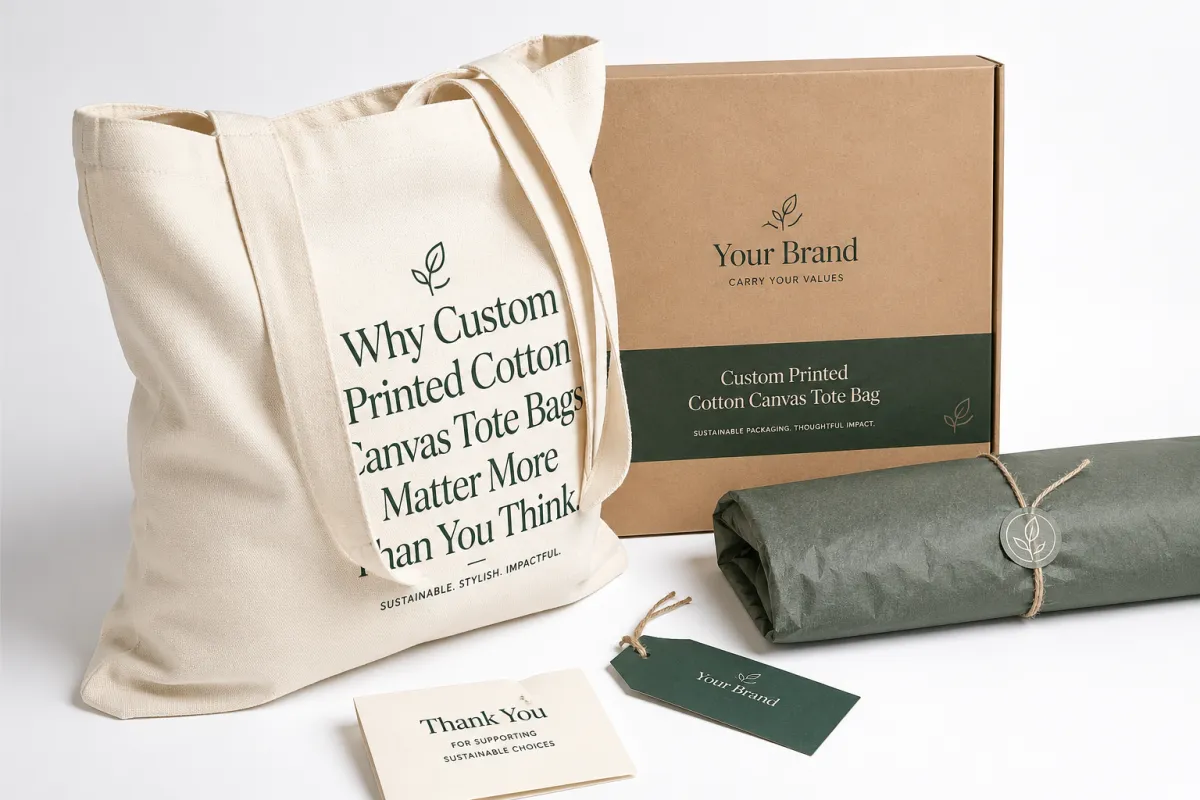
Custom printed cotton canvas tote bags matter because they do not disappear after a single use. A paper bag gets folded, recycled, or trashed. A thin woven bag may be cheap, but it is often flimsy and forgettable. A well-made canvas tote keeps getting carried, and every repeated use gives you another impression without paying for another placement.
That is the economics piece. The same design decision gets spread across many touchpoints instead of just one transaction. For a brand team, that is kinda the whole point.
From a packaging perspective, custom printed cotton canvas tote bags work best when they are treated as durable touchpoints, not novelty objects. They can support store pickup, subscription fulfillment, loyalty rewards, conference handouts, and staff appreciation programs. A bag with a clear mark, readable hierarchy, and enough structure to survive daily handling becomes part of the journey from warehouse to home use.
The material matters just as much as the design. Cotton canvas has body. That changes print placement, handle stress, and the way the tote feels in hand. In branded packaging programs, that tactile feel reads as quality. It is the same reason people notice a clean box finish or a well-fitted insert. The object feels cared for.
Honestly, teams underestimate how much work one bag can do. I have seen custom printed cotton canvas tote bags become grocery bags, gym bags, book bags, and the default “grab this on the way out” carrier for months. That frequency can beat short-form media for raw exposure. Not because it is flashy. Because it keeps showing up.
“A tote earns value with every use. If it fails early, you lose impression value, pay for a replacement, and weaken how people feel about the brand.”
That is the lens I use with custom printed cotton Canvas Tote Bags: repeat exposure instead of one-and-done distribution. Once that lens is fixed, conversations about fabric weight, stitch density, print method, and lead time become much easier to run and defend with actual numbers.
What Are Custom Printed Cotton Canvas Tote Bags and How Do They Work?
At its core, a custom printed cotton canvas tote bag is a woven cotton fabric tote decorated with a brand mark, icon, campaign artwork, or message. The weave gives it structure, creates the print surface, and handles a lot of the carrying strength. Heavier canvas usually keeps its shape better and feels more premium. Lighter canvas is cheaper, but it often looks and behaves less substantial.
The production path is straightforward, but the sequence matters. Fabric gets sourced and inspected, then cut into panels. Depending on the method, panels are printed flat or printed after assembly. After that, seams are stitched, handles are added, and edges are reinforced. Final steps include trimming, pressing, folding, and packing. Some factories prefer pre-cut printing. Others prefer printing after sewing. Either route can work if the team controls movement and heat through the process.
Customization starts with the artwork file, not the tote body. You cannot fix poor placement later. Canvas does not hide weak decisions. If the logo sits too close to a seam, stitching can shift it. If the art relies on very fine linework, ink can close in or lose definition on textured cotton fibers. Good Design for Custom printed cotton canvas tote bags means matching the artwork to a stitched object that bends, stretches, and gets handled by real people.
Common decoration methods for custom printed cotton canvas tote bags include:
- Screen printing for high opacity and strong solid color on larger volumes.
- Digital printing for tonal work, detailed art, and short to medium runs.
- Heat transfer for small-batch flexibility and certain specialty looks, with durability tied closely to film and application quality.
- Embroidery-style detail for texture and a premium finish in limited coverage areas.
Proofing is where most problems get stopped before they become expensive. A visual proof checks size, position, and color intent. A production proof checks how the design behaves on the chosen canvas and on the real production line. For higher-value custom printed cotton canvas tote bags, a physical sample is usually the smarter move because it reveals handle feel, bag stiffness, and contrast under real lighting instead of a calibrated monitor.
If you need broader packaging context, packaging.org gives a solid grounding in standards and practical vocabulary. Those references help when you are balancing materials, fold behavior, and brand experience, and they push the project away from decorative ambition and toward actual use.
That is the real function of custom printed cotton canvas tote bags. They carry objects, but they also carry habit and recognition. The bag does not stop working when the order closes; it keeps doing packaging work every time it leaves the house.
How Do Custom Printed Cotton Canvas Tote Bags Get Made? Production, Materials, and Finishes
Material selection changes everything in this category. Custom printed cotton canvas tote bags are usually ordered by fabric weight, measured in ounces or gsm. A lighter range around 5 to 8 oz can work for light promotional use, while 10 to 14 oz tends to deliver better structure and less print distortion during use. Heavier grades usually feel better to carry, resist sagging, and give print edges cleaner behavior because the canvas holds shape under tension.
Weave density is the second big gate. A tighter weave often improves edge crispness and gives a cleaner surface under print. A looser weave can feel softer and more relaxed, but it can also pull ink unpredictably, especially across high-contrast areas. For custom printed cotton canvas tote bags, that difference affects opacity, wash response, abrasion behavior, and first-touch perception.
Finishes define the quality floor. Untreated natural canvas looks honest and fits an eco-minded direction well. Coated or treated surfaces improve repeatability, though they can alter drape and stiffness. Edge binding, gusset design, lining, zipper type, and interior pockets all raise labor and material cost, and they also raise perceived value when the tote supports retail positioning or loyalty utility.
Printing on cotton behaves very differently than printing on paper, foil, or rigid board. Screen printing delivers thick, opaque color and stable solid areas. Digital printing handles gradients and photo-style art better, especially on shorter runs with multiple variations. Heat transfer can work for small editions and specialty looks, but it needs strict matching to the fabric, expected wear, and finishing schedule. A tote that gets folded and carried frequently should be judged on abrasion resistance as much as visual richness.
Pre-treatment and curing are part of quality, not optional steps. Natural cotton may absorb unevenly if the line runs too fast, and dark backgrounds often reveal that quickly. Temperature, dwell time, and ink chemistry must match the textile substrate, or prints can crack, fade, or haze under daily use. For teams comparing formats, this is the moment to treat the fabric as a packaging substrate in its own right instead of an afterthought.
Transit resistance matters because totes move. If fulfillment is split across stores or warehouses, ask about seam strength, compression, and carton handling. The transport testing guidance from ISTA is useful even when the item is soft goods. Even without a hard shell, crushing, thread fatigue, and print memory can show up if shipping conditions are poor.
Quality control for custom printed cotton canvas tote bags should cover these checkpoints every run:
- Dimensions to ensure the tote fits intended use and packing configuration.
- Seams and bar-tacks to withstand load, especially by handles and bottom corners.
- Print registration that stays consistent across the full batch with no visible drift.
- Color consistency across repeats, colors, and any reprints that may follow.
- Trim quality including thread security, edge smoothness, and control of puckering.
These basics are exactly where problems hide. A good mockup can still fail on handle attachment, stitch spacing, or wash resilience. In packaging terms, a custom printed cotton canvas tote bag deserves the same standards as any other component in a professional packaging program.
| Option | Typical Spec | Approx. Unit Cost | Best Use | Tradeoff |
|---|---|---|---|---|
| Light canvas tote | 6-8 oz, 1-color print, basic seams | $0.90-$1.80 at larger volumes | Event handouts, light inserts | Lower durability and structure |
| Midweight tote | 10 oz, reinforced handles, 1-2 color print | $1.60-$3.20 | Retail giveaways, loyalty gifts | Higher setup and fabric cost |
| Premium tote | 12-14 oz, gusset, zipper, lining, multi-location print | $3.50-$7.50+ | Merchandising, premium packages | Longer lead time and higher MOQ pressure |
These prices are directional, not fixed, and should never replace real quoting. They are useful for framing decisions between custom printed cotton canvas tote bags and other options like custom printed boxes or inserts. As construction gets richer, labor and finishing dominate more quickly than raw fabric, and that shift is usually where budget tension appears.
Step-by-Step Guide: From Brief to Approved Tote Run
Most successful custom printed cotton canvas tote bag projects begin with purpose, then decoration. A giveaway tote needs low cost and easy stackability. A fulfillment tote needs stronger structure and packing logic. A loyalty asset needs visual consistency on shelves and at handoff moments. The brief has to state not just what the bag should look like, but what it should endure.
Step 1: Define the use case. Decide whether the tote is for events, merchandising, shipping, or long-life customer engagement. Purpose drives every spec decision. A tote carrying books or groceries needs sturdier seams and stronger handle construction than a garment sleeve or brochure-only run. Most failures happen when teams assume one spec covers all channels.
Step 2: Lock the visual hierarchy. The front mark should be readable from normal shopping distance, because people notice bags in motion. Secondary text can move to side panels or interiors only if readability and panel space support it. One approval owner helps, because too many approvals introduce avoidable drift in spacing, spelling, and proportions.
Step 3: Prepare production-ready files. Suppliers need clean vector or high-resolution artwork, exact color references, and accurate scaling. Safe margins, bleed, and minimum point sizes still matter in textile prints, especially with textured weaves. Transparent effects and thin gradients often need simplification because canvas can alter visual behavior quickly.
Step 4: Lock the physical spec. Confirm size, gusset depth, handle length, closure type, and whether lining or interior pockets are required. Ask operations early about packing constraints. A beautiful bag that does not work in carton dimensions or shelf flow creates avoidable downstream waste. A custom printed cotton canvas tote bag should fit the warehouse and channel, not just the design intent.
Step 5: Review samples with use-case stress. Test under neutral light, realistic weight, and real opening behavior. Ask if handles sit properly, if print still reads cleanly, and if the bag collapses in ways that hurt function. A physical sample reveals what a PDF never can when the tote is expected to move.
Step 6: Set replenishment logic. A first run is rarely the end; it is the baseline. When demand confirms, replicate the same spec sheet, proof method, and storage instructions for the next wave. This habit keeps consistency high even when teams, channels, or buyers change during campaign expansion.
If the organization is still building its packaging matrix, it helps to compare the tote to nearby formats. Our Custom Packaging Products page helps align tote strategy with boxes, inserts, and other components. The outcome should be one coherent system that supports shipping, retail, and post-purchase touchpoints together.
Common Mistakes in Custom Printed Cotton Canvas Tote Bag Projects
Under-specifying is the costliest error in custom printed cotton canvas tote bag projects. A bag meant for heavy use but built with thin fabric and basic stitching will fail fast, and the failure is often blamed on print quality when construction is the real issue. Match material and structure to the expected load before orders are approved.
Treating canvas like flat graphics is the next common trap. Weights, folds, texture, and seams all interfere with tiny details and thin lines. Micro linework can disappear, and delicate gradients can blur under pressure if method and design do not align. Simplify visuals to what the cloth can support, especially on small print zones.
Seams and stitch placement are often ignored until the finished run reveals a weakness. A print near a side seam can drift after sewing. A bottom-heavy layout may look accurate in the file but misalign once the gusset opens. Handle angles and spacing can also create visual imbalance if they fight the logo. Construction flaws can make a premium-looking bag feel cheap in use.
MOQ misunderstanding creates two opposite mistakes: overbuying for safety or underbuying for budget control. Many teams treat minimums as fixed walls and never model alternatives. A staged plan works better: pilot quantity, replenishment quantity, then scale-up. That keeps custom printed cotton canvas tote bags aligned with campaign demand and cash flow instead of guesswork.
Ignoring finishing details is one more quiet cost sink. Loose thread, weak bar-tack, and sloppy tagging can trigger returns and complaints that sound like printing issues but are really assembly issues. In retail packaging, customers do not split those differences. They care about how the bag performs. Hangtags, inserts, and care notes need equal inspection discipline.
The timeline trap usually shows up near approval. Proofing gets pushed to the end, and teams start reviewing a sample under pressure. A rushed sign-off amplifies defects. Custom printed cotton canvas tote bags need breathing room for setup, sample correction, and final confirmation. Once full production starts, even small changes can lock in for months.
From my side of this work, the projects that go sideways always share a pattern: strong mockup confidence, weak sewn-object verification. A tote is a textile package. The sooner the team treats it as such, the better each subsequent run performs.
Expert Tips for Better Custom Printed Cotton Canvas Tote Bags Performance
Design in layers, not noise. Strong imagery belongs on the front, with less aggressive support copy on side or interior areas. That keeps custom printed cotton canvas tote bags readable at distance and avoids visual overload beside shelves stacked with custom printed boxes and other retail materials.
Type is one of the highest-risk variables. Bags are read as people pass by. Thin type, tight scripts, and complex strokes lose shape quickly on woven fabrics. Bold hierarchy and clear contrast usually hold better, especially on natural tones and open-weave surfaces. Keep message distance in mind, not only file beauty.
Handle construction gets less attention than it deserves. Ask for stitch spacing, bar-tack type, thread class, and folding method. Most customer disappointment starts at the first repeated handle pull. If the carry points fail, brand credibility drops instantly. For custom printed cotton canvas tote bags, structural durability is the message.
Test with realistic weight, not just display weight. A tote that looks fine empty can shift, twist, and stretch when carrying a full use load. A 3-pound gift run and an 8-pound grocery run create different results. Better data usually appears during practical testing, and that data should shape final approval, not assumptions.
A first-run audit can save a lot of stress. My preferred approach is a visual pass on the first few pieces and a second pass at around 50 units before full scale release. Early checks catch color drift, edge changes, and print shift when corrections are still possible. The extra time is cheap compared with a full batch correction.
Keep a short production memory for every successful job. One-page notes on fabric weight, dimensions, print placement, approval timestamps, and packing conditions turn a one-off success into a repeatable workflow. That documentation helps the next team member reproduce results without starting over.
Sustainability language needs to be accurate. Reusable canvas helps, but it is not automatically greener than a single-use alternative if it is never used enough. If sustainability claims include paper or FSC elements, keep the statements specific and documented. Trust is built with precise communication, not slogans.
Most teams win with a mixed system: custom printed cotton canvas tote bags for reuse, custom printed boxes for unboxing, and aligned product packaging pieces for channel-specific needs. A single format cannot own the full journey.
Cost, Timeline, and Planning for Custom Printed Cotton Canvas Tote Bags
Cost for custom printed cotton canvas tote bags is layered. Fabric weight, size, handle structure, print technique, color count, trim decisions, packaging materials, and freight all add in. As complexity rises, labor and finishing become bigger than raw textile. A plain one-color run can stay budget-friendly, while a zipper-and-lining version can move quickly into a different pricing lane.
Planning stays easier when teams use three practical tiers. A basic tier usually combines standard canvas, one print area, and simple construction. A mid-tier model adds gusset depth, sturdier handles, or multiple print zones. A premium tier can include zipper, lining, better hardware, and tighter trim quality. Each upgrade improves function or feel but increases setup and QA time.
A clean quote should separate base tote, print setup, color cost, finishing, and shipping. If that line breakdown is not clear, ask for it again. That detail makes comparison possible and keeps custom printed cotton canvas tote bags from hiding cost in vague or bundled items.
When evaluating bids, compare same-spec totals only. The following planning points help keep teams aligned:
- Fabric choice: lighter canvas lowers unit costs; heavier canvas improves structure and visual weight.
- Print method: screen printing works efficiently for bold solids, while digital provides better flexibility for tonal variations and shorter runs.
- Complexity: reinforced handles, zippers, pockets, and lining improve functionality and add labor.
- Timeline: proof creation, sample review, and final inspection each need real time in the calendar.
- Packaging: folding method, carton counts, humidity control, and pallet load strategy directly affect shipping outcomes.
Lead times reflect both volume and risk tolerance. A straightforward custom printed cotton canvas tote bags order with stable approval can move quickly. A first-time build with sampling, revisions, and special details needs extra days for correction and confirmation. A practical plan usually includes one to two proof rounds, one sample checkpoint for new construction, and final inspection before leaving the factory floor.
Storage and transport decisions can either protect or hurt the run. Cotton is forgiving in some ways and vulnerable in others: humidity, dust, and repeated folding can degrade the look of print and structure. Pack totes to avoid heavy crushing and keep finished goods in stable, dry storage before distribution. That avoids the “looks fine online, dull in the field” problem.
For teams managing broader packaging decisions, packaging design and material selection resources help reinforce one uncomfortable truth: the lowest material cost is rarely the best package outcome. A few cents saved on fabric can disappear if returns rise from weak handles, cracked print, or delayed delivery.
Pilot first, scale second. A small initial run gives evidence about wear, storage, and customer use. After that, the next custom printed cotton canvas tote bags order can be tuned to observed behavior instead of guessed from a design deck. That is usually where the real savings show up.
FAQ and Action Steps for Your Custom Printed Cotton Canvas Tote Bag Launch
If launch is near, the right move is not to keep polishing wording and hope the tote carries the weight. Narrow the tote spec, approve final artwork, and request a real proof. A physical sample changes the discussion from theory to measurable decisions.
Use this launch checklist to keep the team moving:
- Finalize artwork size, placement, and approved color targets.
- Lock the tote specification, including fabric weight, handle length, closure, and lining if needed.
- Request visual proofing and add a physical sample if the design or structure is complex.
- Approve decoration method and shipping-packaging setup before full approval is issued.
- Reserve time for QC, carton checks, and shipping review in the timeline.
- Document the final spec so reorders match the first run exactly.
Short timelines usually fail where risk is highest: artwork approval, sample speed, and last-minute changes to fabric or finish. Custom printed cotton canvas tote bags launch cleanly when those choices happen early and stay fixed.
When your team wants to compare this format against other branded packaging products, our Custom Packaging Products page can help match the tote program with the full packaging system. That keeps the tote aligned with boxes, inserts, and retail display instead of operating as a disconnected giveaway.
What are the real differences between custom printed cotton canvas tote bags and simple printed totes?
Custom printed cotton canvas tote bags usually use heavier material, stronger handles, and higher repeat-use potential than lighter printed totes. The result is better durability under load, more frequent exposure, and a premium tactile impression. The tradeoff is usually higher unit cost and sometimes a higher minimum order requirement.
How long do custom printed cotton canvas tote bags usually take from artwork to delivery?
Lead time depends on proofing, print method, quantity, and whether a physical sample is required. First-time or complex runs naturally take longer because setup and inspection steps need more touchpoints. For planning, include at least one proof review and one final QC stage so custom printed cotton canvas tote bags do not move too quickly into the wrong build.
How much do custom printed cotton canvas tote bags typically cost per piece?
Unit economics shift by fabric weight, print area, number of colors, tote size, and finishing elements like zippered closures or lining. Simple runs can remain relatively low when ordered at scale, while premium runs rise quickly as labor and material content increase. Compare quotes only when the spec sheet is identical across suppliers.
How many custom printed cotton canvas tote bags should I order for a first campaign?
Start with a quantity that proves performance without committing blindly. A pilot should be big enough to test real usage, then top up in a second wave once results are clear. This strategy keeps you from overcommitting to a spec that has not faced daily-use conditions.
How do I choose print methods for custom printed cotton canvas tote bags with best value?
Screen printing usually gives strong value for bold marks and solid color coverage, while digital printing offers better handling for shorter runs and complex tonal images. If the target use is high-wear, evaluate print behavior on actual woven surfaces and under movement, not just on a monitor preview. Performance in use should outrank the first visual pass.
What should I do first if I want to launch custom printed cotton canvas tote bags quickly?
Set one purpose, one production spec, and one approval owner before discussing volume. Keep the artwork clean, lock tote size, and choose a proof route early. With those basics in place, custom printed cotton canvas tote bags move faster because fewer variables need rescue later.
For the cleanest launch, lock one use case, compare two quotes against one spec, and set proof and inspection dates now. Test the sample under weight and real light before the full order goes out. That is the part people skip, and it is also the part that saves the most headaches.

