Buyer Fit Snapshot
| Best fit | Custom Printed Paper Mailers Supplier projects where brand print, material claims, artwork control, MOQ, and repeat-order consistency need to be specified before quoting. |
|---|---|
| Quote inputs | Share finished size, material target, print colors, finish, packing count, annual reorder estimate, ship-to region, and any compliance wording. |
| Proofing check | Approve dieline scale, logo placement, barcode or warning zones, color tolerance, closure strength, and carton packing before bulk production. |
| Main risk | Vague material claims, crowded artwork, missing packing details, or unclear freight terms can make a low unit price expensive after revisions. |
Fast answer: Custom Printed Paper Mailers Supplier: Film, Print, MOQ, and Carton Packing should be specified like a repeatable production item. The safest quote records material, print method, finish, artwork proof, packing count, and reorder notes in one written spec.
Production checks before approval
Compare the actual filled-product size with the drawing, then confirm tolerance on folds, seals, hang holes, label areas, and retail display edges. Reserve space for logos, QR codes, warning copy, and material claims before decorative graphics fill the panel.
Quote comparison points
Review material grade, print process, finish, sampling route, tooling charges, carton quantity, and freight assumptions side by side. A quote is only useful when the supplier can repeat the same color, closure quality, and packing count on the next order.
A custom printed paper mailers supplier does a lot more than run ink over paper and ship a pallet. The right partner helps turn a shipping sleeve into a real brand touchpoint. That mailer still has to protect the product, fit the fulfillment flow, survive transit, and look like it belongs to the brand. That is not the same thing as buying plain stock packaging and pretending the job is done.
From a packaging buyer's point of view, a custom printed paper mailers supplier sits somewhere between manufacturer, translator, and problem-solver. You bring the product size, the artwork, the shipping method, and the sustainability goals. They turn that pile of inputs into a mailer spec that works on the line and makes it through the carrier network. In practice, that means choosing the right paper grade, deciding whether a self-seal closure makes sense, and checking whether the print area can handle the logo without landing in a fold or glue zone. Simple on paper. Not so simple in production.
The branding side gets underestimated all the time. A plain kraft mailer gets the parcel out the door, sure. A printed one can make the shipment feel deliberate, support retail packaging standards, and carry the same visual language as the rest of the brand. I have seen a lot of teams spend real money on branded packaging and product packaging while treating the mailer like an afterthought. That usually ends with an awkward mismatch between the shipping bag and the rest of the unboxing. If the operation already uses Custom Packaging Products or even Custom Poly Mailers elsewhere in the mix, the paper mailer should still fit the same system instead of floating off on its own.
Most teams are not shopping for decoration. They want a shipping component that can take abuse, keep costs in range, and still look clean enough that customers do not think it came from a generic warehouse shelf. That is why the smartest custom printed paper mailers supplier conversations start with measurements, closures, and print limits instead of a mockup alone. The mockup is the easy part. The real work is making it hold up.
What a custom printed paper mailers supplier actually does
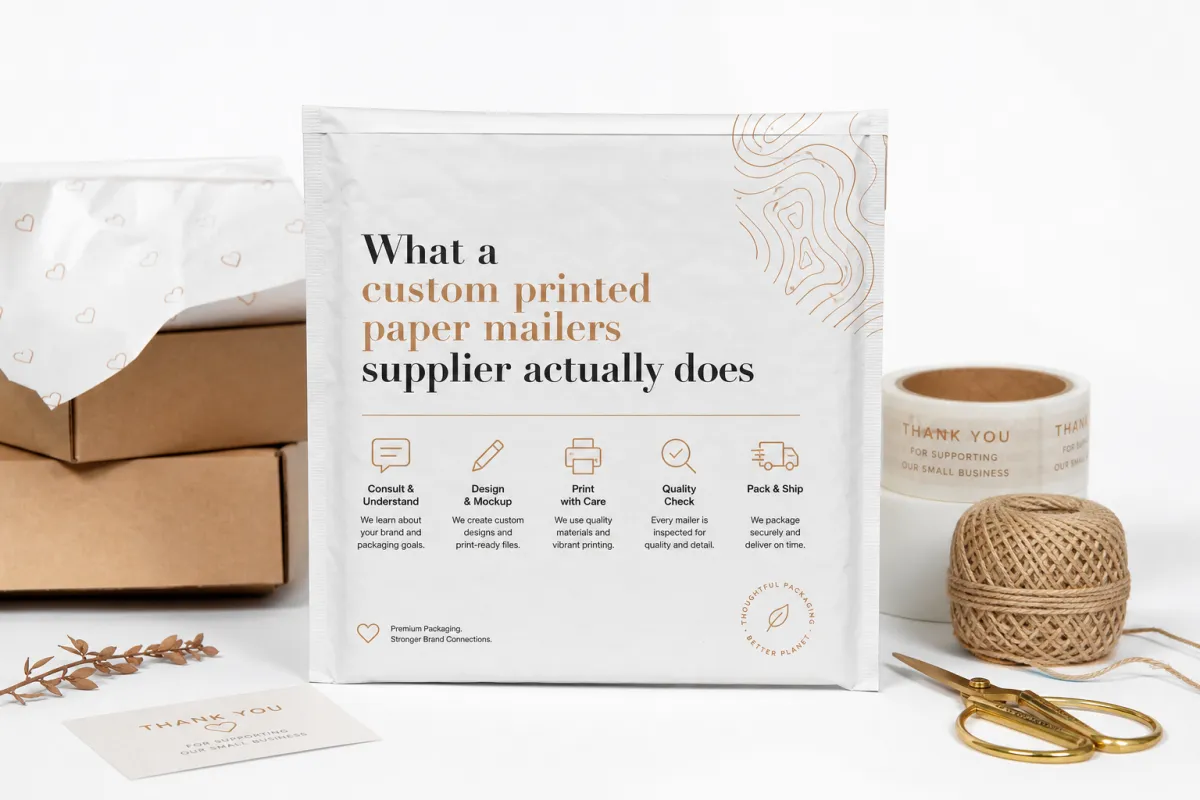
A custom printed paper mailers supplier usually starts by turning an idea into something buildable. You may already know the product dimensions and the logo. The supplier still has to figure out how much overlap the closure needs, whether the seams can handle pressure, and what the mailer will look like once a box, folded garment, booklet, or accessory is inside. That is where the technical side of packaging design stops being abstract and starts being a set of real tradeoffs.
Several paper mailer formats show up again and again. Flat mailers work well for thin goods. Gusseted mailers add room for bulkier contents. Self-seal mailers save time in fulfillment. Reinforced versions bring more confidence for heavier items or rougher shipping routes. A good custom printed paper mailers supplier will say plainly when the structure you want is asking too much. That honesty is useful, even if it is not the answer you wanted.
What should that partner help with? Structural fit, print method selection, paper recommendations, sample review, and shipping performance are the big pieces. A useful custom printed paper mailers supplier does not stop at “What artwork do you want?” They ask how the package will be filled, whether there is a return path, whether the mailer will go through parcel sorting, and whether the brand wants a matte, natural, or brighter print surface. Those questions sound basic. They are actually the difference between a package that works and one that looks clever in a PDF and annoying in a warehouse.
A mailer that looks sharp in a flat mockup can behave very differently once it is folded, glued, sealed, and pushed through real fulfillment. Catch that gap early and you save yourself a lot of pain later.
For buyers managing more than one format, the mailer often sits beside mail-ready cartons, sleeves, and branded inserts. That is why the same custom printed paper mailers supplier discussion may touch retail packaging, package branding, and the broader packaging mix across multiple fulfillment channels. If the mailer needs to match a box program, the print colors and surface finish should be reviewed together, not treated as separate projects. Packaging systems work better when they actually behave like systems.
Some suppliers are good at graphics and weak on shipping performance. Others can build a sturdy mailer but struggle with repeatable color or clean registration. The better partners understand both sides and can name the tradeoffs without dancing around them. That matters whether you are ordering a seasonal run or locking in a repeatable shipping format for ongoing fulfillment. Nobody needs a supplier who smiles, nods, and quietly guesses.
How custom printed paper mailers are made
The production flow usually starts with artwork and a dieline. A custom printed paper mailers supplier needs the print-ready file to sit on a layout that matches the actual finished shape, not a guess. Once the dieline is confirmed, the file moves to proofing, where placement, bleed, safe zones, and barcode readability should all be checked before the press starts running. That step matters more than many teams expect. A logo that looks centered on-screen can land too close to a fold in the finished mailer. And then everybody suddenly has opinions.
Paper choice changes both appearance and performance. Lighter kraft stocks can be economical and recyclable, but they may show more variation in print density. Heavier paper adds stiffness and can improve the perceived quality of the piece, especially for branded packaging that is meant to feel premium. Surface finish matters too. Uncoated paper gives a natural look, coated paper can sharpen image detail, and recycled content can support sustainability goals if the construction still performs in transit. Recycled does not automatically mean better. If the adhesive or coating gets in the way of recovery, the environmental story gets fuzzy pretty fast.
Printing methods shape the result in a pretty obvious way once you start comparing samples. Flexographic printing is common for repeat production and can be efficient on longer runs. Offset printing often brings finer detail and cleaner color control for artwork with more nuance. Digital printing can work well for short quantities or projects that need variable data or quick changes. A seasoned custom printed paper mailers supplier should explain which method fits your volume and why, instead of pushing the only machine they have on the floor. If the answer sounds like a sales script, keep asking.
For a quick comparison, here is how the main methods usually stack up:
| Print method | Best fit | Strengths | Watch-outs |
|---|---|---|---|
| Flexographic | Longer repeat runs, simpler graphics | Efficient setup, steady spot color, good for bold branding | Less ideal for photographic detail or very tight tonal control |
| Offset | Detailed artwork, stronger visual finish | Sharp detail, smoother gradients, dependable registration | Higher setup effort, usually better suited to planned volume |
| Digital | Short runs, test programs, fast revisions | Flexible changes, lower setup burden, quick proof cycles | Unit cost can climb faster on larger quantities |
After printing, the paper is cut, folded, and sealed, then packed for shipment. Adhesive application looks minor until it fails. A weak closure can open in transit. A closure that bites too hard can slow down fulfillment or tear the material during packing. A capable custom printed paper mailers supplier treats that balance as part of the structure, not a finishing detail nobody needs to think about.
Sample review should happen before a large run. That is where color drift, logo placement, and fit problems get caught while fixes are still cheap. It also gives the buyer a chance to see whether the mailer feels too flimsy, too rigid, or just right for the product. For businesses that care about Custom Printed Boxes, sleeves, and other product packaging elements, that tactile check often tells the truth faster than a digital proof ever will.
Transit stress is the final test. Good suppliers think about compression, corner crush, conveyor handling, and parcel sortation before the first shipment leaves the plant. If you want a deeper technical benchmark, transit testing standards from ISTA are a useful reference point. Packaging should be judged by how it handles the trip, not only by how it looks on a screen.
How to choose a custom printed paper mailers supplier
Start with manufacturing capability. Can the custom printed paper mailers supplier actually produce the size, closure style, paper grade, and print coverage you need without forcing awkward compromises? That sounds basic, yet it is where a lot of projects go sideways. A supplier that only handles one size range or one paper stock may still quote the job, then quietly steer the spec toward whatever is easiest for production. That is not always malicious. Sometimes it is just what they know. Either way, you have to catch it.
Print consistency matters just as much. Logos, brand blocks, and color fields should be checked for registration, density, and repeatability across the run. A mailer can look excellent in a digital mockup and still disappoint if dark solids print unevenly or if fine type gets soft at the edges. For a brand that cares about package branding, inconsistency kills the point of the print investment. A shopper does not care that the supplier’s press was having a mood.
Sustainability claims deserve a close read. Ask what the paper is made from, whether recycled content is available, how the closure materials behave, and whether the design supports easy disposal. A recycled paper claim means more when the supplier can describe the fiber source, the coating, and the adhesive instead of tossing out vague green language. If sustainability is central to the project, ask for documentation and look for third-party standards such as FSC rather than trusting the marketing copy. No one should have to decode a brochure to figure out what the material actually is.
Minimum order quantity is another practical filter. A smaller MOQ helps a brand test a design without overcommitting cash, but it often comes with a higher unit price. Larger orders usually improve pricing, though they raise inventory risk. A solid custom printed paper mailers supplier will help you think through reorder flexibility so you are not stuck holding a year of packaging because the forecast got too optimistic. That kind of inventory mistake is easy to make and annoying for months.
Communication is the last major test. Look for clear answers around tolerances, proof approval, freight planning, and what happens if a spec changes after artwork is submitted. The best supplier relationships feel calm and specific. Nobody should have to guess whether a quoted size is interior or exterior, whether a print area excludes the glue zone, or whether a revised logo will trigger another proof cycle. If the responses are vague now, they will be vague later.
If you are comparing multiple packaging paths, zoom out and look at the whole system. Some businesses pair paper mailers with mail-ready cartons for premium orders, or with Custom Poly Mailers for wetter routes and heavier handling. Others build the whole outbound experience around one paper format and use the same visual language across inserts, tape, and labels. That broader view turns packaging into a brand asset instead of a pile of separate purchasing decisions. It also makes the supplier conversation a lot more useful.
Custom printed paper mailers supplier pricing: what drives cost
Pricing is rarely about one number. The custom printed paper mailers supplier quote reflects paper grade, size, print coverage, number of colors, finishing, closure style, and any reinforcement needed for the load. A simple kraft mailer with one-color branding usually costs less than a full-coverage printed mailer on heavier stock with a stronger seal and a more refined surface finish. That is normal. The cost is doing what the structure asks it to do.
Smaller orders almost always carry a higher unit cost because setup work gets spread across fewer pieces. Larger runs improve efficiency, let the supplier buy material more effectively, and often lower the per-piece number in a meaningful way. That does not mean the biggest order is the smartest order. It just means the pricing curve rewards volume, which is normal in packaging manufacturing and not unique to mailers.
Artwork complexity matters more than many buyers think. Tight color matching, heavy ink coverage, multiple print stations, and graphics that wrap across folds all add production effort. If your design includes fine text, dark backgrounds, or a precise brand color, expect the custom printed paper mailers supplier to spend more time on setup and proofing. That time should show up in the quote. If it does not, ask why. The answer may be harmless, or it may be the part they plan to discover after the order is placed. Not ideal.
There are also costs that are easy to miss if you only stare at the unit price:
- Proofing and prepress setup
- Plate or tooling charges for certain print methods
- Custom die or size setup if the mailer is not standard
- Freight, packaging, and pallet configuration
- Rush production premiums when the calendar is tight
- Special inserts, tear strips, or reinforced closures
That is why two quotes can look similar while one ends up much more expensive once everything lands. A buyer who compares only the unit price may miss freight, setup, or correction fees and wind up with a higher landed cost than expected. A careful custom printed paper mailers supplier should be willing to quote the same specification and call out anything that changes the final number.
Here is a practical pricing view for common project styles. These are broad planning ranges, not promises, because paper grade, print coverage, and freight all move the number:
| Project style | Typical order profile | What usually drives the price | Planning note |
|---|---|---|---|
| Plain stock-style paper mailer with simple branding | Lower to mid volume | Material choice, one-color print, basic seal | Good for testing a new shipping format |
| Custom printed mailer with moderate coverage | Mid volume | More print area, better registration, stronger finish | Often the best balance for growing brands |
| Full-coverage premium mailer | Higher volume | Heavy ink use, color control, finishing, structure | Useful when the unboxing experience is part of the sale |
| Reinforced or specialty mailer | Any volume, depending on load | Extra paper layers, stronger adhesive, special construction | Worth it if damage reduction matters more than lowest cost |
If a quote feels suspiciously cheap, ask what got left out. Sometimes the answer is freight. Sometimes it is proofing. Sometimes the supplier swapped in a lighter stock or trimmed closure strength to hit the number. A good custom printed paper mailers supplier will not hide those choices behind vague language, because the mailer still has to survive real handling once it leaves the dock.
For teams with a larger packaging program, compare the mailer cost against the cost of other branded packaging components. A mailer may cost more than a plain box, but less than a full custom setup with inserts, labels, and protective dunnage. The right answer depends on shipping weight, product fragility, and how much visual impact the brand wants at the doorstep.
Process and timeline from quote to shipment
The timeline usually begins with an inquiry and a specification review. A custom printed paper mailers supplier should ask for product dimensions, expected contents, target quantity, print coverage, shipping method, and any sustainability requirements. If the quote request is thin on detail, the estimate may be too rough to trust. Strong projects start with a clean spec sheet, not a casual email thread full of guesswork.
After the initial review comes quoting and dieline confirmation. This is where the supplier checks whether the proposed mailer size actually supports the product and whether the artwork fits the usable print area. If the dimensions are unclear, the project can stall here. One missing measurement can change the closure overlap, which then affects both the look and the function of the mailer. I have watched that happen more than once, and it is always the same boring problem: nobody wrote down the real size.
Artwork setup and proofing usually come next. This stage can move quickly if the files are print-ready, but it can slow down if the brand team keeps editing copy, changing colors, or shifting logo placement. A disciplined custom printed paper mailers supplier will tell you which changes are safe and which ones trigger a new proof. That clarity saves time because everyone knows what still needs approval. Less drama. More shipping.
Then comes sampling or a short prototype run if the project needs one. That step is especially useful when the product is delicate, the mailer has to hit a strict fit, or the brand wants a very specific feel in the hand. A sample often reveals details that do not show up in digital files: how crisp the fold line feels, whether the closure pulls too tight, and whether the color still reads well under warehouse lighting. It is a little annoying to wait for, and absolutely worth it.
Production follows once the proof is approved. The actual lead time depends on order size, print method, paper availability, and current factory scheduling. For many projects, a clean approval path can move in roughly 12 to 15 business days after the final proof is signed, though larger or more complex runs can take longer. A custom printed paper mailers supplier should be able to tell you where the schedule can stretch, and that conversation should happen before the order is locked.
Quality control is not a single event. A careful supplier checks print registration, seal strength, count accuracy, and packing condition before release. That is not overkill; it is normal protection against mistakes that get expensive once the goods are already in your distribution center. If the project carries more risk, ask whether the supplier reviews transit durability using methods aligned with packaging industry practice and related standards. The discipline around packaging quality is one reason organizations like the Institute of Packaging Professionals remain useful reading for buyers who want better language around material selection and test planning.
Internal approvals often create hidden delays. Marketing may want the brand lockup changed, operations may want a different pack count, and fulfillment may ask for a more forgiving seal. Those groups do not always move at the same speed, so build a small buffer into the timeline. A reliable custom printed paper mailers supplier can keep the work moving, but they cannot approve the artwork for you.
Here is a practical way to think about the process:
- Collect product measurements and shipping requirements.
- Ask the supplier for a true spec-based quote.
- Confirm the dieline, print area, and closure style.
- Review proofs carefully, including bleed and safe zones.
- Approve samples if the project needs them.
- Schedule production and freight together.
- Plan receiving so the mailers do not sit in the wrong storage conditions.
That sequence looks simple, but it prevents a lot of avoidable rework. It also keeps the discussion grounded in specific decisions instead of vague impressions. A custom printed paper mailers supplier should welcome that level of clarity because it makes the finished order more predictable.
Common mistakes when sourcing paper mailers
One of the easiest mistakes is ordering by outside dimensions alone. The interior fit, the overlap needed for the closure, and the way the product sits once inserted all affect whether the mailer actually works. A bag that looks large enough on paper can still be tight at the seal, especially if the item is rigid or has a folded edge. A seasoned custom printed paper mailers supplier will usually ask for the real product size rather than relying on the label description.
Artwork errors show up all the time. Low-resolution logos, missing bleed, weak contrast, and text placed too close to folds can all lead to ugly results. The issue is not only visual. If important information sits in a glue zone or near a seam, it can disappear in production. Proofing should be treated like a technical review, not a quick thumbs-up on a PDF.
Choosing only on unit price can backfire. Cheaper mailers may save a few cents up front but create more damage, more returns, or a weaker first impression. From a packaging buyer's point of view, that trade is often false economy. If the mailer is part of retail packaging, the customer notices the failure immediately and usually remembers it. Not in a fun, brand-loyalty way.
Skipping samples is risky, especially for premium brands. A PDF tells you very little. A sample shows whether the paper feels right, whether the closure is strong enough, and whether the printed surface matches the intended tone of the brand. A custom printed paper mailers supplier who pushes back on samples without a solid reason is usually telling you something about their process maturity.
Shipping conditions get overlooked too often. A paper mailer that works fine for a light domestic shipment may not hold up for a heavier item, a humid warehouse, or a longer transit route with more handling. If the route is rough, the structure should be checked more carefully. The best suppliers think about the route as part of the spec, not as a separate problem after the fact.
There is also a branding mistake worth calling out. Some teams treat the mailer as a side project and never connect it to the rest of the package system. That can lead to a mismatch between the mailer, inserts, labels, and other product packaging components. The more consistent the visual language, the more the package feels intentional. That is one reason good package branding does not happen by accident.
Expert tips and next steps with a custom printed paper mailers supplier
Start with a clean spec sheet. Product dimensions, target mailer size, desired print area, quantity, shipping method, and sustainability requirements should all sit in one place before you ask for a quote. A custom printed paper mailers supplier can move much faster when the brief is complete, and you can compare responses more fairly when every supplier is quoting against the same assumptions.
Ask for samples or a short prototype run when the packaging will carry premium branding, a delicate item, or a tight dimensional fit. That extra step is usually worth the time. If the mailer is going to sit next to custom printed boxes, retail inserts, or another branded shipper, the sample also helps you see whether the visual family feels coherent across the whole packout. The branding can be lovely on screen and kinda weird in the hand. Better to catch that before production.
Compare quotes on the same basis, not just the same headline price. Paper grade, closure strength, print method, freight, and setup work all affect value. A lower unit number may still be the more expensive choice if the mailer damages product or arrives with inconsistent print. The strongest custom printed paper mailers supplier relationships are built on straight answers, not on the lowest number in isolation.
Plan a reorder buffer if the mailers support ongoing fulfillment. Nothing is more annoying than finding out that a successful package design has turned into a supply chain headache because the reorder came too late. A modest safety stock can protect the schedule, especially if the print run takes planning time or if the paper grade is not always sitting in inventory.
From a technical buyer's point of view, the smartest path is usually simple: measure the product, define the shipping route, choose the structure, then lock the artwork. That order reduces revision cycles and keeps the design grounded in manufacturing reality. It also avoids the classic trap of building a pretty mockup that cannot survive the way parcels are actually handled. Pretty is not a shipping spec.
Before you place the order, ask the supplier a few direct questions:
- What paper grades and closure styles fit this product weight?
- What print method makes the most sense for this quantity?
- What tolerances should we expect on size and color?
- Do you recommend a sample or prototype before full production?
- How is freight handled, and what is the real landed cost?
Those questions reveal a lot. A capable custom printed paper mailers supplier will answer them with numbers, process steps, and practical tradeoffs instead of broad promises. That is exactly what you want when the mailer is part of a larger branded packaging program or a shipping system that has to run every day without drama.
If you are still deciding between formats, a paper mailer is often a good fit for lighter goods, flatter items, and brands that want a cleaner sustainability story. A different structure may be better for wet routes or more abrasive handling, and that is fine. The point is to match the packaging to the product, not force the product into a pretty but fragile wrapper. A thoughtful custom printed paper mailers supplier helps you make that call with fewer surprises, which is usually the best outcome for both the brand and the warehouse team.
The takeaway is pretty straightforward: build the spec before you build the quote. If you lock the product dimensions, print area, closure style, shipping route, and material goals first, the supplier conversation gets sharper and the risk drops fast. That one step does more for a custom printed paper mailers supplier project than a polished mockup ever will.
FAQ
What should I ask a custom printed paper mailers supplier before requesting a quote?
Ask what paper grades, sizes, print methods, and closure styles they can produce for your product weight and shipping route. Also confirm minimum order quantities, sampling options, turnaround time, and whether freight is included in the quote. Those basics make the first estimate much more reliable and help the custom printed paper mailers supplier quote against the right spec.
How do I compare custom printed paper mailers supplier pricing fairly?
Compare quotes using the same dimensions, paper stock, print coverage, quantity, and finishing details. Then check for setup charges, proof fees, freight, and rush costs so the true landed price is clear. A lower headline number is not always the better deal if the custom printed paper mailers supplier has trimmed paper weight or left out a key production step.
How long does it usually take a custom printed paper mailers supplier to finish an order?
The timeline usually depends on artwork readiness, sampling needs, order quantity, and current production capacity. A clean, approved spec can move much faster than a project that needs repeated proof changes or custom samples. In many cases, a well-prepared custom printed paper mailers supplier can move from approval to shipment in a matter of business days rather than weeks, but larger or more detailed orders need more room.
Can a custom printed paper mailers supplier help with sustainability goals?
Yes, many suppliers can recommend recyclable paper structures, recycled-content options, and designs that reduce excess material. Ask how the mailer is made, not just how it is marketed, so you can verify the material story. A responsible custom printed paper mailers supplier should be able to explain paper source, closure materials, and disposal considerations without slipping into vague green language.
What file or artwork issues cause the most problems for paper mailer printing?
Low-resolution logos, missing bleed, incorrect dielines, and text placed too close to folds or seals are common trouble spots. Supplying press-ready files and reviewing a proof closely can prevent color shifts and layout errors. The more complete the file package you give a custom printed paper mailers supplier, the fewer surprises you will face in production.
Pick the supplier by fit, process, and proof discipline, not by price alone. That is usually the difference between packaging that simply ships and packaging that actually supports the brand. If the goal is clean execution, repeatable quality, and dependable presentation, a good custom printed paper mailers supplier is worth the time it takes to choose well.

