Buyer Fit Snapshot
| Best fit | Custom Printed Reusable Shopping Bags projects where brand print, material claims, artwork control, MOQ, and repeat-order consistency need to be specified before quoting. |
|---|---|
| Quote inputs | Share finished size, material target, print colors, finish, packing count, annual reorder estimate, ship-to region, and any compliance wording. |
| Proofing check | Approve dieline scale, logo placement, barcode or warning zones, color tolerance, closure strength, and carton packing before bulk production. |
| Main risk | Vague material claims, crowded artwork, missing packing details, or unclear freight terms can make a low unit price expensive after revisions. |
Fast answer: Custom Printed Reusable Shopping Bags: Quote Scope should be specified like a repeatable production item. The safest quote records material, print method, finish, artwork proof, packing count, and reorder notes in one written spec.
Production checks before approval
Compare the actual filled-product size with the drawing, then confirm tolerance on folds, seals, hang holes, label areas, and retail display edges. Reserve space for logos, QR codes, warning copy, and material claims before decorative graphics fill the panel.
Quote comparison points
Review material grade, print process, finish, sampling route, tooling charges, carton quantity, and freight assumptions side by side. A quote is only useful when the supplier can repeat the same color, closure quality, and packing count on the next order.
A grocery tote that survives weeks of errands can carry your brand far longer than the purchase inside it, which is why custom printed reusable shopping bags deserve more attention than a quick checkout decision. In practice, the bag a customer carries out the door becomes moving retail packaging, and that means it can shape how they remember your store, your product presentation, and even your package branding long after the receipt is folded away.
I have seen buyers get the most out of these bags when they treat them like a real product, not just a promo item. The difference shows up fast. A bag that feels right in the hand gets reused, and a bag that gets reused keeps showing your logo in parking lots, kitchens, offices, and on a few awkwardly busy subway rides too.
The real value shows up in everyday use. Custom printed reusable shopping bags are not only carriers; they are working brand surfaces that can support grocery checkout, boutique packaging, trade show handouts, food service takeout, and event giveaways without feeling disposable. A well-built bag can be used dozens of times, sometimes much longer when the material, stitching, and print method are selected with care. That repeated use is where the return comes from. The shopper gets something useful, and the brand gets repeated impressions in a setting that a throwaway sack never reaches.
Many buyers miss the point because they compare bags like they are just another line item, the way they might compare paper inserts or mailer specs. Custom printed reusable shopping bags sit at the meeting point of packaging design and marketing. The material has to feel right, the print has to read clearly, and the bag has to hold up under daily use. If one part falls short, the whole piece feels cheap. If the construction and artwork work together, the bag keeps doing brand work for months.
For retailers, community organizations, and promotional teams, custom printed reusable shopping bags often do a job that lives between branded packaging and daily utility. That makes them different from Custom Packaging Products meant to stay on a shelf or in a shipping lane. A bag walks into the parking lot, into the kitchen, into the office, and sometimes into another store entirely. That mobility is useful when the bag is designed well, and costly when the artwork, handle strength, or construction is off.
The simplest way to think about custom printed reusable shopping bags is this: they are practical carriers with a long tail of brand exposure. The sections that follow cover how they are made, what shapes pricing, how the process usually works, and how to choose a version that fits the job instead of merely looking polished in a proof.
What Are Custom Printed Reusable Shopping Bags?
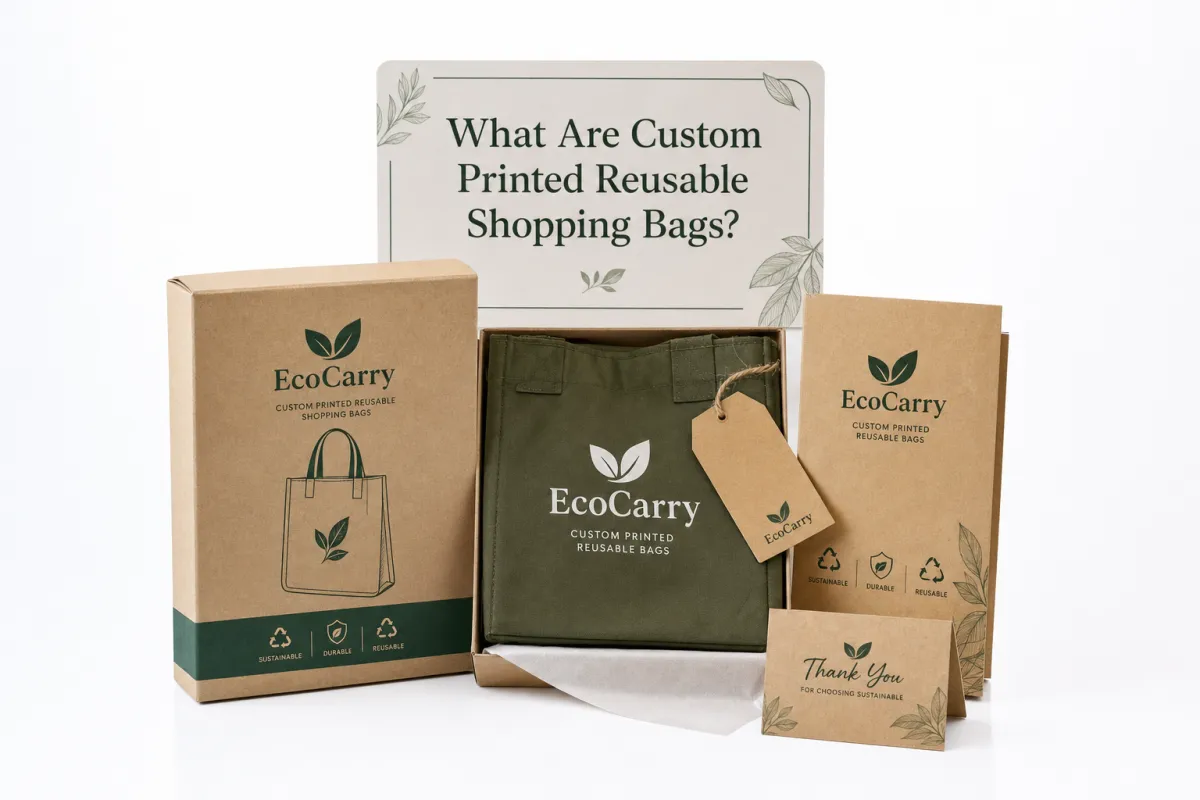
Custom printed reusable shopping bags are durable Carry Bags Made for repeated use and printed with a logo, message, illustration, or retail mark. Unlike single-use checkout bags, they are built to stay in circulation, which means the construction matters as much as the graphics. The better the bag performs, the more often it gets seen, and the more value it sends back to the brand that ordered it.
They show up anywhere practical use matters. Grocery stores use them for carryout. Boutiques use them as part of the purchase experience. Trade show teams hand them out so prospects have something useful to carry brochures and samples. Food service businesses use them for takeout and packaged meal programs. Community events use custom printed reusable shopping bags because they can hold a stack of literature, water bottles, or small giveaways while still putting a logo in public view.
Part of their appeal is that they function like an everyday version of branded packaging. A customer may not think of the bag as part of the product, but they do notice whether it feels sturdy, whether the print looks crisp, and whether it has enough room for the items they bought. That impression travels with the bag. Clean design supports package branding. A flimsy bag can undermine it in a hurry.
There is a plain retail truth behind all of this: the bag can outlast the purchase. A salad, sweater, candle, or bottle of sauce may be gone in a day, but custom printed reusable shopping bags can keep moving through errands and repeat trips. In that sense, they behave more like a long-term retail packaging asset than a one-time container. Smart buyers think about size, handle style, and print placement before they think about artwork color.
If you are evaluating custom printed reusable shopping bags for a store launch or promotion, start with one question: what should the bag do after the sale? If the answer is “carry heavy groceries,” the spec needs strength. If the answer is “look polished at a boutique counter,” the spec needs presentation. If the answer is “distribute a lot of information at an event,” the print needs clarity and contrast. The use case shapes everything else.
A reusable bag is only cheap if it fails fast. If it keeps carrying products, repeating your logo, and holding up in everyday use, it becomes one of the most cost-effective pieces of retail packaging you can buy.
How Custom Printed Reusable Shopping Bags Are Made
The production path for custom printed reusable shopping bags usually starts with material selection and ends with inspection, packing, and shipment. In between, the bag goes through cutting, printing, assembly, reinforcement, and quality checks. The sequence sounds simple, yet the details separate a dependable bag from one that twists, tears, or prints poorly.
Most reusable bags start as flat stock or roll goods, depending on the material. Nonwoven polypropylene, woven polypropylene, cotton, canvas, jute, and RPET all behave differently in production. The supplier cuts panels to size, adds gussets when the bag needs more volume, and then builds the body with sewn seams, heat-sealed edges, or stitched reinforcement at stress points. A good bag is not just fabric with handles attached; it is a small construction project.
Handle style carries more weight than many buyers expect. Short loop handles feel compact and retail-friendly, while longer shoulder handles make the bag useful beyond checkout. Reinforced handles are worth asking for when the bag will carry heavier goods, because the failure point in many custom printed reusable shopping bags is not the body panel but the connection between the handle and the seam. A bottom insert can also help the bag stand open and hold its shape, which makes packing easier for staff and customers alike.
The artwork stage is where file prep and proofing earn their keep. A supplier usually takes your logo or design file, places it on a production template, and shows a mockup or proof for approval. That proof should cover print size, placement, color expectation, and any notes about front and back panels. If the art is too detailed for the material, this is the moment to say so. Simple logos and bold line work usually print more cleanly on custom printed reusable shopping bags than tiny text or thin detail, and yes, that is gonna save everyone a headache later.
Print method selection depends on the substrate and the design. Screen printing is common for bold spot-color graphics on many reusable bag styles. Flexographic printing can work well on some film and roll-fed constructions. Digital printing helps with more complex images or shorter runs, especially where color variation matters. Heat transfer can be useful for certain polyester-based surfaces or for artwork that needs full-color detail without a large setup commitment. The best method is not the fanciest one; it is the one that suits the bag material and the intended use.
Build quality affects performance in direct, visible ways. Better stitching improves load capacity. Stronger material improves repeat use. Accurate print registration keeps the logo readable after folding and handling. A bag that feels balanced in the hand also tends to communicate quality better than a bag that flops around or collapses awkwardly. Buying custom printed reusable shopping bags should feel more like specifying a useful product and less like ordering a throwaway promo item.
Materials, Printing, and Cost Factors
Material choice is the biggest decision in most custom printed reusable shopping bags orders because it shapes cost, feel, strength, print results, and how the bag presents your brand. Some buyers want the lowest practical unit cost. Others want a heavier hand, a more premium appearance, or a sustainability story that fits the rest of their package branding. There is no single best answer, only a better fit for the job in front of you.
Nonwoven polypropylene is often the entry-level workhorse. It is widely used for promotional and retail carryout bags because it is lightweight, economical, and easy to decorate. Woven polypropylene feels sturdier and usually handles heavier loads well. Cotton and canvas create a softer, more premium look and support a brand that wants a natural texture. Jute brings a distinct, rustic appearance and a strong tactile identity. RPET, made from recycled polyester content, is often chosen by buyers who want a recycled-material story that fits broader product packaging goals.
The print side of the equation matters just as much. One color on one side is simpler and cheaper than a multicolor design on both sides. Large solid coverage can cost more than a small mark because it uses more ink, more setup attention, and sometimes more drying time. Special registration, color matching, metallic effects, or print placement near seams can also add complexity. A clean, high-contrast logo often delivers the best balance of cost and legibility for custom printed reusable shopping bags.
| Material | Typical Feel | Good For | Very Rough Unit Range at 5,000 Pieces |
|---|---|---|---|
| Nonwoven polypropylene | Light, practical, retail-friendly | Promotions, grocery carryout, high-volume programs | $0.18-$0.45 |
| Woven polypropylene | Strong, more structured | Heavier loads, repeated use, value-focused retail | $0.35-$0.85 |
| Cotton or canvas | Soft, premium, natural hand feel | Boutiques, lifestyle brands, gift programs | $1.25-$3.75 |
| Jute | Textured, earthy, distinctive | Farm markets, specialty retail, eco-positioned brands | $1.40-$3.50 |
| RPET | Clean, modern, recycled look | Premium promotions, sustainability-led retail packaging | $0.75-$2.25 |
Those ranges are not quotes, and they should not be treated as fixed market truth. Order quantity, bag size, handle style, reinforcement, closure type, and freight can move the number in either direction. A small run with rich decoration can cost more per bag than a larger, simpler order. That is normal. It is one reason buyers should ask suppliers for tiered pricing, a minimum order quantity, and a separate freight line so they can compare landed cost instead of only product cost.
If sustainability claims are part of the spec, it helps to read beyond the sales sheet. The Packaging Association offers useful perspectives on materials and packaging strategy, while the ISTA site is useful for understanding transit testing expectations. That does not mean every reusable bag needs formal lab testing, but it does mean buyers can think more clearly about durability, handling, and distribution risk.
One practical way to think about pricing is this: a cheaper custom printed reusable shopping bags order is only cheaper if it still performs the job. If the handle tears, the print fades, or the size is wrong, the cost per use goes up fast. A stronger bag that gets reused twenty or thirty times can create more brand exposure than a flimsy bag that dies after a few errands. That is a real value calculation, not just a marketing line.
For buyers building a broader brand system, the bag should also stay consistent with other Custom Packaging Products. A recycled-fiber mailer, a printed insert, and a reusable tote do not need to match exactly, but they should feel like they belong to the same visual family. That consistency strengthens retail packaging and gives the whole brand a more deliberate look.
Custom Printed Reusable Shopping Bags Process and Timeline
The usual buying process for custom printed reusable shopping bags is manageable when the stages are clear. It starts with a brief: what size you need, how the bag will be used, what the artwork looks like, how many units you want, and when the bags need to arrive. From there, the supplier confirms construction, sends a proof, and moves into production after approval. That is the ideal flow, and the smoother it is, the less room there is for expensive surprises.
Timing depends on a few specific factors. Artwork readiness matters first. If the file is already vector-based and the brand colors are settled, the job moves faster. If the file needs cleanup, color correction, or layout changes, the proof stage takes longer. Stock availability matters too, especially for special colors or less common materials. Larger orders and more complex print methods naturally take more time. Seasonal demand can also stretch the schedule, which is why custom printed reusable shopping bags for promotions or events should not be ordered at the last second.
A practical timeline often looks like this: one to three days for quoting and setup questions, one to five days for proofing depending on how complete the artwork is, and roughly 10 to 15 business days after proof approval for many standard production runs. Shipping transit time comes after that. Some simple orders can move faster, while more detailed builds, specialty materials, or custom sampling can extend the schedule. It is better to ask for a production window plus transit time than to rely on a single delivery promise.
Delays usually happen in predictable places. Missing vector files slow artwork prep. Late color changes force a new proof. Unclear dimensions cause back-and-forth on bag size. Approving a proof too quickly without checking print placement can create a run that is technically correct but visually disappointing. In other words, the process itself is usually not the problem; vague instructions are. Clear direction is the best protection for custom printed reusable shopping bags.
If the order supports an event date, store opening, or replenishment cycle, add a buffer. A few extra days can save a lot of stress if freight shifts or a proof needs one more round. That is especially true if the bags are part of a coordinated launch alongside other product packaging or custom printed boxes. The smartest buyers treat the timeline as a chain of steps, not a single finish line.
Step-by-Step Guide to Choosing the Right Bag
Start with the use case. That sounds basic, but it is the step that saves the most trouble. Grocery carryout needs a different structure than a boutique purchase bag. Trade show giveaways need a different print area than employee totes. A bag designed for light apparel is not the same as one designed for bottled goods or bulk pantry items. Custom printed reusable shopping bags work best when the use case defines the shape, not the other way around.
- Define the load. If the bag must carry canned goods, bottles, or multiple boxed items, look for stronger seams, wider handles, and a material that can hold weight without stretching too much.
- Choose the feel. A soft cotton tote feels very different from a structured woven polypropylene bag, and that tactile impression becomes part of the brand experience.
- Set the print goal. Decide whether the logo needs to stand out from across a room, support a premium retail look, or simply identify the store at checkout.
- Match the size to real products. The bag should fit what your customers actually buy, not a hypothetical product mix that exists only on paper.
- Check the finishing details. Handle length, gusset depth, bottom support, closure, and foldability all affect daily use.
Artwork should follow the same logic. Bold logos, readable type, and strong contrast usually work better than dense detail. On textured materials like jute or coarse canvas, tiny elements can disappear. On darker substrates, light ink may need stronger contrast or a different production approach. A good proof should show exactly how the design will sit on the bag, because custom printed reusable shopping bags are judged quickly by shoppers who do not pause to decode a complicated layout.
Requesting a mockup or sample is often worth the extra step. Even a simple sample can reveal whether the handles feel right, whether the bag stands open well, and whether the print size is appropriate. I have seen buyers choose a design that looked great in a digital proof but felt awkward in the hand once the sample arrived. That is not a failure of the proof; it is a reminder that a bag is a physical object, not just a layout.
For orders where presentation matters, compare the bag against other Custom Packaging Products and make sure the overall brand story stays consistent. A reusable bag that feels too casual next to a carefully designed box can create a mismatch. A well-matched set of retail packaging pieces can make a small business look far more established than its size would suggest.
Confirm the final details in writing before release: quantity, exact dimensions, material, print colors, print sides, packaging method, ship-to address, and who approved the proof. That sounds simple, but it is the step that keeps custom printed reusable shopping bags from drifting into confusion. A good order is usually a clear order.
Common Mistakes to Avoid When Ordering Reusable Bags
The first mistake is chasing the lowest unit price without checking how the bag is built. A cheap quote can hide weak seams, lighter material weight, unreinforced handles, or a size that looks fine in a spreadsheet but fails in real use. With custom printed reusable shopping bags, the purchase price is only part of the real cost. If the bag does not last, the brand loses the chance to keep showing up in daily life.
Artwork mistakes are just as common. Thin lines can vanish. Small text can blur. Low-contrast colors can disappear against a natural or textured background. A design that looks clean on a white screen may not read well on kraft, jute, dark polypropylene, or any surface with texture. If the logo carries the whole brand story, it needs enough size and contrast to survive the material. That is one of the most overlooked problems in custom printed reusable shopping bags.
Sizing errors happen more often than buyers admit. A bag can look attractive in the mockup and still be wrong for the products inside it. A short gusset might be fine for flat apparel but too tight for boxed goods or groceries. Handle length can also be wrong if the customer needs to carry the bag over a shoulder. Good retail packaging should support the items, not just frame them. That principle applies here as well.
Skipping sample review or proof approval can create expensive surprises. Print placement may drift. Color can appear warmer or cooler than expected. Seam lines can interrupt a logo in a way that was not obvious on the first layout. The more custom the run, the more important this step becomes. A fast approval process is useful only if the underlying details are right.
Freight and storage get ignored more than they should. A container of custom printed reusable shopping bags that arrives too early can sit in the way and tie up space. A shipment that arrives too late can leave a promotion understocked at the exact moment it should be working. This becomes especially frustrating for store openings or event campaigns because the bag is usually part of a larger branded packaging plan.
One more thing: do not assume every reusable bag needs the same durability level. A community giveaway may only need moderate use. A grocery carryout bag may need a much stronger spec. A premium boutique tote may need a more refined finish than a utility bag, even if the unit count is lower. Matching the spec to the job is the simplest way to avoid waste and frustration.
Expert Tips and Next Steps for a Better Order
Match the bag style to the setting. Grocery environments reward strength and practicality. Boutique settings reward polish and a cleaner look. Trade show settings reward high visibility and easy carrying. A bag that feels right in one environment can feel out of place in another, which is why the best custom printed reusable shopping bags are selected with the customer experience in mind, not just the logo placement.
Use artwork that reads fast. People see a reusable bag in motion, not under studio lighting. That means clean contrast, a clear logo hierarchy, and a layout that works at a glance. If the design is too busy, the bag becomes visual noise. If it is too small, the logo gets lost. Strong package branding depends on immediate recognition, and the same rule applies to the bag.
Ask for material swatches, print proofs, and unit-cost tiers at the same time. Seeing them side by side makes it easier to compare value. A slightly higher quote may be worth it if the bag lasts longer, holds better, or looks more aligned with the rest of the product packaging. Buyers who make decisions on total value usually end up happier with the order than buyers who chase the lowest headline number.
Build a buffer into both timeline and quantity. If the bags support a launch, a seasonal campaign, or a recurring sales event, ordering a little extra is often cheaper than reordering in a rush. The same goes for delivery timing. One extra week of cushion is a small price to pay for avoiding event-day stress. Custom printed reusable shopping bags are useful because they are practical; practicality includes planning for the unexpected.
If you are mapping out a larger branded system, compare the bag with other Custom Packaging Products so the visual language stays steady across the customer journey. A tote, a mailer, and a box can each do a different job while still sharing color discipline, logo treatment, and material cues. That kind of consistency gives a brand a more settled, professional feel.
For buyers who want an outside standard to reference, the Packaging Association and ISTA both provide useful context around packaging performance and transport expectations. You may not need formal testing for every order, but knowing how materials behave under handling, stacking, and transit helps you ask better questions before production starts.
My practical advice is simple: gather your artwork, target quantity, needed delivery date, and preferred material before requesting quotes. Then ask suppliers to compare options for custom printed reusable shopping bags by construction, print method, and freight, not just by price. That approach usually leads to a better fit, fewer revisions, and a finished bag that actually earns its keep.
And if your brand also needs custom printed boxes, insert cards, or other retail packaging pieces, keep the same standard in mind. A reusable bag is strongest when it supports the whole brand system, not when it stands alone. Done well, custom printed reusable shopping bags become part of a coherent package branding strategy that stays useful long after the checkout moment.
Frequently Asked Questions
What materials work best for custom printed reusable shopping bags?
Nonwoven polypropylene is often the most budget-friendly choice for promotions and retail carryout, especially if you need a larger quantity. Cotton, canvas, jute, and RPET usually suit brands that want a more premium or sustainability-focused look. The best material depends on how often the bag will be reused, how heavy the contents are, and how the bag should feel in the customer’s hand. For many buyers, the right answer is less about trend and more about matching the bag to the actual use of custom printed reusable shopping bags.
How much do custom printed reusable shopping bags usually cost?
Pricing depends on quantity, material, bag size, print colors, and construction details like reinforced handles or gussets. Higher volumes usually lower the unit cost, while smaller runs and more complex artwork usually cost more per bag. Freight, packaging, and any special finishing should be checked separately so the quote reflects the full landed cost. In many cases, custom printed reusable shopping bags are best judged by total value per use rather than the lowest sticker price.
What is the usual turnaround for custom printed reusable shopping bags?
Turnaround depends on how quickly artwork is approved, whether materials are in stock, and which print method is used. Simple orders with ready-to-print files can move faster than jobs that need custom sampling, color matching, or special construction. It is smart to ask for a clear lead time plus shipping transit time so the delivery date is realistic. If the bags are tied to a launch or event, build in a small cushion so custom printed reusable shopping bags arrive with breathing room.
Can custom printed reusable shopping bags carry heavier items?
Yes, if the bag is built with the right material weight, seam construction, and handle reinforcement. Wider gussets, stronger stitching, and thicker substrates usually improve carrying performance for groceries or bulkier purchases. Always match the bag specification to the actual load, not just the look of the finished design. That is especially important with custom printed reusable shopping bags meant for store carryout or repeated customer use.
How should I prepare artwork for custom printed reusable shopping bags?
Use clean vector artwork when possible so logos stay sharp at production size. Keep text large enough to read, and make sure color choices have enough contrast against the bag material. Send any brand color references, placement notes, and size expectations up front so the proof process goes faster. A simple, clear file usually gives the best result on custom printed reusable shopping bags, especially if the bag surface is textured or the print area is small.
If you are getting ready to request quotes, lock in five things first: finished bag size, expected load, print method, artwork format, and delivery date. Those details cut out most of the back-and-forth, and they make the proof process much cleaner. That is the easiest way to order custom printed reusable shopping bags that do the job instead of just looking good on screen.

