Custom Printed Rigid Mailers: Buy Smarter, Pack Better
Custom printed rigid mailers solve a very specific packaging problem: you need a shipper that stays flat, protects the contents, and still looks like it belongs to a real brand. For books, apparel, prints, subscription inserts, and other flat-pack goods, custom printed rigid mailers do more than move product from A to B. They improve the first impression, reduce bending damage, and avoid the cheap, forgettable look that weakens packaging presentation.
That matters because buyers decide fast. A plain poly mailer is fine for a basic shipment. A stiff, well-printed mailer sends a different message. It says someone planned the packaging instead of grabbing the nearest envelope-shaped object and calling it strategy.
Rigid mailers also sit in a useful middle zone. They are lighter and slimmer than a corrugated box, but more protective and more polished than a flexible mailer. That middle ground is why they keep showing up in e-commerce, publishing, direct-to-consumer retail, and subscription packaging.
What rigid mailers are, and why they feel premium
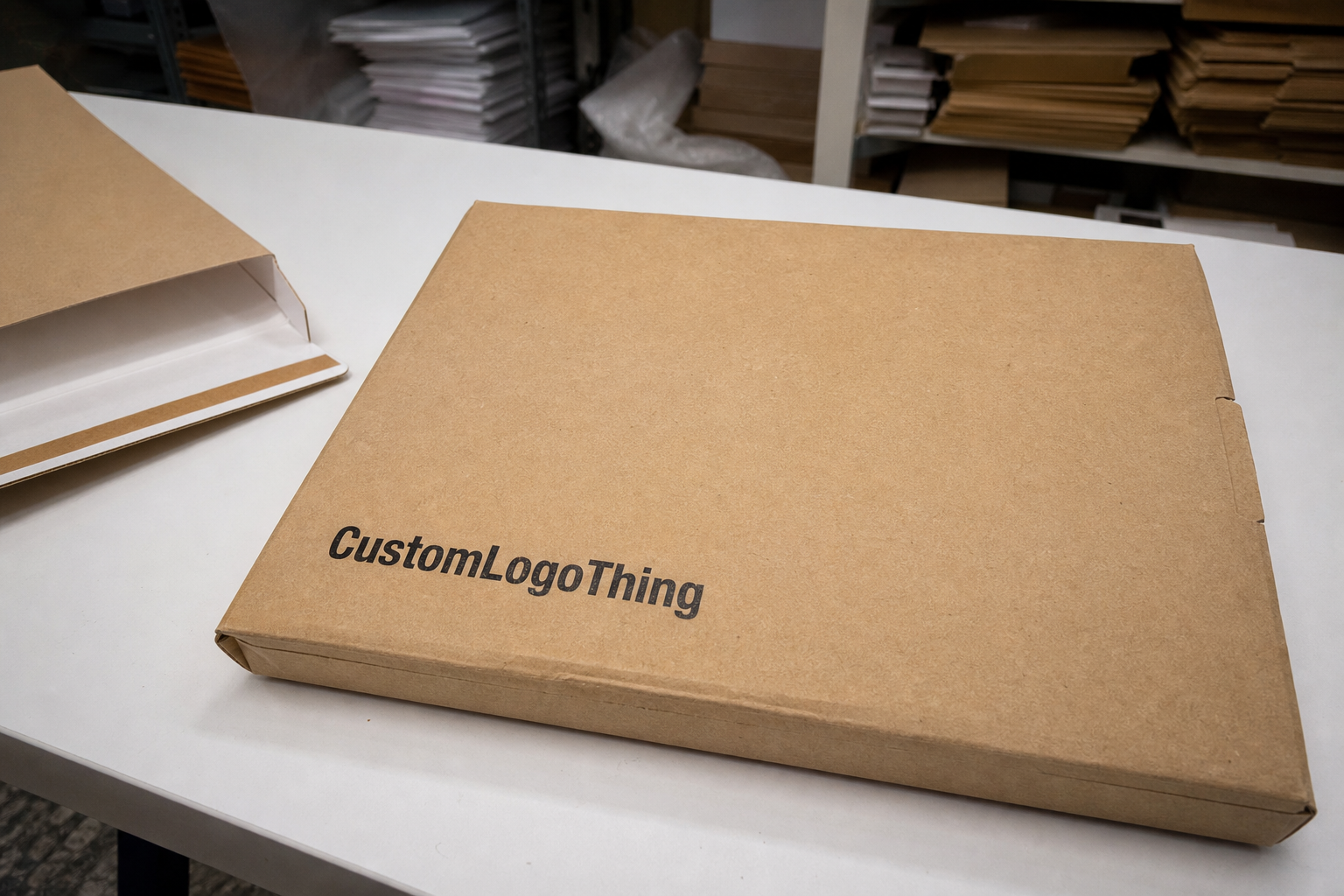
A rigid mailer is a folding mailer built from board stock or layered paperboard that resists creasing, edge crush, and the dreaded “squashed envelope” problem. The structure is usually simple: front panel, back panel, closure flap, and enough stiffness to protect what is inside without adding the bulk of a box. For flat items, that is often exactly what the shipment needs and nothing more.
In practical terms, rigid mailers sit between a poly mailer and a corrugated shipper. Poly mailers are light and inexpensive, but they flex. Corrugated boxes are stronger, but they can be excessive for books, art prints, or apparel that just needs shape retention and a cleaner presentation. Custom printed rigid mailers fill that gap well.
The value is not just protection. It is perceived value. A rigid mailer supports better unboxing, cleaner presentation on arrival, and less dependence on extra outer packaging. That can be the difference between “shipped” and “thoughtfully packaged.”
They also work well as part of a broader branded packaging system. If you already use Custom Packaging Products for inserts, sleeves, or secondary packaging, rigid mailers can keep the whole shipment looking consistent. Consistency sounds boring until a customer opens an order and every component feels like it came from a different business.
“A good mailer has two jobs: protect the item and make the brand look intentional.”
That premium feel comes from a few visible cues: stiff board, clean edges, confident print, and a closure that does not look flimsy. A buyer may not know the board grade or coating spec, but they will absolutely notice whether the package looks crisp or tired.
How custom printed rigid mailers work in shipping
The construction is straightforward, but the details matter. Most custom printed rigid mailers use a board core, a printed wrap or direct-print exterior, adhesive seams, and a tuck or peel-and-seal closure. Depending on the spec, you may also get tear strips, tamper-evident features, or a self-seal flap that speeds up packing.
The print is usually applied to the outer surface as full-color branding, spot colors, or a restrained logo treatment. Matte and gloss finishes are the most common choices. Matte tends to read more premium and hides handling marks better. Gloss gives stronger visual pop, but it can show scuffs faster, especially on dark art or heavy coverage.
During shipping, the stiffness protects against the usual abuse: stacking pressure, conveyor bends, corner knocks, and compression in transit. That does not make the mailer indestructible. It means the package is better at keeping flat items flat. If the product is fragile, the mailer still needs the right internal fit and sometimes an insert or sleeve.
Rigid mailers work especially well for:
- Flat apparel packs
- Books and notebooks
- Prints, stationery, and art cards
- Subscription inserts or sample kits
- Lightweight retail packaging that needs a more polished exterior
If the shipment is soft, non-fragile, and cost-sensitive, Custom Poly Mailers may still make more sense. Different tool, different job. No need to force a rigid structure onto products that do not benefit from it.
For brands that care about presentation, rigid mailers can also coordinate with custom printed boxes and other branded packaging pieces. The goal is not to make every item look expensive. It is to make the packaging system feel deliberate.
Key specs that affect fit, durability, and branding
Most buying mistakes start with size. People measure the product, ignore the insert or wrap, and then wonder why the mailer feels tight. The internal dimension has to account for the item, any protective sleeve, and the packing margin your team needs so the closure does not fight the contents.
Board thickness changes performance quickly. Lighter board can work for apparel inserts or paper goods, but heavier board is safer for books, rigid art prints, and anything with corners that can get crushed. A common range is about 300gsm to 600gsm board, depending on the look and the shipping stress. Higher stiffness usually costs more, but it also lowers the chance of bent edges and crushed corners.
Print coverage matters more than many buyers expect. A simple logo and a two-color layout are cheaper than a full-wrap design with rich solids, tight registration, and edge-to-edge coverage. If your artwork uses large black panels, ask for ink and coating guidance. Deep black on the wrong surface can look blotchy or pick up rub marks.
Surface finish changes both feel and durability. Here is the practical version:
- Matte feels understated and usually hides fingerprints and scuffs better.
- Gloss gives stronger visual pop, especially on bright branding.
- Soft-touch adds a premium tactile feel, but it raises cost and can show abrasion if the shipment is rough.
- Uncoated can look natural and recycled, but it may be less forgiving for detailed art.
Closure and security matter too. A peel-and-seal strip is faster for packing lines. A tear strip improves opening. If the order needs returns or secondary use, make sure the structure still closes cleanly after first use. That is not guaranteed, and it is annoying when a buyer has to wrestle with the package twice.
Ask whether the design was built with transit testing in mind. The shipment does not need a lab drama, but for more sensitive packs you should ask about ISTA 3A assumptions or a similar test approach. The ISTA standards are widely used for simulating drops, vibration, and compression, which is useful when the product cannot afford guesswork. For fiber sourcing or recycled board claims, FSC certification is worth checking if sustainability claims are part of the packaging story.
There is also a practical production constraint that buyers sometimes miss: very large mailers behave differently from small ones. Larger panels are more likely to show warp, print shift, or pressure marks if the board spec is too light. Smaller mailers are easier to keep crisp, but the margin for error is tighter. In other words, size changes more than dimensions. It changes how forgiving the package is during production and transit.
Cost, pricing, MOQ, and unit cost factors
Custom printed rigid mailers are priced by a few moving parts: size, board grade, print coverage, finish, and added features like tear strips or custom inserts. Quantity matters too. A low MOQ is convenient, but convenience is not free. Smaller runs usually carry a higher unit cost because setup gets spread across fewer pieces.
Here is a practical comparison for buyers trying to balance packaging quality against budget:
| Spec | Typical build | Best for | Indicative unit cost at 5,000 pcs | Notes |
|---|---|---|---|---|
| Value spec | 300-350gsm board, 1-color print, basic matte | Simple mailings, light apparel, low-risk shipments | $0.42-$0.68 | Lowest cost, but limited premium feel |
| Mid spec | 400-500gsm board, full-color exterior, matte or gloss | Brand-led e-commerce, books, stationery, subscription packs | $0.72-$1.15 | Best balance for most brands |
| Premium spec | 500-600gsm board, soft-touch, special finishes, tear strip | High-value retail packaging, gifting, launch kits | $1.20-$2.10 | Higher perceived value and stronger presentation |
Those numbers move with size and print complexity. A large full-wrap mailer costs more than a small one with a centered logo. Foil, embossing, or spot UV can push the price up again. If you need the real number, compare landed unit cost, not just the factory quote. Freight, duties, packing, and carton configuration all affect the final result.
Setup and tooling are another hidden item. Dieline preparation, plate charges, and print setup can be small on a large order, then irritating on a short run. That is normal. What is not normal is ignoring them and acting surprised when the “cheap” quote grows teeth.
For smaller brands, the smartest comparison is usually one premium spec and one value spec. That shows where the real tradeoff sits: better finish and stronger board, or lower unit cost and higher margin. If the mailer is part of the brand experience, the better spec can be worth it because it protects the customer’s first impression. The same logic shows up in custom printed boxes, where presentation and protection are often tied together.
One more reality check: if the product itself is low margin, do not overbuild the mailer. A $1.80 package around a $6 item is hard to justify unless the packaging is doing most of the selling. Packaging should support the sale, not swallow it.
Minimum order quantities vary by supplier and print method, but the pattern is predictable. Digital or short-run methods can allow smaller quantities with faster setup. Offset and specialty finishing usually want higher volume to make the per-unit economics work. That is not a sales pitch. It is just how press time and material waste add up.
Process and timeline: from artwork to delivery
The production path is standard. It usually goes like this: quote, dieline confirmation, artwork setup, proofing, sample approval, production, then shipping. If anyone skips the dieline step, the odds of a rework go up fast.
Most delays happen for boring reasons. Artwork is not set to the correct dieline. Bleeds are missing. Fonts are too small. Someone wants to add a line of copy after proof approval. Each of those sounds harmless until the press file has to be rebuilt. That is how a normal order becomes a slow one.
Typical lead times depend on complexity. Simple custom printed rigid mailers can move in about 12 to 18 business days after proof approval. More detailed artwork, specialty finishes, or sample iterations can push that closer to 3 to 5 weeks. Shipping time is separate, which people conveniently forget until the cartons are already in transit.
A physical sample is worth the delay when the fit is tight or the product value is high. A sample tells you whether the closure works, whether the board feels stiff enough, and whether the printed color matches the expectation under real light. A digital proof cannot do that. It can only pretend.
If the supplier offers a prototype, use it. Ask for the exact board, finish, and closure method, not a “close enough” version. The whole point is to catch problems before they turn into a full run of awkward packaging.
If the order needs to match a broader branded packaging system, ask for the final production dieline and keep it archived. That makes repeat orders easier and keeps the spec from drifting. Nothing kills consistency faster than relying on memory and old emails.
Common mistakes buyers make with mailer specs
The first mistake is sizing by product alone. The product is not the whole story. You have to account for inserts, tissue, sleeves, labels, and any extra protection. If you do not, the mailer will be too tight or the pack will look sloppy because there is too much empty space.
The second mistake is overdesigning the outside. A clean logo, one or two brand colors, and a thoughtful layout often do more for perceived value than a crowded surface with six messages fighting for attention. More ink is not more premium. Sometimes it is just noise with a budget.
Then there is compression risk. Buyers often assume stiffness means invincibility. It does not. If the route includes heavy stacking or rough handling, you still need the right board spec and sometimes a stronger closure. Otherwise the corners arrive dented and everyone blames the courier, which is easier than admitting the spec was wrong.
Another issue is finish mismatch. Dense artwork and fine typography can look different on matte versus gloss. Dark backgrounds can scuff. Soft-touch can be beautiful and annoying in equal measure. Test the finish against the actual design, not the version in your head.
Color drift is another quiet problem. What looks like a rich navy on screen can print lighter or warmer on board, especially on textured or uncoated surfaces. If brand color accuracy matters, request a print sample or a controlled proof standard. “Close enough” is not a color system.
Finally, some teams skip sample approval because they want speed. That is usually a false economy. A sample catches bad fit, weak stiffness, color drift, and awkward opening behavior. Skipping it is how people end up with pretty packaging that does not actually work.
Buying tips before you place the order
Request the dieline before final artwork. Every panel, flap, and bleed area needs to be clear. If you are working with a designer, make sure they know the structure is not a flat flyer. That mistake is common, and it costs time.
Ask for a sample or prototype when the product is fragile, expensive, or customer-facing. If the item has a low replacement value and a forgiving fit, you may not need a full prototype. If it is a launch item or a premium gift pack, you probably do. Simple rule.
Compare one premium spec against one value spec. Side by side, the difference becomes obvious fast. You can see where stiffness, finish, and closure details actually matter. That is better than paying extra for features nobody will notice.
Check the packing workflow too. Rigid mailers can be efficient, but only if your team can store them flat, fold them quickly, and seal them without fighting the structure. A beautiful mailer that slows the line is not a win. It is a headache with better typography.
Use the packaging to support the brand story, not shout over it. Clean visuals, sensible hierarchy, and a clear logo usually outperform a crowded design. If you need more packaging options for a broader launch, review Custom Packaging Products and match the mailer to the rest of the system instead of treating it like an isolated purchase.
For brands comparing direct mail against lighter shipping formats, keep the use case honest. If the item is soft, non-fragile, and cost-sensitive, a poly format may make more sense. If the item needs a more polished presentation and better shape retention, custom printed rigid mailers are the stronger choice.
There is also a quality-control side that gets overlooked. Ask how the supplier checks carton counts, print alignment, seam adhesion, and surface finish consistency. For repetitive orders, that matters more than a flashy product page. A good mailer is only useful if the printed panels line up and the closures work the same way in every batch.
Next steps to order the right rigid mailer
Start with measurements. Product, insert, sleeve, label zone, and any extra padding all need to be measured before you ask for a quote. That gives you a realistic internal size and avoids the usual “it looked fine on screen” problem.
Next, decide what matters most. Is the goal premium look, stronger protection, lower unit cost, or faster turnaround? You can usually optimize two of those. Trying to max all four is how budgets drift and specs get muddy.
Then shortlist two or three versions and ask for quotes against the same dieline. That is the only fair comparison. Otherwise you are comparing different shapes, different board weights, and different finishes while pretending the numbers mean the same thing.
If the order depends on exact fit or color, approve a sample before full production. It is a small delay compared with redoing a run of 5,000 mailers because the closure feels off or the exterior finish does not match the mockup.
Finally, keep the approved artwork and dimensions on file for repeat orders. That saves time, protects consistency, and makes future custom printed rigid mailers easier to reorder without rebuilding the spec from scratch.
If you are planning a launch or refreshing an existing pack line, treat the mailer as part of the production system, not just a decorative layer. The right spec is usually the one that fits the product cleanly, survives transit, and still looks intentional after handling. That is the whole job.
FAQ
Are custom printed rigid mailers better than standard poly mailers?
Yes, if you need a more premium look, better structure, or added protection against bending and crush damage. Poly mailers are lighter and cheaper, but they flex more and do less for perceived value. Rigid mailers make the most sense when presentation and protection both matter.
What product types work best in rigid mailers?
Flat or semi-flat items are the best fit: apparel, books, prints, stationery, accessories, and subscription inserts. They also work well for lightweight items that need branded packaging with a cleaner unboxing moment. Odd shapes or fragile items may need extra interior protection.
What affects the price the most?
Size, board thickness, print coverage, finish, and quantity are the biggest drivers. Higher MOQ usually lowers unit cost, while more complex artwork and specialty coatings raise it. The cheapest quote is not automatically the best value if the mailer performs poorly.
How long does production usually take?
Lead time depends on artwork approval, sample needs, order size, and print complexity. Simple runs often move faster, while detailed artwork or special finishes add time. The easiest way to slow the job down is changing the spec after proof approval.
Do I need a sample before ordering in bulk?
Strongly recommended if the product is expensive, the fit is tight, or the print has to be exact. A sample confirms dimensions, finish, closure, and overall feel before you commit to a full run. That is the cheapest way to avoid a bad surprise.
If you are choosing packaging for a launch, use the same discipline you would use for custom printed boxes or any other customer-facing product packaging. Measure first, compare specs against the real use case, and do not let the quote alone make the decision. That is the cleanest way to order custom printed rigid mailers that look good, ship well, and do not waste money.