Buyer Fit Snapshot
| Best fit | custom printed tissue paper for packaging buyers comparing material specs, print proof, MOQ, unit cost, freight, and repeat-order risk where brand print, material, artwork control, and repeat-order consistency matter. |
|---|---|
| Quote inputs | Share finished size, material target, print colors, finish, packing count, annual reorder estimate, and delivery region. |
| Proofing check | Approve dieline scale, logo placement, barcode or warning zones, color tolerance, and any recyclable or compostable wording before bulk production. |
| Main risk | Vague material claims, crowded artwork, or missing packing details can create delays even when the unit price looks attractive. |
Fast answer: Custom Printed Tissue Paper: What It Is and How It Works should be specified like a repeatable production item. The safest quote includes material, print method, finish, artwork proof, carton packing, and reorder notes in one written spec.
What to confirm before approving the packaging proof
Check the product dimensions against the actual filled item, not only the sales mockup. Ask for tolerance on folds, seals, hang holes, label areas, and retail display edges. If the package carries a logo, QR code, warning copy, or legal claim, reserve that space before decorative graphics fill the panel.
How to compare quotes without losing quality
Compare board or film grade, print process, finish, sampling route, tooling charges, carton quantity, and freight assumptions side by side. A lower quote is only useful if the supplier can repeat the same color, closure quality, and packing count on the next order.
Custom Printed Tissue Paper is usually the first branded surface a customer touches, and that tiny moment carries more weight than a lot of packaging teams want to admit. It costs less than a box upgrade, less than a molded insert, and a whole lot less than rebuilding the entire packout. Yet the second the tissue opens, the parcel feels different. More deliberate. More finished. That is why brands trying to balance presentation, budget, and consistency keep coming back to custom printed tissue paper.
It is lightweight tissue stock printed with a logo, repeating pattern, message, or seasonal artwork. Brands use it to wrap apparel, line gift boxes, protect finishes from scuffing, or create a cleaner reveal inside retail packaging and subscription shipments. It does not need to yell. If it does, somebody got the brief wrong. The job is to add brand presence without adding much weight, bulk, or labor. Done well, it behaves like branded tissue paper should: quiet, useful, and hard to ignore.
That makes it unusually efficient from a packaging buyer's point of view. One sheet can support branding, reinforce a premium impression, and make a small item feel giftable. Compared with Custom Printed Boxes, packaging inserts, or heavier cartons, Custom Printed Tissue Paper usually lands lower on the cost ladder while still doing real work in the customer experience. It sits in that sweet spot between branded packaging and practical filler. Not glamorous. Very useful.
I have seen teams spend weeks arguing over a box style, then solve half the customer experience with the right tissue spec in one afternoon. Not magic. Just smart sequencing. If you are building a broader branded packaging program, you can pair tissue with other Custom Packaging Products so the full presentation feels planned instead of stitched together at the last minute.
What Custom Printed Tissue Paper Is and Why It Matters
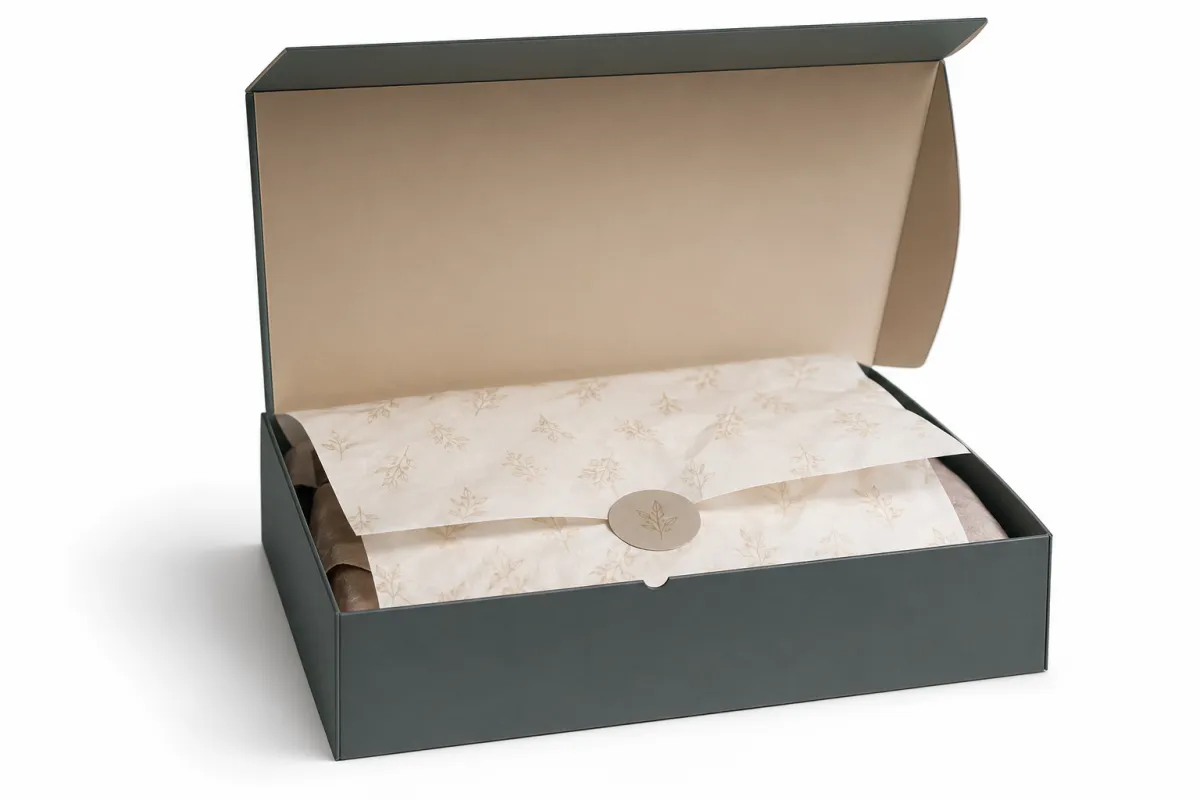
Custom Printed Tissue Paper is lightweight tissue stock printed with brand elements for use in product packaging. The paper is thin enough to fold neatly around items, but it still needs enough strength to survive packing, handling, and the friction that comes with repeated folding. Typical paper weights sit in the broad 17-30 gsm range, though the right spec depends on the use case and how much opacity the brand wants.
The material matters because it reaches the customer early. A box may carry the logo, and a shipping label may carry the address, but Custom Printed Tissue Paper is often the first tactile branded layer inside the parcel. That makes it a small piece of packaging with a loud opinion. In practice, it can influence how expensive the product feels, how curated the order seems, and whether the buyer thinks the seller cared about the details.
For apparel, the use case is obvious. Shirts, scarves, and accessories usually need wrapping that avoids creasing and adds a clean reveal. Cosmetics brands use custom printed tissue paper to cushion presentation items and keep jars, compacts, and tube sets from rubbing against each other. Gift brands rely on it to make a basic package feel more considered. Subscription box teams use it to keep recurring shipments recognizable month after month. Retail packaging teams use it when they want a light but effective brand layer, not a full structural overhaul.
People underestimate how much perception comes from the surface treatment. A plain mailer says "shipped." Custom printed tissue paper says "prepared." That difference is small, but buyers notice it because they scan for signs of care. A tissue wrap with repeated logos or a restrained pattern can do more for package branding than a louder design elsewhere in the packout that never quite settles into place. It can even do some of the work of a small packaging insert, without the extra thickness.
It also serves a practical role. Tissue can keep surfaces from rubbing, help products stay visually clean, and reduce the sense that the item was dropped loosely into the box. It is not protective packaging in the ASTM or ISTA sense of cushioning a fragile product through a full transit simulation, but it does support presentation and light surface protection. If your order includes larger shipping considerations, standards from ISTA are worth understanding because presentation layers and transit layers are different jobs.
Where it fits best: custom printed tissue paper usually works when a brand wants stronger presentation without moving all the way into heavier, more expensive custom packaging. That includes apparel, gift sets, subscription boxes, premium retail packaging, small electronics accessories, and any Product Packaging That needs to feel more deliberate on first touch.
There is a strategic side too. Tissue sits between decoration and function. It can work beside labels, stickers, belly bands, or custom printed boxes and build a consistent family of branded packaging elements. Built well, that system stops feeling like a stack of parts. It starts looking like one brand with a point of view. That is the whole point of custom printed tissue paper: a simple layer that pulls the rest of the package into line.
How Custom Printed Tissue Paper Works From Artwork to Roll
The production flow behind custom printed tissue paper is not complicated, but the details matter. It usually starts with artwork setup, moves into color separation and print method selection, then continues through sheet or roll formatting, cutting, packing, and shipping. Most problems show up before the press ever starts. Proofing matters because of that.
Artwork prep is the first checkpoint. Logos should ideally be supplied as vector files because vectors scale cleanly and keep edges sharp. A repeating pattern is often easier to print than a single centered logo that has to land in the exact same place on every sheet. If the brand wants a border, watermark, or edge-to-edge pattern, the repeat needs to be mapped correctly so the final result does not look awkward once folded. Bleed allowance matters too, especially if the design reaches close to the cut edge. With custom printed tissue paper, a few millimeters can decide whether the repeat feels polished or slightly off.
Then comes the print method. Flexographic printing is common for larger runs because setup costs spread across more sheets, and it handles repeating artwork efficiently. Offset printing can produce crisp detail and strong color control on certain jobs, especially when the design needs fine lines or careful registration. Digital printing is often the better fit for smaller quantities or designs that need more flexibility without high setup costs. None of these wins every time. The right choice depends on volume, art complexity, and target price for the custom printed tissue paper run.
Paper stock shapes the result as well. A smoother tissue usually shows sharper logos, while a more absorbent or textured stock may soften edges. Opacity affects whether ink shows through to the back side, and finish changes the hand-feel. A buyer who only checks the artwork on screen can miss all of that, which is why physical proofs are useful. Screen viewing and paper behavior are not the same thing. Not even close.
Most suppliers follow a short workflow:
- Receive artwork and target quantity.
- Confirm sheet size, repeat size, and print area.
- Prepare a digital proof or strikeoff.
- Approve the proof and schedule production.
- Print, cure or dry, cut or rewind, then pack.
- Ship the finished order to the buyer.
The timeline depends on the print method and the size of the order. Small proofed jobs can move quickly, but production still needs time for setup, drying, finishing, and freight. A simple custom printed tissue paper order might be ready in 10-15 business days after approval, while a larger or more custom run can take longer. Add shipping time, and the total lead time often lands around two to four weeks, sometimes more during peak seasons.
| Print approach | Best for | Typical strengths | Trade-off |
|---|---|---|---|
| Flexographic | Higher volumes and repeating patterns | Efficient on long runs, lower unit cost at scale | Setup cost can hurt small orders |
| Offset | Sharper detail and color control | Good registration, strong image quality | More setup and less flexibility than digital |
| Digital | Short runs and variable needs | Fast setup, useful for smaller tests | Unit cost can stay higher at larger volumes |
That table looks simple, but it reflects a real buying decision. If you are ordering custom printed tissue paper for a seasonal launch or a limited retail drop, the lowest per-sheet number may not be the cheapest path once setup and timing are included. If you need repeatable volume for ongoing product packaging, the economics can flip in favor of a method that carries stronger setup costs but lower long-run cost.
For brands still shaping a broader packaging design system, custom printed tissue paper can act as a test bed. It is easier to adjust than a carton or molded insert, and it can still tell you whether the brand is using the right tone, print density, and repeat structure. That is one reason teams use custom printed tissue paper before they commit to larger custom packaging changes.
Key Factors That Shape Custom Printed Tissue Paper Quality
Quality in custom printed tissue paper is not just about whether the logo shows up. It is about how the sheet behaves, how the ink sits, and whether the final result looks deliberate when it is folded, wrapped, and handled at speed. A tissue design can look polished in a mockup and still disappoint in production if the stock, print method, or repeat structure is off.
The biggest variable is paper thickness. Thinner tissue tends to be softer and easier to fold, but it can be more translucent and more vulnerable to tearing. A slightly heavier stock offers better durability and often better opacity, though it may feel less delicate. For some brands, that trade-off is fine. For others, a more translucent tissue creates a layered, premium reveal, especially when the product underneath is attractive and the brand wants a lighter visual touch. This is where custom printed tissue paper starts acting like part of the product story, not just a wrapper.
Print resolution and color consistency come next. A one-color logo can stay crisp and cost-efficient if the linework is clean and the ink coverage is controlled. Full-coverage repeating patterns, by contrast, can expose misregistration, dot gain, or uneven color faster than anyone wants. If the brand is using dark ink on white stock, the result is usually forgiving. Light ink on a colored tissue sheet is harder to control because the undercolor shapes the final appearance.
Repeat alignment matters more than many buyers expect. A pattern that drifts even a little can look sloppy once folded into a box. That is especially true for custom printed tissue paper used in retail packaging, where the customer may view the wrap from several angles. A tight, well-planned repeat creates a more premium effect than a busy design that never quite lands where it should.
Design choice changes the look fast:
- One-color logos usually feel restrained and clean.
- Watermark-style repeats create subtle branding without overpowering the product.
- Bold full-sheet patterns deliver stronger visibility and a more graphic feel.
- Dark-on-light printing is often the easiest route to accurate results.
- Light-on-dark printing can look striking, but it demands tighter color control.
Format matters too. Standard sheet sizes can help packing stations move faster because the team knows exactly how the tissue will fold around the product. Custom cuts work when the product size is unusual or when the box layout has very specific dimensions. Roll formats reduce individual sheet handling, but they are not always ideal if the packout team is used to pre-cut tissue. Labor at the packing table is a real cost, and a format that saves a few cents on paper can still slow the line.
Sustainability belongs in the quality discussion now, not as an afterthought. Buyers often ask whether the tissue contains recycled content, whether the source is FSC-certified, and whether the print system fits local recycling guidance. If that matters to your brand, start by asking for paper sourcing details and certification information from suppliers. The Forest Stewardship Council is a useful reference point when you want to understand responsible fiber sourcing, but the finished spec still depends on the actual paper, ink, and any finishes used.
One subtle point: the best-looking tissue is not always the most expensive one. A simple logo on a good stock, printed cleanly, often looks better than an overworked design on a paper grade that was never right for the job. That is where packaging design becomes practical rather than decorative. Good package branding should support the product, not wrestle it for attention. Custom printed tissue paper gets this right when it knows its job and does not try to be the whole show.
"If the tissue does not survive one packing shift without tearing, the artwork does not matter."
That line sounds blunt, but it reflects a packing reality. A beautiful sheet that jams at the station or tears during wrapping creates friction for the team and inconsistency for the customer. A good custom printed tissue paper spec balances appearance, handling, and operational speed. That balance is what makes the result feel premium instead of fragile.
Custom Printed Tissue Paper Cost and Pricing Factors
Custom printed tissue paper is one of those purchases where the cheapest quote can turn into the most expensive outcome. If the print looks weak, the sheets arrive damaged, or the format slows packing, the brand pays for it in waste and labor. Price matters, but value matters more. From a packaging buyer's point of view, the real question is not "What is the lowest number?" It is "What will this actually cost once the order is used in production?"
Several factors move pricing fast. Quantity is the obvious one. Setup costs get spread across fewer units on small orders, so low-volume custom printed tissue paper often costs more per sheet than buyers expect. Number of print colors is another major driver. One-color repeats are easier to produce than multicolor artwork, and full-coverage patterns usually need more control and more time. Sheet size also affects cost because larger sheets use more paper and may need more handling during cutting and packing.
Paper grade is easy to overlook, but it is a major price lever. A standard white tissue with modest opacity is usually less expensive than a heavier, smoother, or specialty-coated stock. Paper sourced for higher sustainability requirements can also shift the cost depending on certification and availability. Special inks, metallic effects, or unusual color matching raise complexity too. If the goal is branded tissue paper that feels polished without straining the budget, the paper spec matters more than most people think.
Here is a realistic pricing frame many buyers use when comparing options for custom printed tissue paper:
| Order style | Typical use | Relative price pressure | What usually drives the final number |
|---|---|---|---|
| Simple one-color repeat | Apparel, gifting, routine retail packaging | Lowest | Quantity, sheet size, and setup spread |
| Two-color or moderate coverage | Premium retail packaging and subscription boxes | Middle | Color count, proofing, and print control |
| Full-coverage or highly detailed art | Launch kits, high-visibility branding | Highest | Ink coverage, repeat accuracy, and run complexity |
For many brands, small orders sit around $0.08-$0.18 per sheet once setup is spread across 5,000 to 10,000 sheets, depending on print coverage and paper spec. Larger runs can dip lower on a per-sheet basis, while more complex art can move the number into the $0.20-$0.45 range or beyond. Those are working ranges, not promises. Freight, proofing, and rush timing can change the total quickly.
That is why some teams compare custom printed tissue paper with other branded packaging elements before they choose. A simple wrap can sometimes do the job that a more expensive insert or secondary carton would otherwise need to handle. In other cases, the tissue is just one layer in a broader system that includes labels, printed tape, or custom printed boxes. If the tissue saves packing time and creates a better reveal, it may justify a slightly higher unit cost than a plain generic option.
Hidden costs deserve their own mention. Proofing may be included or billed separately. Rush production can add a meaningful premium. Packaging inserts or special folding requirements can create labor charges that never show up in the first quote. Shipping also matters because tissue may be light, but bulk cartons still take space, and dimensional charges can bite on larger orders. A quote that looks best on paper can lose once it lands in your receiving department.
The best way to judge cost is to compare it against the job it performs. Ask how much brand value it adds, how much waste it reduces, whether it speeds the packout, and how it supports the rest of the product packaging system. That gives you a fairer number than price per thousand alone. The cheapest custom printed tissue paper is not necessarily the best buy if it forces a reprint or slows the line.
How Do You Order Custom Printed Tissue Paper Without Slowing the Packout?
Ordering custom printed tissue paper gets much easier once the project is broken into steps. Good orders usually start with a clear purpose. Is the tissue meant to wrap clothing? Fill voids in a box? Create a premium opening moment? Support a seasonal campaign? The answer changes the sheet size, print density, and budget. Without that clarity, buyers tend to pay for detail in places that do not matter.
The first step is defining the spec. That means quantity, sheet dimensions, paper weight, color count, and finish. A packing team that works from a standard box size may want a format that folds neatly with minimal trimming. A subscription brand may need a custom repeat that works across recurring shipments. A gift business might care more about visual impact because the tissue is doing some of the unboxing work on behalf of the product itself. In other words, the custom printed tissue paper spec should match the way the order is actually packed.
Next comes artwork collection. Buyers should gather vector logo files, brand colors, and any pattern references before they request a quote. If the logo only exists as a screenshot from a website, that is a warning sign. Low-resolution files can create fuzzy lines, jagged edges, or color shifts during setup. Cleaner source files usually mean a faster proofing cycle and fewer surprises.
Then the supplier produces a proof. This is where the details get checked: logo scale, repeat spacing, bleed, and overall color direction. A good proof is not a box to tick. It is the buyer's chance to catch spacing issues before the print run starts. If the tissue will be used in a real packout workflow, ask how the fold will sit inside the box and whether the final sheet size needs adjustment. This is also the moment to make sure the custom printed tissue paper still looks good after handling, not just on a screen.
Timeline expectations should stay practical rather than optimistic. Artwork revisions can happen quickly if the files are ready, but print setup, drying, cutting, and packing all take time. A straightforward order may move from approval to shipping in about 10-15 business days. Larger quantities, heavier coverage, or seasonal congestion can extend that window. Add transit, and planning should usually start weeks before the tissue is needed on the packing floor.
Seasonal demand deserves special care. Holiday sales, launches, and limited drops compress timelines because everyone orders at once. A brand that waits too long can end up choosing between a rushed job and a stock spec that does not fit the design. That is a bad trade in most cases. Better to order early and keep a little inventory buffer than to discover that your branded packaging is sitting in the wrong freight lane.
Before sign-off, the buyer should confirm three things:
- The minimum order quantity and any break points for pricing.
- The production window after proof approval.
- The reorder process so the next batch does not start from scratch.
That last item matters more than people think. If a tissue design works well in the line and the customer response is positive, reordering should be simple. A supplier that keeps artwork, size, and spec on file reduces friction and helps the brand stay consistent across product packaging runs. That is especially true for Custom Printed Tissue Paper That ships in recurring seasonal cycles.
One more operational note: if the tissue must work with fragile, textured, or oddly shaped products, test it in the actual packout. A sheet that looks perfect on a table may behave differently around a bottle neck, a knit garment, or a sharp-edged accessory. In packaging, the trial run usually tells the truth faster than the mockup does.
Common Mistakes When Buying Custom Printed Tissue Paper
Most mistakes with custom printed tissue paper are not dramatic. They are small, repeated, and expensive in aggregate. A bad file here, a wrong size there, and suddenly the order takes longer, costs more, or performs worse than planned. The frustrating part is that these problems are usually avoidable.
The first mistake is file quality. Low-resolution logos, thin linework, and colors that only look right on a laptop screen can all create trouble. Tissue is a relatively unforgiving surface because the sheet is thin and the print has to sit cleanly without looking muddy. If the brand uses tiny text, it may disappear when the tissue is folded or overlapped. If the lines are too fine, they can break up. In practice, a simple strong logo often works better than a crowded layout.
The second mistake is picking the wrong sheet size. Oversized tissue wastes material and can slow packers down because they have to fold more than necessary. Undersized tissue creates messy wrapping and can make the product appear inconsistent from one order to the next. The right size depends on the product, the box, and the desired reveal. There is no universal sheet dimension that works for every category.
The third mistake is trying to force too much into the design. Too many colors, too many details, and too much coverage can raise cost and make the result harder to print cleanly. That can also reduce readability. A custom printed tissue paper design should be seen as part of the packaging system, not a miniature poster. Good package branding is legible at a glance and still attractive when unfolded.
The fourth mistake is timeline optimism. If a launch is fixed, the tissue order should be fixed early too. Skipping proof review or assuming a rush fee will solve everything is risky. Rush production can move the job, but it does not erase setup, drying, or freight constraints. A brand that waits until the last minute often pays more and gets fewer options.
The fifth mistake is not testing the tissue in the real workflow. A sheet that feels fine in a design review might tear when folded around a product with rough edges. A glossy cosmetic item may show through more than expected. A soft apparel pack may require a different fold than a rigid accessory box. Custom printed tissue paper needs to prove itself in the actual packing line, not just in the mockup deck.
"The sample has to work at the packing table, not just on a slide."
That is the standard I would use. If the material cannot be handled easily by the people who will use it every day, the project needs another pass. The best orders do not win because they are flashy. They win because they fit the product, the schedule, and the team doing the work.
Another common issue is ignoring the relationship between tissue and the rest of the branded packaging system. If the box design is loud, the tissue may need to be quieter. If the outer package is plain, the tissue may need to carry more of the visual identity. Custom printed tissue paper works best when it supports the broader system rather than fighting it. That balance is what keeps the whole package from feeling like a random pile of parts.
Expert Tips and Next Steps for Better Results
If there is one practical rule for custom printed tissue paper, it is this: start with the customer experience, then work backward into the spec. A logo alone does not make tissue useful. The design should match the product category, the box style, and the emotional job of the unboxing moment. Apparel can handle a quiet repeat. Gifts can handle more visual energy. Premium retail packaging may need a restrained pattern that feels confident rather than loud.
Ask for a physical sample whenever color, opacity, or fold behavior matters. A print proof on screen can only tell you so much. Paper has a hand-feel, and hand-feel matters in packaging. A slightly heavier stock may fold more cleanly, while a lighter one may look more elegant when layered. If your product has a strong finish, such as foil stamping, glass, or satin fabric, the tissue should complement that surface rather than fight it. The best custom printed tissue paper usually looks easy, even though it took a dozen small decisions to get there.
Comparing one or two print approaches before scaling up is also smart. A brand that is new to custom printed tissue paper can test a one-color repeat against a more detailed version and see which one performs better in both cost and presentation. The difference may surprise you. Sometimes the simpler layout wins because it is easier to pack and looks more consistent under real warehouse conditions.
If sustainability is part of the brief, ask the supplier for fiber sourcing, ink details, and guidance on end-of-life handling. Not every tissue sheet is equal. Recycled content, FSC-style sourcing, and ink systems all affect the final profile. For packaging teams that care about the environmental side of product packaging, the material spec should get the same attention as the graphic spec.
The cleanest next steps are straightforward:
- Define the use case for the tissue.
- Collect artwork in vector format.
- Set a quantity target and a backup quantity.
- Confirm sheet size, print area, and paper weight.
- Ask for a proof and review it against your actual packout.
- Lock the production window before the launch date gets close.
That process sounds basic, but it prevents most of the cost overruns and delays that people blame on the supplier. Good ordering is usually about preparation, not luck. The clearer the input, the cleaner the result. That is especially true for custom printed tissue paper, where tiny spec decisions ripple through the whole packing line.
For brands comparing custom printed tissue paper with other branded packaging options, it helps to think in layers. Tissue might handle the reveal. A label might handle the seal. A box might handle structure. Together, they create package branding that feels coherent rather than cobbled together. That is the point where custom printed tissue paper stops being a decorative extra and becomes part of a working system.
So the practical takeaway is simple: pick the smallest tissue spec that still supports the product, the packout, and the brand story, then test it in the real box before you order at scale. That is the move that saves money, avoids ugly surprises, and keeps custom printed tissue paper doing the job it was meant to do.
Frequently Asked Questions
What is custom printed tissue paper used for in packaging?
It wraps products, fills space, and adds a branded layer to the unboxing experience. It is common in apparel, cosmetics, gifts, subscription boxes, and retail orders. It helps products feel more premium without adding much weight or bulk. Many brands use custom printed tissue paper as the visible layer that ties the rest of the packaging together.
How much does custom printed tissue paper usually cost?
Pricing depends on quantity, sheet size, number of colors, print coverage, and paper grade. Small orders usually cost more per sheet because setup and proofing are spread over fewer units. High-volume orders often lower unit cost, but freight and rush timing can still change the total. If you are comparing custom printed tissue paper quotes, look at the full landed cost, not just the unit price.
What artwork format works best for custom printed tissue paper?
Vector files are usually best for logos and repeating patterns because they stay sharp at any size. High-resolution files help prevent fuzzy edges, thin lines, and color shifts during print setup. A repeat pattern or print-ready layout is usually easier for the supplier to produce accurately. That also makes custom printed tissue paper easier to approve before the run starts.
How long does custom printed tissue paper take to produce?
Lead time depends on proofing, print method, quantity, and whether the order is custom or standard. Artwork approval can move quickly, but production and drying steps add time before shipping. Seasonal demand and rush requests can lengthen the timeline, so early ordering is safer. For custom printed tissue paper, a few extra days of planning usually saves a lot of stress later.
Is custom printed tissue paper recyclable?
Often yes, but it depends on the paper grade, ink system, and any coatings or finishes used. Heavily covered prints or specialty treatments may affect recyclability in some local programs. Ask the supplier about material sourcing and end-of-life guidance before placing a large order. If sustainability matters, request the full spec for the custom printed tissue paper before you approve it.

