Buyer Fit Snapshot
| Best fit | Custom Product Label Printing Wholesale projects where brand print, material claims, artwork control, MOQ, and repeat-order consistency need to be specified before quoting. |
|---|---|
| Quote inputs | Share finished size, material target, print colors, finish, packing count, annual reorder estimate, ship-to region, and any compliance wording. |
| Proofing check | Approve dieline scale, logo placement, barcode or warning zones, color tolerance, closure strength, and carton packing before bulk production. |
| Main risk | Vague material claims, crowded artwork, missing packing details, or unclear freight terms can make a low unit price expensive after revisions. |
Fast answer: Custom Product Label Printing Wholesale: Specs & Pricing should be specified like a repeatable production item. The safest quote records material, print method, finish, artwork proof, packing count, and reorder notes in one written spec.
Production checks before approval
Compare the actual filled-product size with the drawing, then confirm tolerance on folds, seals, hang holes, label areas, and retail display edges. Reserve space for logos, QR codes, warning copy, and material claims before decorative graphics fill the panel.
Quote comparison points
Review material grade, print process, finish, sampling route, tooling charges, carton quantity, and freight assumptions side by side. A quote is only useful when the supplier can repeat the same color, closure quality, and packing count on the next order.
Custom Product Label Printing Wholesale: Specs & Pricing
Custom Product Label printing wholesale is rarely just a line item on a quote sheet. For a lot of product categories, the label is the first thing a shopper sees, the first surface they touch, and the first place they decide whether the packaging feels polished or a little off. It also has a technical job to do, which means a label that looks fine on a screen can behave very differently on a bottle, a jar, a carton, or a chilled case once it hits production.
For brands juggling more than one SKU, custom product label printing wholesale brings order to problems that tend to snowball: color drift between reorders, adhesive failure on different package surfaces, inconsistent trim, and last-minute sourcing changes that land right in the middle of production. A repeatable print spec, a stable supply path, and unit costs that are easier to forecast all come from a label program built for wholesale purchasing, not one-off panic buying. That matters whether the labels support branded packaging, retail packaging, or a broader package branding system that has to hold together across shelves, displays, and fulfillment boxes.
Why custom product label printing wholesale can change shelf math
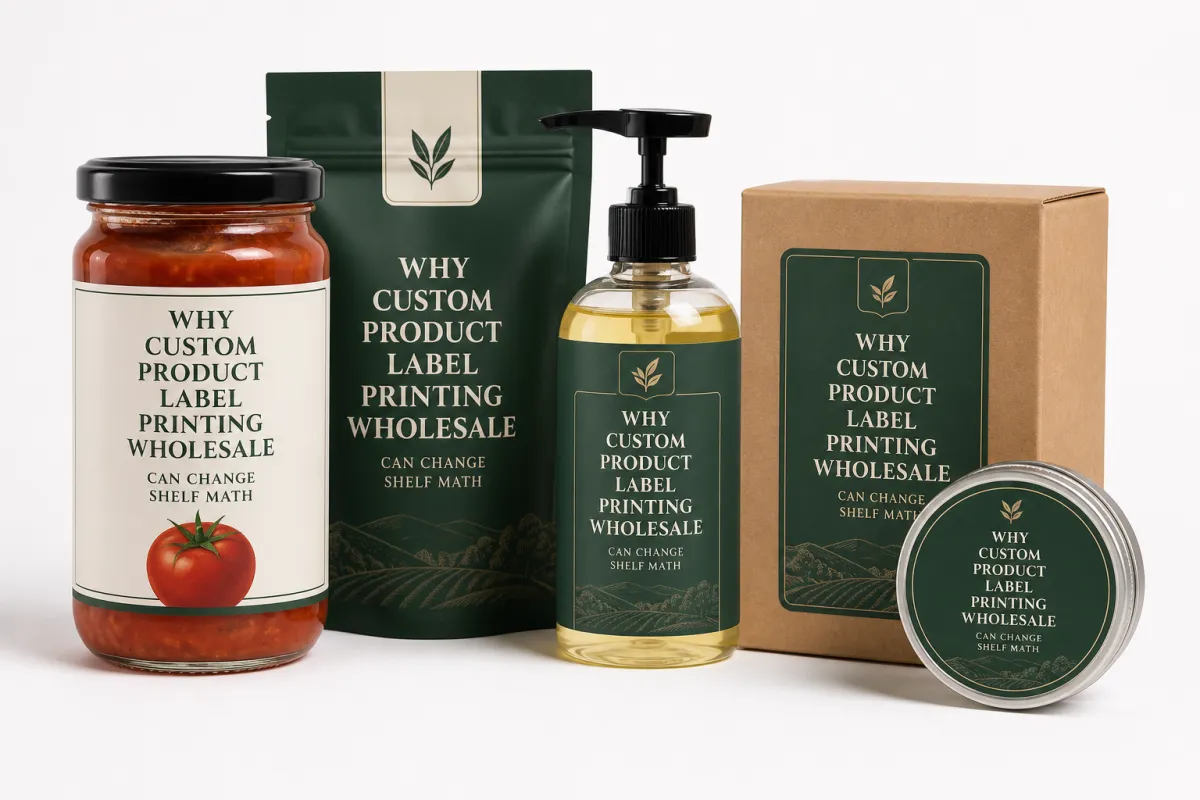
People often think of a label as decoration, but that’s only half the story. Custom product label printing wholesale behaves more like a conversion tool with a technical job attached to it. The label has to catch attention, carry legal copy, survive handling, and apply cleanly at speed. If one of those jobs fails, the cost shows up later as rework, delayed shipments, or a product that looks out of step with the rest of the line.
In a store, the shopper usually touches the package before anything else. That hand feel matters more than people admit. A matte paper label on one SKU and a glossy film label on another can make a product family feel disconnected, even when the formulas are strong and the packaging structure is good. I’ve sat through enough press checks to know that the “small” visual differences are often the ones that make a line look cheap or considered. That is why custom product label printing wholesale affects shelf math directly instead of sitting in the background as a purely visual choice.
Picture a launch with five SKUs. Three are reordered through different suppliers because one run was rushed, one quote looked lower, and one production team swapped to a similar stock without flagging the change. The color shifts. The adhesive changes. The line loses visual continuity. Custom product label printing wholesale addresses that by locking the spec so every reorder follows the same print standard and the same application behavior.
The money side is pretty straightforward. Better labels cut misprints, reduce rework, and lower the odds of emergency freight. They also keep packaging design changes from landing late in the cycle because the first label trial did not fit the container. From a packaging buyer’s point of view, that’s not a style issue. It is inventory control, and it can get kinda expensive fast if the spec is loose.
"A clean label spec saves more money than a rushed reorder ever will."
If you are building a launch plan around Custom Labels & Tags, custom product label printing wholesale gives the operation a dependable baseline. If you are coordinating multiple SKUs through Wholesale Programs, it also makes comparison easier because every quote is built from the same inputs. That buying process feels a lot different from chasing one-off estimates every time the packaging changes.
There is a planning benefit that buyers sometimes underestimate. Wholesale label production makes inventory forecasting cleaner because the unit economics, reorder path, and expected lead time are known in advance. That matters for products tied to seasonal demand, subscription fulfillment, or retail resets where timing carries more weight than a small price difference on the first run. A label order that arrives on time and repeats accurately is worth more than a shiny quote that falls apart at reorder.
Custom product label printing wholesale materials and formats
Format choice comes first because it shapes everything else. Custom product label printing wholesale can be produced as roll labels, sheet labels, cut-to-size labels, or specialty shapes, and each format fits a different application environment. Roll labels are usually the right call for automated application or high-volume hand application. Sheet labels make more sense for office use, sample packs, or smaller batches. Cut-to-size labels are practical for limited edition runs and projects that need a very specific footprint. Specialty shapes can strengthen package branding, though they also add tooling and setup complexity.
On a production line, the format has to match both the container and the equipment. Roll labels are common for bottles, jars, tubs, and pouches because they feed well through applicators. Sheet labels are often used for mailers, inserts, and lower-volume product packaging. If the packaging line changes often, custom product label printing wholesale should be specified with that flexibility in mind, or the order can become harder to use than it looked during quoting. A label that saves a few cents but slows down application is not really a bargain.
Material selection matters just as much. Paper labels still work well for many dry goods, especially where cost discipline matters and the package stays in a controlled environment. BOPP labels are a frequent choice for moisture exposure because the film resists tearing and handles handling better than paper. Clear film can create a no-label look for premium retail packaging, while vinyl is often selected where durability and flexibility matter. Thermal stock is practical for variable data, and textured stocks can support premium packaging design on niche products.
Finish changes both appearance and performance. Matte reads more restrained and can reduce glare. Gloss pushes shelf contrast higher. Soft-touch feels premium, but it is not always the right answer if the package sees abrasion during shipping or store handling. Metallic effects can add emphasis, though they do not suit every category. Custom product label printing wholesale should treat finish as part of the construction, not as an afterthought tacked on at the end.
Use case should guide the selection. Chilled foods need stronger adhesives because condensation affects how labels bond. Beauty products often need premium finishes and cleaner edge quality because the package sits in the customer’s hand and gets inspected up close. Industrial items may need weatherproof stocks or chemical resistance. Packaging professionals ask about storage, handling, and surface type before recommending a label structure because the label has to survive the actual environment, not just a sample table.
For teams working across custom printed boxes, labels, and inserts, the best choice is rarely the most expensive one. It is the construction that matches the package environment and the brand position at the same time. That is one reason custom product label printing wholesale is so useful: it lets a buyer standardize the print method while still tailoring the material to the SKU. You get control without forcing every product into the same rigid setup.
Two outside references are worth keeping close during sourcing. For sustainability and chain-of-custody questions around paper stocks, the FSC site is a useful starting point. For shipping and distribution testing concepts, the International Safe Transit Association at ISTA remains a practical reference for packaging teams that need more than a visual approval.
Custom product label printing wholesale specifications to lock in
Spec discipline is where most label projects either stay on track or drift into avoidable expense. Custom product label printing wholesale needs a clear set of production inputs before the quote should be treated as final. The basic list includes label size, shape, core size, roll direction, bleed, finish, substrate, adhesive type, and artwork resolution. Leave one of those vague and the quote may look right while the production result moves away from what the container actually needs.
Dieline accuracy deserves more attention than it usually gets. A measurement error of only a few millimeters can create visible misalignment on curved surfaces, especially on small bottles and jars. Automated applicators are less forgiving than hand-applied labels. If the dieline is off, the label can wrinkle, lift at the seam, or miss critical copy placement. That is not a printing problem alone; it is a packaging fit problem, and it tends to show up at the worst possible time.
Color management matters as well. If a brand uses the same logo across product packaging, retail packaging, and display cartons, the label should be proofed against a standard reference, not just an on-screen file. Digital printing can hold color well for shorter runs, while flexographic production is often a better fit for larger orders with repeatable artwork and tighter process control. The right method depends on quantity, coverage, and the consistency needed across reorders.
Production details should also be fixed early: proofing method, barcode readability, varnish or lamination, and regulatory text placement. If the label needs to carry nutrition panels, ingredient statements, compliance copy, or variable data, the text block must stay inside the safe area. Once the trim line changes, the whole layout has to be checked again. That part is boring, sure, but it is cheaper to be boring than to reprint thousands of labels.
Environmental exposure changes the spec too. Freeze, moisture, oil, heat, friction, and direct sunlight all affect the right label construction. A label that performs well in a dry storage room can fail in a cooler. A label that looks clean on a flat sample may lift on a round container if the adhesive is not matched to the surface energy of the package. Custom product label printing wholesale works best when the supplier knows the actual use conditions before production starts.
Here is a practical procurement checklist that keeps comparisons honest:
- Dimensions: confirm width, height, and corner style.
- Application: specify hand-applied or machine-applied.
- Surface: note glass, PET, HDPE, coated paperboard, or film.
- Environment: include room temp, chilled, frozen, wet, or outdoor exposure.
- Artwork: provide vector files, fonts outlined, and a verified dieline.
- Compliance: list barcode, country-of-origin, ingredients, warnings, or other regulated text.
If your team is comparing suppliers, ask for the same spec sheet to be priced by each one. That simple move exposes hidden assumptions. One supplier may be quoting a paper stock, another a film label, and a third may be omitting finish entirely. Custom product label printing wholesale works best when the comparison is apples to apples, not a bundle of almost-the-same quotes that are quietly built on different assumptions.
A good label spec should also support your broader packaging system. The same color standards, the same typography rules, and the same finish logic should echo across labels, inserts, and any Custom Packaging Products used in the line. That is how package branding stays consistent instead of feeling improvised from one shipment to the next.
Custom product label printing wholesale pricing, MOQ, and unit cost
Pricing is not random. Custom product label printing wholesale is shaped by quantity, material, finish, number of colors, die-cut complexity, and any special coating or variable data requirement. Buyers often focus on the per-label number first, but the more useful question is what makes the quote move in either direction. That is where the real savings sit.
Quantity is the biggest driver because setup costs get spread across more labels as the run gets larger. A 5,000-piece order may land in one range, while 25,000 pieces may bring the unit cost down sharply. That does not mean bigger is always better. If your inventory turns slowly, a lower unit cost can be offset by storage, obsolescence, or artwork changes that arrive before the labels are used.
Minimum order quantity, or MOQ, exists because press setup, calibration, and finishing all carry a fixed cost. In short-run digital work, MOQ can be low enough for test launches. In flexographic or specialty builds, the minimum is usually higher because the setup has to be spread across a larger run to stay economical. The right MOQ depends on the print method and the label construction, not on a generic industry slogan.
To make pricing easier to evaluate, this table shows the kinds of choices buyers usually compare. The numbers are typical directional ranges, not universal quotes; the final number depends on artwork coverage, label size, and finishing steps.
| Label option | Typical use | Relative setup complexity | Indicative unit cost at 5,000 pcs | Notes |
|---|---|---|---|---|
| Paper roll label | Dry goods, simple cartons, low-abrasion retail packaging | Low | $0.04-$0.08 | Often the most economical for standard custom product label printing wholesale runs |
| BOPP roll label | Bottles, jars, chilled items, moisture-prone products | Medium | $0.06-$0.12 | Good durability, especially where condensation or handling is a concern |
| Clear film label | Premium cosmetics, beverage, and branded packaging effects | Medium | $0.08-$0.16 | Requires stronger proof discipline because print contrast and alignment matter more |
| Textured premium label | Specialty product packaging, artisan lines, high-touch presentation | Higher | $0.10-$0.20+ | Finish and substrate choices can move the price quickly |
The best quote structure is transparent. You should see the per-label price, setup charge, proof fee if any, shipping, and reprint terms before approval. If a quote hides one of those items, custom product label printing wholesale becomes harder to compare and easier to misread. A low per-unit price can turn out to be the expensive option once freight or a special coating shows up later in the process.
There is a simple buying rule that still works. Get at least one like-for-like quote based on the same spec sheet, the same artwork file, and the same delivery expectation. That is the fastest way to identify hidden costs. If one supplier says the job needs 18 business days and another says 9, one of them is probably quoting a different print path or a different finish stack.
For buyers juggling packaging design changes, it helps to compare labels against other components as part of the same budget. A label upgrade that improves shelf visibility may cost less than a complete carton redesign, and the ROI can be clearer. That is one reason custom product label printing wholesale often sits right in the middle ground between speed and brand control.
As a rough planning tool, a straightforward short-run digital label order may move faster and cost more per unit at low volume, while flexographic production often becomes more attractive as quantities rise. The point is not to crown one method as best. The point is to match the method to the order profile, the handling conditions, and the pace of replenishment.
Custom product label printing wholesale process and timeline
The order path should feel predictable. Custom product label printing wholesale usually follows a sequence: inquiry, spec confirmation, artwork upload, digital proof, approval, production, finishing, packing, and shipment. Every step has a purpose. Skip one, and the risk of delay goes up.
Artwork is the most common bottleneck. Incomplete files, missing dielines, low-resolution logos, or vague color targets create back-and-forth that costs days. Late changes to legal text do the same. If the product must ship with compliance copy, the print file should be treated like a production document, not a design draft.
Turnaround should be split into three parts: proof time, production time, and transit time. Buyers often focus only on press time, but that is not the whole schedule. A proof can move in a day, or it can sit for three while internal approvals are collected. Production may take a few business days for a simple order or longer if finishing is involved. Transit depends on location, service level, and freight conditions.
Rush orders can be done when capacity allows, but they usually cost more because they compress prepress, scheduling, and fulfillment windows. That is not a penalty for its own sake. It reflects the real cost of moving a job ahead of the queue. Custom product label printing wholesale is easier to manage when the timeline leaves room for proof review without panic.
In practical terms, a launch timeline should leave room for revision, sample review, and contingency inventory. If the label supports a retail rollout, a subscription drop, or seasonal packaging, a safe planning window is often more useful than the fastest possible quote. Even a strong print partner cannot fix a late approval that lands after production slots are full.
Testing belongs in the timeline when the application is sensitive. Labels that will face condensation, rough handling, or shipping stress should be sampled on the actual package before the full run. That lines up with what packaging teams learn from standards-based thinking and transit testing. A visual approval alone does not prove that the label will stay on through distribution.
For brands that expand into new formats, the label process can also support broader packaging design decisions. Sometimes the right move is to simplify the label and keep the carton richer. Sometimes the label becomes the main branding surface and the box stays quiet. Custom product label printing wholesale gives teams enough control to make that decision based on evidence instead of guesswork.
Why brands choose our custom product label printing wholesale program
Brands usually do not ask for more vendor options. They ask for fewer surprises. That is the practical reason custom product label printing wholesale programs earn repeat business: they reduce variation across reorders and make it easier to keep the whole line consistent. When the label repeats across multiple SKUs, consistent color and repeatable specs are not extras; they are the difference between a polished shelf set and a patchwork look.
Our approach starts with material guidance that is tied to use conditions, not guesswork. A buyer should not have to decode a catalog of finishes to figure out whether the product needs moisture resistance, freezer performance, or a premium face stock. Good sourcing means asking about the container, the fill environment, and the handling pattern before a recommendation is made. That is how custom product label printing wholesale stays practical instead of turning into a back-and-forth exercise.
Procurement teams also value clear quotes and straightforward reorder paths. Budget owners want to know what a run will cost, what the MOQ is, how the lead time is calculated, and what happens if the artwork changes. A clean program makes spend easier to forecast. It also makes replenishment easier because the approved spec can be reused without rebuilding the order from scratch each time.
Quality control matters more than most buyers think. Adhesive testing, proof validation, and print inspection protect against the most frustrating failure mode in label work: a piece that looks good on screen but misbehaves on the container. A label that lifts in a cooler, smears under abrasion, or blocks a barcode creates a much larger problem than a minor price difference on the quote. The buyer ends up paying for the mistake twice.
We keep the conversation factual. Some projects benefit from premium finishes. Others do not. A soft-touch coating may support luxury positioning, but it will not fix a poor dieline. A metallic effect may strengthen retail packaging on one line and be unnecessary on another. Custom product label printing wholesale works best when the recommendation matches the product environment and the sales channel, not a passing trend or a nice-looking sample that won’t hold up in use.
If your broader supply chain includes Manufacturing Capabilities that extend beyond labels, that can help too. A unified production view often reduces handoff friction between labels, cartons, and inserts. That matters for brands trying to coordinate shelf timing, artwork revisions, and multiple packaging components at once.
The same logic applies to digital printing and flexographic printing. One is not universally superior. Digital is often better for shorter runs and variable data. Flexographic production may suit larger volumes where consistency and cost structure matter more. The right answer depends on the run profile, the substrate, and the deadline. That is the kind of decision custom product label printing wholesale should make easier, not more confusing.
Next steps to order custom product label printing wholesale
If you want a quote that is worth comparing, start with a buyer-ready checklist. Custom product label printing wholesale moves faster when the supplier receives label dimensions, quantity, substrate preference, finish, application surface, storage conditions, and any compliance or barcode requirements in one place. The cleaner the brief, the cleaner the estimate.
Reference images help too. One or two package photos can reveal details a PDF mockup misses, especially if the label must wrap around a curved bottle or align with a molded container. A sample package is even better. It lets the supplier judge the real surface, the real curvature, and the real placement constraints instead of guessing from a flat file.
Only ask for pricing after the spec sheet is complete. That is not a stall tactic. It is how you get a number that reflects the actual job. If the spec changes after the quote, the price usually changes too. Custom product label printing wholesale is easiest to buy when the input set is stable.
Before approval, review the proof against the dieline, the color target, and the regulatory copy. A rushed proof sign-off can create expensive cleanup later. Changes after approval usually mean new files, new scheduling, and extra cost. A few extra minutes spent checking the layout can prevent a week of delay.
For teams comparing multiple vendors, a structured buying path works best:
- Confirm the application surface and environment.
- Lock label size, shape, and core requirements.
- Choose the stock and finish based on the product setting.
- Request like-for-like quotes from each supplier.
- Compare lead time, MOQ, freight, and reprint terms.
- Approve the proof only after the dieline and copy are checked line by line.
If you want to expand the same program into other printed components, a coordinated wholesale order can work well across labels, cartons, and inserts. That is where custom product label printing wholesale starts to connect with broader package branding rather than standing alone as a single-sku purchase.
For brands that need labels plus other packaging items, our Wholesale Programs and Custom Labels & Tags pages are a practical starting point. The goal is simple: match the spec, confirm the timeline, and keep the production plan grounded in what the product actually needs. Done that way, custom product label printing wholesale becomes a predictable buying decision instead of a moving target.
Custom product label printing wholesale is strongest when the label, the package, and the supply plan all point in the same direction. That is how brands protect shelf consistency, keep costs visible, and avoid late-stage surprises. If the specs are clean and the timeline is realistic, custom product label printing wholesale can support better launches, better reorders, and better control over the entire product presentation.
What affects custom product label printing wholesale pricing the most?
Quantity usually drives the biggest change because setup costs spread across more labels as the run gets larger. Material, finish, adhesive type, and print complexity also move the number, especially if the label needs moisture resistance, freezer performance, or a premium look. Custom product label printing wholesale quotes become easier to compare when those variables are fixed in advance.
What is the typical MOQ for custom product label printing wholesale?
MOQ depends on the print method and label construction, so there is no single number that fits every order. Short-run digital work often allows lower minimums, while flexographic or specialty builds usually need larger quantities to stay economical. If you need multiple SKUs, ask whether they can be grouped under one custom product label printing wholesale program.
How long does custom product label printing wholesale usually take?
Timeline depends on proof approval, production method, finishing steps, and shipping distance. Simple jobs move faster once artwork is approved, while special materials or coatings add time. The fastest custom product label printing wholesale orders are the ones with complete specs, clean files, and quick proof sign-off.
What artwork files do you need for custom product label printing wholesale?
Vector artwork is preferred because it keeps text and logos sharp at any size. A proper dieline, bleed, and safe area help prevent trim issues and protect critical content. Color references, barcode details, and outlined fonts reduce proof changes later in the custom product label printing wholesale process.
Can custom product label printing wholesale work for chilled or wet products?
Yes, but the adhesive and substrate must match the surface and storage condition. Cold, condensation, and frequent handling require materials that stay put and resist smudging or edge lift. Testing on the actual package is the safest way to confirm performance before full production, especially in custom product label printing wholesale runs that support food, beverage, or cosmetic products.

