Buyer Fit Snapshot
| Best fit | Custom Product Label Rolls Supplier projects where brand print, material claims, artwork control, MOQ, and repeat-order consistency need to be specified before quoting. |
|---|---|
| Quote inputs | Share finished size, material target, print colors, finish, packing count, annual reorder estimate, ship-to region, and any compliance wording. |
| Proofing check | Approve dieline scale, logo placement, barcode or warning zones, color tolerance, closure strength, and carton packing before bulk production. |
| Main risk | Vague material claims, crowded artwork, missing packing details, or unclear freight terms can make a low unit price expensive after revisions. |
Fast answer: Custom Product Label Rolls Supplier: Material, Adhesive, Artwork, and MOQ should be specified like a repeatable production item. The safest quote records material, print method, finish, artwork proof, packing count, and reorder notes in one written spec.
Production checks before approval
Compare the actual filled-product size with the drawing, then confirm tolerance on folds, seals, hang holes, label areas, and retail display edges. Reserve space for logos, QR codes, warning copy, and material claims before decorative graphics fill the panel.
Quote comparison points
Review material grade, print process, finish, sampling route, tooling charges, carton quantity, and freight assumptions side by side. A quote is only useful when the supplier can repeat the same color, closure quality, and packing count on the next order.
Choosing a Custom Product Label rolls supplier sounds simple right up until the first label starts peeling in a cold room or jamming on a dispenser. Most label disasters are not design disasters. They are fit problems, adhesive problems, and application problems that sneak in after the approval email. A good custom product label rolls supplier keeps those headaches off your desk by matching the label to the container, the line speed, and the storage conditions, not just the artwork.
Labels on product packaging do more than sit there and look pretty. They have to survive shipping, moisture, handling, refrigeration, and the occasional rough employee who treats a roll like a pizza box. I have seen a beautiful label fail because the adhesive was chosen for room temperature, then used on a bottle that spent three days in a chilled warehouse. A decent custom product label rolls supplier asks how the label is applied, whether the package gets chilled, whether the surface is glass or film, and whether the roll needs to work in a hand dispenser or a machine. Get that part right, and reorders stop being a drama.
What a custom product label rolls supplier actually does
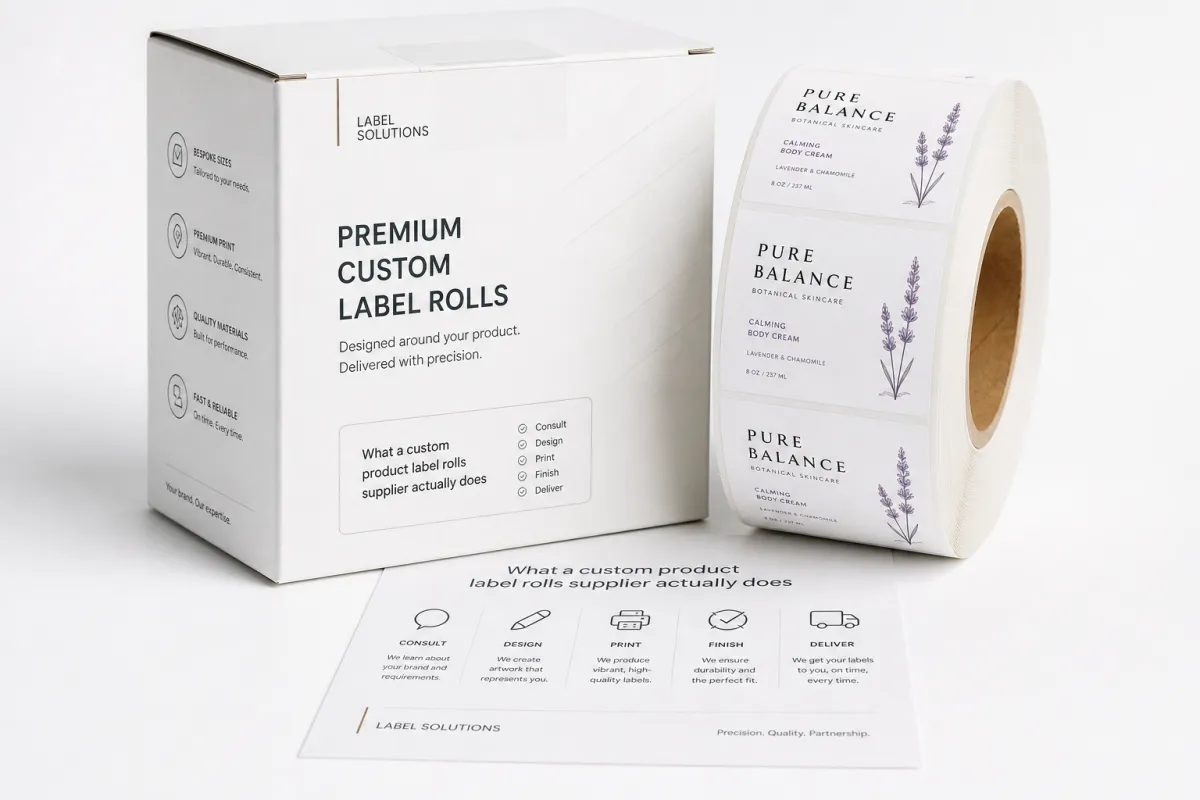
A custom product label rolls supplier does a lot more than print stickers and wind them onto a core. The job is to turn your artwork into labels that feed cleanly, stick properly, and survive the way your product actually lives. That might mean a hand-applied bottle label, a pressure-sensitive mark for jars, or a machine-ready roll for a bottling line that has zero patience for sloppy specs. The best suppliers think about the whole packaging system, not just the file you uploaded at 4:57 p.m.
Roll labels are not the same thing as sheet labels, and the difference matters the second production gets busy. Sheets work fine for short manual jobs. Rolls are built for speed, repeatability, and fewer awkward pauses at the application stage. A sharp custom product label rolls supplier will help with core size, unwind direction, and gap spacing so the roll actually works on the floor. That kind of detail saves time. More important, it saves money you were not planning to spend twice.
Material choice is where a lot of buyers stumble. A capable custom product label rolls supplier will steer you through paper, BOPP, vinyl, clear film, textured stock, freezer-grade adhesive, removable adhesive, and moisture-resistant adhesive without turning it into a sales pitch. These choices decide whether the label curls, peels, smudges, or stays locked in place. For retail packaging, that is not a minor detail. It is the difference between a product that looks finished and one that looks rushed.
Labels also carry part of the brand story that Custom Packaging Products and Custom Labels & Tags handle across cartons, inserts, and shipping materials. A good custom product label rolls supplier understands finish, color consistency, and how the label sits beside custom printed boxes or other branded packaging. A label that looks polished in a PDF and flat on the bottle is not a win. It is a reminder that screens lie.
A label supplier should not stop at "What do you want printed?" They should ask where it goes, how it is applied, and what breaks first if the spec is wrong.
That last part matters more than people like to admit. The right custom product label rolls supplier reduces waste, avoids downtime, and makes reorders feel routine instead of chaotic. If a supplier cannot explain why a roll size, adhesive, or finish was chosen, they are printing first and thinking second. That order usually ends badly. Packaging has enough surprises already.
How a custom product label rolls supplier process works
The workflow looks straightforward on paper: brief, file check, proof, production, finishing, winding, packing, shipping. Real life throws in missing dimensions, fuzzy artwork, and somebody who forgot the label has to fit on a curved surface. A disciplined custom product label rolls supplier will not rush past proofing just to sound fast. Proofing is where the expensive mistakes get caught before they turn into inventory.
After the brief lands, a good custom product label rolls supplier should check more than spelling. Line thickness, barcode readability, contrast, bleeds, and die-cut behavior all matter once the label is printed and wound onto a roll. Small mistakes stop being small right here. A copy fix during proofing is cheap. A corrected print run is not cheap, and nobody enjoys explaining that to accounting.
Lead times depend on material choice, finishing, and order size. Simple digital roll labels can move quickly once approvals are in place. Specialty stocks, foil, lamination, and large quantities take longer. A practical custom product label rolls supplier should give you three timelines: best case, standard, and rush. That tells you what is realistic and what extra speed actually costs. If a quote promises "fast turnaround" and nothing else, the calendar is being massaged.
Delays usually come from the same tired places: missing dimensions, vague application notes, late approvals, and artwork built for a screen instead of print. A custom product label rolls supplier cannot print on wishful thinking. Send complete specs the first time and the job moves faster. It is not glamorous. It is just effective.
For labels used in cold-chain or shipping-sensitive work, ask whether the supplier thinks the way a tester would think. A good reference point is the ISTA shipping test standard. That does not mean every label needs a formal lab protocol. It does mean the supplier should think about abrasion, condensation, transit abuse, and temperature swings instead of assuming the label will enjoy a quiet life. Most labels do not.
Key factors to compare when choosing a custom product label rolls supplier
Start with material. A smart custom product label rolls supplier will explain paper, BOPP, vinyl, clear film, and textured stocks in plain language tied to actual use, not brochure fluff. Paper can work well for dry indoor retail packaging. BOPP handles moisture better. Clear film can look sharp on premium containers, and it will also expose every bubble and scratch under it. The cheapest option is not automatically the smartest one. Annoying, yes. Still true.
Adhesive matters just as much. Permanent, removable, freezer-grade, and moisture-resistant adhesives behave differently on glass, plastic, corrugate, and coated containers. A solid custom product label rolls supplier should ask about the exact surface, storage temperature, and whether the product sweats in refrigeration. If your product is chilled, frozen, oily, or handled constantly, the adhesive recommendation should change. If it does not, somebody is guessing.
Finish changes both the look and the wear. Matte, gloss, soft-touch, foil, and lamination all affect shelf impact, abrasion resistance, and cost. In branded packaging, finish is not decoration. It is part of package branding. A matte label can feel cleaner and quieter. Gloss can punch harder under store lighting. Lamination can buy you more durability. A thoughtful custom product label rolls supplier will connect those choices to the real job instead of waving around a shiny sample card like that solves everything.
Roll specs are where projects quietly fall apart. Core diameter, outer diameter, unwind direction, label gap, and winding orientation all matter if the labels need to feed through a dispenser or automated line. A reliable custom product label rolls supplier will ask how the labels are applied before locking the roll format. If the supplier seems confused by core size, keep looking. That kind of confusion belongs in their warehouse, not on your production floor.
Color consistency is another test worth taking seriously. Ask how proofs are handled, whether digital and reorder runs are matched against a master standard, and how color drift is controlled over time. If your labels sit beside custom printed boxes or other retail packaging, even a small mismatch can make the whole line look off. Customers usually do not say "color drift." They say, "Why does this look cheap?" Same problem. Less polite wording.
Environment matters too. Heat, cold, condensation, oils, friction, and shipping can all chew through a weak label. A good custom product label rolls supplier should talk through those conditions without making it sound like a research paper. For paper sourcing, especially on FSC-backed programs, the Forest Stewardship Council is a useful reference. If sustainability claims matter on your retail packaging, the substrate and certification path need to be clear, not vague and decorative.
Custom product label rolls supplier pricing: what drives cost
Pricing is not random, even when the quote makes it feel that way. A custom product label rolls supplier usually prices based on quantity, label size, material, adhesive, finish, print complexity, and setup effort. A 2 x 3 inch paper label with one-color copy is a different job from a clear BOPP label with four-color graphics, foil, and a specialty adhesive. Buyers who compare only unit price are often comparing two different jobs and calling it shopping.
Volume changes the math quickly. Small runs carry higher per-label pricing because setup costs get spread across fewer pieces. Larger runs usually lower the unit price, but only if the spec stays stable and the inventory will actually get used. A good custom product label rolls supplier should help you balance quantity against shelf life, design changes, and storage space. Nobody needs 40,000 labels sitting in a back room because someone chased a lower unit price and forgot the brand is still changing.
Here is a practical pricing snapshot. These ranges are not promises; they are the kind of numbers buyers often see for standard roll labels, depending on coverage, size, and supplier capability.
| Option | Typical Use | Approx. Unit Price at 5,000 | Notes |
|---|---|---|---|
| Paper C1S roll label | Dry retail packaging, short runs | $0.05-$0.10 | Good for simple branding, less moisture resistance |
| White BOPP roll label | Bottles, jars, chilled products | $0.08-$0.16 | Common sweet spot for durability and cost |
| Clear film roll label | Premium product packaging | $0.10-$0.22 | Looks clean on transparent containers, surface prep matters |
| Foil or specialty finish label | High-impact retail packaging | $0.15-$0.30+ | Higher shelf appeal, more setup and finishing cost |
Several line items push the price up. Rush timing, specialty adhesives, custom finishing, proof revisions, and extra handling all add cost. A custom product label rolls supplier may also charge for plate setup, artwork fixes, or test proofs if the job is complex. Ask before you compare quotes. That one question cuts down on fake price shopping fast. If shipping matters, compare total landed cost, not just the number in the email subject line.
There is also the cost of failure, and this is where cheap turns expensive. If a label peels on a refrigerated bottle, slows down application, or looks off on the shelf, the reprint can cost more than paying for a better spec from the start. A practical custom product label rolls supplier helps you spend where it matters: adhesive, substrate, and line compatibility. That is usually cheaper than remaking finished stock while a production team stands around pretending not to notice.
Step-by-step guide to ordering from a custom product label rolls supplier
Step one is defining the use case with annoying precision. A strong custom product label rolls supplier needs to know the product type, package material, storage conditions, application method, and how long the label has to survive. Is it going on a glass bottle, a plastic jar, a corrugate shipper, or a pouch? Will it sit in a fridge, a freezer, or a warehouse that somehow feels like a sauna at noon? Those answers shape the material choice.
Step two is gathering exact specs. Measure the label size, note the corner style, add bleed, confirm quantity, and define core size and unwind direction. If the labels must run through a dispenser or machine, say so immediately. A good custom product label rolls supplier will use those details to avoid roll-format problems. If you send a vague request and expect the supplier to guess the machine setup, you are not ordering. You are gambling.
Step three is requesting a quote and samples. Do not judge material from a screen. Ask for a sample set or at least a close match so you can test it on the actual container. A practical custom product label rolls supplier should be willing to help here because real packaging is physical, not theoretical. A sample can reveal adhesion issues, color mismatch, finish glare, and texture problems that a PDF will never show you. That is the point.
Step four is proof review. Check spelling, barcode readability, contrast, legal copy, and all dimensions before approving. If the label carries regulatory text or compliance details, verify that too. A careful custom product label rolls supplier should give you a proof that mirrors the production file closely enough to catch problems early. Spend the extra ten minutes here. It costs less than explaining to the warehouse why 3,000 labels were approved with the wrong net weight.
Step five is a pilot run if the packaging is new, the finish is unfamiliar, or the environment is rough. If your labels will see moisture, abrasion, refrigeration, or automated application, test a small batch before full production. The best custom product label rolls supplier will not mind. They should welcome it. A pilot run protects both sides because it turns opinions into evidence.
Step six is locking the approved spec into a repeat-order checklist. Save the final artwork, the approved proof, the label size, the material, the adhesive, the core size, the unwind direction, and the package count. Then send the same spec every time. A dependable custom product label rolls supplier can work quickly when the buyer is organized. Reorders should not require detective work, a long email thread, and a lucky guess.
For buyers who want to keep the broader packaging line clean, document label choices next to carton specs, shipping notes, and any brand color standards used on branded packaging or custom printed boxes. That keeps the custom product label rolls supplier working from the same playbook instead of trying to decode a loose pile of old emails.
Common mistakes when working with a custom product label rolls supplier
The biggest mistake is choosing by price alone. A cheap quote can hide weak adhesive, poor roll specs, or a finish that makes the label look tired on the shelf. A competent custom product label rolls supplier should help you compare the real fit, not just the invoice total. If the label fails during application or on the product, the "savings" disappear fast. Packaging buyers usually learn this once. After that, they stop calling it savings.
Another common miss is skipping real-world testing. Labels that look fine on a monitor can curl, bubble, smear, or peel once they meet condensation, friction, or a chilled surface. A seasoned custom product label rolls supplier should encourage testing on actual containers, not just paper proofs. If the product lives in a cold room or gets handled a lot, testing is not optional. It is basic risk control.
People also forget to specify unwind direction, core size, and roll orientation. That sounds minor until the label arrives and the applicator cannot use it. A reliable custom product label rolls supplier will ask, but buyers should not count on the supplier to catch every omission. If the roll is wrong, a good print job becomes useless stock. That is a frustrating waste of time, and there is no elegant way to dress it up.
Artwork errors are another expensive habit. Files without bleed, weak margins, poor barcode contrast, or unreviewed copy create avoidable revisions. A careful custom product label rolls supplier may catch the problem, but you still lose time. If the label is part of retail packaging, the layout has to survive print, cutting, and winding. Beautiful packaging design is nice. Print-safe packaging design is better.
There is also the surface mismatch problem. Glass, plastic, kraft, frozen goods, and textured containers all behave differently. A label that sticks perfectly to one substrate may fail on another. The right custom product label rolls supplier should match adhesive to surface, not just material to budget. That distinction matters more than most buyers think. It is the difference between a line that runs smoothly and a line that starts collecting excuses.
Finally, people skip reorder documentation. Six months later, nobody remembers which version was approved, which finish was used, or why the label gap changed. That is how repeat buys turn into a small mystery novel. A disciplined custom product label rolls supplier can only be as efficient as the records you keep. Save the approved spec, save the proof, and save the sample reference.
Expert tips and next steps for choosing a custom product label rolls supplier
Start with a one-page spec sheet. Keep it blunt. Include product type, label size, material, finish, quantity, application method, storage conditions, and timeline. A serious custom product label rolls supplier will answer faster and more accurately when the request is clean. This is not paperwork for the sake of paperwork. It is the difference between a quote based on facts and a quote based on guesswork.
Shortlist suppliers by the quality of their questions, not just the speed of their reply. If a custom product label rolls supplier asks about your dispenser, your surface, your climate, and your target run date, that is a good sign. If they only ask for artwork and quantity, they are treating the job like a commodity. Labels are not all equal. Pretending they are is how people end up buying three versions of the same mistake.
Ask for evidence of similar work, especially if your labels need freezer performance, machine application, or stronger shelf impact. A good custom product label rolls supplier should be able to show sample types or explain how they handled a comparable spec. If your project touches larger package branding goals, keep the label aligned with the rest of the line so it does not fight the carton or shipper. That is how branded packaging feels deliberate instead of patched together.
If your product is still changing, start with a pilot run. A smaller order lets you confirm color, adhesion, and handling before committing to a bigger buy. The most useful custom product label rolls supplier is not the one that says yes to everything. It is the one that tells you what the label can and cannot do, then helps you choose accordingly. That kind of honesty saves time and awkward rework.
Use the first order as a benchmark. Save the final quoted price, lead time, print quality notes, and any issues from receiving or application. Then compare future quotes against that baseline. A dependable custom product label rolls supplier gets easier to evaluate once you have a real reference point. Without one, every quote looks like a fresh puzzle. With one, the bad quotes stand out quickly.
If you are building out a packaging system, pair labels with the right containers, cartons, and inserts so the whole thing feels intentional instead of pieced together. A well-matched label and a well-chosen box do more for retail packaging than another round of vague brand talk. The result is cleaner product packaging, tighter package branding, and fewer surprises on the production floor. That is the kind of boring win that quietly pays for itself.
For teams that want a practical starting point, browse our Custom Labels & Tags and compare them with our broader Custom Packaging Products. That makes it easier to keep the label spec aligned with the rest of the line instead of treating it like an isolated purchase. A thoughtful custom product label rolls supplier should fit into that bigger picture, not fight it.
FAQs
How do I compare custom product label rolls suppliers without getting lost in quotes?
Compare the same spec set every time: size, material, adhesive, finish, quantity, and roll specs. Ask what is included in the price, especially setup, proofing, shipping, and remake policy. Request samples or photos of similar jobs so you can judge print quality and material fit Before You Buy. A custom product label rolls supplier that cannot quote apples to apples is making comparison harder than it should be.
What should I ask a custom product label rolls supplier before ordering?
Ask whether the labels are compatible with your surface, dispenser, or application machine. Confirm lead time, proofing steps, and whether rush production is available. Verify unwind direction, core size, and any special storage or handling requirements. A good custom product label rolls supplier should answer these without dodging the question.
Why does custom product label rolls supplier pricing vary so much?
Material and adhesive choices can change cost more than people expect. Smaller quantities usually carry a higher per-label price because setup costs are spread across fewer units. Finishes, special shapes, rush timing, and shipping all push the final number up. That is normal pricing behavior for a custom product label rolls supplier, not a scam, though some quotes are definitely easier to explain than others.
What is the typical turnaround from a custom product label rolls supplier?
Simple jobs can move quickly once artwork is approved and specs are locked. Specialty materials, custom finishes, or machine-ready roll specs usually take longer. The fastest way to avoid delay is to send complete specs and approve proofs promptly. A custom product label rolls supplier can work fast when the buyer does not create avoidable back-and-forth.
How do I know if a custom product label rolls supplier is right for my packaging line?
They should ask about your dispenser or machine, not just your artwork. They should recommend the right roll format, core size, and unwind direction for your process. They should be willing to test or sample materials before full production if your setup is sensitive. If a custom product label rolls supplier treats those questions like annoyances, that is your answer.
Picking a custom product label rolls supplier is really about reducing risk with boring, practical details: the right material, the right adhesive, the right roll format, and the right proofing process. If you get those right, the labels support the product instead of causing trouble. If you get them wrong, you pay for it twice. The actionable move is simple: send a one-page spec with surface type, storage conditions, application method, roll requirements, and a real sample request. That gives a supplier enough information to recommend something That Actually Works, not just something that prints.

