Buyer Fit Snapshot
| Best fit | Custom Product Sleeves with CMYK Printing Explained projects where brand print, material claims, artwork control, MOQ, and repeat-order consistency need to be specified before quoting. |
|---|---|
| Quote inputs | Share finished size, material target, print colors, finish, packing count, annual reorder estimate, ship-to region, and any compliance wording. |
| Proofing check | Approve dieline scale, logo placement, barcode or warning zones, color tolerance, closure strength, and carton packing before bulk production. |
| Main risk | Vague material claims, crowded artwork, missing packing details, or unclear freight terms can make a low unit price expensive after revisions. |
Fast answer: Custom Product Sleeves with CMYK Printing Explained should be specified like a repeatable production item. The safest quote records material, print method, finish, artwork proof, packing count, and reorder notes in one written spec.
Production checks before approval
Compare the actual filled-product size with the drawing, then confirm tolerance on folds, seals, hang holes, label areas, and retail display edges. Reserve space for logos, QR codes, warning copy, and material claims before decorative graphics fill the panel.
Quote comparison points
Review material grade, print process, finish, sampling route, tooling charges, carton quantity, and freight assumptions side by side. A quote is only useful when the supplier can repeat the same color, closure quality, and packing count on the next order.
A plain stock carton can look a lot more expensive once Custom Product Sleeves with cmyk printing wrap around it. That is the trick. Keep the base structure you already paid for, then add color, copy, and shelf presence right where people actually notice it.
For a lot of brands, that is the difference between packaging that holds the thing and packaging that helps sell it. A sleeve can carry photography, ingredient callouts, promo language, seasonal art, or a tidy brand system without forcing a full structural redesign. That matters when budgets are tight, SKUs keep multiplying, or the launch date is already breathing down your neck.
I have watched more than one team get stuck between “we need it to look premium” and “we do not have time to reinvent the box.” Sleeves are usually the practical answer. Not glamorous. Just useful. And useful wins more often than people like to admit.
Custom product sleeves with CMYK printing: why they punch above their weight
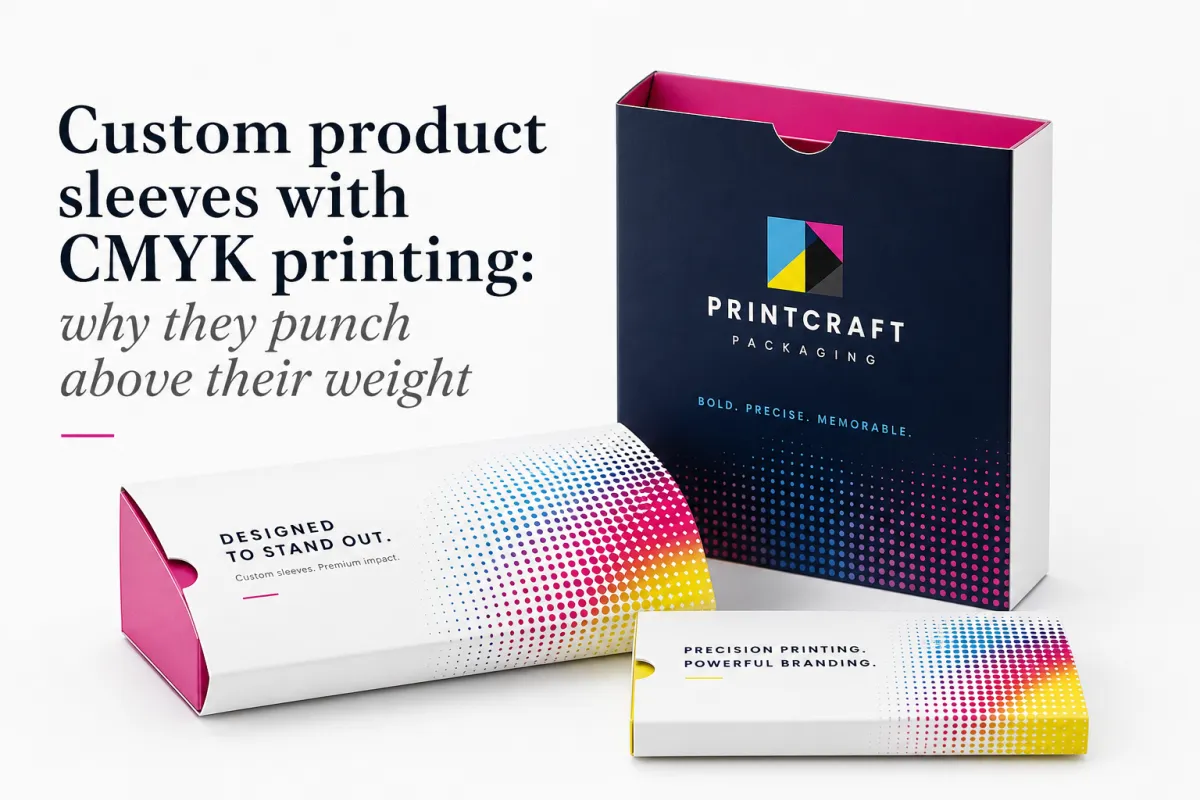
Walk down a shelf with ten near-identical items and the pattern is obvious. The box may be basic, but the brand that gets picked usually owns the front face. That is why custom product sleeves with cmyk printing punch above their weight. They turn a standard carton, tray, jar, or tuck box into branded packaging that looks intentional instead of cobbled together at the last minute.
A product sleeve is exactly what it sounds like: a printed wrap that slips over another package. In practice, it usually covers one or more visible sides of a box and stays put with a tuck, adhesive point, or tight friction fit. If you already have a stock carton or a standard box format, custom product sleeves with cmyk printing can deliver a stronger visual identity without paying for a completely new structure.
A sleeve is also easier to deploy across a family of products. I have seen brands use one base box for six SKUs and let the sleeve do the heavy lifting: flavor, scent, size, seasonal variant, limited edition, you name it. That keeps production sane. It also keeps inventory from turning into a mess of slightly different cartons that nobody wants to count.
The sustainability side is real, but it does not happen by accident. A sleeve can use less material than a fully printed custom carton, especially when the underlying box gets reused across multiple SKUs or the sleeve is cut tightly with little waste. If the board comes from a responsible source and the finish stays recyclable, custom product sleeves with cmyk printing can give you a better ratio of visual impact to material use than heavier, fully printed constructions.
What most buyers miss is that the problem is not only color. Color matters. The bigger issue is balancing brand impact, recyclability, and production reality. A sleeve that looks great on a mockup but jams on the line, hides a barcode, or adds a plastic film where none was needed ends up costing more than it saves.
A sleeve has to do three jobs at once: look good from three feet away, run cleanly in production, and still make sense when it reaches the recycling bin.
That is why custom product sleeves with cmyk printing are usually a packaging decision first and a print decision second. They sit where structure, brand, and storytelling overlap. Used well, they bridge the gap between custom printed boxes and label-only solutions. They also give brands room for promotions, seasonal runs, and multi-SKU systems without rebuilding the whole pack every time the marketing team gets excited.
And yes, the sleeve can be kinda invisible when it is done well. The base box still does its job, the sleeve gives it personality, and nobody in operations has to start from scratch.
How custom product sleeves with CMYK printing work
CMYK is the standard four-color process used on most commercial packaging presses. Cyan, magenta, yellow, and black combine in tiny dots to build a wide range of colors, photos, gradients, and detailed graphics. For custom product sleeves with cmyk printing, that matters because sleeves usually carry exactly those elements: lifestyle imagery, flavor cues, ingredient panels, icons, and layered brand systems.
Why does CMYK fit so well? Because sleeves rarely need a single solid brand color and nothing else. They usually need a mix of tones, secondary accents, and image-based content that would be a pain to manage with separate spot inks. That is where custom product sleeves with cmyk printing become practical. One press pass can handle a lot of visual ground, especially when several SKUs share the same dieline and only the artwork changes.
The path from design file to finished sleeve usually starts with a dieline. That dieline shows the cut shape, fold lines, glue areas, bleed, and safe zones. If artwork reaches the trim edge, bleed is mandatory. If copy sits near a fold, the safe zone matters. If you are printing custom product sleeves with cmyk printing, those technical details decide whether the pack looks polished or merely close enough.
Here is the production logic in plain language:
- Artwork setup - Design on the printer's dieline, usually in CMYK mode, with the proper bleed and resolution.
- Proofing - Review a digital proof, and when color is critical, ask for a press-matched sample or contract proof.
- Press run - Print the sheets or web, depending on whether the job uses offset printing or digital printing.
- Finishing - Add coating, varnish, soft-touch film, or lamination if specified.
- Die cutting and converting - Cut, crease, and finish the sleeve so it folds cleanly and holds its shape.
That process sounds straightforward. It is not, really. The details are where quality lives. Custom product sleeves with cmyk printing can shift from screen to press, especially with deeper neutrals, rich blacks, and highly saturated brand colors. A designer may see one thing on a calibrated monitor and something very different on uncoated board or textured kraft. That is not a failure. That is print behaving like print.
For that reason, smart teams build proofing into the schedule instead of treating it like a nice extra. If a logo is color-sensitive, a consumer item sits beside established brand assets, or the sleeve will face close retail comparison, custom product sleeves with cmyk printing deserve tighter approval than a throwaway promo mailer.
From the production floor side, the sleeves that go smoothly are the ones with clean files and unambiguous specs. The ones that slow everyone down usually have the same three problems: the wrong dieline version, no margin for finishing, and somebody asking for a color change after proofs are already approved. That is the stuff that turns a normal job into a headache.
Key factors that affect quality, sustainability, and performance
The substrate is the first big decision. SBS board gives a smooth, bright surface with strong print fidelity. Kraft has a warmer, more natural look that supports an earthier brand story. Recycled board can signal lower impact, but it may show more variation in fiber, ink holdout, and surface tone. For custom product sleeves with cmyk printing, those differences change both the visual result and the feel in hand.
In packaging terms, board choice is not just about stiffness. It affects how dense the ink looks, how crisp the typography reads, and how the sleeve behaves when folded. A heavy 18 pt stock can feel substantial for premium retail packaging, but a lighter caliper may be the smarter move if the sleeve has to slide over a tight carton or stay cost-efficient at scale. The point is simple: custom product sleeves with cmyk printing should fit the package, not fight it.
Finishing choices matter just as much. An aqueous coating usually offers a cleaner sustainability profile than a full-film lamination and can improve rub resistance without turning the sleeve into a plastic-heavy wrap. Varnish can sharpen certain designs while keeping the surface fairly simple. Soft-touch lamination creates a premium tactile effect, but it also changes recyclability assumptions and can raise cost. If your project leans green, ask whether the finish matches the end-of-life path you want.
| Material or finish | Visual effect | Practical note |
|---|---|---|
| SBS board | Bright white, crisp color | Strong choice for photos and high-contrast branding |
| Kraft board | Natural, earthy tone | Great for eco cues, but colors print darker and warmer |
| Recycled board | Varied, slightly muted surface | Useful for sustainability messaging and lower-impact positioning |
| Aqueous coating | Clean, subtle protection | Often easier to defend from a recycling standpoint than film wraps |
| Soft-touch lamination | Matte, velvety premium feel | Can elevate presentation, but may complicate recyclability goals |
Design itself is another quality driver. Heavy ink coverage can look rich, but it can also flatten structure, slow drying, and create a closed-in feel. Strong contrast makes copy easier to read. White space helps shelves breathe. Barcode readability is not optional, and neither is keeping key copy away from folds or glue zones. That is where experienced packaging design usually shows up: not in how much art gets added, but in how much discipline the layout keeps.
Brand consistency is where many sleeves either succeed or quietly drift. Offset printing usually gives excellent repeatability on larger runs, while digital printing can be better for shorter runs or variable artwork. The right choice depends on quantity, color demands, and turnaround. If you are producing multiple versions of custom product sleeves with cmyk printing, ask how the printer controls color across versions and whether calibration standards are documented.
One honest caveat: no printer can promise a perfect on-screen match without seeing the actual board, finish, and press conditions. That is not a cop-out. It is how the process works. Paper, coating, and ink all influence the final result, and the same file can land a little differently across substrates.
Two outside references are worth keeping in the conversation when sustainability and distribution matter. FSC helps frame responsible sourcing of paper materials, and ISTA gives packaging teams a way to think about transport testing and distribution performance. Neither replaces your supplier's spec sheet, but both can sharpen the discussion around custom product sleeves with cmyk printing when the project has to satisfy brand, operations, and sustainability at the same time.
EPA recycling guidance and local municipal rules still matter too. A sleeve that is technically paper-based may still underperform if it is heavily coated, mixed with non-paper components, or attached to another material that is hard to separate. From a packaging buyer's point of view, the best sleeve is the one that fits the product, the line, and the recycling claim without asterisks hiding in the fine print.
Custom product sleeves with CMYK printing: cost, pricing, and quote drivers
Price is where interest turns into procurement. The good news is that custom product sleeves with cmyk printing can be surprisingly efficient compared with fully custom printed boxes, especially when the base carton stays standard and only the outer sleeve changes. The less-good news is that sleeve pricing depends on more variables than many buyers expect.
Quantity is the biggest one. Setup and prepress costs get spread across the run, so unit price usually drops as volume rises. A short digital run of 500 pieces might land somewhere in the $0.55-$1.20 range per unit depending on size and finish, while 5,000 offset-printed sleeves could often fall into roughly $0.12-$0.32 each. Those are planning ranges, not promises, but they show why custom product sleeves with cmyk printing often make the most sense once the run size grows.
Stock thickness and coverage also push pricing. A heavier board costs more than a lighter one. Full-bleed graphics cost more to run than designs with generous white space. If the artwork uses large dark areas, metallic accents, or rich saturation, ink usage and press control can get more demanding. If there are multiple versions for different SKUs, the proofing and plate or file setup work multiplies fast.
Here is a practical way to compare quote drivers:
| Quote driver | Typical cost impact | What to ask |
|---|---|---|
| Quantity | Higher volume lowers unit cost | Ask for tiered pricing at 500, 1,000, 5,000, and 10,000 pieces |
| Substrate | Premium or thicker board increases cost | Compare SBS, kraft, and recycled options side by side |
| Print coverage | Full-bleed and dense color can raise press time | Check whether your design needs a fully flooded back or only a partial wrap |
| Finishing | Coating, lamination, and special varnishes add cost | Confirm whether the finish is functional or just decorative |
| Version count | Multiple SKUs increase setup and proofing time | Ask how the supplier prices changes between one design and several versions |
| Rush timing | Expedited schedules often cost more | Request a standard and rush quote for comparison |
One reason sleeves are attractive is that they can protect margin while still improving shelf presence. A brand that already has a standard carton does not need to pay for a completely new structure just to improve its visual story. That makes custom product sleeves with cmyk printing a smart middle ground between sticker-based branding and fully custom printed boxes.
When you compare quotes, do not stop at unit price. Total landed cost matters more. That includes proofing, freight, kitting, storage if needed, and any special handling for multiple versions. A quote that looks cheaper on paper can become more expensive once the job lands in the warehouse. I would rather see a buyer ask ten careful questions than chase the lowest line item and discover missing fees later.
There is also a point where simpler really is cheaper. If a sleeve only needs a one-color mark, a single spot color job may be the smarter route. If the design needs photos, gradients, and versioned artwork, CMYK earns its keep. The goal is not to make the spec fancy. The goal is to make it honest and workable.
Custom product sleeves with CMYK printing: step-by-step process and timeline
The workflow usually starts with the brief. What does the sleeve have to do? Is it selling a seasonal promotion, labeling a flavor family, adding premium presentation, or covering a stock carton already sitting in inventory? Clear answers keep custom product sleeves with cmyk printing from turning into an endless revision loop.
A realistic production sequence looks like this:
- Dimensions and structure - Confirm the product size, the carton it will wrap, and the closure style.
- Dieline review - Make sure the cut and fold geometry supports the artwork and the line's folding behavior.
- Artwork prep - Build files in CMYK, place images at proper resolution, and label all technical layers clearly.
- Proof approval - Review digital or physical proofs and resolve any color or copy changes before production.
- Press and finishing - Print, coat, dry, die cut, crease, and convert.
- Packing and shipping - Bundle sleeves in usable counts so they can move efficiently into assembly or kitting.
Timeline is where expectations and reality often part ways. Simple jobs can move in roughly 10-12 business days after proof approval, while more complex runs often need 12-15 business days or more, especially if there are specialty finishes, multiple versions, or manual assembly requirements. When a schedule gets compressed, digital printing may shorten the front end because it can reduce plate-related setup, but not every sleeve is a digital fit.
What usually slows the process down? Late artwork changes. Color proof revisions. Stock substitutions. Waiting for one final internal signoff while everyone else has moved on to other work. Those delays are common, and they are also avoidable. Custom product sleeves with cmyk printing run best when the approval chain is short and the decision-maker is clear.
There is also a difference between standard and rush work that buyers should understand. A rush order does not just mean faster printing. It can mean fewer proof cycles, tighter freight windows, more expensive expediting, and less flexibility if something is wrong. In packaging terms, urgency is a cost center. If the launch date is fixed, the most reliable way to protect it is to freeze art earlier and lock the spec before the order goes to press.
For launch planning, a simple rule helps: build one extra approval day for every stakeholder beyond the packaging lead. A sleeve with one decision-maker can move quickly. A sleeve with marketing, operations, compliance, and sales all weighing in can stall for a week on a single comma. That is not a print issue. It is a project management issue, and it affects custom product sleeves with cmyk printing as much as any other form of product packaging.
When a team skips that discipline, the job rarely fails in a dramatic way. It just gets messy. Messy turns into reproofs. Reproofs turn into delays. Delays turn into expensive overnight freight and a lot of awkward emails. Nobody needs that kind of excitement.
Common mistakes to avoid with sleeves and CMYK files
The biggest design mistake is treating screen color like print color. Screens emit light; paper reflects it. That sounds obvious, but it explains a lot of disappointment. Deep blues, warm grays, and saturated reds often shift on press, especially on recycled or uncoated stocks. If you want custom product sleeves with cmyk printing to match brand expectations, proof against the actual substrate whenever possible.
File prep problems show up constantly. Missing bleed. Text sitting too close to folds. Low-resolution images. Dieline layers left unnamed or accidentally printed. Each one adds rework risk. Each one can also delay the job while the printer asks for corrections. Here is the short version of what to check before export:
- Include the correct bleed on every edge that reaches trim.
- Keep key text and logos inside a safe zone.
- Use high-resolution imagery, usually 300 dpi at final size when appropriate.
- Keep dielines, folds, and glue zones on non-printing layers.
- Confirm barcode contrast and scanability before release.
Another common error is overbuilding the artwork with too much dark ink. Dense black backgrounds can look dramatic, but they also make the piece heavier visually and sometimes less sustainable in tone. A cleaner layout with well-placed contrast often feels more premium than a full-bleed dark flood. With custom product sleeves with cmyk printing, restraint can be a real brand asset.
Finish choice can create its own trap. A glossy or laminated sleeve may feel luxurious, but it can also clash with recyclability goals or make the package look too generic for a natural brand. On the other hand, choosing a recycled stock without understanding how it prints can lead to duller color and lower contrast than the design intended. That is why the best sleeve projects treat finish, stock, and color as one conversation, not three separate ones.
Packaging mistake to avoid: assuming all recycled papers print the same. They do not. Fiber mix, surface texture, brightness, and caliper all affect the final result. If your brand story depends on visual precision, test the stock before approving a large run of custom product sleeves with cmyk printing.
One more practical miss: forgetting that sleeves have to work after they leave the render. A mockup can look perfect and still fail if it slides on the carton, scuffs in transit, or hides a critical label. That is why I always push teams to think past the approval screen and into the actual handoff point.
Expert tips and next steps for better sleeve projects
Start with the actual package, not the artwork. Measure the product, the carton, the retail display footprint, and the closure behavior before requesting a quote. A sleeve that is two millimeters too loose or too tight can create more waste than a slightly more expensive board choice ever will. That is basic. It is also where many projects go sideways.
If color matters, ask for a printed proof or a press-matched sample. Digital proofs are useful for layout and content checks, but they do not always tell the full story on press. For brand-critical jobs, especially those that sit beside established branded packaging or a recognizable product family, custom product sleeves with cmyk printing deserve a color signoff that reflects the actual board and finish.
Keep the structure as simple as it can be while still doing the job. Fewer folds, fewer changes, fewer finishing steps. That usually means less waste and a smoother schedule. It also makes life easier for co-packers and warehouse teams. A beautiful sleeve that is miserable to assemble is not elegant. It is a maintenance problem with better typography.
Before you send art, confirm five things:
- Stock choice and caliper
- Coating or finish
- Recyclability goal
- Quantity and version count
- Target ship date and approval owner
If you are building a larger packaging program, it helps to look at the sleeve as one part of a broader system rather than a one-off print job. Our Manufacturing Capabilities page shows the kind of production support that matters when sleeve projects need repeatability, while Custom Packaging Products covers other formats that may fit the same brand family. Sometimes the best answer is not a sleeve alone; sometimes it is a sleeve paired with a smarter carton strategy.
From a buyer's point of view, the cleanest projects are the ones that lock the spec early and keep the approval chain short. That is how custom product sleeves with cmyk printing move from concept to shelf without unnecessary churn. They do not need to be flashy to work. They need to be deliberate, printable, and honest about what the pack is supposed to do.
Here is the practical takeaway: pick the board and finish first, approve the dieline second, and only then worry about the final color tweaks. Do that, and you are already ahead of most sleeve projects I see.
And honestly, that is the real advantage. custom product sleeves with cmyk printing can give you more brand presence, better control over cost, and a clearer sustainability story than many people expect. Used well, they make a standard package feel considered. Used carelessly, they become another expensive surface. The difference is in the details.
Frequently asked questions
Are custom product sleeves with CMYK printing recyclable?
Usually yes, if the sleeve is made from recyclable paperboard and avoids plastic-heavy lamination or mixed-material add-ons. Aqueous coatings are often easier to defend from a recycling standpoint than full-film wraps, but local rules still matter. If the sustainability claim is part of the sell, confirm the stock and finish with your printer before approving custom product sleeves with cmyk printing.
How long do custom product sleeves with CMYK printing take to produce?
A typical timeline includes prepress, proofing, production, finishing, and shipping, so approvals are the biggest variable. Simple runs can move faster, while complex artwork changes, special finishes, or rush jobs add time. Ask for a production schedule up front so your launch does not get stuck behind last-minute revisions.
What drives the price of custom product sleeves with CMYK printing?
The biggest cost drivers are quantity, substrate choice, print coverage, finishing, and die-cut complexity. Multiple SKUs or frequent version changes can increase setup and proofing costs. Comparing unit price alone can be misleading, so ask for a quote that includes freight, proofs, and any finishing extras.
Is CMYK better than spot color for product sleeves?
CMYK is usually better for photos, gradients, and artwork with many colors or multiple SKUs. Spot colors are stronger when exact brand matching is critical or when a very specific ink tone matters. Many projects use a hybrid approach, using CMYK for imagery and spot color for a brand-critical logo.
What file setup should I use for custom product sleeves with CMYK printing?
Build artwork in CMYK mode, place it on the correct dieline, and include bleed and safe margins. Use high-resolution images, outline fonts or embed them properly, and keep fold lines and glue areas clearly labeled. Request the printer's spec sheet before export, because exact requirements vary by press and finishing method.

