Buyer Fit Snapshot
| Best fit | Custom Product Sleeves from Recycled Paper Packaging projects where brand print, material claims, artwork control, MOQ, and repeat-order consistency need to be specified before quoting. |
|---|---|
| Quote inputs | Share finished size, material target, print colors, finish, packing count, annual reorder estimate, ship-to region, and any compliance wording. |
| Proofing check | Approve dieline scale, logo placement, barcode or warning zones, color tolerance, closure strength, and carton packing before bulk production. |
| Main risk | Vague material claims, crowded artwork, missing packing details, or unclear freight terms can make a low unit price expensive after revisions. |
Fast answer: Custom Product Sleeves from Recycled Paper Packaging should be specified like a repeatable production item. The safest quote records material, print method, finish, artwork proof, packing count, and reorder notes in one written spec.
Production checks before approval
Compare the actual filled-product size with the drawing, then confirm tolerance on folds, seals, hang holes, label areas, and retail display edges. Reserve space for logos, QR codes, warning copy, and material claims before decorative graphics fill the panel.
Quote comparison points
Review material grade, print process, finish, sampling route, tooling charges, carton quantity, and freight assumptions side by side. A quote is only useful when the supplier can repeat the same color, closure quality, and packing count on the next order.
Custom Product Sleeves recycled paper can carry a surprising amount of work for a packaging program without asking you to rebuild the structure underneath. That is the practical appeal. A sleeve can lift shelf presence, support a cleaner materials story, and separate SKUs, bundles, or seasonal versions without forcing a full reset of the product packaging system.
For a packaging buyer, that kind of flexibility matters. Sleeves are one of the few print components that can change the look of a product quickly while leaving the base carton, jar, tray, or mailer untouched. A plain pack can feel considered the moment it is wrapped in custom product sleeves recycled paper. If the artwork is disciplined and the stock is chosen with care, the finished piece often looks more expensive than the material cost suggests. That comes from good packaging design, not from luck.
Many brands end up here because a sleeve is a sensible middle path between plain packaging and a fully printed custom box. It brings in branding, copy, promo messaging, and shelf impact, yet the core protection still comes from the package already in use. If you are comparing formats across a wider program, the full range on Custom Packaging Products is a useful place to start.
Why Custom Product Sleeves Recycled Paper Work So Well
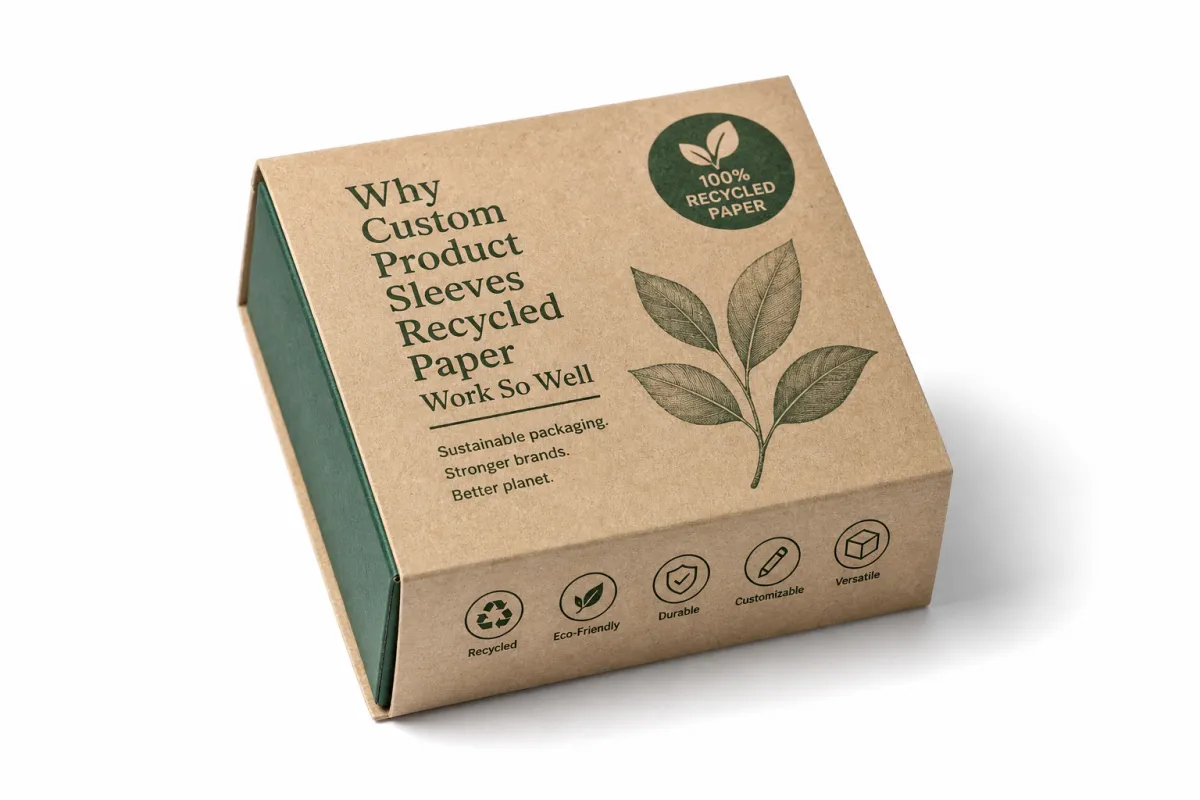
Custom product sleeves recycled paper work because they create a strong visual shift with a relatively small material footprint. The sleeve wraps around the base pack, so you are not decorating every face of a carton or replacing the primary container. That makes the format especially useful for launches, holiday editions, retail promotions, and product family segmentation where the brand wants a fresh look without tossing out a working structure.
On shelf, the sleeve behaves like the front page. It can name the product, call out a scent or flavor, highlight a feature, or announce a promotion in the exact place shoppers notice first. Most people do not stand and study packaging for long. They glance, compare, and move on. Custom product sleeves recycled paper help that quick glance land on the right message while the package underneath does the protecting.
Recycled paper also has a visual character that can be very refined. Some buyers still assume recycled stock means rough, brown, and unfinished. That assumption usually says more about the design than the paper. A well-selected recycled sheet, paired with strong typography and a controlled color palette, can feel cleaner and more premium than a heavier stock crowded with decoration. Bad artwork makes packaging look cheap long before recycled content does.
The sustainability story is real, though it should be told carefully. Custom product sleeves recycled paper can support a lower-impact package because they often use less material than a fully printed carton and can be produced with recycled content or FSC-certified paper. That does not turn every sleeve into an environmental win. The useful part is Choosing the Right amount of paper, the right recycled percentage, and the lightest finishing approach that still protects the pack.
In day-to-day packaging work, brands rely on custom product sleeves recycled paper for a few common reasons:
- Seasonal updates: a fast graphics change for holidays, campaigns, or retail-specific promotions.
- SKU separation: clear visual distinction across scents, sizes, bundles, or flavors.
- Brand refresh: a direct way to modernize branded packaging without replacing the structural pack.
That is why custom product sleeves recycled paper keep showing up in beauty, wellness, specialty food, subscription, and gifting programs. The format is adaptable and practical, a combination that is easier to say than to find.
“A sleeve should solve a packaging problem, not become a packaging hobby. If the base box already does the protective work, the sleeve should focus on clarity, brand impact, and cost discipline.”
If you are weighing material options, the better question is not whether custom product sleeves recycled paper sound sustainable enough. The sharper question is whether the sleeve gives you enough shelf value, enough fit, and enough durability for the job it has to do. That is where the real packaging decisions live.
How Custom Product Sleeves Recycled Paper Are Made
Custom product sleeves recycled paper usually move through a fairly direct sequence: material selection, dieline development, artwork setup, printing, cutting, scoring, folding, and final assembly. The route sounds simple, and on paper it is. The quality lives in the space between those steps, where a small measurement error can turn into a stack of avoidable corrections.
The dieline is the map. It tells the printer where the sleeve wraps, where the folds sit, where the seam lands, and how much tolerance the pack needs for insertion and removal. A snug sleeve can feel crisp in the hand, but if it is too tight it can scuff the box, buckle at the seam, or pop open under handling stress. A loose sleeve can be just as bad because it looks careless. Fit has to be intentional.
Paper choice matters as much as layout. A mid-weight recycled sheet often hits the right balance for custom product sleeves recycled paper because it holds ink well, folds cleanly, and avoids unnecessary bulk. Heavier stock can make sense for larger wraps or a more premium presentation, yet too much thickness can create noisy folds, increase cracking on tight creases, and add waste if the sleeve no longer matches the box with enough precision.
Print method should follow run size and artwork stability. Digital printing is usually the practical choice for short runs, seasonal tests, and frequent design changes because setup is lighter and turnaround is often quicker. Offset printing starts to make more sense as volume rises, especially when color consistency across a larger batch matters more than tiny savings on setup. For many custom product sleeves recycled paper jobs, the real decision comes down to quantity, color needs, and how often the artwork is likely to change.
Finishing changes the feel, but it also changes cost and production risk. Matte and gloss coatings are common. Aqueous varnish is often used for a lighter protective layer. Embossing, foil, and soft-touch coatings can raise perceived value, though they work best when used sparingly. The point is not to use every finish available. The point is to support the package story without paying for decorative clutter that does not earn its keep.
Here is a practical view of the common build choices for custom product sleeves recycled paper:
| Production Route | Best For | Typical Strength | Tradeoff |
|---|---|---|---|
| Digital print | Short runs, frequent artwork changes, sampling | Fast approval cycle, flexible versions | Unit price is higher at larger volumes |
| Offset print | Mid to high volume, consistent branding | Better economics at scale, strong color control | More setup time and higher initial prep cost |
| Basic matte or aqueous finish | Most retail packaging and branded packaging | Clean look, moderate scuff resistance | Less dramatic than premium finishing |
| Soft-touch, foil, emboss | Premium collections, gifting, limited editions | Stronger tactile presence and shelf distinction | Higher cost, more production variables |
The honest version is simple: custom product sleeves recycled paper are not hard to make. The hard part is making them look simple, fit correctly, and survive the handling that happens between packing, shipping, and retail display. Simple is usually harder than it looks.
For brands that already use custom printed boxes, a sleeve can be the more efficient upgrade path because it avoids a full structural redesign. That gives you a way to protect margin while improving presentation. A good supplier will help translate box dimensions into sleeve specs, then confirm whether the recycled paper choice works with the print coverage and finishing plan. Careful production planning is not glamorous. It does save money.
For sustainability language that comes up during sourcing, the FSC site is a useful reference for responsible forest management and certification terms. It does not make the packaging choice for you, but it gives you a more grounded benchmark than vague green claims.
Key Factors That Affect Fit, Print, and Durability
Paper grade is usually the first decision point for custom product sleeves recycled paper. Heavier stock adds structure and a more substantial hand feel, yet the extra thickness also raises cost and can make folding less forgiving. Not every sleeve needs a thick board. Many buyers reach for heavier paper because thicker sounds safer. Sometimes it is. Often it is just more expensive.
Recycled content deserves the same careful treatment. A higher recycled percentage sounds compelling in a pitch deck, but it is not automatically the best answer for every use case. Some recycled sheets perform beautifully. Others may be less crisp on folds, less vibrant with certain inks, or more likely to scuff. The right custom product sleeves recycled paper spec is the one that survives the package’s actual journey, not the one that reads best in a sustainability line item.
Product shape changes sleeve geometry quickly. Square boxes are the easiest. Rectangle cartons are still manageable. Rounded jars, tapered containers, and oversized kits demand tighter tolerance control because the sleeve has to stay aligned without drifting or gapping at the edges. A simple mockup can prevent a lot of unnecessary trouble. Measure the filled product, not the theory version. Product packaging fails most often in the space between assumed dimensions and real ones.
Print coverage affects both appearance and durability. Large dark solids look strong, but they can show fingerprints, fold wear, and edge scuffing more readily than lighter layouts. Dense ink coverage also needs more attention during drying and finishing. If custom product sleeves recycled paper are going into retail packaging that gets handled often, the artwork should be designed with abrasion in mind. Pretty is useful. Durable keeps the job alive.
The fold zones deserve respect. Tiny type, logos, barcodes, and other critical marks should not sit on a crease unless there is no other option. That sounds obvious until a reprint lands on someone’s desk because the barcode crosses the fold and scans badly. Print planning is the point where custom product sleeves recycled paper either stay efficient or turn into a steady stream of avoidable costs.
Shipping-heavy programs need testing as well. If the sleeve will move through ecommerce channels, a supplier may recommend distribution testing aligned with ISTA methods or similar internal protocols. That does not mean every sleeve needs a formal lab report. It does mean the package should be treated as part of the system, especially if the sleeve is tightly wrapped, has exposed edges, or sits around fragile contents.
One tradeoff gets missed often: more recycled content is not a win if it creates higher waste from wrinkled sleeves, weak seams, or shipping damage. A reprint because the sleeve failed is worse for the budget and worse for the environment. The better spec is usually the one that balances recycled content, fit, and useful lifespan.
- Choose moderate stock first: start with a mid-weight recycled paper unless the product clearly needs more structure.
- Check fold placement: keep logos, barcodes, and critical copy away from crease lines.
- Test the real product: use the filled package, not an empty mockup, to verify fit.
- Match finish to use: scuff-prone packs need more protection than display-only sleeves.
For custom product sleeves recycled paper, fit is never a minor detail. It decides whether the package looks intentional or rushed. A sleeve that sits straight and closes cleanly does more for package branding than a loud design that barely holds itself together.
Process, Timeline, and Lead Time for Production
The production process starts before anyone touches a press. A good brief should include product dimensions, target quantity, desired recycled content, finish preference, print coverage, and the date the sleeves need to be in the building. If the order is custom product sleeves recycled paper, the supplier also needs to know whether the sleeve is wrapping a box, a jar, a kit, or a bundle. Each format behaves differently.
After the brief comes the dieline and artwork stage. This is where a lot of schedules quietly unravel. Late artwork is one delay. A dimension change after the dieline has already been approved is another. A third is the familiar “the proof looks fine, but now we want the logo larger and the color warmer” request. That kind of change is not a tweak. It resets the job. For custom product sleeves recycled paper, those resets cost time because folding, cutting, and print setup all depend on the same geometry.
Proofing should be treated like a decision checkpoint, not a formality. Digital proofs are useful for layout and copy. Physical samples are better for fit, finish, and handling. If the sleeve is for a launch or retail rollout, sample approval needs to happen while there is still room to correct the design. I have seen more budget waste from skipped samples than from nearly any other packaging shortcut. The savings vanish the moment a full run arrives wrong.
Lead time depends on complexity and quantity. Simple digital short runs can move fairly quickly once artwork is final, while larger offset jobs with special finishing usually need more breathing room. For many custom product sleeves recycled paper projects, a practical window is often 12-15 business days from proof approval for straightforward work, and longer if the order includes custom finishing, tight registration, or large quantities. That is not a promise. It is a realistic starting point.
Here is a clean way to think about the timeline:
- Brief and dimensions: 1-2 business days if the product measurements are ready.
- Dieline and artwork setup: 2-5 business days depending on revisions.
- Proof and sample review: 2-7 business days depending on whether a physical sample is needed.
- Production and finishing: 5-15 business days depending on run size and process.
- Packing and shipping: 1-7 business days depending on destination and freight method.
That sequence can feel slow on a calendar, yet it is still faster than fixing a bad order after launch. Lead time should be discussed before a quote is accepted, not after. A good price means little if the sleeves miss the promotion window or the product lands in retail without its branded packaging.
One practical note: if your custom product sleeves recycled paper are part of a wider packaging rollout, line them up with the rest of the system early. If the cartons, labels, inserts, and sleeves all move on different timelines, someone ends up making compromises under pressure. Packaging teams do not need more surprises. They need fewer.
Cost, Pricing, MOQ, and Quote Basics
Cost for custom product sleeves recycled paper comes down to a handful of predictable inputs: size, quantity, paper grade, print coverage, finishing, and shipment method. A common misunderstanding is that the sleeve itself is small, so the quote should be small too. That is not how the work behaves. Setup, proofing, cutting, and folding still exist, and they do not disappear just because the order is modest.
Unit pricing usually drops as quantity rises because setup gets spread across more sleeves. That part is standard. What buyers often miss is that the first price break does not always land where they expect. A run of 500 sleeves may be dramatically more expensive per unit than 1,000, while moving from 5,000 to 10,000 may save far less if setup costs are already absorbed. Every job has its own math, which is why vague “affordable” quotes are not very useful.
MOQ, or minimum order quantity, exists because production has fixed work at the start. Press adjustments, tooling, make-ready waste, and cutting setup all take time. Those costs are real whether you print 100 sleeves or 10,000. If a supplier offers custom product sleeves recycled paper below a realistic MOQ, ask where the tradeoff sits. Sometimes digital short-run methods make it possible. Sometimes the quality or the margin gets squeezed somewhere else. Guessing is not a plan.
A proper quote comparison should be apples to apples. Confirm the exact sleeve dimensions, recycled content, paper weight, print method, coating, special finish, proof type, freight, and packaging format. A low quote that leaves out freight or finishing is not low. It is incomplete. That kind of quoting slows procurement down and turns a straightforward purchase into detective work.
For a rough buying mindset, custom product sleeves recycled paper often make sense in these ranges:
- Short-run digital: higher per-unit cost, lower setup pain, better for testing and frequent updates.
- Mid-volume offset: better per-unit economics once quantities climb and artwork stabilizes.
- Premium finishes: higher perceived value, but only worth it if the design actually benefits from them.
Here is a practical comparison of common buying paths:
| Order Type | Typical Quantity Range | Relative Cost | Best Use Case |
|---|---|---|---|
| Digital short run | 250-2,000 units | Higher per unit, lower setup | Launch tests, seasonal updates, small SKU counts |
| Offset mid run | 2,000-20,000 units | Lower per unit at scale | Stable designs, retail rollouts, repeat orders |
| Premium finish run | 1,000+ units | Higher due to finishing steps | Gift sets, luxury branding, high-touch retail packaging |
For many buyers, the real question is not the lowest quote. It is which custom product sleeves recycled paper spec gives the brand the right mix of appearance, durability, and margin. A sleeve that saves two cents but creates a 3% reject rate is not a bargain. It is a leak.
If you are ordering other packaging pieces at the same time, grouping sleeves with a broader packaging kit can reduce administrative friction. A supplier working across Custom Packaging Products can often help keep dimensions, finishes, and delivery timing aligned across the full program. That kind of coordination matters more than it usually gets credit for in procurement meetings.
Common Mistakes That Quietly Blow Up the Budget
The most expensive mistake is designing for appearance only. A sleeve can look strong on screen and still fail in production if the fit is wrong, the print area lands over folds, or the paper is too thin for the product. Custom product sleeves recycled paper should be designed for the object they wrap, not for a mood board.
Over-specifying the stock is another familiar problem. Buyers often jump straight to the heaviest recycled paper available because heavier sounds more secure and more premium. Sometimes that is true. Often it is not. A mid-weight recycled sheet can deliver the same shelf effect with cleaner folding and lower cost. If the product is not getting punished in transit, there is no prize for buying more paper than the job needs.
Artwork mistakes are quietly brutal. Small type near folds, low-contrast brand marks, thin rules, and dense solids all increase the odds of rework. The trouble is that these issues look minor during design review. They become obvious only when the finished sleeve arrives with cracked ink, awkward folds, or text that is hard to read. That is why packaging design needs production thinking from the start.
Skipping samples is another classic. Tight schedules push people to move fast, then they spend more time fixing preventable issues later. A sample or mockup does not guarantee perfection, but it gives you a chance to catch the problems that matter: shade variation, sleeve tension, edge alignment, and finish feel. For custom product sleeves recycled paper, that checkpoint is cheap insurance.
Here are the budget leaks I see most often:
- Wrong dimensions: the sleeve is too loose, too tight, or misaligned with the base pack.
- Paper overkill: a heavier stock adds cost without solving a real problem.
- Print risk: dark coverage, fine type, and poor fold planning drive reject rates up.
- No proofing: small mistakes become full-run mistakes very quickly.
- Unclear specs: freight, coatings, and exact size assumptions are not confirmed before quoting.
The hidden cost is not just money. It is schedule slip, damaged confidence, and extra admin work. A clean order is easier for everyone. The packaging world is full of avoidable drama, and custom product sleeves recycled paper are not exempt from it.
One more blunt point: if the sleeve is meant to support retail packaging, do not let the budget discussion ignore display performance. A sleeve that looks cheap under store lighting will not be rescued by a lower unit cost. Shoppers do not care what the quote was. They care what they see.
Expert Tips and Next Steps for Smarter Orders
Start with dimensions. Always. Measure the filled product, confirm the wrap area, and build the sleeve spec around the real package instead of an estimate. Custom product sleeves recycled paper are easy to underestimate because the piece looks simple. That simplicity can be deceptive. The tighter the fit, the more exact the spec needs to be.
Keep the layout clean. A recycled paper sleeve already gives you a practical, responsible visual cue. There is no need to bury that in decoration. Strong typography, controlled hierarchy, and a clear focal point will do more for shelf impact than random texture or overworked graphics. Package branding should feel considered, not noisy.
Ask for a sample or mockup if the sleeve is new, if the carton size changed, or if the product will move through shipping and retail handling. For custom product sleeves recycled paper, sample approval is where you check whether the structure, print, and finish are working together. It is steady, ordinary work, and it often marks the difference between a clean launch and a box of regrets.
If you are comparing suppliers, use a short checklist so the quote review stays manageable:
- Exact dimensions: base package size, wrap depth, and seam position.
- Stock specification: recycled content, paper weight, and desired feel.
- Print details: colors, coverage, special inks, and finish.
- Quantity and target ship date: the numbers that affect price and timing.
- Compliance or sustainability claims: FSC, recycled content, or other required language.
That checklist makes it easier to compare custom product sleeves recycled paper without getting distracted by polished sales language. It also helps you spot where a quote is incomplete or where a supplier is making assumptions that do not match the actual use case. That kind of clarity saves money and awkward emails.
For brands that want a practical next step, the safest move is to test the sleeve against the actual pack, then lock the spec before the full run. If the product line includes cartons, inserts, or mailers, connect the sleeve decision to the broader system so the whole package feels like one family, not a pile of unrelated parts. A good packaging line usually looks that way because someone cared about the details early.
Custom product sleeves recycled paper work best when they are treated as a strategic packaging tool, not as decorative leftovers. That is the heart of it. Use less material where you can, Choose the Right recycled sheet for the job, keep the fit tight, and avoid paying for fancy extras that do not help sales or durability. Do that, and custom product sleeves recycled paper can deliver strong branding, cleaner economics, and a better fit with modern branded packaging goals.
If you want the simplest way to think about it, custom product sleeves recycled paper should earn their place by improving presentation, protecting the base pack, and keeping the order efficient. If they do that, the spec is probably right. If they do not, the sleeve is just expensive paper with a logo on it. In other words, the next action is pretty straightforward: measure the packed product, request a sample on the real substrate, and approve the sleeve only after it proves it can fit, print, and hold up in the way your product actually travels.
Are custom product sleeves recycled paper strong enough for retail use?
Yes, if the stock weight matches the product and the sleeve is sized correctly. Retail sleeves work best when they wrap a stable inner box or container instead of carrying the full load alone. If the package gets handled a lot, ask for a sturdier recycled sheet and a finish that resists scuffing.
What recycled paper grade works best for custom product sleeves?
A mid-weight recycled paper usually gives the best balance of print quality, fold performance, and cost. Heavier stocks are useful when the sleeve needs structure or a premium feel, but they can raise both price and waste. Ask your supplier for recommendations based on the exact box size and whether the sleeve needs to travel through ecommerce shipping.
How much do custom product sleeves recycled paper usually cost?
Pricing depends mostly on size, quantity, print coverage, finish, and paper grade. Short runs cost more per unit because setup is spread over fewer sleeves. If you want a real apples-to-apples quote, make sure every supplier is using the same dimensions, stock, and finishing assumptions.
What is the typical turnaround for recycled paper product sleeves?
Simple jobs can move fast if artwork is ready and approval is clean. Custom sizes, special finishes, and larger quantities usually need more lead time for proofing and production. The safest move is to ask for a schedule before you approve the quote, not after.
Can custom product sleeves recycled paper include printing, foil, or coatings?
Yes, most sleeves can be printed with logos, product details, and brand colors. Foil, embossing, and coatings are possible too, but they should support the design instead of cluttering it. If sustainability is a priority, ask about water-based or low-impact finishing options before final approval.
Used well, custom product sleeves recycled paper are one of the cleanest ways to improve shelf presence without overbuilding the pack. Get the dimensions right, keep the artwork disciplined, and choose the stock with real handling in mind. That is how custom product sleeves recycled paper earn their place in a packaging program.

