Buyer Fit Snapshot
| Best fit | Custom Recyclable Tote Bags Bulk projects where brand print, material claims, artwork control, MOQ, and repeat-order consistency need to be specified before quoting. |
|---|---|
| Quote inputs | Share finished size, material target, print colors, finish, packing count, annual reorder estimate, ship-to region, and any compliance wording. |
| Proofing check | Approve dieline scale, logo placement, barcode or warning zones, color tolerance, closure strength, and carton packing before bulk production. |
| Main risk | Vague material claims, crowded artwork, missing packing details, or unclear freight terms can make a low unit price expensive after revisions. |
Fast answer: Custom Recyclable Tote Bags Bulk: Specs, Pricing, MOQ should be specified like a repeatable production item. The safest quote records material, print method, finish, artwork proof, packing count, and reorder notes in one written spec.
Production checks before approval
Compare the actual filled-product size with the drawing, then confirm tolerance on folds, seals, hang holes, label areas, and retail display edges. Reserve space for logos, QR codes, warning copy, and material claims before decorative graphics fill the panel.
Quote comparison points
Review material grade, print process, finish, sampling route, tooling charges, carton quantity, and freight assumptions side by side. A quote is only useful when the supplier can repeat the same color, closure quality, and packing count on the next order.
Retailers, event teams, and fulfillment managers keep running into the same headache: flimsy carriers disappear fast, reorders creep up, freight keeps getting uglier, and the brand look starts drifting from location to location. That is why custom recyclable tote bags bulk is usually the cleaner buy. The unit cost stays under control, the branding stays consistent, and disposable bags stop chewing through budget and inventory like a slow leak nobody wants to deal with.
From a packaging buyer's point of view, this is not about trend language. It is about repeat performance. The right tote becomes part of your branded packaging system, almost like a moving ad that still has a job after the sale. The wrong tote turns into a complaint with handles. I have seen both, and the difference is usually less glamorous than people expect. This post breaks down what to compare, which specs actually matter, where pricing shifts, and how to order custom recyclable tote bags bulk without paying for features that do nothing.
Why custom recyclable tote bags bulk beat disposables
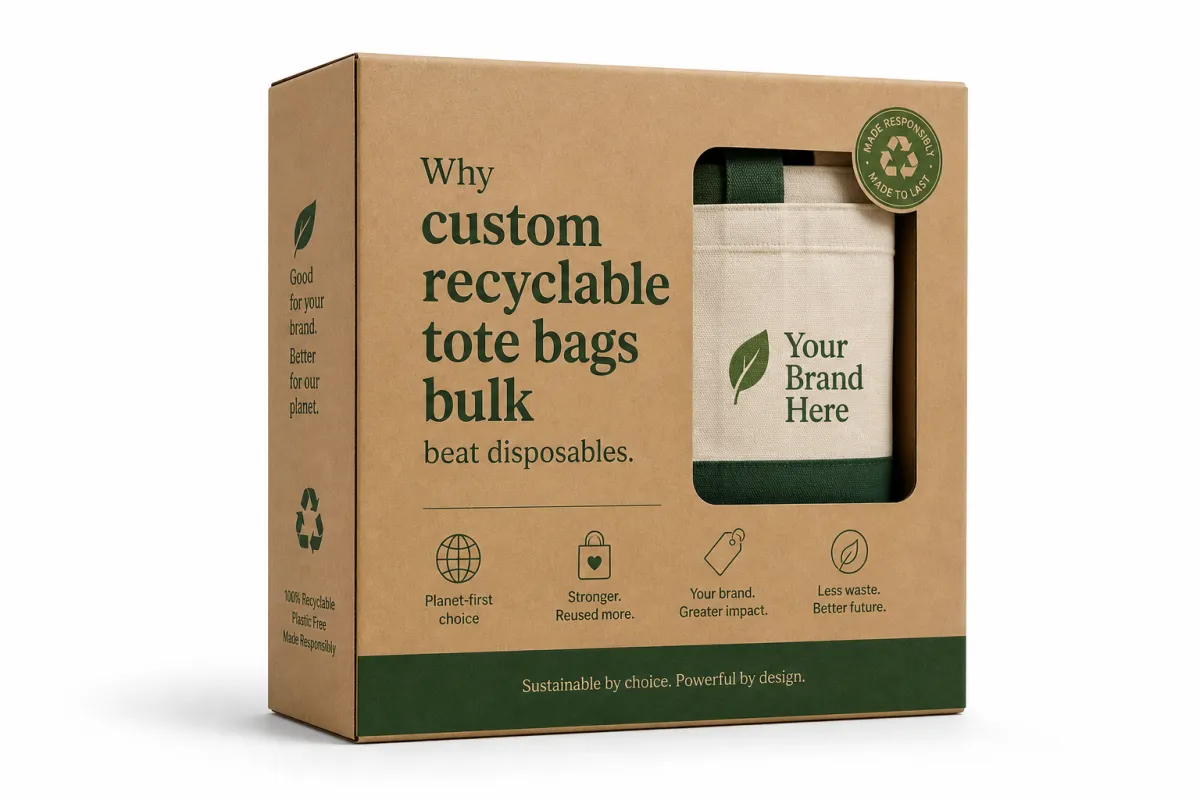
A grocery chain, pop-up shop, or trade show booth can burn through hundreds of carriers in a week. Weak bags disappear by lunch. That is the practical case for custom recyclable tote bags bulk: fewer emergency reorders, better print consistency, and less friction at the handoff. Disposables may look cheaper on the first invoice, but the replacement cycle has a habit of eating that savings before anyone notices.
The math is not subtle. Bulk ordering usually drops the unit price because setup fees, print prep, and freight get spread across more pieces. A run of 5,000 bags almost always prices better per unit than a run of 500. Procurement people care about that because the real win is predictability, not a tiny swing in material cost. For custom recyclable tote bags bulk, buyers are paying for fewer surprises and fewer "why did this number change?" meetings.
Brand impact matters too. A tote reused for errands, commuting, or gifting can generate far more impressions than a single-use carrier ever will. That is why the best custom recyclable tote bags bulk orders are planned like package branding, not tossed in as promo filler. The bag should fit the rest of the product packaging story, especially if you already use labels, inserts, or Custom Packaging Products to keep the retail experience consistent.
Durability changes the economics fast. A tote that survives 20 to 50 trips, depending on material and use, has a completely different cost profile than one that tears after two. For stores that issue bags daily, that means fewer replenishment headaches and less short-lived waste moving through the supply chain. The better question is not whether custom recyclable tote bags bulk costs more than a disposable option. The better question is how many uses you need before the math flips in your favor.
Reusable totes also make campaign planning easier. Seasonal artwork can stay consistent across multiple locations, and one approved spec can be reordered without redesigning the whole bag. That matters in retail packaging programs where store teams want fewer variables, not more. It matters even more in event work, where quantities are large, deadlines are ugly, and there is no time to troubleshoot a weak carrier program.
A tote that gets a second or third use changes the cost equation quickly. The real question is not whether it is cheap on day one, but whether it still looks decent after the first week of actual use.
There is one caution that should be said plainly. Not every tote labeled recyclable is recyclable in every local system. Material claims depend on construction, inks, coatings, and the recovery stream available to the end user. The U.S. EPA's recycling basics are a useful reference point for general consumer guidance: EPA recycling resources. For a purchase decision, the safest move is to ask how the bag should be disposed of after use and whether the supplier can support the claim with documentation. That is how custom recyclable tote bags bulk stays practical instead of vague.
There is also a planning advantage. If your brand already buys boxes, mailers, or inserts, the tote can fit into the same artwork system. Many teams treat it as part of a larger custom printed boxes and packaging suite, which helps color consistency and keeps approvals simple. Once the design language is locked, custom recyclable tote bags bulk becomes one line item in a cleaner sourcing program.
Custom recyclable tote bags bulk: product details to compare
Buyers often compare only price and skip the construction details that decide whether a tote performs or folds up in real life. For custom recyclable tote bags bulk, the fabric, stitching, and decoration method matter as much as the artwork. Two bags can look nearly identical in a mockup and behave very differently once they are loaded, dragged, stuffed under a counter, and handed out all day.
Material choices that fit different jobs
Recycled PET is a strong pick for lightweight retail and event use because it feels familiar, handles full-color graphics well, and often offers better moisture resistance than natural fiber options. It works especially well in custom recyclable tote bags bulk programs where the bag needs to look polished without blowing up the budget. Cotton and canvas make more sense for premium gifting, employee welcome kits, and resale merchandise where hand feel and perceived value matter. Nonwoven polypropylene is usually the most cost-efficient option for mass giveaways, grocery programs, and high-volume promotions.
Each material comes with tradeoffs. Cotton can be very reusable, but it wrinkles and absorbs moisture. Canvas feels sturdier, but it adds weight and cost. Nonwoven polypropylene is easy to price at scale, yet it can feel less premium if the print and construction are basic. Recycled PET sits in the middle for many buyers, especially when the order has to balance durability, sustainability messaging, and unit cost. That is why custom recyclable tote bags bulk should match the use case, not the habit.
Construction details are where the bag earns trust or loses it. Ask about stitch count, seam type, gusset depth, handle attachment, and reinforcement points. A bag with a 4-inch gusset can fit boxed items better than a flat bag of the same width. A bar-tacked handle is more likely to hold weight than a simple stitched seam. If the tote will carry catalogs, food, or boxed samples, those details matter more than a decorative feature on the outside. In short, custom recyclable tote bags bulk should be judged like a working package, not a prop.
Decoration methods and their real cost
Screen print is still the workhorse for many orders because it is durable and cost-effective, especially for one to three spot colors. It suits logos with bold shapes and strong contrast. Heat transfer is useful when artwork includes gradients, fine detail, or multiple colors that would be expensive to separate on a screen. Embroidery creates a more premium finish on canvas or heavier cotton, but it usually adds cost and may not be the right choice for very large logos or tight timelines. The right method depends on how the bag will be used and how much wear you expect from custom recyclable tote bags bulk.
Decoration also changes recyclability and washing performance. Heavy ink coverage, foil effects, and layered transfer films can complicate end-of-life handling. That does not automatically make the bag a bad purchase, but it should be disclosed and understood. If the tote will be used in food service or by staff who wash bags often, durable, low-cracking print is more valuable than a flashy finish that looks good for one photo and breaks down after a few uses.
Short version: choose screen print for scale, heat transfer for detail, and embroidery for premium presentation. Then verify how each option changes unit Price and Lead time before you place the order. That quiet discipline is what keeps custom recyclable tote bags bulk from turning into an expensive guessing game. And yes, the cheapest option is not always the smart one. It is kinda amazing how often that needs saying.
| Material / Build | Typical Unit Price at 1,000 pcs | Best Use | Key Watchouts |
|---|---|---|---|
| Nonwoven polypropylene | $0.18-$0.55 | Promotions, grocery handouts, mass events | Lower premium feel; print durability depends on ink coverage |
| Recycled PET | $0.60-$1.40 | Retail carryout, brand campaigns, event resale | Ask about recycled content proof and coating details |
| Cotton | $0.85-$2.20 | Giveaways, staff kits, light premium merchandise | Wrinkles easily; weight can increase freight |
| Canvas | $1.80-$4.50 | Premium retail, gifting, long-term reuse | Higher cost; embroidery and heavy stitching can raise setup time |
Those numbers are not fixed quotes. Print coverage, handle style, packaging, and freight can move them fast. Still, they give buyers a realistic frame for comparing custom recyclable tote bags bulk offers instead of chasing the cheapest line item and finding out later that the spec is too thin, too small, or too weak for the job.
Materials, sizes, and specs that change performance
Specs drive real-world behavior. A tote that looks generous in a mockup can still be awkward at the register if the opening is too narrow or the handle drop is too short. For custom recyclable tote bags bulk, buyers should focus on fabric weight, dimensions, handle length, and load expectations before they worry about artwork placement.
Fabric weight is a useful starting point. Nonwoven bags are often discussed in grams per square meter, while cotton and canvas are commonly measured in ounces. A lighter bag can work for brochures or apparel, but it is usually the wrong choice for boxed goods or heavy groceries. A heavier fabric usually improves perceived quality, though it also raises cost and shipping weight. That tradeoff is normal in custom recyclable tote bags bulk.
Dimensions matter just as much. Common tote sizes range from compact event bags around 10 x 12 inches to larger grocery-style bags around 15 x 16 inches or bigger, with gussets from 3 to 6 inches. Handle length changes whether the bag carries comfortably in hand or over the shoulder. For shoulder carry, a drop of roughly 9 to 11 inches is often easier to live with. These are not hard rules, but they are solid reference points when requesting quotes for custom recyclable tote bags bulk.
Shape matters too. Structured bottoms help bags stand upright at checkout and in photos, while foldable or flat bags travel more easily in a distribution box or kit. If the bag is meant to be packed into another package, think about storage volume and carton optimization. Packaging teams often miss this and end up paying freight for air. Good packaging design avoids that mistake by matching the tote's physical footprint to the way it will be stored and shipped.
Load rating is another question that should be asked directly. If a supplier cannot tell you how much the bag is intended to carry, the order is not fully specified. A grocery tote, a conference bag, and a luxury retail bag do not need the same strength. For custom recyclable tote bags bulk, a clear load target protects both the brand and the user experience.
A sample review should be more than a quick glance. Check seam strength near the handle attachment, look for skipped stitches, inspect print registration, confirm color accuracy against the approved proof, and verify that the bag actually fits the intended contents. If the tote is supposed to carry a boxed product, pack the box. If it is supposed to carry paperwork, insert the folders. That is the most practical way to judge custom recyclable tote bags bulk before the full run starts.
Quick buyer framework
- Start with the load - light merch, boxed product, groceries, or staff kits.
- Match the fabric - nonwoven for volume, rPET for balance, cotton or canvas for premium feel.
- Set dimensions last - fit the product first, then shape the bag around it.
- Choose print based on artwork - one-color logo, multi-color design, or premium finish.
- Ask for samples - physical or digital, then approve only after the bag is tested in use.
If your tote order is part of a larger sourcing program, compare it with other Custom Packaging Products and keep the artwork system aligned. The same brand colors, logo rules, and finishing decisions used on mailers or inserts should carry into custom recyclable tote bags bulk. That consistency cuts approval cycles and keeps the package branding coherent across channels.
For teams that buy often, a direct ordering path can also simplify procurement. If you are handling repeated campaigns or multi-store programs, see how Wholesale Programs can support larger replenishment schedules. That is especially useful for custom recyclable tote bags bulk buyers who want a repeatable spec and fewer surprises on reorder.
Custom recyclable tote bags bulk pricing, MOQ, and add-ons
Pricing looks simple until the quote lands. The lowest number on the page can hide setup charges, artwork adjustments, or freight assumptions that change the final invoice. For custom recyclable tote bags bulk, buyers should ask for a quote that clearly separates product cost, decoration cost, sampling, packaging, and shipping.
The main cost drivers are straightforward: material, size, print coverage, decoration method, handle construction, and quantity. Larger orders usually bring the unit price down because tooling and setup are spread over more pieces. Custom features can erase that savings quickly. A two-color print costs more than one color. Embroidery costs more than screen print. A reinforced bottom or specialty handle can add both labor and material cost. That is why custom recyclable tote bags bulk quotes should be compared line by line, not by headline total alone.
Minimum order quantity, or MOQ, depends on the material and decoration method. Simple one-color nonwoven runs may start relatively low, while custom shapes, full-color graphics, or premium fabrics usually require higher minimums. If you need flexibility, ask for tiered pricing at 500, 1,000, and 2,500 units. That shows the real cost curve and helps you decide whether to place a smaller pilot first or move straight to a larger run of custom recyclable tote bags bulk.
Some buyers focus only on unit price and miss the hidden costs. Sample fees, artwork prep, plate or screen charges, rush production, and split shipments can all matter. Freight is another variable. A light tote bag may ship cheaply in a small carton, but a heavier cotton or canvas order can add up fast if the cartons are oversized. Good custom recyclable tote bags bulk purchasing means asking about the complete landed cost before approval.
Here is a cleaner way to compare suppliers. Ask each one for the same specifications, same decoration method, same quantity, and same delivery destination. Then compare the full landed cost, not just the product price. If one quote is much lower, confirm whether the difference comes from thinner fabric, smaller print area, lower stitch count, or longer lead time. The answer is usually sitting right there. Procurement teams in retail packaging and promotional sourcing do this for a reason: they want consistency, not pleasant surprises.
If the quote does not separate product, print, and freight, the buyer is still guessing. Guessing is expensive at scale.
A realistic pricing frame helps. For custom recyclable tote bags bulk, a simple nonwoven bag with one-color print may sit at the low end of the market, while a heavy canvas tote with embroidery and custom packaging can move into a much higher bracket. If your brand sells premium goods or wants a bag that feels like merchandise instead of a freebie, pay for the features people notice right away: fabric weight, handle comfort, and print clarity. Do not pay extra for a finish nobody sees.
For sustainability claims, ask for documentation, not slogans. If a supplier says a bag contains recycled content, ask how that claim is verified. If the bag uses paper components or fiber-based tags, ask whether the material is certified under a recognized standard such as FSC, and review the documentation on FSC. Strong sourcing programs do not run on adjectives. They run on documents, spec sheets, and repeatable approval steps. That is especially true for custom recyclable tote bags bulk.
Custom recyclable tote bags bulk process and timeline
The fastest orders start with clear inputs. A supplier can quote faster when quantity, size, material, artwork, and delivery target are already defined. For custom recyclable tote bags bulk, the usual flow runs from quote request to spec review, then artwork submission, proof approval, sample confirmation, production, and shipping.
Artwork usually causes the first delay. Logos often arrive in the wrong format, low resolution, or with colors that were never defined in Pantone terms. Clean vector files and a clear color target save time right away. If your design team can send AI, EPS, or PDF files with the fonts outlined, the proof process moves faster. That helps in custom recyclable tote bags bulk because artwork correction can add days before production even starts.
Samples and digital proofs do different jobs. A digital proof confirms layout, size, and color intent, while a physical sample confirms feel, strength, and fit. If the tote carries heavy or irregular items, a physical sample is the better choice. If the order is straightforward and the bag construction is standard, a digital proof may be enough. Either way, the approval stage should not be rushed. Once production starts, changes get expensive. That applies to custom recyclable tote bags bulk and pretty much every branded packaging program that wants to stay on budget.
Timeline expectations should stay realistic. Simple orders may move from proof approval to production in a few weeks, while more complex runs can take longer depending on material availability, decoration method, and carton packing requirements. Freight can change the delivery date more than the tote itself. A rush air shipment can save a launch, but it can also erase the savings from buying in bulk. That is why custom recyclable tote bags bulk should be scheduled with buffer time whenever possible.
A few decisions save days. Finalized artwork helps immediately. Approved Pantone colors cut back-and-forth. A clear size spec avoids re-quoting. Fast feedback on proofs keeps the order moving. If the launch date is fixed, tell the supplier early so production and shipping can match the deadline. Good custom recyclable tote bags bulk planning is mostly disciplined coordination, not guesswork.
It also helps to think about the package system around the tote. If the bags are being inserted into cartons, gift kits, or mailers, make sure the outer pack is designed for the tote's folded size. That is where package branding and shipping efficiency meet. A tote that fits the carton properly can reduce void fill, shorten pack-out time, and protect the print during transit. For teams that manage broader merchandising or fulfillment, that is a real operational win.
For heavier bundles or multi-piece kits, ask whether the supplier has considered transit stress and carton strength. Many buyers think only about the tote itself, but the shipment can fail in a poor outer box. If you are moving stacked cartons or pallets, testing aligned with ISTA methods is worth discussing with your logistics team. The tote is one part of the system. The shipment is another. Strong custom recyclable tote bags bulk programs respect both.
Why buyers choose our custom recyclable tote bags bulk program
Most buyers are not looking for drama. They want a supplier who can match the spec, communicate clearly, and deliver the same result again on reorder. That is the real value of a well-run custom recyclable tote bags bulk program. Not noise. Not shiny promises. Just repeatable quality.
Consistency matters more than a one-time bargain. If the first run uses a 10-ounce canvas and the reorder quietly drops to 8 ounces, the customer notices. If the print shifts or the handle length changes, the brand feels less reliable. A strong supplier cuts that risk by locking the spec, confirming samples, and documenting the order in a way procurement can actually use. That is a big reason serious buyers choose custom recyclable tote bags bulk from a supplier that takes process as seriously as price.
Transparency is another advantage. A buyer should know where the cost comes from, what the MOQ is, how long each stage will take, and what changes trigger extra charges. That kind of clarity saves time on both sides. It also makes reorder planning easier because the baseline is visible. In practice, the best custom recyclable tote bags bulk vendor is the one that makes the next order feel like a controlled repeat, not a brand-new negotiation every time.
Sustainability should be concrete. If a tote uses recycled fiber, ask how that claim is documented. If a paper component is part of the bag system, ask whether the chain of custody is clear. If the print method affects recyclability or washability, that should be explained before the order is placed. Buyers in procurement and marketing both want the same thing here: a claim that can hold up under scrutiny. That is the standard that keeps custom recyclable tote bags bulk credible in front of internal stakeholders.
Service matters in less visible ways too. Clean proofs reduce approval loops. Good samples prevent production errors. Straightforward pricing makes budget planning easier. These are boring advantages until they save a launch. Then they become the whole story. If your team already sources custom printed boxes, inserts, or mailers, a tote program that follows the same discipline gives you a stronger packaging system overall. That is why custom recyclable tote bags bulk works best as an operational decision, not a novelty buy.
Short version: the right supplier helps you avoid overpaying for unneeded features, underbuying on strength, or missing a deadline because the proof was sloppy. That is the real value proposition, and it is what serious buyers look for in custom recyclable tote bags bulk.
Next steps for custom recyclable tote bags bulk orders
If you are ready to quote custom recyclable tote bags bulk, start with four numbers: quantity, size, target delivery date, and intended use. That gets you a more accurate recommendation than a vague "need tote bags" request. Once those basics are set, choose the material, print area, and whether the bag should be foldable, structured, or gusseted. Those are the decisions that drive cost and performance.
Send the artwork in the cleanest format you have. A vector logo, preferred colors, and a short note about the intended contents go a long way. If there are compliance needs, retail rules, or packaging restrictions, mention them up front. A tote that works for a fashion brand may not suit a food promotion or a trade-show kit. The more the supplier knows at the start, the more accurate the custom recyclable tote bags bulk quote will be.
Ask for a sample or proof before production. That one step can prevent the most expensive mistakes: poor color, weak handles, awkward sizing, or a print area that looks fine on screen and tiny in real life. For larger runs, it is also smart to confirm carton pack-out and pallet counts so freight does not become a surprise. In a bulk program, those details are not small. They are the difference between a tidy rollout and a messy one.
Most buyers do best with a simple sequence: confirm spec, review proof, approve sample, then release production. If the program is part of a broader branded packaging refresh, keep the bag aligned with your labels, mailers, and in-store materials so the whole customer experience feels intentional. The tote should support the brand, not wander off on its own.
For a quote that actually makes sense, send the quantity, material, print colors, logo files, and target date today. Then ask for sample options and a landed-cost breakdown. That is the fastest path to a clean custom recyclable tote bags bulk order. If you need a recurring supply plan, keep the spec fixed and reorder on the same baseline. That is how custom recyclable tote bags bulk stays efficient, predictable, and easy to defend internally.
The smartest custom recyclable tote bags bulk buyers move on three things now: confirm the quantity, choose the material, and request a proof or sample before production. Do those three things now, and the rest of the order gets a lot easier to manage. That is the practical takeaway, and it beats guessing every time.
What materials are best for custom recyclable tote bags in bulk?
Recycled PET is a strong fit for lightweight retail and event use because it balances cost, print quality, and weather resistance. Cotton or canvas works better for premium resale, gifting, or longer-term reuse. Before You Buy custom recyclable tote bags bulk, ask whether the material matches your local recycling stream and whether the supplier can support the claim with documentation.
What is a typical MOQ for custom recyclable tote bags bulk orders?
MOQ varies by fabric, size, and decoration method. Simple one-color runs usually start lower than custom shapes or full-color designs. If you are comparing custom recyclable tote bags bulk quotes, request tiered pricing at 500, 1,000, and 2,500 units so you can see where the best value actually starts.
How long do custom recyclable tote bags bulk orders usually take?
Artwork approval and sampling are the first checkpoints that affect timing. Production often takes several weeks after proof approval, depending on complexity, print method, and material availability. Shipping method can change delivery more than the bag construction itself, so custom recyclable tote bags bulk should be scheduled with buffer time if the launch date is fixed.
Can I print my logo on custom recyclable tote bags bulk?
Yes. You should confirm the print area, color count, and durability requirements first. Ask for a proof so you can verify placement and legibility before production. It is also smart to ask whether the decoration method affects recyclability or washability, especially in custom recyclable tote bags bulk programs that will be reused often.
How do I choose the right size for custom recyclable tote bags bulk?
Match the tote dimensions to the products or materials it needs to carry. Check handle length and drop if shoppers will wear the bag on a shoulder. If the bag must hold boxed, heavy, or irregular items, order samples before committing to custom recyclable tote bags bulk at scale.

