Buyer Fit Snapshot
| Best fit | Custom Recycled Rigid Boxes with Embossing for Brands projects where brand print, material claims, artwork control, MOQ, and repeat-order consistency need to be specified before quoting. |
|---|---|
| Quote inputs | Share finished size, material target, print colors, finish, packing count, annual reorder estimate, ship-to region, and any compliance wording. |
| Proofing check | Approve dieline scale, logo placement, barcode or warning zones, color tolerance, closure strength, and carton packing before bulk production. |
| Main risk | Vague material claims, crowded artwork, missing packing details, or unclear freight terms can make a low unit price expensive after revisions. |
Fast answer: Custom Recycled Rigid Boxes with Embossing for Brands should be specified like a repeatable production item. The safest quote records material, print method, finish, artwork proof, packing count, and reorder notes in one written spec.
Production checks before approval
Compare the actual filled-product size with the drawing, then confirm tolerance on folds, seals, hang holes, label areas, and retail display edges. Reserve space for logos, QR codes, warning copy, and material claims before decorative graphics fill the panel.
Quote comparison points
Review material grade, print process, finish, sampling route, tooling charges, carton quantity, and freight assumptions side by side. A quote is only useful when the supplier can repeat the same color, closure quality, and packing count on the next order.
A box can signal quality before anyone reads a line on it, and custom recycled rigid Boxes with Embossing do that with unusual clarity. The first touch matters: a raised logo catches the light, the board feels firm in the hand, and the package tells a story of care before the product is even opened. That is why many brands choose custom recycled rigid boxes with embossing for product packaging that needs to feel deliberate rather than flashy. If you are comparing structures, start by browsing our Custom Packaging Products and notice how much the board build changes the sense of value.
What makes these boxes compelling is the balance between material restraint and visual presence. The design does not depend on a glossy flood coat or layers of plastic decoration; it relies on structure, paper, and pressure to create a tactile brand moment. For a lot of branded packaging programs, that is exactly the right mix. The box feels substantial, the message feels considered, and the recycled content supports a cleaner material story without forcing the design to look bare or unfinished. Used well, custom recycled rigid boxes with embossing fit naturally into premium retail packaging, gift sets, skincare, apparel, and influencer mailers.
What custom recycled rigid boxes with embossing actually are
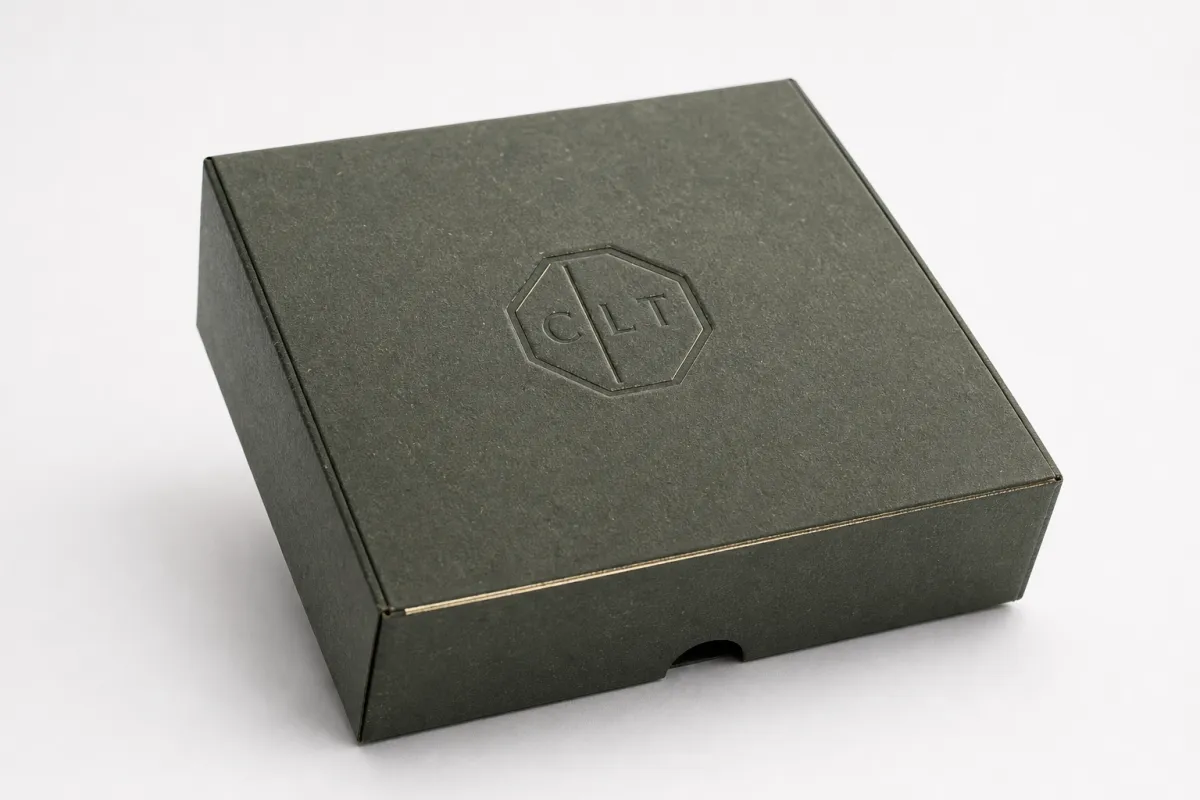
At the simplest level, custom recycled rigid boxes with embossing are thick setup-style boxes made from dense recycled board, then wrapped in a printed or specialty paper and finished with a raised or pressed design element. The rigid board gives the box its structure, while the outer wrap gives it its visual identity. The embossing becomes the tactile signature. It can be a logo, a pattern, a border, or a short line of text, and it often matters more than people expect because the hand notices texture before the eye has fully settled on color.
In practice, the format works best when the product itself has a perceived value that should not be weakened by flimsy packaging. Gift sets, skincare jars, apparel fold packs, curated subscription kits, candles, and presentation packaging that sits on a shelf or appears during an unboxing all benefit from this approach. Custom recycled rigid boxes with embossing help the brand look organized and intentional, which matters even more when the inner product is simple but the retail presentation needs to feel complete. A soft-touch coating, a natural wrap, or a textured paper can reinforce that impression without making the build complicated.
The sustainability angle is practical rather than performative. Recycled board reduces demand for virgin fiber, paper-based wraps are easier to recover than heavy mixed-material decoration, and a well-sized structure avoids wasting board and freight volume. Packaging is not only a design object; it is also a material decision. The EPA has a useful overview of recycling systems and material recovery at EPA recycling guidance, and that context helps brands make better calls on paper content, adhesives, and finish choices. Custom recycled rigid boxes with embossing can support a cleaner story when the structure is kept sensible. I have seen teams spend extra money on decoration they did not really need, then wonder why the package felt crowded instead of premium.
"A good embossed mark should feel like it belongs to the box, not like it was stamped on as an afterthought. If the texture looks natural in the hand and stays readable under real lighting, the packaging has done its job."
There is also a branding advantage that is easy to miss. A lot of custom recycled rigid boxes with embossing look quieter from across a room than heavily printed cartons, yet that quietness can be an asset. It makes the package easier to place in a premium lineup, less dependent on trend-driven graphics, and more likely to age well in retail packaging. That is one reason many packaging teams keep returning to embossed rigid structures: they can feel modern without forcing the point. Quiet can be powerful, and sometimes it is the smarter move.
How custom recycled rigid boxes with embossing are made
The build starts inside out. A dense recycled chipboard or equivalent setup board forms the shell, and the board is cut, scored, and folded to match the finished dimensions. Then the outer wrap is applied, which may be printed paper, uncoated stock, textured specialty paper, or a paper wrap with a soft-touch finish. After that, the embossing tool is pressed into the panel to create the raised or recessed detail. Custom recycled rigid boxes with embossing are not decorated first and structured later; the structure and surface need to work together from the start.
There are a few emboss styles worth separating clearly. Blind embossing raises or sinks the artwork without ink, foil, or varnish, so the effect depends entirely on light and shadow. Registered embossing aligns the texture with print or foil, which is useful when a logo has to stay precise. Shallow relief gives a subtle tactile result, while deeper relief creates a stronger hand feel but can stress the wrap if the paper is too brittle. For custom recycled rigid boxes with embossing, the best choice usually depends on the artwork size, the wrap paper fiber direction, and how much pressure the paper can tolerate before cracking or whitening.
Why board grain and wrap paper matter
Board grain is one of those production details that can make or break the finish. If the grain runs against the fold direction or the wrap paper is too stiff, corners can open, edges can fray, or the embossed area can look slightly distorted. Fine logos with hairline strokes are especially sensitive. On a soft, absorbent wrap, the impression may look crisp and tasteful. On a slicker stock, the same artwork can look shallow unless the tooling depth and press settings are adjusted. That is why custom recycled rigid boxes with embossing should always be proofed on the exact stock, not just on a screen render. A mockup that looks lovely on a monitor can still fail in the hand, and that gap is where budgets start slipping.
What tooling actually does
The embossing die and counter-die create the pressure that shapes the surface. Think of it as controlled compression rather than decoration. The tooling has to match the panel size, paper stretch, and expected relief depth. If the design is too intricate, the pressure may flatten small counters inside letters like "a," "e," or "o." If the mark is too large and too deep, the board can buckle around it. This is why production teams often simplify logos slightly for custom recycled rigid boxes with embossing instead of trying to force a perfectly flat graphic into a tactile process. A mark that is a little cleaner usually reads better than one that tries too hard.
The same logic applies to die cutting, inserts, and closure features. A rigid box may use a separate tray, magnet flap, ribbon pull, or tuck-in cradle, and each of those details adds tolerances that affect assembly. The design phase is where good packaging design earns its keep. When the dimensions, board thickness, and insert depth are coordinated early, the result feels precise rather than forced. When they are not, the box may still close, but it will not feel premium in the hand. It will feel like a compromise, which is never the goal.
There is also a sourcing angle worth mentioning. Brands that want traceable paper inputs often ask about FSC-certified paper or recycled content claims, especially when the package becomes part of a larger sustainability message. If that matters to your program, ask for documentation before production starts. The forest products and recycled fiber conversation should be handled as a spec issue, not an assumption. A useful starting point is the FSC site at fsc.org, because it helps teams separate paper sourcing claims from the actual structure spec. Custom recycled rigid boxes with embossing can support those goals, but only if the material stack is chosen carefully and the paperwork matches the promise.
One thing I have learned from press checks is that paper behaves differently once it is wrapped around a thick board. A stock that looks perfect in flat sheets can be a little stubborn at the corners, and that is where the emboss either stays crisp or starts to feel mushy. You kind of have to respect the material instead of bullying it into shape.
Key factors that shape cost and unit pricing
Pricing for custom recycled rigid boxes with embossing is usually driven by five variables first: box size, board thickness, wrap material, embossing complexity, and how many panels carry decoration. A small two-piece box with a simple blind emboss on the lid can be materially cheaper than a magnetic closure box with a printed wrap, foil inside, and embossed side panels. The more surfaces you touch, the more handling steps you create, and the more likely the cost will rise. That does not mean you should avoid details; it just means the details need to be chosen on purpose.
The setup-versus-volume tradeoff is real. Tooling, die setup, cutting form prep, and press adjustments cost money whether you order 500 units or 10,000 units. That is why smaller runs often carry higher unit pricing, while larger quantities spread the fixed work over more boxes. For a buyer, the practical question is not only "What is the unit price?" but also "Where does the run size start to make the box economical?" With custom recycled rigid boxes with embossing, moving from a short run to a mid-size run can change unit cost more than changing print coverage.
| Option | Typical use | Approximate unit range | What drives the price |
|---|---|---|---|
| Simple rigid box with blind emboss | Gift sets, skincare, small retail kits | $1.20-$2.60 at 1,000-3,000 units | Board thickness, lid size, emboss area, wrap stock |
| Printed wrap with registered emboss | Premium branded packaging, influencer kits | $1.80-$3.80 at 1,000-5,000 units | Print registration, tooling precision, proof rounds |
| Magnetic rigid box with inserts and embossing | Higher-value retail packaging, luxury presentation | $2.50-$6.50 at 1,000-5,000 units | Closure hardware, inserts, assembly labor, finish steps |
| Specialty wrap, deep emboss, multi-panel decoration | Seasonal launches, premium product packaging | $3.50-$8.00+ depending on order size | Paper cost, setup time, handling complexity, rejection risk |
Those ranges are not fixed quotes, because the final number depends on exact dimensions, the location of the emboss, and whether the supplier is using stock components or a fully custom build. Even so, they are useful for setting expectations. If you are trying to manage budget, focus first on the lid area and one high-impact tactile moment. That approach often gives custom recycled rigid boxes with embossing a premium feel without loading the box with expensive finishes that do not add much to the consumer experience.
Some extras move pricing faster than buyers expect. Magnets add hardware and alignment labor. Ribbon pulls add hand assembly. Soft-touch lamination adds a process step and can change how the emboss reads. Inserts can be simple paperboard trays, or they can be detailed multi-part structures that hold a product at a precise height. If you compare quotes for custom recycled rigid boxes with embossing, ask vendors to separate the structure cost from the finish cost, because that makes it easier to see where the money is going. It also helps you decide what is worth paying for and what is just decoration for decoration's sake.
For brands reviewing custom printed boxes alongside rigid packaging, the key is to compare total value rather than chasing the lowest unit price. A box that saves twenty cents but crushes too easily, prints poorly, or weakens the logo impression can cost more later in returns, replacements, or brand damage. Good packaging design should hold up in storage, shipping, and retail display. That is where solid structure and sensible specs pay off.
Production steps and timeline for custom recycled rigid boxes with embossing
A clean production run for custom recycled rigid boxes with embossing usually begins with the brief: product dimensions, target quantity, product weight, artwork files, finish expectations, and the delivery date. Then the supplier builds a dieline, confirms the internal fit, and checks whether the selected board thickness supports the planned closure and insert. Once the structure is approved, artwork is prepared for print or wrap, and the emboss location is locked in. If a brand skips those early checks, the run can drift into revisions that cost both time and money.
Sampling is where the real decision-making happens. Digital proofs help with layout and copy, but they do not tell you how the logo will feel under pressure. Physical mockups, emboss test pulls, and board/wrap tests are far more useful. For custom recycled rigid boxes with embossing, the test sample can reveal subtle issues that a computer mockup cannot, such as whether the logo reads clearly under diffuse light, whether the panel bows near the fold, or whether the wrap paper is too soft to hold a sharp edge.
Typical manufacturing sequence
- Approve dimensions, structural style, and dieline.
- Confirm artwork, logo placement, and emboss depth.
- Run tooling for die cutting, scoring, and emboss plates.
- Print or prepare the wrap stock.
- Wrap the board and form the shell.
- Press the emboss into the approved area.
- Assemble inserts, closures, and final components.
- Inspect, cure, pack, and prepare for shipment.
That sequence sounds straightforward, but the timing changes with each spec choice. A simple setup with stock components and a single emboss may be ready in about 12-15 business days after proof approval. Add custom inserts, specialty paper, or a second proof round, and the schedule can stretch to 18-25 business days or more. For custom recycled rigid boxes with embossing, plan around the slowest likely step, not the fastest hoped-for one. That gives your launch calendar enough breathing room for shipping, receiving, and any final inspection on arrival.
Shipping testing is another piece that should not be ignored. If the box will travel through parcel networks, palletized freight, or retail distribution, ask whether transit testing is appropriate. The packaging community often references ISTA methods for distribution testing, and those standards help teams think more clearly about drop, vibration, and compression risks. A good place to start is ISTA, especially if the product has fragile components or a presentation insert that must stay aligned. Custom recycled rigid boxes with embossing should feel premium on the shelf and still arrive in shape.
One more practical point: curing and inspection matter. A freshly wrapped rigid box may look finished, but adhesives and coatings need time to settle before packing. That is especially true when the wrap is heavier, the emboss is deep, or the assembly has multiple folds. A supplier that rushes the last stage can create scuffing, corner lift, or subtle warp that only becomes visible once the boxes are packed. For custom recycled rigid boxes with embossing, a little patience at the end often saves a lot of frustration later.
I have also seen schedules slip because someone treated the first sample like a formality. It is not a formality. It is the moment where you learn whether the emboss is actually readable, whether the inside fit is right, and whether the chosen finish is gonna hold up once the box starts moving through real hands and real shipping lanes.
Common mistakes when ordering recycled rigid boxes with embossing
The most common mistake is asking too much from the logo. Very thin strokes, tiny text, and crowded artwork tend to flatten once the emboss is pressed into the wrap. A design that looks sharp on a screen may lose character on paper, especially if the paper has a natural tooth or the tooling depth is conservative. With custom recycled rigid boxes with embossing, simpler usually reads better: fewer letters, slightly thicker lines, and more negative space around the mark.
Dimension errors are another expensive trap. A box can look perfectly sized in a render, then fail once the actual product, insert, and closure tolerances are measured in real life. I have seen brands approve a lid height that leaves no room for the product label, the inner tray, or even basic finger clearance. That is not a small problem; it changes the whole user experience. For custom recycled rigid boxes with embossing, always confirm the finished product dimensions, not just the bottle or item dimensions.
Finish conflicts cause plenty of trouble too. A wrap can look refined in a sample but scuff badly in shipping if the coating, paper type, and handling conditions are not considered together. A soft-touch surface may feel excellent in the hand, yet it can show rub marks if the boxes are stacked tightly or packed with rough inserts. If you want custom recycled rigid boxes with embossing to stay clean in transit, ask how the finish will behave under compression, friction, and warehouse handling. A glossy sample on a desk is one thing; a carton sliding against other cartons in transit is another.
Another mistake is oversizing the structure in the name of presentation. A box that is too large wastes board, increases freight volume, and weakens the sustainability story. It can also make the product seem less secure if the insert does not fit closely enough. Good packaging design respects the product first. In many cases, a tighter, smarter build looks more premium than a bigger one. Custom recycled rigid boxes with embossing should feel intentional, not inflated.
There is also a mismatch risk when teams assume all recycled board behaves the same. It does not. Caliper, stiffness, surface absorbency, and wrap adhesion can vary by grade, and those differences affect the final emboss. If a supplier says one recycled board is better for a fine raised mark and another is better for a deeper relief, that is not a sales pitch; it is a production reality. The box may still pass a basic visual check, but the tactile result can shift a lot depending on the material stack. That is why I always recommend a press sample on the exact board, not a close enough substitute.
Expert tips for stronger branding and cleaner embossing
Use one hero tactile element instead of stacking too many effects. That advice saves a lot of packaging from looking busy. A centered lid emboss, for example, can carry the whole visual system if the typography and paper choice are disciplined. If you start adding foil, spot varnish, multiple print colors, and side-panel graphics, the box can lose the calm, material-first feel that makes custom recycled rigid boxes with embossing feel premium in the first place. Restraint usually gives the strongest result.
Pair recycled textures with typography that knows how to breathe. Wide letterspacing, moderate font weight, and clean spacing around the logo help the emboss read clearly without shouting. That is especially useful for skincare, wellness, apparel, and gift-oriented product packaging, where the unboxing moment should feel thoughtful rather than overdesigned. A paper with a slight natural grain can be a strong choice, because it gives the embossed form something real to interact with. It also hides small handling marks better than a very slick wrap.
Where to place the embossed mark
Lid center is the classic choice, and for good reason: it creates instant recognition when the box is stacked or presented flat. Side panels and flap edges can work well too, especially when the opening sequence matters. If the box opens like a reveal, a hidden emboss on the inside lid can create a quieter premium moment. For custom recycled rigid boxes with embossing, placement should match the shelf behavior and the unboxing behavior, not just the artwork layout.
Lighting matters more than many teams expect. A design that looks sharp under studio lights may disappear under soft retail lighting, while a deep relief can cast shadows that feel heavier than intended. Test samples under the same conditions where the boxes will actually live: store shelves, fulfillment worktables, office desktops, or social-content setups. That kind of testing is basic, but it is where the honest answer lives. If the mark holds up there, it will usually hold up elsewhere.
"The best embossed boxes do not ask the shopper to work for the brand. They make the brand legible at a glance, pleasant in the hand, and credible when the product is finally opened."
It also helps to think about package branding as a system rather than a single print event. The rigid box, insert, product label, and shipper carton should all speak the same visual language. If the outer box is soft and minimal, the inner components should not suddenly become loud and busy. When the materials and surfaces stay in conversation, custom recycled rigid boxes with embossing feel more polished and the whole package feels less like a one-off and more like a real brand program.
If you want to compare structures and finishes before committing to a full run, review our Custom Packaging Products and look for the box style that supports the emboss depth you want. That is often the easiest way to narrow down options without overbuying decoration that the material cannot hold cleanly. It also keeps the conversation grounded in what the box can actually do.
One small but useful habit: keep a shelf sample near a window and another under warm indoor light. Emboss depth shifts more than people expect from one lighting environment to another, and that quick check can save a round of revisions later.
Next steps before you request quotes for custom recycled rigid boxes with embossing
Before you send quote requests for custom recycled rigid boxes with embossing, gather the basics: finished product dimensions, target quantity, product weight, artwork files, and the date the boxes actually need to land. If you already know whether you need inserts, magnets, a ribbon pull, or inside printing, include that too. Every one of those choices affects cost, timing, and the way the box performs in use. When the brief is complete, the quote becomes far more useful because the vendor is pricing the same structure you need, not a guess.
It also helps to decide early how much unboxing theater you really want. A single embossed lid may be enough. Some brands need a custom insert and a branded inside panel; others only need the outside shell to carry the message. There is no universal answer. The right call depends on product price point, channel, and how the box will be stored after opening. For custom recycled rigid boxes with embossing, the smartest money is usually spent on the touchpoint the customer notices first.
- Send exact dimensions: Include product size, fit allowance, and any insert depth.
- Share the artwork early: Logos, fonts, and panel placement all affect emboss feasibility.
- State the quantity clearly: Unit cost changes a lot across short-run and mid-run quantities.
- Ask about samples: Physical mockups show more than a digital proof ever will.
- Request material details: Confirm board grade, wrap stock, and whether recycled content claims are documented.
When you compare vendors, do not stop at the lowest unit price. Ask about board thickness, wrap options, emboss depth, sample method, and how much variation to expect from run to run. If one supplier can show you a cleaner emboss on recycled stock and another can only offer a broader but shallower mark, that difference matters more than a few cents on the quote. Custom recycled rigid boxes with embossing should be judged on the finished experience as much as on the invoice.
Used well, custom recycled rigid boxes with embossing give a brand a premium, tactile, and responsible presentation without relying on excess material or flashy decoration. They work because they respect the product, the shelf, and the shipping lane all at once. If you are building packaging that needs to look sharp, feel substantial, and stay grounded in sensible production choices, that is a very strong place to start. The best next move is simple: lock the finished dimensions, choose one emboss location, and request a physical sample on the exact recycled board before you approve the run.
Are custom recycled rigid boxes with embossing durable enough for shipping?
Yes, when the board caliper, wrap stock, and closure style are chosen correctly, rigid boxes hold their shape very well in transit. The embossing itself usually does not weaken the structure if the tooling depth is matched to the paper and panel size. For fragile products, add inserts or tighter fit tolerances so the item does not move inside the box, especially with glass, metal, or layered kits. In practical terms, custom recycled rigid boxes with embossing can be very ship-ready, but the internal build has to support the product, not just the appearance.
What affects the price of custom recycled rigid boxes with embossing the most?
The biggest drivers are box size, board thickness, wrap material, embossing complexity, and order quantity. Tooling and setup make smaller runs more expensive per unit, while larger runs spread those costs out. Extra features like magnets, inserts, specialty papers, and multiple finishes can raise the price quickly. If you want a clean estimate for custom recycled rigid boxes with embossing, send exact dimensions and the real finish plan, not just a rough idea of the look.
How long do custom recycled rigid boxes with embossing usually take to produce?
Typical timing depends on dieline approval, sampling, tooling, production, and shipping, so the full schedule should be mapped early. Simple orders move faster; custom inserts, specialty wraps, or multiple proof rounds add lead time. A practical schedule often places sampling first, then mass production after signoff. For custom recycled rigid boxes with embossing, ask for a timeline that separates proofing from production so you can see where the real time goes.
Can custom recycled rigid boxes with embossing use a fully recycled build?
Often yes, but the exact recycled content depends on the board grade, outer wrap, and any added components. Many brands choose recycled board with paper-based wraps and water-based adhesives to keep the structure more recycling-friendly. If you need a specific sustainability claim, confirm the material spec and post-consumer content before production. That way, custom recycled rigid boxes with embossing support the message you plan to put on the carton and in your marketing.
What should I send to get an accurate quote for custom recycled rigid boxes with embossing?
Send finished dimensions, product weight, quantity, artwork, and whether you need inserts or special closures. Include your target look, preferred emboss area, and any finish limitations so the manufacturer can price the right build. If timing matters, share your required delivery date and ask what sample steps are needed before approval. The more complete the brief, the easier it is to price custom recycled rigid boxes with embossing without surprises later.

