Buyer Fit Snapshot
| Best fit | custom reinforced mailer boxes choose the build for packaging buyers comparing material specs, print proof, MOQ, unit cost, freight, and repeat-order risk where brand print, material, artwork control, and repeat-order consistency matter. |
|---|---|
| Quote inputs | Share finished size, material target, print colors, finish, packing count, annual reorder estimate, and delivery region. |
| Proofing check | Approve dieline scale, logo placement, barcode or warning zones, color tolerance, and any recyclable or compostable wording before bulk production. |
| Main risk | Vague material claims, crowded artwork, or missing packing details can create delays even when the unit price looks attractive. |
Fast answer: Custom Reinforced Mailer Boxes Choose The Build: Film, Closure, Print, and Fulfillment should be specified like a repeatable production item. The safest quote includes material, print method, finish, artwork proof, carton packing, and reorder notes in one written spec.
What to confirm before approving the packaging proof
Check the product dimensions against the actual filled item, not only the sales mockup. Ask for tolerance on folds, seals, hang holes, label areas, and retail display edges. If the package carries a logo, QR code, warning copy, or legal claim, reserve that space before decorative graphics fill the panel.
How to compare quotes without losing quality
Compare board or film grade, print process, finish, sampling route, tooling charges, carton quantity, and freight assumptions side by side. A lower quote is only useful if the supplier can repeat the same color, closure quality, and packing count on the next order.
Custom reinforced mailer boxes usually earn their keep after a shipment shows up dented, crushed, or bent at the corners. That is the plain truth behind a lot of packaging decisions. In real use, custom reinforced mailer boxes are less about visual flair and more about surviving compression, stack pressure, and the rough handling that happens between a fulfillment table and the customer’s hands.
Heavy products, fragile goods, premium kits, and subscription programs can push standard mailers past their comfort zone quickly. Custom reinforced mailer boxes step in when the box has to keep its shape, protect the contents, and still look like deliberate branded packaging instead of damage control. That balance matters because product packaging has to do two jobs at once: hold up in transit and present the product well when it arrives.
At Custom Logo Things, the right choice usually comes down to the actual product, not the idealized version sitting in a spec sheet. A box that looks fine in a rendering can still fail in a warehouse if the walls bow under load or the corners start to collapse in transit. I have watched more than one sample look perfect on a desk and then lose its nerve as soon as it was stacked, packed, and carried around for a few days. The real task is matching the build to the product, the shipping lane, and the cost target without pretending those three things always agree.
Why custom reinforced mailer boxes stop damage fast
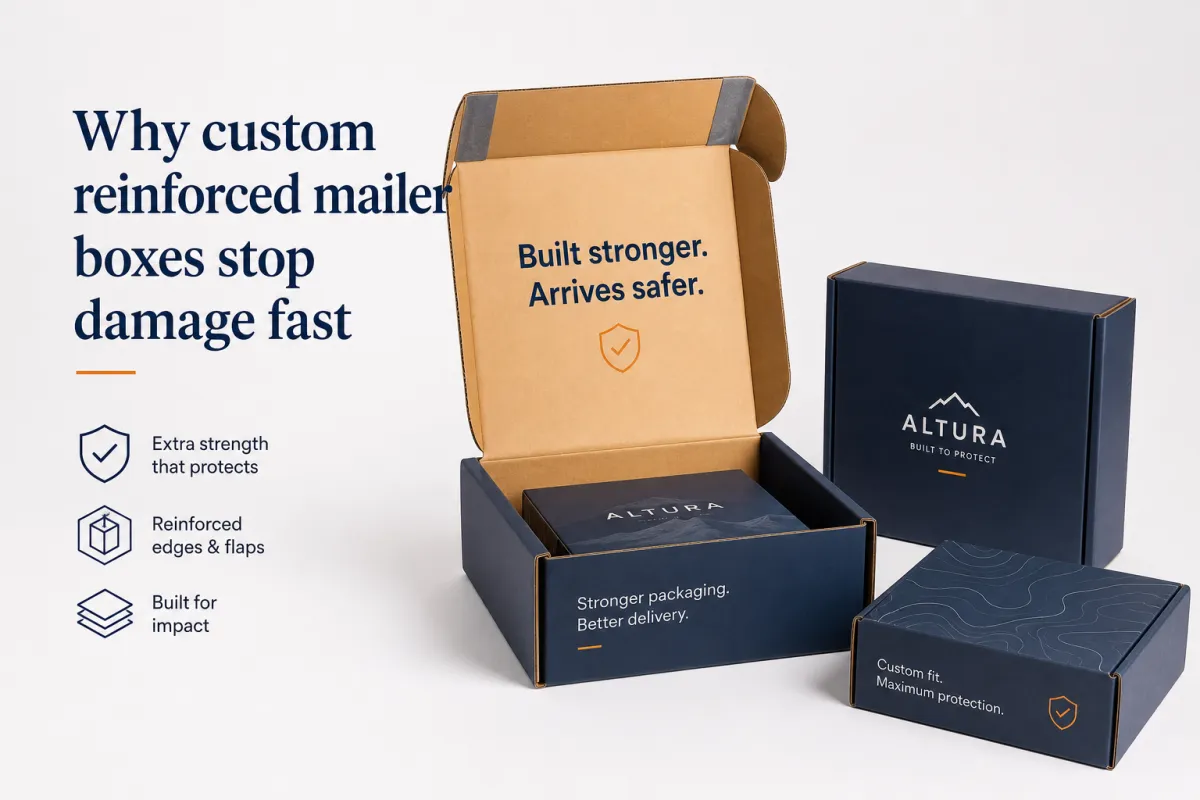
Most shipping damage is quiet. It is compression, corner crush, lid flex, and stack pressure doing exactly what physics predicts. Custom reinforced mailer boxes are built to resist those loads, which is why they make such a difference for heavier products and delicate contents. When the walls stay square, the box can take abuse without passing that stress straight into the item inside.
That is why custom reinforced mailer boxes often come into play after one too many returns. A bent lid or crushed corner is not just a cosmetic complaint. It usually points to board grade, fold structure, closure strength, or insert support that was too light for the actual distribution environment. One weak point can turn a good unboxing into a refund, and that gets old fast.
Plain language version: a reinforced mailer is a mailer structure with extra board strength, stronger folds, or added support so it stays square under load. That reinforcement might come from the board itself, a double-wall structure, or internal inserts. The goal stays simple: keep the box from collapsing before it reaches the customer.
They are a strong fit for heavier kits, premium ecommerce orders, fragile accessories, boxed sets, subscription programs, and retail packaging that needs to land clean. They also make sense when the outside of the box is part of the brand experience. A crushed box does not communicate quality. It communicates that the packaging was asked to do more than it was built for.
Good use cases usually include:
- Heavier skincare, candle, or glass accessory kits
- Subscription boxes with dense fill weight
- Printed sets with inserts and multiple components
- Premium mail-order items that must arrive shelf-ready
- Gift packaging that has to survive parcel handling without looking tired
From a packaging buyer’s point of view, custom reinforced mailer boxes are really about buying back control. Carrier handling is never fully predictable, but board strength, structure, and flex can be specified. That is usually where the damage stops.
How custom reinforced mailer boxes are built
The build begins with board grade. That sounds basic, yet it is where plenty of specs go off course. Board can range from lighter folding carton stock to heavier corrugated structures, and that choice changes performance, price, and assembly. In custom reinforced mailer boxes, the wall construction and flute profile matter because they determine crush resistance and how the box behaves when stacked.
There are a few common ways custom reinforced mailer boxes get built. A single-wall mailer can be strengthened with extra folds or a heavier liner. A double-wall mailer adds structure outright. Some designs use glued edge reinforcement at stress points, while others rely on insert-supported construction to stabilize the interior. The right answer depends on the weight and fragility of the contents, not on what sounds impressive in a spec sheet.
Common build options
Single-wall with reinforcement: This is often the leanest option when the product is moderately heavy but not punishing. It keeps material use under control while adding support where the box is most likely to fail. For many custom reinforced mailer boxes, this lands in the useful middle ground between cost and strength.
Double-wall mailers: More material, more structure, more resistance to crush. They usually cost more and take up more storage space, but they can be worth it for dense products or longer shipping routes. If the item is valuable or fragile, double-wall custom reinforced mailer boxes are often the safer route.
Insert-supported designs: These use custom inserts or internal supports to lock the product in place. That reduces movement, and movement is often the real enemy. A product that does not bounce around is a product that survives. This works especially well for custom printed boxes with multiple components or a centered presentation style.
Glued edge reinforcement: This helps keep seams and corners from failing when the box is opened, closed, and stacked more than once. It is not glamorous, but neither is replacing damaged inventory or handling returns that could have been prevented.
The print surface matters too. A pretty box that caves in is still a bad box. Custom reinforced mailer boxes often use printed outer liners, coatings, or lamination options, but those finishes have to support the structure rather than fight it. A heavier coating can improve appearance and add surface protection, yet the box still needs the right board underneath to do the real work.
That tradeoff shows up everywhere: more strength usually means more weight, more material, and a higher unit price. There is no free lunch in packaging. If someone promises all three miracles at once, ask which corner is being cut. Usually it is the one that matters most. And if the box is gonna fail, it usually fails at the folds or the corners, not in some dramatic collapse that looks obvious from across the room.
One practical way to compare builds is to think in terms of performance instead of marketing labels. The table below gives a useful shorthand for comparing custom reinforced mailer boxes during quoting.
| Build option | Typical strength | Typical cost impact | Best fit |
|---|---|---|---|
| Single-wall with reinforcement | Moderate | Lowest to medium | Lighter premium goods, small kits, branded packaging runs |
| Double-wall mailer | High | Medium to high | Dense products, fragile items, shipping lanes with heavy stack pressure |
| Insert-supported mailer | High for internal stability | Medium | Gift sets, multi-item packs, retail packaging with a fixed unboxing layout |
| Glued edge reinforced design | Moderate to high | Medium | Repeated handling, stronger corners, cleaner opening and closing performance |
For brands that also need other packaging formats, it helps to compare the mailer spec against the rest of the lineup. Sometimes the answer is not a larger mailer at all; it is a different format from Custom Packaging Products or a lighter secondary shipper like Custom Poly Mailers for items that do not need rigid structure.
If you want a reality check, look at the packaging test methods published through ISTA and the broader standards work followed by many packaging teams. Their focus on distribution testing is a reminder that packaging should be judged under transit conditions, not just under office lighting on a desk. That is where custom reinforced mailer boxes prove their value.
Key factors to specify before you order custom reinforced mailer boxes
Before you request a quote, start with the product itself. Exact dimensions, packed weight, and any fragile zones that need clearance or padding should all be on the table. Custom reinforced mailer boxes are not sized by guesswork. They are sized by the item, the insert, the closure, and the amount of movement you can tolerate.
Weight matters more than many buyers expect. A box that behaves well at 8 ounces may struggle badly at 24 ounces if the center of gravity sits high or the contents shift. If the product moves inside the carton, that force has to go somewhere. Usually it ends up in the corners, the lid, or the contents you were trying to protect.
Shipping reality matters too. Parcel handling, stack pressure, warehouse dwell time, climate exposure, and route length all affect performance. A shipment sitting in a warm warehouse for days may behave differently from one that moves quickly to the customer. If the box uses adhesives, coatings, or inserts, the environment belongs in the spec conversation.
What to lock in early
- Exact product dimensions: Include the item, padding, and any insert thickness.
- Packed weight: The final packed kit weight matters more than the product weight alone.
- Fragile zones: Glass corners, pumps, lids, chips, screens, or loose hardware.
- Movement tolerance: Decide how much empty space is acceptable, if any.
- Carrier profile: Standard parcel, freight, regional courier, or retail redistribution.
Branding and presentation come next. Print coverage, color count, finish, inside printing, and the unboxing moment all shape the final spec. In custom reinforced mailer boxes, structure and presentation can work together, but you still need to decide which one carries more weight. Sometimes the outer shell can stay restrained while the insert carries the visual punch. Other times the outside needs to do more of the talking.
That is where packaging design turns practical. A bright inside print can create a stronger first impression than flooding the outer surface with ink, and a restrained exterior can leave more budget for board strength. Neither approach is automatically better. It depends on whether the box is doing luxury, retail packaging, ecommerce, or plain utility.
Sustainability belongs in the brief as well. If recyclability matters, ask about board content, coatings, and any mixed-material inserts. The FSC system is a useful reference point for responsibly sourced paper-based materials, but the exact board and finish still need confirmation for your build. Local recycling rules are not always kind to heavy lamination or mixed substrates.
Operationally, think about storage and assembly. Custom reinforced Mailer Boxes That Ship flat can save space, but they still need to fold quickly and consistently. If the box takes too long to assemble, the labor cost shows up fast at scale. A design that is structurally excellent but awkward to pack can still become the wrong choice. That is the part people skip until the first big fulfillment week makes them regret it.
A buyer should also ask how the box behaves when packed at volume. Does the lid spring open? Do the corners stay square after repeated handling? Does the insert shift during fast line packing? Those questions sound dull because they are dull. They are also the difference between a smooth rollout and a warehouse team that starts questioning the packaging decision.
Production process and timeline for custom reinforced mailer boxes
The production flow usually starts with a quote and spec review. After that comes dieline setup, proofing, sampling, production, inspection, packing, and shipping. Custom reinforced mailer boxes move faster when the spec is clear from the start. They slow down when the buyer is still deciding whether the product is 9.2 ounces or 10.1 ounces. Those little differences matter, and they matter more than most launch calendars want to admit.
Simple repeat orders can move fairly quickly once the structure is already approved. New structures take longer because they need a dieline check, often a sample, and more back-and-forth on fit. If custom printing or special coatings are involved, expect extra time for setup and curing. That is normal. The box does not care about your launch date.
Realistic timing depends on the build, quantity, and finish, but these ranges are a better planning tool than wishful thinking:
- Simple reorder: Often 10-15 business days after approval, depending on workload and shipping distance.
- New structure with standard print: Often 15-25 business days after proof approval and sample sign-off.
- Complex build with inserts or specialty finish: Often 20-35 business days, sometimes longer if testing or revisions are needed.
That is not a promise. It is a realistic working range. The actual schedule depends on artwork readiness, material availability, production queue, and whether the final proof gets approved without a last-minute change. If someone is promising custom reinforced mailer boxes in a near-impossible timeline, ask what step they are skipping. Usually it is quality control or basic reality.
The biggest delays are predictable: missing dimensions, unclear artwork, late approvals, test failures, and changes after the proof is already locked. Those are all fixable, but they cost time. The most common mistake is assuming the plant can adjust it after the sample is done. Sure. If you enjoy delays and extra freight charges.
“The cleanest production runs are the ones where the buyer knew the packed weight, the fit, and the finish before the quote went out. Everything else gets expensive in a hurry.”
Build in buffer time before launch. Not because everyone involved is careless, but because supply chains are messy and carriers are not sentimental. If the sales team says the campaign is locked for the first week of the month, the packaging should be approved earlier than that. Custom reinforced mailer boxes should never depend on carrier luck or a heroic overnight turnaround.
Custom reinforced mailer boxes cost, pricing, MOQ, and quotes
Cost is driven by a few predictable things: board grade, box size, structural reinforcement, print complexity, coatings, inserts, quantity, and freight. Custom reinforced mailer boxes are not expensive because someone enjoys charging more. They cost more because structure takes material, and material takes money. Print coverage can also move the price fast if the design uses multiple colors, heavy ink laydown, or an interior print.
For small runs, unit pricing is usually higher because setup costs are spread across fewer boxes. Larger runs reduce the per-unit cost because tooling, printing, and setup get amortized across volume. That is simple economics, not a hidden trick. The real question is where the quantity break makes sense for your demand forecast.
Here is a practical way to think about pricing ranges for custom reinforced mailer boxes. These are broad working figures, not a universal quote:
| Run size | Typical unit range | What usually drives the price |
|---|---|---|
| 1,000 to 2,500 units | $0.80-$2.25 each | Setup costs, lower economies of scale, simple print or low-color runs |
| 5,000 to 10,000 units | $0.45-$1.35 each | Better volume pricing, steadier production efficiency, more predictable freight |
| 20,000+ units | $0.28-$0.95 each | Volume savings, simplified setup per piece, better material purchasing |
Those ranges shift if the build uses heavier board, more detailed print, specialty coating, or a custom insert. They also shift if the box needs to be delivered flat in a master carton with extra protection. Packaging quotes are only comparable when the specs are truly the same. Match the dimensions, board, print method, finish, and delivery terms before comparing pricing. Otherwise the numbers are speaking different languages.
MOQ is another place where people get tripped up. There is no universal minimum. Digital or lower-tooling programs may accept smaller quantities, while offset printing and more complex custom builds usually need higher volume to make sense. If a supplier offers a tiny MOQ, check whether the unit price quietly reflects that convenience. Spoiler: it usually does.
When reviewing a quote for custom reinforced mailer boxes, ask what is included. Does it cover samples? Are tooling charges separate? Is packaging for shipment included? What about custom inserts, special finishes, or freight from the factory to your warehouse? Hidden extras do not stay hidden for long. They show up in the final invoice and suddenly everybody wants to talk about math.
Good quote comparisons should always match:
- Exact dimensions
- Board grade and flute type
- Print method and color count
- Finish or coating
- Inserts or extra reinforcement
- Delivery terms and destination
If you need broader packaging support, it helps to review the rest of your product packaging system at the same time. Sometimes a custom box should do less, not more. Sometimes the outer shell and the internal insert need to be split across different formats so the total cost stays manageable. That is one reason brands keep coming back to a full packaging line instead of a one-box-per-problem approach.
Common mistakes with custom reinforced mailer boxes
The first mistake is oversizing the box. Extra empty space often creates more damage than it solves because the product can move, shift, and hit the walls during transit. If the contents bounce around, custom reinforced mailer boxes will still fail at the weakest point. Bigger is not automatically safer. That is a myth people keep paying for.
The second mistake is under-specifying the board. A lighter mailer design copied from a softer product rarely works for heavier goods. Brands sometimes assume a box that held a tote or T-shirt will handle glass, metal, or dense gift sets. It will not, at least not for long. The failure usually looks like corner crush, lid bowing, or seam stress.
The third mistake is skipping real testing. A polished mockup is not a shipping test. A proof can show print quality and visual alignment, but it cannot tell you whether the box survives actual handling. That is why standards and test methods matter. A useful reference point is the packaging industry’s focus on performance testing, and it is worth reviewing resources from Packaging World alongside test guidance from ISTA. Print quality is nice. Survival is better.
The fourth mistake is approving the structure before checking how it works at scale. If the box takes too long to assemble, fills awkwardly, or chews up labor in fulfillment, the design can become a budget problem even if the shipping damage improves. Good custom reinforced mailer boxes should work for the warehouse team as well as the customer.
There is also a branding mistake worth calling out. Some companies overbuild the box and then overprint it, stacking ink, coatings, and decorative layers until the cost gets silly. Better to make one clear decision: use the structure for protection and let the design support the brand. Package branding works best when it looks intentional, not desperate.
One more thing: do not assume sustainability and strength are enemies. Many custom reinforced mailer boxes can still be paper-based and recyclable if the materials are specified correctly. The key is checking the finish and insert materials instead of assuming every shiny surface is eco-friendly because somebody used the word “premium.”
Next steps for custom reinforced mailer boxes
Start with measurement. Measure the product, the packed kit, and every fragile point that needs clearance or support. Weigh the final packed unit, not just the product by itself. Custom reinforced mailer boxes should be specified from actual shipping data, not from a drawer full of optimistic estimates.
Next, order samples or a prototype and test them with the real item inside. Check drop resistance, stack behavior, fit, and whether the box stays square after handling. If the product is moving at all, fix that before you approve the final structure. The sample stage is the cheapest place to uncover a weakness.
Then gather two or three quotes with identical specs. Same size. Same board. Same print. Same finish. Same delivery terms. Otherwise the price comparison is fake. It is amazing how often “cheaper” simply means “not the same box.”
After that, lock the structure and document the spec clearly. Keep the dieline, board description, print details, insert notes, and packed weight in one place. That makes reorders easier and reduces the chance of someone “improving” the box later with changes nobody asked for. For custom reinforced mailer boxes, the best version is the one you can reproduce consistently.
If the box is part of a bigger packaging rollout, align it with the rest of the line before ordering. That may include custom printed Boxes for Retail sets, secondary shippers, or other branded packaging elements that need to look like they belong together. A clean packaging system beats a collection of disconnected fixes every time.
Final checkpoint: if the box protects the product, fits the fulfillment flow, and stays inside your margin target, you have the right build. If it only solves one of those problems, keep working. Custom reinforced mailer boxes are worth doing properly because damage is expensive, returns are annoying, and customers can tell when a package was chosen with care.
When the spec is right, custom reinforced mailer boxes do exactly what they are supposed to do: protect the product, support the brand, and arrive looking like someone planned the shipment instead of hoping the carrier would be gentle. That is the whole point, and the simplest way to get there is still the same: measure the real packed unit, test the sample with the real product, and lock the structure before you place the order.
FAQs
What makes custom reinforced mailer boxes different from standard mailer boxes?
They use a stronger structure, thicker board, or added reinforcement to resist crushing and bending. That makes custom reinforced mailer boxes a better fit for heavier products, fragile contents, and shipments that need a cleaner premium presentation.
How much do custom reinforced mailer boxes usually cost?
Price depends on size, board grade, print method, finish, inserts, quantity, and shipping. Smaller runs usually cost more per unit, while larger orders lower the unit price because setup costs are spread across more boxes.
What is the MOQ for custom reinforced mailer boxes?
MOQ varies by supplier and printing method, so there is no universal number. Digital or lower-tooling programs often allow smaller quantities, while offset or highly custom builds usually need more volume to make the numbers work.
How long does production take for custom reinforced mailer boxes?
Timeline usually includes proofing, sampling, production, quality checks, and shipping. Simple repeat orders are faster; new structures, special finishes, or artwork changes add time. A realistic buffer is smarter than hoping the calendar will cooperate.
Are custom reinforced mailer boxes recyclable?
Most paper-based reinforced mailer boxes can be recycled if they do not use heavy plastic lamination or mixed-material parts. Local recycling rules still matter, so it is smart to confirm the finish and construction before choosing a spec.

