Buyer Fit Snapshot
| Best fit | Custom Sustainable Apparel Mailer Boxes That Ship projects where brand print, material claims, artwork control, MOQ, and repeat-order consistency need to be specified before quoting. |
|---|---|
| Quote inputs | Share finished size, material target, print colors, finish, packing count, annual reorder estimate, ship-to region, and any compliance wording. |
| Proofing check | Approve dieline scale, logo placement, barcode or warning zones, color tolerance, closure strength, and carton packing before bulk production. |
| Main risk | Vague material claims, crowded artwork, missing packing details, or unclear freight terms can make a low unit price expensive after revisions. |
Fast answer: Custom Sustainable Apparel Mailer Boxes That Ship: Film, Print, MOQ, and Carton Packing should be specified like a repeatable production item. The safest quote records material, print method, finish, artwork proof, packing count, and reorder notes in one written spec.
Production checks before approval
Compare the actual filled-product size with the drawing, then confirm tolerance on folds, seals, hang holes, label areas, and retail display edges. Reserve space for logos, QR codes, warning copy, and material claims before decorative graphics fill the panel.
Quote comparison points
Review material grade, print process, finish, sampling route, tooling charges, carton quantity, and freight assumptions side by side. A quote is only useful when the supplier can repeat the same color, closure quality, and packing count on the next order.
Custom sustainable apparel mailer boxes sound simple until you start pricing them, sampling them, and trying to push them through fulfillment without turning your pack line into a daily nuisance. The right custom sustainable apparel mailer boxes can replace the ugly box-in-a-box routine, reduce void fill, and still look polished when the customer opens the lid. That is the actual win: less waste, cleaner presentation, and fewer packaging mistakes that only show up after launch.
From a packaging buyer’s perspective, the best custom sustainable apparel mailer boxes have to do three things at once. They need to protect folded garments, carry branded packaging without feeling overdesigned, and keep shipping efficient enough that your margin does not quietly evaporate. Treat them like generic cartons and you usually get oversized boxes, higher freight, and a customer opening a package that feels wasteful for no good reason.
The sustainability part gets sloppy fast. People toss around “eco” like it is a material spec, which it absolutely is not. Real sustainability decisions in custom sustainable apparel mailer boxes usually come down to board choice, recycled fiber content, coatings, ink coverage, and how much empty space you ship. That is the stuff worth caring about.
I have seen brands spend a lot of money trying to make a box look responsible while the actual structure wastes more material than the old one did. Pretty is fine. Useful is better. If the box does both, great. If it only does one, you are probably paying for an expensive mood.
What Are Custom Sustainable Apparel Mailer Boxes?
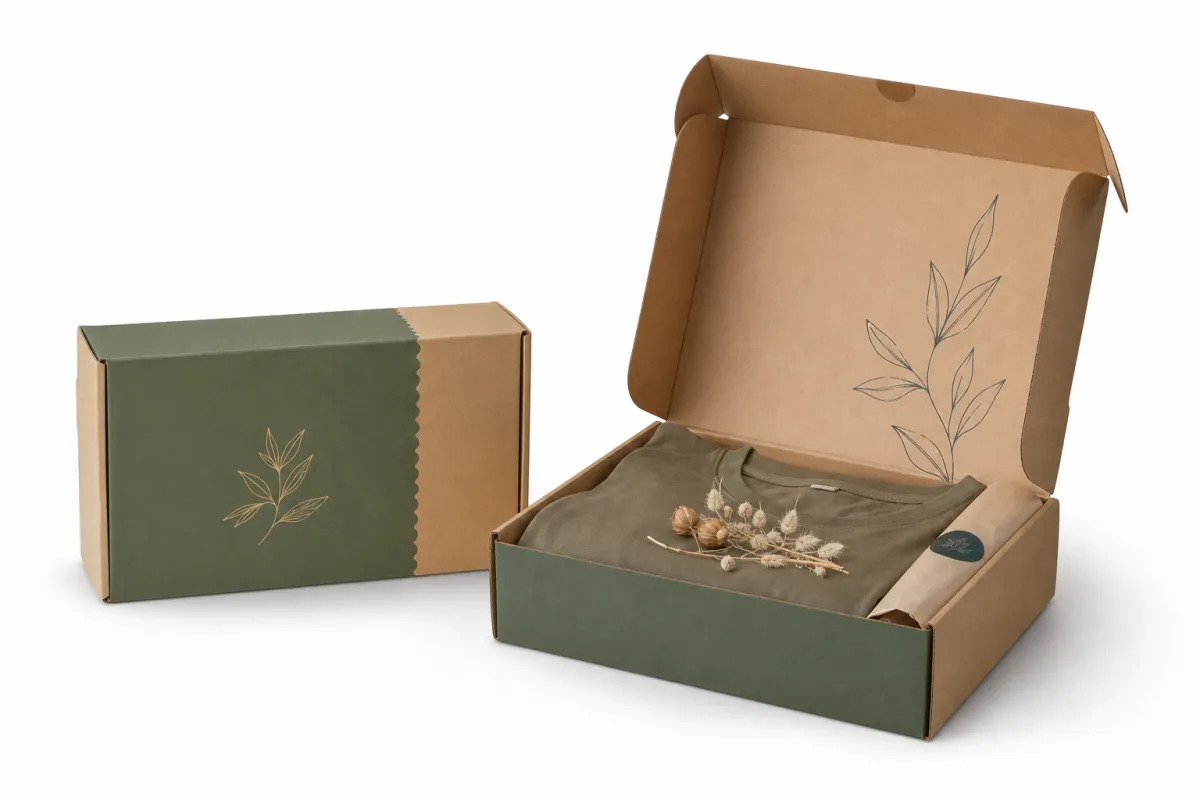
Custom sustainable apparel mailer boxes are right-sized folding boxes built for apparel, usually for folded tees, hoodies, leggings, socks, sleepwear, or bundled accessories. They are usually made from paper-based board, recycled content, or other lower-impact materials that fit a more responsible product packaging strategy. In practice, they replace the wrap-it, overpack-it, and-hope-nobody-notices approach with something cleaner and more deliberate.
The format is simple. Most custom sustainable apparel mailer boxes ship flat, fold into shape, and lock with tuck flaps or interlocking panels. That means you can pack a garment, close the lid, apply a label, and send it out without a second outer carton for standard e-commerce orders. For apparel brands, that is a very real operational win. Less labor. Less dunnage. Fewer boxes eating up space in the warehouse.
Why do brands use them? Because they solve a boring but expensive problem. A well-sized mailer protects folded garments, gives the customer a neat opening experience, and avoids the flimsy feel of a generic shipper. It also works well as retail packaging when a product might be handled in-store, gifted, or photographed before it is worn. If your custom sustainable apparel mailer boxes look clean and fit properly, the box does part of the selling for you.
The sustainability piece deserves a straight answer. Real impact comes from the physical choices, not the marketing copy printed on the box. Recycled fiber content matters. So does board weight, print coverage, and the amount of energy and material wasted moving air around. A box that is technically recyclable but oversized, heavily inked, and shipped with too much filler is not some environmental victory lap. It is just a more expensive version of the same waste.
Here is the practical takeaway: custom sustainable apparel mailer boxes are not only for “green” brands. They are for brands that want a better fit between product, brand presentation, and shipping cost. If the box is designed properly, it can improve both branded packaging and operational efficiency at the same time. That combination is rare enough to deserve attention.
Most buyers end up choosing these boxes because they want form and function in the same package. They need the packaging design to reflect the brand, but they also need it to survive parcel shipping without turning into a crushed mess. That balance is the whole job. Not romance. Not slogans. Just a box that works.
One more thing: the “sustainable” part should be honest, not decorative. If a supplier cannot explain the board construction, the fiber source, or the finish in plain language, that is a yellow flag. Not a dealbreaker by itself, but definitely a sign to slow down before you start printing claims on the lid.
How Custom Sustainable Apparel Mailer Boxes Work
Custom sustainable apparel mailer boxes work because the structure is simple and the workflow is fast. The box folds flat for storage, opens into shape with a few movements, and closes with flaps that hold without extra glue or secondary packaging in most cases. For apparel fulfillment, that matters. A packer can move from garment to label to outbound carton with very little friction, which is exactly what you want when order volume starts climbing.
In a normal packing flow, the garment is folded to a standard template, placed into the box, and paired with tissue, an insert card, or a light paper wrap if the brand wants more polish. Then the box is closed, inspected, labeled, and sent to the shipping lane. That sounds basic because it is basic. Good product packaging usually wins by being easy to repeat at scale, not by being clever once.
These boxes are especially useful for tees, hoodies, socks, underwear, activewear sets, and lightweight accessories. They are also a strong fit for custom printed boxes used in direct-to-consumer shipping where the unboxing moment matters. If the item is bulky, oddly shaped, or heavy, the math changes. A mailer can still work, but it may need thicker board or corrugated construction to avoid collapse in transit.
That protection tradeoff matters. Custom sustainable apparel mailer boxes are usually strong enough for standard parcel shipping, but they are not magic. They do not replace heavier corrugated packaging when the product is dense, fragile, or expected to take rough handling. If you are shipping a thick sweatshirt set or a multi-item bundle with accessories, test the closure, the compression resistance, and the corner strength Before You Order thousands.
Some brands also use custom sustainable apparel mailer boxes for returns or reusable subscription programs. That can work well if the closure is designed to survive a second opening and resealing. But do not assume a box that looks nice on day one will behave nicely after a return trip. Reverse logistics can be rough, and packaging that is too delicate tends to make that very clear.
For teams comparing packaging systems, the simple test is this: does the box make picking, packing, shipping, and returns easier without wrecking the brand? If the answer is yes, the format is probably doing its job. If not, you may be forcing a presentation-first design into a logistics problem. That is where many custom sustainable apparel mailer boxes fall apart.
Custom Sustainable Apparel Mailer Boxes: Materials, Cost, and Tradeoffs
Material choice is where custom sustainable apparel mailer boxes either make sense or quietly get expensive. The three common options are recycled kraft, SBS or coated paperboard, and E-flute corrugated. Each one solves a different problem. Each one also creates a different bill. People like pretending price is one simple number. It is not.
Recycled kraft gives a natural, understated look that fits well with minimal branding and low-to-moderate print coverage. It is popular when the brand wants an earthy, responsible feel without looking overproduced. SBS or coated paperboard is better when you want sharp printing, clean whites, and a more retail-ready finish. E-flute corrugated is the safer pick when the contents are heavier, the route is rougher, or the brand wants more crush resistance without jumping to a much bulkier shipper.
Price is driven by more than board grade. Size, print coverage, finish, inserts, die-cut complexity, and quantity all matter. A small box with simple one-color branding can be manageable. A large box with heavy flood color, soft-touch lamination, an insert, and a tricky closure? Different story. Custom sustainable apparel mailer boxes often look affordable in a quote summary until you account for setup, sampling, freight, and storage.
At low quantities, sample and setup costs can make the unit price feel annoyingly high. At higher quantities, the unit cost usually drops quickly, especially if the design stays consistent across product lines. That is why many brands standardize one or two box sizes instead of making a separate box for every SKU. Fewer dies, fewer art files, fewer mistakes. Shocking concept, somehow still rare.
There are hidden cost traps too. Specialty coatings, foil, extra-heavy ink coverage, custom inserts, rush production, and premium freight all push landed cost upward. Landed cost is the number that matters, not the pretty number in the first email. If you are comparing custom sustainable apparel mailer boxes from multiple vendors, ask for a quote that includes setup, proofing, freight, and any add-on finishing. Otherwise you are comparing half the picture.
Sustainability also has tradeoffs. Recycled content helps, but if the box collapses, overhangs the product, or uses a finish that makes recycling harder, the environmental story weakens fast. A box that is technically greener on paper but performs badly in transit can create more waste than a slightly simpler design that fits better and ships cleaner. That part gets ignored when teams chase a label instead of a result.
For documentation, ask for paper source details and any chain-of-custody paperwork if you are making a fiber claim. The Forest Stewardship Council is one common reference point for responsibly sourced fiber. For shipping performance, many teams use test methods aligned with ISTA standards when they want to know whether the box will survive real parcel handling instead of just looking nice on a sample table.
If the box only looks greener but ships with more void fill, more freight weight, or more returns, you did not reduce waste. You just moved it around.
| Material | Best For | Typical Look | Protection | Rough Unit Cost at 5,000 | Main Tradeoff |
|---|---|---|---|---|---|
| Recycled kraft board | Minimal branding, natural aesthetics, lighter apparel | Warm, matte, understated | Good for standard parcel shipping | $0.38-$0.72 | Less crisp color reproduction |
| SBS or coated paperboard | Retail presentation, vivid graphics, premium branded packaging | Bright, smooth, sharp print | Moderate, depends on board weight | $0.48-$0.88 | Finish choices can affect recyclability |
| E-flute corrugated | Heavier garments, longer shipping routes, added crush resistance | Structured, sturdy, less refined | Best of the three for protection | $0.62-$1.10 | Bulkier, less sleek shelf presence |
Those ranges are not magic numbers. They move with size, print count, supplier location, inserts, and freight. Still, they give buyers a useful starting point. If a supplier is wildly outside those bands for a standard run, ask why. There may be a good reason. There may also be a markup dressed up as specialty service.
One more practical note: if your box is doing double duty as retail packaging and shipping packaging, do not choose only for print quality. A beautiful box that arrives dented is just an expensive complaint. Custom sustainable apparel mailer boxes should be selected for the full journey, not just the moment they sit under a studio light.
And yes, coatings matter more than most teams expect. A light aqueous coating can protect graphics without turning the carton into a recycling headache. A heavy film laminate may look premium in a sample photo, but it can push the box into a less friendly end-of-life path. The tradeoff is real, so make it on purpose.
Step-by-Step: How To Spec the Right Box and Timeline
The cleanest way to spec custom sustainable apparel mailer boxes is to start with the apparel, not the packaging. Measure the folded garment flat, then map the finished folded dimensions, accessory bundle size, tissue wrap, insert card, and any barcode or return-label requirements. If you start with box dimensions and work backward, you usually end up with a box that is either too loose or too tight. Both are bad, just in different ways.
Choose the structure based on use case. A brand with a polished direct-to-consumer unboxing can prioritize clean lines and strong package branding. A subscription program may want a closure that holds up to reuse. A warehouse that ships high volume may care more about fast assembly than decorative extras. That is why custom sustainable apparel mailer boxes should be treated as operational tools, not just design objects.
- Measure the product fully. Include the folded garment, tissue, insert, and any seasonal extras.
- Choose the board and structure. Pick recycled kraft, SBS, or E-flute based on weight and presentation needs.
- Request a dieline. Confirm panels, flaps, closure style, and print-safe zones before artwork starts.
- Order a structural sample. Check fit, stackability, and whether the lid bulges or crushes.
- Approve artwork and claims. Verify recycled-content language, barcode placement, and any sustainability statements.
- Test shipping. Run transit tests with real product before full production if the route is new or the box is new.
That sample step matters more than most teams think. A dieline can look perfect on a screen and still fail with a real garment inside. The box might close with too much pressure, the label area may get blocked, or the corner score may fold badly after the first pack out. One sample round is cheap insurance. Two is sometimes necessary if the structure is new or the print coverage is dense.
Timing is usually manageable if the project stays normal. Sampling often takes about 1-2 weeks. Production commonly takes 2-4 weeks after approval. Freight is separate, and it can add more time depending on method and distance. If your launch date is fixed, build a buffer for artwork corrections and proof revisions. Custom sustainable apparel mailer boxes rarely fail because the box itself was impossible. They fail because someone underestimated the calendar.
Approval order matters too. Confirm the product spec first, then the dieline, then the artwork, then the sample, then the final production proof. If you reverse that order, you waste time and burn money. A lot of packaging design pain comes from people approving the pretty thing before they approve the functional thing. That classic mistake still shows up every week.
If you are building a broader packaging system, it helps to compare the mailer with other formats. Some brands pair mailers with Custom Packaging Products for sets, inserts, and specialty retail items. Others use Custom Poly Mailers for ultra-light shipments and reserve custom sustainable apparel mailer boxes for higher-value orders or retail-forward kits. The best mix depends on order profile, not brand ego.
One small operational habit saves a lot of pain: ask the supplier to show where the artwork sits relative to the folds, glue areas, and label zones. Designers tend to think in flat rectangles. Packaging does not. Scores, bends, and closures eat into real estate fast, and a pretty file can go sideways in one production run if nobody checks the map.
Common Mistakes With Custom Sustainable Apparel Mailer Boxes
The first mistake is oversizing. Teams think a little extra space is harmless, but it usually creates more void fill, higher shipping cost, and a package that feels lazy instead of premium. Custom sustainable apparel mailer boxes should fit the product with just enough room for easy packing and a little breathing space. A giant box full of air is not sustainable. It is just expensive emptiness.
The opposite mistake is just as annoying. Choose a box that is too tight and you can crush the garment, distort the lid, or create a closure that has to be forced shut on the line. That leads to wrinkling, damaged corners, slow packing, and customer complaints. Nobody likes opening a mailer and finding the contents pressed into something that looks packed under protest.
Finish mistakes are common too. Heavy gloss, thick lamination, and decorative add-ons can make custom sustainable apparel mailer boxes harder to recycle and more expensive to produce. If you want the box to support a sustainability claim, keep the finish choices aligned with that claim. Clean ink coverage, simple coatings, and paper-forward constructions usually make more sense than flashy extras that look better in a mockup than they do in real life.
Data mistakes are a quiet killer. Vague dimensions, missing closure specs, bad artwork files, and unlabeled insert placement cause avoidable delays. In packaging, sloppy inputs usually become sloppy outputs. The supplier cannot guess your folding allowance, and your warehouse team does not need a box that only works if every garment is folded with ceremonial precision.
Claim mistakes are the ones people regret later. Do not print recycled, eco, sustainable, or compostable language unless the material and documentation support it. That is not just a branding issue. It is a trust issue. Custom sustainable apparel mailer boxes can carry honest sustainability messaging, but only if the claims are specific and defensible. “Made with recycled fiber” is clearer than vague virtue signaling dressed up as packaging design.
Another easy mistake is ignoring the full shipping path. Some custom sustainable apparel mailer boxes survive local delivery just fine but fail after longer zone shipping or rough handling. If your average order travels farther, gets stacked higher, or sits in a hot warehouse, test under those conditions. Standard parcel expectations are not the same as ideal lab conditions. Anyone who tells you otherwise is selling something.
Good brands also remember that the packaging has to be packed by humans, not by vibes. If your design slows the line, needs extra inserts to stay closed, or requires a double-check on every order, that cost shows up somewhere. It usually shows up on the labor report or in a late shipment. Both are annoying in equal measure.
I have watched teams spend weeks on graphics and then realize the closure needed an extra tuck to survive packing. That kind of miss is fixable, but it is also preventable. The boring part of packaging is often the part that saves the most money. Annoying, yes. True, absolutely.
Expert Tips To Lower Impact Without Making the Box Feel Cheap
Use one box family across multiple SKUs whenever you can. That lowers inventory complexity, simplifies reorders, and reduces the chance that one size goes obsolete while another runs out. It also makes custom sustainable apparel mailer boxes easier to manage during seasonal swings. Fewer box types is not glamorous, but it is efficient. Efficiency tends to outlive pretty chaos.
Keep the print restrained. Limited ink coverage, a strong logo, and one well-placed interior message often do more for branded packaging than a box covered edge to edge in decoration. You do not need to shout to feel intentional. A clean layout on custom sustainable apparel mailer boxes usually reads more premium than a box that looks like it won a design contest and lost a production meeting.
Treat the inside as valuable space. A short thank-you line, care note, return instruction, or seasonal message can make the unboxing feel thoughtful without increasing material use much. That inside surface is also a better place for some package branding than the outside, because the customer actually looks at it. Outside graphics matter, sure, but the inside is where the moment lands.
Think about reuse. If a box may be used for returns, gifting, or subscription replenishment, specify board strength and closure style accordingly. A weak closure might pass for a one-way shipment and fail the moment someone tries to reuse it. Custom sustainable apparel mailer boxes that survive more than one trip usually need a little more structure, but not necessarily more fluff. The trick is to strengthen where it matters, not everywhere.
Paperwork matters more than marketing language. Ask for board specs, recycled-content documentation, and local recycling guidance before publishing sustainability claims. If your team is unsure how the box will be handled after disposal, check local rules rather than guessing. Packaging can be recyclable in one area and poorly accepted in another. That is normal, frustrating, and not something a glossy brochure fixes.
There is also a visual trick that works better than most fancy finishes: contrast. A natural kraft exterior with a clean interior print can feel deliberate and elevated. A simple one-color logo on the lid can also outperform noisy full coverage. The goal is not to make custom sustainable apparel mailer boxes look cheap. The goal is to make them look considered. That is a different thing.
For teams balancing multiple packaging formats, a mix of standard mailers and specialized formats can work well. Some orders are better suited to a simple mailer. Others need extra protection or a different presentation. The point is to choose the lightest practical solution, not the lightest theoretical one. That usually means the package is greener, easier to pack, and less likely to disappoint the customer.
One practical rule: if you can remove a feature without hurting performance, remove it. If the feature only exists to impress the design deck, it probably does not belong on the production quote.
What To Do Next Before You Place an Order
Before you order custom sustainable apparel mailer boxes, audit your top SKUs and write down the folded dimensions, monthly volume, shipping method, and any accessories that must fit inside the box. That one exercise saves more money than another round of vague brainstorming. Product packaging decisions get much easier when the inputs are written down instead of remembered from someone’s inbox.
Then request three quotes using the same spec sheet. Compare material, board weight, print coverage, finish, setup, sampling, and landed freight cost on equal terms. If one supplier is cheaper but does not include the same finish or box strength, the comparison is meaningless. Ask for apples-to-apples. Better yet, ask for the box that will survive the real route without overspending.
Order one sample or prototype and test it with the actual product, actual label, and actual shipping conditions. Not a guess. Not a dummy size that “feels close enough.” Real apparel boxes reveal fit problems fast. If the box ships smoothly in a pilot, you have useful data. If it fails, you saved yourself from a much bigger mistake.
For new designs, run a small pilot before full production. That gives you room to adjust the size, finish, or print coverage based on what happens in packing and transit. Custom sustainable apparel mailer boxes are at their best when they are tuned to the order pattern, not imagined in a vacuum. The pilot phase is where you catch the awkward stuff before it becomes expensive.
If you are adding these boxes to a broader branded packaging system, connect the dots across apparel, inserts, and other mail formats. The best package branding usually feels consistent without being identical. That lets you keep the look cohesive while still Choosing the Right format for each SKU.
In the end, custom sustainable apparel mailer boxes should fit your product, your margin, and your sustainability claim before you scale. If they do all three, you have a package that actually earns its place in the line. If they only do one of the three, you probably need another round of specs.
The cleanest final check is boring, but it works: measure the product, confirm the board, and test the route. If one of those three fails, fix it before production. If all three hold, move forward. That is the kind of practical discipline that keeps packaging from turning into a very expensive lesson.
Are custom sustainable apparel mailer boxes recyclable?
Usually yes, if they are made from paper-based board with minimal plastic coating or film. The exact answer depends on your local recycling rules and the finish you choose. Heavy laminates, mixed-material wraps, and decorative extras can make custom sustainable apparel mailer boxes harder to accept, so keep the structure simple if recyclability is the goal.
How much do custom sustainable apparel mailer boxes cost?
Price depends on size, board grade, print coverage, finish, and order quantity. Small runs cost more per unit because setup and sampling are spread across fewer boxes. For most buyers, the smarter question is landed cost, not factory cost, because freight and add-ons can change the real number fast.
What material is best for custom sustainable apparel mailer boxes?
Recycled kraft works well for a natural, understated look. SBS or coated paperboard is better when you want sharper print and a cleaner retail feel. E-flute corrugated is the safer pick when the apparel is bulkier, heavier, or shipping farther. The best material depends on product weight, presentation, and how much abuse the box will take.
How long does production take for custom sustainable apparel mailer boxes?
Sampling often takes about 1-2 weeks. Production commonly takes 2-4 weeks after approval, depending on complexity and quantity. Add freight time separately and leave extra room if artwork revisions or proof changes are likely.
Can custom sustainable apparel mailer boxes be used for returns?
Yes, if you design them with a closure that can survive a second opening and reseal. Add a return label area or tear strip only if your workflow actually uses it. Test the full return path before launch so the box does not fail on the second trip.
Custom sustainable apparel mailer boxes are not complicated, but they do reward careful specs. The brands that do best with them keep the design honest, match the board to the product, and test the shipping path before they go wide. That is how you get custom sustainable apparel mailer boxes that ship smarter, look better, and waste less without pretending the box is greener than it really is.

