Buyer Fit Snapshot
| Best fit | Custom Retail Carrier Bags Bulk projects where brand print, material claims, artwork control, MOQ, and repeat-order consistency need to be specified before quoting. |
|---|---|
| Quote inputs | Share finished size, material target, print colors, finish, packing count, annual reorder estimate, ship-to region, and any compliance wording. |
| Proofing check | Approve dieline scale, logo placement, barcode or warning zones, color tolerance, closure strength, and carton packing before bulk production. |
| Main risk | Vague material claims, crowded artwork, missing packing details, or unclear freight terms can make a low unit price expensive after revisions. |
Fast answer: Custom Retail Carrier Bags Bulk: Pricing, Specs, Process should be specified like a repeatable production item. The safest quote records material, print method, finish, artwork proof, packing count, and reorder notes in one written spec.
Production checks before approval
Compare the actual filled-product size with the drawing, then confirm tolerance on folds, seals, hang holes, label areas, and retail display edges. Reserve space for logos, QR codes, warning copy, and material claims before decorative graphics fill the panel.
Quote comparison points
Review material grade, print process, finish, sampling route, tooling charges, carton quantity, and freight assumptions side by side. A quote is only useful when the supplier can repeat the same color, closure quality, and packing count on the next order.
Custom retail carrier bags bulk orders look simple on a quote sheet. Then the real work starts and the spreadsheet stops being cute. The bag is not just a bag. It is the last thing a customer touches at checkout and often the first branded item they carry outside your store. That makes it part packaging, part marketing, and part customer experience. If the material feels cheap or the print looks off, people notice. Fast.
I have seen retailers spend weeks polishing fixtures, lighting, and displays, then toss all that effort into a flimsy carrier bag that tears before the customer reaches the car. Dumb move. A good bag should hold the product, fit the brand, and keep reorder headaches out of the picture. That is why custom retail carrier bags bulk buying makes sense for stores that care about consistency. You get predictable unit cost, cleaner presentation, and fewer last-minute scrambles when a promotion kicks off or a new location opens.
Most buyers end up asking the same three things: what is the unit price, how long will it take, and will it actually look right? Fair questions. If those three line up, the bag earns its place. If they do not, the cheap quote turns expensive the minute freight, reprints, or missed launch dates enter the chat. The sections below break down the parts that matter so you can judge custom retail carrier bags bulk options with less guesswork and a lot fewer surprises.
Why custom retail carrier bags bulk orders change the checkout math
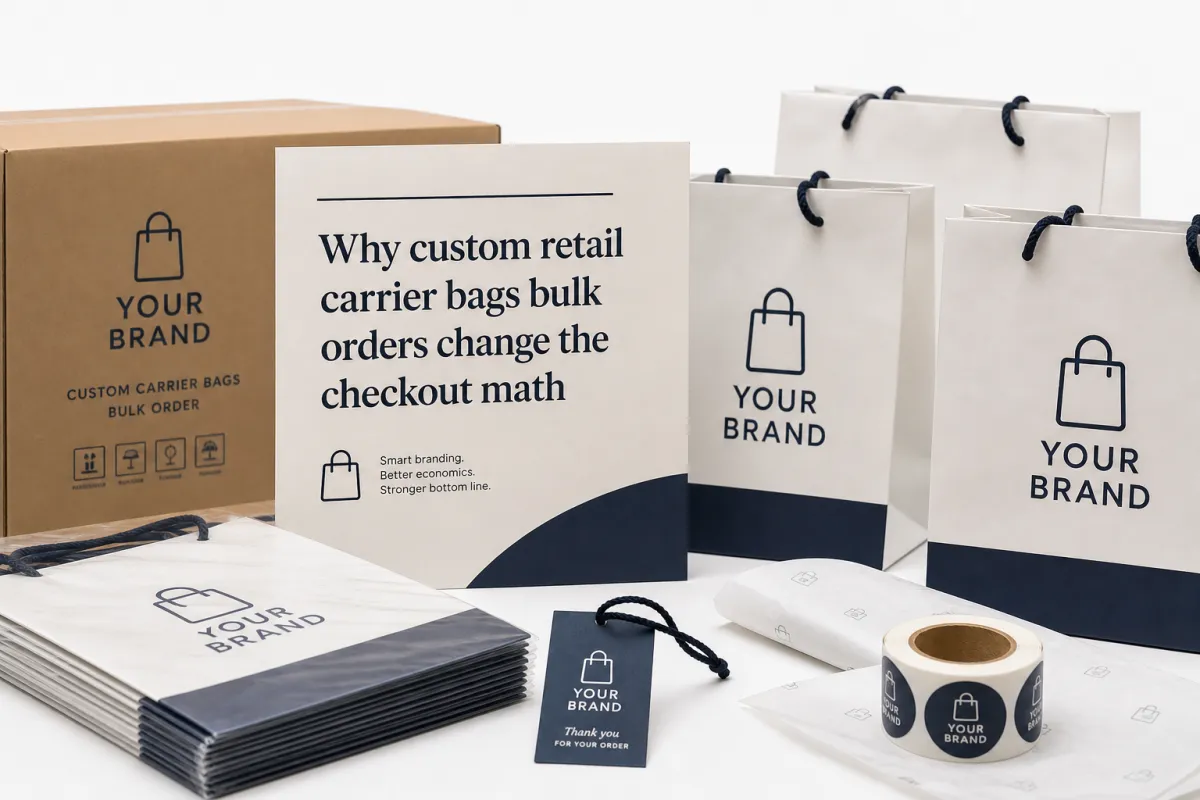
Some teams still treat a carrier bag like dead inventory. That is lazy thinking. A bag is a walking ad, a utility item, and a quiet signal about how seriously you take your brand. Every customer carrying it past neighboring stores gives you a little extra exposure. A storefront sign does not get that kind of sidewalk time. That is the simple reason custom retail carrier bags bulk orders often deliver more value than one-off buys. Once the artwork is approved, the design keeps working every time a bag leaves the store.
The math improves because fixed costs stop bullying the unit price. Plate charges, print setup, color matching, die cutting, handle assembly, and proofing can look ridiculous on a small run. Spread those costs across 5,000 or 10,000 bags and the per-unit number usually drops in a way that actually matters. That is where custom retail carrier bags bulk buying starts making commercial sense instead of feeling like a procurement exercise someone got stuck with after lunch.
Consistency matters just as much. A boutique selling apparel does not want a different shade of black every time a reorder lands. A pharmacy needs a bag that feels clean, private, and easy to carry to the car. Gift shops care about presentation. Grocery-adjacent stores need strength. Trade-show merch needs something that can survive brochures, samples, and impulse buys without folding like a bad excuse. A stock bag can patch a gap, but custom retail carrier bags bulk orders let the store control the visual story from checkout to curb.
"The cheapest bag is not the lowest-cost bag. A reprint, a missed launch, or a handle failure can erase the savings faster than anyone likes to admit."
That is the commercial reason so many retailers move into custom retail carrier bags bulk: fewer emergency buys, fewer mismatched replacements, and less brand drift between locations. The same logic that applies to Custom Packaging Products and custom printed boxes applies here too. Packaging should work as a system. The bag is part of that system, not the leftover item at the end. Customers see it outside the store. That visibility is not free.
There is also a supply-chain angle. Small repeat orders create noise. More approvals. More freight invoices. More reorder slips sitting unanswered until somebody notices the stock room is empty. Larger custom retail carrier bags bulk purchases cut that noise down. Planning gets cleaner, stockouts happen less often, and merchandising does not have to chase purchasing every other week. For multi-location retailers, that calm is worth real money.
Product details that matter for custom retail carrier bags bulk
Material comes first because it sets the tone immediately. Kraft paper is the workhorse. It signals simple, clean, and retail-friendly without trying too hard. Coated paper gives a smoother finish and handles richer print better. Recycled paper fits brands that want the sustainability story without paying luxury pricing. LDPE and HDPE still have a place in certain lightweight retail and pharmacy uses. Nonwoven polypropylene is common for reusable carryouts that need more body. Premium fabrics like cotton canvas or laminated woven options cost more, but they can keep your logo in circulation long after the sale is done. Picking the right material is the difference between a generic bag and a real custom retail carrier bags bulk program.
Handle style changes both the look and the experience. Twisted paper handles feel familiar because they are familiar. Flat handles are cheaper and useful for budget runs or high-volume distribution. Rope handles push the bag into premium territory fast, which is why they show up so often in gift retail and upscale apparel. Die-cut handles keep things compact and stack neatly, which helps when shelf space is tight. Do not pick handles because they look nice in a mockup. Pick them because they support the load, feel decent in the hand, and survive the trip after checkout. If the bag is gonna carry a bottle set, boxed merchandise, or anything awkward, that comfort detail stops being optional. In custom retail carrier bags bulk orders, it often decides whether the bag gets reused or gets dumped in the nearest bin.
Finishing changes the mood of the whole package. Matte lamination softens the look and makes the bag feel more refined. Gloss pushes color harder and helps logos stand out at a distance. Foil stamping, embossing, spot UV, and window cutouts can all improve shelf appeal, but none of them are free. A jewelry or fragrance retailer may justify the extra spend because the bag is part of the product experience. A fast-moving apparel chain may be better off with a clean, repeatable system that prints well season after season. Either way, the goal stays the same: make the custom retail carrier bags bulk order look intentional, not improvised five minutes before approval.
Branding placement matters just as much as the bag material. One-sided print can work when the logo is simple and the message is short. Two-sided print makes sense if the bag will be seen in crowded shopping areas or photographed by customers. Full-panel branding gives you more reach, but seams and gussets can ruin artwork if the layout is handled carelessly. A packaging team that understands those limits will usually map the safe zone before artwork is finalized. That is how custom retail carrier bags bulk projects stay tidy in production and clean on the sales floor.
- Kraft paper: strong for natural branding, gift shops, and general retail carryouts.
- Coated or laminated paper: better for premium apparel, cosmetics, and polished branded packaging.
- Nonwoven polypropylene: useful for reuse, heavier items, and longer brand exposure.
- Recycled paper: a practical fit for responsible sourcing programs and eco-conscious retail packaging.
- Reusable fabric: best for premium merchants that want the bag to stay in use after purchase.
Anyone comparing custom retail carrier bags bulk with other packaging categories will recognize the pattern. The same brand logic that applies to Custom Printed Boxes applies here too: repeatability, correct structure, and a design that still looks deliberate after a customer has carried it for half an hour. That is the difference between decoration and actual package branding.
Specifications to confirm before quoting custom retail carrier bags bulk
Most pricing mistakes start with vague specs. If two people ask for “paper bags,” they can end up with wildly different quotes because the bags are not the same size, thickness, or finish. For custom retail carrier bags bulk, the quote should always include width, gusset, height, handle drop, and finished fold size. Those numbers affect storage, shipping, print area, and how the bag feels in a customer’s hand. A bag that is too shallow or too narrow may look cheaper on paper, then fail the moment the product actually needs to fit.
Strength matters just as much. For paper, ask for GSM and ask whether the bottom or handles are reinforced. A light promo bag can use thinner stock. A heavier retail carryout needs more structure and better reinforcement. For film-based options, gauge and seal quality become the key points. Nonwoven and fabric bags need attention to stitch quality, strap attachment, and seam integrity. If your custom retail carrier bags bulk order has to carry bottles, boxed sets, or dense merchandise, ask the supplier how the bag performs under realistic load instead of staring at a polished sample and hoping for the best.
Artwork is another place where details save money. Send vector logos if you have them. Define Pantone colors clearly. State the exact print area, bleed, and safe zone. If the artwork includes tiny copy, line weights, or barcodes, confirm the minimum readable size before anyone signs off. A supplier who has handled custom retail carrier bags bulk work before will spot problems like text crossing a gusset fold or a logo drifting too close to a seam. Those are small mistakes during design and annoying ones during production.
Operational specs matter too. Ask for carton pack count, carton dimensions, pallet configuration, and whether the bags will arrive retail-ready or warehouse-packed. If the bags are heading straight to stores, the pack format might matter more than you expect. If they are going to a central warehouse, pallet efficiency can shape freight costs more than the print price does. Those details are standard in serious custom retail carrier bags bulk buying, and they make reorders much easier to manage later.
Compliance should not show up as an afterthought. If you need recycled-content claims, get the documentation in order before launch. If the bags touch food, ask about food-contact suitability. If the project depends on responsible sourcing, review the chain-of-custody rules and certification language at FSC. For general packaging best practices, the Institute of Packaging Professionals at packaging.org is a solid reference. The point is not paperwork for its own sake. The point is making sure the custom retail carrier bags bulk order supports the claim you plan to print on it. If the material claim is shaky, the whole thing starts looking kinda flimsy.
- Dimensions: width, gusset, height, handle drop, and folded size.
- Material strength: GSM, gauge, reinforcement, stitch quality, or seal quality.
- Artwork: vector file, Pantone references, bleed, and safe zones.
- Carton plan: pack count, carton size, and pallet configuration.
- Compliance: FSC, food-contact needs, or local labeling requirements where relevant.
Pricing and MOQ for custom retail carrier bags bulk
Price is never just price. It is a pile of decisions pretending to be a number. Material, size, print count, finishing, handle type, and total quantity all move the quote. For custom retail carrier bags bulk, a one-color kraft bag usually sits near the low end. A laminated bag with rope handles, foil, or other extras climbs quickly. Buyers should treat every added feature like a line item with a reason. If the feature does not improve retail packaging, presentation, or durability, it probably does not deserve the extra spend.
Setup costs are the part nobody likes to talk about. A run of 1,000 bags may carry the same artwork prep as 10,000 bags, but the fixed cost gets divided very differently. That is why small orders can feel expensive before freight even joins the party. Once the order reaches the next tier, the unit economics usually improve enough to justify a larger buy and fewer reorders. That is one reason custom retail carrier bags bulk purchasing shows up so often in chain retail and seasonal merchandising.
MOQ depends on product type. Standard paper bags often allow lower entry points because the construction is simpler and the conversion process is familiar. Reusable fabric or heavily finished bags usually need more setup, which pushes MOQ higher. If you need a lower minimum, keep the print simple, avoid premium finishing, and choose a standard structure. That is a practical way to get into custom retail carrier bags bulk without sitting on more inventory than you can use.
| Material / Style | Typical MOQ | Typical unit price at 5,000 pcs | Best use | Notes |
|---|---|---|---|---|
| Kraft paper with twisted handles | 1,000-3,000 | $0.18-$0.34 | General retail, gift shops, apparel carryouts | Good balance of cost and presentation for custom retail carrier bags bulk |
| Coated or laminated paper | 1,000-2,000 | $0.28-$0.55 | Premium retail, cosmetics, jewelry, branded gifting | Better color depth; finish adds cost but improves shelf impact |
| Nonwoven polypropylene | 500-2,000 | $0.22-$0.48 | Reusable promotions, heavier merchandise, events | Often chosen for long brand life in custom retail carrier bags bulk |
| Reusable fabric or canvas | 500-1,000 | $0.60-$1.50 | Premium programs, gift-with-purchase, higher perceived value | Higher price, but stronger reuse potential and brand exposure |
Read that table as a buying framework, not a promise. Freight, duties, packaging, and split shipments can move landed cost a lot, especially if the order ships in stages. Ask for tiered pricing so you can compare 1,000, 3,000, 5,000, and 10,000 units side by side. A good custom retail carrier bags bulk quote shows where the break point really sits instead of hiding it behind a single attractive number.
One practical rule keeps buyers out of trouble: compare landed cost, not only unit price. A supplier that costs a touch more per bag but gives you cleaner proofing, better carton packing, and lower freight risk may still be the cheaper outcome overall. In retail procurement, the lowest line item is not always the least expensive result. That is especially true for custom retail carrier bags bulk, where a delay can wipe out an entire promotion window.
Process and timeline for custom retail carrier bags bulk orders
The process should feel organized, because chaos in packaging usually means somebody skipped a step. It starts with an inquiry, then moves into specification review, artwork check, proof approval, production, quality control, and shipping. For custom retail carrier bags bulk, that sequence matters because each step protects the next one. If the quote uses vague dimensions, the proof will be wrong. If the proof is wrong, production slows down. If production slows down, the bags show up after the campaign starts, and nobody wants to explain that to marketing.
The biggest delays are not mysterious. Incomplete artwork causes back-and-forth. Missing color references force guesswork. A late change in dimensions can reopen the proof entirely. If speed matters, the fastest route is usually the one that gives the supplier complete information up front. Standard one-color bags move faster than multi-finish or fully custom structural designs, and that pattern holds across most custom retail carrier bags bulk programs. Good specs shorten the timeline. Bad specs invent delays.
Sampling protects both sides. Some projects only need a digital proof. Others need a pre-production proof or a physical sample, especially when color accuracy, handle strength, or finish has to be checked before volume production starts. If the bags are going to a premium store opening or a seasonal launch, a sample can save a very expensive rerun. Suppliers who do custom retail carrier bags bulk well understand that sampling is not bureaucratic fluff. It is cheap insurance.
Lead times vary by complexity and shipping distance. Simple paper bags can often move in roughly 12-15 business days after proof approval. More involved reusable or specialty-finish runs can take longer. Freight may add time too, especially if the order needs consolidation or split delivery. The smartest planning habit is to work backward from the store date, not forward from the purchase order. That rule applies to custom retail carrier bags bulk the same way it applies to any packaging tied to a launch.
"If the bag has to land before a launch, build buffer time into the schedule. Protect the opening date first and argue about the spreadsheet later."
Testing can matter as well. If the bags will carry heavier products, drop testing or carton testing informed by ISTA methods may be worth discussing during quoting. That step helps avoid surprises after delivery and matches the bag to how stores actually use it. A supplier that treats custom retail carrier bags bulk like a technical job instead of a commodity order is usually the one that prevents the annoying failures: crushed corners, weak handles, and cartons that ship badly for no good reason.
Why choose us for custom retail carrier bags bulk
Retail buyers do not need noise. They need a supplier who can quote clearly, confirm the structure, check the artwork, and ship something that looks exactly like what was approved. That is the point of custom retail carrier bags bulk done properly. The right partner reduces risk before production starts, which is where most avoidable mistakes can still be fixed. A weak supplier may dangle a lower opening price. A better supplier gives you a cleaner process, fewer corrections, and a result that looks like it belongs in the store instead of surviving by accident.
At Custom Logo Things, the focus stays on practical retail packaging decisions: material selection, print method, MOQ, and turnaround. That is the part of the job that protects margin. If the program needs a lightweight paper bag for a boutique, a sturdier reusable option for an apparel chain, or a more polished bag for premium gift packaging, the recommendation should match the use case. That becomes even more useful if your brand already manages Custom Packaging Products across several categories or needs recurring supply through Wholesale Programs. The bag should fit the same disciplined approach as the rest of the packaging plan.
Flexibility matters too. One retailer may want a test run before placing a larger order. Another may need a reliable reorder path across multiple store locations. A supplier who can handle both keeps the process simple without forcing you into oversized inventory. That is why custom retail carrier bags bulk should never be judged on one quote alone. The real test is whether the supplier can repeat the result, not just sell it once and disappear into the fog.
Service should be measurable. Ask whether the quote is transparent, whether sample support exists, whether proof corrections move quickly, and whether reorders stay consistent from one production lot to the next. In branded packaging, consistency is not a bonus feature. It is the difference between a retail chain that looks coordinated and one that looks patched together with whatever was on hand. A solid custom retail carrier bags bulk supplier helps protect that consistency across seasons, stores, and promotions.
- Clear quotations: no vague line items hiding in freight or setup.
- Specification support: dimensions, material, and print guidance before production.
- Proof control: fewer artwork errors and fewer late-stage surprises.
- Repeatability: reorders that match the first run closely enough to protect the brand.
- Commercial fit: options that match budget, presentation, and quantity without forcing overbuying.
Honestly, the best supplier is not the loudest one in the room. It is the one that can explain thickness, handle strength, print placement, and lead time without hiding behind jargon, then deliver exactly that. In custom retail carrier bags bulk, clarity matters more than hype. Retailers already have enough variables. Packaging should reduce friction, not add another one to the pile.
Next steps for ordering custom retail carrier bags bulk
If you are ready to quote custom retail carrier bags bulk, start with the basics and do it properly. Gather the dimensions, quantity, material preference, handle style, number of print colors, and the target delivery date. Add a short note about what the bag will carry and where it will be used. That context helps the supplier recommend a structure that actually fits the job instead of just filling space on a form.
Brand assets should be complete before you send the request. Include a vector logo, Pantone references if they exist, and a simple mockup if you have one. If the bag needs to feel premium, say that plainly. If it needs to stay utility-first, say that too. Better briefs create fewer revisions. A good custom retail carrier bags bulk quote is built on facts, not guesses, and facts save money.
Ask for tiered pricing even if you think you already know the quantity you want. Compare several volumes. The best break point may sit a little above or below your first estimate. Ask for a proof, sample, or material recommendation too if this is a first run or if the bag supports a new store launch. That extra step often separates a clean rollout from a mess. For many buyers, custom retail carrier bags bulk works best when the spec is locked early and the order has enough buffer to avoid rush freight.
If you want to move quickly, send a short package: dimensions, artwork file, quantity tiers, target date, and any compliance notes. That gives the quoting team what they need to respond accurately and keeps procurement moving. Custom retail carrier bags bulk works best when the bag is planned as part of the sales strategy, not treated like an afterthought someone remembered on Thursday afternoon. The stores that get that right usually spend less time chasing reorders and more time selling.
One clean rule to follow: confirm the spec, confirm the landed cost, and confirm the proof before you release production. Do those three things and the order is usually boring in the best possible way. That is the goal. Packaging should not be dramatic.
Frequently Asked Questions
Are custom retail carrier bags bulk orders cheaper than smaller runs?
Yes. Setup, artwork, and print prep get spread across more units, which drops the per-bag cost. The bigger savings usually show up after the first pricing tier, not just at the largest quantity. Ask for quotes at several volumes so you can compare real unit economics for custom retail carrier bags bulk. A smaller order can still make sense if the launch window is tight, but the math usually improves once you get out of the lowest tier.
What is the usual MOQ for custom retail carrier bags bulk?
MOQ depends on material, size, and print complexity. Standard paper bags often start lower than fully custom reusable or highly finished bags. If you need a lower MOQ, reduce print colors and skip premium finishes; that usually makes custom retail carrier bags bulk easier to approve. I would rather see a clean, simple bag at the right quantity than a fancy concept sitting in storage because the order was too big for the program.
How long do custom retail carrier bags bulk orders usually take?
Lead time depends on proof approval, production complexity, and shipping distance. Simple designs usually move faster than multi-color or specialty-finish bags. Build in extra time before store launches or seasonal promotions, especially if your custom retail carrier bags bulk order includes samples or carton testing. If the timeline looks tight, protect the launch date first and adjust the spec before you start trimming the schedule.
Which material works best for retail carrier bags in bulk?
Kraft paper is a strong choice for a natural, retail-friendly look. Reinforced paper or reusable materials work better when customers carry heavier items. Choose the material based on product weight, brand feel, and budget, and the right custom retail carrier bags bulk spec usually becomes obvious quickly. There is no magic answer here. The best material is the one that fits the product and does not fight the customer.
What artwork files do you need for a bulk quote?
Send vector artwork when possible, along with Pantone colors and exact bag dimensions. Include the print area, handle style, and any required bleed or safety margins. If you are unsure, a simple PDF mockup is still enough to start the quoting process for custom retail carrier bags bulk. The more complete the brief, the fewer revisions you will need later, which is usually where projects go sideways.

