Buyer Fit Snapshot
| Best fit | Custom Reusable Grocery Bags Bulk Order projects where brand print, material claims, artwork control, MOQ, and repeat-order consistency need to be specified before quoting. |
|---|---|
| Quote inputs | Share finished size, material target, print colors, finish, packing count, annual reorder estimate, ship-to region, and any compliance wording. |
| Proofing check | Approve dieline scale, logo placement, barcode or warning zones, color tolerance, closure strength, and carton packing before bulk production. |
| Main risk | Vague material claims, crowded artwork, missing packing details, or unclear freight terms can make a low unit price expensive after revisions. |
Fast answer: Custom Reusable Grocery Bags Bulk Order: Material, Print, Proofing, and Reorder Risk should be specified like a repeatable production item. The safest quote records material, print method, finish, artwork proof, packing count, and reorder notes in one written spec.
Production checks before approval
Compare the actual filled-product size with the drawing, then confirm tolerance on folds, seals, hang holes, label areas, and retail display edges. Reserve space for logos, QR codes, warning copy, and material claims before decorative graphics fill the panel.
Quote comparison points
Review material grade, print process, finish, sampling route, tooling charges, carton quantity, and freight assumptions side by side. A quote is only useful when the supplier can repeat the same color, closure quality, and packing count on the next order.
A custom reusable grocery bags bulk order is not a small purchasing decision. It changes how customers carry groceries, how often they see your logo, and how much disposable packaging leaves the store with them. Pick the wrong bag and you end up with a weak handout that gets shoved into a trunk and forgotten. Pick the right one and it keeps doing its job long after checkout, which is the whole point.
The best custom reusable grocery bags bulk order projects start with actual shopping behavior, not a pretty mockup. A bag can look polished in a proof and still fail in the aisle if it sags under bottled drinks or tears at the handle. I have seen buyers get excited about a low unit price, then lose the savings the first time a handle gives out in the parking lot. That is not a fun conversation.
Supermarkets, neighborhood grocers, CSA programs, farmers markets, and event teams all use custom reusable grocery bags bulk order programs for the same reason: volume lowers setup costs and makes the per-unit math workable. Once the order size grows, the question shifts. It is not about whether the tote exists. It is about which tote will get used again and again without looking cheap after the second trip.
Why a Custom Reusable Grocery Bags Bulk Order Makes Sense
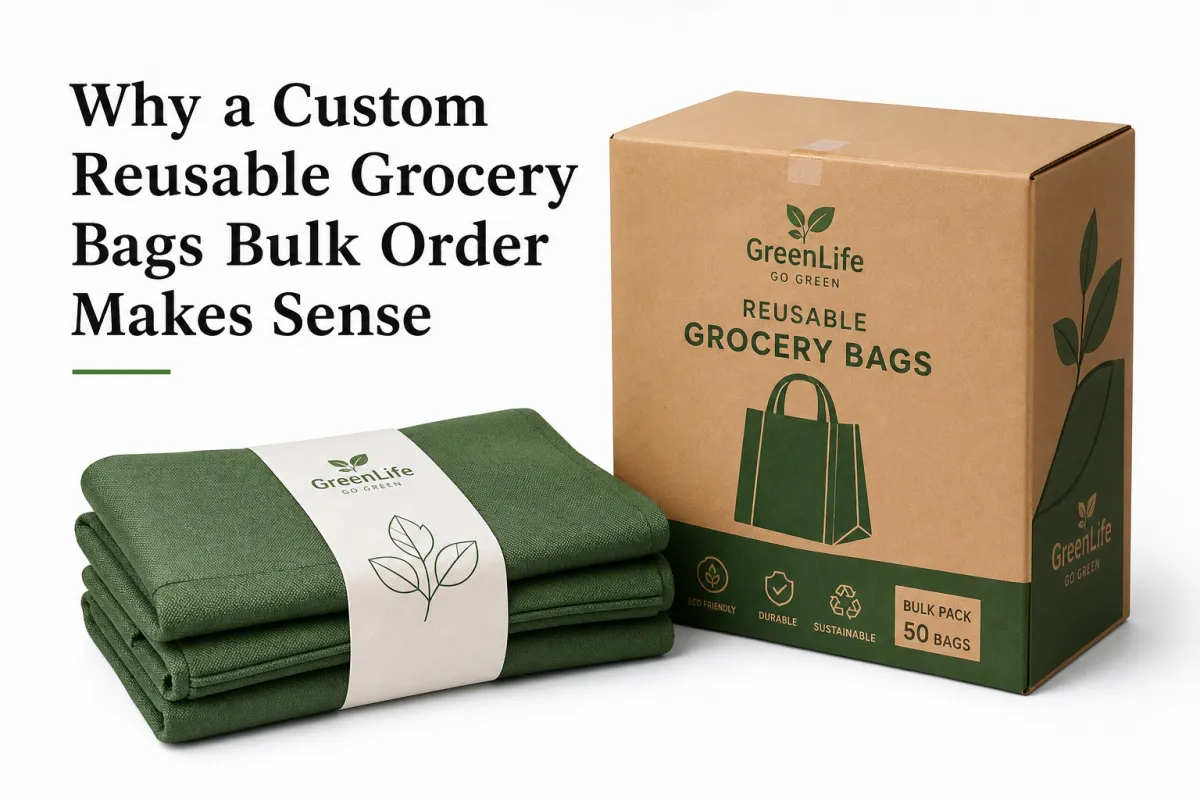
A durable tote can replace a long trail of disposable bags, but only if the structure is strong enough to survive real shopping. Handles need to hold a carton of milk without digging into the hand. Seams need to stay closed under strain. The base needs enough shape to keep cans, produce, and bottles from becoming a heap. That is the real logic behind a custom reusable grocery bags bulk order: one bag, many trips, less waste.
From a packaging buyer's view, the value goes past the material itself. A well-planned custom reusable grocery bags bulk order can speed up checkout because shoppers are less likely to ask for extra bags. It can also make the store look better. Fewer torn handles at the register. Fewer flimsy promo bags on the floor. Fewer complaints from people who expected a grocery tote and got something closer to an event giveaway.
There is also the visibility factor. A tote is moving media. It travels farther than a flyer and lasts longer than a social post. A strong custom reusable grocery bags bulk order supports branded packaging and retail presence in a way that actually earns its keep. Customers carry the logo because the bag still works, not because anyone asked them to become a billboard.
For grocers, the economics are cleaner than many teams expect. A single order of 5,000 or 10,000 bags can push the unit cost low enough for resale, loyalty rewards, or checkout distribution. Once the construction is right, a custom reusable grocery bags bulk order stops acting like a sunk cost and starts behaving like a merchandising tool with repeat impressions built in.
Operations benefit too. A tote with a box-bottom or gusseted shape packs faster and holds shape better in the cart. Better pack-out means fewer crushed items and fewer customers coming back because the produce got flattened on the way home. That is why buyers compare tote selection the same way they compare product packaging for fragile items: by asking how it performs after the sale, not just how it looks on a screen.
The cheapest tote is often the most expensive one if it fails before the third grocery run. In a custom reusable grocery bags bulk order, durability is the whole point, not a bonus feature.
If you already buy through Wholesale Programs, a tote program fits into the same purchasing rhythm. If your team also manages Custom Packaging Products, the bag should be reviewed with the same care used for cartons, inserts, and shelf-ready packaging. Packaging is packaging. The format changes. The job does not.
Custom Reusable Grocery Bags Bulk Order Product Options
Material choice sets the tone for the entire order. In a custom reusable grocery bags bulk order, common options include non-woven polypropylene, woven polypropylene, cotton, canvas, recycled PET, and laminated constructions. Each one answers a different question. How much weight will it carry? How premium should it feel? How many trips should it survive before it gets retired?
Non-woven polypropylene is often the budget-friendly pick for high-volume distribution. It prints cleanly, folds flat, and keeps setup simple. That makes it a regular choice for a custom reusable grocery bags bulk order aimed at supermarkets, promotions, and membership campaigns. Woven polypropylene brings more strength and a firmer hand, which matters when the bag needs to carry heavier loads or hold up through repeated use.
Cotton and canvas sit higher on the price scale. They feel more premium, they are often used for resale, and they support a stronger lifestyle brand image. A custom reusable grocery bags bulk order in cotton or canvas usually focuses less on chasing the lowest price and more on perception, longevity, and shelf appeal. Recycled PET fits well when sustainability messaging matters and the brand wants a smoother, more polished surface. Laminated bags add a cleaner wipeable finish and often sharper print definition.
Bag style matters just as much as material. A tote can be gusseted, box-bottom, insulated, foldable, or reinforced at the handle. In a custom reusable grocery bags bulk order, those structure choices often decide whether the bag feels like a serious grocery solution or a cheap promo item. Box-bottom bags stand up better in the trunk. Insulated versions help with frozen or chilled items. Fold-flat packs are easier to hand out when storage space is tight and the order needs to move fast.
Common bag styles and how they perform
- Gusseted shopping totes - a solid all-purpose choice for checkout and resale.
- Box-bottom grocery bags - stable for heavy items and easier to load.
- Reinforced carry bags - better for repeat use and larger order weights.
- Insulated totes - practical for dairy, frozen food, and meal kits.
- Fold-flat reusable bags - useful for giveaways, subscriptions, and compact storage.
Decoration method changes the final look, the cost, and the production path. Screen print works well for bold logos and simple artwork. Flexographic print can be efficient for larger runs with limited color complexity. Heat transfer helps when a design needs finer detail, and woven labels add a tactile, more premium finish. Full-color branding is possible, but it needs to match the material so the design still reads clearly from a distance. Packaging design and brand presentation overlap right there, whether people want to admit it or not.
Handle style is another detail buyers tend to underestimate. Short, soft handles can dig into the hand when the bag is full. Longer web handles make shoulder carry more comfortable, especially for shoppers walking from a parking lot or transit stop. A custom reusable grocery bags bulk order should be judged by how the handle feels on a real grocery trip, not by how neat it looks in a rendering. Stitching and seam reinforcement matter just as much, because the failure point is usually not the logo. It is the stress line.
There is no universal best option. A discount grocery chain, a local CSA, and a premium market all need different specs. A well-managed custom reusable grocery bags bulk order can support all three, but only if the material, print method, and structure fit the actual audience instead of a vague idea of what a reusable bag should be.
| Material / Style | Typical Feel | Common Use Case | Approx. Unit Range at 5,000+ |
|---|---|---|---|
| Non-woven polypropylene | Light, economical, easy to fold | Mass distribution, store promos, checkout handouts | $0.45-$1.10 |
| Woven polypropylene | Stronger, more structured, longer wear | Heavy groceries, repeat retail use | $0.65-$1.35 |
| Recycled PET | Smoother finish, sustainability story | Retail branding, eco-forward promotions | $0.90-$1.90 |
| Cotton | Soft, natural, premium hand-feel | Resale, loyalty gifts, higher-end retail | $1.10-$2.75 |
| Canvas | Dense, durable, long-lasting | Premium retail, frequent carry, souvenir programs | $1.80-$4.50 |
| Laminated polypropylene | Wipeable, glossy or matte, more rigid | Heavier branding, retail presentation, easy cleaning | $0.85-$1.60 |
That table is a planning tool, not a final quote. Real pricing for a custom reusable grocery bags bulk order moves with size, artwork, reinforcement, packaging format, freight, and how much setup the project requires. The pattern stays the same, though. More complex construction and more premium material both push the unit price up.
Specifications That Matter in Custom Reusable Grocery Bags Bulk Order Projects
A quote only helps if the specs are clear. For a custom reusable grocery bags bulk order, the first details to lock down are dimensions, fabric weight, handle length, gusset size, print coverage, and the expected load capacity. Leave those fuzzy and the rest of the numbers slide around too. That is how a project drifts from a clean estimate to a very annoying invoice.
Thickness or GSM matters because it affects both performance and handling. A heavier bag usually feels stronger and survives more use, but it also changes folding behavior, storage density, and the way the bag hangs at checkout. In a custom reusable grocery bags bulk order, a slightly heavier fabric can be the smarter buy if it cuts down on returns, complaints, and replacement orders. The lowest price tag is not always the lowest total cost.
Branding details change visibility more than many teams expect. A front-only print may save money, but a two-sided print can double the number of impressions in real use. In some programs, the logo needs to sit above the gusset line so it remains visible when the bag is full. In others, the best placement is low and wide so the mark reads while the tote is hanging from the shoulder. Good packaging design is part placement, part restraint, and part knowing how the bag will actually be seen.
Color choice carries its own risk. Ink limits, background tone, and material finish all affect the final look. White ink on dark fabric can look sharp, but not every production line handles it the same way. If the brand depends on a precise Pantone match, that needs to be stated early. A custom reusable grocery bags bulk order with sloppy color planning can end up dull, muddy, or inconsistent from carton to carton. That kind of surprise is expensive and completely avoidable.
Quality factors deserve real attention. Ask about odor, especially on laminated or recycled materials. Ask about stitch density, seam finish, and handle reinforcement. Ask whether the supplier can explain how recycled content claims are documented. Retailers should also ask about carton labeling and dimensional consistency, because mixed sizing slows receiving and creates extra labor in the store. Nobody enjoys unpacking a shipment and discovering three versions of the same bag.
For performance claims, it helps to borrow a little discipline from transport packaging. The ISTA framework exists for a reason: distribution is where weak packaging gets exposed. A grocery tote is not a corrugated shipping case, but the same principle applies. If the sample cannot survive ordinary handling, the bulk run will not magically get better because the order is larger.
If sustainability documentation matters, especially for paper hangtags, inserts, or brand collateral that travels with the bag, the FSC standard can support the story. That does not make a bag sustainable by itself. It does help procurement teams separate real claims from vague marketing language. In a custom reusable grocery bags bulk order, trust comes from clear specs and verifiable materials, not from adjectives doing the heavy lifting.
- Dimensions: confirm height, width, and gusset in inches or centimeters.
- Fabric weight: request GSM or oz/yd2 so comparisons stay honest.
- Handle length: define hand carry versus shoulder carry use.
- Print coverage: front only, back only, or both sides.
- Load target: specify the typical shopping weight, not a wishful maximum.
One practical habit saves a lot of money: ask for a spec sheet before you commit. A custom reusable grocery bags bulk order should be bought the same way any serious retail packaging item is bought, with enough data to compare options instead of guessing and hoping.
Pricing, MOQ, and Cost Drivers for Bulk Orders
Price in a custom reusable grocery bags bulk order comes down to a few repeatable variables. Material is the biggest one. Print colors add cost. Bigger bags use more substrate. Reinforced handles and thicker seams increase labor. Packaging format, such as individual folding, belly bands, or carton configuration, can move the number more than buyers expect.
MOQ exists because setup is real work. Plates, screens, art prep, machine calibration, and production scheduling all create overhead before the first bag is finished. That is why very small runs usually look expensive. A custom reusable grocery bags bulk order starts to make financial sense once the fixed setup cost gets spread across enough units to bring the per-bag figure into useful territory.
Buyers should also ask about the items that often sit outside the headline quote. Plate charges. Sampling. Rush fees. Freight. Split shipments. Revisions after proof approval. Each one can affect the final invoice. If a supplier gives a simple unit price without explaining the extras, the real cost of the custom reusable grocery bags bulk order may be higher than the first number suggests.
There is a better way to compare quotes: estimate the total cost across the expected usage life. A $0.72 tote that survives six months of weekly use may be a better purchase than a $0.48 tote that tears early and needs replacing. That matters even more for customer-facing retail packaging, where one weak product can damage trust. The right custom reusable grocery bags bulk order is the one that lowers replacement frequency, not just initial spend.
Here is a planning view that helps buyers sanity-check the quote.
| Order Factor | How It Affects Price | Buyer Question to Ask |
|---|---|---|
| Material | Premium fibers and heavier fabrics raise cost | Does the bag need a premium feel or just utility? |
| Print colors | More colors usually mean more setup and more labor | Can the design be simplified without hurting the brand? |
| Bag size | Larger bags use more material and larger print areas | Will the bag fit the actual basket or cart profile? |
| Reinforcement | Extra stitching or thicker handles add labor and parts | How much weight should the bag carry in daily use? |
| Quantity | Higher volume usually lowers cost per unit | Can the buying plan support a larger run or staggered releases? |
MOQ also interacts with packing and shipping. A custom reusable grocery bags bulk order packed densely in cartons can reduce freight cost per bag. A loose or oversized pack-out can do the opposite. That is why procurement teams should ask whether the quote assumes bulk carton packing, retail-ready folding, or individual bag wrapping. The format matters more than many buyers realize, and it shows up on the invoice whether anyone planned for it or not.
For teams that already buy other Custom Packaging Products, none of this is surprising. The cheapest quote usually belongs to the easiest specification, not the best performing one. A custom reusable grocery bags bulk order should be benchmarked like any other packaging purchase: compare unit cost, setup cost, carton count, freight, and service life as one equation instead of pretending the line item lives alone.
Production Process and Timeline for Custom Reusable Grocery Bags Bulk Order
The production workflow is straightforward, but every step matters. A custom reusable grocery bags bulk order usually moves from inquiry to quote, then artwork review, proof approval, sampling if required, production, quality check, packing, and freight. A supplier with a disciplined process keeps surprises down. A loose process creates delays at every handoff and somehow still acts surprised when the schedule slips.
Timelines depend on the product. Simple stock-style bags with straightforward print can move quickly once artwork is approved. A custom size, a complex color setup, or a specialty finish adds time. For a custom reusable grocery bags bulk order, the most common cause of delay is not the factory floor. It is the client side: missing artwork files, slow proof review, late color changes, or unclear ship-to instructions.
That is why a milestone-based schedule works better than a vague target date. The buyer should know when the quote will be frozen, when the proof will be approved, when the sample will be checked, when production starts, and when cartons should be booked for pickup. A custom reusable grocery bags bulk order gets easier to manage once those dates are visible to everyone involved.
A practical timeline to plan around
- Inquiry and quoting: 1-3 business days for clean specs.
- Artwork review and proofing: 2-5 business days depending on revisions.
- Sampling: adds time when the project needs physical approval.
- Production: often 12-20 business days for standard builds, longer for specialty work.
- Quality check and packing: usually a few additional days.
- Freight: varies by destination and should be buffered into the plan.
For store launches, seasonal promotions, and market openings, build in extra time. Freight is the part most people underestimate. A custom reusable grocery bags bulk order that finishes production on time can still arrive late if the receiving window is tight or the carrier schedule changes. Good planners leave room for inspection, counting, and distribution before launch day, because launch day is not the time to discover a pallet problem.
Retail teams often ask for a "fast" order, but speed only helps if the result is accurate. If the proof is rushed, the print can shift. If the sample is skipped, the handle length might be wrong. If the shipping address is incomplete, cartons can bounce between facilities. A custom reusable grocery bags bulk order needs process discipline more than it needs optimism.
When buyers handle this well, the program feels easy internally. Brand teams get control over appearance. Operations gets a product that behaves predictably. Finance gets a cost structure that can be forecast. That is the same kind of order management many teams want from Custom Printed Boxes and other retail packaging items, and the same discipline works here too.
Why Choose Us for Custom Reusable Grocery Bags Bulk Order
Custom Logo Things helps buyers make practical decisions instead of guessing their way through a product spec. For a custom reusable grocery bags bulk order, that matters. The right vendor should help match the bag structure, print method, and quantity to the job the bag actually needs to do. A tote for mass checkout is not the same as a tote for retail resale. Treating them like the same thing is how money gets wasted.
We focus on the details that control quality at scale: consistent dimensions, clear print setup, reliable carton packing, and realistic lead-time planning. In a custom reusable grocery bags bulk order, those details keep one carton from looking different from the next. They also protect brand presentation. Color mismatch, crooked handles, weak stitching, and inconsistent fold quality are minor problems on a sample and major problems across 10,000 units.
That is why our approach is packaging-industry thinking, not commodity selling. A strong tote supports brand recognition, store traffic, and retail presentation, but only when it is treated as part of the broader packaging system. The bag sits beside shelf labels, carry-out policies, loyalty programs, and product packaging decisions. If those pieces do not align, the bag becomes a loose accessory instead of a useful tool.
We also help buyers reduce risk before production begins. That can mean comparing materials, checking artwork for printability, reviewing sample options, or clarifying shipping expectations. A custom reusable grocery bags bulk order gets easier when someone on the supplier side can turn purchasing goals into production specs instead of just reading the order form back to you and calling it expertise.
For teams that need more than one packaging category, the FAQ page can answer common setup questions, and the broader catalog of Custom Packaging Products makes it easier to plan related purchases in one place. A custom reusable grocery bags bulk order often pairs well with matching carry-outs, inserts, and seasonal retail packaging so the entire program feels deliberate instead of stitched together at the last minute.
What procurement teams usually value most is reliability. Not flashy promises. Not vague "premium" language. Reliable communication, accurate proofs, and output that matches the approved spec. A custom reusable grocery bags bulk order should be judged by whether it protects margin, supports the brand, and stays in use long enough to matter. That is where the real value lives.
What to Prepare Before You Request a Quote
The fastest way to get a useful quote is to send the right information up front. For a custom reusable grocery bags bulk order, start with quantity, bag size, material preference, print colors, delivery location, and target in-hand date. Those six items shape almost every other number. Without them, the estimate stays broad, and broad estimates are annoying to compare and even worse to approve.
Artwork is the next big variable. Vector files are best because they scale cleanly and print sharply. Logos, text-heavy layouts, and line art all benefit from that format. If you only have a raster file, send the highest-resolution version available and ask for an art review before production starts. A custom reusable grocery bags bulk order can be delayed by one badly prepared logo more easily than by almost anything else.
It also helps to define the use case before you quote. Retail checkout, event giveaway, farmers market resale, and subscription insert bags each need different specs. A shopper carrying three heavy items needs a different bag from a customer receiving a branded handout at a weekend event. The same custom reusable grocery bags bulk order can serve both, but only if the bag design reflects the intended use instead of pretending one shape fits every job.
If the order will be used in customer-facing retail, ask for a sample or a detailed spec sheet. Touch the material. Check the seam quality. Test the handle length. Fold it. Load it. That hands-on review often prevents expensive mistakes. In packaging, tactile feedback still matters. A bag can look fine on a monitor and feel wrong in the hand, and that is enough to reduce repeat use.
Procurement teams should also decide how much variation they are comfortable with. Multiple colors, multiple sizes, or mixed packaging formats may be possible, but they can influence MOQ and price. A clean custom reusable grocery bags bulk order quote should break out each variation so the total can be compared without guesswork. If the supplier cannot explain the variation structure clearly, the quote is not ready for approval.
Finally, do not underestimate the value of simple alignment between teams. Marketing wants the logo large. Operations wants the bag to fold flat. Finance wants cost control. A good custom reusable grocery bags bulk order balances those goals instead of letting one department dominate the spec. That is how the order stays useful after the invoice is paid.
Send the quantity, size, artwork, material preference, and delivery timing, and the rest can be shaped into a clean proposal. If you are planning a custom reusable grocery bags bulk order, start with the use case, choose the construction that fits the load, and ask for a sample or spec sheet before approval. That approach usually produces a better bag, a cleaner production run, and fewer surprises at scale. In plain terms: know what the bag has to carry, how often it will get used, and how it needs to pack down. Get those three things right, and the rest stops being guesswork.
FAQ
What is the usual MOQ for a custom reusable grocery bags bulk order?
MOQ depends on material, print method, and bag size, but a custom reusable grocery bags bulk order often starts at a few hundred units and becomes more efficient as volume rises. Smaller runs can work with stock items, but setup costs usually make them less attractive on a per-unit basis. If the project needs custom sizing or multiple print steps, expect the minimum to climb.
Which material is best for custom reusable grocery bags in bulk?
Non-woven polypropylene is often the budget-friendly choice for mass distribution, while woven polypropylene, cotton, and canvas feel more premium and usually last longer. For a custom reusable grocery bags bulk order, the best material depends on whether the bag is meant for one-time promotion, repeat retail use, or resale. The right answer changes with the audience, the carry weight, and how often you want the logo back in public.
How long does a custom reusable grocery bags bulk order usually take?
Simple bulk orders can move quickly once artwork is approved, but custom sizes, special printing, and sample rounds can add time. A custom reusable grocery bags bulk order should always include buffer time for proofing, production, freight, and receiving so the bags arrive before your event or launch. Tight timelines leave no room for file fixes or shipping delays, and both happen more often than anyone likes.
Can I order multiple colors or sizes in one bulk run?
Often yes, but mixed colors or sizes can affect Pricing and MOQ because production may need separate materials, setup, or packing steps. For a custom reusable grocery bags bulk order, ask for a quote that breaks out each variation so you can compare the total cost clearly. That way you can see whether the variety is worth the extra labor and coordination.
What artwork do you need for a custom reusable grocery bags bulk order?
Vector artwork is preferred because it prints cleanly and scales without blur, especially for logos, line art, and text-heavy designs. If you only have a raster file, send the highest-resolution version available and request an art review before your custom reusable grocery bags bulk order moves into production. Clean files save time, reduce proof corrections, and keep the final print closer to what you approved.

