Buyer Fit Snapshot
| Best fit | Custom Window Bag Packaging Wholesale Pricing and MOQ projects where brand print, material claims, artwork control, MOQ, and repeat-order consistency need to be specified before quoting. |
|---|---|
| Quote inputs | Share finished size, material target, print colors, finish, packing count, annual reorder estimate, ship-to region, and any compliance wording. |
| Proofing check | Approve dieline scale, logo placement, barcode or warning zones, color tolerance, closure strength, and carton packing before bulk production. |
| Main risk | Vague material claims, crowded artwork, missing packing details, or unclear freight terms can make a low unit price expensive after revisions. |
Fast answer: Custom Window Bag Packaging Wholesale Pricing and MOQ should be specified like a repeatable production item. The safest quote records material, print method, finish, artwork proof, packing count, and reorder notes in one written spec.
Production checks before approval
Compare the actual filled-product size with the drawing, then confirm tolerance on folds, seals, hang holes, label areas, and retail display edges. Reserve space for logos, QR codes, warning copy, and material claims before decorative graphics fill the panel.
Quote comparison points
Review material grade, print process, finish, sampling route, tooling charges, carton quantity, and freight assumptions side by side. A quote is only useful when the supplier can repeat the same color, closure quality, and packing count on the next order.
Custom window bag packaging wholesale solves a stubborn retail problem: how to show the product clearly without turning the package into an expensive ornament. Buyers want to see what is inside. Brands want protection, shelf presence, and a margin that still makes sense after freight, setup, and reorders. Those needs collide quickly. The window is the compromise that works when the structure is sound, the film is chosen carefully, and the print spec is not pretending cost is a side issue. Custom window bag packaging wholesale can support snacks, soaps, candles, apparel accessories, and small gift items without draining the budget that should be reserved for the actual launch.
In packaging reviews, I have watched buyers ignore a polished mockup and go straight for the item they could see through a clear panel. That is not a design accident; it is human behavior. A window gives the customer a fast answer, and fast answers sell. For that reason, custom window bag packaging wholesale keeps resurfacing in retail packaging conversations. The customer can judge color, texture, fill level, and overall quality at a glance. Fewer questions usually means less hesitation, and less hesitation usually means more sales. In transit, the right build can protect the item better than a flimsy clear sleeve or a bare display pack that looks neat but behaves badly.
Most launch mistakes start the same way. A brand spends heavily on graphics, specialty finishes, and packaging flourishes, then discovers the run quantity is too small, freight is too high, or the second reorder was never budgeted. That is where discipline matters. Custom window bag packaging wholesale works best when the spec stays honest from the first quote to the final pallet. The package should show the product, not swallow the margin. It should also fit within the broader retail packaging plan, not fight it. That sounds plain, but packaging is kinda a numbers game.
Custom window bag packaging wholesale: why the window sells faster
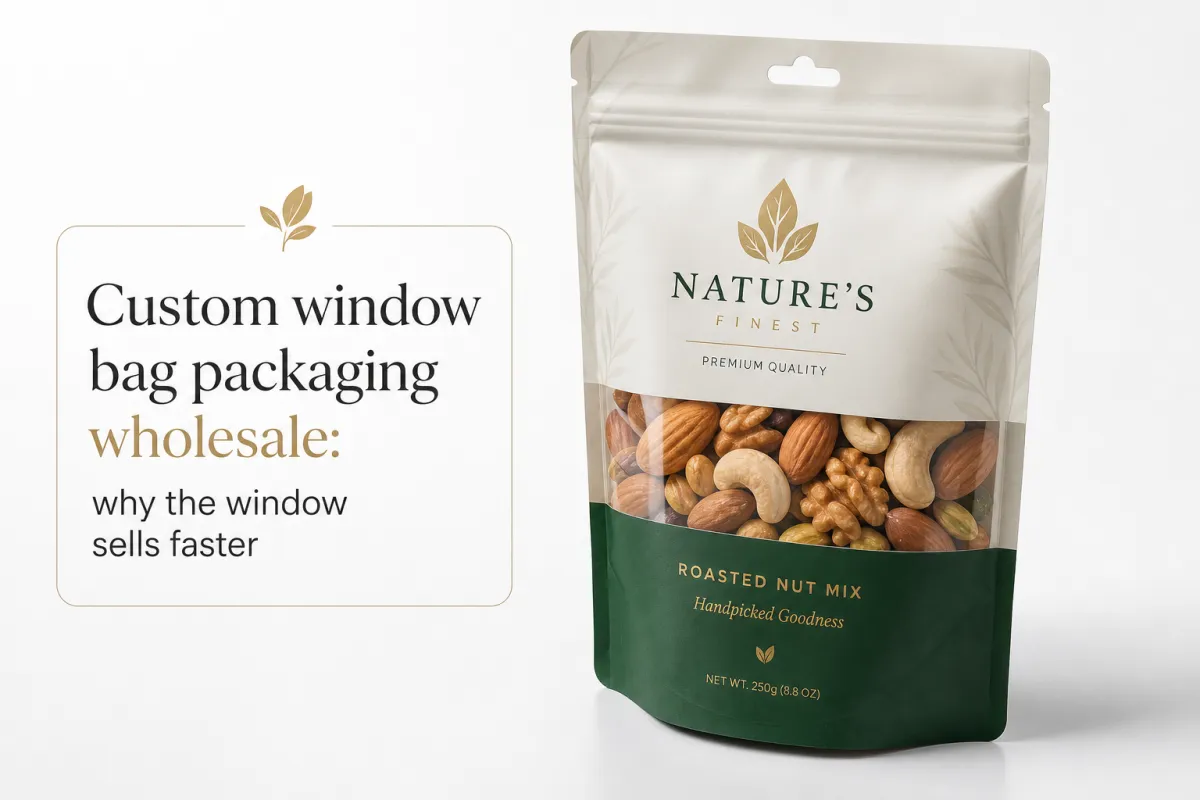
Custom window bag packaging wholesale sells because it reduces uncertainty. Shoppers do not need a long explanation when the item is visible through a clean, well-placed panel. Snacks with texture, soaps with natural variation, candles with a specific wax finish, and accessories with shape-dependent appeal all benefit from that instant proof. A window says, "Here it is." That line is shorter than marketing copy, and usually far more persuasive.
There is a second effect that gets missed in a lot of packaging meetings: speed. Industry observers have long pointed out that shoppers make many shelf decisions in just a few seconds, which is exactly why a visible product beats a paragraph of claims. On a crowded shelf, the window changes the rhythm of the aisle. A fully printed bag can look premium, yet it can also disappear into visual noise if the design is not doing something memorable. A clear panel breaks the block of color, gives the eye a resting point, and invites a closer look. That matters when the shopper is comparing five similar options in ten seconds or less.
Credibility is the quieter advantage. Custom window bag packaging wholesale does not just display the product; it proves it. Newer brands feel that effect most strongly. A tidy package with a clean product view makes the branding feel direct and less theatrical. That honesty carries over into e-commerce too. A front-facing window can make a product feel like a real object, not a studio prop. For categories where return risk is tied to expectation mismatch, that matters more than a glossy finish ever will.
Window packaging can also sharpen the copy. Shelf space is limited, and package faces are crowded with claims, ingredients, barcodes, legal copy, and maybe a QR code. The window adds one more job to the surface: showing the item itself. That is useful. It lets the design stay lean while still supporting premium positioning. For brands balancing aesthetics against unit cost, custom window bag packaging wholesale often delivers more value than a heavily decorated pack that only looks expensive from ten feet away.
"If I can see the product, I do not have to imagine it." That is the appeal of the window. The graphics still matter, but the view through the panel does real selling.
A store associate can face product faster when the item is visible. Restocking becomes easier to verify. A buyer walking past a shelf can tell, at a glance, whether the pack is full, clean, and worth picking up. For brands using Custom Packaging Products across multiple formats, window bags often sit beside Custom Printed Boxes in display sets or bundled promotions. The goal is not sameness. The goal is immediate comprehension. Custom window bag packaging wholesale handles that without forcing the budget into a corner.
Food is not the only place where the format makes sense. Small apparel accessories, bath items, sample kits, and gift products all benefit when the item itself has visual appeal. Hiding that appeal behind opaque board can feel like bad judgment. Custom window bag packaging wholesale gives the product space to help carry the presentation while the package handles structure and protection. It also works well in pouch packaging programs where the product needs visibility and a dependable seal.
What makes custom window bag packaging wholesale worth using?
The short answer is simple: it lowers the distance between seeing and buying. Custom window bag packaging wholesale works because it removes doubt, and doubt is expensive. A shopper who can inspect the item through a clear panel is less likely to pause, less likely to ask for help, and less likely to walk away. In categories where the product has texture, color, or a distinctive form, the bag sells through its own honesty.
There is also a practical comparison worth making. A fully opaque pack can hide flaws, but it can also hide strengths. A windowed bag shows both, which means the design has to be disciplined. That discipline pays off. The package becomes a sales tool, not a stage prop. For many buyers, custom window bag packaging wholesale is the point where presentation, protection, and cost finally agree with one another.
That agreement matters most when a brand wants a premium look without paying for a premium structure everywhere else. A well-placed clear film window, a restrained print layout, and the right closure can do more than an oversized box with a decorative finish. The result is Packaging That Feels direct, commercial, and believable. In retail, believable is often the stronger word.
There is another reason it earns shelf space. A window package lets a buyer verify product size and fill level before opening the bag, which cuts down on disappointment later. That matters in the real world, where a six-ounce pouch that looks full in a mockup can look oddly thin on a store peg. The best custom window bag packaging wholesale programs do not hide that reality; they design around it.
Product details that make custom window bag packaging wholesale work
The structure comes first. Custom window bag packaging wholesale can be built as a flat pouch, a gusseted bag, a stand-up pouch, or a folded paper-based bag with a clear panel. Each format behaves differently. A flat bag is simpler and often cheaper. A gusseted build offers more volume. A stand-up pouch reads better on shelf. None of those choices is universally right. Product weight, fill shape, display style, and opening method decide the answer, not a preference for whatever looks nice in a mockup.
Material choice decides whether the package feels smart or merely decorative. Kraft gives a natural, tactile look. SBS or coated paper gives a smoother print face and cleaner color reproduction. Flexible packaging film is better when moisture resistance, odor control, or stronger barrier performance is needed. Dry, lightweight products may do fine in a paper-based build. Grease-sensitive or scent-sensitive items often need laminated film or a lined structure. Custom window bag packaging wholesale should be selected for the actual product, not a mood board.
The window itself has a job to do. In custom window bag packaging wholesale, the panel should reveal enough of the product to build trust, but not so much that the package loses strength or exposes flaws. The best windows show texture, color, fill level, or a branded insert. The weak ones show uneven filling, dust, or a smaller-than-expected item. A good window sells. A careless one apologizes. Clear film windows are especially effective when the product already has strong visual character.
Usability details are not decoration. A resealable zipper matters for products opened more than once. A heat seal helps with tamper evidence and freshness. A tear notch improves the first opening. A hanging hole supports peg display. Bottom gussets improve stability. These details shape how custom window bag packaging wholesale performs after the box leaves the printer and lands in the buyer's hands. Retail packaging has a second life, and the customer lives with that part.
Finish changes the emotional tone of the pack. Matte often reads calm and modern. Gloss pushes color harder and catches more light. Soft-touch adds a premium tactile note. Foil and spot UV can raise shelf presence, though they also lift the unit price faster than most first-time buyers expect. For many wholesale buyers, a restrained one-color or two-color build with a clean window is the better business decision. It protects margin and still looks deliberate. That is how custom window bag packaging wholesale stays useful instead of ornamental.
Overbuilding is easy. Selling through an overbuilt package is not. If a design uses every effect available and still fails to improve product packaging performance, it should be cut back. The strongest custom window bag packaging wholesale often looks simple because the product itself is doing the heavy lifting. In side-by-side comparisons, the simpler option often wins on both cost and shelf clarity.
Specifications for custom window bag packaging wholesale orders
Proper quoting starts with the real numbers. Custom window bag packaging wholesale needs finished dimensions, fill weight, product density, and a clear explanation of how the product sits inside the bag. A pouch for loose snacks behaves differently from a pouch for folded accessories. The dieline should follow the actual volume, not the optimistic version. If the measurements are off, the bag may seal poorly, look bloated, or waste shipping space.
Window size and position should be settled early. In custom window bag packaging wholesale, the window is not a decorative afterthought. It affects layout, seal area, and shelf readability. Centered windows are common. Off-center windows can work when the brand needs room for a logo lockup or more typography. Irregular cutouts can look sharp, but they usually add cutting complexity and cost. The right choice depends on whether shelf impact matters more than budget control.
Barrier performance needs the same attention. Moisture, oxygen, grease, and scent transfer can ruin a good-looking package if the material is not suited to the product. Consumables may require food-safe materials. Bakery items, snacks, and some personal care products benefit from grease resistance. Long distribution chains call for testing instead of guesswork. Ask for moisture vapor transmission rate (WVTR) and oxygen transmission rate (OTR) data when freshness is part of the promise, not just a vague "keep it good" claim. The ISTA testing methods are worth reviewing when packaging will be stacked, dropped, or shipped through multiple handling points. That kind of check is boring in the best possible way; it prevents expensive surprises later.
Window film choice changes the quote too. PET is common when clarity and stiffness matter. PLA may be used when sustainability claims are part of the brief, though performance, heat resistance, and end-of-life realities need to be checked carefully. Not every "eco" film is actually better in landfill, composting, or curbside recycling, so the claim should match the local waste stream. Other clear films exist, and each one shifts the balance between price, clarity, and end-use conditions. For custom window bag packaging wholesale, the film is not a small detail. It is part of the cost structure and part of the performance structure.
A solid production brief for custom window bag packaging wholesale should include the following:
- Finished size and target fill weight
- Window size, shape, and position
- Material preference and thickness target
- Print coverage and finish requirements
- Closure type, seal type, and opening method
- Shipping format: flat, folded, or pre-filled
- Any food-safe, barrier, or fiber sourcing requirements
Dieline accuracy matters more than many first-time buyers expect. A few millimeters can change everything when a bag includes a zipper, gusset, or die-cut window. That is why sample approval is not paperwork theater. It is the test that shows whether the plan survives contact with reality. If the sample is off, the final run can end up with crooked windows, poor sealing, or a fit that looks careless. Custom window bag packaging wholesale runs smoothly only when the technical file is clean.
Quality checks should be direct. Cut accuracy. Window edge cleanliness. Color tolerance. Seam strength. Product fit. Add a test pack, not just a print proof. Fragile, oily, or irregular products deserve a sample using the actual fill. That is the point where problems surface, while they are still fixable. It is not glamorous. It is cheaper than reworking 5,000 units.
If the project includes fiber sourcing or sustainability claims, the FSC standard is a better reference point than vague "eco" language. The same logic applies to recycled content or source control. Buyers pursuing custom window bag packaging wholesale should ask for documentation that matches the claim, not a polished sentence that sounds responsible without proving anything.
Custom window bag packaging wholesale pricing, MOQ, and cost drivers
Custom window bag packaging wholesale pricing usually comes down to five variables: size, material, print coverage, finish complexity, and window construction. Larger bags use more material. Heavier board or laminate increases cost. Dense print coverage adds setup and ink work. Foil, spot UV, and specialty coatings bring more labor and more risk. A simple window is cheaper than a custom die-cut shape with added finishing steps. None of this is mysterious. It is manufacturing math.
MOQ follows the same logic. A smaller run has to carry the setup cost across fewer units, which raises the per-bag price. A larger run dilutes the fixed cost and brings the unit number down. For custom window bag packaging wholesale, the best range is the one that matches sales velocity without tying up cash in slow-moving inventory. The right order size depends on the product's movement, not on how ambitious the launch sounds in a meeting.
Here is a practical comparison for quote planning. The numbers are not universal, and they move with bag size, print coverage, and finish selection, but they give a useful starting point for custom window bag packaging wholesale.
| Run size | Typical use | Unit price range | Setup cost | Notes |
|---|---|---|---|---|
| 1,000-2,500 | Pilot launch or limited retail test | $0.42-$0.78 | $180-$450 | Higher unit cost, useful for fit checks and shelf response |
| 5,000-10,000 | Main launch and early reorder planning | $0.18-$0.34 | $180-$450 | Usually the best balance of cost and inventory control |
| 20,000+ | Replenishment or established product line | $0.11-$0.22 | $180-$450 | Best per-unit cost, though lead time and cash outlay rise |
If a quote looks unusually cheap, read the fine print. Some low numbers exclude artwork changes, freight, window tooling, or a second proof. Some hide thinner material. Custom window bag packaging wholesale should not feel like a surprise box. Ask what is included, what triggers extra charges, and whether the quote is based on the actual dieline or on a placeholder size that will never survive production.
Cost spikes appear in predictable places. Multi-step finishing, custom inserts, unusual window shapes, heavier board, and high ink coverage all push the price upward. If the bag is assembled or pre-packed, labor and shipping move up too. Flat-shipped bags are usually cheaper to move and easier to warehouse. Pre-filled units only make sense when the project truly needs that format. For many brands, a clean flat pack gives better economics and fewer headaches.
A tiered quote request helps clear the fog. Ask for one price at the minimum viable order, one at the likely launch quantity, and one at a larger production run. That makes the margin picture easier to read. It also shows whether custom window bag packaging wholesale works as a test run or a full-scale launch. Guessing is expensive. Tiered pricing is not exciting, but it is practical.
If your order also touches Wholesale Programs, compare repeat-order terms before choosing the first run size. A slightly larger opening order can make sense if it reduces the next two replenishments and keeps the packaging aligned with demand. That is ordinary buying discipline, not optimism wearing a tie. For some brands, that decision alone makes custom window bag packaging wholesale the better long-term option.
Process and timeline for custom window bag packaging wholesale
The workflow for custom window bag packaging wholesale is usually direct: inquiry, spec review, dieline confirmation, artwork setup, proof approval, sampling, production, inspection, and shipping. It only turns messy when the brief is incomplete. A good supplier asks for dimensions, material preference, window details, and target quantity before talking about pricing. That saves everyone from re-quoting the same job three times.
Timing changes with complexity. A simple structure with a standard window and clean artwork moves faster than a new shape with a specialty finish. Sampling takes time because the buyer needs to see the fit and the print behavior in the actual material. Proof approval matters too. A four-day delay on a basic question is enough to push the schedule. That is not a supplier problem. That is a timeline problem.
Most delays show up in the same places. Missing dimensions. Vague artwork. Last-minute material changes. A window moved after the dieline is already approved. Someone on the buyer side decides the logo should be larger, then the pack has to be rebuilt. Custom window bag packaging wholesale is not fragile, but it does need decisions to stay still long enough for production to happen.
A practical schedule should include cushion. If the launch date is fixed, do not plan as though every step will move perfectly. Leave time for sample review, proof corrections, print setup, production, and freight transit. Working backward from the shelf date usually produces a more realistic plan than starting with the day the quote arrives. Seasonal launches and promo drops deserve extra breathing room. The packaging team will use it well.
One decision-maker on the buyer side saves time. Two people can approve a design. Five people can stall it. That sounds blunt because it is. Custom window bag packaging wholesale moves best when one person owns the final call and the internal feedback is collected before it reaches production.
Here is a simple timeline framework that works for many projects:
- Day 1-2: Send specs, quantity, artwork, and target ship date.
- Day 3-5: Review quote, confirm structure, and approve dieline.
- Day 6-10: Receive proof or sample, then request corrections if needed.
- Day 11-20: Production for standard builds; complex builds may take longer.
- Final step: Inspection, packing, and freight booking.
That schedule is a planning model, not a promise. Unusual windows, premium finishes, and compliance review all add time. Packaging teams get blamed for slow work when the real issue is late approval. Custom window bag packaging wholesale only appears slow when the front end is disorganized.
Brands comparing Custom Packaging Products across formats often line up the window bag with companion cartons, inserts, or display boxes at the same time. That keeps the packaging language consistent and gives the whole line a more deliberate look. A product shelf tells a story whether the brand planned it or not. The better choice is to plan it. The same logic applies when retail packaging needs to support launch kits, promotions, and repeat orders.
Why choose us for custom window bag packaging wholesale
Buyers do not need noise. They need predictable output. Custom window bag packaging wholesale should come with consistent dimensions, clean print, and communication that does not hide the important parts. If a supplier cannot explain how the window is cut, how the seams are checked, or what changes the price, that is a warning sign. Fancy presentations do not rescue a weak run. Clear specifications do.
The wholesale value sits in the details buyers actually feel: realistic MOQ options, stable pricing, proof support, and structure recommendations that fit the product. Some items need a paper-based look. Some need a barrier liner. Some need more shelf presence and less surface treatment. Custom window bag packaging wholesale should adapt to the product instead of forcing the product into a generic package.
There is a difference between a printer and a packaging partner. A printer prints what is sent. A packaging partner helps refine the dieline, trims unnecessary cost, and catches design problems before they become inventory problems. If a design is overbuilt, that should be said plainly. If the window is too large, that should be said too. If a finish raises unit cost without improving shelf performance, say that as well. Honest packaging advice is worth more than polite overproduction.
Quality control should stay specific. For custom window bag packaging wholesale, check cut accuracy, window alignment, seal strength, and print consistency before shipment. Ask for a sample approval path that uses the actual material, not just a flat art proof. That difference separates a pretty PDF from a package that behaves in the real world. Food, scented, and delicate products leave very little room for error.
Packaging should support sales without pretending to be the product. A pack can look expensive and still be a poor wholesale buy. A pack can look simple and still perform well. Margin matters. So does usefulness. That is why custom window bag packaging wholesale is often a smarter choice than a fancier format that costs more and contributes less at shelf.
From a broader branding view, window packs sit comfortably beside custom printed boxes, display cartons, and other retail packaging pieces. They work especially well when a brand wants the product visible but still wants a structured, professional presentation. That is why so many buyers return to custom window bag packaging wholesale for launches, replenishment, and promo sets.
Next steps for custom window bag packaging wholesale
The next move is simple. Gather the product dimensions, fill weight, target quantity, window preference, print files, and required ship date. If the product has an irregular shape or a fragile fill, send a sample if possible. One physical sample can replace a long chain of email guesses. Custom window bag packaging wholesale quotes improve fast when the brief is complete.
Compare two quote scenarios. One should prioritize lower unit cost. The other should prioritize shelf impact. If the lower-cost version still looks strong, the decision gets easier. If the premium version does not improve the business case, trim it back. That is not being cheap. That is buying packaging with a calculator in hand. Brands that work this way usually protect margin better and reorder with less drama.
If the shape, fill level, or window placement is new, ask for a sample or prototype before mass production. That matters most when the bag needs to stand, reseal, or move through several handling points. One approved sample is worth more than ten opinions. Once the sample is right, the production run becomes routine instead of speculative.
Repeat programs work better when they are tied to a wholesale plan instead of a rush order. That is where Wholesale Programs help keep replenishment moving and prevent the panic reorder that always seems to appear just as stock is running low. A strong launch is not the finish line. It is the start of the next buying cycle. For brands that reorder on schedule, custom window bag packaging wholesale becomes easier to manage and easier to scale.
Before you request quotes, lock three things down: the true fill size, the window size, and the order volume that matches your sales pace. If those inputs are vague, the price will be vague too. If they are clear, custom window bag packaging wholesale turns into a straightforward manufacturing decision instead of a guessing game.
Frequently Asked Questions
What affects custom window bag packaging wholesale pricing the most?
Size, material choice, print coverage, and window complexity drive most of the cost. Special finishes, custom inserts, and heavier barrier materials raise the unit price quickly. Ordering more units usually lowers the per-bag cost because setup is spread across the run. In practical terms, custom window bag packaging wholesale gets cheaper when the run is larger and the structure is simpler. Clear film windows and plain print layouts usually keep the quote closer to the low end.
What is a typical MOQ for custom window bag packaging wholesale orders?
MOQ depends on structure, materials, and printing method rather than one fixed number. Simpler stock-based formats can start lower; fully custom builds usually need a larger run to make sense. Ask for tiered quotes so you can see the difference between a small test run and a production order. That is the clearest way to judge custom window bag packaging wholesale against your margin target. It also helps you compare flexible packaging options against cartons or custom printed boxes.
Can I customize the window size and shape on wholesale packaging?
Yes, window size, placement, and shape are usually customizable if the dieline supports it. Complex shapes can improve shelf appeal, though they may add cutting and setup costs. The window should show the product clearly without weakening the bag or interfering with sealing. That balance is what makes custom window bag packaging wholesale useful rather than decorative. A well-sized clear panel often performs better than a large cutout that exposes the wrong part of the product.
How long does production take for custom window bag packaging wholesale?
Simple jobs move faster; new sizes, custom windows, and specialty finishes take longer. Sampling and proof approval are usually the biggest checkpoints before full production begins. Add time for freight, especially if the packaging is needed for a launch date. Good planning keeps custom window bag packaging wholesale on schedule without forcing the whole order into a rush. The tighter the brief, the more predictable the timeline.
What do I need to start a custom window bag packaging wholesale quote?
Send the product dimensions, fill weight, target quantity, and preferred material. Include your print files, window preference, finish choices, and any food-safe or barrier requirements. If you have a deadline, share it upfront so the quote reflects a realistic timeline. The more complete the brief, the better the custom window bag packaging wholesale pricing will be. A physical sample helps even more when the fill is irregular or the product is delicate.

