Buyer Fit Snapshot
| Best fit | Custom Satin Ribbon for Boxes projects where brand print, material claims, artwork control, MOQ, and repeat-order consistency need to be specified before quoting. |
|---|---|
| Quote inputs | Share finished size, material target, print colors, finish, packing count, annual reorder estimate, ship-to region, and any compliance wording. |
| Proofing check | Approve dieline scale, logo placement, barcode or warning zones, color tolerance, closure strength, and carton packing before bulk production. |
| Main risk | Vague material claims, crowded artwork, missing packing details, or unclear freight terms can make a low unit price expensive after revisions. |
Fast answer: Custom Satin Ribbon for Boxes: Branding That Feels Premium should be specified like a repeatable production item. The safest quote records material, print method, finish, artwork proof, packing count, and reorder notes in one written spec.
Production checks before approval
Compare the actual filled-product size with the drawing, then confirm tolerance on folds, seals, hang holes, label areas, and retail display edges. Reserve space for logos, QR codes, warning copy, and material claims before decorative graphics fill the panel.
Quote comparison points
Review material grade, print process, finish, sampling route, tooling charges, carton quantity, and freight assumptions side by side. A quote is only useful when the supplier can repeat the same color, closure quality, and packing count on the next order.
Two packages can leave the same warehouse, carry the same product, and even use the same box style. Add custom satin ribbon for boxes to one of them, though, and the customer reads it differently before the lid even moves. The package suddenly feels more considered. More giftable. A little more worth opening. That reaction is not magic; it is material psychology. Satin catches light in a soft, deliberate way, and the ribbon introduces motion to a surface that would otherwise sit still.
I have seen this play out in product sampling meetings more times than I can count. A team arrives convinced the box itself is doing all the work, then a ribbon sample lands on the table and the tone shifts. The same carton feels warmer. More premium. Sometimes, honestly, a bit more human. That is why custom satin ribbon for boxes keeps showing up in beauty, gifting, jewelry, luxury e-commerce, and PR mailers. It does one job very well: it changes the first impression without needing to shout.
For brands building branded packaging, that matters. Ribbon can support package branding, frame a logo, and set expectations for retail kits, subscription drops, product launches, and seasonal sets. If you are comparing matching components too, our Custom Packaging Products page is a practical place to start, because ribbon works best when it fits the box instead of fighting it for attention. That part is kind of obvious once you see a mismatched example.
The strongest programs treat custom satin ribbon for boxes as part of the packaging system, not as an afterthought added on Friday afternoon. Box size, closure style, print method, shipping method, and brand tone all shape the final result. A 10 mm ribbon on a rigid magnetic box says something very different from the same ribbon on a folding mailer. The real work is making the whole package feel intentional from the first glance through the final reveal.
Custom Satin Ribbon for Boxes: Why the Unboxing Feels Bigger
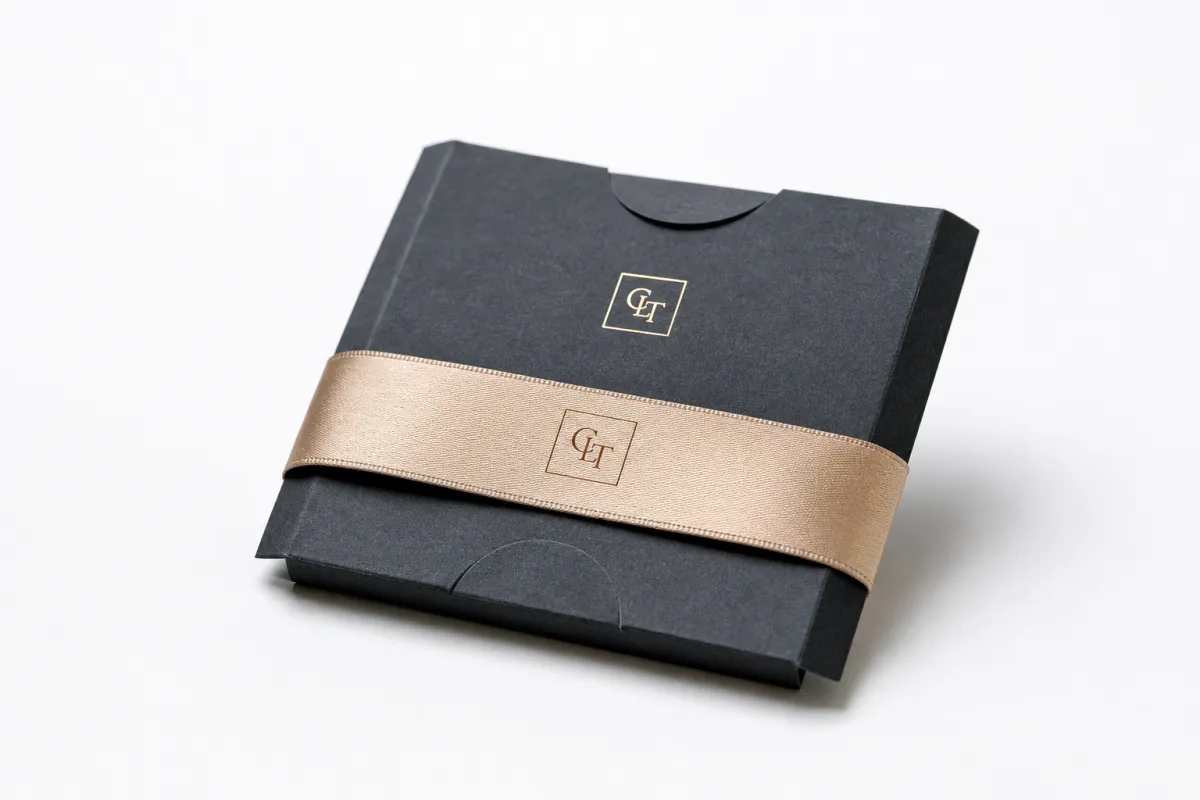
Picture two identical boxes sitting on a desk. Same dimensions. Same product inside. Same shipping label. One is sealed with tape and a plain flap, while the other uses custom satin ribbon for boxes tied into a neat bow. The second package feels like a gift before anyone opens it. Satin creates that shift because it brings sheen, softness, and movement to a surface that would otherwise feel flat and transactional.
Satin works because it reflects light in a controlled way. It is glossy without feeling loud, and smooth without looking cold. That balance is useful for packaging buyers who need the finish to feel premium without tipping into excess. Custom satin ribbon for boxes can soften the geometry of rigid packaging, add contrast to matte cartons, or signal that a release belongs in a higher tier. A small material choice, yes. A large visual return, also yes.
There is a practical definition worth keeping in view. Satin ribbon for packaging is usually a woven or finished ribbon with a smooth face, enough body to hold a knot or loop, and edges that can stay neat through handling. Depending on the supplier, custom satin ribbon for boxes can carry printed logos, short messages, repeated marks, or subtle brand blocks. That makes it useful for both decoration and branding, which is why it shows up so often in premium programs.
The strongest use cases are the ones where the customer should feel a little extra care. Retail gifting, influencer mailers, event kits, luxury mail-order, and seasonal packaging all benefit from custom satin ribbon for boxes. A holiday capsule may be short-lived, but the memory of the packaging can outlast the box itself by weeks. Sometimes months. That is where the value lives.
Many packaging teams underprice the visual role of closure. Structure and print get the budget attention, while finishing gets treated as optional. In premium product packaging, finishing is often what the customer sees first. Satin ribbon can act as a frame, a seal, or a signal. It can also keep the brand from feeling too rigid. A box can be precise and still feel warm. The trick is not overthinking it until the package loses its nerve.
“If the ribbon feels like an afterthought, the whole package feels like an afterthought.” That line comes up a lot in conversations with teams selling into giftable, beauty, and high-aspiration categories.
The comparison is simple. Plain closure methods tell the customer, “This package is doing its job.” Custom satin ribbon for boxes says, “This package was designed to be seen, touched, and remembered.” That is why ribbon appears so often in packaging design for cosmetics, jewelry, gourmet food, boutique apparel, and direct-to-consumer launches that want a premium signal without looking stuffy.
All of this leads to a bigger point: the ribbon should match the box, not merely decorate it. A ribbon that is too narrow on a large rigid box can look timid. A ribbon that is too wide on a small carton can overwhelm the layout. Good custom satin ribbon for boxes work starts with proportion, then moves to color, print, and application method. The more deliberate those choices, the stronger the package reads.
How Custom Satin Ribbon for Boxes Is Produced and Applied
The production flow for custom satin ribbon for boxes usually begins with stock selection. A supplier will ask for width, color, quantity, artwork, and the intended use case. Then comes the proof stage, where the design is laid out on the ribbon to check spacing, repeat length, and legibility. Only after the proof is approved does the order move into printing, weaving, heat transfer, or another finishing method. That sequence matters because a logo that looks perfect on a screen can fail fast once it lands on a flexible surface.
Customization methods vary more than many buyers expect. Some versions of custom satin ribbon for boxes use surface printing, which works well for clean logos and short copy at moderate volume. Others use woven branding, foil-style accents, or heat transfer, depending on the budget and the visual goal. If the artwork is simple and the order is large, printing can be efficient. If the ribbon needs a more integrated, textile-like look, woven or specialty methods may justify the extra cost.
Application is the other half of the story. Custom satin ribbon for boxes can be tied by hand into a bow, wrapped around a sleeve, threaded through a box closure, or pre-attached during pack-out. Each method changes labor demand. Hand-tying adds warmth and variation, which can be ideal for small premium runs, but it also adds labor and inconsistency. Pre-attached ribbon is faster on a line, though it needs tighter control over length and alignment. Nobody wants a box line turning into a ribbon clinic.
That is one reason sample approval matters so much. A physical sample lets the team check how the ribbon feels, how the logo reads at arm’s length, and whether the color still works under store lighting or camera flash. For custom satin ribbon for boxes, a sample is not a formality. It is a risk check. It catches issues with sheen, print sharpness, edge finish, and even the way the ribbon behaves in a knot before the full run starts.
Packaging teams also need to think about how the ribbon behaves during pack-out. Some ribbons slip more easily than others. Some crease if they are folded sharply. Some fray at the ends unless they are heat-sealed or cut cleanly. If the line is moving quickly, that can turn into wasted seconds on every unit. With custom satin ribbon for boxes, a tiny handling issue at scale becomes a real labor cost, not just a nuisance.
For teams that ship finished kits, it helps to align the ribbon method with the pack format. A rigid box with a lift-off lid might work well with a wraparound tie. A mailer might need a shorter pre-cut piece and an internal closure card. A sleeve might need the ribbon to run through slits instead of around the full perimeter. The right custom satin ribbon for boxes method is the one that matches the packaging structure, not just the artwork.
There is also a standards lens here. If the box will travel through parcel networks, the packaging still needs to survive real handling. For shipping validation, many teams use ISTA test methods as a baseline for drop and vibration expectations. Ribbon is decorative, yes, but the package still has to pass basic transit stress. A bow that looks perfect in the studio is not enough if it arrives crushed or untied.
Key Factors That Shape Custom Satin Ribbon for Boxes
The first factor is width. For custom satin ribbon for boxes, width changes the whole visual ratio. A 10 mm ribbon may suit a small jewelry box or sample carton, while 25 mm or 38 mm often works better on larger rigid boxes and gift sets. The wrong width throws off the package in a way that is hard to ignore. Too narrow can look underdesigned. Too wide can swallow the box face.
Length matters just as much. If the ribbon is tied into a bow, the tails need enough room to look deliberate rather than short and awkward. If it is wrapped around a box sleeve, you need enough yardage to cover the perimeter and still leave a clean closure. With custom satin ribbon for boxes, teams often underestimate how much extra length gets consumed by bows, overlaps, and setup waste. Careful measurement saves rework, and rework is where budgets quietly go to die.
Color contrast is another factor people misjudge on screen. A logo may look crisp in the artwork file and disappear in production if the ribbon and box stock sit too close in value. A champagne ribbon on a cream box can vanish. A charcoal ribbon on deep navy board can do the same. In custom satin ribbon for boxes, contrast often matters more than the exact shade family because the customer sees the package at a distance first.
Box style changes the decision too. Rigid boxes usually support wider, more prominent ribbon because they have larger faces and cleaner edges. Folding cartons often call for a lighter touch. Mailers can work with ribbon, but the structure must support the closure without bulging. Sleeves and unusual shapes need their own logic. A good rule is straightforward: the ribbon should respect the geometry of the box. That is where strong package branding starts to feel purposeful rather than decorative.
Durability is the practical variable that gets forgotten until storage or transit exposes it. Satin can crease, fray, or lose its crisp appearance if it is crushed in bulk. If the order will sit in a warehouse before use, or if finished kits will travel through multiple touchpoints, choose a ribbon construction that holds its finish. In custom satin ribbon for boxes, the cheapest-looking option is often the one that looks fine on day one and tired by day ten.
Artwork complexity also deserves attention. Small text, thin lines, and crowded taglines do not always reproduce well on satin. The ribbon surface moves, and the print must stay readable across folds and curves. A clean logo plus a short brand line often beats a detailed layout every time. That is especially true in Custom Printed Boxes programs where the ribbon supports the print system instead of fighting it.
Step back from the mockup and imagine the real viewing distance. How does the package look from three feet away? From a desk? In a product photo? The design that wins on-screen is not always the design that wins in the hand. That is why so many strong custom satin ribbon for boxes programs use restraint. They rely on proportion, contrast, and clean repetition instead of trying to say everything at once.
Paperboard sourcing can matter as well, especially if the packaging story includes responsible material choices. If the outer box uses certified fiber, FSC certification gives you a recognized framework for sourcing claims. The ribbon itself may not be FSC-certified, but the total package can still tell a credible sustainability story if the box, insert, and print choices align. That honesty is what keeps the message believable.
Process and Timeline for Custom Satin Ribbon for Boxes
A solid production plan for custom satin ribbon for boxes starts with a simple inquiry, not with artwork alone. The supplier needs ribbon width, color target, quantity, box dimensions, and the expected application method. Then comes a quote, then artwork submission, then proofing. If a sample is required, that step should happen before the full run is released. The sequence sounds basic, yet most timeline problems begin when one of those steps gets rushed or skipped.
Lead time depends on more than production capacity. Quantity has a big impact, of course, but so does print complexity. A single-color logo on standard satin can move faster than a multi-color repeat with precise registration. Custom widths, specialty finishing, and cut-to-length requirements also add time. For custom satin ribbon for boxes, the useful planning question is not “How fast can you make it?” It is “What has to be approved before the clock can actually start?”
Typical orders often need around 10 to 20 business days after proof approval, though that range shifts with volume, sampling, and freight. Rush jobs can compress the schedule, but they rarely remove proofing discipline. If the artwork arrives late or the color needs a correction, the calendar moves. That is why custom satin ribbon for boxes should be planned against the box production schedule, not after it. Packaging that lands in separate waves creates avoidable warehouse clutter and launch stress.
There is a clear difference between standard production and rush work. Standard orders give the team room to correct artwork, compare colors, and approve a sample without pressure. Rush work can suit a small event run or a time-sensitive launch, but it narrows the room for revision. With custom satin ribbon for boxes, the fastest path is usually the one with the fewest surprises. That means clean files, stable specs, and a sign-off process that is actually used, not just mentioned in a meeting.
Build your timeline backwards from the ship date. If the ribbon has to arrive before the boxes are packed, allow time for freight transit, receiving, and any rework. If the packaging is tied to a press event, add a buffer for color correction and reproofs. In premium packaging, a one-day delay can ripple through the whole launch. That is why custom satin ribbon for boxes deserves its own schedule line, not a loose note in the margin.
Here is the practical planning sequence many teams use:
- Confirm the box dimensions, closure style, and ribbon width.
- Approve the logo placement and repeat length for custom satin ribbon for boxes.
- Request a proof or sample if the ribbon will be customer-facing.
- Lock the production date only after sample approval.
- Match freight timing to the box and assembly schedule.
Planning note: The ribbon should arrive early enough to absorb one round of corrections. That matters even more if the package will be photographed for marketing or sold through retail channels, where the ribbon becomes part of the first impression. A tidy sample in a meeting is useful; a tidy line item in the wrong week is not.
Cost and Pricing: What Drives a Quote for Custom Satin Ribbon for Boxes
Price is shaped by a handful of specific variables. Width, total yardage, print method, color count, ribbon quality, and packaging requirements all affect the final quote for custom satin ribbon for boxes. A narrow single-color ribbon in a large run is a different purchasing decision from a short, premium run with multiple proof rounds. The mistake many buyers make is comparing quotes that do not actually describe the same product.
MOQ, or minimum order quantity, has a strong effect on unit price. Small orders often carry a higher per-piece cost because setup, proofing, and plate or file preparation are spread across fewer yards. A 1,000-yard order may feel expensive compared with a 5,000-yard order, but the setup math is what drives the gap. For custom satin ribbon for boxes, the economics usually improve as the run grows, provided the quantity matches the packaging plan.
Here is a useful pricing snapshot for comparison. These are broad market-style ranges, not a promise from every supplier, but they help buyers talk in real numbers instead of vague adjectives.
| Ribbon Option | Best Fit | Typical MOQ | Relative Cost | Notes |
|---|---|---|---|---|
| Single-face printed satin | Retail gifting, PR kits | 500-1,000 yards | $0.18-$0.28 per yard at 5,000 yards | Strong value for basic logo work on custom satin ribbon for boxes |
| Double-face satin | Visible bows, premium mailers | 500-1,000 yards | $0.24-$0.38 per yard at 5,000 yards | Smoother on both sides, useful when the ribbon twists |
| Woven-edge or woven branding | Luxury packaging, long shelf life | 1,000+ yards | $0.30-$0.55 per yard | Often chosen for crisp branding and a more textile-like feel |
| Special finish or foil-look ribbon | Seasonal launches, event packaging | 1,000+ yards | $0.35-$0.60 per yard | Higher visual impact, but not always the most forgiving option |
Those ranges explain why small orders can feel expensive. If you only need a few hundred yards of custom satin ribbon for boxes, the setup cost still exists. Sample fees, file cleanup, and proofing time do not disappear just because the order is small. That is why teams often see better value by aligning ribbon buys with a quarter’s worth of packaging demand rather than a single week’s launch.
Hidden costs deserve attention too. Artwork revisions can add time. Rush fees can add money. Special cutting, rewinding, or pre-assembly can alter the quote. Freight is often the least exciting line item, but it can move the total more than expected if the ribbon needs to cross regions quickly. With custom satin ribbon for boxes, “cheap” is only useful if the final landed price still fits the box program.
The comparison framework that saves the most confusion is simple. Check that every supplier is quoting the same width, same total length, same print method, same finish, and same delivery terms. A lower price on a narrower ribbon is not actually a lower price. A quote that skips sampling may look better until the proof stage exposes a problem. Smart buying of custom satin ribbon for boxes is less about chasing the lowest number and more about comparing the same thing across vendors.
Cost rule of thumb: If the ribbon is visible in photos, retail display, or gift unboxing, the value is in the brand signal as much as the material itself. That is why many teams are comfortable spending a little more on a ribbon that photographs cleanly and ties consistently. In premium packaging, appearance is part of the product story.
For a broader packaging purchase, it helps to pair ribbon sourcing with your other packaging buys through our Custom Packaging Products range. That way the box, insert, and ribbon are priced as one system instead of three disconnected purchases. It also makes volume planning easier when the packaging design sits inside a launch calendar.
Common Mistakes With Custom Satin Ribbon for Boxes
The most common mistake is choosing a ribbon that is too narrow for the box. It sounds minor, yet the package can end up looking underbuilt. Custom satin ribbon for boxes should support the visual scale of the carton. A slim ribbon on a large rigid box can look like a last-minute fix, especially if the box itself is tall, wide, or highly finished. Proportion is the first test.
The second mistake is crowding the artwork. Satin is a flexible surface, and tiny text does not always stay readable once the ribbon bends, twists, or folds into a bow. Long taglines, overly detailed marks, and thin lines can disappear. In custom satin ribbon for boxes, simpler often performs better. A clean logo, a short brand line, and good repeat spacing usually beat a cluttered layout that tries to say too much.
Color planning is another trap. Teams sometimes choose a ribbon that looks elegant in isolation but weakens the package once it sits against the box stock. That is especially risky with matte cartons, soft-touch lamination, or highly saturated board colors. The ribbon should either contrast clearly or harmonize in a controlled way. If it blends too much, the branding fades. If it clashes, the whole package feels noisy. Good package branding depends on that balance.
Handling problems are just as damaging. Frayed ends, uneven bow loops, and ribbon that slips during packing can make even a premium package feel rushed. If the ribbon is cut inconsistently, the variation shows. If it is tied too loosely, it loses shape in transit. With custom satin ribbon for boxes, production quality is only half the equation. Assembly quality is the other half, and customers notice both.
Skipping a physical test is probably the biggest hidden risk. A ribbon can look perfect in a digital mockup and still crease badly when folded around corners. A print can look centered on screen and drift once the fabric is tensioned. That is why test wraps and sample ties are worth the time. For custom satin ribbon for boxes, the sample often reveals the one detail that would have annoyed everyone later.
Another issue is pairing the ribbon with a box style that cannot support it. A fragile folding carton may not hold a heavy wrap the way a rigid box does. A mailer may not leave enough structure for a full bow. If the package is part of a shipping program, the ribbon should be chosen alongside the parcel test plan. Otherwise the finish may survive the studio but not the carrier network.
And there is a branding mistake that is easy to miss: using ribbon to solve a messaging problem. Ribbon is a finishing touch, not a place to print the entire brand story. If the box, insert, and outer pack are already speaking clearly, the ribbon only needs to reinforce the message. That is usually where custom satin ribbon for boxes performs best. It strengthens the package instead of carrying it alone.
One more comparison helps. A premium package with an inconsistent ribbon can feel less trustworthy than a simpler package with no ribbon at all. Buyers are remarkably sensitive to consistency. If one bow is tight and another is loose, or if the print drifts from one side to the next, the package looks hand-finished in the wrong way. Custom satin ribbon for boxes should look crafted, not careless.
Expert Tips and Next Steps for Custom Satin Ribbon for Boxes
Start with a spec sheet. That sounds basic, but it solves half the quoting problems. Include box dimensions, ribbon width, intended closure style, artwork files, color targets, quantity, and delivery date. The tighter the brief, the more accurate the quote for custom satin ribbon for boxes. If the supplier knows whether the ribbon will be tied, wrapped, or threaded through slits, they can suggest a more realistic length and finish.
Request a physical sample whenever the ribbon is going to customers, media, or retail buyers. A screen cannot tell you how the satin feels in the hand. It cannot show how light moves across the ribbon. It cannot reveal whether the logo remains readable from a few feet away. For custom satin ribbon for boxes, the sample is the closest thing to a live test before production scales up. That is the boring answer, but it is also the one that saves money.
Think about audience first. A luxury gifting program wants one kind of ribbon behavior. An e-commerce launch wants another. Retail display needs a ribbon that holds its shape on shelf. Event packaging may favor a more dramatic bow or a faster tie method. The right custom satin ribbon for boxes choice depends on who sees it, where they see it, and how long the package needs to stay polished.
Keep the branding hierarchy clean. One message is usually enough. If the ribbon already carries a logo, do not force it to also carry a paragraph, a tagline, and a website. That is how beautiful packaging gets crowded. In custom satin ribbon for boxes, restraint often looks more expensive than decoration. A short mark repeated well beats a crowded surface every time.
It also helps to compare suppliers on communication, not only on price. Response speed, proof quality, and willingness to explain the finish matter because ribbon projects often move alongside box production. If a supplier sends a crisp proof, asks the right questions, and flags a risk early, that is worth something. The cheapest custom satin ribbon for boxes quote is not a win if it creates extra revisions or delays later.
For brands trying to tighten the whole packaging stack, ribbon should be reviewed with the rest of the box system. That includes inserts, tissue, seal labels, and any outer shipper. Strong product packaging programs do not build each piece in isolation. They decide how the customer experiences the package from the first glance to the final reveal. That consistency is the quiet part customers notice most.
If your box program also includes paperboard sourcing claims, keep the language precise. FSC-certified board, recyclable cartons, and reduced-material inserts are different claims with different implications. Avoid vague sustainability language. Buyers and consumers are more alert than they used to be, and sloppy wording can weaken trust quickly. Responsible packaging design is specific, not fuzzy.
One final observation from the buyer side: the ribbon should earn its place. If it adds cost, labor, and time, it should also add something visible and memorable. That does not mean dramatic. It means purposeful. The best custom satin ribbon for boxes feels inevitable once you see it, as if the package was always meant to look that way.
For teams planning a launch, the next move is straightforward. Define the box, define the audience, request a sample, and compare at least two quotes on the same spec. Then choose the version that delivers the clearest presentation of custom satin ribbon for boxes without forcing the rest of the packaging to compensate for a weak finish.
That is the real standard: not whether the ribbon is pretty, but whether it strengthens the whole package. If it does, custom satin ribbon for boxes can turn ordinary cartons into branded moments that feel polished, confident, and worth opening.
What width works best for custom satin ribbon for boxes?
Smaller boxes usually do better with a narrower ribbon, often around 10 mm to 16 mm, so the closure does not overpower the package. Medium and large boxes can handle 25 mm or wider because the surface area gives the branding more room. The best width for custom satin ribbon for boxes depends on box dimensions, logo size, and whether the ribbon is decorative, structural, or both.
How long does custom satin ribbon for boxes usually take to produce?
Timelines vary by quantity, print method, and whether artwork proofing or sampling is required. Simple orders can move faster, while special finishes, custom widths, or changes to the artwork often add time. A safe plan is to line up custom satin ribbon for boxes with the box schedule before final approval so the packaging does not land in separate phases.
Is custom satin ribbon for boxes expensive for small orders?
Small orders usually cost more per unit because setup, proofing, and minimum production runs are spread across fewer pieces. Larger quantities generally reduce the unit cost, but only if the order size matches your actual packaging plan. A clear spec sheet makes custom satin ribbon for boxes easier to compare without paying for unnecessary extras.
Can custom satin ribbon for boxes be printed on both sides?
Some ribbon methods support stronger visibility on one side, while others are better balanced across both faces. Double-sided branding can cost more, so it usually makes sense for packaging that is highly visible or often photographed. If custom satin ribbon for boxes will appear in photos, ask for a sample because camera angles can change how the print reads.
What should I send with my quote request for custom satin ribbon for boxes?
Send box dimensions, ribbon width preference, artwork files, color targets, quantity, and the required delivery date. It also helps to include the closure style, because a bow, wrap, or sleeve changes the ribbon length and application method. If you can share a reference image, the supplier can quote custom satin ribbon for boxes against the look you actually want instead of guessing.

