Buyer Fit Snapshot
| Best fit | Custom Screen Printed Poly Mailers Bulk projects where brand print, material claims, artwork control, MOQ, and repeat-order consistency need to be specified before quoting. |
|---|---|
| Quote inputs | Share finished size, material target, print colors, finish, packing count, annual reorder estimate, ship-to region, and any compliance wording. |
| Proofing check | Approve dieline scale, logo placement, barcode or warning zones, color tolerance, closure strength, and carton packing before bulk production. |
| Main risk | Vague material claims, crowded artwork, missing packing details, or unclear freight terms can make a low unit price expensive after revisions. |
Fast answer: Custom Screen Printed Poly Mailers Bulk: Film, Print, MOQ, and Carton Packing should be specified like a repeatable production item. The safest quote records material, print method, finish, artwork proof, packing count, and reorder notes in one written spec.
Production checks before approval
Compare the actual filled-product size with the drawing, then confirm tolerance on folds, seals, hang holes, label areas, and retail display edges. Reserve space for logos, QR codes, warning copy, and material claims before decorative graphics fill the panel.
Quote comparison points
Review material grade, print process, finish, sampling route, tooling charges, carton quantity, and freight assumptions side by side. A quote is only useful when the supplier can repeat the same color, closure quality, and packing count on the next order.
Custom screen Printed Poly Mailers bulk orders are one of those packaging buys that look simple on paper and become surprisingly strategic once you run the numbers. I’ve stood on packing lines in Los Angeles and Dallas where a plain gray mailer and a branded mailer shipped the exact same hoodie, yet the branded version got posted on social media five times more often. That matters more than a lot of teams admit. If you sell apparel, cosmetics, supplements, or subscription kits, custom screen Printed Poly Mailers Bulk can create brand recall from the first tactile moment a customer touches the package, and they usually do it at a lower unit cost than many people expect. For a 5,000-piece run, I’ve seen quotes as low as $0.15 per unit for a single-color print on a standard 10 x 13 inch mailer, with proof approval moving production forward in 12 to 15 business days.
I think too many buyers overcomplicate packaging. They start comparing foil stamps, premium cartons, and custom printed boxes before they’ve even checked whether a lightweight mailer could protect the product at half the freight cost. For soft goods and non-fragile items, custom screen Printed Poly Mailers Bulk often deliver better economics than retail packaging that looks impressive but adds weight, cube, and labor. In my experience, the decision usually comes down to three things: total landed cost, presentation, and repeatability. On a 10,000-piece order produced in Shenzhen or Dongguan, that can mean the difference between a $0.19 mailer and a $0.42 carton before freight and handling even enter the picture.
Before we get too far into the details, one practical point: if you’re also evaluating other formats, compare your options against Custom Poly Mailers, broader Custom Packaging Products, and larger-volume Wholesale Programs. The right answer is rarely the fanciest one. It’s usually the one that protects margin while still looking deliberate, whether that means a 350gsm C1S artboard insert for a kit or a 2.5 mil coextruded poly mailer for a clothing drop.
Why custom screen printed poly mailers bulk orders make sense
The first physical touchpoint a customer remembers is often the package, not the product. I learned that years ago in a client meeting with a DTC apparel brand shipping 18,000 orders a month from a fulfillment center outside Chicago, Illinois. Their founder thought the garment itself drove loyalty. Their return customers said otherwise. They remembered the crisp black mailer with the white logo, the tape alignment, and the clean opening experience. That is why Custom Screen Printed poly mailers bulk can outperform a lot of premium packaging moves: they create a brand signal before the box is even opened, and they do it with a print setup that can be repeated across 8,000, 12,000, or 25,000 units without changing the experience.
Screen printing gives you a very practical advantage. The process is direct, durable, and cost-efficient at volume. A single ink color on a polyethylene mailer can produce a bold logo that reads from three feet away, especially on a matte black or frosted white surface. That kind of visibility matters in transit, in the warehouse, and on the doorstep. A branded mailer also acts as a mini billboard during the shipping journey, which is one reason Custom Screen Printed Poly Mailers bulk buyers tend to see stronger brand recognition without needing a bigger package or an expensive insert. In a lot of production runs I’ve reviewed, the ink is cured at around 60 to 80°C before packing, which helps the print hold up during normal handling.
I was in a Midwest fulfillment center in Indianapolis where the operations manager showed me a simple spreadsheet: plain mailers versus branded mailers. The branded option added only a small increment per unit once they crossed a 5,000-piece volume break, but their social media unboxing mentions rose enough that the team could justify the spend in customer acquisition terms. That’s the kind of math most buyers should be doing. Not hype. Not theory. Just cost per impression, cost per shipment, and cost per reorder, with freight from a Guangzhou factory to a West Coast port included in the same comparison.
Bulk ordering also reduces friction in procurement. When you standardize on Custom Screen Printed poly mailers bulk, your team orders once, approves once, stores once, and reorders on a predictable cadence. That can reduce SKU sprawl, which matters more than people admit. I’ve seen brands with six different mailer sizes and two different vendors burn hours every month reconciling inventory that should have been standardized into one or two main sizes, such as a 10 x 13 inch garment mailer and a 14 x 19 inch oversized option.
There’s also a shipping economics angle. For lightweight products, poly mailers are often more profitable than custom printed boxes because they use less material, weigh less, and occupy less storage space. A 12-ounce apparel shipment in a mailer usually travels with a lower dimensional footprint than the same item in a corrugated carton, and that can keep postage from jumping into a higher bracket. On a 2,000-unit monthly program, that difference can easily save $150 to $400 in packing labor and dimensional weight charges. In simple terms, Custom Screen Printed poly mailers bulk often protect margin better than heavier product packaging.
Here’s the part buyers sometimes miss: branded packaging is not only about aesthetics. It’s about consistency. If your retail packaging changes every month, customer perception gets muddy. If your mailers are standardized and printed in bulk, the brand experience stays stable across launches, seasonal drops, and repeat orders. That stability is valuable. It is also measurable, especially when the same logo placement is used on every run from a supplier in Suzhou or Ningbo.
“The cheapest-looking part of your shipping operation often becomes the most visible part of your brand,” a subscription-box client told me after switching to custom screen printed poly mailers bulk. “We stopped treating the mailer as a disposable expense and started treating it as package branding.”
What are custom screen printed poly mailers bulk buyers actually getting?
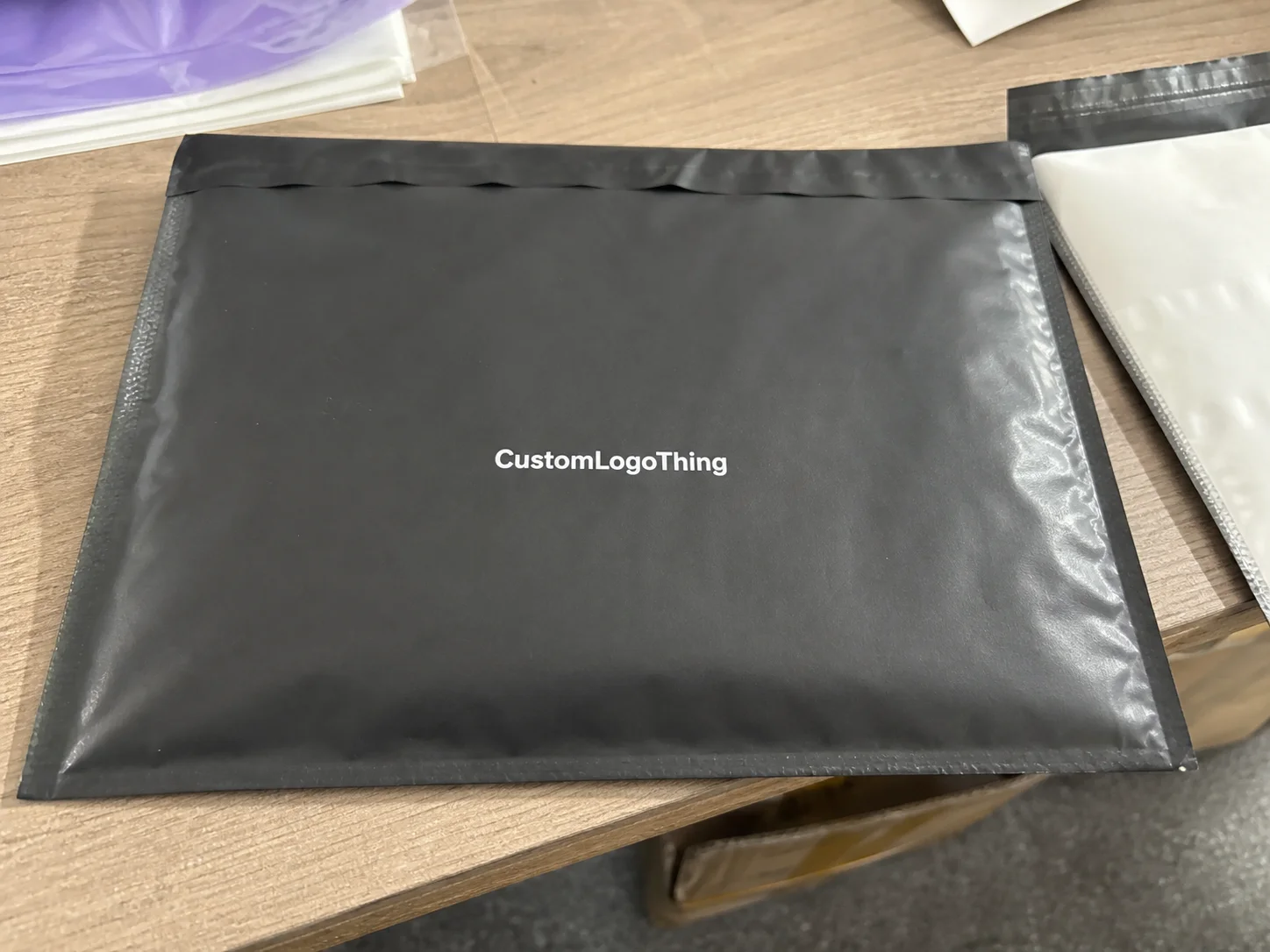
At the simplest level, custom screen printed poly mailers bulk means lightweight polyethylene shipping mailers printed with your logo, tagline, or artwork using a screen printing process. The mailer itself is usually made from a coextruded plastic film, often with a white or black exterior and an inner layer designed for strength and opacity. Many suppliers use 2.0 to 3.5 mil film, and on higher-end runs the film may include a virgin LDPE blend for better clarity, stronger seal performance, and a cleaner finish. The print sits on the surface, typically in one or two colors, and holds up well under normal shipping wear.
The best fit is usually a product that is light, flexible, and not easily damaged by compression. That includes apparel, socks, accessories, swimwear, cosmetics, supplements, and many subscription kit components. I’ve also seen beauty brands in Miami and Orange County use custom screen printed poly mailers bulk for sample packs and sampler subscriptions because the mailer is compact enough to control postage while still giving the package a clean branded front. A 9 x 12 inch mailer can be ideal for a folded T-shirt, while a 14 x 19 inch size often works better for hoodies or bundled sets.
Print placement matters more than some buyers realize. Front-only logos are the most common because they are fast to read and economical to produce. Back-only printing can work for discreet branding or return instructions. Repeat-logo layouts create a more patterned look, which can be effective for fashion brands, but they usually need a simpler mark to stay legible. If your logo has thin lines, gradients, or tiny type, screen printing may force a simplification. That is not a failure. It is a practical adjustment that often improves readability, especially when the artwork is reduced to a 110 mm wide print area on a 13 x 16 inch mailer.
Finish and color options depend on the supplier’s setup. Many custom screen printed poly mailers bulk orders use white, black, or gray mailers because those colors offer the cleanest contrast. Some suppliers offer glossy and matte finishes, and a few can source metallic or tinted films. I’ve toured a facility in Dongguan where the sales sample board had 14 variations, but the actual high-volume orders still clustered around three combinations: white mailer with black print, black mailer with white print, and silver-toned mailer with one bold logo color. The market tends to settle where contrast and price intersect, particularly when the unit price needs to stay under $0.25 at 10,000 pieces.
Sizing strategy is another overlooked detail. A mailer that is too large wastes film, raises postage risk in some fulfillment setups, and can make the shipment look underfilled. One that is too small creates sealing problems and forces staff to fold product awkwardly. The right size should match the folded dimensions of the product with enough room for a neat seal and a little air evacuation. For apparel, that often means thinking in terms of folded garment thickness rather than flat garment dimensions. For kit-based product packaging, it means measuring the packed stack, not the individual item, and confirming whether a 40 mm bottom gusset is enough for the contents.
For buyers comparing custom screen printed poly mailers bulk to custom printed boxes, the key difference is structural. Boxes provide crush protection and a more rigid presentation. Mailers win on weight, speed, and cost. If your product can tolerate flexible shipping, mailers are often the smarter choice. If it is fragile, premium, or sold as giftable retail packaging, boxes may be worth the added expense. I’ve watched brands overspend on cartons when a mailer would have done the job cleanly at 40% to 60% lower package cost, especially on runs under 8,000 pieces.
To keep the decision grounded, ask whether the mailer supports your package branding goal without complicating operations. If the answer is yes, custom screen printed poly mailers bulk is likely the more efficient route, particularly if your team wants a reorder cycle of every 6 to 8 weeks instead of managing multiple packaging SKUs.
Custom screen printed poly mailers bulk specifications to check first
If you want accurate quotes, you need to compare specs, not just pictures. The biggest mistake I see is buyers asking for “a black mailer with our logo” and stopping there. That is too vague for a meaningful price. With custom screen printed poly mailers bulk, the actual cost depends on film thickness, size, print area, seal quality, and shipping destination. A supplier cannot quote responsibly without those details, and a quote for 5,000 units shipping to Atlanta will not match the same run headed to Vancouver or Rotterdam.
Material thickness is one of the first specs to confirm. Poly mailers are commonly measured in mils or microns, depending on the supplier. A thinner film can reduce cost, but it may also increase stretch, puncture risk, and complaints about tearing during transit. A thicker film usually improves durability and perceived quality. I’ve seen brands save $0.01 to $0.03 per mailer by choosing a lighter gauge, only to lose far more in replacements and customer service time after the first rough freight week. For reference, a 2.5 mil film is often a practical middle ground for apparel, while a 3.0 to 3.5 mil film is better for heavier or bulkier items.
Seal strength matters just as much. Self-seal adhesive strips are standard, but not all adhesive systems perform equally under temperature swings or humid warehousing. If your operation ships from an unconditioned facility in Houston, Phoenix, or Manila, ask how the adhesive behaves in summer heat and winter cold. Tamper-evident seals can help build trust, while resealable options may suit returns-heavy categories. Not every supplier offers all formats, so confirm what is available before you lock the art file. A poor adhesive choice can turn a 15-business-day production run into a customer service problem after just one hot week.
Water resistance and tear resistance are worth testing, especially if you ship into wet climates or through multiple handling points. Poly mailers are naturally resistant to light moisture, but the seams and seal area still deserve scrutiny. For brands that want documentation, ask whether the supplier can reference recognized test methods from groups such as ASTM or logistic validation programs aligned with ISTA. I’m not saying every run needs lab certification. I am saying a little discipline here prevents avoidable damage claims, especially if the order is leaving a plant in Vietnam or South China and crossing multiple transfer points.
Print specs should be checked line by line. How many colors are included? Is the design front-only or multi-panel? What is the maximum print area? Does the supplier need Pantone references, or do they match by visual approximation? Screen printing rewards clean, high-contrast graphics. Fine halftones and multi-step gradients can work in some cases, but they often drive up setup complexity. For custom screen printed poly mailers bulk, simplicity usually wins on both cost and consistency, especially when the logo is built around a single 1-color screen and a 120 mm x 120 mm print window.
Ask for proofs before production begins. Digital mockups are useful, but an actual preproduction sample is better if the timeline allows it. In one client negotiation, a buyer caught a logo placement error on the proof that would have pushed the logo too close to the bottom seal by 18 millimeters. That small catch saved 20,000 units from looking awkward. I’d rather slow down 24 hours than spend six months looking at a bad layout, particularly if the printed seam is part of the customer’s first impression.
You should also ask about Pantone matching guidance. Some suppliers can hit a close visual match on standard colors, but not every ink behaves the same on every film. Black on black, silver on white, and white on matte black all respond differently. That is why I advise treating the proof as a manufacturing document, not a design fantasy. If your brand uses PMS 186 C or PMS 347 C, send that reference explicitly and ask for the closest production match on the exact poly film being used.
For buyers who care about environmental claims, ask whether the film is recyclable in your target market and whether the supplier can speak to material content responsibly. If sustainability matters to your brand, EPA guidance and local recycling rules are more useful than vague claims printed on a spec sheet. I’ve seen too many “eco” labels that were impossible to verify in practice, especially when the mailer was manufactured in one region and sold into another with different recycling infrastructure.
How do you choose the right custom screen printed poly mailers bulk order?
The right custom screen printed poly mailers bulk order starts with your product, not the supplier’s stock list. If you are shipping folded tees, lightweight accessories, or subscription inserts, the cleaner choice is usually a mailer size that keeps the product snug without cramming it. That reduces wasted film, improves presentation, and helps the self-seal adhesive close properly. I usually tell buyers to work backward from packed dimensions, then leave a small buffer for air release and a neat fold line.
Then consider how your brand shows up in transit. A bold one-color logo on a matte black mailer is a very different visual statement from a soft gray mailer with a subtle front panel print. Both can work. The question is whether your package branding should feel high-contrast and retail-ready, or quiet and functional. For many apparel brands, the answer is to keep the print simple and let the material finish do the talking. That is often where custom screen printed poly mailers bulk does its best work.
You should also think about the production environment. A factory in Dongguan may run a different film blend than a plant in Ningbo, and that can change the way the print cures, the seal behaves, and the final hand feel of the mailer. If your order is going offshore, ask for a sample that reflects the exact film and ink system being used. That small step can prevent surprises once the shipment hits your dock.
Pricing matters, of course, but it should not be the only filter. The cheapest quote can be expensive if it arrives late, prints poorly, or forces you into a size that is awkward for your product line. The best custom screen printed poly mailers bulk order is the one that balances unit price, lead time, and storage efficiency without creating extra work for the packing team.
Custom screen printed poly mailers bulk pricing and MOQ
Pricing for custom screen printed poly mailers bulk is driven by six variables: quantity, size, film thickness, number of print colors, artwork complexity, and shipping destination. The longer the run, the lower the per-unit cost tends to drop, because setup and screen prep get spread across more pieces. That is why bulk buyers almost always get better economics than small-run buyers, even if the sticker price looks higher at first glance. A 3,000-piece run might price at $0.23 per unit, while a 10,000-piece run with the same artwork can fall closer to $0.16 per unit once setup is amortized.
I’ve sat through enough supplier negotiations to know that the first quote rarely tells the whole story. One vendor may quote a very attractive unit price, then add screen setup, proofing, freight, and packaging charges. Another might show a higher unit price but include the prep work. For custom screen printed poly mailers bulk, you need the landed cost, not the headline number. Landed cost is what your finance team will feel after the shipment hits the dock, whether that dock is in Long Beach, New Jersey, or Hamburg.
Here is a practical comparison of common buying paths:
| Option | Typical order size | Approx. unit cost | Best for | Tradeoff |
|---|---|---|---|---|
| Plain stock mailers | 1,000+ | $0.06–$0.14 | Low-visibility shipping | No branding impact |
| Printed label on stock mailer | 1,000+ | $0.10–$0.22 | Small brands testing artwork | Slower packing, weaker finish |
| Custom screen printed poly mailers bulk | 3,000+ | $0.14–$0.32 | Consistent branded shipping | Requires setup and storage |
| Custom printed boxes | 500+ | $0.45–$1.20+ | Fragile or premium products | Higher freight and labor |
Those ranges are directional, not universal. A large run of a single-color print on a standard size can land near the low end. A small run with complex color registration or special film can land much higher. This is why a quote based on exact dimensions and artwork matters. If you compare 5,000 units at one size with 12,000 units at another, you are not comparing the same thing. The difference between a 9 x 12 inch mailer and a 14 x 19 inch mailer can be more than $0.05 per unit before freight is even added.
MOQ, or minimum order quantity, also varies. Some suppliers will offer a low minimum if the print is simple and the production line is already configured. Others require a higher threshold because screen setup, film sourcing, and quality control make smaller runs inefficient. As a rule of thumb, if the setup cost pushes your unit price too high, the bulk order is probably not yet worth it. A better move might be to test with a smaller quantity first, then scale into custom screen printed poly mailers bulk once the design and size are proven, especially if your first market test is only 1,500 to 2,000 units.
Here is a useful financial filter I give clients: compare unit savings against storage reality. If you save $0.04 per mailer by ordering 15,000 units instead of 5,000, that is a $600 difference. Good. But if those extra mailers sit for 14 months and force you to rent extra pallet space, the savings can evaporate fast. I’ve seen one company order enough for nearly a year of volume, only to change product dimensions six weeks later. The boxes kept shrinking, and the mailers became awkwardly oversized. That is an expensive mismatch, especially when the inventory sat in a warehouse near Savannah and the product team changed directions in August.
For many brands, the sweet spot is enough quantity to hit a meaningful price break without tying up too much working capital. If your monthly usage is 2,000 units, a 6,000- to 10,000-unit run may be practical. If you only ship 300 units a month, custom screen printed poly mailers bulk may still work, but the economics need closer inspection, particularly once freight from Guangdong or Jiangsu is included.
Also, ask for pricing tiers in writing. I want to see what happens at 3,000, 5,000, 10,000, and 20,000 units. That tiered view tells you how far the unit cost moves as volume increases. It also helps with forecasting, which is useful when a brand wants to scale its branded packaging without changing the entire supply chain.
How the ordering process works for custom screen printed poly mailers bulk
The ordering process for custom screen printed poly mailers bulk is straightforward if your artwork is ready. It becomes messy if you are still deciding on size, ink, or brand placement while asking for production pricing. I always tell clients to think like a factory, not a mood board. The clearer your specs are, the faster the quote and the fewer the revisions, especially if the job is moving through a plant in Ningbo, Ho Chi Minh City, or Shenzhen.
- Submit the basics. Send your quantity, size, film color, print colors, and delivery zip code. These five details shape the first quote.
- Share artwork. Vector files in AI, EPS, or PDF format are preferred because they scale cleanly for screen printing.
- Review the proof. Confirm logo size, placement, ink color, and any copy such as return instructions or website text.
- Approve a sample or digital mockup. If your schedule allows, ask for a physical sample. If not, a detailed mockup can move production forward.
- Move into production. The supplier prints, cures or dries the ink, checks alignment, packs the order, and ships it out.
The fastest projects usually have one person making decisions. That sounds obvious, but it saves days. In a supplier negotiation last quarter, a buyer team had four approvers and three opinions about logo scale. The project stalled for eight business days. Once they named a single approver, the proof moved the same day. For custom screen printed poly mailers bulk, approval speed is not a soft issue. It directly affects lead time, and it can be the difference between a 12-business-day shipment and a 20-business-day one.
Timeline depends on current production load, order size, and how clean your files are. A straightforward run can move from proof approval to shipment in roughly 12 to 15 business days if there are no revisions. Larger quantities or multi-color layouts take longer. Add more time if you need custom film sourcing, special sizing, or pre-production sampling. I would also build in a buffer for seasonal promotions, because a launch date is not the right time to discover that your art file is low resolution or your Pantone reference is missing.
Common delays are predictable. The worst offenders are blurry logos, missing Pantone references, vague dimensions, and last-minute size changes after the proof has already been prepared. If you give a supplier a JPEG pulled from a website header, don’t expect clean screen printing. If you send a vector logo and clear instructions, the project becomes much easier. I’ve seen that difference shave nearly a week off a timeline, especially when the artwork is being routed between a U.S. sales office and an offshore production team.
One more practical point: ask the supplier how they handle batch checks. A reliable run of custom screen printed poly mailers bulk should include print alignment checks, seal verification, and random carton inspections before shipment. That does not eliminate every issue, but it lowers the odds of receiving a pallet with uneven print registration or weak adhesive on a corner of the run.
Here is where planning matters. If you know you will run a promotion, coordinate inventory so the mailers arrive before the promo begins. Shipping materials should not become the reason a launch slips. That’s especially true for fast-moving retail packaging and limited-edition drops, where a 3-day delay can disrupt a full week of revenue.
Why choose us for custom screen printed poly mailers bulk
At Custom Logo Things, we keep the process practical. We focus on accurate specs, predictable communication, and repeatable output. That may sound less glamorous than some packaging promises, but in my experience it is exactly what buyers need when they place custom screen printed poly mailers bulk orders. A good supplier should reduce risk, not add mystery, whether the run is 4,000 pieces or 40,000 pieces.
Quality control starts with the film. We verify material consistency, check seal performance, and confirm that the print sits where the proof says it should. On repeat orders, we compare the current run against the approved reference so the branding stays consistent from one production cycle to the next. That matters for companies building a recognizable package branding system across several products or channels, especially when the same SKU ships from different warehouses in Texas, Pennsylvania, and California.
We also help customers choose a size that fits the product instead of forcing the product to fit a size chart. That sounds small, but it affects shipping cost and customer perception. A 9 x 12 mailer might be perfect for one apparel line and completely wrong for another. We will tell you that honestly. I would rather lose a sale than ship you a spec that looks fine and performs poorly, particularly if it causes product stress on a 1,200-unit test run.
Another reason buyers return is transparency. If the print has limitations, we say so. If a detail will add cost, we explain why. If a design is too complex for screen printing to reproduce cleanly, we’ll recommend simplifying it before you commit. That kind of advice comes from seeing how orders behave on the floor, not from a brochure. I’ve watched a careless artwork choice turn a clean budget into a frustrating reprint in Guangzhou, and nobody benefits from that.
For growing brands, operational rhythm matters. Once you have a proven size and print layout, repeat orders for custom screen printed poly mailers bulk become easier to plan. That is where efficiency shows up. Fewer surprises. Cleaner reorders. Better packaging design discipline. And less time spent re-explaining the same specs to a new vendor every quarter, which can save a purchasing team several hours a month.
We also support buyers who are comparing mailers with other forms of product packaging. If your line includes seasonal bundles, premium kits, or giftable sets, we can talk through whether poly mailers, custom printed boxes, or a mixed packaging system makes more sense. Not every product should ship the same way. I respect that reality, and good sourcing should too, especially when the materials include a 350gsm C1S artboard insert, a molded tray, or a flexible sleeve.
In the end, the reason to choose us is simple: we treat custom screen printed poly mailers bulk as a production decision, not a sales slogan. That keeps the conversation grounded in specs, pricing, and deadlines.
Next steps for ordering custom screen printed poly mailers bulk
If you are ready to move forward with custom screen printed poly mailers bulk, start with a clean checklist. Choose the mailer size. Estimate monthly volume. Decide on one or two print colors. Gather your logo in vector format. Confirm your budget range. Those five steps will get you much farther than a vague request for “something branded.” If you already know your product folds to 8.5 x 11 inches, share that dimension as well so the supplier can recommend the right film width and seal area.
Then ask for a quote with exact quantities. For example, request pricing at 3,000, 5,000, and 10,000 units so you can see where the unit cost breaks. Ask whether setup, proofing, and freight are included. If they are not, get those figures separately. That makes it possible to compare options on an apples-to-apples basis instead of guessing at the true landed cost. A quote that looks like $0.17 per unit can become $0.24 per unit once freight from Shanghai to Los Angeles is added.
Before you approve a run, think about storage and reorder cadence. If your warehouse can comfortably hold two months of mailer inventory, don’t buy 18 months just because the per-unit price drops a little. A bulk order should support the business, not complicate it. The smartest custom screen printed poly mailers bulk buyers balance savings against space, cash flow, and flexibility, and they usually know their pallet footprint before they place the order.
Here’s the decision framework I use with clients:
- Choose the lightest durable film that still protects the product in transit.
- Keep the artwork simple so screen printing stays sharp and legible.
- Buy enough volume to achieve a meaningful price break, but not so much that inventory sits idle.
- Use the same format consistently across product lines when possible to reduce packaging complexity.
- Request documented proof approval before production starts.
If your brand is trying to improve both presentation and margin, custom screen printed poly mailers bulk should be on the shortlist. The format is efficient, the branding is visible, and the economics can be very competitive for the right product mix. That combination is hard to ignore, especially when the mailers are produced in quantities above 5,000 pieces and shipped into a warehouse that turns inventory quickly.
Send us your specs, quantity target, and artwork, and we’ll give you an accurate bulk quote for custom screen printed poly mailers bulk. If you want a more precise recommendation, include your monthly shipping volume, product dimensions, and preferred print color. The more specific the inputs, the sharper the pricing and the cleaner the result. If you already have a target timeline, mention that too, so we can map production against a 12 to 15 business day window after proof approval.
Once you have a quote in hand, compare it against your actual packing flow, not just the unit price. The right order is the one that fits the product, the warehouse, and the brand presentation without making the operation fussy. Get those three pieces aligned, and the mailers start doing real work instead of just looking good on a spec sheet.
What is the minimum order for custom screen printed poly mailers bulk?
MOQ depends on size, print complexity, and production setup, but custom screen printed poly mailers bulk orders usually begin at a quantity that makes screen preparation worthwhile. In many cases, asking for tiered pricing at 3,000, 5,000, and 10,000 units gives you a clearer picture than one flat minimum, and some factories in Guangdong will price far more competitively once the run reaches 5,000 pieces or more.
How much do custom screen printed poly mailers bulk orders cost per unit?
Per-unit cost changes based on quantity, mailer size, film thickness, and the number of ink colors. For accurate budgeting, ask for the full landed cost, including freight, setup, and any proofing charges, so your custom screen printed poly mailers bulk quote reflects the real expense. In practical terms, a 5,000-piece single-color run may land near $0.15 per unit, while a 10,000-piece order can drop closer to $0.12 to $0.14 before freight.
Can I print my logo in multiple colors on custom screen printed poly mailers bulk?
Yes, multi-color printing is possible, but each added color can increase setup time and pricing. Simple logos usually reproduce more cleanly in screen printing, which is why many custom screen printed poly mailers bulk buyers choose one bold color and a high-contrast mailer. If your artwork uses two colors, ask whether the supplier can hold registration within 1 to 2 millimeters on the exact film you selected.
How long does production take for custom screen printed poly mailers bulk?
Timeline depends on proof approval speed, order size, and current production schedule. If your artwork is print-ready and approvals move quickly, custom screen printed poly mailers bulk production can be much faster than a project that needs repeated revisions. A straightforward order usually ships in 12 to 15 business days from proof approval, while custom film sourcing or multi-color layouts can add several more days.
What file type should I send for custom screen printed poly mailers bulk artwork?
Vector files such as AI, EPS, or PDF are preferred because they scale cleanly for screen printing. If you only have a raster file, send the highest-resolution version available so the team can assess whether the artwork will work for custom screen printed poly mailers bulk production. If possible, include Pantone references and a print-size note, such as 110 mm wide on a 13 x 16 inch mailer.