Buyer Fit Snapshot
| Best fit | Custom Shelf Ready Boxes projects where brand print, material claims, artwork control, MOQ, and repeat-order consistency need to be specified before quoting. |
|---|---|
| Quote inputs | Share finished size, material target, print colors, finish, packing count, annual reorder estimate, ship-to region, and any compliance wording. |
| Proofing check | Approve dieline scale, logo placement, barcode or warning zones, color tolerance, closure strength, and carton packing before bulk production. |
| Main risk | Vague material claims, crowded artwork, missing packing details, or unclear freight terms can make a low unit price expensive after revisions. |
Fast answer: Custom Shelf Ready Boxes: What They Are and How They Work should be specified like a repeatable production item. The safest quote records material, print method, finish, artwork proof, packing count, and reorder notes in one written spec.
Production checks before approval
Compare the actual filled-product size with the drawing, then confirm tolerance on folds, seals, hang holes, label areas, and retail display edges. Reserve space for logos, QR codes, warning copy, and material claims before decorative graphics fill the panel.
Quote comparison points
Review material grade, print process, finish, sampling route, tooling charges, carton quantity, and freight assumptions side by side. A quote is only useful when the supplier can repeat the same color, closure quality, and packing count on the next order.
Custom Shelf Ready Boxes: What They Are and How They Work
Thirty seconds is often all a store associate has before the aisle clogs, a shopper reaches in, or the next task pulls them somewhere else. If a case opens cleanly, presents the product well, and moves from carton to shelf without a fight, Custom Shelf Ready Boxes earn their place fast. If the carton resists, the stocker slows down, the product gets banged up, and the display starts looking tired before the day is half over.
That is why custom shelf ready boxes are more than shipping cartons with a prettier face. They are retail packaging built to travel safely, open in a controlled way, and become the display with minimal extra handling. Done properly, they reduce stocking labor, protect the product in transit, and give the shelf a clean, deliberate appearance instead of something assembled in a hurry.
What Are Custom Shelf Ready Boxes?
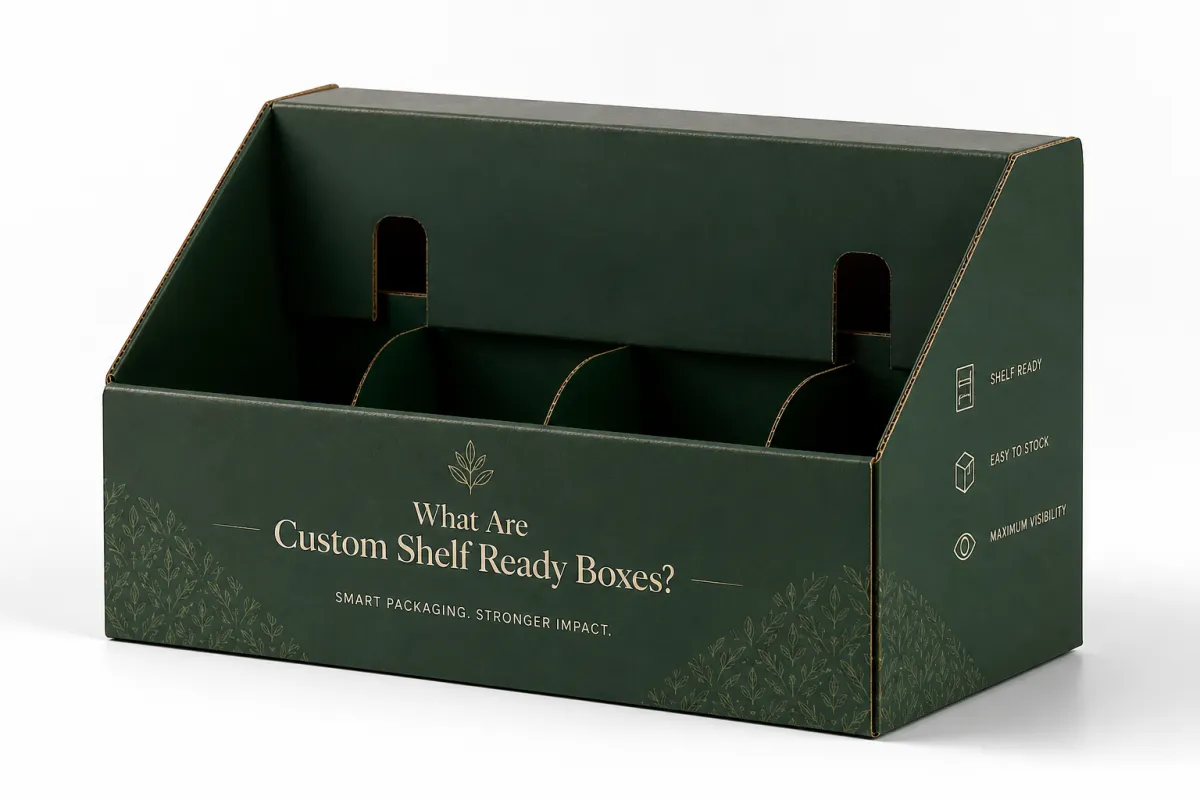
Custom shelf ready boxes are shipping cartons designed to do two jobs at once. They protect the product through warehousing, freight, and handling, then open in a planned way and turn into a retail display with very little extra work. That sounds simple on paper. The real challenge is getting the box to survive stacking, impacts, vibration, and the rough handling that happens when people are moving fast, then still open neatly and sit properly on the shelf.
Retailers like custom shelf ready boxes because they save time where time is scarce. Grocery chains, club stores, convenience stores, beverage brands, snack programs, and other fast-moving categories all benefit from quicker replenishment. A carton that goes from pallet to shelf in one move cuts labor, keeps displays cleaner, and reduces the awkward product dumping that wastes seconds and bruises product. That kind of efficiency matters more than a fancy finish that slows the store team down.
There is a branding side to this as well. A shelf-ready case still belongs to your product packaging system and your broader retail packaging plan. It is not just corrugated logistics. If the panel facing the shopper looks weak, torn, or off-brand, that is the story the shelf tells. A well-planned carton supports branded packaging and package branding without making stocking harder, and that balance is the heart of the format.
One mistake shows up often: treating shelf ready as decoration only. It is not. Custom shelf ready boxes still need to function like real shipping cartons first. If the structure bows, splits, or collapses in transit, the attractive front panel does not rescue the shipment. Retail buyers care about shelf presentation, but they care just as much about product arriving intact and ready to sell. I have seen more than one launch stumble because the marketing team approved a beautiful face while the box itself was kinda flimsy.
"A shelf-ready carton that opens badly is just a shipping box in nicer clothes."
Most shelf-ready formats show up where product turns quickly and labor is tight: grocery endcaps, club store pallets, convenience counter displays, beverage runs, snack resets, and promotional multipacks. The common thread is speed. If staff needs to stock a large volume of units in a short window, custom shelf ready boxes usually justify the extra structural planning.
How Custom Shelf Ready Boxes Work on the Shelf
The mechanics are the real story. Good custom shelf ready boxes use tear-away panels, perforations, front openings, reinforced side walls, and a display face that stays tidy after opening. The aim is to make one motion do most of the work. Open the case, fold or remove the top, place it on the shelf, and let the product do the selling.
The usual path is straightforward: product is packed into the case, the case is sealed, cartons are palletized, shipped, and received at the store. A store associate opens the carton at the tear feature, positions it against the shelf or display fixture, and stocks from the open case. No separate tray. No repacking. No wrestling with flaps that keep springing back up. That is the promise of custom shelf ready boxes.
Tray-and-Sleeve, Wraparound, and RSC-Style Designs
Not every shelf-ready format behaves the same way. Tray-and-sleeve builds use a tray base with a printed sleeve that becomes the display face. They are useful when shelf presentation matters and the base needs to stay stable. Wraparound designs begin as a flat blank that wraps around the product, which can reduce material use and improve fit for certain pack patterns. RSC-style shelf-ready designs start with a regular slotted carton structure and add perforations or tear panels so the case opens into a display unit.
For custom shelf ready boxes, the right format depends on product weight, pack count, and the way the retailer wants the carton opened. A light snack item may work well in a tray-and-sleeve. A heavier beverage multipack may need a stronger wraparound or modified RSC so the structure can handle stacking and line handling. There is no universal answer, only the right structure for the job in front of it.
Why Opening Mechanics Matter
Opening mechanics are where smart design either creates savings or creates frustration. If a perforation tears too far, the case loses strength. If it tears too short, store staff spend extra time fighting the panel. If the front has to be cut with a knife, the carton stops saving labor and starts inviting safety problems. The best custom shelf ready boxes open quickly, leave a clean shelf face, and still carry the remaining product without sagging.
The shelf opening also has to match the planogram. A carton can look perfect in a drawing and still fail if it ends up two inches too wide, too tall, or too deep for the fixture. That is not a small issue. It can stop a launch before it starts. In retail packaging, shelf fit is not a suggestion. It is part of the floor plan.
That is why a carton should be tested with the actual product, not a foam block or a guessed size. If the case sits crooked, blocks the neighboring items, or hides too much of the front panel, the store team will notice immediately. Custom shelf ready boxes work best when structure and retail environment are designed together from the start.
Key Design Factors for Custom Shelf Ready Boxes
Strong packaging design starts with the product, not the artwork. That is especially true for custom shelf ready boxes. Before anyone talks about colors or front-panel messaging, you need the unit weight, carton count, stacking load, shipping route, and whether the product stands upright, nests, or shifts in transit. Those details determine the board grade, the tear path, and whether the front cutout can hold its shape under real use.
Product details that matter most include:
- Weight per filled carton - a 1.5 lb snack case behaves very differently from a 22 lb beverage case.
- Pack count - 6-pack, 12-pack, and 24-pack layouts change the support needed inside the carton.
- Fragility - glass, coated paper cups, rigid plastic, and pouches each call for different protection.
- Shipping distance - longer routes and more handling usually require stronger corrugate.
- Shelf orientation - upright, side-facing, or nested layouts affect tear placement and display height.
Board choice is where a lot of projects either get practical or get cheap in the wrong place. For lighter loads and shorter routes, a B-flute or E-flute structure can work well if the print and cut features are not too aggressive. For heavier items, double-wall or a stronger single-wall board with the right ECT rating may be the better choice. A common spec might be 32 ECT for lighter shelf-ready cartons and 44 ECT or higher for heavier distribution loads, though the final number depends on the product and pallet pattern. There is no prize for overbuilding by 40 percent. There is also no reward for underbuilding and learning about it from a buyer after the fact.
Retailer requirements are not optional. Shelf footprint, opening direction, barcode placement, case pack count, and display visibility rules all affect the final build. Some retailers want the front face to show a certain amount of branding. Others want the tear feature on a specific side so staff can stock from a particular direction. If the carton sits under a shelf lip or inside a tray, those dimensions need to be right before production begins. Custom shelf ready boxes should fit the retailer, not force the retailer to adapt.
Graphics matter too, but they should support function. The front panel needs enough contrast to read from a few feet away, especially in crowded retail aisles where shoppers pass hundreds of boxes at once. That is where custom printed boxes earn their keep. Still, do not bury the perforation line or handhold area under heavy ink coverage, varnish, or lamination if it makes opening harder. A clean tear line is worth more than a dramatic panel that store staff cannot use easily.
Sustainability belongs in the discussion now, and rightly so. A recyclable corrugated build with fewer packaging layers is easier to defend than a mixed-material setup that creates sorting headaches. If your material source matters, FSC-certified paperboard can be a useful option. Learn more about that standard at FSC. For many buyers, the practical sustainability gain is simple: fewer inner packages, less void fill, and fewer handling steps at the store.
Testing is the safety net. For shipping and distribution checks, teams often reference ISTA testing standards along with ASTM-based methods and retailer-specific requirements. Compression, drop, and vibration testing are not paperwork exercises. They show whether the structure can handle the abuse it will actually see. That is the cheapest moment to find out.
Strong custom shelf ready boxes are usually boring in the best way. They fit, open cleanly, stack well, and avoid drama. Packaging drama is expensive.
If you are still building the rest of your packaging program, it helps to compare structure and print options across the full line. Our Custom Packaging Products page is a good starting point for looking at formats beyond shelf-ready cases, including display-focused and shipping-focused builds.
Custom Shelf Ready Boxes Pricing: What Drives Cost
Pricing for custom shelf ready boxes depends on structure, board grade, print method, coatings, die-cut complexity, and quantity. That is the short version. The longer version is that a carton that saves store labor can justify a higher unit price than a plain shipper, while a carton that looks polished but slows stocking often loses the argument quickly. Retail buyers think in total cost, not just carton cost.
Short runs cost more per unit because setup costs get spread across fewer cartons. Larger orders usually bring the piece price down, but only if the structure is stable and the design does not require too much tooling. Sample rounds are usually more expensive on a per-unit basis as well. A prototype build can cost two to five times more per box than the full production run because the press setup, cutting, and handwork are being done for a small number of samples. That is normal.
For a practical range, simple custom shelf ready boxes in larger volumes might land around $0.22-$0.40 per unit for basic structural work and light print, while more complex printed cases with perforations, specialty coatings, or heavier board can move into the $0.45-$0.90 per unit range depending on quantity and specs. Small runs or highly customized constructions can sit above that. Anyone promising a universal price without seeing the dieline is guessing, and I would be wary of a quote that sounds too tidy.
| Structure | Typical Use | Approx. Price at 5,000 Units | Complexity | Stocking Speed |
|---|---|---|---|---|
| Basic tray-and-sleeve | Snacks, lightweight multipacks, short shelf runs | $0.28-$0.45 each | Low to moderate | Fast |
| Modified RSC with tear-away front | General retail, grocery, beverage promos | $0.32-$0.58 each | Moderate | Fast |
| Wraparound shelf-ready design | Heavier product, tighter fit, stronger presentation | $0.40-$0.75 each | Moderate to high | Very fast |
| High-graphics custom printed boxes with specialty finish | Premium retail packaging, brand-forward launches | $0.60-$1.10 each | High | Fast if fit is correct |
The table is a useful starting point, though the quote still depends on the real job. A carton with heavy ink coverage, tight perforation tolerances, or a custom display face can cost more than a plain-looking version with a stronger board spec. Freight matters too. Oversized cartons can raise shipping cost, which means a design that looks slightly cheaper on paper may cost more by the time it reaches the warehouse.
Watch for hidden costs as well. Structural revisions after the first sample. Retailer compliance changes after the fact. Extra warehouse storage if the cases are too large. Extra freight because the pallet pattern is inefficient. Those are the expenses that turn a supposedly cheap run into a bad decision. Custom shelf ready boxes should be judged as part of the full system, not as a single line item.
If you are requesting quotes, ask for the following so you can compare apples to apples:
- Exact product dimensions and filled carton weight.
- Board grade and flute type.
- Print coverage, ink count, and coating or lamination details.
- Quantity, sample needs, and target launch date.
- Retailer or shelf footprint requirements.
- Testing expectations and any drop or compression targets.
Custom Shelf Ready Boxes Process and Timeline
The process gets easier when the project starts with facts instead of optimism. For custom shelf ready boxes, the first step should be discovery: product dimensions, filled weight, pack count, retailer specs, artwork files, launch date, and any shipping or temperature conditions that could affect the carton. If those details are missing, the quote will be vague and the sample will likely need revisions. That is not a mystery. That is cause and effect.
After discovery comes structure development. A dieline is created, then a CAD review checks internal fit and shelf footprint. This is where opening direction, perforation placement, and stack strength get sorted out. If possible, test the dieline against the real product and an actual shelf target. A carton that matches the illustration but misses the fixture by half an inch is still wrong.
Sample, Test, Approve
Sample build is the point where the design stops being theoretical. A good sample shows whether the tear line opens smoothly, whether the product sits upright after opening, and whether the front panel holds its shape. For many custom shelf ready boxes, simple samples can take about 3 to 10 business days, while production often lands in the 2 to 5 week range after approval, depending on print complexity and order size. If structural revisions are needed, add time. Rushing this stage is how expensive mistakes get locked in.
Testing should not be skipped. A carton that looks perfect in the sample room can still fail in transport if the stack load is too high or the board grade is too light. Check compression, drop, and vibration. If the route is rough, test for that. If the retailer is strict, test to that standard. The point is to catch problems before the customer or store team does.
Approvals matter as much as construction at this stage. Sign off on the structure, graphics, barcode placement, and compliance details before production begins. That includes checking whether the front display face aligns with brand rules and whether any handling marks or tear scores interfere with print. Custom shelf ready boxes are unforgiving of last-minute design swaps. Change one size, and the shelf fit changes. Change one panel, and the opening behavior changes. Packaging has a way of making small edits feel larger than expected.
A realistic timeline for a straightforward launch looks like this:
- Discovery and quote - 1 to 3 business days if specs are complete.
- Dieline and structural review - 2 to 5 business days.
- Sample build - 3 to 10 business days.
- Revisions and approval - 2 to 7 business days, longer if retailer feedback is slow.
- Production - about 2 to 5 weeks after approval.
- Freight and receiving - anywhere from a few days to a week or more, depending on the route.
If you need a launch with no room for delay, start earlier than you think you need to. That sounds obvious, yet retail timelines have a way of compressing. A buyer changes the planogram. Marketing updates the artwork. Procurement asks for one more sample. Suddenly the calendar is tight. That is why custom shelf ready boxes should be built into the launch schedule, not treated like a finishing task.
If your team is also building broader packaging plans, our custom printed boxes and other branded packaging options can be lined up at the same time so your display, shipper, and secondary packaging all share the same design logic.
Common Mistakes With Custom Shelf Ready Boxes
Most failures with custom shelf ready boxes come from a handful of predictable mistakes. None of them are glamorous. All of them are expensive. The frustrating part is that they are usually preventable with a sample, a ruler, and a truthful look at how retail staff actually work during a reset.
- Designing for a render instead of reality. A box can look perfect on screen and still fail to open cleanly or stay upright once stocked.
- Ignoring shelf dimensions. If the carton misses the planogram, the print does not matter.
- Choosing weak board. Underbuilt corrugate saves a few cents and creates damage, bowing, and returns.
- Putting tear lines and barcodes in the wrong place. Store staff should not have to fight the case or cover the code with a marker.
- Skipping prototype testing. The first run is not the place to discover that the front panel tears too far.
There is another mistake that shows up often enough to deserve a second mention: treating the carton like a pure graphics project. Yes, custom shelf ready boxes should support brand presentation. No, that does not mean every square inch needs a giant logo or a heavy finish. If the graphics interfere with the opening score or make the panel harder to read in store lighting, the design is working against itself.
Retail buyers remember launches that go wrong. They remember cases that arrived crushed, displays that would not fit, and packaging that turned stocking into a labor problem. They also remember the brands that solved the problem quickly. That is why the safest path is usually the plain one: correct dimensions, adequate board strength, clean opening mechanics, and a print layout that respects the structure.
From a packaging buyer's point of view, the real cost of a mistake is not the box itself. It is the relaunch, the missed shelf placement, the labor hours spent fixing it, and the product that gets written off because the display failed. That is why custom shelf ready boxes deserve real testing instead of wishful thinking.
Expert Tips and Next Steps for Custom Shelf Ready Boxes
My practical advice is simple: start with the retailer rules, then build the carton around them. Not the other way around. The best custom shelf ready boxes are usually the ones that feel almost invisible to the store team. They open fast, stand up, fit the shelf, and disappear into the job they were built to do. That is not dull. That is good packaging.
Labor savings are often the biggest win. A carton that saves even 10 to 15 seconds per case adds up fast across a full reset or weekly restock cycle. On a large program, that can be more valuable than shaving a cent off board cost. If your box makes stocking slower, it is charging rent in the wrong direction.
Here are the best next steps if you are planning custom shelf ready boxes for a launch:
- Gather product dimensions, weight, and pack count.
- Collect retailer shelf or display requirements before design starts.
- Request a dieline and review it against the real product.
- Build one physical sample with actual inventory, not a substitute.
- Have a store-level user or field rep open and stock the sample.
- Compare quotes by board grade, print method, and testing support, not just unit price.
If you want a clean evaluation, ask every supplier the same questions. What board are they quoting? What is the opening method? How many print colors? Is the price based on production quantity or sample quantity? Are revisions included? Do they offer structure support, or are they only selling a box and hoping the layout sorts itself out? Those answers tell you more than a polished render ever will.
One more practical point: if the carton needs premium branding, build that into the structure from day one. Do not bolt it on later. Strong branded packaging is a design decision, not a rescue mission. A display face that communicates clearly, opens cleanly, and survives the shelf is far more useful than a pretty carton that makes people work harder.
If you are ready to move, start with specs, a target shelf footprint, and a sample deadline. That gives the production team something concrete to build around and keeps the launch from drifting. And yes, custom shelf ready boxes can be cost-effective, but only when the structure, print, and retail requirements are aligned from the beginning. Build them to reduce labor, protect product, and fit the shelf the first time. That is the job.
What are custom shelf ready boxes used for?
They move product from shipping carton to retail display with less handling. Custom shelf ready boxes help store staff stock faster, keep shelves cleaner, and cut down on extra unpacking. They are common in grocery, club, convenience, beverage, snack, and other high-turn retail settings.
How are custom shelf ready boxes different from regular cartons?
Regular cartons are built mainly to ship and store product. Custom shelf ready boxes are designed to open cleanly and become a display unit on the shelf. They usually need stronger tear features, tighter shelf-fit tolerances, and print placement that supports retail visibility.
How much do custom shelf ready boxes cost?
Price depends on size, board grade, print coverage, coatings, and quantity. Simple production runs can be fairly modest per unit, while heavier builds or premium printed cases cost more. Prototype rounds almost always cost more per unit than full production, so sample pricing should be treated separately. These ranges are directional, not a promise or a quote.
How long does it take to make custom shelf ready boxes?
Simple samples often take about 3 to 10 business days. Production commonly runs 2 to 5 weeks after approval, depending on complexity and order size. If the project needs structural revisions or retailer sign-off, the schedule can stretch.
What information do I need for a quote on custom shelf ready boxes?
Share product dimensions, weight, pack count, artwork files, retailer requirements, and your target quantity. Add your launch date, shipping conditions, and any testing needs so the quote reflects the real job. The better the brief, the fewer surprises later.

