Buyer Fit Snapshot
| Best fit | Custom Shipping Bag Supplier projects where brand print, material claims, artwork control, MOQ, and repeat-order consistency need to be specified before quoting. |
|---|---|
| Quote inputs | Share finished size, material target, print colors, finish, packing count, annual reorder estimate, ship-to region, and any compliance wording. |
| Proofing check | Approve dieline scale, logo placement, barcode or warning zones, color tolerance, closure strength, and carton packing before bulk production. |
| Main risk | Vague material claims, crowded artwork, missing packing details, or unclear freight terms can make a low unit price expensive after revisions. |
Fast answer: Custom Shipping Bag Supplier: Film, Print, MOQ, and Carton Packing should be specified like a repeatable production item. The safest quote records material, print method, finish, artwork proof, packing count, and reorder notes in one written spec.
Production checks before approval
Compare the actual filled-product size with the drawing, then confirm tolerance on folds, seals, hang holes, label areas, and retail display edges. Reserve space for logos, QR codes, warning copy, and material claims before decorative graphics fill the panel.
Quote comparison points
Review material grade, print process, finish, sampling route, tooling charges, carton quantity, and freight assumptions side by side. A quote is only useful when the supplier can repeat the same color, closure quality, and packing count on the next order.
Custom Shipping Bag Supplier: How to Choose Wisely
A custom shipping bag supplier does a lot more than slap a logo on plastic. The good ones balance protection, postage, presentation, and production without turning any of them into a mess. That balance is where most ordering mistakes start.
From a packaging buyer's angle, a mailer can look flawless on a screen and still fall apart in transit if the gauge is too light, the seal is weak, or the dimensions are just a little off. Choosing a custom shipping bag supplier is really three decisions packed into one: packaging, operations, and brand. Miss one, and the whole thing gets kinda expensive.
Some businesses need a printed poly mailer and nothing more. Others are better off mixing Custom Poly Mailers, Custom Shipping Boxes, and other Custom Packaging Products. Flashy is not the goal. Matching the package to the way the team actually ships is the goal.
Honestly, too many buyers treat mailers like an accessory. They are not. In ecommerce shipping, the bag affects damage rates, fulfillment speed, postage weight, and the first physical impression a customer gets. I've seen a cheap-looking bag undermine an otherwise premium product before the box is even opened. A sharp custom shipping bag supplier understands that the customer experience starts before the package is even opened.
What a Custom Shipping Bag Supplier Actually Does
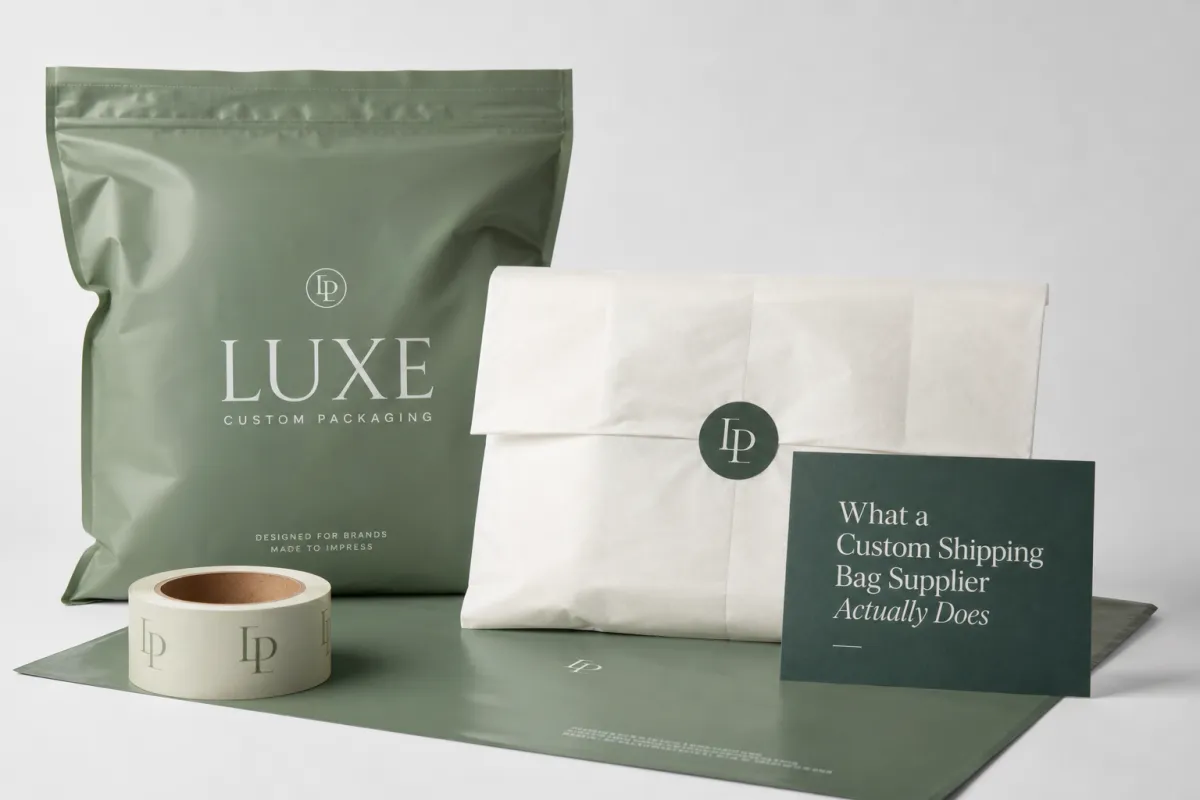
A custom shipping bag supplier sources or manufactures mailers to a defined spec, then turns that spec into a repeatable finished product. Material selection, sizing, print setup, sealing method, and packing format all sit in that lane. The supplier is not just a printer. It is part of the production system.
Most buyers start with branding because package branding is visible and easy to compare. The better suppliers start with structure. What is the product weight? Is it rigid, soft, or sharp-edged? Does it need opacity? Will it ship alone or with inserts? Those questions matter because a mailer that works for a lightweight garment will not always work for a boxed accessory or a multi-piece retail kit.
A good custom shipping bag supplier will also talk through practical details like adhesive strip strength, gusset depth, and whether the outer film should be 2.5 mil, 3 mil, or thicker. The jargon sounds annoying, but the difference shows up fast in the warehouse. A bag that tears during packing or opens in transit ends up costing more than the quote ever saved.
The category lives between branding and logistics. Some brands use mailers for apparel and lightweight goods. Others reserve them for secondary packs and move heavier SKUs into corrugated formats. That is why a custom shipping bag supplier should be evaluated as part of the broader packaging program, not as a random one-off order.
The simple version is this: a strong supplier helps you decide what should happen to the product before, during, and after shipment. They should understand retail packaging, order fulfillment, transit abuse, and the visual cues that support trust. If they only talk about ink and film, they are missing half the job.
Good suppliers typically help with:
- Mailer sizing based on product dimensions instead of guesswork.
- Material recommendations based on puncture risk, weight, and handling.
- Artwork setup that keeps logos crisp and readable at production scale.
- Shipping format choices that cut waste and speed up packing.
That is the real value of a custom shipping bag supplier: not just bags, but better shipping economics and fewer headaches in the line.
How a Custom Shipping Bag Supplier Process Works
The order process usually begins with a specs conversation. A custom shipping bag supplier will ask for product dimensions, approximate weight, artwork files, target quantity, and the shipping environment. Skip any of those inputs, and the quote may still arrive, but it will be less useful than it looks.
After the inquiry, the supplier usually narrows the material options. That may mean choosing between virgin polyethylene, recycled-content film, or a co-extruded structure that improves puncture resistance. The right choice depends on the bag’s job. A lightweight apparel mailer can use a different build than a heavy accessory pack, and a thoughtful custom shipping bag supplier will explain that plainly.
Then comes artwork prep. This is where buyers often burn time. Vector files, brand colors, bleed, and safe zones all matter. A clean file moves fast. A messy file can add a week or more if the supplier has to rebuild the layout. The best custom shipping bag supplier teams review the artwork against the die line before production so the first proof actually helps.
- Inquiry and spec review - dimensions, quantity, print colors, and closure type.
- Material recommendation - film gauge, opacity, seal strength, and finish.
- Artwork proofing - logo placement, color checks, and print-ready file confirmation.
- Sample or digital proof approval - one more chance to catch fit or branding issues.
- Production - print, converting, sealing, inspection, and packing.
- Freight and delivery - carton counts, palletization, and arrival timing.
Lead times vary, but the pattern is predictable. A first-time custom run usually takes longer than a reorder because the supplier is managing setup, proof approval, and material allocation at the same time. In many cases, first orders land in the 12-20 business day range after artwork approval, while a reorder can move faster if the specs are locked and the factory already has the film. A reliable custom shipping bag supplier should tell you where the time is going instead of tossing out a vague rush promise.
Sampling is another checkpoint. A physical sample can expose problems that a PDF hides: a seal that is too narrow, a bag that sticks during packing, or a print layout that disappears once folded. If the supplier is serious, they will treat the sample as a quality gate, not a little bonus item.
Communication matters as much as machinery. A clean schedule can collapse if a buyer changes dimensions after proof approval, or if the supplier learns too late that the order has to ship by a hard date. A strong custom shipping bag supplier asks follow-up questions early because those questions prevent expensive rework later.
The workflow looks simple on paper. In real life, it is a chain of small decisions, and each one affects print accuracy, freight timing, and pack-out speed. A dependable custom shipping bag supplier makes the process visible enough that the buyer can plan around it instead of reacting to it.
Custom Shipping Bag Supplier Pricing: What Drives Cost
Pricing is where a custom shipping bag supplier can look cheap, expensive, or oddly fair depending on how the quote is built. Unit price only tells part of the story. The real cost depends on size, thickness, print coverage, order volume, freight, and how much setup is needed to do the job properly.
Bag size is one of the first cost drivers. Larger bags use more film, more ink, and more carton space. Thickness matters too. A 2.5 mil film is not priced like a 4 mil film because the extra resin changes both material cost and performance. A custom shipping bag supplier that quotes without discussing gauge is giving you half a number and hoping you do not notice.
Print coverage changes the math fast. One-color logos on a white mailer are usually cheaper than full-coverage printing with multiple colors, edge-to-edge artwork, or metallic effects. Depending on the print method, setup fees may come from plates, digital setup, or other prepress work. A buyer comparing quotes from a custom shipping bag supplier should ask how the printing method affects both setup cost and unit price.
Order quantity is the classic cost lever. Bigger runs usually lower the per-unit cost, but not always the total spend. If a business buys more than it can use in a reasonable window, storage and cash flow become hidden costs. A good custom shipping bag supplier should help the buyer align MOQ with real demand instead of pushing volume for the sake of volume.
| Mailer Type | Typical Order Size | Common Unit Range | Notes |
|---|---|---|---|
| Plain poly mailer | 1,000-10,000+ | $0.12-$0.22 | Lowest setup, limited branding, good for price-sensitive fulfillment |
| One-color printed mailer | 3,000-20,000+ | $0.18-$0.32 | Balanced option for package branding and efficient order fulfillment |
| Full-coverage custom mailer | 5,000-25,000+ | $0.30-$0.55 | Strong visual impact, higher print complexity, more setup sensitivity |
| Heavy-duty or specialty film mailer | 5,000-15,000+ | $0.35-$0.70 | Better puncture resistance, often used for sharper or denser products |
Those ranges are wide on purpose, because a custom shipping bag supplier will price differently based on film structure, print method, and delivery location. Still, the table shows something useful: the cheapest unit price is not automatically the best value. A slightly higher quote can cut returns, damage claims, and repacking labor.
Look beyond unit cost. Freight can move the total landed price more than buyers expect, especially for bulky cartons or palletized shipments. Rush fees can also change the picture. Sampling, artwork correction, split shipments, and warehousing charges often sit outside the headline quote. A careful custom shipping bag supplier will list those items separately so they do not pop up later as surprises.
If sustainability matters, the price conversation changes again. Recycled-content film, recyclable structures, or certification-related documentation may add cost, but they can also support a broader packaging strategy. That matters for brands trying to keep product packaging aligned with sustainability claims and customer expectations. A supplier who can explain those tradeoffs clearly is usually worth more than the lowest bid.
One more thing gets missed all the time: the quote should be judged against the cost of failure. If a bag tears once in every few hundred shipments, the replacement labor and customer service cost may wipe out the savings from a lower-priced order. In that sense, a custom shipping bag supplier is not just pricing plastic. It is pricing consistency.
Key Factors to Compare in a Custom Shipping Bag Supplier
The first thing to compare is material performance. A custom shipping bag supplier should be able to discuss film gauge, tear resistance, seal integrity, opacity, and surface finish without hand-waving. If the product has a sharp edge, a zipper, or a rigid corner, the bag needs a structure that can handle that risk. Otherwise, the failure shows up in transit, not in the quote.
For brands shipping apparel or soft goods, a lighter mailer may be enough. For denser goods, a stronger film is usually the better move. In some cases, a buyer may need to step up to a different format entirely and compare mailers against Custom Shipping Boxes. A skilled custom shipping bag supplier should be honest when the bag is not the right fit.
Branding quality is the second comparison point. Clear printing, consistent color, and correct logo placement all matter, but they should not come at the expense of function. Good package branding builds trust; sloppy branding makes a bag look cheap even if the material is solid. A strong custom shipping bag supplier understands how finish, contrast, and art placement shape the first impression.
Reliability deserves just as much attention. Ask about sample quality, response time, production transparency, and proof of on-time fulfillment. A supplier that answers quickly during quoting and then disappears during proofing is a red flag. The best custom shipping bag supplier relationships feel boring in the best possible way: predictable, documented, and easy to reorder.
Compliance and sustainability matter too, especially for buyers making recycled-content claims or trying to avoid fuzzy environmental language. If a supplier says a bag is recyclable, ask what that means in your market and whether the claim is supported by the material and local recycling systems. For recycled fiber or chain-of-custody questions, FSC is a useful reference point at fsc.org. For shipping and distribution testing, ISTA is a widely used authority. A careful custom shipping bag supplier should not treat those references like decoration; they should shape the product decision.
The last comparison is total value. Buyers sometimes compare the headline quote and stop there, but a packaging failure can cost far more than a modest per-bag increase. Returns, repacks, damaged goods, and negative reviews hit harder than a few cents on a custom mailer. That is why choosing a custom shipping bag supplier is really a risk management exercise with branding upside.
Compare suppliers on these five points:
- Material performance for the actual product shape and weight.
- Print quality and consistency across the full order.
- Lead time accuracy and communication during proofing.
- Documentation for sustainability or compliance claims.
- Support for reorder stability and future scaling.
Step-by-Step: Ordering From a Custom Shipping Bag Supplier
The cleanest buying process starts before the quote request. Measure the product as it will ship, not as it sits loose on a table. If the item needs a protective insert, include that in the measurement. A good custom shipping bag supplier needs the packed dimensions because the bag has to fit the real shipment, not the idealized product photo.
Next, define the shipping environment. Does the package travel through parcel networks with multiple touchpoints? Is it shipped from a warehouse with high-volume order fulfillment? Does it face wet weather, vibration, or abrasion? Those details determine whether the bag needs extra opacity, a stronger adhesive strip, or a thicker gauge. A custom shipping bag supplier can make better recommendations when the buyer shares those conditions upfront.
Then request quotes using the same spec sheet every time. That means the same dimensions, quantity, print colors, artwork file type, finish, and delivery target. Comparing mismatched quotes is one of the easiest ways to overpay without realizing it. If one custom shipping bag supplier includes freight and another does not, the lower number is mostly an illusion.
Once the samples arrive, test them like a warehouse would. Check the opening speed. Check whether the adhesive strip seals cleanly under pressure. Check the print legibility under normal lighting. Check for split seams, wrinkling, static, or anything that slows the pack line. A sample from a custom shipping bag supplier should be evaluated for the job it will actually do, not for how it looks in a meeting.
"The best packaging test is not the mockup. It is the first real packing run with a stopwatch, a stack of product, and a warehouse team that has to do this all day."
Proof review is where a lot of avoidable errors can still be caught. Confirm the logo size, confirm the color values, confirm the placement of text, and confirm the bleed. If something feels off, raise it before production starts. A dependable custom shipping bag supplier will welcome corrections at this stage because it prevents bigger losses later.
After approval, confirm the operational details: carton counts, pallet configuration, storage space, and reorder triggers. If the bags are used in a seasonal business, set the reorder point early so inventory does not run out during peak periods. A custom shipping bag supplier that supports reorder planning makes the second purchase much faster than the first.
Best-practice ordering checklist:
- Send exact packed dimensions and product weight.
- Share final artwork files in a print-ready format.
- Ask for sample or proof approval before production.
- Confirm lead time after approval, not before.
- Document the approved spec for the next reorder.
That is the difference between buying packaging once and building a repeatable system with a custom shipping bag supplier. The first approach reacts to need. The second one supports scale.
Common Mistakes When Choosing a Custom Shipping Bag Supplier
The biggest mistake is ordering by price alone. A custom shipping bag supplier with the lowest quote may be shaving film thickness, weakening seal quality, or using a print setup that creates more waste. The savings can vanish the first time a bag splits or a shipment needs to be repacked.
Vague specs create the next wave of problems. If the buyer does not define dimensions, print colors, finish, or closure style, the supplier has to guess. Guessing is expensive. It also creates frustration on both sides because everyone thinks they agreed to the same thing when they did not. A strong custom shipping bag supplier will ask clarifying questions; that is a good sign, not a nuisance.
Skipping samples is another common error. A mockup can look perfect while the physical bag performs badly in real use. Maybe the seal is weak. Maybe the print is too dark. Maybe the bag is awkward for staff to open in the packing lane. A serious custom shipping bag supplier will encourage sampling because physical tests catch issues that digital proofs hide.
Operations teams are often left out of the decision, and that creates slowdowns later. The people loading orders may know exactly which mailer format slows the line, which adhesive annoys staff, or which size wastes too much material. A custom shipping bag supplier can only optimize around the actual workflow if the warehouse team has a voice.
Timeline mistakes are costly too. Buyers sometimes approve artwork late, then expect an immediate ship date. That is not how most production schedules work. A first-time run usually has proof rounds, setup, and material lead time. If the buyer leaves no buffer, a normal delay turns into a rush-fee problem. A careful custom shipping bag supplier should help set expectations early, but the buyer still needs to protect the schedule.
Another mistake is confusing branding with strength. A beautiful bag that tears is not good branded packaging. The opposite is a problem too: a very durable bag that looks careless may hurt the perceived value of the product. The goal is balance. A smart custom shipping bag supplier helps the buyer reach that balance instead of pushing one side too hard.
Problems that show up most often:
- Using product dimensions instead of packed dimensions.
- Approving artwork without checking the final die line.
- Ignoring freight costs in the total landed price.
- Ordering too much or too little relative to demand.
- Choosing a finish that looks good but slows packing.
Once you spot those patterns, the ordering process gets easier. A good custom shipping bag supplier reduces friction; a weak one creates it.
Expert Tips and Next Steps With a Custom Shipping Bag Supplier
If I were building a supplier shortlist from scratch, I would use a scorecard. Nothing fancy. Just five categories: pricing, sample quality, lead time, communication, and packaging performance. A custom shipping bag supplier that wins on all five is rare, but the exercise stops one shiny feature from masking a weaker overall fit.
Try two or three bag options in a real packing run before committing to a large order. That matters especially for products with awkward edges, rigid inserts, or delicate finishes. A bag that looks fine in the office can feel slow or fragile on the packing line. A practical custom shipping bag supplier should support this kind of test instead of resisting it.
Ask for a reorder plan. Sounds basic, and that is exactly why it gets skipped. If the supplier already has your approved art, final dimensions, and production notes on file, the next order can move faster and with fewer surprises. A reliable custom shipping bag supplier makes the second transaction easier than the first.
Document what worked. Save the exact dimensions, the approved artwork files, the seal type, the print finish, and the packing method used by the warehouse. That record becomes your internal specification sheet. It also protects you if staff changes or demand spikes. A custom shipping bag supplier can only repeat success if the success is written down clearly.
For brands expanding beyond mailers, compare how the shipping bag fits into the broader packaging mix. Some SKUs may move better in Custom Poly Mailers, while others need a box for better crush resistance. Others may need a wider Custom Packaging Products strategy that includes inserts, labels, or secondary packaging. The right custom shipping bag supplier should help you think in systems, not single SKUs.
The most useful next step is also the most practical: request samples, compare quotes line by line, confirm the timeline assumptions, and test the bag in the real packing environment. That sequence reveals more than a glossy sales deck ever will. The best custom shipping bag supplier is the one that fits your product, your operation, and your growth plan without creating hidden work.
Final checks before you place the order:
- Does the bag fit the packed product with enough tolerance?
- Does the print support brand recognition without slowing production?
- Does the lead time match your replenishment cycle?
- Does the quote include freight, setup, and any sample costs?
- Will the bag hold up across your normal shipping route?
That is the practical test. Not whether the custom shipping bag supplier sounds impressive, but whether the packaging works consistently once it reaches the warehouse, the carrier, and the customer. If you get those five checks right, the rest gets a lot less dramatic.
Frequently Asked Questions
What should I ask a custom shipping bag supplier before ordering?
Ask about minimum order quantity, lead time, print method, material thickness, and whether samples are available before production. You should also request a full quote breakdown so you can compare setup fees, freight, rush costs, and unit pricing on the same basis. A careful custom shipping bag supplier should confirm whether the bag matches your product dimensions and shipping environment, not just your artwork.
How long does a custom shipping bag supplier usually take?
First-time custom orders usually take longer because artwork, proofs, and setup must be approved before production begins. The timeline can stretch if files need revisions, materials are out of stock, or the supplier batches jobs by print run. Reorders are often faster when the custom shipping bag supplier already has your approved specs and final artwork files on hand.
What affects custom shipping bag supplier pricing the most?
The biggest drivers are bag size, material thickness, print coverage, color count, and the number of bags ordered. Shipping, rush fees, and artwork revisions can raise the total cost even when the unit price looks attractive. A slightly higher quote from a custom shipping bag supplier may be better value if it reduces damage, returns, or packing time.
Can a custom shipping bag supplier help with branding?
Yes, Printed Poly Mailers can reinforce brand recognition through color, logo placement, and consistent visual identity. A good custom shipping bag supplier should help balance branding with readability, protection, and the practical needs of fulfillment. Branding works best when the mailer feels intentional, not overloaded with graphics that complicate production.
What minimum order quantity should I expect from a custom shipping bag supplier?
MOQs vary widely based on print process, material type, and whether the order is a standard or fully custom format. Smaller runs often cost more per unit, so it helps to plan around expected demand and reorder timing. Ask whether the custom shipping bag supplier offers staged production or repeat-order pricing if you do not want to overbuy inventory.
If you want packaging that supports the product instead of working against it, start with the numbers, then check the sample, then judge the relationship. That is the real test of a custom shipping bag supplier. It is also the part most teams skip before they regret it.

