Buyer Fit Snapshot
| Best fit | Custom Shipping Document Pouches projects where brand print, material claims, artwork control, MOQ, and repeat-order consistency need to be specified before quoting. |
|---|---|
| Quote inputs | Share finished size, material target, print colors, finish, packing count, annual reorder estimate, ship-to region, and any compliance wording. |
| Proofing check | Approve dieline scale, logo placement, barcode or warning zones, color tolerance, closure strength, and carton packing before bulk production. |
| Main risk | Vague material claims, crowded artwork, missing packing details, or unclear freight terms can make a low unit price expensive after revisions. |
Fast answer: Custom Shipping Document Pouches: Uses, Costs, and Options should be specified like a repeatable production item. The safest quote records material, print method, finish, artwork proof, packing count, and reorder notes in one written spec.
Production checks before approval
Compare the actual filled-product size with the drawing, then confirm tolerance on folds, seals, hang holes, label areas, and retail display edges. Reserve space for logos, QR codes, warning copy, and material claims before decorative graphics fill the panel.
Quote comparison points
Review material grade, print process, finish, sampling route, tooling charges, carton quantity, and freight assumptions side by side. A quote is only useful when the supplier can repeat the same color, closure quality, and packing count on the next order.
Custom Shipping Document Pouches: Uses, Costs, and Options
One missing commercial invoice can park a pallet at the dock for hours. I have watched that happen over a single bad handoff, and it was exactly as annoying as it sounds. That is the problem custom shipping document pouches are supposed to solve. Cross-border freight does not care that the paperwork was "somewhere in the box." It wants the right form, in the right place, right now.
For packaging buyers, custom shipping document pouches are a small consumable with an outsized effect on fulfillment, ecommerce shipping, and carrier handoff speed. They keep paperwork visible, protected, and attached to the shipment where the next person in line can find it without digging through tape, stretch film, or a pile of guesses. That kind of reliability sounds boring on paper. On a live dock, it saves real time.
"A document pouch does not look expensive on a spec sheet, but on a busy dock it can decide whether freight keeps moving or sits around waiting for a reprint."
That is why serious buyers do not treat custom shipping document pouches like an afterthought. They check film thickness, adhesive behavior, size, and print requirements the same way they check carton strength or tape performance. Small component. Real operational impact. No drama required.
What Are Custom Shipping Document Pouches?
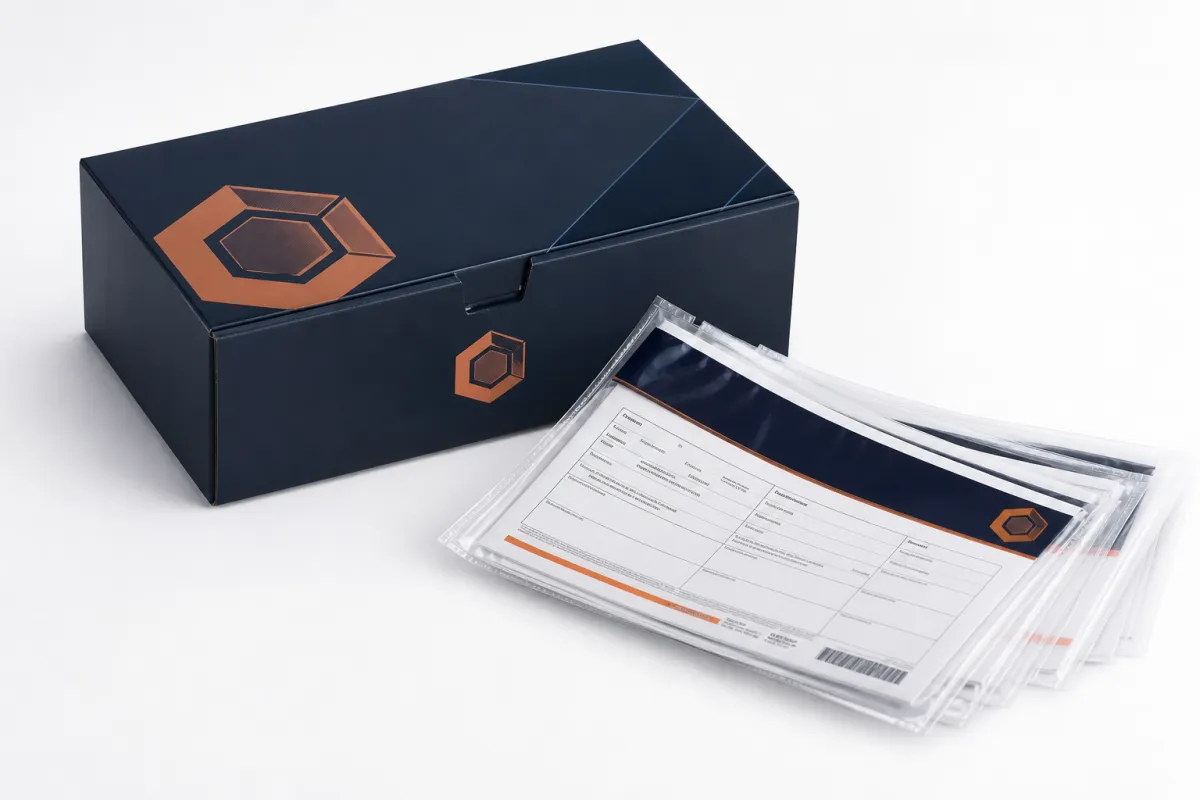
Custom shipping document pouches are pressure-sensitive envelopes, usually clear or translucent, that hold paperwork on the outside of a carton, pallet, or mailer. They create a visible pocket for forms that need to stay dry, attached, and easy to read. The job sounds simple. The consequences are not.
Picture a truck pulling up to a warehouse at 7:30 a.m. The pallet is wrapped, labeled, and scanned, but the commercial invoice is missing from the outside of the load. Someone checks receiving. Someone calls the shipper. Someone opens internal systems. Ten minutes becomes thirty, then somehow the whole morning starts wobbling. Custom shipping document pouches exist to break that chain before it starts.
The product itself is straightforward. A pouch usually uses a thin polyethylene or polypropylene film with a pressure-sensitive adhesive on the back. The clear front lets workers read packing slips, invoices, customs forms, return authorizations, MSDS sheets, or routing labels without opening anything. For many users, the value is not the pouch by itself. It is the time saved by not handling paperwork twice.
Why does custom matter? Because not every shipment carries the same paperwork load. A domestic retail carton may only need a one-page slip. Export freight can carry a folded packet with multi-language declarations. Custom shipping document pouches can be sized for the largest insert, printed with handling cues, tinted for privacy, or shaped to fit a specific lane. That beats forcing one generic pouch into every operation and pretending it works.
There is also a branding angle, though function still wins. Good custom shipping document pouches sit inside the broader world of branded packaging and package branding. A printed line, logo edge, or instruction panel can make a shipment feel more deliberate. For companies already using Custom Shipping Boxes or Custom Poly Mailers, the pouch can finish the story instead of looking like a random add-on.
Honestly, a lot of teams underestimate how much a pouch shapes process discipline. If the paperwork has a fixed home, crews are less likely to tuck it inside the carton, tape it to the wrong face, or hand it to a driver separately. That consistency matters in custom shipping document pouches, especially where compliance checks or receiving audits are part of the route.
For buyers building a broader packaging design system, these pouches also fit neatly alongside Custom Packaging Products. They are one piece of a larger visual and operational package: box, mailer, label, slip, and document holder all pulling in the same direction instead of competing for attention.
How Custom Shipping Document Pouches Work in Transit
The workflow for custom shipping document pouches is simple on paper and a little less charming in motion. A packer inserts the document packet, seals the top flap, applies the pouch to the outside of the shipment, and the load moves through staging, scanning, palletizing, truck transfer, receiving, and sometimes customs review. Every one of those steps is a chance for the paperwork to stay visible or get buried.
Adhesion is the mechanical issue that matters most. A pouch may stick beautifully to smooth corrugate and then fail on dusty recycled board. It may hold fine on a carton at room temperature, then curl at a cold dock or soften in a hot trailer. That is why custom shipping document pouches need the adhesive matched to the substrate, not just the size matched to the form. Rough cartons, stretch wrap, coated surfaces, and poly mailers all behave differently.
Visibility comes next. Clear fronts let handlers confirm the contents without peeling the pouch away. That sounds minor until you count the number of shipments a warehouse touches in a day. On a busy line, saving even 5 to 10 seconds per parcel or pallet adds up fast. In that sense, custom shipping document pouches are a speed tool as much as a protection tool.
The paperwork inside matters too. Packing slips and invoices are common, but so are customs declarations, export packets, route labels, receiving instructions, and safety sheets. If the pouch is too tight, documents wrinkle and become hard to scan. If it is too large, the contents shift around and look sloppy. The best custom shipping document pouches are sized so the insert sits flat without forcing the packer to fold it three extra times.
From a transit standpoint, good execution creates a fast-access control point. Poor execution creates a delay waiting to happen. A wrinkled pouch under stretch film is hard to locate. A pouch placed near a corner can get scuffed or torn. A low-tack adhesive on rough corrugate may lift halfway down the route. That is why many buyers test custom shipping document pouches under real conditions instead of trusting a desk sample.
For packaging teams already weighing product packaging, retail packaging, and shipping presentation, the pouch belongs in the same discipline. It should support the shipment, not fight it. That is also why some programs align pouch specifications with transit testing methods borrowed from ISTA, especially when freight is exposed to vibration, compression, or repeated handling.
One practical point sits on top of all that: if the shipment has to meet sustainability criteria, the pouch program should sit inside the same procurement logic used for paper and board. Not every lane needs the same material, but some buyers want documentation on recycled content or sourcing through groups such as FSC. That is not always necessary for the pouch itself, yet it often matters in the bigger branded packaging conversation.
Key Factors That Shape Cost and Performance
Pricing for custom shipping document pouches comes down to five main variables: size, film thickness, adhesive type, print coverage, and order quantity. The bigger the format and the more specialized the spec, the higher the unit cost tends to be. Nothing exotic there. The surprise is how fast a small design choice can move the price by 20% or more.
At lower volumes, the per-piece price usually tracks with material and setup efficiency. At higher volumes, the run becomes more sensitive to waste, print complexity, and die-cut consistency. A standard clear pouch may cost little more than a plain consumable, while printed or reinforced custom shipping document pouches can move into a higher bracket because the line has to do more work. If the artwork includes multiple colors, barcode placement, or special instructions, expect added press time and proofing.
Here is a practical comparison many buyers use during sourcing:
| Option | Typical Use | Approx. Unit Cost at 5,000 Pieces | Performance Notes |
|---|---|---|---|
| Standard clear pouch | Invoices, packing slips, basic routing forms | $0.05-$0.09 | Best for dry indoor lanes and lighter document loads |
| Printed branded pouch | Retail fulfillment, visible package branding, export packets | $0.08-$0.14 | Improves recognition and can support process instructions |
| High-adhesion pouch | Rough corrugate, long-haul freight, high-touch routes | $0.10-$0.18 | Better hold, especially where dust or temperature swings are an issue |
| Extra-deep pouch | Customs packets, folded multi-page forms, document bundles | $0.11-$0.22 | Reduces overstuffing and helps the packet lie flatter |
That table is a starting point, not a quote. A buyer shipping 50,000 units a month may negotiate below those levels. A low-volume user with unusual dimensions may pay more. The important comparison is not only the pouch price, but the cost of failure. One missing document can mean a reprint, a call to the customer, a missed cutoff, or a claim. In that light, custom shipping document pouches are often cheaper than the disruption they prevent.
Strength and ease of use fight each other a little, which is normal. A stronger adhesive improves hold but can be harder to remove from returns packaging or reusable totes. A thicker film can protect paper better, but may feel stiffer when the packer inserts documents. In real operations, that balance matters. Too much spec creates handling friction; too little creates failure. Good custom shipping document pouches usually land in the middle, where the pouch is dependable without becoming annoying.
For perspective, compare the pouch to other branded packaging investments. A custom printed box may shape the customer's first impression, while the pouch shapes the carrier's and warehouse team's first impression. In ecommerce shipping, those are different moments, but both belong to the same service experience. Buyers who already optimize custom printed boxes usually understand why this little pocket deserves the same seriousness.
When a program spans domestic retail, export, and wholesale replenishment, the pouch spec can vary by lane. Some teams standardize one format to keep order fulfillment simple. Others accept a few versions because the operational savings outweigh the complexity. There is no universal answer, which is why custom shipping document pouches should be evaluated against actual shipment behavior, not just a quote sheet.
Step-by-Step: Ordering Custom Shipping Document Pouches
The cleanest way to source custom shipping document pouches is to start with the documents, not the pouch. Measure the largest form you expect to use. Note whether the paper arrives folded, stacked, or packeted. Confirm whether the pouch needs to hold a single sheet or a multi-page bundle. That one audit prevents a lot of rework later.
Next, map the packaging surface. Are the pouches going onto corrugate, poly mailers, stretch-wrapped pallets, or coated cartons? The answer changes the adhesive recommendation. A rough recycled carton may need a stronger bond than a smooth shipper. A lane exposed to condensation or outdoor staging may need different film behavior than a climate-controlled fulfillment center. Good custom shipping document pouches are selected with the shipment environment in mind, not just the document size.
Then choose the format. Some buyers want plain clear pouches. Others want a tinted face to reduce glare or protect sensitive paperwork. Some want a printed warning, a scan cue, or a logo panel that matches their retail packaging and package branding. If the pouch is part of a larger launch, it can echo the tone of the box or mailer without swallowing the function. If you are already using Custom Shipping Boxes or Custom Poly Mailers, that continuity can make the program feel more polished.
Proofing is where mistakes get expensive, so treat it seriously. Confirm barcode size, copy placement, language requirements, and any compliance text before production. If a customs packet must be readable at a glance, print contrast matters more than decorative design. If the pouch includes a company logo, check that the artwork does not cover the critical area of the form. The best custom shipping document pouches support the document instead of competing with it.
Sampling should happen on real packaging, not a flat table. A pouch can look perfect in a studio and fail on a dusty carton or a tightly wrapped pallet. Apply it to the actual substrate, fill it with real paperwork, and stage it the way the warehouse will. Then ask the people who touch it every day what slowed them down. That feedback is worth more than a pretty mockup.
For companies with multiple lanes, sequencing the rollout helps. Start with the highest-risk lane first: export freight, weather-exposed pallets, or shipments that frequently require supporting paperwork. That is where custom shipping document pouches usually prove their worth fastest. Once the lane is stable, roll the spec into broader order fulfillment workflows.
Process and Timeline: From Spec Sheet to Warehouse Use
A typical custom shipping document pouches project moves through six steps: request the spec, review size and adhesive options, approve artwork, produce samples, validate adhesion, and release production. The sequence is simple. The speed is not always simple, because each round of adjustments can add a few business days.
For a repeat order, timelines can be surprisingly short if the spec is already approved and the artwork does not change. New custom work takes longer because size, print, and adhesive all need to line up. As a practical rule, many teams see simple projects move in roughly 10 to 15 business days after approval, while more complex versions may take longer if sampling is involved. Custom shipping document pouches with specialty print, unusual dimensions, or high-adhesion builds are the ones most likely to stretch the schedule.
Internal coordination matters more than people think. Procurement may focus on cost. Operations will care about pack speed. Compliance wants the paperwork in the right place. Customer service wants fewer calls about missing documents. If those groups do not agree before launch, the pouch spec can get pulled in three directions at once. The smoothest custom shipping document pouches rollouts happen when one person owns the lane definition and everyone else signs off early.
Warehouse rollout also needs simple instructions. If staff must guess whether the pouch goes on the side panel, the lead flap, or the top face, the program will drift within a week. A one-page SOP with photos can save much more money than a fancy specification sheet. It helps to mark the standard pack-out position, whether the paperwork should be folded longways or shortways, and what happens when a shipment includes extra forms. In other words, make the easy path the correct path for custom shipping document pouches.
One useful test is to measure the first 100 shipments after launch. Are workers inserting documents on the first try? Are scanners reading the paperwork without pouch removal? Are any pouches lifting in cold storage or under trailer heat? Those early observations tell you whether the spec is stable or merely acceptable on paper. Real production always teaches something a spec sheet cannot.
If the pouch is part of a broader packaging system, compare it against the rest of the shipment flow. A carton that survives transit but hides paperwork under tape still creates service friction. A mailer that looks clean but loses its customs packet is only half-done. The best custom shipping document pouches fit into a complete packaging and documentation plan, not a disconnected buying decision.
Common Mistakes That Cause Damage, Delays, or Waste
The most common mistake with custom shipping document pouches is undersizing. Teams size the pouch for a single folded invoice, then later discover they also need to fit a packing slip, a return sheet, and a customs form. The result is crumpled paper, weak seals, or documents hanging halfway out of the opening. That is not just untidy. It raises the odds of damage and misreads.
Adhesive mismatch is another frequent problem. A low-tack bond on rough corrugate can peel during transit. A very aggressive adhesive on reusable packaging can leave residue or make removal unpleasant. For shipments that travel through hot trailers, cold docks, or humid environments, the adhesive choice matters more than many buyers expect. Custom shipping document pouches should be tested on the actual surface and under the actual temperature range.
Overfilling is a quiet failure mode. Too many pages in one pouch reduce clarity, weaken the seal, and make the insert hard to flatten. Workers start pushing the packet in at an angle, and the pouch becomes visually messy. That can slow down scanning and receiving. A better approach is to increase pouch depth or split paperwork into a clean two-packet system if the lane truly needs it. For custom shipping document pouches, neatness is not vanity; it is legibility.
Placement errors cause a different kind of trouble. If the pouch lands behind stretch film, under a strap, or in a shaded corner of the pallet, it can be missed by the driver or the receiver. If it is placed too low, it can pick up scuffing from dock contact. If it is placed where forklifts or conveyors brush against it, the odds of tearing go up. Good custom shipping document pouches should be visible at a glance and protected from the worst handling points.
Process drift may be the biggest risk of all. Even a solid pouch fails when one shift uses a different insert rule than another. The form gets printed wrong. Someone places the paperwork inside the carton instead of outside. A team lead skips the placement standard because the line is busy. These are small deviations, but they create inconsistency. The fix is not usually a better pouch. It is better training paired with a clear standard for custom shipping document pouches.
There is also a branding mistake worth calling out. Some teams add too much print and then cover the clear viewing area. That undercuts the whole point. A pouch can reinforce branded packaging without turning into a billboard. A small logo, a color band, or a simple handling cue usually works better than heavy graphics. In shipping, function should lead. Visual identity can follow.
Expert Tips for Better Visibility, Branding, and Next Steps
If you want custom shipping document pouches to work harder for you, start with visibility. A clean, high-clarity film often beats a decorative design because warehouse staff and carriers need to read the form instantly. Anti-glare film can help on bright docks, and a tinted edge can improve contrast without blocking the document. I would choose readability first, branding second, and decoration third. That order keeps everyone from making a pretty mistake.
That said, small design choices can still improve process speed. A printed instruction strip can tell staff exactly which way to insert paperwork. A subtle color cue can separate export lanes from domestic ones. A logo can help a shipper spot its own documentation in a mixed facility. Used carefully, custom shipping document pouches can support package branding without getting in the way of the task.
Match the pouch to the shipping lane. Domestic retail shipments usually need fast insertion and good basic hold. Cross-border freight often needs deeper pockets and stronger adhesion because the packet is larger and the route is longer. Returns may need a format that is easier to remove or reopen. Wholesale pallet lanes often benefit from a sturdier hold and a placement standard that survives long-haul movement. One spec does not fit every lane, and that is exactly why custom shipping document pouches are worth customizing in the first place.
Use a pilot before full rollout. Pick one SKU, one region, or one warehouse line. Track whether the pouch reduced missing-document calls, improved receiving speed, or cut reprints. A small controlled test gives you better data than a quick approval based on appearance alone. If the pilot shows fewer delays and cleaner handoffs, expand. If not, revise the adhesive or the size before you lock in the spec. That beats discovering a failure after 20,000 units are already in circulation.
It also helps to compare the pouch project to other packaging decisions. Teams often spend weeks on custom printed boxes, then rush the document holder in a day. That is backwards. If the paperwork gets separated from the shipment, the best-looking box in the building will not rescue the lane. For that reason, custom shipping document pouches belong in the same planning conversation as product packaging, retail packaging, and order fulfillment.
One more practical note: if you are building a broader branded supply chain, do not isolate the pouch from the rest of the system. The carton, mailer, label, insert, and document holder should all point in the same direction. That is the difference between packaging design that merely looks coordinated and packaging Design That Actually helps operations.
For teams ready to act, the next steps are straightforward: audit the current paperwork, measure the largest insert, request samples on real packaging, test adhesion under real handling conditions, and standardize the best-performing custom shipping document pouches across the lanes that need them most. Done well, they become a quiet control point that keeps freight moving, keeps paperwork legible, and keeps service teams out of avoidable fire drills.
FAQ
What size should custom shipping document pouches be?
Start with the largest document you expect to use, including folded invoices or customs packets. Leave enough room for quick insertion, but do not oversize so much that the contents float around and wrinkle. If multiple packet types are used, a slightly larger pouch can simplify custom shipping document pouches standardization across the warehouse.
Are custom shipping document pouches waterproof?
Many are moisture resistant, but true protection depends on the film, seal quality, and adhesive performance. For wet docks or outdoor staging, ask for materials that handle rain, splash, and condensation better than a basic clear sleeve. The top seal matters too; custom shipping document pouches protect paper best when the paperwork is dry and fully enclosed.
How much do custom shipping document pouches cost?
Pricing usually depends on size, film thickness, adhesive type, print coverage, and volume. At 5,000 pieces, many buyers see roughly $0.05-$0.22 per unit depending on the spec. The more useful comparison is not the pouch alone, but the cost of delays, reprints, and customer service time avoided by using reliable custom shipping document pouches.
How long does it take to order custom shipping document pouches?
Simple repeat orders can move quickly if the spec is already approved and artwork does not change. New projects take longer because sampling, proofing, and adhesion testing can add extra steps. The fastest timelines usually come from having the document dimensions, shipping surface, and forecasted volume ready before you request custom shipping document pouches.
What are the best use cases for custom shipping document pouches?
They are especially useful for pallets, export shipments, retail replenishment, returns, and any shipment that carries multiple forms. They help when paperwork must stay visible to carriers, warehouses, or customs officials throughout transit. They also support cleaner branded packaging, especially when paired with other coordinated custom shipping document pouches and shipping materials.
If you only remember one thing, make it this: the best custom shipping document pouches are the ones matched to the document, the lane, and the surface they actually face in the real world. Measure first, test on real packaging, and do not let a cheap-looking pouch create a expensive-looking delay. That is the whole trick. Keep the paperwork where people can find it, and the shipment usually stops being a problem.

