Buyer Fit Snapshot
| Best fit | Custom Shipping Label Stickers Bulk projects where brand print, material claims, artwork control, MOQ, and repeat-order consistency need to be specified before quoting. |
|---|---|
| Quote inputs | Share finished size, material target, print colors, finish, packing count, annual reorder estimate, ship-to region, and any compliance wording. |
| Proofing check | Approve dieline scale, logo placement, barcode or warning zones, color tolerance, closure strength, and carton packing before bulk production. |
| Main risk | Vague material claims, crowded artwork, missing packing details, or unclear freight terms can make a low unit price expensive after revisions. |
Fast answer: Custom Shipping Label Stickers Bulk: Prices & Specs should be specified like a repeatable production item. The safest quote records material, print method, finish, artwork proof, packing count, and reorder notes in one written spec.
Production checks before approval
Compare the actual filled-product size with the drawing, then confirm tolerance on folds, seals, hang holes, label areas, and retail display edges. Reserve space for logos, QR codes, warning copy, and material claims before decorative graphics fill the panel.
Quote comparison points
Review material grade, print process, finish, sampling route, tooling charges, carton quantity, and freight assumptions side by side. A quote is only useful when the supplier can repeat the same color, closure quality, and packing count on the next order.
Custom shipping label stickers bulk is one of those buys where the real savings show up after the invoice clears. The sticker price matters, sure. But the bigger win is fewer reorders, fewer line stoppages, and fewer ugly surprises when a warehouse team runs out halfway through a pick wave.
Buy labels piecemeal and you pay for rush shipping, artwork fixes, and the one bad print that slips into every tiny batch. Buy custom shipping label stickers bulk with the right specs, and the job starts acting like infrastructure instead of a recurring headache. That is the difference between a clean order fulfillment system and a week spent hunting labels in the back office.
For brands with steady ecommerce shipping volume, bulk labels also keep package branding consistent. The shipping label is functional, but it still sits on the box next to your tape, carton, and insert card. If the label looks sloppy, the whole package feels cheaper. Buyers notice. Packing teams do too.
I have watched more than one operations team lose half a day because the "temporary" label spec changed, then changed again, then got blamed on the supplier. It never ends well. A stable label spec is boring, and boring is good.
Why Custom Shipping Label Stickers Bulk Beats Piecemeal Ordering
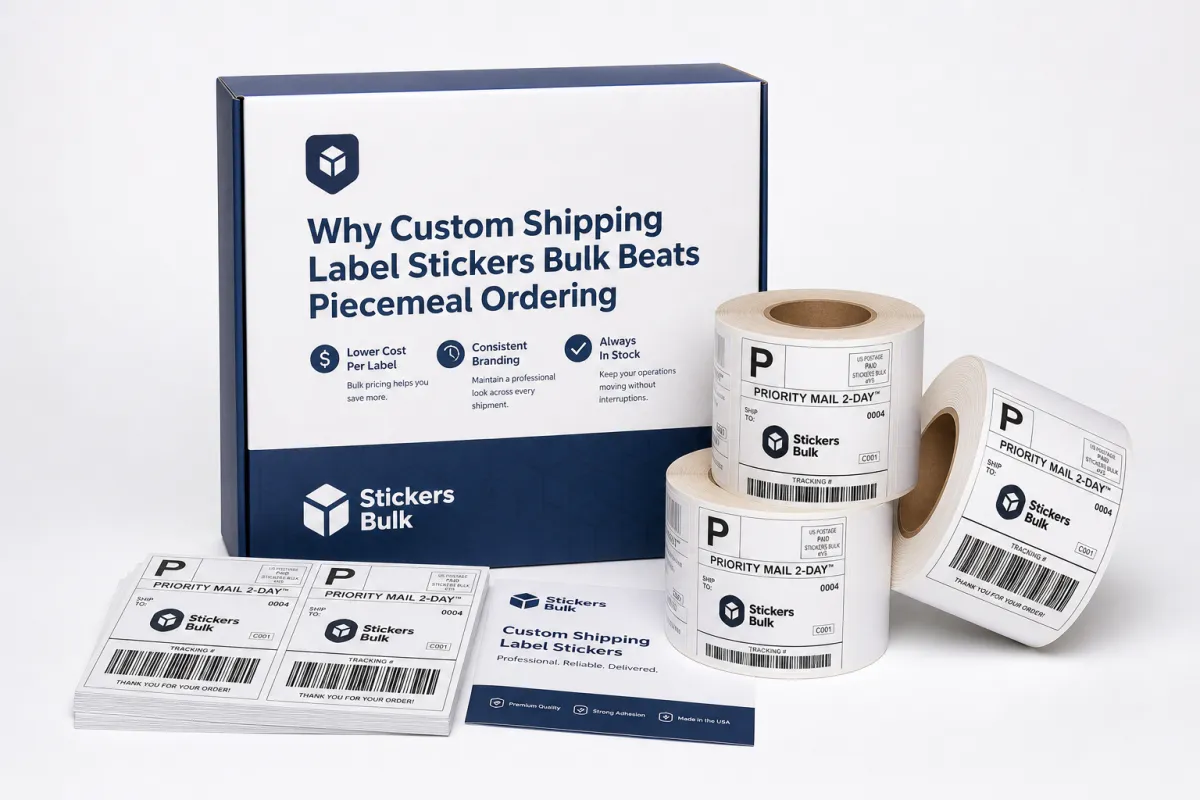
Small label orders look harmless until the fourth reorder lands on somebody's desk. Then the admin work starts stacking up. Someone confirms the size again, someone else approves a proof, and another person explains why the old carton label no longer matches the new carrier requirement. Custom shipping label stickers bulk cuts that noise down fast.
From a packaging buyer's point of view, the value is not just unit cost. It is fewer interruptions on the pack line, fewer artwork revisions, and fewer chances to get stuck with a leftover batch that no longer fits the workflow. A 500-piece order can work for testing, but if you ship the same SKU every day, a test order is not a plan. It is a delay with a polite name.
One warehouse change can shift everything. Maybe the carrier asks for a larger scannable zone. Maybe the carton size changes by half an inch. Maybe the brand updates its retail packaging and the old label layout suddenly clashes with the new packaging design. That is where custom shipping label stickers bulk pays off. Fix the spec once, then run the same label consistently across repeat shipments.
Here is the part people usually miss: bulk labels reduce hidden labor. A fulfillment coordinator does not want to chase label files, manage six small reorders, and explain why one batch arrived on sheets while another came on rolls. They want one known spec, one known supplier path, and one predictable restock point. That matters even more for brands balancing branded packaging, product packaging, and shipping output at the same time.
“A label that looks fine on a screen but fails in the warehouse is not premium. It is a mistake with better lighting.”
If you ship the same parcel type every day, the economics get even cleaner. The unit price on custom shipping label stickers bulk usually drops, but the bigger savings come from fewer reprints, fewer spoilage issues, and fewer staff hours spent handling exceptions. Cheap labels are cheap only until they create waste. Then they are just expensive in disguise.
That is why brands that care about Custom Packaging Products usually treat labels like part of the same system, not an afterthought. Good packaging works as a set: cartons, mailers, inserts, and labels speaking the same visual language without getting in each other's way.
Custom Shipping Label Stickers Bulk: Materials and Adhesives
Material choice is where most bad label orders begin. Buyers focus on price, then discover the label needs to survive moisture, abrasion, freezer storage, or a rough carton surface. Custom shipping label stickers bulk only works well when the stock and adhesive match the shipping environment.
For simple dry shipping, paper labels are still the lowest-cost option. They print cleanly, look crisp, and work well on standard corrugate and mailers. For many ecommerce shipping programs, paper is enough as long as the box stays dry and the label is not getting scraped by conveyors or condensation. If the package gets heavy warehouse handling, synthetic stock is safer.
Synthetic materials, usually polypropylene or similar films, cost more but hold up better against moisture and abrasion. They are a smarter pick for refrigerated goods, high-touch parcels, or shipments that sit in damp transit conditions. Custom shipping label stickers bulk in synthetic stock may cost more per unit, but replacing failed labels costs even more. That tradeoff is not hard if the package has a job to do.
Adhesive strength matters just as much as face stock. Permanent adhesive works for standard cartons and most mailers. Removable adhesive makes sense for repackaging, returns, or reusable bins. High-tack adhesive is the better call for textured corrugate, cold surfaces, or low-energy plastics. Freezer-rated adhesive is for labels that need to stay put below room temperature, not for a standard shelf label that somebody hopes will "probably be fine."
Finish matters too, though not for vanity reasons. Matte finishes reduce glare under bright warehouse lights and can improve barcode readability. Gloss can look sharper on some printed designs, but it is not always the best choice for scanning. No-topcoat or light-coated stocks may be enough for straightforward shipping labels, while more durable topcoats help when labels get handled, stacked, or exposed to scuffing.
For buyers comparing options, here is the practical version:
| Material / Adhesive | Best Use | Typical MOQ | Typical Unit Price at 5,000 | Notes |
|---|---|---|---|---|
| Paper / Permanent | Dry cartons, standard ecommerce shipping | 500 to 1,000 | $0.05 to $0.10 | Lowest-cost option; best for clean warehouse conditions |
| Paper / Removable | Repackaging, returns, reusable containers | 500 to 1,000 | $0.07 to $0.12 | Useful when labels must come off without tearing the surface |
| Synthetic / Permanent | Moisture, abrasion, rough handling | 1,000+ | $0.09 to $0.18 | Better for longer transit, cooler storage, and high-touch parcels |
| Synthetic / High-Tack or Freezer | Cold chain, textured cartons, low-temp surfaces | 1,000+ | $0.12 to $0.24 | Costs more, but reduces label failure in tougher conditions |
Those numbers are only ballparks for common sizes such as 3 x 5 or 4 x 6. Print coverage, slitting, roll core size, and special finishes all move the quote. Still, the pattern holds: custom shipping label stickers bulk gets more expensive when the environment gets harsher, and that is normal.
If sustainability matters, ask for FSC-certified paper where possible. FSC certification does not magically fix bad packaging decisions, but it does give buyers a cleaner sourcing story. If you want a stricter view on shipping durability, the testing standards published by ISTA are a better reference point than guesswork.
For brands building a coordinated shelf and shipping presence, label stock should not be chosen in isolation. If your cartons or mailers already carry strong visual identity, pair them with the right label finish so the full package reads as one system. That is where Custom Shipping Boxes and Custom Poly Mailers can help keep the whole program aligned.
Custom shipping label stickers bulk should match the package, not fight it. That sounds obvious, yet people still choose the cheapest adhesive and act shocked when labels fail on cold cartons. Amazing how often "good enough" turns into a return authorization.
Custom Shipping Label Stickers Bulk Print Specs That Keep Barcodes Scannable
The print file is where a pretty label becomes a usable label. Custom shipping label stickers bulk needs artwork that looks clean and scans cleanly. Those are not the same thing. A barcode can sit inside a nice layout and still fail if the quiet zone is cramped or the contrast is weak.
Start with size. If the label is going on a small mailer, do not squeeze a full address block, marketing message, and large logo into a tiny footprint. Leave breathing room. Most shipping labels perform best when the barcode, routing information, and essential text have clear separation. In practical terms, a 4 x 6 label gives enough room for standard shipping data and a scannable barcode without turning the layout into a traffic jam.
For raster artwork, 300 dpi is the bare minimum for clean print. Vector files are better for logos, line art, and text because they stay sharp at any size. If the barcode is rasterized, keep it high resolution and test it at final size. Tiny text is another common failure. Once the type drops below a readable size and lands on a glossy or low-contrast background, the label may look acceptable on screen but miserable in the sorter.
Barcode quiet zones matter more than most people think. Keep a clear margin around the barcode, and do not let boxes, icons, or decorative lines crowd the edges. If the label is for fulfillment software or multi-SKU shipping, variable data must also be set up correctly. That means serial numbers, routing codes, and address fields need to be mapped before production, not corrected after the run arrives.
Here is a simple preflight list that saves money:
- Confirm exact label dimensions, including bleed and corner radius if needed.
- Send vector artwork for logos and text whenever possible.
- Keep barcode contrast strong and the quiet zone open.
- Use final barcode data before proof approval.
- Match the file format to the print method and roll or sheet setup.
- Check whether the label needs sequential numbering, variable addresses, or routing codes.
That last point matters for order fulfillment. If a label set has to sync with warehouse software, the file prep is not just design work. It is production setup. A clean file reduces manual corrections, speeds proof approval, and cuts the chance of a reprint. Custom shipping label stickers bulk is cheaper when nobody has to rescue a bad layout.
Common mistakes are brutally ordinary. Black text over a dark background. Barcode data too close to a die line. Artwork exported at screen resolution. A logo that looks elegant but has thin strokes that disappear on press. None of that is mysterious. It is just avoidable.
If your labels are part of broader Custom Printed Boxes or retail-ready cartons, keep the whole package hierarchy in mind. The shipping label should complement the packaging, not compete with it. A good label supports the unboxing experience without pretending it is the star.
Custom shipping label stickers bulk also benefits from a proof that is treated like a production tool, not a courtesy PDF. Check the final dimensions, print method, barcode type, and placement before approving. That single habit prevents most of the expensive nonsense.
Custom Shipping Label Stickers Bulk Pricing and MOQ
Pricing for custom shipping label stickers bulk is not magic. It comes from a few predictable drivers: size, material, adhesive, print coverage, format, and whether the order needs special handling like variable data or freezer-rated stock. If a quote is dramatically lower than the rest, usually one of those specs has been quietly downgraded.
Small runs often start around 500 to 1,000 pieces. That range is common because setup cost has to go somewhere. The better unit price usually shows up at 5,000 pieces and above, where plate, setup, and proofing costs get spread across more labels. If you need repeated reorders, the volume break is where the real savings begin.
For a straightforward 4 x 6 shipping label on paper stock, a common ballpark at 5,000 pieces might land around $0.05 to $0.10 each. Synthetic stock, specialty adhesive, or extra print coverage can push that to $0.09 to $0.24 each depending on the spec. If the order includes variable numbering, Custom Die Cutting, or unusual finishing, the price may move higher. That is not a surcharge for fun. It is labor and material.
Compare quotes only after you normalize the specs. A cheap quote for a lighter stock with weaker adhesive is not the same product. Same with rolls versus sheets. Same with four-color print versus one-color. Same with standard permanent adhesive versus freezer-grade adhesive. If the quote sheet does not list the exact materials and quantity, you are not comparing prices. You are comparing wishful thinking.
Here is a cleaner way to evaluate bulk pricing:
- Ask every supplier for the same label size, stock, adhesive, and format.
- Confirm whether the price includes proofing, slitting, and freight.
- Check the MOQ and the price break at 5,000, 10,000, and 25,000 pieces.
- Ask what happens if the barcode or layout needs a revision.
- Compare lead time on the same production specification, not a sample version.
That last point matters because a sample quote can look cheap and still be useless for real production. Buyers often compare a test run on paper to a bulk run on synthetic stock and call it a fair comparison. It is not. Custom shipping label stickers bulk should always be priced against the same final use case.
Also, factor in the cost of failure. A label that peels off in transit, jams a dispenser, or prints poorly is not just a scrap. It creates labor, rework, and possibly customer service tickets. The "cheap" quote often gets expensive the minute the first bad carton leaves the dock. That is why custom shipping label stickers bulk is a buying decision, not a coupon hunt.
If your purchasing team also buys shipping cartons, mailers, or inserts, it may be worth reviewing the full packaging spend together. Custom Labels & Tags can often be coordinated with other packaging lines so you are not managing artwork and lead times in separate silos. That alone cuts the kind of admin work nobody enjoys.
Ordering Process and Timeline for Bulk Label Runs
The cleanest custom shipping label stickers bulk orders follow a predictable path. First comes the request for quote. Then the supplier confirms material, adhesive, size, and finish. After that, the proof gets reviewed. If the job needs a physical sample, that happens before the full production run. Then the labels go into production, followed by packing and freight.
Simple jobs move faster than complicated ones. A standard paper label with final artwork can often move through proofing and production in about 7 to 10 business days after approval, depending on the factory queue. Synthetic or freezer-rated orders often need 10 to 15 business days. If the job includes multiple SKUs, sequential numbering, or custom slitting, 15 to 20 business days is not unusual. Shipping time comes after that and depends on destination and freight method.
Delays almost always come from the same places. The customer sends the wrong size. The barcode artwork is not final. The proof gets revised three times because the finish was not discussed early. Or the team decides, mid-process, that the labels should now be on rolls instead of sheets. That is how an easy order turns into a calendar problem.
Rolls and sheets should be chosen based on the packing process, not personal preference. Rolls are better for dispensers and automated lines. Sheets work well for manual application, easy counting, and smaller internal teams. If the order will be repeated, match the format to the fulfillment setup first. Convenience matters less than consistency once volume goes up.
Custom shipping label stickers bulk also benefits from clear communication about application conditions. Will the label go on dry corrugate, coated cartons, cold packaging, or textured poly mailers? Will it be applied by hand or by machine? Does it need to survive freezer storage or rough outbound handling? Those details are not trivia. They are production specs.
Here is the practical timeline buyers should expect:
- Quote stage: 1 to 2 business days if the specs are complete.
- Proof stage: 1 to 3 business days, faster if the artwork is final.
- Sampling stage: Adds time only if the material or barcode setup is new.
- Production stage: Often 7 to 15 business days, depending on complexity.
- Freight stage: Depends on location and service level.
That is the part many teams underestimate. Production time is only half the equation. Transit time matters, especially when the warehouse is counting on the labels to support a launch, a promotion, or a replenishment wave. A serious buyer asks for both numbers in the quote.
Rush service can exist, but it should not be the default plan. If the spec is fuzzy, rushing just means paying more to make a bad decision faster. A clean proof beats a frantic last-minute reprint. Every time.
For brands that want one supplier conversation across multiple packaging categories, bulk label ordering can sit beside broader packaging procurement through Wholesale Programs. That is useful if you are balancing labels with carton and mailer purchases and want fewer scattered quotes.
Why Choose Us for Custom Shipping Label Stickers Bulk
People do not buy custom shipping label stickers bulk because they want a stack of paper. They buy it because they need labels that show up on time, work on the line, and look consistent from the first carton to the last. That is the baseline. Anything less is noise.
Our approach is practical. We check artwork before production so the common failures get caught early: barcode crowding, weak contrast, wrong dimensions, and file formats that are fine for a monitor but bad for print. That prepress step saves more money than a flashy promise ever will. It also keeps the order from turning into a back-and-forth mess.
Material recommendations matter just as much. A standard dry-shipping carton does not need the same stock as a cold-chain parcel. A smooth mailer does not behave like a rough recycled box. Custom shipping label stickers bulk should be matched to the actual shipping environment, not guessed from a product photo.
Consistency is another practical advantage. Bulk buyers care about repeatability. They want the same color, the same adhesive feel, the same roll direction, and the same print result every time the order repeats. That is how operations teams stay sane. Vague "premium quality" claims do not help when a forklift driver is peeling labels at 6 a.m.
If your packaging program includes a broader brand system, we can keep it coherent across product packaging and shipping materials. That often means lining up labels with Custom Shipping Boxes, Custom Poly Mailers, and other Custom Packaging Products so the final presentation looks intentional rather than patched together.
There is also a cost-control angle. Better setup means fewer rejects. Fewer rejects means less waste. Less waste means the label budget actually stays where it belongs instead of leaking into reprints and emergency freight. Custom shipping label stickers bulk should make the operation simpler, not more theatrical.
Honestly, most buyers do not need more marketing language. They need a label that sticks, scans, and arrives when promised. That is the job. A good supplier respects that and does the unglamorous work properly.
Next Steps to Place Your Bulk Label Order
If you are ready to place custom shipping label stickers bulk, start with the facts. Gather the exact label size, quantity range, surface type, application method, and any barcode or variable data requirements before requesting a quote. That single prep step makes every supplier response easier to compare.
Send the cleanest artwork file you have. Vector format is best for logos and text. If the design includes a barcode, make sure the data is final before proofing. If the label has to stick to a difficult surface, add a photo of that surface. A picture of the carton or mailer can prevent a wrong adhesive recommendation and a messy first run.
Then compare quotes on the same spec sheet. Not a close enough version. The same version. Ask for the proof. Confirm lead time. Confirm freight. Confirm whether the order is on rolls or sheets. Once those details are fixed, lock the order and stop changing the finish halfway through. That behavior is how buyers waste money while pretending they are saving it.
For teams managing recurring ecommerce shipping, a stable label spec becomes part of the operating system. It keeps pack-out faster, reduces order fulfillment friction, and supports better package branding across the rest of the line. If the label order is part of a larger packaging refresh, keep the whole system aligned instead of treating each item as a one-off.
If you are comparing custom shipping label stickers bulk options right now, the fastest route is simple: define the spec first, use the proof to remove guesswork, and then move into production with confidence. That is how you get a label that does its job without draining the budget.
Frequently Asked Questions
What is the minimum order for custom shipping label stickers bulk?
Bulk minimums usually start around 500 to 1,000 labels, depending on size, material, and whether the labels are rolled or sheeted. The best unit pricing usually appears at higher quantities such as 5,000 and up, because setup cost gets spread across more labels. If you only need a test run, ask for the smallest production quantity that matches the final spec so you do not compare apples to samples. That is the only fair way to review custom shipping label stickers bulk.
Should I choose rolls or sheets for custom shipping label stickers bulk?
Choose rolls if the labels are going into a dispenser or automated packing line, because rolls move faster and waste less time. Choose sheets if your team applies labels by hand and wants easy storage, counting, and distribution. If the order will be repeated, match the format to your fulfillment process first and the packaging convenience second. For custom shipping label stickers bulk, process beats preference every time.
What file format do you need for custom shipping label stickers bulk artwork?
Vector files like AI, EPS, or PDF are best for logos and text because they stay crisp at any size. If the design includes barcodes or raster images, use high-resolution files and keep the barcode data final before proofing. Outline fonts and confirm the final dimensions before sending files so the proof does not turn into a resize problem. That one step saves a lot of frustration on custom shipping label stickers bulk runs.
How long does custom shipping label stickers bulk production take?
Standard production usually starts after proof approval, not after the first email, so clean artwork speeds everything up. Typical turnaround is often measured in business days, with faster jobs available when the specs are simple and final. Shipping time depends on destination and freight method, so ask for both production time and transit time in the quote. That is the only honest way to schedule custom shipping label stickers bulk properly.
Can custom shipping label stickers bulk handle waterproof or freezer use?
Yes, but the material and adhesive need to be selected for that environment instead of assuming a standard paper label will survive. Synthetic stocks and temperature-rated adhesives are the safer choice for cold storage, moisture, or rough handling. If the label has to stay readable in extreme conditions, request a sample or test run before committing to the full order. For difficult environments, custom shipping label stickers bulk should be tested before it becomes a warehouse problem.
How do I keep barcode reprints from eating into my label budget?
Lock the barcode data before proof approval, and do not change the layout after the supplier has already started prepress. If the warehouse or carrier system can change the data at the last minute, build in a clear approval step so the print file and the live data stay in sync. That small bit of discipline cuts waste fast. In my experience, the reprint bill usually starts with one person saying, "It should be fine." It rarely is.
Bottom line: if you need custom shipping label stickers bulk, decide the shipping surface first, then match the adhesive and stock to that surface, then lock the barcode and file specs before you ask for quotes. Do those four things up front and the order gets simpler, the proof gets cleaner, and the labels are a lot more likely to work the first time.

