Buyer Fit Snapshot
| Best fit | Custom Die Cut Packaging Inserts Quote projects where brand print, material claims, artwork control, MOQ, and repeat-order consistency need to be specified before quoting. |
|---|---|
| Quote inputs | Share finished size, material target, print colors, finish, packing count, annual reorder estimate, ship-to region, and any compliance wording. |
| Proofing check | Approve dieline scale, logo placement, barcode or warning zones, color tolerance, closure strength, and carton packing before bulk production. |
| Main risk | Vague material claims, crowded artwork, missing packing details, or unclear freight terms can make a low unit price expensive after revisions. |
Fast answer: Custom Die Cut Packaging Inserts Quote: Pricing & Specs should be specified like a repeatable production item. The safest quote records material, print method, finish, artwork proof, packing count, and reorder notes in one written spec.
Production checks before approval
Compare the actual filled-product size with the drawing, then confirm tolerance on folds, seals, hang holes, label areas, and retail display edges. Reserve space for logos, QR codes, warning copy, and material claims before decorative graphics fill the panel.
Quote comparison points
Review material grade, print process, finish, sampling route, tooling charges, carton quantity, and freight assumptions side by side. A quote is only useful when the supplier can repeat the same color, closure quality, and packing count on the next order.
Custom Die Cut Packaging Inserts Quote: Pricing & Specs
A Custom Die Cut packaging inserts quote can stop a bad fit before the first board is cut. A gap of 2 mm sounds tiny until a premium product rattles loose, shows up scuffed, and turns a polished unboxing into a damage claim. Retail packaging, e-commerce, and direct-to-consumer brands all run into the same problem: the outer box gets the attention, while the insert quietly decides whether the package holds up.
That is why a custom die cut packaging inserts quote is more than a price request. It is the quickest way to confirm fit, material, and production feasibility before anyone approves samples. If the carton looks expensive but the interior support fails, the whole package feels cheap. Buyers notice. Customers do too.
Why a Custom Die Cut Packaging Inserts Quote Can Save a Shipment
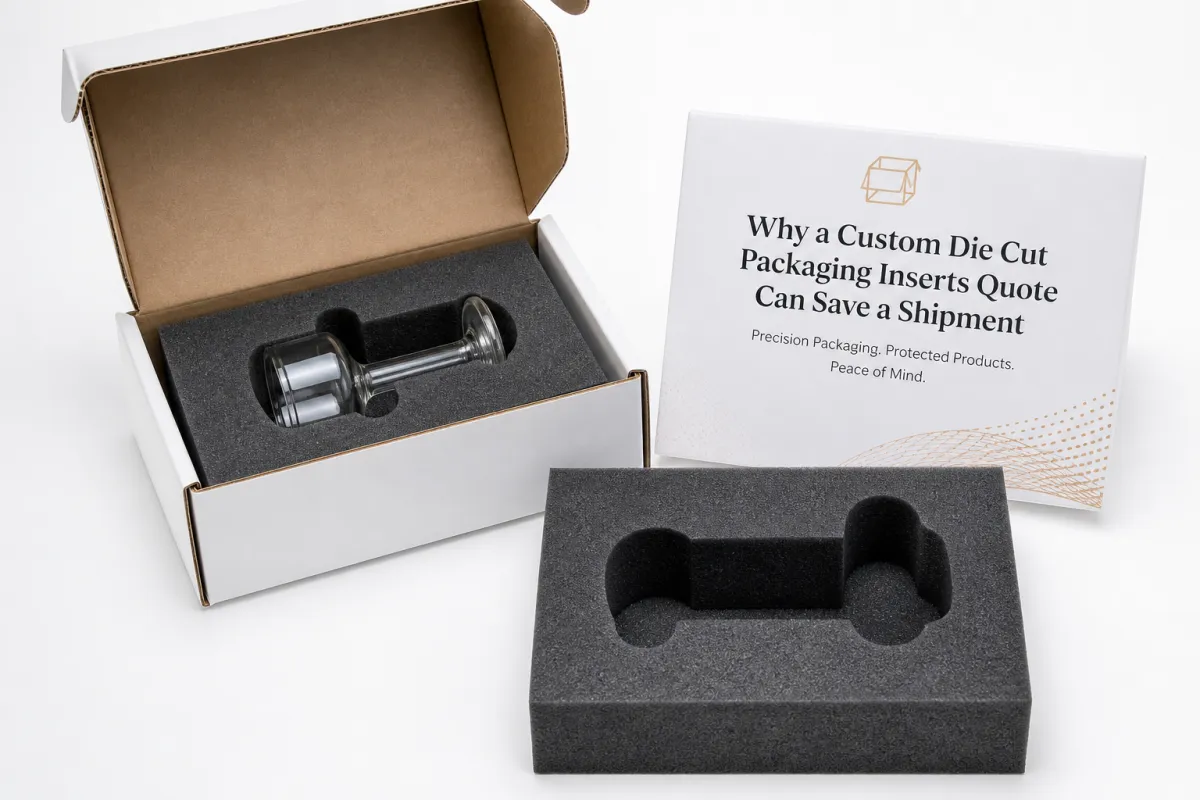
A custom die cut packaging inserts quote often surfaces problems that a spec sheet never shows. A few millimeters off can be the difference between a clean delivery and a return. A bottle leans. A cosmetic jar slides. A multi-part electronics kit presses into a sidewall. The carton survives. The product does not. That is a very expensive way to learn about fit.
From a packaging buyer's point of view, the insert is a control point. It controls movement, presentation, and consistency across batches. A custom die cut packaging inserts quote helps lock those control points down early, before tooling or sample revisions eat the budget. That matters when the product is fragile, premium, or sold in high volume, where small errors multiply fast.
The better quotes do not stop at a unit price. They compare materials, cut method, and order size so the trade-offs are clear. Paperboard can look cheaper than foam until the cavity count, caliper, and tolerance requirements push the total higher. A good custom die cut packaging inserts quote makes that math visible instead of burying it in a neat little spreadsheet that pretends all options are equal.
There is also a brand issue. Companies spend money on custom printed boxes, branded packaging, and polished packaging design, then ruin the experience with a loose insert. It happens all the time. The carton feels premium in hand, but the product floats inside. A custom die cut packaging inserts quote is where that mistake usually gets caught.
A 3 mm fit error is not a tiny tolerance problem. It is a packaging failure that shows up later as returns, complaints, and freight waste.
Another reason to ask for the quote early: it can reveal whether the current box size is actually the right one. Plenty of product packaging programs start with an inherited carton dimension and force the insert to make it work. That usually creates wasted headspace, extra corrugate, or a weak stack profile. A solid custom die cut packaging inserts quote can expose that problem before production starts.
I've seen teams spend weeks optimizing the outside of the box and then act surprised when the inside behaves like a loose drawer. Cute on paper. Annoying in a warehouse.
What a Custom Die Cut Packaging Inserts Quote Should Include
A useful custom die cut packaging inserts quote should read like a working spec, not a shrug in spreadsheet form. At minimum, it should list product dimensions, cavity layout, material type, quantity, print requirements if any, and the destination zip code for freight calculation. Leave those out, and the number is not really comparable. It is just noise with a currency sign.
The details matter because a Die Cut Insert is fit-based. The supplier needs the exact product size, but also the way the product is held. One cavity or five? Does it need a finger notch? Is it protecting glass, electronics, or a set of components shipped together? A complete custom die cut packaging inserts quote answers those questions instead of pretending they do not exist.
- Product dimensions: length, width, height, and any protrusions that change the fit.
- Product weight: important for top-load compression and stacking.
- Cavity count: one item, a set, or multiple SKUs in one tray.
- Material preference: corrugated, paperboard, foam, molded pulp, or specialty board.
- Fulfillment needs: retail shelf presentation, mailer protection, or bulk shipping.
- Freight destination: needed for realistic landed-cost estimates.
The strongest quotes separate insert styles cleanly. Corrugated inserts are common for e-commerce and heavier loads. Paperboard and chipboard work well for presentation-heavy retail packaging. Foam can cradle delicate or highly finished items, while molded pulp fits brands that care about compostable material sourcing. A serious custom die cut packaging inserts quote should not mash those options into one vague total.
It should also spell out tooling, setup, dieline work, and sample charges. Those are not filler lines. They tell you whether a low unit price is actually low, or whether the total jumps once engineering and freight get added. If a supplier will not break those pieces out, the buyer cannot compare landed cost with confidence. That is a weak custom die cut packaging inserts quote.
Proofing terms belong here too. Good suppliers state whether they will provide a dieline review, how many revision rounds are included, and what changes trigger a re-quote. If the product dimensions change after engineering begins, or if the box size changes after the insert is built, the quote should be updated. That is normal. Pretending it is not normal is the part that causes trouble.
For brands that care about testing and transit performance, it helps to align the insert with recognized methods such as ISTA transit testing standards. If the insert uses fiber-based stock, certification choices such as FSC chain-of-custody sourcing can also matter to the brand story and procurement team.
A custom die cut packaging inserts quote should leave you with three blunt answers: Will it fit? Will it protect? Will it scale at the quantity you need?
Die Cut Insert Materials, Structures, and Fit Specs
The right material is the one that matches the product, the channel, and the price target. A custom die cut packaging inserts quote should compare those options in practical terms. A rigid presentation insert is not the same thing as a lightweight mailer insert, and neither should be priced or engineered the same way.
For premium retail packaging, paperboard and chipboard usually deliver a clean look with strong print compatibility. For shipping protection, corrugated die cut structures offer better crush resistance and better load distribution. Foam can give precise cradle support for delicate products, though buyers often pay more for the material and the cutting complexity. Molded pulp brings a recycled-content story that many brands want, but tooling and minimums can be higher. The custom die cut packaging inserts quote should reflect those trade-offs without hiding them behind one neat number.
Fit specs are where the real work happens. A cavity that is too tight can scuff labels or deform closures. A cavity that is too loose allows movement, which is worse in transit. Most projects start with a small clearance around the product, then get tuned after a sample is tested. For odd-shaped items, a custom die cut packaging inserts quote should account for protrusions, shoulders, handles, and any weak points that should never bear pressure.
Material thickness and structure affect more than appearance. They affect slot tolerance, stack strength, and how the insert behaves under compression. A 16 pt board behaves differently from a 24 pt board. E-flute corrugated behaves differently from B-flute. Density changes how tightly a product sits; flute direction changes how the load spreads. Those are the kinds of details an experienced custom die cut packaging inserts quote should address.
And yes, sometimes a small design change fixes what a more expensive material was being asked to do. That part is kinda unglamorous, but it saves money.
Common structure choices
- Single-layer die cut insert: efficient for simple product holds and lower-cost runs.
- Nested cavities: good for kits, bottle-and-cap combinations, and accessory sets.
- Layered boards: useful when the product has multiple height zones or needs visual depth.
- Lock-tab construction: helpful when the insert must stay assembled during packing.
- Finger-notch cutouts: improve ease of removal and protect delicate finishes.
Multi-component products need special attention. Cosmetic boxes often include a jar, a dropper, and a card. Electronics may include a device, a cable, and a manual. Gift sets can include several fragile pieces in one box. In each case, the insert is part protection, part merchandising, and part packaging design. A well-built custom die cut packaging inserts quote should treat the insert as a system, not a tray.
There is a buyer habit that causes trouble: ordering the insert after the box design is frozen. That can force compromises in cavity depth or create dead space. A better path is to develop the box and insert together, especially when branded packaging needs to feel consistent across the product line. A thoughtful custom die cut packaging inserts quote can show whether a one-size-fits-all family of inserts is possible, or whether each SKU needs its own structure.
For comparison, here is how common insert types usually stack up:
| Insert Type | Best For | Typical MOQ | Approx. Unit Cost at Mid-Size Run | Notes |
|---|---|---|---|---|
| Paperboard / chipboard | Retail packaging, presentation kits, lighter products | 1,000 to 2,500 | $0.18 to $0.45 | Clean appearance, good for custom printed boxes |
| Corrugated die cut | E-commerce, heavier items, general product packaging | 500 to 1,500 | $0.22 to $0.60 | Strong crush resistance, efficient for shipping |
| EVA or PE foam | Fragile products, luxury electronics, high-value goods | 500 to 1,000 | $0.45 to $1.25 | Precise fit, higher material cost, very stable hold |
| Molded pulp | Eco-led brands, transit protection, molded tray programs | 5,000 to 10,000 | $0.30 to $0.80 | Tooling and setup can raise startup cost |
Those ranges are not universal, and they should not be treated like a fixed catalog price. Still, they give buyers a realistic starting point for a custom die cut packaging inserts quote, especially when comparing suppliers across different production methods. The cheapest number is not always the cheapest outcome.
One more practical point: if the product will ship through parcel networks, test the insert under actual motion and compression, not just on a desk. A good quote should support that kind of validation, because retail packaging and transit packaging do not always behave the same way.
Custom Die Cut Packaging Inserts Quote Pricing and MOQ Basics
Pricing for a custom die cut packaging inserts quote usually follows a familiar logic: material, cut complexity, quantity, finish, and freight. The buyer only sees the final number, so it helps to break those drivers apart. A simple insert in a standard board size can be economical. A deep cavity insert with multiple cutouts and tight tolerances will cost more, even before shipping gets added.
Material choice is the first lever. Paperboard and corrugated are typically lower-cost than specialty foam, but structure matters just as much. A simple board insert may need one pass through the cutter. A more complex one may need several operations, plus stripping, folding, or lamination. That is why two quotes that look similar on paper can split apart once production details are included. A good custom die cut packaging inserts quote makes those differences easy to see.
MOQ works the way most procurement teams expect, with a packaging twist. Smaller runs usually carry higher per-unit pricing because setup and cutting time get spread across fewer pieces. That is especially true for custom die cut products, where the engineering effort does not shrink just because the order is small. A pilot run can be smart when the fit is uncertain. A production run makes sense once the spec is stable. A custom die cut packaging inserts quote should show both paths if the supplier can support them.
Here is a practical way to think about quote types:
- Prototype quote: used to validate fit, cavity depth, and handling.
- Pilot run quote: small production batch for market testing or launch prep.
- Production quote: the best unit cost when quantities and specs are locked.
Freight matters more than many buyers expect. If the insert is bulky but light, carton count can drive the cost up. If the insert is heavy, zone pricing can climb quickly. A complete custom die cut packaging inserts quote should include shipment packaging, palletization if relevant, and any split-delivery or warehousing fees. Without those items, the landed cost comparison is incomplete.
There are also simple ways to control cost without weakening the design. Standardize outer dimensions where possible. Reduce waste around the cavities. Simplify geometry so the die can do the work in fewer steps. Group closely related SKUs into one insert family instead of engineering a one-off for every version. Those choices lower production friction and usually improve quote consistency.
The fastest way to trim a custom die cut packaging inserts quote is not always to ask for a cheaper material. Sometimes it is to remove one unnecessary cavity or widen a box by a few millimeters so the board nests more efficiently. That is the kind of change a buyer may not spot until the supplier shows a revised layout.
For Brands That Sell through product packaging programs with multiple channels, it can be worth comparing insert economics against the outer box itself. A slightly larger carton can reduce insert complexity, but it can also raise shipping dim weight. A slightly smaller carton can improve freight but make the insert harder to manufacture. The best custom die cut packaging inserts quote balances those forces rather than chasing the lowest insert-only price.
As a rule, a quote that separates setup, tooling, sample, production, and freight is easier to trust than one all-in line item. Transparency is not optional here. It is how buyers avoid surprise costs after approval.
How the Custom Die Cut Packaging Inserts Quote Moves Into Sampling and Production
The process behind a custom die cut packaging inserts quote should be straightforward, but it only moves fast when the buyer sends usable information. The usual flow starts with intake, moves into design review, then quote approval, sampling, revisions, production, and final shipment. Each step depends on the one before it. Skip one, and the schedule starts slipping.
The fastest projects usually include three things: a product sample, inside-box dimensions, and an intended quantity. If the supplier can see the item in hand, the quote becomes far more accurate. If not, the engineering team has to infer the clearances from photos or drawings, and that stretches the timeline. A strong custom die cut packaging inserts quote shortens time by reducing guesswork.
Realistic timing depends on complexity. A simple insert with clean geometry may move from inquiry to sample in a short window. A multi-cavity layout or an irregular product shape takes longer because the insert must be engineered around the item, not around a generic cavity. Revision cycles add time too, especially when the box size changes after the insert has already been drafted. That is where many projects lose days.
These are the stages most buyers encounter:
- Brief intake: dimensions, quantity, product photos, and material preference are collected.
- Design review: the supplier checks fit, board thickness, and cavity layout.
- Draft quote: pricing is issued with setup, sample, and freight notes.
- Sample production: a prototype is cut and checked against the product.
- Revisions: clearance, depth, and notch placement are adjusted if needed.
- Production: final order is run after approval.
- Shipment: inserts are packed for delivery, often with pallet options for larger jobs.
The main sources of delay are predictable. Incomplete measurements. Unclear product weights. Late changes to the shipper size. A buyer may think these details can be resolved later, but they affect the quote itself. When the product is fragile or premium, the custom die cut packaging inserts quote should be updated before production, not after.
Rush jobs are possible in some cases. The real question is whether speed compromises fit. If a supplier can accelerate a proof without cutting corners, fine. If the schedule requires skipping sample checks on a product with sharp edges or variable dimensions, the risk climbs fast. That is why the smartest custom die cut packaging inserts quote is the one that balances urgency with control.
Buyers who care about validation often ask for a transit test plan. That can include drop testing, vibration checks, or compression evaluation against the expected load profile. Inserts stop being a packaging component and start acting like an operational safeguard pretty quickly. If you need a reference point, use recognized transit methods and document the conditions before scaling the order.
From a packaging industry standpoint, the biggest advantage of a disciplined quote process is not speed alone. It is fewer surprises. Fewer surprises mean fewer re-runs, less scrap, and better product packaging consistency across batches.
A custom die cut packaging inserts quote that is engineered well on the front end usually pays back in lower returns and fewer internal corrections later.
Why Buyers Choose Us for Custom Die Cut Packaging Inserts
Buyers usually do not choose a supplier because of a single number. They choose a team that can make the number make sense. That is the difference with Custom Logo Things. A custom die cut packaging inserts quote is treated as an engineering and communication exercise, not just a sales response. The goal is to protect the product, keep the quote readable, and reduce revision churn.
That matters most when the product is fragile, premium, regulated, or assembled from multiple parts. A cosmetics set may need a stable presentation insert. An electronics kit may need layered protection and cable management. A bottle program may need a snug cavity with enough clearance to avoid pressure on the closure. In each case, a custom die cut packaging inserts quote should reflect the actual product, not a generic template.
Responsive prepress and dieline review are not minor features. A one-line correction to a fold, score, or cut path can save a run. A missed spec can do the opposite. Packaging buyers know this, and production teams know it too. That is why a useful custom die cut packaging inserts quote needs fast back-and-forth with people who understand packaging design, not only order entry.
The other advantage is consistency. A clean quote process supports consistent reorders, better forecasting, and less risk when multiple box sizes or product versions are in play. That is valuable for branded packaging programs where appearance and protection must match from one batch to the next. It is also valuable for retail packaging where presentation needs to stay stable across different channels.
Here is the practical comparison buyers often make:
| Supplier Type | What You Get | Risk Level | Best Use Case |
|---|---|---|---|
| Commodity vendor | Fast number, limited engineering detail | Higher | Simple, low-risk insert programs |
| Packaging specialist | Quote plus fit guidance and revision support | Lower | Fragile, premium, or multi-part product packaging |
| Prototype-first partner | Sample support, testing input, tighter feedback loop | Lowest for uncertain fit | Launches, line extensions, and new SKUs |
A custom die cut packaging inserts quote from a specialist should feel more useful because it solves more than price. It should answer fit questions, material questions, freight questions, and approval questions in one pass. That cuts time on email threads and helps the buyer make a cleaner decision.
If your team needs a broader packaging conversation, the same discipline applies to the rest of the pack. You can review Custom Packaging Products to align the insert with the outer carton, or route detailed specs through Contact Us when the product shape is unusual or the launch timeline is tight.
One honest point: not every project needs a highly engineered insert. Some low-risk items can use simpler board structures and save money. The value of a strong custom die cut packaging inserts quote is that it clarifies where engineering matters and where it does not.
Next Steps After You Request a Quote
If you want a useful custom die cut packaging inserts quote, gather the basics before you send the request. Product dimensions. Product weight. Photos from several angles. Box size. Quantity. Shipping destination. If you have one finished unit or a sample, include that reference too. The more exact the input, the cleaner the quote.
After you submit the details, expect a follow-up if anything is missing. That is normal. The supplier may ask for a tighter measurement, a product photo with a ruler, or confirmation of whether the insert is holding one item or a full set. That extra question is usually faster than a bad guess. A good custom die cut packaging inserts quote depends on that back-and-forth.
If the fit is uncertain, send a physical sample. Email threads can only do so much when the item has a curved profile, a cap, a handle, or a finish that cannot be compressed. A physical reference often removes guesswork faster than a dozen messages. In practice, it is the shortest path to a better quote and fewer revisions.
Before comparing suppliers, use a simple checklist:
- Does the quote separate setup, sample, production, and freight?
- Does it specify material type, thickness, and cavity count?
- Are revision terms and sample policy spelled out clearly?
- Does the supplier explain MOQ and what changes it?
- Is the lead time realistic for your launch window?
Those questions matter because a low number can hide expensive gaps. A strong custom die cut packaging inserts quote does the opposite. It shows what is included, what is optional, and where the design can be optimized before production begins.
For buyers working across multiple SKUs, the best move is often to standardize as much as possible: same board family, same cavity logic, and only the minimum insert changes needed for each product. That approach supports better package branding, better production efficiency, and more predictable reorder pricing. It also makes the custom die cut packaging inserts quote easier to compare the next time you need it.
If the box is already locked and the insert is still floating around as an afterthought, stop and collect the measurements again. One clean spec now beats three rushed revisions later. Send the dimensions, quantity, and shipment destination next, then ask for a custom die cut packaging inserts quote that clearly shows material options, sample policy, and freight. That is the cleanest path to a better fit, fewer damages, and packaging that protects the product value instead of undermining it.
How fast can I get a custom die cut packaging inserts quote?
Simple projects can often be quoted quickly when dimensions, quantity, and material preference are provided up front. Complex layouts, multiple cavities, or missing measurements usually slow the response because the supplier has to engineer the fit first. The fastest path is to submit a product sample, inside-box dimensions, and a target initial order quantity.
What details do I need for an accurate custom die cut packaging inserts quote?
Provide product dimensions, weight, fragility level, box size, quantity, and any branding or print requirements. Include photos or a sample if the item is irregularly shaped, because drawings alone often miss protrusions or clearance issues. State whether the insert must protect one item, a set, or multiple components in the same shipper.
Does the MOQ change based on insert material or cut complexity?
Yes, MOQ often rises when the insert uses special materials, detailed cavities, or custom tooling that adds setup time. Simpler structures and standard board sizes usually allow lower minimums and better per-unit pricing. Ask whether prototype runs are available so you can validate fit before committing to a full production order.
Are samples included with a custom die cut packaging inserts quote?
Some suppliers include a sample as part of the quote process, while others charge separately for prototype work. A sample is especially valuable when the product is fragile, heavy, or has unusual geometry that could shift in transit. Always confirm whether sample costs are credited back if you move into production.
What affects the final price besides quantity?
Material selection, cut complexity, finish, print coverage, and freight all influence the final landed cost. Tighter tolerances, layered structures, and extra revision rounds can also raise the total beyond the base per-unit figure. The most useful quote shows setup, sample, production, and shipping costs separately so you can compare vendors fairly.

