Buyer Fit Snapshot
| Best fit | Custom Shipping Labels Wholesale projects where brand print, material claims, artwork control, MOQ, and repeat-order consistency need to be specified before quoting. |
|---|---|
| Quote inputs | Share finished size, material target, print colors, finish, packing count, annual reorder estimate, ship-to region, and any compliance wording. |
| Proofing check | Approve dieline scale, logo placement, barcode or warning zones, color tolerance, closure strength, and carton packing before bulk production. |
| Main risk | Vague material claims, crowded artwork, missing packing details, or unclear freight terms can make a low unit price expensive after revisions. |
Fast answer: Custom Shipping Labels Wholesale: Specs, Pricing & More should be specified like a repeatable production item. The safest quote records material, print method, finish, artwork proof, packing count, and reorder notes in one written spec.
Production checks before approval
Compare the actual filled-product size with the drawing, then confirm tolerance on folds, seals, hang holes, label areas, and retail display edges. Reserve space for logos, QR codes, warning copy, and material claims before decorative graphics fill the panel.
Quote comparison points
Review material grade, print process, finish, sampling route, tooling charges, carton quantity, and freight assumptions side by side. A quote is only useful when the supplier can repeat the same color, closure quality, and packing count on the next order.
Custom Shipping Labels wholesale matter more than most buyers expect. A label is not just a sticker on a carton. It affects handling, scan accuracy, and the pace of the packing line. On a busy dock, one bad label can slow packers, trigger scan failures, and send work back for reprint. If the line is gonna slow down, it usually happens over something tiny. That is where labor costs start creeping in. custom shipping labels wholesale buying is really about repeatability, not just the lowest unit price.
From a packaging buyer’s point of view, the best label program is the one that behaves the same every time: same adhesive grab, same print quality, same core size, same feed behavior, no drama. That kind of consistency protects throughput. It also keeps ecommerce shipping, warehouse staging, and branded packaging from turning into three separate arguments over one roll of labels.
This page covers the practical side of custom shipping labels wholesale: product specs, material choices, pricing drivers, lead times, and the questions that separate a smart purchase from a cheap one that causes headaches later. If you manage broader packaging programs too, compare labels with other shipping formats like Custom Labels & Tags, Custom Shipping Boxes, and Wholesale Programs so the pack line stays balanced.
Why custom shipping labels wholesale matter on busy docks
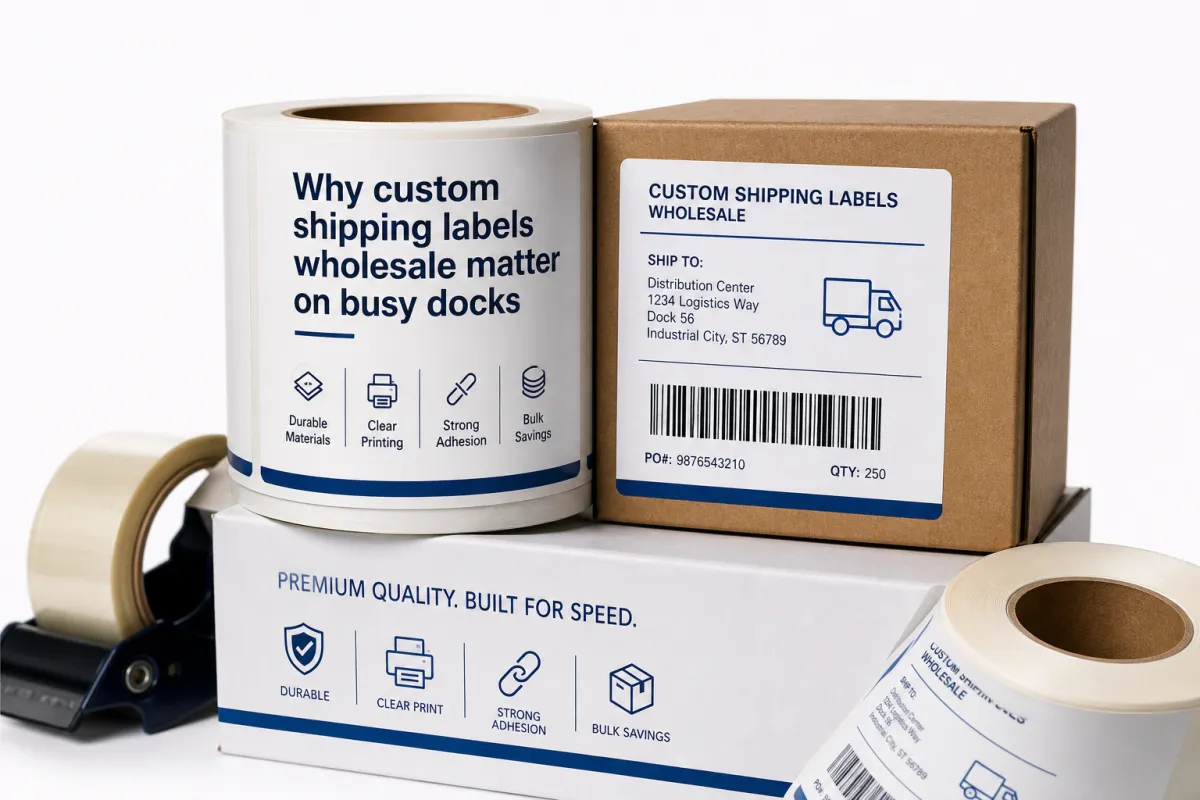
Picture a line pushing cartons every few seconds. One label lifts, curls, or prints faintly, and a packer has to stop, reapply, or send the carton back for another print. That is not a design issue. It is a production issue. custom shipping labels wholesale programs fix that by locking in a consistent stock and a consistent format so the team can keep moving without babysitting the label.
Labels do more than identify a package. They guide carriers, support receiving, protect product packaging, and carry barcode data that systems depend on. A label that feeds well through the printer and sticks cleanly to corrugated board reduces waste, cuts misreads, and improves first-pass readability. A label that looks fine on a sample sheet but fails on a cold carton or dusty recycled box becomes expensive fast. I have seen teams blame the scanner when the real problem was adhesive performance. That gets old quickly.
Buyers tend to focus on the printed face and ignore the rest of the construction. That is where wholesale ordering pays off. With custom shipping labels wholesale, the value is not only lower unit cost from buying in bulk. It is also the ability to keep the same adhesive chemistry, the same liner release, and the same print result across reorders. Planning gets easier. Emergency buys happen less often.
Shipping and logistics punish small mistakes. One supplier change can mean a new roll diameter, a different unwind direction, or a slight adhesive shift that slows application. In a warehouse already dealing with labor pressure, that friction is not small. custom shipping labels wholesale reduces that risk by giving the operation a stable, repeatable supply of labels built for how the floor actually works.
A label should disappear into the workflow. If the crew has to think about it, the label is probably doing less than it should.
That is why the conversation should start with use case, not artwork. Carton IDs, return labels, fragile handling, pallet labels, and branded shipping seals all need different production specs. custom shipping labels wholesale lets you standardize the common items and order them in planned cycles instead of chasing last-minute shortages.
Custom shipping labels wholesale product details and uses
Most buyers need one of three formats: roll labels for thermal printers, sheet labels for office workflows, or fanfold labels for higher-volume packing stations. Roll labels are common in shipping because they feed fast and keep the pack line moving. Sheet labels still make sense for smaller teams or mixed office setups. Fanfold labels help when roll handling creates too much downtime. In every case, custom shipping labels wholesale should match the printer and the pace of the work.
The applications go beyond carton stickers. A single wholesale label program might include carton identification labels, return address labels, barcode labels, fragile labels, pallet labels, and branded shipping seals. Some operations use them alongside custom printed boxes and other product packaging assets so the shipment looks coherent from warehouse to customer. In that setup, custom shipping labels wholesale becomes part of the larger package branding system, not just a back-end supply item.
Construction details change how the label behaves. Face stock affects print contrast and appearance. Adhesive determines initial tack and long-term hold. The liner changes dispensing speed and waste. A matte paper face with permanent adhesive behaves very differently from a semi-gloss synthetic stock with removable adhesive. That is why custom shipping labels wholesale decisions should follow the actual carton, pouch, or mailer surface used in the operation.
Branding can fit without wrecking function. A logo in the corner, a color band, a short handling message, or a printed return address can add polish while leaving the scan area clean. Discipline matters. Keep the barcode zone clear. Keep key data in the same place. Do not crowd the label with decorative graphics just because someone wants it to pop. Good custom shipping labels wholesale work supports retail packaging and shipping performance at the same time.
Here is a practical way to think about the main options.
| Label format | Best use | Typical wholesale pricing drivers | Common workflow note |
|---|---|---|---|
| Roll labels | High-volume shipping stations, thermal printers, fast application | Core size, roll diameter, face stock, adhesive, print coverage | Usually the best fit for custom shipping labels wholesale in warehouse settings |
| Sheet labels | Office shipping, low-volume dispatch, mixed desktop use | Sheet size, label count per sheet, adhesive type, finish | Useful where printer speed is less critical |
| Fanfold labels | Continuous packing lines, larger label quantities, reduced roll handling | Perforation, stack height, printer compatibility, stock type | Can speed replenishment at the station |
| Synthetic labels | Moisture, abrasion, freezer, and rough-transit conditions | Film stock, topcoat, adhesive performance, durability testing | Often chosen for tougher ecommerce shipping conditions |
The best wholesale option is not the one with the lowest sticker price. It is the one that fits the line, prints clearly, and applies without a fight. A label that saves a fraction of a cent but creates jams or scan failures is not cheap. That is one of the first lessons buyers learn with custom shipping labels wholesale.
Materials, specs, and performance standards
Before placing custom shipping labels wholesale orders, confirm the basics: label size, core size, roll diameter, rewind direction, perforation, printer compatibility, and whether the job is direct thermal or thermal transfer. Those details are not paperwork. They decide whether the labels actually run on the production floor. If even one is off, the line slows down or the printer needs adjustment. That sounds simple. It kinda isn't once a warehouse is already moving at full speed.
Direct thermal labels are simple and efficient because they do not require ribbon. They fit short- to medium-life shipping labels well, especially when the carton moves quickly through the system and long-term durability is not the priority. Thermal transfer labels use a ribbon and produce a more durable image. For custom shipping labels wholesale, thermal transfer makes more sense when labels face heat, moisture, abrasion, or longer transit times.
Material selection should follow the shipment environment. Paper labels usually work for standard corrugated shipping. Synthetic labels, often polypropylene or polyester, are better when moisture, tearing, or scuffing is likely. In cold-chain work, freezer-grade adhesives and low-temperature face stocks matter because a label that fails on chilled packaging can stop receiving cold. That is a real problem in custom shipping labels wholesale programs for food, wellness, and industrial supply chains.
Adhesive behavior deserves more attention than it gets. Recycled carton surfaces, chilled cartons, dusty board, and rough corrugate all change how a label grabs. A permanent adhesive may be ideal for a standard box, yet too aggressive for a return label that needs clean removal later. A removable adhesive can help with workflow labels, but it may not hold up on rough transit. This is where a knowledgeable custom shipping labels wholesale supplier earns trust by recommending the right adhesive instead of the most expensive one.
Barcode performance is another area where real-world testing matters. Contrast, quiet zones, print resolution, and label placement all affect scan readability. A barcode that looks crisp to the eye can still fail at a scanner if the ink density is off or the layout crowds the symbol. For operations that depend on automation, custom shipping labels wholesale should be tested on the actual printer and scanner setup before the full run gets approved. If you need a standards reference, the ISTA site is useful for transport testing context, and the Packaging Machinery Manufacturers Institute offers broader industry resources.
In practice, I recommend a sample or short run any time a label carries a barcode, a regulatory note, or a brand-critical color. A proof can tell you a lot, but a print on the actual line tells you more. It saves awkward phone calls later, which everyone appreciates.
- Thermal direct: lower setup complexity, strong for short-life shipping labels.
- Thermal transfer: better for durability, moisture resistance, and longer transit.
- Paper face stock: cost-effective for standard cartons and general fulfillment.
- Synthetic face stock: stronger in cold storage, abrasion, and rough handling.
- Freezer adhesive: useful for chilled packs and cold-chain shipments.
For buyers who also manage greener sourcing, ask about FSC-certified paper options where the application allows it. The FSC framework can support responsible paper sourcing, though it does not replace the need to test adhesive and print performance. That distinction matters in custom shipping labels wholesale buying, because sustainability and function have to hold together.
Custom shipping labels wholesale pricing, MOQ, and cost drivers
Wholesale label pricing usually comes down to a few predictable inputs: material, size, print colors, finish, quantity, and whether the label is stock or custom die-cut. For custom shipping labels wholesale, the biggest savings often come from standardizing size and print layout across departments, not from chasing the lowest quote on a one-off order. Once the production setup is stable, unit cost tends to improve more cleanly.
Minimum order quantity is not random. It usually ties back to setup efficiency, tooling, raw material roll yields, or press scheduling. Standard sizes and common materials support lower entry quantities. Specialty adhesives, custom shapes, or multiple print colors may need a larger run to make sense. That is why custom shipping labels wholesale should be quoted with the full spec in hand, not with rough estimates that lead to revisions later.
To make the economics more concrete, here is a practical range many buyers use as a planning starting point. For 5,000 pieces, plain direct Thermal Shipping Labels in a standard size might land around $0.02-$0.05 per label, depending on material and coverage. Thermal transfer paper labels may sit closer to $0.03-$0.07. Synthetic or freezer-grade labels can move into the $0.05-$0.12 range or higher, especially with specialty adhesive. Those are not fixed prices, but they are a sensible way to frame custom shipping labels wholesale budgeting.
Hidden costs can matter just as much as the quoted unit price. Artwork revisions, special coatings, variable data printing, proofing changes, and split shipments can raise the real landed cost. If a plant has to store extra cartons or deal with printer waste because the labels are not feeding well, that belongs in the math too. A buyer looking at custom shipping labels wholesale should compare total cost per shipped package, not just the price of the roll or sheet.
Planning keeps costs under control. Standardize label sizes across departments where possible. Use one adhesive for similar carton surfaces. Set reorder points before inventory gets thin. Order in replenishment cycles instead of rushing for an emergency run. Those habits keep custom shipping labels wholesale programs steady and predictable, which is exactly what most shipping teams want.
The table below shows how buyers usually think about price drivers.
| Cost driver | Lower-cost choice | Higher-cost choice | What changes in the warehouse |
|---|---|---|---|
| Face stock | Paper | Synthetic or specialty film | Durability, moisture resistance, tear strength |
| Adhesive | Standard permanent | Freezer, removable, or aggressive tack | Box compatibility and performance in hard conditions |
| Print method | Single-color thermal | Multi-color, coated, or variable data | Branding detail and setup time |
| Format | Standard roll size | Custom die-cut or odd size | Printer fit and application speed |
| Logistics | Single shipment | Split freight or rush delivery | Total landed cost and receiving complexity |
For many buyers, the smartest savings come from cutting waste rather than trimming print specs until the label barely works. If a label runs faster, sticks better, and scans the first time, the operation gains time everywhere downstream. That is the real value of custom shipping labels wholesale, especially in busy order fulfillment environments.
Ordering process and timeline for wholesale label jobs
A clean intake process makes the entire job easier. Start with the use case, printer model, label dimensions, quantity, artwork, and any compliance or barcode requirements. That information gives the supplier a real basis for quoting custom shipping labels wholesale instead of guessing at the spec and fixing it later.
Proofing matters after intake. A digital proof can confirm layout and copy, but it cannot fully show adhesive behavior or how the label will look on the actual carton surface. For demanding jobs, a sample approval is worth the time. When a buyer needs exact brand color, barcode clarity, or tight text placement, custom shipping labels wholesale should not move into full production until the proof has been checked against the real workflow.
Production timing depends on complexity. Common sizes on standard materials often move faster than custom constructions, specialty adhesives, or highly detailed print work. A simple run may be ready in about 7-10 business days after proof approval, while more complex jobs can run 12-15 business days or longer if the material must be sourced. In my experience, custom shipping labels wholesale timelines are most predictable when the buyer locks the spec before order entry.
There are a few ways to speed things up. Send final artwork, not a draft. Confirm the exact printer type. Approve proofs quickly. Avoid late-stage changes to barcode size or label dimensions. Those small decisions keep custom shipping labels wholesale jobs moving and prevent schedule slips that ripple into the shipping department.
Receiving also deserves attention. Ask how the order will be packed, how cartons will be labeled, and whether pallet counts are needed for phased warehouse rollout. If the operation uses multiple shifts or satellite packing stations, staged delivery can help, but it should be planned in advance. One missed pallet count can create confusion that costs more than the labels themselves, especially in custom shipping labels wholesale programs tied to launch dates or seasonal volume.
Good timeline planning protects inventory. A label shortage at the shipping station can slow the whole floor, and that delay usually costs more than holding a few extra boxes in reserve. That is why custom shipping labels wholesale should be ordered with a reorder point that reflects actual usage and lead time, not just a best-case forecast.
Why choose us for custom shipping labels wholesale
What matters most in a label supplier is manufacturing discipline. Consistent material sourcing, careful spec control, and dependable production standards matter more than broad claims. A buyer who uses custom shipping labels wholesale for shipping and logistics needs a partner who can keep the output steady, not just someone who can quote a low number once.
Support should be practical. If the adhesive is wrong for recycled corrugate, say so. If the face stock should change because the labels need better abrasion resistance, explain why. If the printer demands a specific core size or roll diameter, catch that before the order is released. That kind of guidance makes custom shipping labels wholesale more valuable because it reduces line-side surprises.
Prepress support is another place where the right supplier helps. Barcode placement, regulatory text, and brand placement all become easier when the layout is built with production in mind. That matters for buyers who use labels alongside package branding, ecommerce shipping inserts, or Branded Shipping Cartons. It also matters for teams managing broader packaging design systems across multiple SKUs.
Communication counts too. A customer should know what is happening with proofs, production, and delivery without chasing updates. That is not luxury service. It is basic operational respect. In custom shipping labels wholesale, predictable communication supports predictable inventory, and predictable inventory supports smooth shipping.
We focus on repeatable output because repeatability is what shipping teams need. Whether the order is for general fulfillment, product packaging support, or a rolling replenishment program, the goal is the same: labels that arrive on spec, run cleanly, and hold up under pressure. That is the real promise behind custom shipping labels wholesale.
If you are building a larger packaging program, it can help to coordinate labels with Custom Poly Mailers or carton programs so the whole shipment feels intentional. Labels should support the box, the mailer, and the workflow, not fight them.
Next steps for custom shipping labels wholesale orders
Before you request a quote, gather three essentials: label size, printer model, and expected monthly quantity. Those details narrow the best options quickly and make custom shipping labels wholesale pricing easier to compare. If you already know the shipping environment, note whether the cartons are new, recycled, chilled, or handled in high-humidity storage.
Then follow a simple decision path. Choose the material for the environment. Confirm the adhesive for the box surface. Lock the format that fits the printer and the application speed. That is usually the cleanest way to buy custom shipping labels wholesale without overbuying features the line will never use.
Any label that carries a barcode, a shipment compliance note, or a brand-critical color should be sampled or proofed before full production. That small step protects you from expensive reprints. It is especially useful when custom shipping labels wholesale orders are tied to software systems, because a layout mismatch can spread trouble across the whole packing floor.
Plan your reorder point based on lead time and real usage rate. If the warehouse burns through a roll faster during peak weeks, build that into the forecast now. A buffer of finished labels is cheaper than a stoppage, and stoppage is what everyone wants to avoid. That is the practical logic behind custom shipping labels wholesale: steady supply, steady quality, steady output.
If you are comparing materials, price tiers, and production timing, start with the application first and the artwork second. That keeps the spec honest. It also keeps custom shipping labels wholesale aligned with the real job, which is getting the right package out the door without friction.
FAQs
What is the typical MOQ for custom shipping labels wholesale?
MOQ depends on material, size, and print method, but wholesale orders are usually set around production efficiency rather than a single fixed number. Standard sizes and common materials often support lower entry quantities, while custom dies, specialty adhesives, or multiple print colors usually require larger runs. For custom shipping labels wholesale, the most accurate quote comes from a full spec, not a rough estimate.
Are custom shipping labels wholesale better on rolls or sheets?
Rolls are usually better for warehouse and shipping station workflows because they feed thermal printers quickly and reduce handling time. Sheets can make sense for office-based shipping, lower-volume operations, or environments that do not use dedicated label printers. In most high-throughput custom shipping labels wholesale programs, rolls are the default choice.
Which material is best for durable shipping labels wholesale orders?
Paper labels work well for standard carton shipping, but synthetic stocks are a better choice when labels face moisture, tearing, abrasion, or cold storage. For the strongest everyday performance, match the material to the shipment environment instead of choosing a stock based only on price. That approach usually delivers better results in custom shipping labels wholesale buying.
How do I make sure barcodes scan correctly on wholesale shipping labels?
Use strong contrast, keep the quiet zone clear, and confirm the barcode size fits the printer resolution and scanner type. Test the proof on the actual printer and packaging line before approving a full run, especially if automation depends on the label. Good custom shipping labels wholesale work should pass the scan test without guesswork.
What files should I send for custom shipping labels wholesale artwork?
Send the final logo or artwork in a print-ready format, plus exact label dimensions, barcode data, and any required text or compliance notes. If variable data is needed, provide the data file structure early so the production team can confirm layout and avoid delays. That preparation speeds up custom shipping labels wholesale quoting and reduces proof revisions.
Choosing custom shipping labels wholesale is really about building a label program that supports the floor, the scanner, and the package from the first carton to the last pallet. If you compare specs, price tiers, and production timing with the shipment environment in mind, you get better control over cost and fewer surprises in the warehouse. Start with the use case, test the sample, and lock the spec before the order goes live. That is the practical path to custom shipping labels wholesale that performs the way it should.

