Buyer Fit Snapshot
| Best fit | Thermal Shipping Labels Supplier projects where brand print, material claims, artwork control, MOQ, and repeat-order consistency need to be specified before quoting. |
|---|---|
| Quote inputs | Share finished size, material target, print colors, finish, packing count, annual reorder estimate, ship-to region, and any compliance wording. |
| Proofing check | Approve dieline scale, logo placement, barcode or warning zones, color tolerance, closure strength, and carton packing before bulk production. |
| Main risk | Vague material claims, crowded artwork, missing packing details, or unclear freight terms can make a low unit price expensive after revisions. |
Fast answer: Thermal Shipping Labels Supplier: Material, Adhesive, Artwork, and MOQ should be specified like a repeatable production item. The safest quote records material, print method, finish, artwork proof, packing count, and reorder notes in one written spec.
Production checks before approval
Compare the actual filled-product size with the drawing, then confirm tolerance on folds, seals, hang holes, label areas, and retail display edges. Reserve space for logos, QR codes, warning copy, and material claims before decorative graphics fill the panel.
Quote comparison points
Review material grade, print process, finish, sampling route, tooling charges, carton quantity, and freight assumptions side by side. A quote is only useful when the supplier can repeat the same color, closure quality, and packing count on the next order.
Thermal Shipping Labels Supplier: How to Choose the Right One
The first time a label roll feeds crooked on a busy packing line, everybody notices. I have watched a whole outbound window slip because one roll was wound the wrong way and nobody caught it until the printer started chewing liner. That is why a thermal shipping labels supplier matters: one bad roll can jam a printer, slow order fulfillment, and turn a normal ecommerce cutoff into a mess you do not want on your desk.
Labels are tiny compared with the rest of your shipping materials, but they touch every parcel. If the label is wrong, the carton, mailer, or pallet may still move, yet the carrier handoff gets clumsy, scan rates slip, and labor gets burned on reprints that should never have happened. For brands that also rely on Custom Labels & Tags, Custom Shipping Boxes, or Custom Poly Mailers, the label choice should fit the larger packaging system instead of sitting off by itself like an afterthought.
What a Thermal Shipping Labels Supplier Does
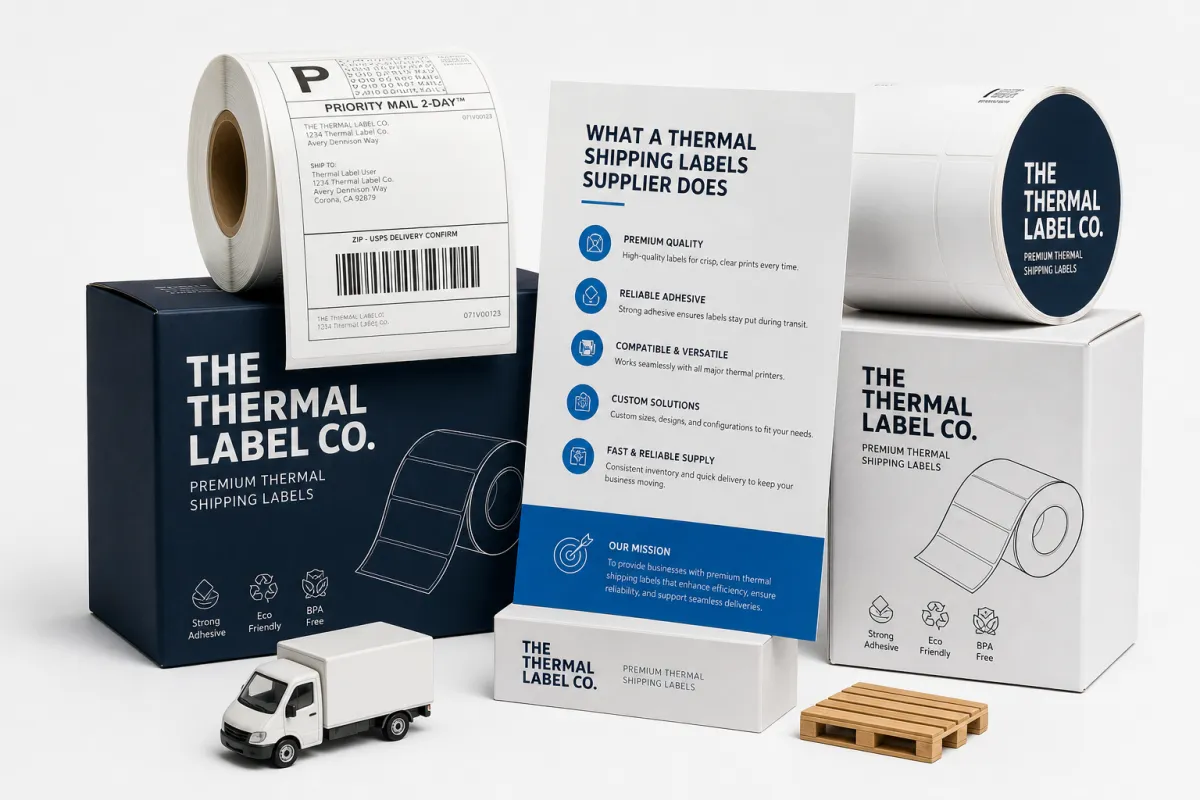
A thermal shipping labels supplier does more than dump blank rolls in a box and call it done. The better ones help you Choose the Right face stock, adhesive, roll size, and printer format so the label fits your operation instead of forcing your operation to bend around the label. That sounds basic. It is not. Anyone who has watched a 4x6 roll jam during a 500-order wave knows how fast a small mismatch turns into a real problem.
Thermal shipping labels usually come in two types: direct thermal and thermal transfer. Direct thermal labels use a heat-sensitive coating and do not need a ribbon, which keeps setup simple for high-volume ecommerce shipping. Thermal transfer labels use a ribbon, which gives you better durability for rough handling, colder environments, or longer storage. A thoughtful thermal shipping labels supplier should explain that difference in plain language, not hide behind jargon and hope nobody notices.
The supplier is not just selling a commodity. The supplier should help with printer compatibility, roll winding direction, core size, outer diameter, adhesive strength, and replenishment consistency across repeat orders. That matters in order fulfillment because one site may use a Zebra desktop printer, another may run an industrial unit, and a third may print labels at a packing station next to customer service. A good thermal shipping labels supplier keeps those details aligned so procurement, warehouse staff, and packaging managers are not all solving the same issue in different ways.
Who needs this the most? Usually ecommerce brands, 3PLs, warehouses, manufacturers with outbound parcel traffic, and ship-from-store operations. Smaller teams get here after they realize how much time laser sheets waste. Laser labels can work, but they usually slow the workflow, add paper handling, and clutter the bench. Thermal setup is cleaner, faster, and easier to standardize across shipping stations. For a brand trying to improve package protection and keep dimensional weight under control through better carton selection, labels are only one piece of the system, but they are the piece that touches every parcel.
The best thermal shipping labels supplier helps you buy fewer surprises. That means stable specs, repeatable quality, and a clear answer when you ask why one roll costs a little more than another. If a supplier cannot explain those differences, the low quote is probably hiding labor, waste, or downtime somewhere else. I have never once seen a too-cheap label roll turn out to be free in practice. Funny how that works.
- Ecommerce brands that need fast label printing at the packing bench
- 3PLs that need repeatable roll specs across clients and shifts
- Warehouses that run multiple printers and need consistent feed performance
- Manufacturers shipping mixed parcels, cartons, and parts kits
- Ship-from-store teams that need compact, dependable label rolls
How Thermal Labels Work in Real Shipping Operations
A thermal shipping labels supplier should be able to explain the printing process without turning it into a lecture. In a normal shipping workflow, order data flows from your ecommerce platform or warehouse system into the printer, the printer heats the label surface or ribbon at the right spots, and the finished label comes off ready to peel, apply, and scan. The process sounds basic, but label construction changes how often that sequence breaks down.
Direct Thermal Versus Thermal Transfer
Direct thermal labels are common in ecommerce shipping because they are simple: no ribbon, fewer consumables, and a fast path from order to carton. They work well for most parcel labels that will not sit around for months. A thermal transfer setup adds a ribbon, which costs more up front but gives stronger print durability and better resistance to smudging, moisture, and abrasion. In a cold dock or freezer-adjacent environment, that extra durability can be the difference between a clean scan and a label that starts to fade before the carrier even touches it.
From a packaging buyer's point of view, the label method should match the job. If your parcels leave the building within hours, direct thermal often makes sense. If the label needs to survive long transit packaging cycles, rough handling, or repeated touch points, thermal transfer can be the safer choice. A knowledgeable thermal shipping labels supplier should ask about your shipping window, storage conditions, and package protection concerns before recommending one option over the other.
The Print-Apply-Scan Path
The label has to survive a very short but demanding journey. It comes off the roll, passes through the printer, peels from the liner, sticks to a carton or mailer, and then needs to scan cleanly at the handoff point. If any part of that chain is weak, the problem shows up as a reprint, a delay, or a package that gets set aside for manual review. A thermal shipping labels supplier worth your time will talk through barcode contrast, adhesive bond, and storage conditions because those details affect scan accuracy just as much as the printer itself.
Label construction matters here. Face stock affects print clarity. Adhesive affects whether the label stays on corrugated board, poly mailers, or coated cartons. Liner thickness affects feed consistency and how easily the roll unwinds. Roll winding direction matters because some printers expect face-out rolls while others require face-in. Even the outer diameter matters if your desktop printer has limited space. I usually ask for those specs in writing, because a label that looks right on paper can still behave badly on the machine. And yes, I have seen a perfectly good label program become a headache because someone assumed "close enough" was fine.
Most shipping labels run at 203 dpi and that is fine for standard barcodes and address blocks. If you print dense data, tiny fonts, or multiple service marks, 300 dpi can help. Temperature also matters more than many teams expect. A direct thermal label can darken in a hot truck or near a heat source, while a thermal transfer label with the right ribbon can hold up better under stress. The smart move is to choose the label based on the actual warehouse floor, not the ideal lab condition a sample was printed in.
For operations that ship across multiple stations, the right label setup can reduce reprints, cut waste, and keep throughput steady. That is why a thermal shipping labels supplier should be treated as part of your fulfillment process, not just as a line item in procurement.
Key Factors to Compare in a Thermal Shipping Labels Supplier
When I compare a thermal shipping labels supplier, I start with fit, not price. Cheap rolls are easy to find. The hard part is finding a supplier that can keep your label running cleanly across shifts, printers, and seasons. A roll that seems fine during testing can still curl, jam, or lose adhesion once it reaches a hotter dock or a colder receiving area.
The first thing I want to know is whether the supplier can match the exact printer setup. That means label width and length, core size, outer diameter, gap sensing, and winding direction. For desktop printers, common core and roll dimensions are often different from industrial units, and the wrong spec can stop production immediately. A strong thermal shipping labels supplier will ask for your printer model before quoting, not after the first order arrives.
Adhesive performance comes next. Permanent adhesive is fine for most corrugated cartons, but poly mailers, recycled cartons, and cold surfaces may need a stronger tack or a freezer-grade adhesive. The label should stick fast enough to survive distribution but not so aggressively that it tears the face stock during application. If you ship on mixed surfaces, test the same label on plain corrugated, kraft mailers, and any coated packaging materials you use regularly.
Consistency matters more than most buyers want to admit. A supplier who can hold the same shade, coating behavior, and die-cut quality from lot to lot saves time on requalification. That consistency matters for a growing brand because a line that starts with 500 parcels a day can jump to 5,000 in peak season. The last thing you want is a surprise change in print darkness or adhesive behavior right when order fulfillment is under pressure.
I also like suppliers who can provide samples quickly and explain their quality control in practical terms. Do they check liner release? Do they track lot numbers? Can they confirm the same spec on repeat orders? Those are the questions that separate a real thermal shipping labels supplier from a simple reseller. If the answers are vague, expect the same vagueness to show up when you need help later.
A label that costs two cents less but feeds badly is not a bargain; it is a hidden labor charge.
For teams shipping in rough transit packaging environments, I also pay attention to testing language. Suppliers who understand ISTA test thinking usually have a better handle on how labels behave through vibration, temperature shifts, and handling abuse. I am not saying every parcel needs full transit certification, but the supplier should think like a packaging engineer, not just a quote writer. On the sustainability side, it is fair to ask whether paper components are sourced with FSC chain-of-custody in mind; you can review the basics at FSC. That is not box-checking fluff. It is part of making sure the program is defensible if procurement or compliance asks questions later.
- Printer fit: exact model, sensing type, core size, and roll diameter
- Adhesive match: permanent, removable, freezer-grade, or high-tack
- Material quality: direct thermal coating or thermal transfer face stock
- Order support: samples, technical help, and repeat-spec consistency
- Supply reliability: stock depth, replenishment speed, and lot control
Thermal Shipping Labels Supplier Pricing: What Drives Cost
Pricing is where a lot of buyers get trapped. A thermal shipping labels supplier might look expensive on the quote sheet, but the total landed cost can still be lower once you factor in freight, waste, reprints, and labor. I like to separate unit price from real operating cost because a label that saves pennies on paper can cost dollars in the warehouse if it jams or peels off.
Several variables drive the price. Material grade matters because standard paper direct thermal labels are cheaper than synthetic or freezer-rated options. Adhesive type matters because stronger or specialty adhesives cost more. Roll count matters because higher quantities usually lower per-label cost, but only if you can store and use the inventory before it ages or degrades. Custom dimensions also raise cost because they may require different die cuts, different winding, or a more specialized production run from the thermal shipping labels supplier.
For a practical comparison, I like to look at identical specs side by side. Compare the same label size, same adhesive, same roll count, same core, and same ship terms. If one quote is for 5,000 labels and another is for 10,000, or one includes freight while another does not, the numbers are not really comparable. That sounds obvious, but it is where a lot of procurement mistakes happen.
| Label Option | Typical Use | Typical Price Range | What You Gain |
|---|---|---|---|
| Standard direct thermal paper | High-volume parcel labels for fast ecommerce shipping | $0.015-$0.035 per label | Low consumable cost and simple printer setup |
| Heavy-adhesive direct thermal | Recycled cartons, rough boxes, or curved mailers | $0.025-$0.050 per label | Stronger bond and fewer peel failures |
| Thermal transfer paper with ribbon | Longer transit, abrasion, or colder handling conditions | $0.030-$0.080 per label plus ribbon cost | Better smudge resistance and print durability |
| Synthetic or specialty stock | Rough handling, moisture exposure, or longer shelf life | $0.050-$0.120 per label | Highest durability and better environmental resistance |
That table is not a universal price list, because volume, print coverage, and market conditions will shift it. Still, it gives a realistic picture of where cost usually moves. If you order 5,000 labels, the freight charge may add another $12-$45 depending on location and box size. If you are running repeated shipments, a schedule that ships every two to four weeks can lower carrying costs and keep old stock from collecting dust on a shelf.
The cheapest label is the one that still scans after it sits in a hot truck or a cold dock.
One more thing many buyers miss: if your label choice helps improve carton selection, you may also reduce dimensional weight charges on the parcel side because the whole packing routine becomes more disciplined. That is not a label-only effect, of course, but it shows how tightly labels and packaging decisions are tied together. A good thermal shipping labels supplier should understand that the quote is only part of the financial picture. If they only talk about sticker price and never mention waste, reruns, or freight, they are not looking at the whole problem.
Ordering Process and Timeline for Thermal Shipping Labels
A smooth order starts long before the first roll ships. A thermal shipping labels supplier should ask for the printer model, label dimensions, adhesive needs, annual volume, and storage environment before quoting a custom or semi-custom order. That information lets the supplier match the product to the way your team actually prints, peels, and applies labels on the floor.
- Define the spec - Confirm label size, adhesive strength, roll count, core size, and winding direction.
- Request samples - Ask for the exact format you plan to run, not a similar roll that only looks close on paper.
- Test on real equipment - Run the labels on your actual printer at your actual speed and on your actual cartons or mailers.
- Check scan behavior - Verify barcode darkness, peel performance, and adhesion after application.
- Approve the production run - Lock the spec, confirm freight terms, and place the order with a buffer for launch.
In a normal stocked order, sample transit can take two to five business days, testing may take another day or three, and repeat production often ships quickly if the spec is already approved. Custom work takes longer. If the roll size, liner, or adhesive needs a new setup, a production timeline of 10 to 15 business days after proof approval is a reasonable expectation. A responsible thermal shipping labels supplier should say that clearly instead of promising a fantasy timeline that nobody on the production side can keep.
Delays usually come from missing details. A vague printer model, a change in label width after approval, or a last-minute request for a new adhesive can slow everything down. I have also seen teams forget to test at the same print density they plan to use in production, which creates barcode contrast problems after the order is already on the dock. That kind of mistake is expensive because it shows up at the worst possible time: right when a launch or seasonal spike is about to start.
For new sites or SKU launches, I suggest a small rollout buffer. Keep one approved case per printer type in reserve, train the receiving and packing staff on where the labels belong, and document the settings so the same spec can be reordered later without guesswork. If your organization has multiple packaging streams, align the label rollout with the rest of the shipping materials so purchasing, warehousing, and operations are not all using different assumptions. A careful thermal shipping labels supplier makes those repeat orders boring, and boring is good in procurement. No drama, no guesswork, no "why is the roll upside down?" moment at 6:45 p.m.
Common Mistakes When Choosing a Thermal Shipping Labels Supplier
The biggest mistake is buying on price alone. A thermal shipping labels supplier that appears cheapest can still cost more if the labels curl, peel, or force reprints. Hidden labor is expensive. One jam in the middle of a busy outbound wave can ripple across the whole shift because the operator has to stop, clear the printer, and rebuild the queue.
Another common miss is skipping sample testing on the actual printer and actual package. Bench testing on a desk in a clean room does not tell you how the label behaves on a cold carton with dust on it or a poly mailer with a little surface tension. If the label is going on recycled corrugated, textured boxes, or glossy packaging, test it there. A dependable thermal shipping labels supplier will encourage that because they know the label has to survive the warehouse floor, not just a sample table.
Mismatch problems can be sneaky. A core that is too large, a roll that is wound the wrong way, or a label that is a few millimeters off can create recurring jams even when the face stock itself is fine. I have also seen well-made labels fail simply because they were stored in a hot, humid area near a dock door or a heater. Thermal coatings are sensitive to heat and light, so storage discipline matters. Cool, dry, and out of direct sun is the right direction.
Weak communication is the last big issue. If a supplier cannot answer a straightforward question about liner thickness, adhesive type, or lead time, that usually means the order paperwork will be just as fuzzy. For buyers, that can turn a small specs question into a production mistake. A trustworthy thermal shipping labels supplier keeps the conversation clear and documents the approved setup so no one is guessing later.
Good label performance also depends on the package under it. A label cannot fix a crushed carton or a stretched poly mailer, so teams that care about package protection often review the whole outbound system together. That is where label planning can sit alongside Custom Shipping Boxes and Custom Poly Mailers to make sure the outer packaging and the label are doing their jobs without fighting each other.
- Do not skip sample testing on real printers and real cartons
- Do not assume one label spec fits every site or shift
- Do not ignore storage heat, humidity, or direct sunlight
- Do not approve a quote without checking size, roll format, and freight terms
Expert Tips and Next Steps for a Smooth Rollout
If I were setting up a label program from scratch, I would start with a spec sheet. A good thermal shipping labels supplier can work faster when everyone is looking at the same details: printer model, label size, adhesive, roll count, core, winding direction, and storage limits. That sheet becomes the reference point for future reorders, seasonal spikes, and multi-site expansion.
Then I would test the sample at real speed. If the packing line runs 600 parcels per shift, even a five-second delay per jam adds up fast. That is why I like to see labels printed at the exact density and speed the team will use in production, not in a quiet office at half speed. A useful thermal shipping labels supplier will not rush past that step. They will want to know if the label peels cleanly, scans on the first pass, and stays put after handling.
Documenting the setup matters more than people think. Save the printer settings, the approved roll photo, the supplier spec, and any notes on barcode scan issues. If something changes later, that paper trail makes troubleshooting much faster. It also helps if you are comparing a new supplier against an existing one, because you can check landed cost and performance side by side rather than relying on memory. For brands that need broader packaging support, bundling label planning with Custom Packaging Products or a matching print program for Custom Labels & Tags keeps sourcing cleaner across the whole operation.
One practical habit I recommend is setting a reorder trigger before stock gets low. If a warehouse uses three weeks of labels every month, do not wait until the last case is open to reorder. Keep a small safety stock, especially during peak ecommerce shipping seasons or product launches. A dependable thermal shipping labels supplier should be able to support that rhythm without making every replenish feel like a special project.
So here is the short version: compare fit first, test on real equipment, compare landed cost rather than unit price alone, and confirm how the supplier handles repeat orders. That approach cuts surprises and helps the label program behave like the invisible utility it should be. The practical takeaway is simple: lock the spec, test on your worst-case package, and keep the approved sample on file. That is how you avoid the Monday-morning label mess.
How do I choose a thermal shipping labels supplier for Zebra printers?
Match the label size, core size, winding direction, and sensing type to your exact Zebra model. Ask for sample rolls and test print speed, barcode darkness, and peel performance before placing a larger order. If the roll feeds fine for five minutes but starts drifting after a full shift, that is your warning sign.
What should I ask a thermal shipping labels supplier before I buy?
Ask about material type, adhesive strength, liner thickness, and whether the labels are direct thermal or thermal transfer. Confirm minimum order quantities, lead times, sample availability, and whether the supplier can support repeat orders with the same spec. I also like to ask who owns the lot records, because that answer tells you how much traceability you will get later.
Are thermal shipping labels better than laser labels for ecommerce?
Thermal labels are usually faster to print, cleaner to handle, and better suited for high-volume fulfillment. Laser labels can work in some low-volume setups, but thermal options typically reduce waste and improve workflow speed. If your team prints in bursts all day, thermal is usually the calmer choice.
Why do thermal shipping labels curl or stop sticking?
Curl often comes from heat exposure, poor storage, or a label construction that does not match the printer and application environment. Poor adhesion can happen when the adhesive is too light for the carton surface or when dust, moisture, or cold temperatures affect bonding. Sometimes the issue is not the label at all, just the way the roll was stored near a heater or in direct sun.
How can I compare thermal shipping labels supplier pricing accurately?
Compare quotes using the same label size, material, adhesive, roll count, and shipping terms so the numbers are truly comparable. Include freight, setup fees, reprint waste, and downtime risk when judging the real cost of each thermal shipping labels supplier. That is the part most spreadsheets miss, and it is usually the part that ends up costing you.


