Buyer Fit Snapshot
| Best fit | Custom Shrink Sleeve Labels projects where brand print, material claims, artwork control, MOQ, and repeat-order consistency need to be specified before quoting. |
|---|---|
| Quote inputs | Share finished size, material target, print colors, finish, packing count, annual reorder estimate, ship-to region, and any compliance wording. |
| Proofing check | Approve dieline scale, logo placement, barcode or warning zones, color tolerance, closure strength, and carton packing before bulk production. |
| Main risk | Vague material claims, crowded artwork, missing packing details, or unclear freight terms can make a low unit price expensive after revisions. |
Fast answer: Custom Shrink Sleeve Labels: Design, Cost, and Fit should be specified like a repeatable production item. The safest quote records material, print method, finish, artwork proof, packing count, and reorder notes in one written spec.
Production checks before approval
Compare the actual filled-product size with the drawing, then confirm tolerance on folds, seals, hang holes, label areas, and retail display edges. Reserve space for logos, QR codes, warning copy, and material claims before decorative graphics fill the panel.
Quote comparison points
Review material grade, print process, finish, sampling route, tooling charges, carton quantity, and freight assumptions side by side. A quote is only useful when the supplier can repeat the same color, closure quality, and packing count on the next order.
A bottle can look ordinary on a screen, then turn into a very different package once heat pulls a printed film tight over its shoulders, curves, and seams. That is the real draw of custom shrink sleeve labels: they create a 360-degree branded surface on shapes that standard labels often cannot cover cleanly without looking awkward or half-finished.
Packaging buyers run into this problem all the time. Containers are rarely perfect cylinders. You get tapers, contoured grips, neck rings, pump tops, trigger sprayers, and closures that need tamper-evident coverage on top of everything else. custom shrink sleeve labels handle those headaches in one structure, which is why they show up so often in beverage, personal care, nutraceutical, household, and specialty retail packaging.
I am going to break down what they are, how the application process works, what drives cost, and where projects usually fall apart. If you are planning branded packaging that needs to look intentional instead of improvised, custom shrink sleeve labels deserve a serious look before art gets approved or quotes go out.
What Custom Shrink Sleeve Labels Really Are
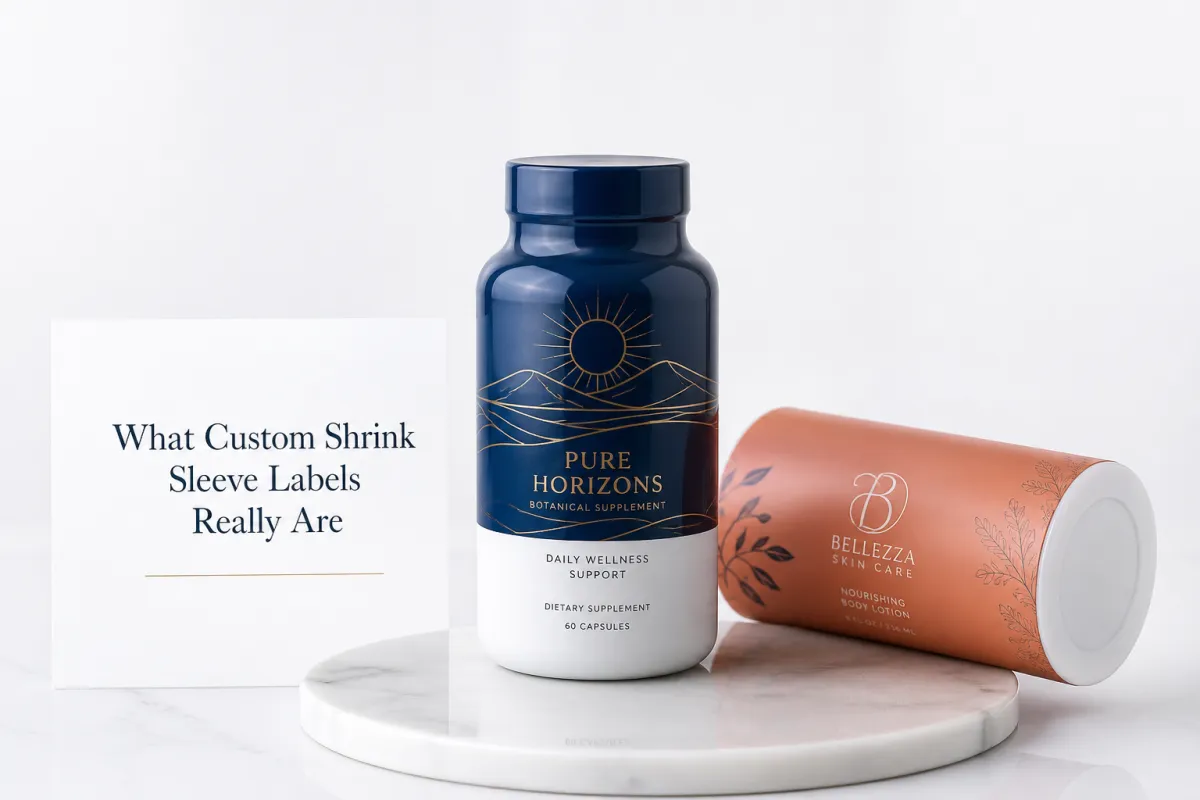
At the simplest level, custom shrink sleeve labels are printed film sleeves that slide over a container and shrink with heat until they match the shape underneath. The label starts flat and oversized. Once it passes through a heat tunnel or another controlled shrink process, it becomes a tight graphic shell. That is how an odd-shaped bottle stops looking like an afterthought and starts looking like somebody actually planned the package.
In practical terms, the sleeve does two jobs at once. It carries branding, legal copy, and graphics across a large printable surface. It also conforms to the container so the package still feels smooth in the hand and tidy on the shelf. That matters on bottles with shoulders, narrow necks, tapering walls, ribs, or molded seams. A pressure-sensitive label can still work in those cases, but custom shrink sleeve labels usually give the design team more freedom and the marketing team more room to work.
Here is the part buyers usually appreciate after they see samples: the whole package becomes the canvas. Bold color blocking, wraparound gradients, window cutouts, product callouts, and tamper bands can all live on the same structure. That is a big reason custom shrink sleeve labels are common in retail packaging, where first impressions carry more weight than the copy block ever will.
There is a practical upside too. These labels can hide container seams, unify mixed bottle shapes across a product family, and strengthen shelf presence for brands trying to stand out in a crowded category. If you are comparing packaging options, think about how the sleeve fits into the whole system, not just the label itself. In many cases, custom shrink sleeve labels pair well with broader branded packaging programs, including Custom Labels & Tags for secondary items and Custom Packaging Products for the rest of the line.
The other reason they matter is protection. A sleeve can offer moisture resistance, scuff resistance, and a cleaner way to combine decoration with tamper evidence. That is not magic. It is film engineering plus good prepress. Still, when the structure is chosen well, custom shrink sleeve labels can make a package look premium while holding up better than a lot of people expect in real distribution.
How They Work on the Line
The process behind custom shrink sleeve labels is pretty straightforward once you break it into stages. First, the artwork is printed on a film such as PETG, PVC, or OPS. Then the film is formed into a tube with a seam, cut to length, and supplied to the applicator. The sleeve goes over the container, and heat is applied so the film contracts and conforms to the bottle or jar.
That shrink step sounds simple, but the engineering behind it is where the project succeeds or fails. Every sleeve needs a shrink ratio that matches the container geometry. A 2:1 or 3:1 shrink ratio may sound like a technical detail, yet it decides whether the design lands evenly around a shoulder or distorts badly on the lower body. With custom shrink sleeve labels, the art cannot be treated like a flat rectangle. It has to be built around the actual shape, the fill level, and the way the film pulls during heat exposure.
Film choice matters just as much as artwork prep. PETG is often chosen for strong shrink performance and good clarity. PVC can be cost-effective and widely used, although recycling goals and heat behavior need a closer look. OPS is another option for certain containers, especially where shrink and stiffness match the application. The right film depends on the container material, tunnel temperature, and whether the line is manual, semi-automatic, or fully automated. I have seen buyers obsess over print quality and forget the line equipment. That mistake gets expensive fast. custom shrink sleeve labels should be engineered for the machine as much as for the artwork.
On the production side, the applicator and tunnel have their own constraints. Heat exposure has to be high enough to activate the film, but not so aggressive that it warps the container or leaves wrinkles that never fully settle out. Glass, PET, HDPE, and heat-sensitive containers all behave differently. A sleeve that looks perfect on a sample bottle can act very differently at line speed, especially if the fill temperature, ambient humidity, or tunnel settings shift. That is why a good converter will ask annoying questions early. Those questions save a lot of grief later.
There is also a functional split buyers should understand. Full-body decorative sleeves are built to create the shelf look and wrap the entire container, while tamper-evident sleeves are engineered to break visibly when removed and may cover the cap, neck, or closure area. The construction and regulatory expectations are not the same. For custom shrink sleeve labels, that distinction affects perforation placement, tear-tab design, and how much of the closure area needs coverage.
The sleeve is not just a graphic choice. It is part of the manufacturing process. Good custom shrink sleeve labels are planned with the bottle, the fill line, the tunnel, and the end-user experience in mind from the start.
Custom Shrink Sleeve Labels Cost and Material Factors
Pricing for custom shrink sleeve labels comes down to a handful of variables that interact more than people expect. Film type, print method, sleeve dimensions, seam requirements, white ink coverage, metallic effects, perforations, tear tabs, and order quantity all play a part. A straight, lightly contoured bottle with simple artwork is much easier to produce than a heavily sculpted container with full-wrap coverage and specialty finishing.
For a practical reference point, a straightforward run of 5,000 pieces may often land somewhere around $0.18-$0.35 per unit, depending on coverage, film choice, and finishing. Smaller runs can cost noticeably more per piece because setup and prepress are spread across fewer labels. Highly decorated work, tight timing, or complex container testing can push the number upward. That is not a flaw in the quote; it usually means the project has more moving parts than a simple label run.
Curved and contoured containers deserve special mention. When the shape is unusual, the supplier may need more distortion work in prepress, more sample checking, and more careful tuning during application. Those steps protect the final fit, but they also raise labor. For custom shrink sleeve labels, the shape of the bottle can matter as much as the number of colors in the art.
| Film / Option | Best Fit | Typical Strengths | Cost Pressure |
|---|---|---|---|
| PETG | Contoured bottles, premium retail packaging | Strong shrink performance, good clarity, broad decoration options | Often mid to higher |
| PVC | General-purpose sleeves, budget-conscious runs | Widely available, familiar converting behavior | Often lower to mid |
| OPS | Certain straight or lightly tapered containers | Good stiffness, reliable decoration on the right geometry | Often mid |
| Full-body sleeve with tamper band | Food, beverage, health, and personal care products | 360-degree branding plus visible closure protection | Usually higher |
From a sustainability standpoint, film choice should be checked against the full package structure and local recycling rules. If recyclability is part of the brief, suppliers often compare the sleeve material against the container material and the sortation expectations in the market. The EPA recycling guidance is a useful reference point when you are sorting out what the package means in the real world, not just on a spec sheet. That matters because a sleeve that looks good on a render may not behave the same way in recovery streams, and sometimes that mismatch is kind of the whole problem.
Buyers also need to think about the print strategy. More colors do not always mean better branding, but they do change the economics. White ink underlays, metallic spots, matte coatings, and specialty varnishes can add value, and they add cost too. If the package is part of a broader retail packaging rollout, sometimes the smartest move is to spend the budget where the shelf needs it most and keep the rest of the package disciplined. That is how good package branding usually works: not by piling on everything, but by choosing the right details.
One more practical note: ask suppliers to quote custom shrink sleeve labels based on the actual container dimensions, the expected annual volume, the application method, and any compliance or tamper-evidence needs. When a quote is built on a vague guess, it often looks attractive until proofing exposes the missing pieces. Then everybody acts surprised. Nobody should be surprised.
Step-by-Step Process and Timeline
The cleanest way to manage custom shrink sleeve labels is to treat the project like a packaging program, not a quick print order. Start by collecting the container height, body diameter, shoulder profile, neck finish, fill level, closure style, and whether the product will live in a wet cooler, a refrigerated case, or a dry retail environment. Those details help the supplier size the sleeve correctly and judge what kind of film and shrink profile will hold up.
- Discovery: gather accurate dimensions, photos, and a physical sample if possible.
- Prepress: build the dieline, distort the artwork for the shrink path, and confirm legal copy placement.
- Proofing: review digital proofs and, when needed, a press proof or prototype sleeve.
- Production: print, convert, slit, and prepare the sleeves for application.
- Application: dial in tunnel settings, conveyor speed, and placement on the actual packaging line.
That sequence looks linear, but delays usually happen at the edges. Missing container samples, late art changes, and unclear application equipment details can all add days or weeks to the schedule. A typical project for custom shrink sleeve labels may move from proof approval to production in roughly 12-15 business days for straightforward work, but complex structures, custom finishes, or multiple proof rounds can stretch the timeline well beyond that.
Prepress is where the art gets real. Since the sleeve will shrink, the design team needs to account for panel placement, distortion around shoulders, and the way any barcode or small legal copy will read once the film settles. A good supplier will often create a dieline that shows the registration area, seam position, and trim allowances so the layout does not drift during production. With custom shrink sleeve labels, a beautiful design that is not mapped correctly can become a production headache very quickly.
If the product is sensitive to heat, abrasion, condensation, or regulatory labeling requirements, ask for a sample or proof before launching a full run. That is especially useful for branded packaging that needs to survive refrigeration, transport, or high-touch retail handling. I also like to see the final application method defined early, because the same sleeve can behave differently on a manual line than it does on a fully automatic system.
For projects tied to broader distribution testing, it can be smart to align the package evaluation with ISTA methods so the sleeve is not the only thing that gets attention. If the bottle is part of a larger pack-out or shipping system, the whole unit should be considered together. That kind of thinking saves time later and usually leads to better product packaging decisions overall.
From a buyer’s point of view, the best timeline is the one that avoids rework. Accurate specs, final art, and a clear application plan do more to keep custom shrink sleeve labels on schedule than any promise of speed ever will.
Common Mistakes That Hurt Custom Shrink Sleeve Labels
One of the biggest mistakes in custom shrink sleeve labels is treating the layout like a flat label. That is how text ends up too close to a curve, logos warp across a shoulder, and barcodes land in areas where scanners have a hard time reading them. A sleeve may start flat in prepress, but it does not stay flat once heat enters the picture.
Skipping container testing is another common failure point. Bottles with sharp shoulders, pronounced seams, textured surfaces, or unusual taper angles often need more care than a standard cylinder. If the film shrinks unevenly, you can get wrinkles, thin spots, lifted edges, or graphics that look stretched in a way no designer wanted. With custom shrink sleeve labels, the physical sample is not optional on difficult shapes; it is part of the job.
The wrong film can create another round of issues. A film that shrinks too aggressively can distort the print or stress a heat-sensitive container. A film that is too soft can scuff easily during distribution. Poor opacity can also allow the container color to show through when the brand intended a solid field. These are not minor defects when the package is sitting on a retail shelf competing with cleaner-looking items.
Small type is its own trap. Legal copy, ingredient text, warning statements, and scannable codes all become less forgiving when they move onto a curved surface. A font that looks crisp on a proof can become hard to read if the sleeve compresses it near a seam or shoulder. That is why custom shrink sleeve labels should be designed with a margin of safety around readability, not just aesthetics.
A sleeve that looks perfect on screen can still fail on the bottle if the shrink ratio, panel placement, and container geometry were never tested together.
Pricing surprises usually come from missing information. A supplier can only quote accurately if they know the actual fill level, the container dimensions, the expected quantity, the application method, and whether tamper evidence or special finishes are required. If any of those variables change after artwork and tooling begin, the project often goes back through proofing. That is expensive and avoidable.
There is also a packaging system issue that gets overlooked. If the sleeve is part of a branded packaging rollout, the sleeve should not be designed in isolation from the carton, shipper, or secondary labels. The product packaging should feel connected, whether that means coordinating with Custom Printed Boxes, matching a neck label, or aligning the sleeve with the rest of the shelf family. The best custom shrink sleeve labels are usually the ones that sit comfortably inside a larger visual system rather than shouting by themselves.
Expert Tips for Better Custom Shrink Sleeve Labels
When a sleeve project goes well, you can usually trace it back to one simple decision: the team built the design around the container first. That sounds obvious, but it is easy to forget when a marketing team is working from a brand deck and not from a bottle sample. The package should feel intentional, with the shape, graphics, and closure all supporting the same visual idea. That is where custom shrink sleeve labels earn their keep in modern packaging design.
Start with a strong shelf hierarchy. Pick one panel to do the heavy lifting, then make sure the product name, brand mark, and key callout remain readable from the primary viewing angle. A lot of package branding falls apart because every panel wants to be the hero. Better to choose a focal area and let the rest of the sleeve support it. If the package is moving through crowded retail packaging environments, clarity beats cleverness more often than people want to admit.
Think about the environment, not just the print. If the bottle will sit in condensation, ride through a cold case, or get handled often, ask for performance details up front. Moisture resistance, abrasion behavior, and closure coverage all influence the final result. I have seen custom shrink sleeve labels look excellent in a clean sample box and then get scuffed badly by case packing or chilled display. A little planning up front saves a lot of frustration later.
If your project is premium or technically sensitive, request a press proof or production sample. That is especially helpful when color accuracy matters, when white ink needs to anchor a bright design, or when the sleeve must match other branded packaging assets across the line. For example, if the product family also uses Custom Labels & Tags or other Custom Packaging Products, keep the visual language aligned so the shelf story feels unified.
Another practical tip: keep the application method, tunnel settings, and container sample consistent from proofing through launch. If the sample bottle changes, the heat profile changes, or the line speed shifts, the final appearance can drift. That is one of those details that sounds small until a shipment of custom shrink sleeve labels arrives and the package no longer looks like the approved proof. Then everybody gets to pretend that was mysterious.
If you are balancing sustainability goals, cost, and performance, be honest about priorities. Sometimes the best choice is a sleeve that looks fantastic and performs well, even if it is not the cheapest option on the sheet. Other times, a simpler structure with fewer finishes is the smarter move because it keeps the project on budget and easier to run. There is no single answer for every product; there is only the best fit for this container, this line, and this shelf.
Next Steps Before You Order Custom Shrink Sleeve Labels
Before you request a quote for custom shrink sleeve labels, gather the pieces that let a supplier give you a real answer instead of a placeholder number. You will get a better result, and usually a better price, if you send accurate information the first time.
- Exact container dimensions, including shoulder and neck details.
- Photos of the bottle or jar from multiple angles.
- A physical sample, if the container shape is unusual.
- Expected quantity for the first run and the annual volume outlook.
- Application method, including manual, semi-automatic, or automated equipment.
- Product environment, such as refrigerated, wet, high-touch, or shelf-stable.
- Any tamper-evidence, compliance, or barcode requirements.
- Artwork files and a short note about the branding direction.
Then compare suppliers on more than price alone. Ask how they handle prepress, whether they can help with distortion and panel placement, what film options they recommend, and whether they will support testing on your actual container. Good suppliers do more than print custom shrink sleeve labels; they help protect the fit, the shelf appearance, and the launch timeline.
If you are weighing the sleeve against another label structure, ask for a direct comparison that includes application speed, decoration coverage, moisture resistance, and the final look in retail packaging. That kind of side-by-side review often makes the decision easier. For some products, pressure-sensitive labels are still the better choice. For others, custom shrink sleeve labels are the cleanest way to solve an awkward shape and create a stronger branded package.
My best advice is simple: treat the label, the container, and the application process as one system. That is how you avoid the common fit problems, hidden costs, and shelf disappointments that show up when each piece is spec'd in isolation. When the structure is planned well, custom shrink sleeve labels can deliver the kind of fit and shelf impact that makes the whole package feel finished. Skip the guesswork, get the actual bottle in hand, and build from that. Everything else is just expensive optimism.
What are custom shrink sleeve labels used for on packaging?
They are used to cover curved, tapered, or unusually shaped containers with 360-degree graphics that standard labels cannot handle as cleanly. They are also common when a brand wants stronger shelf impact, moisture resistance, or tamper-evident coverage. In practice, they can help unify a product family even when the container shapes vary.
Are custom shrink sleeve labels better than pressure-sensitive labels?
They are better when the package has a complex shape or needs full-body decoration. Pressure-sensitive labels can still be the smarter choice for flat or gently curved containers, especially when the budget is tight or the line setup is simple. The right option depends on shape, performance needs, application equipment, and the final look you want.
How much do custom shrink sleeve labels cost?
Cost depends on film type, sleeve size, print complexity, finishing, and how many pieces you order. Short runs usually cost more per unit because setup is spread across fewer labels, while larger runs tend to improve unit pricing. Specialty inks, perforations, white ink, and difficult container shapes can raise the number further.
How long does the custom shrink sleeve labels process take?
Lead time depends on artwork approval, proofing, film selection, and production scheduling. Straightforward jobs can move fairly quickly once proofs are approved, while complex containers or multiple proof rounds add time. The fastest path is to send accurate specs, final art, and volume needs up front so the supplier can quote and plan correctly.
What should I send for a custom shrink sleeve labels quote?
Send exact container dimensions, photos, and a sample if possible. Include quantity, product type, application method, and any special performance needs such as moisture resistance or tamper evidence. If you already have artwork, attach it; if not, describe the branding direction clearly so the quote reflects the real scope of the project.

