Buyer Fit Snapshot
| Best fit | Custom Sized Poly Mailers for Art Prints projects where brand print, material claims, artwork control, MOQ, and repeat-order consistency need to be specified before quoting. |
|---|---|
| Quote inputs | Share finished size, material target, print colors, finish, packing count, annual reorder estimate, ship-to region, and any compliance wording. |
| Proofing check | Approve dieline scale, logo placement, barcode or warning zones, color tolerance, closure strength, and carton packing before bulk production. |
| Main risk | Vague material claims, crowded artwork, missing packing details, or unclear freight terms can make a low unit price expensive after revisions. |
Fast answer: Custom Sized Poly Mailers for Art Prints: Material, Print, Proofing, and Reorder Risk should be specified like a repeatable production item. The safest quote records material, print method, finish, artwork proof, packing count, and reorder notes in one written spec.
Production checks before approval
Compare the actual filled-product size with the drawing, then confirm tolerance on folds, seals, hang holes, label areas, and retail display edges. Reserve space for logos, QR codes, warning copy, and material claims before decorative graphics fill the panel.
Quote comparison points
Review material grade, print process, finish, sampling route, tooling charges, carton quantity, and freight assumptions side by side. A quote is only useful when the supplier can repeat the same color, closure quality, and packing count on the next order.
Shipping costs rarely arrive with a warning siren. They leak out in tiny charges—$0.42 here, $0.68 there—until your margin quietly disappears. I’ve watched artists lose 6% to 11% of order profit by using oversized packaging, and custom sized poly mailers for art prints are often the fastest correction. If your prints are light but parcel dimensions are inflated, carriers may apply dimensional pricing rules, turning a “cheap” mailer into an expensive habit (ask me how many times I’ve seen that spreadsheet horror show).
I remember when I first started reporting on packaging plants about eight years ago. I thought I’d be writing about machines and materials. Instead, I kept finding the same story: operational death by small packaging mistakes. Consulting later with independent print studios and poster brands shipping 200 to 3,000 orders a week confirmed it—teams obsess over paper stock and color fidelity, then treat outbound packaging like an afterthought. Honestly, I think that logic is upside down. Your customer meets your package before they fully experience your print.
The goal here is practical execution, not theory. You’ll see how custom sized poly mailers for art prints function with rigid inserts, how to calculate fit correctly, what costs look like at different volumes, where projects fail, and how to launch without blowing up fulfillment. If you’re still mapping broader options, compare formats across Custom Packaging Products, then narrow into Custom Poly Mailers once your size matrix is defined.
Why Custom Sized Poly Mailers for Art Prints Matter More Than Most Artists Think
Here’s the uncomfortable part: many art businesses pay an “air tax.” Ship an 11x14 print in a mailer sized for a sweatshirt and extra volume compounds across hundreds of labels. I reviewed one Los Angeles studio’s six-month shipping file—1,842 parcels—and found roughly $1,180 in avoidable spend by reducing average package footprint about 18% while maintaining protection levels.
That studio had a second issue: bend complaints. Their replacement rate sat at 3.9%, which sounds manageable until labor, reprint cost, and second postage are included. We moved them to two core sizes of custom sized poly mailers for art prints, each paired with calibrated stiffeners (E-flute for larger formats, 28pt chipboard for smaller ones). Sixty days later, bend-related replacements fell to 1.2%. Not zero. Dramatically better.
Plain definition: custom sized poly mailers for art prints are flexible outer mailers made to your packed dimensions, not just artwork dimensions. That difference is everything. A packed unit includes:
- Print in archival or polypropylene sleeve (usually 1.5–2.5 mil)
- Backing board or corrugated stiffener (often 24pt–32pt board, or E-flute)
- Optional corner guards for premium editions
- Insert cards or care notes
Artists naturally think in art sizes: 8x10, 11x14, 16x20. Fulfillment teams have to think in packed thickness and insertion tolerance. I’ve timed packing lines where a narrow opening added 6 to 9 seconds per order. At 500 weekly orders, that’s roughly an hour of labor lost to friction alone. One founder told me, “It’s only a few seconds.” I said, “Exactly. A few seconds multiplied by your life.”
Within the packaging stack, these mailers are a weather and scuff barrier, not structural armor. Rigid components still absorb bend and corner forces. Poly handles rain splash, belt scuffs, and handling grime. That’s why custom sized poly mailers for art prints work best as one piece of a system, not as a standalone fix.
Trade-offs are real. Most shops don’t need five custom SKUs. Most orders don’t need 3.5 mil film. Eco claims vary wildly in quality. The metrics that matter are straightforward: fewer damages, lower delivered shipment cost, faster pack speed, and stronger branded impact at the doorstep.
How Custom Sized Poly Mailers for Art Prints Work in Real Shipping Conditions
Poly mailers handle moisture and abrasion well. They do not resist bending forces well on their own. During compression tests, I’ve seen unreinforced prints in poly warp under top load in under 90 seconds. Add the right stiffener and failure thresholds jump significantly.
A dependable stack for flat artwork usually looks like this:
- Archival sleeve to reduce surface rub and humidity exposure
- Rigid insert (chipboard, SBS, or micro-corrugated by format)
- Optional corner guards for high-value editions
- Custom sized poly mailers for art prints as exterior barrier
Dual-adhesive strips come up in nearly every sourcing call. For many direct-to-consumer art brands, value depends on return behavior. Standard peel-and-seal is usually enough for one-way shipping and costs less. Dual strip (seal + reseal) can help where returns are frequent, such as open-edition décor prints. One Chicago client saw modest improvement—about 0.4 days faster return initiation—while material cost rose $0.03 to $0.06 per unit.
Material specs matter more than sales language. Common options include LDPE/LLDPE blends in the 2.0 to 3.5 mil range, co-extruded films with better puncture behavior, and recycled-content films (often 30% to 80% PCR, supplier dependent). Privacy-sensitive shipments should use higher opacity films; translucent films can reveal insert graphics and label shadows.
After negotiating with converters in Shenzhen, Ho Chi Minh City, and California, one lesson keeps repeating: ask for puncture and dart impact data, not adjectives like “durable.” If a supplier cannot provide basic test references or internal QC tolerances, pause and keep shopping. I learned this the hard way after one sample batch that looked fantastic and failed like wet tissue paper (I was not calm that afternoon).
For test frameworks, review shipment protocols from ISTA. Full certification may be unnecessary for smaller brands, but borrowing ISTA logic for drop orientation and compression sequence improves real-world outcomes.
Comparison snapshot: how do custom sized poly mailers for art prints stack up against alternatives?
| Option | Protection Profile | Typical Unit Cost (5,000 qty) | Storage Footprint | Best Use Case |
|---|---|---|---|---|
| Stock oversized poly mailer | Low alone; moderate with insert | $0.09–$0.16 | Low | Early-stage stores with inconsistent SKUs |
| Semi-custom near-fit poly | Moderate with insert | $0.14–$0.24 | Low-Mid | Studios with 3–5 dominant print sizes |
| Custom sized poly mailers for art prints | High system efficiency with insert | $0.18–$0.36 | Low-Mid | Brands optimizing damage + postage + unboxing |
| Rigid mailer envelope | Higher bend resistance | $0.42–$0.88 | Mid-High | Premium prints, longer routes, lower volume |
Key Sizing, Material, and Branding Factors Before You Order
The sizing formula I teach is plain, unglamorous, and reliable:
Mailer internal dimensions = packed print length/width + tolerance allowance + closure allowance
Example: an 11x14 print in a 2 mil sleeve with a 24pt board may measure around 11.25 x 14.25 inches packed. Add 0.25 to 0.50 inch insertion tolerance on width and 0.5 to 1.0 inch on length based on seal style. That typically lands around 11.75 x 15.0 inches or 12 x 15 inches, depending on film gauge and production variation.
The most common error is sizing to artwork instead of the packed unit. I audited a New York poster brand with three custom SKUs; every one was undersized by 0.25 inch in at least one dimension once stiffeners were included. Packers compensated by stretching openings manually, which contaminated seals and caused intermittent pop-opens in transit.
Film thickness should match route risk and bundle behavior. Low-risk domestic lanes with single-print shipments and adequate backing often perform well at 2.0–2.5 mil. Multi-item bundles, long-zone shipping, or rough carrier handling often justify 2.8–3.5 mil due to lower puncture incidence.
Edge and corner risk is chronically underestimated. A small allowance—roughly 0.25 to 0.5 inch in the right place—can improve insertion speed and reduce scuffing without creating excess internal movement. Too much void lets the pack shift and transfers force to corners.
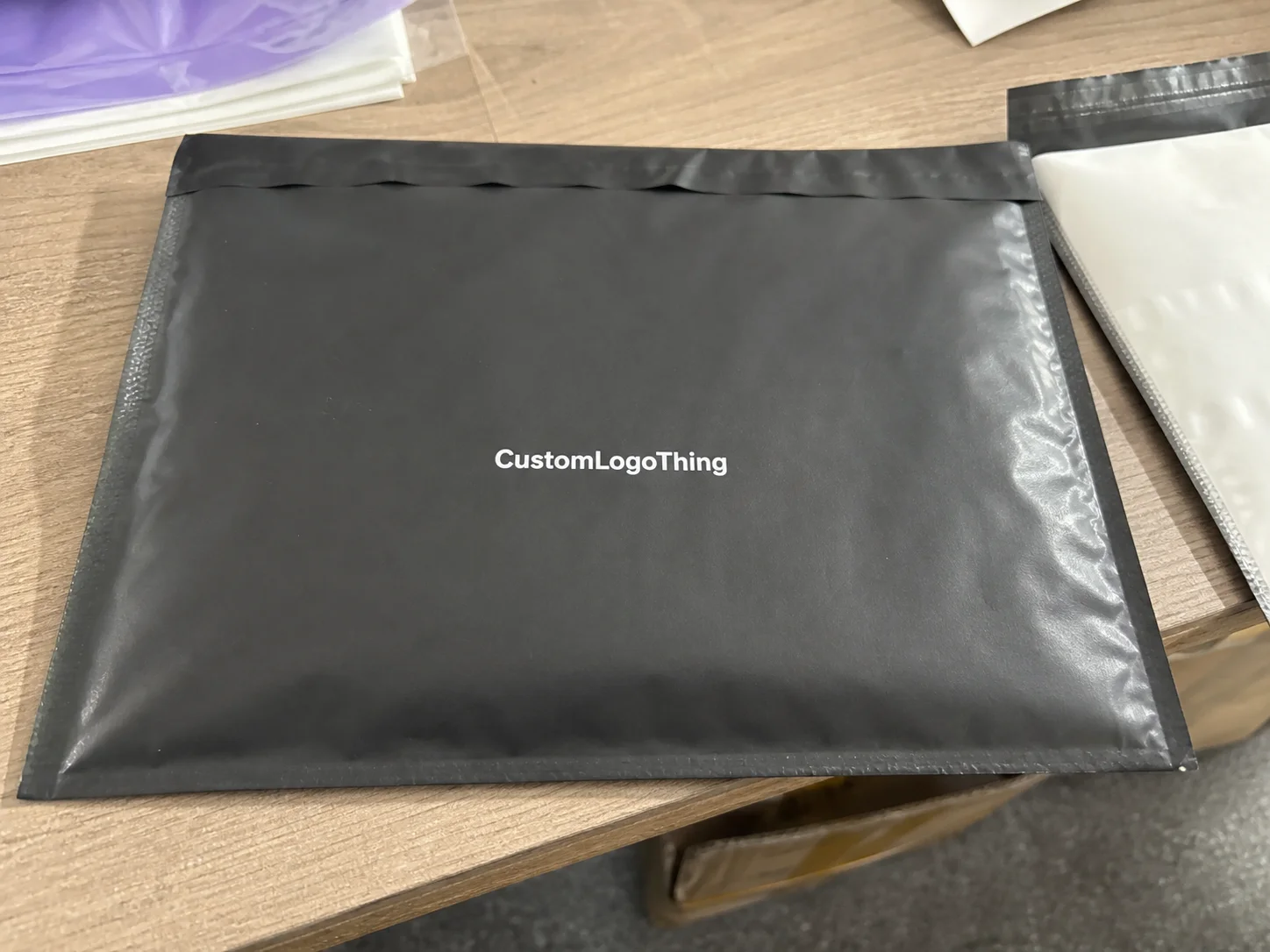
Branding turns custom sized poly mailers for art prints into more than a shipping consumable. One-color flexo gives clean, efficient identity. Full-color gravure or digital can elevate presentation for premium launches but adds setup complexity. Matte tends to read premium; gloss photographs vividly. In one A/B sequence I ran, matte black with a white logo lifted “premium feel” comments by about 19% against plain white stock, while conversion impact varied by audience.
That choice should align with your wider packaging design system. If framed pieces or wholesale kits use Custom Printed Boxes, your mailer language should still feel connected. Consistent product packaging increases recall. Visual fragmentation reads accidental (and customers notice more than brands assume).
Sustainability questions now show up in routine support tickets. Buyers ask about recycled content, curbside compatibility, and disposal instructions. If you position eco benefits, tie claims to hard facts: PCR percentage, resin type, and local recycling limitations. For baseline references, EPA recycling resources are useful when drafting customer-facing copy.
One operational detail that pays off quickly: reserve a clean label zone. I recommend at least a 4x6 inch uninterrupted area with high contrast under barcode regions. Busy graphics beneath labels can reduce scan reliability, especially in dim hubs. I’ve seen overnight belt systems in New Jersey reject labels that looked perfectly fine under office lighting. That was a very expensive “looks fine to me.”
Cost and Pricing Breakdown: What Custom Mailers Really Cost Per Print
Invoice unit price is only one line in the math. True cost per delivered print includes:
- Unit price of the mailer
- Plate/setup or cylinder fees
- Inbound freight to studio or 3PL
- Storage cost (shelf or pallet)
- Waste from obsolete or mis-sized inventory
- Damage replacements and support labor
Typical ranges I see for custom sized poly mailers for art prints at practical order quantities:
- 2,500 units: about $0.24–$0.44 each
- 5,000 units: about $0.18–$0.36 each
- 10,000 units: about $0.14–$0.29 each
Setup can range from $90 for simple one-color jobs to $400+ for multi-color structures. Freight varies hard by origin and timing; I’ve seen $280 LTL domestic replenishments and $1,900 ocean-linked shipments on larger import lots.
MOQ economics can fool disciplined operators. A 20,000-unit run may cut per-unit cost by 3 to 7 cents. If monthly usage is only 800, you’re carrying over two years of exposure. One logo change, one size shift, or one sales-mix swing and projected savings become dead stock.
A Phoenix artist collective ordered aggressively to hit $0.13 per mailer. Eight months later, demand shifted from 12x18 to 11x14. They wrote off 6,200 units. The write-down wiped out every projected unit saving. Honestly, I think this is one of the most avoidable cash-flow mistakes in small ecommerce ops.
Postage effect is where custom sized poly mailers for art prints often outperform expectations. Better fit can reduce dimensional triggers and eliminate void-driven bulge, especially with standardized packed profiles. A $0.30 average postage improvement across 1,000 monthly orders equals $300 monthly before damage reductions are counted.
Practical scenario comparison for 11x14 flat prints at 1,000 monthly orders:
| Scenario | Mailer Cost/Unit | Avg Damage/Replacement Rate | Avg Shipping Cost/Order | Estimated Total Monthly Packaging + Damage Impact |
|---|---|---|---|---|
| Oversized stock mailer + basic board | $0.12 | 3.5% | $6.40 | ~$6,960 |
| Semi-custom near-fit + improved board | $0.19 | 2.0% | $6.15 | ~$6,530 |
| Custom sized poly mailers for art prints + tuned insert | $0.25 | 1.1% | $5.95 | ~$6,260 |
Hidden cost drivers worth watching:
- Heavy ink coverage and flood coats
- Special finishes (soft-touch, metallic effects)
- Rush production windows under 7 business days
- Frequent artwork revisions after proof lock
My default rule: optimize for lowest total cost per successfully delivered print, not for the lowest mailer unit line on a quote sheet.
Step-by-Step Process and Timeline to Launch Your Mailer Spec
Most failures happen before the first purchase order. Specification discipline determines whether launch is smooth or chaotic.
Step 1: Audit top-selling sizes and bundles
Pull 90 days of order history. Rank by volume and revenue. In most stores, three sizes cover 70%+ of demand. Include bundle behavior (2-pack, 3-pack) when it exceeds 10% of orders so your matrix reflects actual demand.
Step 2: Build a focused size matrix
Launch with core SKUs only. I usually recommend 2 to 4 mailer sizes, not 9. An Austin client tried 11 sizes to “perfect fit” every option and lost more to pick errors than they saved in material. (Their picker called it “Tetris with consequences,” which is still the best description I’ve heard.)
Step 3: Request dielines and physical samples
Never approve from PDF alone. Ask for blank and printed samples in target gauges (for example, 2.5 mil and 3.0 mil). Test with real packed orders, real labels, and real tape behavior. Empty mockups are deceptive.
Step 4: Pilot with live shipments
Run at least 50 to 100 pilot orders across multiple zones. Track:
- Damage incidence by type (corner bend, puncture, moisture)
- Pack time per order (seconds)
- Customer feedback mentions tied to packaging
- Carrier exceptions or scan issues
Step 5: Finalize artwork and reorder thresholds
Lock artwork version control. Define a clear label-safe zone. Set reorder points using weekly usage, lead time, and safety stock. If lead time is 25 business days and usage is 600 per week, a reorder trigger near 3,000 to 3,600 units is common, adjusted for risk tolerance.
Typical timeline for custom sized poly mailers for art prints:
- Spec alignment: 3–5 business days
- Sampling and revisions: 7–14 business days
- Production after approval: 12–20 business days
- Transit to studio/3PL: 3–10 business days domestic, longer for imports
Product drops punish weak buffer planning. I’ve seen teams announce release dates before packaging landed and then scramble into expensive emergency buys. A two-week cushion helps if cash flow allows.
“We thought packaging was a design decision. It turned out to be an operations decision first.” — Print studio founder, Portland, after reducing average pack time from 94 seconds to 63 seconds per order.
Operational handoff needs to be explicit. Build a one-page SOP with visuals for insert orientation, seal pressure, label placement, and final QC checks. Train every packer. Audit the first 200 orders. Small process drift can erase gains from even well-specified custom sized poly mailers for art prints.
Common Mistakes That Cause Damage, Delays, or Overspending
Mistake 1: Using poly mailers alone for unmounted prints.
This still shows up constantly. Poly is not rigid protection. Remove backing and corner bends climb fast, especially on long routes.
Mistake 2: Ignoring packed thickness in sizing.
Teams measure raw artwork and forget sleeve + board stack-up. Result: tight insertion, torn seams, slower labor.
Mistake 3: Over-customizing too early.
One-color identity and two sizes usually beat six finishes and seasonal variants while demand is still volatile. Early systems should be boring and dependable. Boring is underrated in fulfillment.
Mistake 4: Missing fulfillment ergonomics.
I timed two pack setups in the same warehouse. A slightly wider opening cut average handling by 8 seconds and reduced scuff incidents.
Mistake 5: Skipping route testing across climates.
Gulf humidity and dense urban compression expose weaknesses local tests won’t catch. Pilot across diverse lanes.
Mistake 6: No before-and-after ROI tracking.
Without baseline metrics, value remains guesswork. Track damage %, pack time, cost per order, and post-delivery feedback mentions.
The biggest blind spot may be the assumption that “premium look” equals transit performance. Beautiful retail packaging logic does not always survive parcel stress. Aesthetics should follow mechanics. That applies to custom sized poly mailers for art prints and to every layer of package branding.
Expert Playbook: Actionable Next Steps to Implement Custom Sized Poly Mailers for Art Prints
If you want clean execution in 30 days, use this plan.
Week 1: Define priorities
- Identify top 3 print sizes by order count
- Document current damage rate and replacement-cost baseline
- Select one baseline spec (example: 2.8 mil co-ex film, permanent seal)
Week 2: Source and sample
- Request quotes for 2,500 / 5,000 / 10,000 quantities
- Ask for one backup material spec in case lead times shift
- Get physical samples and verify packed fit
Week 3: Pilot and measure
- Ship 50–100 live orders using pilot mailers
- Run quick internal drop/compression checks
- Confirm label adhesion and barcode readability
Week 4: Lock and launch
- Finalize artwork and reorder-point logic
- Train packing staff on SOP
- Place first production PO with buffer timing
Set measurable targets from day one:
- Reduce damage claims by 30% within 60 days
- Cut pack time by 10–20 seconds per order
- Improve post-delivery packaging feedback mentions by 15%
Customer-facing messaging should be ready too. A short insert line works well: “Your print ships in right-sized protective packaging to reduce corner stress and weather exposure.” Pair that with disposal guidance that matches your material. Clear language strengthens trust and reinforces your branded packaging story.
If your catalog includes flat prints, framed pieces, and gift sets, keep the system connected. Your poly strategy should coordinate with box formats and overall product packaging architecture. Consistency beats complexity.
The sequence I recommend stays simple: audit demand → test two sizes → pilot live shipments → measure outcomes → scale reorder logic. That flow works for solo artists shipping 50 monthly orders and teams sending 5,000+ parcels.
Final take: custom sized poly mailers for art prints are one of the few packaging upgrades that can improve protection, speed, and cost at the same time—if specs are grounded in packed dimensions and real shipment testing. Execute it well and packaging stops being a supply line item; it becomes operational infrastructure. And yes, it’s oddly satisfying when your shipping dashboard finally stops yelling at you in red.
What Are Custom Sized Poly Mailers for Art Prints and Do You Actually Need Them?
If you ship flat artwork regularly, the short answer is yes—usually. Custom sized poly mailers for art prints are built to your packed dimensions, which helps reduce excess void, control postage, and support faster packing. They are not a substitute for rigid protection, but paired with the right insert they create a repeatable shipping system that lowers damage rates and improves presentation.
- Use them if: you ship consistent print sizes, track damage costs, and want better fit and brand consistency.
- Hold off if: your SKU mix changes weekly and order volume is too low to justify MOQ exposure.
- Minimum viable setup: 2 core sizes, one tested film gauge, one rigid insert standard, and a documented packing SOP.
FAQ
What size should custom poly mailers be for 8x10 or 11x14 art prints?
Measure the fully packed unit, not only the artwork. Include sleeve thickness, backing board dimensions, and any insert cards or corner protectors. Add insertion tolerance (often 0.25–0.5 inch on key dimensions). Test at least one physical sample in your real packing workflow before production approval.
Are custom sized poly mailers for art prints enough protection by themselves?
Usually not for flat prints. Custom sized poly mailers for art prints provide weather and abrasion protection, while rigid inserts provide bend resistance. Match board strength to route distance, handling variability, and print value.
How much do custom sized poly mailers for art prints cost per unit?
Most projects land between $0.14 and $0.44 per unit based on size, film gauge, print complexity, and quantity. Evaluate total delivered cost, including setup, freight, storage, and waste risk, then compare against lower damage rates and labor/postage effects.
What is the typical production timeline for custom sized poly mailers?
A common sequence is spec alignment, sampling, production, and freight transit. Many teams finish in roughly 3 to 6 weeks total, though multiple revisions or import routing can extend timelines. Rush options exist but usually increase cost and reduce material/print flexibility.
Can custom sized poly mailers for art prints be eco-friendlier?
Yes. Look for recycled-content films, accurate recyclability guidance, and claims supported by resin data. Balance sustainability goals with puncture resistance and transit reliability. Right-sizing also cuts material use and avoids unnecessary shipping volume.