Buyer Fit Snapshot
| Best fit | Custom Sleeve Boxes Wholesale Supplier projects where brand print, material claims, artwork control, MOQ, and repeat-order consistency need to be specified before quoting. |
|---|---|
| Quote inputs | Share finished size, material target, print colors, finish, packing count, annual reorder estimate, ship-to region, and any compliance wording. |
| Proofing check | Approve dieline scale, logo placement, barcode or warning zones, color tolerance, closure strength, and carton packing before bulk production. |
| Main risk | Vague material claims, crowded artwork, missing packing details, or unclear freight terms can make a low unit price expensive after revisions. |
Fast answer: Custom Sleeve Boxes Wholesale Supplier: Specs & Pricing should be specified like a repeatable production item. The safest quote records material, print method, finish, artwork proof, packing count, and reorder notes in one written spec.
Production checks before approval
Compare the actual filled-product size with the drawing, then confirm tolerance on folds, seals, hang holes, label areas, and retail display edges. Reserve space for logos, QR codes, warning copy, and material claims before decorative graphics fill the panel.
Quote comparison points
Review material grade, print process, finish, sampling route, tooling charges, carton quantity, and freight assumptions side by side. A quote is only useful when the supplier can repeat the same color, closure quality, and packing count on the next order.
Custom Sleeve Boxes Wholesale Supplier: Specs & Pricing
Working with a custom sleeve Boxes Wholesale Supplier sounds simple until a 1 mm board change becomes a 2 mm panel shift and a stack of sleeves starts rejecting on the line. I watched that happen in Shenzhen, where a buyer stood beside a pallet of misaligned blanks and realized the sample had never been checked against the final tray dimensions. That is why a Custom Sleeve Boxes Wholesale supplier should be involved before artwork approval, not after cartons are already headed toward a container.
That early check matters because sleeve packaging solves a very specific problem. It gives a product a crisp shelf face, a clean reveal, and a premium layer of branded packaging without the freight weight of a rigid box. Brands that care about tighter package branding and lower packaging spend often find that a custom sleeve Boxes Wholesale Supplier can keep the presentation sharp while holding the unit cost near $0.15 per unit for 5,000 pieces on a simple build. That balance is not flashy, but it is usually profitable.
Why a Custom Sleeve Boxes Wholesale Supplier Matters
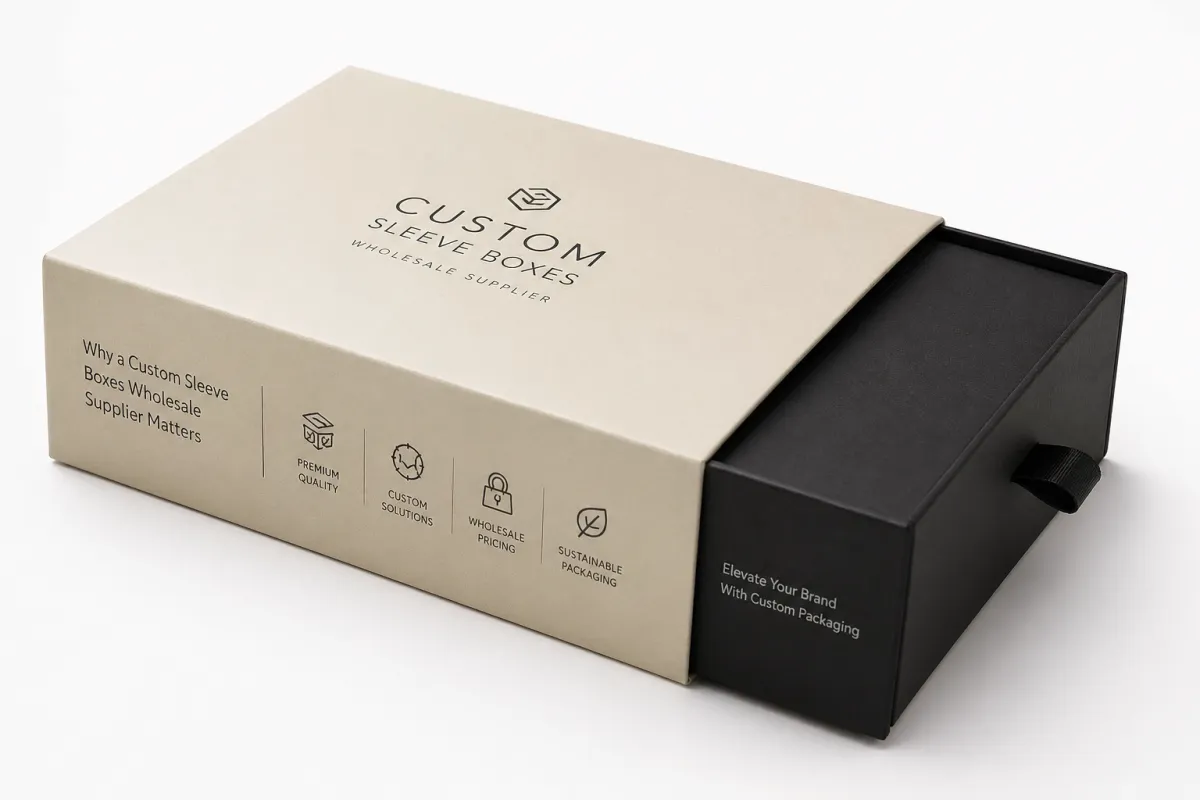
Buyers often treat sleeve packaging like a decorative band, and that is usually where the trouble starts. A sleeve is a measured structure with a defined opening width, a specific board caliper, print registration tolerances, and an insertion method that has to work on the line at 30 to 60 cartons per minute. A custom sleeve Boxes Wholesale Supplier knows the sleeve must fit the tray, carton, or product face with enough friction to stay put, but not so much pressure that 350gsm C1S artboard cracks at the score. One millimeter too much, and the paperboard starts acting like it has a personal vendetta.
At a cosmetics meeting in Guangzhou, a brand wanted a glossy sleeve over a matte inner tray for a serum set that retailed at $42.00. The first sample exposed a 0.5 mm overbuild at the seam, and one corner sat visibly proud by nearly 2 mm. A custom sleeve Boxes Wholesale Supplier caught the flaw during sampling, corrected the die, and prevented a reprint of 8,000 sleeves. Fit, consistency, and control are not abstract ideas here; they decide whether the package works or turns into an expensive lesson in avoidable waste.
Wholesale sourcing brings clear advantages. Tooling is easier to reuse once the die is approved, and freight loads improve when the spec stays standardized across 5,000, 10,000, or 20,000 units. Setup costs spread across higher quantities, and the unit price starts behaving like a wholesale order instead of a one-off prototype. A strong custom sleeve boxes wholesale supplier will explain those economics plainly instead of loading the spec with features that do not improve the sale. I appreciate that kind of honesty because nobody needs a packaging quote padded with decorative math.
Many buyers still underestimate how much the supplier shapes the retail result. The best custom sleeve boxes wholesale supplier is not simply printing paper in a plant outside Dongguan or Foshan; they are managing fit, registration, coating, carton pack-out, and lead time so the package lands on shelf the way the brand intended. That matters most in retail packaging, where the sleeve has to protect the product and present it at the same time, often after a 1,200-kilometer freight move from South China to a distribution center in the north.
Successful sleeve programs usually stay disciplined. A simple structure, a clean print file, and a stable production spec often beat a flashy concept packed with finishes and thin tolerances. Buyers who care about scale tend to start with a custom sleeve boxes wholesale supplier before they lock the final artwork, because production limits show up early when the design is still easy to adjust. I have seen teams save themselves two full weeks just by asking one blunt question: "What will actually run well on a 350gsm board line?" That question is unglamorous, but it pays rent.
Brands comparing options across Custom Packaging Products and broader Wholesale Programs often find sleeve packaging sits in a useful middle ground. It delivers strong visual impact without the weight of rigid packaging, and it usually ships flatter than a two-piece set from a factory in Zhejiang or Guangdong. Foil, embossing, and die-cut windows still fit within the format when the budget allows. A dependable custom sleeve boxes wholesale supplier will show where the money goes before the first press sheet hits the line.
"The sleeve only looks simple after the factory solves fit, print, and pack-out. Before that, it is a measurement problem."
Industry references help buyers speak with more precision. I often point teams to the Paperboard Packaging Alliance for material context and ISTA for shipping test standards. Those sources do not replace a supplier, though they make conversations about compression, durability, and transit performance more grounded. A good custom sleeve boxes wholesale supplier respects that level of rigor, especially when the order is moving through a warehouse in Shenzhen or a port shipment out of Ningbo.
What Should a Custom Sleeve Boxes Wholesale Supplier Quote Include?
A useful quote should be specific enough to compare without guessing. A custom sleeve boxes wholesale supplier should spell out board grade, finished size, print method, coating, finish, MOQ, die cost, sample cost, and freight assumptions. If the numbers are presented without those details, the quote may look competitive while hiding a weaker build. That is the packaging version of a restaurant menu that lists the entree but not the portion size.
The best quotes also clarify what is included and what is not. Does the price cover structural design, dieline adjustment, or one proof round? Are master cartons included? Is the quoted lead time from artwork approval or from deposit receipt? A disciplined custom sleeve boxes wholesale supplier will answer those questions before the first purchase order, because clean pricing prevents friction later. Procurement teams do not need poetry; they need a line item they can defend without squinting.
Product Details: How Sleeve Boxes Are Built
A sleeve box is simple in structure and exact in execution. The printed sleeve wraps around an inner tray, carton, or product, and the fit has to stay clean from the first open to the last tuck. A custom sleeve boxes wholesale supplier usually starts with product dimensions in millimeters, then builds a dieline that accounts for board thickness, friction, and print wrap so panel art lands in the right place. That is the unromantic part of the job, and also the part that prevents headaches later.
The most common formats include open-end sleeves, tuck sleeves, friction-fit sleeves, belly bands, and sleeves with die-cut windows. Each one solves a different packaging problem. Open-end sleeves slide well over a box or tray. Tuck sleeves work for bundled items. Friction-fit sleeves stay snug during transport. A custom sleeve boxes wholesale supplier should match the style to the actual product flow, not just the rendering. Renderings are charming. Production is where reality shows up with a clipboard and a caliper gauge.
The format works across a wide range of categories: cosmetics, candles, apparel accessories, supplements, gift sets, and promotional kits all benefit from a sleeve that gives the product a clean face without overbuilding the structure. I once saw a candle brand in Foshan switch from a full rigid carton to a printed sleeve over a kraft tray, and freight cube dropped by 18% while the shelf look stayed premium. The CFO smiled, which is rare enough to mention. That sort of comparison is exactly where a custom sleeve boxes wholesale supplier earns their keep.
The unboxing experience changes too. A sleeve can hide the product until the customer pulls the wrap away, which works especially well for launch kits priced between $28 and $75. It can protect the visible face during shipping. It can create a more focused reveal than a full printed carton because the design surface is concentrated. A smart custom sleeve boxes wholesale supplier will help you use that reveal intentionally, especially if the brand wants understated Custom Printed Boxes with a premium finish rather than loud decoration. Not every package needs to shout; some should just stand there looking expensive.
Practical details matter more than most buyers expect. Insertion direction matters because the sleeve can catch if the tray has a loose edge or a sharp fold. Panel alignment matters because a 2 mm shift can move a barcode into the wrong panel or make a logo look off-center. Product height and tray tolerance matter because a sleeve that feels perfect on one sample can look sloppy if the insert changes by 1.5 mm. A good custom sleeve boxes wholesale supplier will ask for the physical product, not only the CAD file. And if they do not ask, that is a small red flag waving in daylight.
At one factory in Dongguan, a sleeve job slipped because the inner tray had a paper overwrap that added more height than the buyer's sample sheet showed. The sleeve itself was correct. The product had changed. That is the lesson most teams learn too late: a custom sleeve boxes wholesale supplier can only build to the dimensions they receive, so the spec has to reflect the actual assembly on the line, not the version everyone hoped would be true.
Materials, Print, and Structural Specifications
Material selection starts with board, and board affects more than appearance. Sleeve packaging commonly uses SBS, CCNB, kraft paperboard, and related folding-carton grades chosen for caliper, finish, and brand position. A custom sleeve boxes wholesale supplier may recommend 350gsm C1S artboard for a polished retail presentation, or 300gsm kraft for a warmer, recycled look depending on the product story and shipping weight. I have a soft spot for kraft when the brand has the discipline to let the texture do the talking. Too many people try to dress it up anyway, and the package ends up looking confused.
SBS prints sharply and holds fine detail well, which makes it a strong fit for cosmetics, fragrance, and retail packaging where image quality drives perception. CCNB can work well for brands balancing cost and appearance, especially on runs above 10,000 units. Kraft paperboard creates a warmer, more restrained look, which suits artisan food, wellness, and eco-forward product packaging. A thoughtful custom sleeve boxes wholesale supplier will explain the tradeoff between brightness, stiffness, and perceived value before you commit. They should also tell you if the board you picked is trying to be three things at once and failing all of them.
Caliper and coating deserve the same attention as the artwork. Board that is too light can collapse or show edge waviness after a 2,000-kilometer truck route. Board that is too stiff can crack on a tight score or fight the insertion process. Coating and lamination influence scuff resistance, fingerprint visibility, and how the sleeve holds up under pallet handling in regional distribution hubs like Guangzhou or Suzhou. I have seen matte lamination save a run from visible rub marks on a high-touch display piece. I have also seen gloss reveal every tiny nick on a badly packed carton, which is the packaging equivalent of wearing white pants to a food festival. A capable custom sleeve boxes wholesale supplier knows the detail is not cosmetic; it changes the customer's perception the moment the box arrives.
Print and finishing choices are where costs climb fast. Offset printing gives excellent color control on larger runs. Digital printing can make sense for lower quantities or quicker sampling. PMS and CMYK choices affect brand consistency across lines and reorders. Aqueous coating is common for protection and cost control. Matte or gloss lamination changes the visual character. Foil, embossing, and spot UV add depth, but they also add setup time and waste. A good custom sleeve boxes wholesale supplier should explain which finishes support the sale and which ones are only decoration. I am very much in favor of restraint when the design already has a strong idea.
For teams comparing package branding options, the spec checklist should stay tight and practical:
- Exact product dimensions, including tray or insert thickness
- Finished sleeve size with clear tolerances
- Bleed, safe area, and barcode placement
- Window size and cutline location, if used
- Print method, color standards, and finish selection
- Quantity per master carton and shipping carton dimensions
If a supplier cannot work from that level of detail, the quote is probably too vague to trust. A serious custom sleeve boxes wholesale supplier will ask for measurements in millimeters, carton count per shipper, and the target freight destination because those details affect production efficiency and landing cost. The boring part is where the money hides, and in packaging that usually means a savings of 8% to 14% when the spec is clean.
Sustainability goals call for a practical conversation, not a slogan. I often point buyers to FSC when they want to understand certified fiber sourcing. Certification does not make a package better by itself, but it does give procurement and compliance teams a cleaner paper trail. A thoughtful custom sleeve boxes wholesale supplier can source FSC-certified board, recyclable coatings, and low-odor finishes when the program needs them, whether the job runs in Guangdong, Zhejiang, or a mixed supply chain split between the two.
Custom Sleeve Boxes Wholesale Supplier Pricing and MOQ
Pricing gets messy when buyers compare quotes that are not built the same way. A custom sleeve boxes wholesale supplier prices by size, board grade, print coverage, special finishes, die-cut windows, tooling, finishing complexity, and freight distance. A quote using SBS with matte lamination cannot be lined up cleanly against one using lighter CCNB with no coating. The numbers may look close, but the builds are different. I have watched procurement teams stare at two PDFs like they were going to confess their differences under pressure. The boxes were not going to budge.
Wholesale pricing works because setup costs are spread across larger runs. Once the die, plates, and color approvals are locked, the unit price usually drops as volume rises and the spec stays stable. A custom sleeve boxes wholesale supplier will often quote several quantities at once so you can see the break points clearly. In a run of 5,000 pieces on 350gsm C1S artboard with aqueous coating, unit pricing often lands around $0.15 per unit to $0.22 per unit depending on the panel count and freight destination. At 20,000 pieces, the same concept can move closer to $0.09 to $0.16 if the structure stays simple and the artwork is efficient.
MOQ is not a random number. It comes from press setup, material yield, finishing steps, and the need to keep quality stable across the run. A sleeve with foil and a window may need a higher MOQ than a straight-printed sleeve because the factory absorbs more setup time and more scrap during calibration. A realistic custom sleeve boxes wholesale supplier will explain that without theatrics. If they sound like they are auditioning for a magic show, keep asking questions until the numbers make sense.
Here is the way I usually break down sleeve pricing for buyers who want a clean comparison. The ranges below are illustrative, but they show how structural choices affect cost in a real production environment in Shenzhen, Dongguan, or Foshan:
| Option | Typical Build | Approx. Unit Price at 5,000 | Approx. Unit Price at 20,000 | Best Use |
|---|---|---|---|---|
| Basic printed sleeve | CCNB, CMYK, aqueous coating | $0.15-$0.19 | $0.08-$0.11 | High-volume retail and promotional kits |
| Premium sleeve | SBS, matte lamination, spot UV | $0.26-$0.34 | $0.11-$0.17 | Cosmetics, gift sets, premium retail packaging |
| Natural kraft sleeve | Kraft board, one- or two-color print | $0.13-$0.21 | $0.07-$0.12 | Wellness, artisan goods, eco-friendly branding |
| Sleeve with window | Die-cut window, film insert, custom cutline | $0.24-$0.39 | $0.12-$0.21 | Products that need visibility at shelf |
That table is a reference point, not a promise. Freight, carton count, and regional labor rates can move the final number, especially if the shipment leaves a factory in Guangdong for a warehouse in Chicago or Rotterdam. The pattern still holds: the more stable and efficient the spec, the better the pricing tends to be. A disciplined custom sleeve boxes wholesale supplier will help you simplify the build before you lock volume.
Margin can be protected without weakening the package. Standardize sizes where possible. Skip foil if the print already carries the brand. Choose nesting-friendly layouts to improve freight efficiency. Keep the same die for repeat runs if the product dimensions do not change. I have seen a customer cut packaging spend by 12.4% over one fiscal year by locking one sleeve size across three SKUs instead of creating a slightly different version for each. The custom sleeve boxes wholesale supplier did not create the saving by magic; they helped the team avoid preventable variation.
Process and Timeline for Wholesale Sleeve Box Orders
The order flow should be clear from the first quote. A professional custom sleeve boxes wholesale supplier usually moves through inquiry, specification review, dieline creation, artwork placement, proofing, sampling, production, quality control, pack-out, and freight booking. Skipping one step rarely saves time. The missing step usually returns later as a delay, which is a lovely little surprise nobody asked for, especially when the shipment is booked out of Shenzhen Port on a Friday.
Timing depends on the job, though the pattern is fairly consistent. A simple sleeve with print-ready artwork and a confirmed dieline may move from proof approval to production in 12 to 15 business days. Add a new die, foil, embossing, or a special coating, and the timeline can stretch to 18 to 25 business days before freight. A responsible custom sleeve boxes wholesale supplier should state that directly instead of promising a fast turn that the line cannot support.
Delays usually come from the same few problems. Missing measurements cause the first round of dielines to miss the target. Late artwork pushes the press slot. Color changes after proofing force re-approval. Sample approvals sit on a buyer's desk for 6 to 8 days longer than expected. I watched one launch slip because the buyer kept adjusting barcode size after the sample was built; production was ready, but the approval chain was not. An experienced custom sleeve boxes wholesale supplier presses for complete information early because they have seen the cost of partial information.
There is a simple way to shorten the schedule. Send exact product specs on day one. Approve the dieline, material, and finish together. Assign one person to design sign-off. If the sleeve wraps a tray or carton, send the physical sample instead of relying only on photos. A good custom sleeve boxes wholesale supplier can move much faster when they are not waiting on scattered confirmations from three departments. Fewer handoffs. Fewer surprises. Fewer frantic emails with subject lines like "urgent final final."
Rush work can happen, though it should be handled carefully. A factory may be able to prioritize a press slot or move finishing, yet quality checks and shipping timing still have to hold. I have seen urgent orders saved by clear communication and I have seen others fail because the buyer demanded a 5-day turnaround without accepting the production constraints. The right custom sleeve boxes wholesale supplier will say what is possible, what is risky, and what should not be rushed.
That discipline matters even more in custom printed boxes programs where the sleeve is part of a larger kit. A missing sleeve can stop an entire assembly line if the inner items are already packed. Good planning protects the packaging budget and the fulfillment schedule at the same time, which is usually where the real cost of a delay shows up.
Why Choose Us for Wholesale Sleeve Packaging
At Custom Logo Things, we treat sleeve work like production, not just print. A reliable custom sleeve boxes wholesale supplier needs pressroom control, precision die-cutting, consistent gluing, finishing lines that hold tolerance, and pack-out practices that keep wholesale orders organized by SKU and ship date. That is the base layer for repeatable results, especially when 15,000 units are moving through a factory in Dongguan or a staging warehouse in Foshan.
Quality control starts before the first sheet reaches the press. We check art alignment, board spec, score accuracy, and the fit between sleeve and insert or tray. During production, we verify color consistency, panel registration, and cut quality. Before shipment, we sample cartons at random and check the outer pack for count accuracy and condition. A seasoned custom sleeve boxes wholesale supplier knows that a beautiful sleeve that arrives crushed is just an expensive mistake. I would rather have a slightly less dramatic sample than a pallet full of heartbreak.
Material sourcing matters too. Reliable paperboard mills, stable finishing partners, and sustainability-friendly options create predictability in lead time and quality. If a brand wants recyclable materials, lower-odor coatings, or FSC-certified fiber, we build those requirements into the spec early instead of treating them as last-minute extras. That is one of the practical benefits of working with a custom sleeve boxes wholesale supplier that understands manufacturing and procurement across Guangdong, Zhejiang, and the freight lanes connecting them.
Communication is another place where a supplier either helps or hurts the job. Fast answers to measurement questions, clear proof notes, and honest status updates keep the buyer out of trouble. In one supplier negotiation years ago, a plant manager in Guangzhou told me, "If the sleeve is late by two days, the brand feels it for two weeks." He was right. A dependable custom sleeve boxes wholesale supplier protects the launch calendar as much as the package itself, and that can be worth more than a 3-cent discount.
That matters even more for clients balancing brand presentation with cost control. A sleeve can elevate package branding without adding the complexity of a fully rigid setup, and it can scale cleanly across repeat runs if the spec stays disciplined. For many brands, that is the right middle ground between elegance and efficiency, especially when a 20,000-unit reorder needs to land in the same quarter as the original launch.
We also keep an eye on the practical side of sustainability. Lighter board generally means less material moving through the supply chain. Right-sized cartons reduce freight waste. Recyclable paper components support simpler end-of-life handling. The EPA's packaging and waste guidance at EPA Sustainable Materials Management is a useful reminder that good packaging is not only about appearance; it is also about responsible material use. A good custom sleeve boxes wholesale supplier should be able to discuss those tradeoffs without buzzwords.
If you are comparing vendors, keep the conversation anchored in measurable details: board grade, caliper, coating, print method, MOQ, lead time, and carton pack-out. That is where the real difference appears. Not in promises. In production at a plant in Shenzhen, a port route through Ningbo, or a finishing line in Dongguan where the final 2 mm of tolerance decide whether the job ships cleanly.
Next Steps: From Quote to Approved Run
The fastest way to get an accurate quote is to send complete information up front. Gather the exact product dimensions, target sleeve size, quantity, orientation, artwork files, preferred finish, and shipping destination before you ask a custom sleeve boxes wholesale supplier to price the job. The better the brief, the faster the answer. That sounds obvious, but I have seen surprisingly expensive projects start with a blurry photo and a sentence that read, "Can you quote this?"
If the sleeve has to fit tightly around a tray, carton, or retail set, ask for a sample or prototype before you greenlight full production. That single step catches problems with board thickness, friction fit, and panel alignment long before they become expensive. I have seen a $120 prototype prevent a $12,000 reprint, and that is not unusual in sleeve work. A careful custom sleeve boxes wholesale supplier will encourage the sample because it protects both sides.
Comparing two or three quotes against the same spec sheet helps too. The differences become visible immediately: heavier board, different coating, different carton count, different waste allowance. Many buyers discover that the lowest quote is missing something important. A transparent custom sleeve boxes wholesale supplier will help you spot those gaps before you sign off, especially if one quote is built on 300gsm board and another on 350gsm C1S artboard.
Lock the timeline early. Confirm how proofs will be approved, how many cartons fit per pallet, what the reorder plan looks like, and whether the job needs a new die or reusable tooling. Those details shape the schedule as much as the artwork. If the program is likely to repeat, tell the supplier now so the production plan can support future runs without rework, whether the next order is 5,000 units or 25,000.
My advice is simple: send the full spec pack to your custom sleeve boxes wholesale supplier so they can quote accurately, build the sample, and move the job into production without guesswork. That is how you protect margin, keep quality stable, and make sure the packaging supports the product instead of complicating it. For teams that care about dependable product packaging, the clearest move is to lock the measurement sheet, approve the dieline, and freeze the finish before anything goes to press.
FAQ
What do I need to request a quote from a custom sleeve boxes wholesale supplier?
Share the exact product dimensions, target sleeve size, quantity, and whether the sleeve wraps a tray, carton, or product directly. Send artwork files, finish preferences, and color standards such as PMS numbers or approved brand references. Include the shipping destination and required delivery date so the custom sleeve boxes wholesale supplier can quote production and freight together, ideally within 24 to 48 hours if the spec is complete.
Can a custom sleeve boxes wholesale supplier match an existing package size?
Yes, though the supplier should measure the current package carefully because a sleeve needs proper clearance and friction fit. Ask for a sample or dieline check before full production if the box must fit a current tray, insert, or retail carton. If the original package came from another plant, send a physical sample so the new custom sleeve boxes wholesale supplier can verify board thickness, caliper, and wrap tolerance down to the millimeter.
What materials work best for wholesale sleeve boxes?
SBS and CCNB are common for retail presentation because they print cleanly and hold crisp edges. Kraft board can be a better fit when the brand wants a natural look or a more understated, recyclable appearance. The best material depends on product weight, finish requirements, shipping conditions, and the shelf experience you want to create, so a custom sleeve boxes wholesale supplier should guide the choice by use case, not by what is cheapest on a single quote.
How does MOQ affect pricing with a custom sleeve boxes wholesale supplier?
Lower quantities usually cost more per unit because setup, tooling, and press time are spread across fewer boxes. Higher quantities generally reduce unit price, especially when the spec is stable and the same die can be reused. Ask for price breaks at multiple volumes so you can compare the true savings against storage and cash flow needs with your custom sleeve boxes wholesale supplier; a 5,000-piece break and a 20,000-piece break can look very different on paper.
How long does production usually take for wholesale sleeve boxes?
Timing depends on whether the job needs a new die, special finishes, or a sample approval cycle before the press run. Simple sleeve orders move faster than complex, multi-finish jobs, especially when artwork arrives print-ready. A supplier should give you a realistic schedule for sampling, production, QC, and shipping rather than a vague estimate, and a strong custom sleeve boxes wholesale supplier will usually quote 12 to 15 business days from proof approval for a standard run.

