Buyer Fit Snapshot
| Best fit | Custom Sleeves for Boxes projects where brand print, material claims, artwork control, MOQ, and repeat-order consistency need to be specified before quoting. |
|---|---|
| Quote inputs | Share finished size, material target, print colors, finish, packing count, annual reorder estimate, ship-to region, and any compliance wording. |
| Proofing check | Approve dieline scale, logo placement, barcode or warning zones, color tolerance, closure strength, and carton packing before bulk production. |
| Main risk | Vague material claims, crowded artwork, missing packing details, or unclear freight terms can make a low unit price expensive after revisions. |
Fast answer: Custom Sleeves for Boxes: Board, Finish, Dieline, and Unit Cost should be specified like a repeatable production item. The safest quote records material, print method, finish, artwork proof, packing count, and reorder notes in one written spec.
Production checks before approval
Compare the actual filled-product size with the drawing, then confirm tolerance on folds, seals, hang holes, label areas, and retail display edges. Reserve space for logos, QR codes, warning copy, and material claims before decorative graphics fill the panel.
Quote comparison points
Review material grade, print process, finish, sampling route, tooling charges, carton quantity, and freight assumptions side by side. A quote is only useful when the supplier can repeat the same color, closure quality, and packing count on the next order.
Custom Sleeves for Boxes: A Practical Packaging Guide
Learn how custom sleeves for boxes improve shelf impact, control costs, and speed production with real specs, material choices, and artwork decisions before you place an order.
A plain carton can disappear on a crowded shelf. Add custom sleeves for boxes, and the same package can feel more deliberate, more seasonal, and more expensive before anyone even picks it up. That is the core appeal: a printed sleeve changes the first impression without forcing a brand to rebuild the whole box system.
For packaging buyers, custom sleeves for boxes solve a very practical problem. They give teams a way to refresh branded packaging quickly, support a product launch, and keep retail packaging aligned across channels while the base carton stays standard. Less structural redesign, fewer moving parts, and a faster route from concept to shelf-ready product packaging all come out of that approach.
In my experience, sleeves become especially useful when a brand is not trying to reinvent the carton, just make it work harder. A company can test a new message, add limited-edition artwork, or cover a multipack in a way that feels intentional without committing to a full custom carton run. In the right setup, custom sleeves for boxes can do much of what custom printed boxes do, while asking for less upfront change when the underlying carton already works well.
Custom Sleeves for Boxes: Why They Stand Out Fast
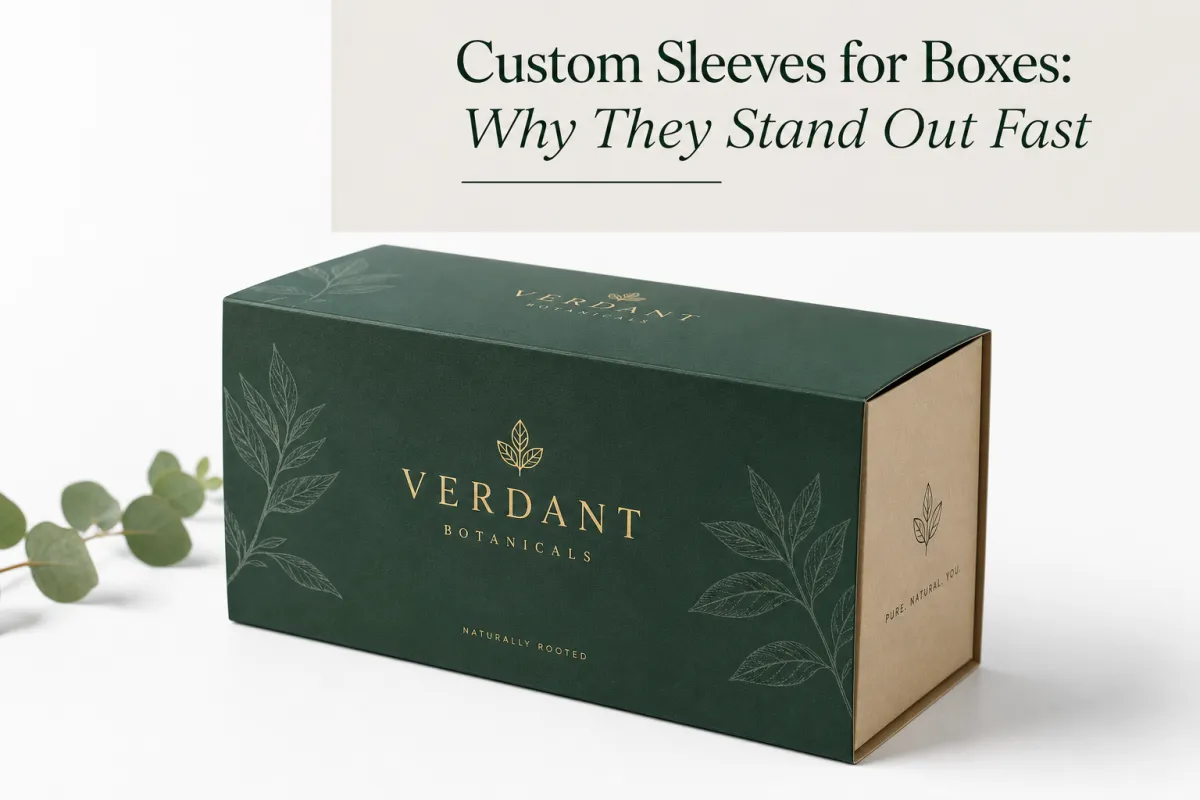
Shoppers often judge value before they read the label, and sometimes before they even touch the product. A sleeve adds a visible branding layer across the face, edge, or full wrap of the box, so custom sleeves for boxes can shift perception in seconds. A clean white mailer becomes a premium gift set. A plain kraft carton becomes a seasonal bundle. The box itself may stay the same, but the message feels different.
Seasonal campaigns, retail resets, and launch calendars all benefit from that flexibility. If a brand needs to introduce a holiday flavor, a new SKU, a bundle, or a trial-size promotion, custom sleeves for boxes move faster than redesigning a full carton line. Inventory stays easier to manage, too, because the base box can remain standardized while the printed outer layer changes. For teams balancing speed and branding, that tradeoff is hard to ignore.
The commercial side matters just as much. Full custom cartons can fit high-volume programs, but they also bring more print coverage, more tooling commitment, and more inventory risk. Sleeves let teams spend on the surfaces customers actually see instead of on every panel. For many buyers, that becomes the difference between a launch that ships on time and a launch that sits in prepress. Custom sleeves for boxes are not always the lowest-cost option in absolute terms, but they are often the most efficient path for package branding.
A good sleeve should do two jobs at once: make the box easier to sell and no harder to pack.
That sounds simple, yet it is where many packaging programs break down. If the sleeve looks polished but creates assembly friction, the warehouse feels it. If it installs well but looks flimsy on shelf, the brand feels it. The better custom sleeves for boxes balance both sides: they support retail packaging goals while fitting real production conditions such as packing speed, replenishment cycles, and shipping limits.
How Custom Sleeves for Boxes Work
Structurally, a sleeve is a printed piece of board or paper that wraps around a box and keeps its shape through scoring, folding, and a closure method such as a glue seam or a tuck-in tab. Custom sleeves for boxes usually begin as a flat dieline, then move through print, finishing, die-cutting, and assembly. Once formed, the sleeve slides over or around the base carton and creates a branded outer layer without changing the primary box structure.
Fit matters more than many first-time buyers expect. A sleeve has to account for the outside dimensions of the carton, board thickness, fold allowances, and the amount of slip needed for smooth assembly. If the sleeve is too tight, it scuffs. If it is too loose, it shifts on the shelf and looks unfinished. That is why custom sleeves for boxes should be measured from the outer box dimensions, not from the product inside. The box is the reference point, not the item it holds.
Several common formats show up again and again. A full wrap sleeve covers most or all visible sides. A belly band usually crosses the middle and fits gift sets and multipacks well. A front-panel sleeve highlights the display face while leaving the rest of the carton exposed. A promotional over-sleeve can be added temporarily for seasonal messages, event branding, or retail display updates. Each version gives custom sleeves for boxes a different balance of coverage, cost, and assembly time.
Which box styles work best
Mailers, tuck-top cartons, rigid-style displays, and standard folding cartons all pair well with sleeves, but the best match depends on the opening style and the amount of friction during assembly. If the base carton has a clean rectangular profile, custom sleeves for boxes are usually straightforward. If the carton has unusual flaps, raised features, or decorative closures, the sleeve needs tighter engineering so it clears those elements cleanly.
A simple workflow helps make the process easier to follow. First, the packaging team confirms the box size and the product packaging requirements. Next, the dieline is created around the outside carton dimensions. Then the artwork is placed with folds, seams, barcode positions, and safe zones in mind. After proof approval, the sleeve is printed, finished, die-cut, and delivered for assembly. That is the basic path for custom sleeves for boxes, and it usually moves much faster than developing a brand-new custom carton format from scratch.
One small detail can save a lot of trouble: always confirm whether the sleeve is meant to be loose, friction-fit, or glued at the seam. That decision changes the dieline, the assembly method, and even the stock choice. It sounds like a little thing, but it is one of those details that can turn a clean project into a headache if nobody locks it down early.
Key Factors That Decide Fit, Finish, and Performance
Fit starts with measurements, not aesthetics. The box length, width, and height need to be measured accurately, then checked against the caliper of the sleeve board and the amount of assembly tolerance. For custom sleeves for boxes, even a 1 to 2 mm variance can matter because the sleeve may look crooked on a retail shelf or create drag during packing. A sleeve that feels crisp in a sample can behave differently once a production line starts moving quickly.
Material choice comes next, and it changes both the look and the performance. Lightweight paperboard can be economical and work well for low-friction applications, while heavier stock can improve hand feel and make the package seem more substantial. In many programs, 14pt to 24pt board is a common planning range, with coated SBS, C1S, kraft, or artboard selected based on print quality and brand tone. For custom sleeves for boxes, the material is not just a substrate; it carries part of the brand story.
Finishing is where a sleeve starts to feel polished or ordinary. Matte coatings reduce glare and can make typography easier to read under store lighting. Gloss coatings push color contrast and can make photography pop. Soft-touch lamination adds a muted, velvety feel that often signals premium positioning. Spot UV, foil stamping, and embossing can highlight logos, product names, or limited-edition cues. Used well, these treatments make custom sleeves for boxes feel intentional. Used too often, they crowd the design and make it feel heavy.
I have seen teams spend extra on finish because they wanted the sleeve to feel premium, then wonder why the final piece looked louder instead of better. Usually the issue is not the treatment itself. It is the mismatch between the finish, the stock, and the actual product price point. A restrained finish on the right board almost always reads more confidently than a pile of effects stacked on top of each other.
Artwork details that save reprints
Artwork should be built with bleed, safe zones, barcode placement, and fold logic in mind. Important text should avoid seams and turn areas, and any UPC or EAN barcode should stay on a flat, scannable surface with enough contrast to read reliably. Low-resolution imagery, thin reversed type, and poorly placed legal copy are common reasons a sleeve looks rushed. With custom sleeves for boxes, the flat artwork can look fine on screen and still fail once it wraps around a carton.
Performance concerns are practical, not theoretical. Sleeves should resist scuffing during handling, survive carton friction in transit, and stay readable after stacking. If the package will move through a parcel network or sit in a warehouse for weeks, ask about rub resistance and compression behavior. For distribution-sensitive programs, standards-based testing matters. The ISTA test methods are useful references for transit and handling validation, while FSC-certified board from FSC can support sourcing claims when sustainable paperboard is part of the brief. Good custom sleeves for boxes should survive the route, not just the proof sheet.
There is also a trust issue here. If a sleeve is being used to support a sustainability claim, the board spec and certification trail need to line up with the actual purchase. Don’t gloss over that part. Buyers, retailers, and auditors notice when the paperwork is fuzzy, and that kind of mistake can undo an otherwise solid packaging program.
Custom Sleeves for Boxes Cost, MOQ, and Quote Drivers
Price is usually the first question, and it should be. The biggest cost drivers for custom sleeves for boxes are size, stock weight, print coverage, finishing, quantity, and whether the design calls for special effects such as foil or embossing. A larger sleeve uses more material and more press area. A full-color design with heavy coverage takes more setup and ink than a simple one- or two-color layout. Special finishes add processing time and waste. If a sleeve is oversized or structurally awkward, the cost rises again because the production line has to handle more complexity.
Many buyers compare sleeves with fully printed cartons for good reason. If the base carton already exists in inventory, sleeves can turn a standard box into a branded product package without paying for complete box coverage. That often makes custom sleeves for boxes a stronger commercial choice for short runs, seasonal packaging, or market tests. A full custom carton may still win when the structure itself needs to change, but for many brands the sleeve is the smarter spend because the box underneath already does the heavy lifting.
| Option | Best For | Typical Unit Cost at 5,000 Units | Notes |
|---|---|---|---|
| 14pt SBS, basic 4-color print | High-volume promotions and simple retail packaging | $0.18-$0.28 | Good starting point when cost control matters more than tactile finish |
| 18pt C1S with matte coating | Mid-range branded packaging and seasonal programs | $0.22-$0.36 | Balances durability, print clarity, and shelf presentation |
| Kraft board with one- or two-color print | Natural-looking product packaging and eco-leaning branding | $0.20-$0.32 | Often chosen for a more textured, understated package branding style |
| Soft-touch with foil or spot UV | Premium launches and gift sets | $0.35-$0.58 | Higher perceived value, but more production steps and stronger setup costs |
Minimum order quantities are another place where expectations need to stay grounded. For digital short runs, some suppliers can produce smaller quantities, sometimes in the 250 to 1,000 range, but the per-unit cost will usually be higher because setup time is spread across fewer pieces. Offset print and standard die-cut workflows often become more efficient in the 2,500 to 5,000 range, with better economics once a job moves above that level. In plain terms, custom sleeves for boxes reward volume, but they do not require huge runs to make sense.
A solid quote should show more than a headline price. Ask for the board specification, print method, finish, die-cutting, glue or assembly approach, packaging format, lead time, freight assumptions, and any design changes that could affect cost. If you are comparing vendors, request price breaks at 1,000, 5,000, and 10,000 units. The drop between tiers can be meaningful because setup costs get spread out quickly. For buyers building a package branding roadmap, that tiered view is often more useful than one flat number. If you need a broader view of structural options, our Custom Packaging Products page is a useful starting point.
One more commercial tip: ask whether the quote assumes fully assembled sleeves or flat-packed delivery. Flat-packed pieces reduce shipping volume and are common for custom sleeves for boxes, but they may add hand assembly time at the facility. If labor is cheap and freight is expensive, flat-packed usually wins. If the line is already busy, pre-glued units may be worth the premium. The right answer depends on the real bottleneck, not on a generic recommendation.
That is also where honesty matters. A low unit price can look great until freight, hand assembly, or rework gets added back into the total. The cleanest estimate is the one that reflects the actual workflow, even if it is a little less flattering on paper.
Production Process and Timeline for Custom Sleeves
Most sleeve projects move through the same chain: brief, dieline, proof, print, finish, die-cut, glue, pack, and ship. That sequence sounds simple, but every step can shape the final result. For custom sleeves for boxes, the dieline phase matters early because a weak structural file creates downstream problems that are hard to fix once artwork is already approved. A clean setup at the start saves more time than any late-stage correction.
- Brief and measurements: Confirm the outside carton size, print goals, finish, quantity, and delivery destination.
- Dieline development: Build the sleeve around the real box, including seam placement and tolerance allowances.
- Artwork proof: Check logos, copy, bleeds, color intent, and barcode placement before printing.
- Production: Print, coat or laminate, die-cut, and convert the sleeve.
- Quality review and shipping: Inspect the run, pack the units, and move them into distribution.
Realistic timing depends on the finish level and the approval process. A simple run of custom sleeves for boxes often takes about 12 to 15 business days from proof approval to shipment, assuming the artwork is ready and the supplier is not waiting on dimensions. Add foil, embossing, complex die lines, or special coatings, and the schedule can stretch. Sampling can add another few days if a physical prototype is needed, which is often the right call for sleeves that have to fit tightly.
Delays usually come from boring reasons, and boring reasons are the expensive ones. Missing files, unresolved dimensions, color corrections, and late approvals can all stall production. If the sleeves will support a launch date, trade show, or retail reset, build in buffer time and do not assume the first proof is the final proof. With custom sleeves for boxes, a one-day delay in artwork can turn into a week of lost margin if the product misses its merchandising window.
If the sleeve needs to move through a distribution network before it reaches shelf, validate more than the look. Transit stress, stacking pressure, and carton scuffing can change how the package presents after shipping. For that reason, a pilot run or test pack is often worth the time. The ISTA protocols are useful for teams that want a structured way to think about package performance, and they pair well with simple in-house checks like drop testing, rub testing, and shelf mockups. That combination keeps custom sleeves for boxes closer to real-world conditions.
When the sleeve is tied to a fixed launch date, treat sample approval as part of the schedule, not an optional extra. A physical sample makes it easier to judge how the sleeve sits on the carton, whether the finish reflects the brand tone, and whether the opening mechanics feel clean. It also helps catch small problems such as a seam that lands too near a logo or a barcode that loses contrast in the final print. Those are the details that separate polished custom sleeves for boxes from average retail packaging.
It is also worth building one extra checkpoint into the timeline for the production sign-off. That little pause can catch a bad barcode location, a misread dimension, or a finish choice that looked good in a mockup but feels off in hand. A few minutes there beats a full reprint later, every time.
Common Mistakes That Make Sleeves Look Cheap
The most visible mistake is sizing. If the sleeve buckles, gaps at the seam, or sits crooked, the shelf impression drops immediately. Nothing makes custom sleeves for boxes look less premium than a fit problem that customers can see from a distance. A sleeve should feel precise, not improvised. If the carton changes even slightly during sourcing, the sleeve spec has to be updated too.
Visual overload is another common problem. Too many fonts, too many claims, too many colors, and too many competing messages can make the design feel noisy rather than confident. Good packaging design does not need every panel to shout. It needs hierarchy. The product name should be clear, the brand should be recognizable, and the supporting copy should do its job quietly. With custom sleeves for boxes, restraint often looks more expensive than decoration.
Weak contrast shows up in both retail packaging and logistics. Light type on a pale background may look elegant on screen, but it can disappear under store lighting or on a dark shelf. Barcode placement deserves the same attention. A barcode printed too close to a fold line, seam, or matte-to-gloss transition can scan badly. Low-resolution files and over-compressed images also hurt the final result, especially when a sleeve carries photography or detailed claims.
Premium is not the same as busy. The strongest sleeves often give one clear message and stop there.
Finish mismatch can quietly ruin a project. A premium serum in a flimsy stock telegraphs low value, even if the graphics are sharp. The opposite is true as well: a lightweight promotion can look unnecessarily expensive if the finish is overdone. For custom sleeves for boxes, the stock and finish should match the product price point and channel. If the sleeve is aimed at a club store, for example, the design should survive handling and stacking. If it is meant for a boutique display, the tactile finish may matter more.
A production checklist helps keep the run clean:
- Confirm the outside box dimensions and board thickness.
- Check that fold lines do not cut through key artwork.
- Keep barcodes, legal copy, and key claims on flat areas.
- Ask for a physical sample when the fit is tight or the finish is unusual.
- Verify the final print method, coating, and assembly format before approval.
That list may look basic, yet basic checks prevent expensive rework. Most bad sleeve jobs are not caused by one dramatic failure. They come from a series of small assumptions that were never confirmed. Avoid those assumptions, and custom sleeves for boxes can look sharp without becoming complicated.
Expert Tips and Next Steps for Custom Sleeves for Boxes
Start with a simple audit: current box sizes, sales channels, launch timing, and the branding job the sleeve has to do. That sounds obvious, but it is where the best projects begin. If a carton already works structurally, custom sleeves for boxes can be added as a smart overlay rather than a full packaging redesign. If the box is still changing every month, the sleeve may need more flexibility than the first brief suggests.
Build a one-page spec sheet before you ask for quotes. Include the exact outside dimensions, estimated quantity, finish preference, artwork format, color expectations, shipping destination, and any special retail needs such as barcodes, hang features, or tamper-evident elements. That level of detail lets vendors quote faster and more accurately. It also reduces the back-and-forth that often slows custom sleeves for boxes in the early stage. If you need a broader packaging conversation, the team behind Custom Packaging Products can help frame the options around your carton style and production goals.
Order a physical sample whenever the sleeve needs to fit tightly, carry critical information, or support premium positioning. A prototype is not a luxury when the sleeve will live on shelf for months. It is risk control. With custom sleeves for boxes, the sample answers practical questions that renderings cannot: Does the sleeve slide without tearing? Does the gloss feel too shiny? Does the matte stock make the color too dull? Those are the questions that matter in the warehouse and the aisle.
Compare at least two print and material options before you commit. A matte SBS sleeve and a soft-touch laminated sleeve may both meet the brief, but they tell different stories to the buyer. One may fit a leaner budget. The other may reinforce a premium price point. This is where packaging teams earn their keep, because the best decision is not always the flashiest one. It is the one that balances appearance, durability, and unit cost across the expected run length. Custom sleeves for boxes should support the business case, not just the mood board.
The cleanest next step is straightforward: finalize the specs, approve a proof, schedule production, and set a replenishment plan once the first run is working. If the sleeve is tied to a launch or seasonal window, do not wait until stock runs low to think about a second order. Reorder timing should be part of the plan from day one. That is how custom sleeves for boxes move from a one-time project to a repeatable packaging system.
Sleeves win because they are practical. They give brands a controlled way to improve shelf impact, manage inventory, and keep product packaging aligned with changing campaigns. Used well, custom sleeves for boxes are not just an accessory; they are a flexible branding tool that can make a standard carton feel current, deliberate, and commercially smarter.
FAQ
What are custom sleeves for boxes used for?
They add branding, promotions, or product information to an existing box without redesigning the full carton. In practice, custom sleeves for boxes are useful for seasonal launches, multipacks, limited editions, and retail display updates. They can also help a standard package look more premium with less production commitment than a full custom carton.
How do I measure custom sleeves for boxes correctly?
Measure the outside dimensions of the base box, not the product inside. Then account for board thickness, fold lines, and the amount of slip needed for easy assembly. Before final artwork is approved, confirm the glue flap or opening style with the supplier so the custom sleeves for boxes fit cleanly and stay aligned.
Are custom sleeves for boxes cheaper than custom cartons?
Often yes, because you can use a stock box and only print the sleeve. The final price still depends on quantity, stock weight, finish, and print coverage. If you need heavy structural changes, though, a full custom carton may be the better value, so custom sleeves for boxes are not automatically the cheapest answer in every case.
What is a normal turnaround time for custom sleeves for boxes?
Timeline usually depends on artwork approval, proofing, printing, and finishing steps. Simple runs move faster than sleeves with special coatings, foil, or complex die-cutting. The safest planning move is to build extra time for sample approval and shipping, especially when custom sleeves for boxes are tied to a launch date or retail reset.
What should I include in a quote request for custom sleeves for boxes?
Send exact box dimensions, expected quantity, substrate preference, and finish requirements. Include artwork files, color expectations, and any special retail needs such as barcodes or hang features. Share delivery timing and destination so the quote reflects the full landed cost. That way, vendors can price custom sleeves for boxes against the real job, not a rough guess.

