Buyer Fit Snapshot
| Best fit | Custom Sticker Sheets for Packaging projects where brand print, material claims, artwork control, MOQ, and repeat-order consistency need to be specified before quoting. |
|---|---|
| Quote inputs | Share finished size, material target, print colors, finish, packing count, annual reorder estimate, ship-to region, and any compliance wording. |
| Proofing check | Approve dieline scale, logo placement, barcode or warning zones, color tolerance, closure strength, and carton packing before bulk production. |
| Main risk | Vague material claims, crowded artwork, missing packing details, or unclear freight terms can make a low unit price expensive after revisions. |
Fast answer: Custom Sticker Sheets for Packaging: Uses, Costs, Setup should be specified like a repeatable production item. The safest quote records material, print method, finish, artwork proof, packing count, and reorder notes in one written spec.
Production checks before approval
Compare the actual filled-product size with the drawing, then confirm tolerance on folds, seals, hang holes, label areas, and retail display edges. Reserve space for logos, QR codes, warning copy, and material claims before decorative graphics fill the panel.
Quote comparison points
Review material grade, print process, finish, sampling route, tooling charges, carton quantity, and freight assumptions side by side. A quote is only useful when the supplier can repeat the same color, closure quality, and packing count on the next order.
Custom Sticker Sheets for Packaging: Uses, Costs, Setup
Custom sticker sheets for packaging solve a very ordinary problem that keeps showing up in production: branding, warnings, seals, and inserts need to live together, not get scattered across rolls, bins, and separate print jobs. For small-batch fulfillment, subscription kits, retail add-ons, and launches with more than one SKU, custom sticker sheets for packaging cut handling time, reduce mix-ups, and make the finished package look intentional instead of assembled in a hurry.
For a packaging buyer, the appeal is plain. One well-planned sheet keeps loose pieces off the packing table, keeps labels tied to the right SKU, and gives the unboxing a cleaner finish without changing the carton, pouch, jar, or mailer. That is why custom sticker sheets for packaging show up so often in branded packaging, product packaging, and busy fulfillment lines. The format earns its keep when a job needs decorative stickers, tamper-evident seals, compliance notes, and promo graphics in one run.
I have seen teams overcomplicate this, then act surprised when the pack station turns into a scavenger hunt. That part is not glamorous. It is just logistics. If the stickers are easy to grab, easy to peel, and easy to place in sequence, the whole operation gets quieter and faster.
Most sticker-sheet problems are not print problems. They are spec problems: wrong adhesive, wrong peel size, wrong surface assumption, or a layout that looks polished on a screen and slows the line in real life.
What Custom Sticker Sheets for Packaging Are
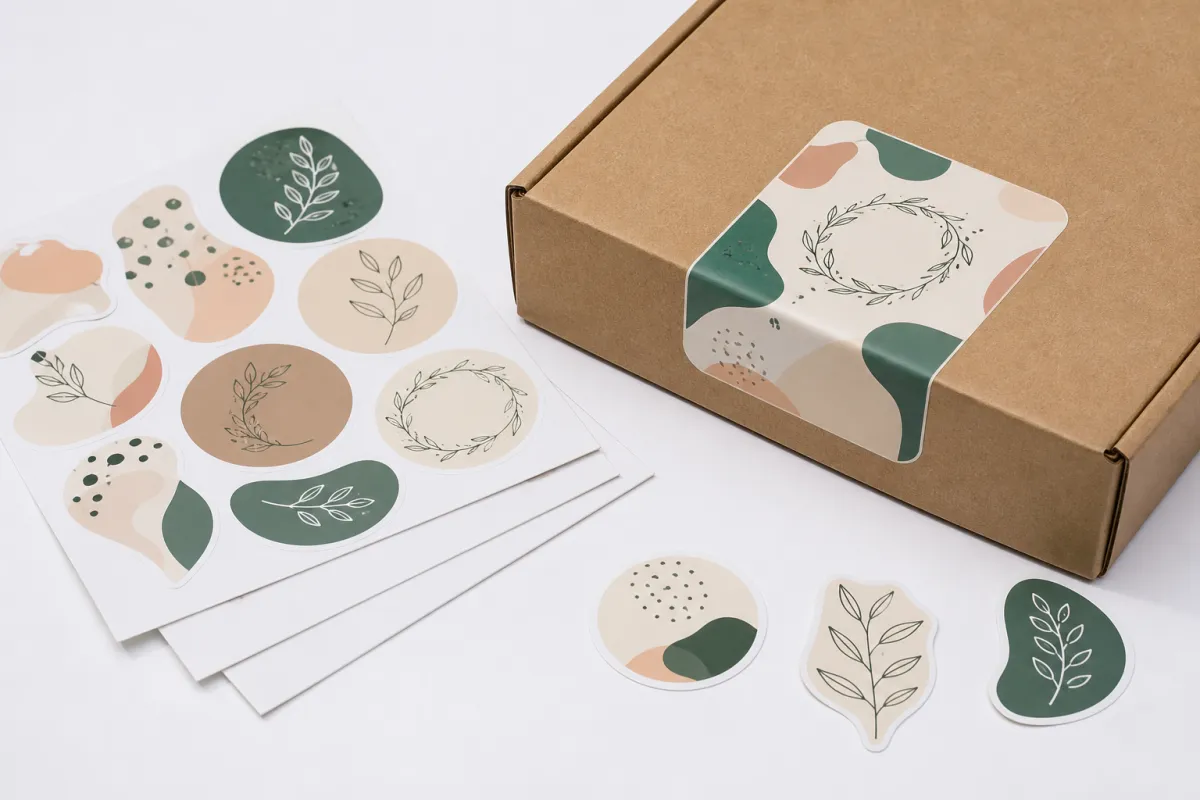
Custom sticker sheets for packaging are printable sheets that hold multiple stickers arranged for hand application, kitting, or light packing work. One sheet can repeat the same design, or it can hold several related pieces: a logo seal, an ingredients label, a warning sticker, and a thank-you note all on one page. That flexibility is the whole point. It gives small and mid-sized brands more control over package branding without adding drama to the rest of the operation.
Think of the sheet as a control surface. Instead of pulling labels from different boxes, the team grabs one sheet and moves through the pack-out in a set order. That sounds small. It is not. In a run of 200 orders, shaving even 10 to 15 seconds off each carton adds up fast. Grouped stickers also make inventory easier to manage. Count sheets, not loose pieces. Fewer partial rolls. Fewer random leftovers. Fewer mistakes when the order volume spikes.
Custom sticker sheets for packaging fit best where people still do the work by hand. E-commerce inserts, subscription box personalization, sample kits, seasonal retail packaging, and multi-SKU launches are all natural uses. They also fit neatly into lean teams that use Custom Packaging Products as part of a wider assembly system, or pair stickers with Custom Labels & Tags for hang-sell items and ship-ready product sets.
The practical value is hard to miss. A sheet format can reduce clutter, improve order accuracy, and clean up the final presentation without forcing a switch to custom printed boxes or a full outer-carton redesign. That is why custom sticker sheets for packaging often beat loose labels when the run is modest and the application is manual.
- Branding: logos, thank-you seals, seasonal art, and social prompts.
- Operations: SKU labels, batch notes, and pack-out checklists.
- Compliance: ingredients, warnings, handling notes, and barcode support.
- Presentation: a neater finish for retail packaging and subscription kits.
If you are comparing options for branded packaging, stop treating stickers like decoration only. In production, they are workhorse pieces. Custom sticker sheets for packaging let one artwork system do several jobs at once, which is often the difference between a tidy pack station and a table covered in random inserts.
How Custom Sticker Sheets for Packaging Work
The production flow is pretty direct, but the details matter. Artwork is laid out on a sheet size, cut lines are set, and the printer produces a finished sheet that peels by hand. Some buyers treat custom sticker sheets for packaging as a design job first. Better results usually come from treating it like an operations job first, then shaping the design around the actual packing steps.
Here is the usual path from file to finished sheet:
- Build the layout around the number of stickers needed per order or per carton.
- Set the die line, cut path, bleed, and safe zone in the file.
- Choose the substrate, adhesive, and finish based on the package surface.
- Review a proof for color, spacing, and peelability.
- Print, cut, finish, and pack the sheets for shipment.
Sheets differ from individual stickers in one important way: they keep related pieces together. A packer can apply a brand seal, a warning label, and an instruction sticker in the same sequence instead of hunting through separate stock. For custom sticker sheets for packaging, that small difference often turns into faster assembly and fewer mistakes on mixed-SKU jobs. In a facility where every order looks a little different, that consistency matters.
Material choice changes how the sheet behaves once it leaves the printer. Paper stock works well for dry indoor use and short life cycles. Vinyl handles moisture better and feels more substantial, which is why it shows up in beverage kits, chilled goods, or retail packaging that gets handled a lot. Specialty stocks add texture or durability, but they also raise the bill. For custom sticker sheets for packaging, the right answer depends less on what looks premium on a computer screen and more on what the package will actually face after it ships.
Finish changes both appearance and protection. Matte cuts glare and feels calmer under warehouse lighting. Gloss adds punch, especially on colorful branding. Soft-touch gives a more tactile premium cue, though it usually pushes unit cost up and may be overkill for short-lived inserts. Lamination can help when the sheet needs scuff resistance, moisture tolerance, or a longer shelf life. None of those options is automatically right. The right finish for custom sticker sheets for packaging depends on the surface, handling, and how long the package sits before the customer sees it.
If the brand also uses custom printed boxes, the sticker sheet should support the box, not fight it. A bright carton plus a highly reflective sticker can feel noisy. A clean seal with controlled color may do more for package branding than a louder graphic ever could. Packaging works better as a system. That is not a cute theory. It is just how the customer sees it.
If the package is handled by hand, the sticker sheet should be designed for the hand first and the camera second.
Key Factors That Shape Performance and Appearance
Adhesion comes first. Surface type matters more than most buyers expect. Corrugated board, coated paper, poly mailers, glass, and matte pouches all behave differently. Temperature and humidity matter too. A pressure-sensitive adhesive that behaves well at 70 to 75 F in a dry room may struggle on a chilled carton pulled straight from storage. Custom sticker sheets for packaging need to be spec'd for the actual substrate, not some generic "package surface" that exists only in the buyer's head.
Application pressure matters too. A light fingertip pass is not the same as a firm press from an operator using the heel of the hand. Most labels reach full bond after a dwell period, often around 24 hours, though that depends on adhesive chemistry and substrate. If a sticker will face cold storage, rough handling, or repeated rubbing in transit, ask for samples and test them under those exact conditions. The bond between the adhesive and the carton is the quiet part of custom sticker sheets for packaging, but it is also the part that decides whether the job holds up.
Sizing and spacing are another big piece. Small labels peel faster when there is enough gap around the art and the cut line is clear. Too little margin makes the sheet hard to handle. Too much margin wastes paper and pushes up the cost per usable sticker. On a busy line, a few millimeters can change how the sheet feels in the hand. That is why custom sticker sheets for packaging should be laid out around the packing workflow, not just the design file.
Color control matters because small labels do not leave much room for error. A barcode needs contrast. A warning label needs legibility at arm's length. A logo seal has to hold its shape at a reduced size. If the artwork depends on thin lines or delicate type, those details can disappear after trimming. For custom sticker sheets for packaging, use strong typography, a clear hierarchy, and enough space between marks so the printer can cut cleanly without crowding the design.
Compliance belongs in the planning stage, not at the end when everyone is tired. If the sheet carries barcode-readable information, check scan quality before production. If it includes ingredient or safety copy, leave room for the longest version of the text, not the shortest. If sustainability messaging matters, paper sourcing and claim language should match the actual stock and supply chain. FSC certification is useful here; see fsc.org for chain-of-custody details. For shipping performance, standards from the International Safe Transit Association are more useful than guesswork, especially if the package needs to survive drop, vibration, and compression.
End feel matters too. Product packaging is not judged only by the front panel. Customers touch the closure, the insert, the seal, and the tab that holds the kit together. That means custom sticker sheets for packaging can shape how premium the whole item feels, even when the outer container stays exactly the same.
If a sticker has to solve a business problem, the sheet should solve that problem before it tries to look pretty. Design should clarify, not add noise. The best custom sticker sheets for packaging are the ones the team can use without thinking about them twice. That is the part a lot of brands miss.
Custom Sticker Sheets for Packaging Cost and Pricing
Pricing for custom sticker sheets for packaging varies because the cost drivers stack up. Sheet size, sticker count per sheet, print method, material, adhesive, finish, and cut complexity all move the quote. A simple paper sheet for a promo mailer lives in a different price band than a waterproof vinyl sheet with a soft-touch laminate and a Custom Die Cut. The right comparison is not just unit price. It is unit price plus waste, reprints, handling time, and the cost of a bad fit on the package.
Ballpark numbers help with budgeting. For a basic paper sheet run, pricing can land around $0.08 to $0.18 per sheet at higher quantities, depending on coverage and size. Mid-range gloss or coated stocks often sit closer to $0.12 to $0.25 per sheet. More durable waterproof or premium-finish builds can move into the $0.20 to $0.45 range, sometimes higher if the design uses multiple cuts or specialty adhesive. Those are planning numbers only. Custom sticker sheets for packaging are quote-sensitive, and the spec can move pricing faster than most buyers expect.
Volume changes the math. Setup costs, file prep, and tooling are easier to absorb across a larger run. Order 500 sheets and the per-sheet price can feel steep. At 5,000 sheets, the same setup spread across more units can drop the cost noticeably. That is why brands that buy packaging supplies in batches often save money when they forecast a few months ahead instead of ordering piecemeal. Custom sticker sheets for packaging reward planning.
| Option | Typical Use | Ballpark Price | Best For |
|---|---|---|---|
| Paper sheets | Promo seals, dry indoor packs | $0.08-$0.18 per sheet | Short runs, low handling, lighter packaging needs |
| Gloss coated sheets | Branding, bright retail packaging | $0.12-$0.25 per sheet | Stronger color pop and moderate scuff resistance |
| Vinyl or waterproof sheets | Chilled goods, handled kits, moisture exposure | $0.20-$0.45 per sheet | Durability, cleaner edges, better environmental resistance |
| Premium finish sheets | Gift boxes, premium branded packaging | $0.24-$0.55 per sheet | Higher perceived value and stronger presentation |
One sneaky pricing trap is comparing a sheet quote to a roll-label quote without counting labor. Roll labels may look cheaper on paper, but if the team has to peel and sort separate items, that labor can wipe out the savings fast. Custom sticker sheets for packaging often make more sense for manual workflows because one sheet can replace several separate pulls. The labor savings may be small on one order and meaningful on fifty.
Ask vendors to quote by sheet, by sticker, and by application use case. That sounds fussy because it is. It creates a clearer cost picture. If you only compare sheet price, you may miss that one spec gives you 20 usable labels and another gives you 30. One quote may include a coating that improves shelf life while another assumes dry storage only. For custom sticker sheets for packaging, the best quote is the one that reflects the real job.
If you are budgeting for a broader packaging refresh, keep the sticker sheet in the same conversation as the box, the insert, and the outer mailer. That is how packaging design stays coherent. It also keeps one part of the system from getting the fancy treatment while the rest stays unfinished. A sticker sheet can make a modest carton feel more polished, but only if the materials and artwork support the whole presentation.
Custom Sticker Sheets for Packaging Process and Timeline
The production timeline usually moves through concept, artwork prep, proof review, setup, printing, cutting, finishing, and packing. A simple custom sticker sheets for packaging order can move quickly once the artwork is final. A more complex job with specialty material, several proof rounds, or a custom cut pattern will take longer. The schedule is not mysterious. It just needs discipline.
Here is the basic sequence most buyers should expect:
- Confirm the sheet size, sticker dimensions, and quantity.
- Prepare artwork with bleed, safe margins, and readable type.
- Approve a proof for color, layout, and cut accuracy.
- Print the sheets and run the cut or kiss-cut operation.
- Finish, inspect, and package the order for shipment.
In many cases, simple jobs can be completed in about 7 to 10 business days after proof approval. More detailed jobs, especially those with custom die lines or specialty finishes, often need 12 to 15 business days or more. If custom sticker sheets for packaging are tied to a launch date, build in extra room. One proof revision or one file correction can eat a day or two before production even starts.
Most delays come from predictable places. Missing bleed is a classic one. Low-resolution artwork is another. So are unclear cut paths and copy that sits too close to the edge. Wrong quantities also slow things down, especially when the buyer thinks sticker count and sheet count mean the same thing. They do not always. For custom sticker sheets for packaging, the order should define both clearly or someone will end up asking again.
A good checkpoint system cuts down on those problems:
- Dimensions: confirm finished size and trim size before proofing.
- Finish: specify matte, gloss, laminate, or specialty coating.
- Adhesive: note whether the surface is paper, plastic, glass, or cold-chain.
- Quantity: state sheets per order and stickers per sheet.
- Shipping: align transit time with launch or fulfillment needs.
For teams handling retail packaging or direct-to-consumer fulfillment, file discipline matters as much as printer capability. A clean artwork system reduces back-and-forth and keeps the project moving. If the brand already manages several packaging components, keep the sticker sheet spec next to the carton spec and the insert spec. That simple habit makes custom sticker sheets for packaging easier to reorder later because the details live in one place instead of scattered across email threads.
And yes, this is the unsexy part. Still matters. A lot.
Common Mistakes That Waste Time or Budget
The biggest mistake is designing for looks only. A sheet may look elegant on a monitor and still fail in a real pack-out if the stickers are too small to peel, too crowded to cut cleanly, or too flimsy for the target substrate. That happens more often than buyers like to admit. Custom sticker sheets for packaging need to work in motion, under time pressure, and by people who may not know the design system at all.
Material mismatch is another common problem. Paper stock on a chilled or humid surface can curl. A lower-tack adhesive can lift on textured corrugate. A glossy finish may fingerprint too easily on hand-applied packs. If the order is headed into cold storage, a bathroom shelf, or a rough transit cycle, the materials should match that reality. The wrong stock can make custom sticker sheets for packaging feel like a savings at the quote stage and a cost once the orders start shipping.
The proof approval trap causes avoidable pain too. Some teams approve files too quickly because the layout looks familiar. Then the printed sheet shows a color shift, an awkward crop, or copy that sat too close to the edge. A digital proof helps, but a physical sample or at least a very careful proof review is better. For custom sticker sheets for packaging, the proof is the last easy moment to catch a mistake before it turns into inventory waste.
Inventory mistakes are expensive in a quieter way. Buyers sometimes order the wrong quantity because they think in terms of sheets while production thinks in terms of stickers. Others forget future SKU changes and end up with leftover stock that no longer fits the packaging line. If the brand changes seasonal messaging often, keep shorter runs or modular art on the sheet. That gives flexibility without throwing away usable material. Custom sticker sheets for packaging should fit a real forecasting plan, not a one-time promo burst.
There is also a less obvious mistake: failing to test how the sheet feels in the hand. Peelability matters. If an operator has to wrestle the sticker off the liner every time, throughput drops. If the backing tears too easily, application gets messy. If the sticker is so small fingers cannot grip it, production slows down. Packaging buyers often focus on adhesive and ignore handling, yet handling is what decides whether custom sticker sheets for packaging actually save time.
Test the sheet the same way the team will use it. Put it on the same carton, the same mailer, the same jar, or the same pouch. Use the same pressure, under the same lighting, with the same gloves if gloves are part of the process. That is the real quality check. Not the mockup.
Expert Tips and Next Steps for Better Packaging
Start with the end use. Basic advice, yes. Still the right place to start. A label on a paper carton does not need the same finish as a seal on a chilled pouch. A promotional insert in a gift kit does not need the same adhesive as a compliance label on a sample bottle. Custom sticker sheets for packaging work best when material, finish, and layout are selected from the package outward instead of from the artwork inward.
Run a small test batch if possible. Put the sheets on real packaging, not on sample boards. Check adhesion after a few hours and again after a full day. Look at edge lift, legibility, and how the sticker interacts with the printed carton or mailer. If the design sits inside a broader branded packaging system, compare the sticker next to the box and insert under warehouse lighting and retail lighting. Those two settings often expose different problems.
If sustainability is part of the brief, be precise. Paper-based custom sticker sheets for packaging may support recycling goals better than plastic-heavy alternatives, but only if the full construction matches the claim. Use FSC-certified paper where relevant, and do not make environmental statements you cannot back up. The EPA has useful guidance on recycling and material recovery at epa.gov. For many brands, the smartest sustainability move is not the loudest one; it is the one that reduces waste, improves yield, and avoids reprints.
Here is a practical vendor checklist that usually improves quotes and cuts delays:
- Artwork files in print-ready format with bleed and safe zones.
- Exact sheet size, sticker count, and finished sticker dimensions.
- Surface type: paper, coated board, plastic, glass, or film.
- Finish preference: matte, gloss, laminate, or specialty coating.
- Quantity range and any likely repeat order schedule.
- Target use: retail packaging, fulfillment, inserts, seals, or compliance.
Use the sheet as a packaging system tool. Ask whether it can replace loose labels, reduce SKUs at the pack station, or support a cleaner assembly process. If a sheet only adds decoration, it may not earn its keep. If it reduces handling, improves package branding, and keeps the order line cleaner, it usually pays back faster than buyers expect. Custom sticker sheets for packaging are small pieces with outsized operational impact.
One last point. Good packaging buying is rarely about the cheapest line item. It is about the lowest total friction. A slightly higher sheet cost can make sense if it improves speed, cuts waste, and makes the finished package look more deliberate. That is especially true for custom sticker sheets for packaging in launch programs, seasonal packs, and multi-SKU retail packaging where consistency matters as much as the print itself.
If you are planning the next packaging refresh, review where the current process creates loose pieces, extra touches, or avoidable rework. Then map where custom sticker sheets for packaging can replace those steps. That one exercise usually surfaces a few quick wins and gives you a cleaner spec before you ask for quotes. And honestly, that is usually where the real savings hide.
FAQ
What are custom sticker sheets for packaging used for?
They bundle branding, instructions, warnings, and promo labels onto one easy-to-handle sheet. Custom sticker sheets for packaging are common in small-batch fulfillment, subscription boxes, kitting, and multi-SKU packaging because they reduce loose pieces and help teams move faster with less sorting.
Are custom sticker sheets for packaging better than roll labels?
Sheets are usually better for short runs, manual application, and mixed designs on one order. Roll labels often make more sense for automation or very high volume. If the team applies labels by hand, custom sticker sheets for packaging usually give simpler handling and storage.
What files do I need for custom sticker sheets for packaging?
Send print-ready artwork with clear cut paths, bleed, and safe margins. High-resolution graphics matter, and text should stay large enough to read after trimming. Include material, finish, and quantity notes so the printer can quote and proof custom sticker sheets for packaging correctly.
How long do custom sticker sheets for packaging take to make?
Simple jobs can move quickly once artwork is approved and the specs are final. Most delays come from revisions, file fixes, or specialty materials. Build extra time into the schedule if you need a proof round, Custom Die Cut, or other custom sticker sheets for packaging details that need setup.
How much do custom sticker sheets for packaging cost?
Pricing depends on sheet size, sticker count, material, finish, adhesive, and quantity. Per-sheet costs usually drop as order volume rises. The better comparison is total packaging value, not the lowest sticker price, especially for custom sticker sheets for packaging that need to perform in real shipping and fulfillment conditions.
Custom sticker sheets for packaging can look simple on the surface, but the best versions are planned with the same care as any other packaging component. Get the adhesive right, match the finish to the surface, and think through how the sheet will move through the pack station. Do that, and custom sticker sheets for packaging become a practical tool for branding, speed, and cleaner product packaging instead of just another supply item.

