Buyer Fit Snapshot
| Best fit | Custom Sustainable Gift Set Boxes projects where brand print, material claims, artwork control, MOQ, and repeat-order consistency need to be specified before quoting. |
|---|---|
| Quote inputs | Share finished size, material target, print colors, finish, packing count, annual reorder estimate, ship-to region, and any compliance wording. |
| Proofing check | Approve dieline scale, logo placement, barcode or warning zones, color tolerance, closure strength, and carton packing before bulk production. |
| Main risk | Vague material claims, crowded artwork, missing packing details, or unclear freight terms can make a low unit price expensive after revisions. |
Fast answer: Custom Sustainable Gift Set Boxes: Board, Finish, Dieline, and Unit Cost should be specified like a repeatable production item. The safest quote records material, print method, finish, artwork proof, packing count, and reorder notes in one written spec.
Production checks before approval
Compare the actual filled-product size with the drawing, then confirm tolerance on folds, seals, hang holes, label areas, and retail display edges. Reserve space for logos, QR codes, warning copy, and material claims before decorative graphics fill the panel.
Quote comparison points
Review material grade, print process, finish, sampling route, tooling charges, carton quantity, and freight assumptions side by side. A quote is only useful when the supplier can repeat the same color, closure quality, and packing count on the next order.
A premium gift set can look expensive in five seconds and wasteful in six. That tension sits right at the center of custom sustainable Gift Set Boxes. They have to hold multiple items, present them with intent, and avoid turning the unboxing into a pile of mixed materials nobody wants to sort out later.
For Custom Logo Things, and for any brand selling premium kits, the real question is not whether the box can look good. The question is whether custom sustainable gift set boxes can feel considered, ship efficiently, and still make sense after the customer opens them. That is a different packaging problem. It is also the one that matters most.
Customers judge gift packaging against the value of the set. A $70 wellness bundle in flimsy retail packaging looks off. A $70 bundle in an overbuilt box with magnets, foil, and plastic foam looks off too, just for a different reason. The best custom sustainable gift set boxes sit in the middle. They look premium without hiding excess behind the word luxury.
What Custom Sustainable Gift Set Boxes Are and Why They Matter
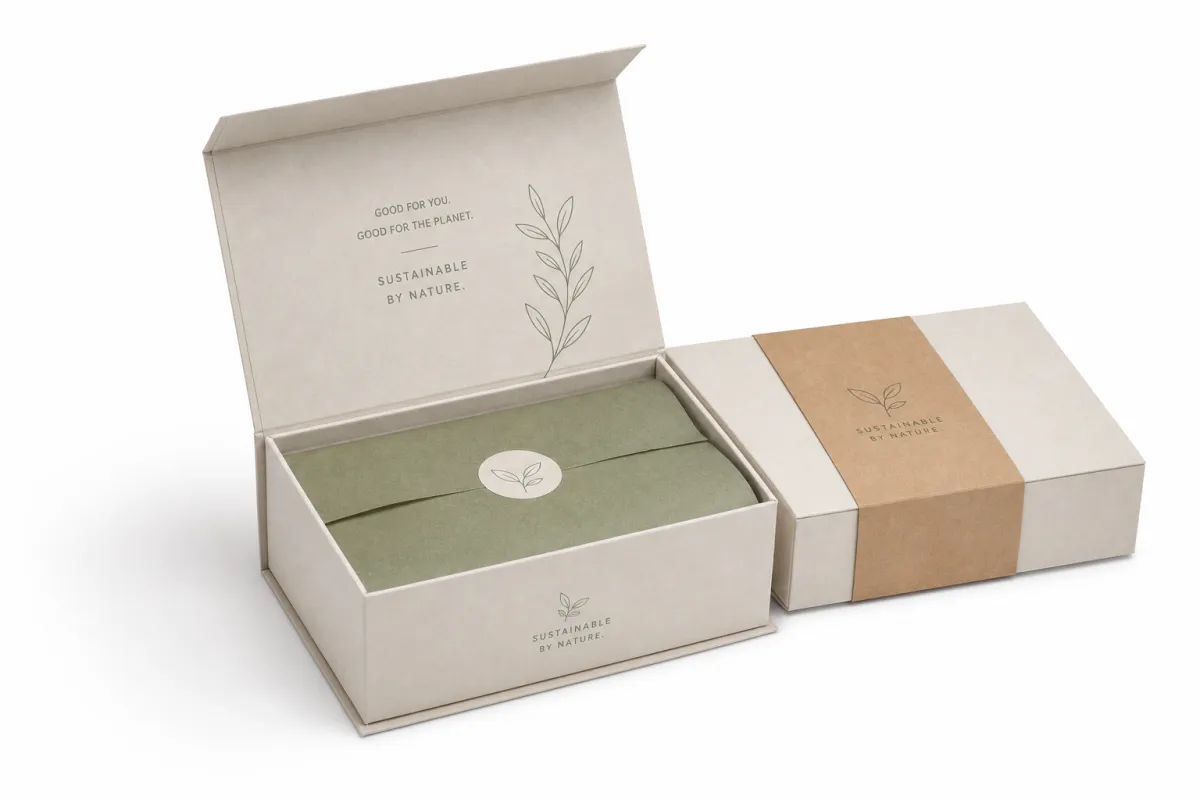
Custom sustainable gift set boxes are coordinated packaging systems built to hold more than one product in a single branded presentation. The system usually includes an outer box, a fitted insert, and a closure or opening style that supports the unboxing experience while cutting unnecessary material. Simple idea. Not always simple execution.
Three jobs happen at once. The box protects the contents. It keeps the items from clashing, rattling, or arriving damaged. It also communicates the brand before the lid is even lifted. Miss one of those jobs and the whole set feels cheaper than the product line inside it.
The sustainability piece matters because gift sets are easy to overpack. A brand can put a candle, a journal, a mug, and a card into a rigid box with foam inserts, but that solution often creates more waste than value. Custom sustainable gift set boxes take a cleaner route: use only the structure, board, and finish needed to deliver the set safely and beautifully.
That shift changes how customers evaluate branded packaging. People notice what they can separate. They notice whether the box is paper-based, whether the insert looks recyclable, and whether the materials are labeled clearly. They also notice when a package claims to be eco-friendly while hiding plastic components that are hard to sort. Buyers are not nearly as gullible as some brands hope.
These boxes fit especially well in a few scenarios:
- Corporate gifts that need a polished but responsible presentation.
- Seasonal kits where multiple items must arrive together in a tight layout.
- DTC bundles that ship directly to customers and need shipping-safe product packaging.
- Subscription launches that rely on a strong first impression and controlled inventory.
- Influencer mailers that need memorable unboxing without heavy waste.
- Premium retail packaging for sets sold as a single purchase rather than as separate SKUs.
There is a commercial angle here too. A coordinated gift set box can reduce filler, lower damage, and simplify fulfillment. Those are not just sustainability wins; they are operating wins. A box that looks expensive and packs efficiently is doing more than marketing. It is improving the economics of the launch without asking for applause.
I have watched teams treat custom sustainable gift set boxes like the last thing on the checklist. Wrong order. They should be part of the product strategy itself. If the packaging is off, the set feels off. If the packaging matches the contents, the whole offer feels intentional.
How Custom Sustainable Gift Set Boxes Work from Structure to Unboxing
Start with the product mix. Before anyone talks about print, paper stock, or coatings, the brand should know the exact dimensions, weights, and fragility of each item. A set with a candle, soap bar, and card behaves differently from a set with glass bottles, metal tins, and a fold-flat brochure. Custom sustainable gift set boxes should be built around the contents, not the other way around.
There are several structure options, and each one behaves differently in production and in use. Folding cartons work well for lighter sets and lower unit costs. Rigid boxes create a more premium feel and support heavier presentation. Corrugated mailers are practical for direct-to-consumer shipping because they combine presentation and transit strength. Sleeves, wraps, and tray-style assemblies can also work if the product mix is simple. The spec should match the job, not the mood board.
The insert is where a lot of brands either save material or waste it. Die-cut paperboard inserts can hold items cleanly when the fit is accurate. Corrugated partitions work well for separating fragile objects. Molded fiber is increasingly attractive because it can replace plastic trays while giving each piece a defined pocket. Tabbed paper structures can do the same job with very little excess if the design is tight.
That internal structure does more than protect the products. It guides the unboxing sequence. A good insert reveals the items one layer at a time. It creates rhythm. It makes the box feel planned instead of stuffed. That is one reason custom sustainable gift set boxes often outperform generic gift cartons even when the outer print is less flashy.
Branding sits on top of that structure. Print coverage, texture, and color choices should support the product story without creating recycling headaches. A matte uncoated paper with a restrained two-color print can feel more premium than a glossy, overdecorated box. The tactile effect matters because customers touch the box before they read the copy. That first touch sets the tone.
A practical workflow usually looks like this:
- Define the product dimensions and total set weight.
- Choose a box style based on shipping and presentation needs.
- Build a dieline and test the insert layout.
- Create a sample with the real products inside.
- Check opening, closing, stacking, and transit behavior.
- Approve print, finish, and assembly steps only after fit is confirmed.
That sequence sounds basic, but skipping one step often costs more than the sampling phase itself. A box that looks right in flat artwork can fail once the actual bottles, jars, or accessories go inside. That is why the best custom sustainable gift set boxes are developed as a system, not as a shell.
For direct-to-consumer launches, it helps to think beyond the shelf. If the box is going to be shipped, not handed over in store, the design should account for transit abuse. The International Safe Transit Association publishes test methods that help define that requirement; see ISTA for the current framework. A box can look beautiful and still fail if it has not been tested for shipping stress.
Key Factors That Shape Performance, Branding, and Sustainability
Material choice is the first serious decision. Recycled paperboard, FSC-certified paper, corrugate, and molded fiber each solve different problems. Recycled paperboard is often a strong choice for lighter custom sustainable gift set boxes that need a premium look. Corrugated board works better when the set ships directly to customers or needs more crush resistance. Molded fiber is especially useful when the insert needs to replace plastic trays without losing alignment.
FSC-certified materials can support chain-of-custody claims, but the certification only matters if the sourcing is documented correctly. The Forest Stewardship Council explains the system clearly at FSC. That kind of verification matters in procurement conversations because buyers increasingly ask for proof, not just promises.
Structural strength matters just as much as appearance. Fragile items need crush resistance, stackability, and insert support. A rigid exterior with a weak insert still allows movement. A paperboard box with good internal engineering can sometimes outperform a heavier box designed mostly for show. Custom sustainable gift set boxes work best when the structure earns its material usage.
A luxury box is only luxurious if the customer does not have to fight it.
That is the heart of package branding. Brands pile on finish after finish because they want the set to feel expensive. A thoughtful print system, a controlled palette, and strong typography often do more for perceived value than heavy decoration. A clean logo, a restrained exterior, and a well-shaped reveal can feel more premium than foil sprayed across every surface. That is not minimalism for the sake of looking clever. It is packaging discipline.
There is a recycling tradeoff to watch closely. Laminates, magnets, foil stamping, plastic windows, and soft-touch coatings can make custom sustainable gift set boxes harder to recycle even if the base board is recycled. Not every add-on is wrong, but each one should earn its place. If a finish only adds visual novelty, it may not deserve the environmental cost or the extra assembly time.
Operational fit is part of sustainability too. A box that ships flat, assembles quickly, and reduces damage can lower waste across the full chain. That includes fewer rejects, less filler, fewer returns, and fewer replacement shipments. A lot of product packaging looks sustainable on paper but creates waste in labor instead. Bad trade. The line should not grind to a halt because the packaging was designed for a mood board.
From a procurement point of view, the smartest custom sustainable gift set boxes are often the ones that simplify decisions. Fewer components. Clearer assembly. Better fit. Less confusion in the warehouse. Those are not glamorous wins, but they show up in margin and customer reviews. That is where the real verdict lands.
The EPA's recycling guidance is useful here because it reminds brands to think about end-of-life behavior as well as appearance. If the customer cannot tell what goes where, the sustainability story gets weaker. Clear disposal language printed inside the lid or on the base can be surprisingly effective in retail packaging and direct mailers alike.
Custom Sustainable Gift Set Boxes: Cost and Pricing Factors
Price is where reality shows up fast. Custom sustainable gift set boxes are not priced like off-the-shelf cartons because the tooling, sampling, and fit requirements are different. The cost picture gets clearer once you separate material cost from conversion cost, print cost, and assembly cost.
The biggest drivers are usually box style, board grade, insert complexity, print coverage, and finishing. A simple folding carton with a paperboard insert is generally cheaper than a rigid box with a custom tray and specialty coating. The more the box has to do structurally, the more the unit price climbs. That does not mean the pricier option is wrong. It just means the cost should track a real need.
Volume changes the math quickly. At low quantities, custom sustainable gift set boxes carry higher setup cost per unit because design time, cutting forms, and sampling are spread over fewer boxes. At larger quantities, those fixed costs smooth out. A project that looks expensive at 1,000 units may become much more rational at 5,000 or 10,000 units.
Sustainability can raise or lower cost depending on the spec. Recycled paperboard is often competitive. FSC-certified stock may add a modest premium. Molded fiber inserts can cost more up front than simple paperboard, but they may eliminate plastic components and improve the packaging story. The question is not which option is cheapest. It is which option gives the best total landed cost and the best customer experience.
Total landed cost includes freight, storage, damage, and labor. A lighter box can reduce shipping spend. A flatter box can improve storage density. A better-fitting insert can reduce returns. Those savings are easy to miss if you only look at the box quote. With custom sustainable gift set boxes, the quote is only one part of the cost picture.
| Option | Typical Use | Approx. Unit Cost at 5,000 Units | Sustainability Notes |
|---|---|---|---|
| Folding carton with paper insert | Lighter gift kits, promotional sets, retail packaging | $0.48-$0.85 | Good recyclability; best with simple print and minimal coatings |
| Corrugated mailer with printed sleeve | DTC shipping boxes, subscription kits, protection-heavy sets | $0.72-$1.35 | Strong for transit; can reduce filler and secondary packaging |
| Rigid box with paperboard insert | Premium gifting, corporate sets, high perceived value | $1.40-$2.80 | Elegant presentation; watch weight, magnets, and coated finishes |
| Molded fiber tray in printed outer carton | Care sets, beverage kits, premium product packaging | $0.95-$1.90 | Strong paper-based alternative to plastic trays; good fit for sustainability claims |
Those numbers are directional, not gospel. Print coverage, embossing, soft-touch coatings, foil, and specialty inserts can move the price a lot. The pattern still holds: custom sustainable gift set boxes can be economical if the structure matches the job, and they can get expensive when the spec drifts into decoration for decoration's sake.
One hidden cost deserves special attention: rework. If the fit is poor, someone in fulfillment has to adjust, refill, or replace the set. If the box arrives damaged, the team pays again. If the assembly is awkward, labor time goes up. In a real production run, those hidden costs often matter more than a small difference in board price.
If you are comparing specs, ask suppliers for the exact material grade, minimum order quantity, tooling cost, and lead time before comparing unit pricing. Also ask whether the quoted price includes insert development and proofing. A quote that looks low on the surface can turn into a more expensive line item once every extra step gets added back in.
For teams still narrowing the spec, it can help to look at Custom Packaging Products as a starting point for format comparison before making a final size and finish decision.
Custom Sustainable Gift Set Boxes Timeline: From Brief to Delivery
A realistic timeline starts before design. The first step is the brief: product dimensions, set contents, sustainability targets, print goals, budget ceiling, and launch date. If those inputs are vague, the whole project slows down later. Custom sustainable gift set boxes move faster when the decision-making is clear at the start.
Next comes structural planning. This is where the dieline is built, the insert layout is mapped, and the opening method is chosen. A simple concept may move quickly, but a fully custom set usually needs one or more physical mockups to confirm fit. That stage is worth protecting because it prevents expensive surprises in production.
Sampling should be treated as a real checkpoint, not a formality. One sample can reveal a lot, but it rarely reveals everything. The box should be tested with the actual products, not substitute objects. Check how the lid closes. Check whether the items stay aligned after a shake test. Check whether the customer can remove the contents without tearing the insert. These are small details that decide whether the set feels polished or annoying.
Production time depends on the structure. Printing, cutting, folding, insert creation, and finishing each add lead time. If a box includes foil, embossing, custom die-cut windows, or molded components, the calendar gets longer. For many custom sustainable gift set boxes, a simple run may move from approved proof to finished goods in roughly 12-18 business days. Fully custom structures, special inserts, or sourced components can push that to 3-5 weeks or more. That variation is normal.
Packaging schedules also need buffer time for approvals and logistics. Artwork revisions can take longer than expected. Material sourcing can shift. Freight can slip. Holiday periods add pressure. A brand that wants custom sustainable gift set boxes to arrive by a specific launch date should work backward from the delivery day and leave room for one round of correction, not just one approval.
Here is a practical timing frame that many teams use as a baseline:
- Brief and scoping: 1-3 business days.
- Dieline and structure development: 3-7 business days.
- Sample production and review: 5-10 business days.
- Revision and approval: 2-5 business days.
- Full production: 12-25 business days, depending on complexity.
- Freight and delivery: 3-10 business days, depending on route.
Those ranges are not promises. They depend on the exact box style, the supplier's workload, and how quickly approvals come back. Still, they are useful because they replace wishful thinking with a planning window that operations teams can actually use.
It also helps to build kitting and packing into the schedule. A great box can still fail a launch if the fulfillment line is not ready. If the team needs a new packing sequence, line training, or extra inspection steps, those should be handled before shipment volume spikes.
Common Mistakes That Undercut Sustainability and Budget
The most common mistake is designing the box before finalizing the product dimensions. That sounds obvious, but it happens constantly. The result is extra filler, wasted space, or a full redesign after sampling. Custom sustainable gift set boxes only work well if the products fit naturally inside the layout.
Another problem is mixed-material overkill. Plastic windows, heavy laminates, magnets, and specialty coatings can all make a box harder to recycle. Some of those features can be justified, but not every one should survive the review. If the sustainability goal is serious, the material stack should be simple enough to explain clearly on the product page and on the packaging itself.
Assembly is often underestimated. A box that looks gorgeous in a mockup but takes too long to build can become a labor problem. The line slows down. The packout cost rises. The team starts improvising. That is a terrible place for custom sustainable gift set boxes to end up, because a clean design should make the process easier, not harder.
Testing is another weak spot. Shipping tests, drop tests, and insert tests are what catch the damage that only appears after the first full batch leaves the warehouse. ASTM and ISTA methods exist for a reason: they replace guesswork with a repeatable process. If a gift set will move through parcel networks, testing is not optional.
Over-customization creates a different kind of waste. Too many box versions, too many insert layouts, or too many colorways can complicate purchasing and create inventory leftovers. That can be a bigger sustainability issue than a slightly heavier board grade. Custom sustainable gift set boxes should be tailored, yes, but not so individualized that they become impossible to manage.
Vague green claims can backfire too. Buyers trust specifics more than slogans. Saying "eco-friendly" is weak. Saying "FSC-certified paperboard, molded fiber insert, and no plastic tray" is stronger. That matters especially in branded packaging, where the packaging itself is part of the evidence.
Here is a simple review checklist that catches many of the usual problems:
- Do the contents fit with at least 1-2 mm of planned clearance where needed, and not so much that items shift?
- Can the box be assembled in under a minute per unit if it is going through a high-volume line?
- Does the spec avoid unnecessary mixed materials that complicate recycling?
- Have real product samples been tested inside the final structure?
- Do the quote, spec sheet, and sustainability claims all say the same thing?
Expert Tips and Next Steps for a Smarter Rollout
Start with one hero SKU or one core gift set before scaling to a full line. That gives you a live test of the packaging design, assembly flow, and customer response without multiplying risk across every product at once. A phased approach usually teaches more than a long planning cycle ever does.
Always request samples with the real products inside. Substitute shapes hide problems. Real products expose them. If the bottle height is off by a few millimeters or the mug handle sits too close to the wall, the unboxing will feel compromised. Custom sustainable gift set boxes are only as good as the fit they deliver in the real world.
Ask for precise details before comparing quotes:
- Exact material specification and board weight.
- Minimum order quantity and overrun allowance.
- Production lead time after proof approval.
- Recycling guidance and component breakdown.
- Test methods used for shipping or handling validation.
Measure success with practical metrics, not just opinions. Damage rate matters. Assembly time matters. Freight cost matters. Customer feedback matters. So does whether people keep or reuse the box, because reuse can signal that the packaging felt worth saving. Those numbers tell you more about custom sustainable gift set boxes than a polished presentation deck ever will.
It also helps to keep the internal approval list short. Product dimensions, sustainability requirements, print goals, budget ceiling, launch date, and the people who can approve changes should all be clear before the project enters production. The fewer hidden decision points, the less likely the box is to slip.
My honest recommendation is to treat the first production run as a learning run. Audit the current packaging. Test one prototype. Refine the structure. Then scale custom sustainable gift set boxes after the box has proved itself in transit, in fulfillment, and in front of a customer. That sequence saves money and usually produces a better-looking result.
If you need a practical starting point, custom sustainable gift set boxes usually reward the brands that choose clarity over excess. The box should protect the set, represent the brand, and support a clean disposal story. Anything beyond that should earn its place. That is how custom sustainable gift set boxes stop being packaging overhead and start becoming part of the product's value.
Handled that way, custom sustainable gift set boxes do more than hold items together. They make the offer feel coherent, reduce avoidable waste, and give the customer a clear reason to trust the brand before the products are even used. Start with the real product dimensions, pick one material stack that fits the job, and test the packed set before sign-off. That is the move.
Frequently Asked Questions
Are custom sustainable gift set boxes more expensive than standard gift boxes?
Often yes at very low volumes, because custom tooling, sampling, and setup costs are spread across fewer units. The gap narrows when you use standard dimensions, simpler print, and recyclable board instead of mixed-material add-ons. Total landed cost can improve if the box reduces shipping weight, filler use, and product damage.
What materials work best for custom sustainable gift set boxes?
Recycled paperboard works well for premium presentation boxes and lighter gift sets. Corrugated board is better when the set will ship directly to customers or needs more crush protection. Molded fiber and paperboard inserts are strong options when you want to avoid plastic trays. I usually tell teams to start with the lightest material that still protects the goods, then adjust only if testing says so.
How do you make custom sustainable gift set boxes feel premium without plastic finishes?
Use a strong structural fit, clean typography, and one or two refined colors instead of heavy decoration. Add tactile paper stock, embossing, debossing, or minimal foil only if it does not compromise recyclability goals. Paper-based inserts and thoughtful opening mechanics often create a better luxury feel than glossy add-ons.
How long does it take to produce custom sustainable gift set boxes?
Simple runs can move quickly after approvals, but fully custom structures usually need time for sampling and revisions. Lead time grows when you add special inserts, complex finishes, or custom sourcing requirements. Build extra time for artwork approval, physical samples, and freight scheduling so the launch is not delayed. If the calendar is tight, say so early; nobody wins by pretending otherwise.
Can custom sustainable gift set boxes be recycled after use?
Usually yes if the box is made from a recyclable paper-based material and does not rely on hard-to-separate components. Coatings, magnets, plastic windows, and heavy laminates can affect recyclability, so spec details matter. Clear disposal instructions help customers recycle the box correctly instead of guessing. Done well, custom sustainable gift set boxes can support both the brand story and the customer's recycling habits without making either one harder than it needs to be.

