Buyer Fit Snapshot
| Best fit | Custom Sustainable Packaging for Cosmetics Made Simple projects where brand print, material claims, artwork control, MOQ, and repeat-order consistency need to be specified before quoting. |
|---|---|
| Quote inputs | Share finished size, material target, print colors, finish, packing count, annual reorder estimate, ship-to region, and any compliance wording. |
| Proofing check | Approve dieline scale, logo placement, barcode or warning zones, color tolerance, closure strength, and carton packing before bulk production. |
| Main risk | Vague material claims, crowded artwork, missing packing details, or unclear freight terms can make a low unit price expensive after revisions. |
Fast answer: Custom Sustainable Packaging for Cosmetics Made Simple should be specified like a repeatable production item. The safest quote records material, print method, finish, artwork proof, packing count, and reorder notes in one written spec.
Production checks before approval
Compare the actual filled-product size with the drawing, then confirm tolerance on folds, seals, hang holes, label areas, and retail display edges. Reserve space for logos, QR codes, warning copy, and material claims before decorative graphics fill the panel.
Quote comparison points
Review material grade, print process, finish, sampling route, tooling charges, carton quantity, and freight assumptions side by side. A quote is only useful when the supplier can repeat the same color, closure quality, and packing count on the next order.
Custom sustainable Packaging for Cosmetics sounds simple until the first prototype lands on a desk. Then the real questions show up. Will the closure hold after heat exposure? Can the carton survive a warehouse stack and a courier drop? Does the structure still make sense after the customer opens it, uses the product, and tries to sort the components for recycling? That is the part people rarely see in mood boards. The package has to protect a delicate formula, carry the brand, and still make sense at the end of its life.
I have watched brands fall in love with a paper-based concept only to discover, two weeks later, that the balm inside slowly softened the coating and the print started to scuff. That kind of thing is annoying, but it is also useful. It proves the point early. Material choice alone does not solve sustainability. A recycled board can still fail if the finish cracks. A paper tube can still underperform if it cannot stop migration from a cream or oil. Custom sustainable Packaging for Cosmetics works only when structure, chemistry, graphics, and logistics are treated as one system rather than four separate decisions. That is the bit that keeps teams honest.
Brands that get this right usually see fewer returns, fewer shipping headaches, and a sustainability story that can survive retailer questions. Brands that rush the process end up with something worse than a bad package: they get a package that looks thoughtful and behaves carelessly. The gap between those outcomes can be tiny. A millimeter of tolerance. A glue flap that is slightly too short. A coating that saves a few cents and costs a lot more in complaints. Tiny details. Expensive consequences.
Custom Sustainable Packaging for Cosmetics: What It Really Means
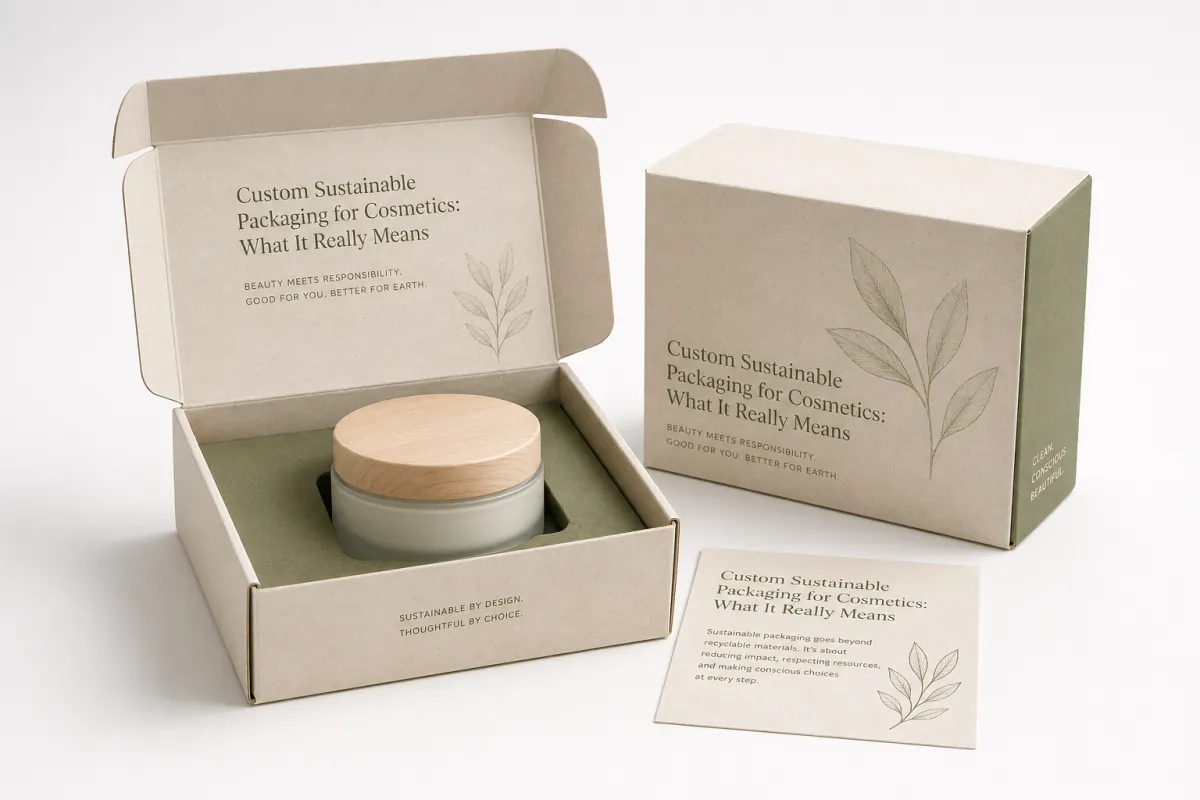
Custom sustainable Packaging for Cosmetics starts with product behavior, not marketing language. A jar of face cream, a serum dropper, a powder compact, and a balm stick do not ask for the same package. That sounds obvious. It is not how many packaging briefs are written. A glossy, eco-leaning concept may win approval in a meeting and still collapse under heat, humidity, pressure, or product migration. A package can be visually restrained and still be the wrong choice if it cannot survive the life of the product it carries.
The practical definition is straightforward: custom sustainable Packaging for Cosmetics is a package system tailored to the formula, the fill method, the shipping method, and the end-of-life path. That may mean recycled paperboard for a secondary carton, molded pulp for a tray, mono-material plastic for a bottle and closure family, or a refill architecture that preserves the outer shell while replacing only the internal component. The best system uses less material where possible, removes waste where it does not add value, and keeps the product stable from filling line to consumer hand.
Cosmetics make this harder because the category is not really one category at all. Oils behave differently from creams. Alcohol-based products stress some plastics and coatings. Powders demand clean fit and contamination control. Serums care about barrier properties and closure integrity. Balms test seals in a way that looks minor on a sample and dramatic after a three-day transport cycle. Custom sustainable packaging for cosmetics has to answer those differences one by one.
There is also a sharp difference between decorative sustainability and actual sustainability. Decorative sustainability uses kraft textures, leaf graphics, and earthy palettes to signal virtue while leaving the structure overbuilt, the materials mixed, and the package hard to recover. Actual sustainability cuts the system down to what the product truly needs. Fewer components. Less scrap. Cleaner fiber paths. Better refill logic. Smarter inserts. Better line efficiency. That is the kind of packaging that earns trust because it can explain itself under scrutiny.
Most packaging failures start with the wrong question. Teams ask what will look eco-friendly before asking what will protect the formula and what customers can reasonably recycle. The first question is visual. The second is operational. Only one of them decides whether the launch survives contact with the supply chain. For premium retail packaging, the strongest outcome usually sits in the middle: a structure that feels composed, uses materials carefully, and avoids the kind of excess that reads as insecurity.
For brands comparing packaging strategies, it helps to separate the work into three layers:
- Primary function: seal integrity, barrier performance, and product protection.
- Brand function: shelf presence, tactile quality, and package branding.
- Environmental function: material reduction, recyclability, refill use, and scrap control.
That framework keeps custom sustainable packaging for cosmetics grounded in something measurable. It also helps teams stop arguing in vague language and start comparing actual tradeoffs.
How Custom Sustainable Packaging for Cosmetics Works in Production
Once the concept is approved, custom sustainable packaging for cosmetics moves into production, and the process gets less glamorous and a lot more revealing. The first decision is format. Folding cartons, rigid boxes, paper tubes, molded pulp trays, mono-material bottles, jars, pumps, droppers, and refill systems each solve a different manufacturing problem. A folding carton is efficient for retail packaging and secondary display. A rigid box creates structure and a stronger unboxing moment. A paper tube can suit balms and sticks. Molded pulp reduces plastic content in inserts. A mono-material bottle may improve recyclability if the closure and body remain in the same family.
Material choice controls more than appearance. It influences moisture resistance, oxygen barrier, compression strength, and how the package behaves under heat, cold, vibration, and stacking pressure. A 300gsm uncoated paperboard carton may be easy to recycle, but it can scuff faster than a coated board. A water-based coating may fit the sustainability goal, yet still need real testing if the product ships through humid lanes or sits in a hot fulfillment center. Custom sustainable packaging for cosmetics needs that kind of testing because beauty products rarely stay in one place for long. They move, sit, get bumped, get restacked, and do it all again.
Coatings, inks, adhesives, and finishes deserve the same level of scrutiny as the board or bottle. A matte luxury look can be built with water-based coatings, low-migration inks, or selective varnish. Put the wrong finish on the wrong substrate, though, and the package loses recyclability or becomes difficult to run cleanly on press. Heavy lamination and broad foil coverage can create a high-end feel, yet they can also add mixed-material complexity that undercuts the sustainability story. Sometimes the smarter move is a leaner graphic system, better typography, and one tactile detail that carries more weight than three decorative layers.
That is why packaging teams start with a dieline. The dieline defines folds, glue tabs, score lines, panel sizes, insert locations, and structural geometry. The next step is prototype work, usually built from white sample board or digital proofs. A pilot run follows if the design needs more than a visual check. Final approval locks the manufacturing specification: board grade, print method, coating type, tolerance range, and pack-out instructions. Custom sustainable packaging for cosmetics depends on that sequence because a rendering cannot tell you whether a flap will buckle, a tray will shift, or a closure will leak after the box is shipped three states away.
If a project needs broader support, it helps to review packaging formats alongside the supplier's actual capabilities. The Custom Packaging Products page is a useful starting point when comparing Custom Printed Boxes, inserts, and secondary packaging options in one place. Matching the structure to the formula is usually the fastest route to better product packaging.
Two standards matter often during development. ISTA test methods help validate transit durability, and FSC certification supports responsible fiber sourcing for paperboard-based builds. The broader context is available at the ISTA packaging test standards site and the FSC forest stewardship certification site.
The practical lesson is blunt: custom sustainable packaging for cosmetics is not a single material decision. It is a production system built from structure, chemistry, graphics, and logistics.
Key Factors That Shape Cost, Performance, and Brand Fit
The formula leads first. Oily balms, alcohol-based mists, water-sensitive creams, and powder products all push custom sustainable packaging for cosmetics in different directions. An oily formula may need a stronger liner or a closure with better chemical resistance. Alcohol can stress some plastics and coatings over time. Water-sensitive products usually require more attention to barrier performance, coating choice, and pack-out protection. A package that ignores chemistry is not sustainable; it is optimistic.
Distribution is the next pressure point. A product sold mainly in boutique retail packaging may only need moderate transit resistance. A product moving through e-commerce faces a different reality. Drop testing, vibration resistance, carton compression, and internal restraint suddenly matter more than display value. If the same item also needs to survive summer warehouse storage or winter truck transport, the design has to be tougher than a shelf-only package. Custom sustainable packaging for cosmetics works best when the shipping story is written into the brief before anyone starts refining the artwork.
Branding pulls in another direction. Premium embossing, foil accents, soft-touch finishes, and specialty inks can create a memorable branded packaging moment, but every decorative layer carries a material and cost impact. That does not mean premium finishes should disappear. It means they should be used with discipline. A restrained foil logo, a single embossed panel, or a high-quality matte coating can still give the package authority without burying it under decoration. For many brands, that is the point where custom sustainable packaging for cosmetics feels expensive in the right way.
Teams often underestimate how similar packages can hide very different economics. Two samples may appear nearly identical on a table. One uses stock board and a standard fold. The other needs custom tooling, tighter registration, a different curing profile, and a longer assembly chain. That difference can show up in scrap, speed, and rework. Custom sustainable packaging for cosmetics becomes more affordable when the design is built for efficient production instead of a polished mockup that only works on camera. The pretty version is not always the practical one, and the practical one is usually the one that survives a six-month reorder.
| Packaging Option | Typical Strength | Common Tradeoff | Approx. Unit Range at 5,000+ |
|---|---|---|---|
| Standard folding carton with water-based coating | Good for lightweight jars, tubes, and secondary retail packaging | Less premium feel than rigid packaging | $0.18-$0.42 |
| Rigid setup box with paper wrap | High shelf presence and strong unboxing value | Higher freight cost and more material usage | $1.10-$2.80 |
| Molded pulp insert with carton | Good protection and improved fiber-based content | More design work to fit product geometry | $0.35-$0.95 |
| Mono-material bottle or jar system | Cleaner end-of-life story when components stay aligned | Tooling and closure matching can raise upfront cost | $0.40-$1.90 |
MOQ matters as well. A high minimum order quantity can reduce unit cost, but only if the brand can store and sell the inventory without creating dead stock. For custom sustainable packaging for cosmetics, buyers frequently balance quantity against launch timing, storage space, and SKU count. Print complexity matters too. Four-color process with specialty coating and two spot colors is a different production burden than a one-color kraft carton. Scrap reduction is part of the economics. Better artwork planning and tighter nesting can save material across a run, especially on custom printed boxes with complicated layouts.
Inserts and dividers deserve a closer look because waste often hides there. A carefully sized molded pulp tray may outperform a multi-piece plastic insert and reduce packing time at the same time. A paperboard cradle can sometimes replace foam and card when the product geometry is simple. That is one of the quieter strengths of custom sustainable packaging for cosmetics: the strongest versions remove parts rather than adding them. Less hardware, fewer touchpoints, fewer ways for the pack to go wrong.
For brands selling across channels, package fit has to be viewed as a system. A jar that feels elegant in a boutique may need a different outer shipper for DTC fulfillment. Too much empty space raises freight costs. Too little space invites movement and damage. Good custom sustainable packaging for cosmetics usually lands in the middle: enough structure to protect the formula, enough restraint to keep cost in check, and enough visual discipline to support the brand identity.
What Custom Sustainable Packaging for Cosmetics Costs and Why
Pricing creates confusion faster than almost any other part of the process. A quote for custom sustainable packaging for cosmetics depends on material choice, structure, decoration, closure system, and volume, yet buyers often see only the final number. That number can move sharply depending on whether the package uses paperboard, rigid board, molded pulp, custom plastic tooling, or a refill component. A simple carton may sit at the low end. A fully branded rigid presentation box can cost several times more per unit because of hand assembly, wrap material, and added board weight.
Two packages can look alike and still behave very differently in cost. One may use standard board stock and a common fold style. Another may require custom tooling, special coatings, tighter tolerances, and a more complex assembly sequence. The closure system changes the math too. A bottle with an off-the-shelf cap is usually easier to source than a custom dropper or pump designed for a specific viscosity and neck finish. Custom sustainable packaging for cosmetics gets more expensive when the design moves away from standard manufacturing paths.
A practical way to think about the cost stack looks like this:
- Material selection: recycled paperboard, virgin fiber, molded pulp, plastics, or hybrid structures.
- Structural complexity: number of panels, inserts, sleeves, or internal supports.
- Decoration: print coverage, embossing, debossing, foil, lamination, and specialty varnishes.
- Closure systems: caps, pumps, liners, droppers, magnets, or refill inserts.
- Order volume: higher volume usually lowers unit cost, but only if inventory risk stays manageable.
- Freight and handling: lighter, flatter packs often save money before the product is even filled.
The long-tail cost of damage is the part many teams miss. A slightly cheaper unit price can vanish if the package fails in transit, creates returns, or weakens the first impression at retail. In that case, custom sustainable packaging for cosmetics with a stronger structure may deliver better total value. The same logic applies to scrap. If a design is easy to align and easy to run, the plant wastes less board and spends less time fixing setup issues. The supplier may not say that out loud, but production lines absolutely do.
Lifecycle value matters too. A more durable carton may reduce damage rates. A refillable container may lower repeat material use. A cleaner fiber-based build may align better with the brand story and reduce customer confusion. Those benefits do not always appear on a quote sheet, yet they influence margin and trust. That is why custom sustainable packaging for cosmetics should be judged on total value, not the lowest per-unit number.
Savings often come from simple moves. Simplify the structure. Reduce mixed materials. Choose inserts that do not overbuild the package. Keep artwork within production-friendly boundaries. Order quantities that fit the press, the converter, and the launch calendar. More brands save money by removing unnecessary layers than by pressuring a supplier for a few cents. That is a plain fact in packaging design, especially for custom sustainable packaging for cosmetics that must look polished without becoming overengineered.
Timing influences cost as well. Sampling, revisions, and approvals all consume labor. A package that needs three prototype rounds will cost more than one that moves cleanly from dieline to sample to production. If the project also includes shipping tests, compatibility checks, or regulatory review, the budget should reflect that reality. It is cheaper to validate up front than to discover a problem after the product is already in motion. That may sound boring. It is. It also saves money.
For buyers comparing multiple options, the most useful question is not "Which is cheapest?" It is "Which package protects the formula, supports the brand, and keeps the operation efficient?" That is the question that usually leads to the right custom sustainable packaging for cosmetics decision.
Step-by-Step Timeline for Launching Custom Sustainable Packaging for Cosmetics
A clean timeline starts with the brief. Before anyone draws a dieline, the brand should define the product type, fill volume, distribution channel, sustainability priorities, and target retail position. That sounds basic because it is basic, yet it saves real time later. If the formula is oily and the launch is DTC-heavy, custom sustainable packaging for cosmetics needs a different structure than a dry powder SKU sold mostly through retail shelves. Vague input creates vague samples, and vague samples create delays.
The next stage is concept development and dimension locking. This is where the team decides how much space the product needs, how much headroom the closure requires, and how the carton or container should fit in the shipper. Dielines are built, artwork zones are mapped, and structural tolerances are checked. If the package includes custom printed boxes, a carton engineer often confirms board direction, fold strength, glue flap size, and score placement so the structure folds accurately on press and in finishing. A good engineer can spot trouble long before a consumer does.
The prototype stage is where custom sustainable packaging for cosmetics earns or loses credibility. A good sample is not just a visual mockup. It should show wall thickness, fit, closure behavior, and insert performance. For bottles and jars, the sample should be tested with the actual formula if possible, or with a close surrogate. For refillable packaging, the refill component should be checked for ease of installation and consistency of seal. A sample that photographs well but feels awkward in hand is not a useful sample. It is just a pretty question mark.
Testing usually includes visual proofing, transit checks, leakage checks, and fit validation. Many teams use ISTA-based transit thinking for shipping durability and may reference ASTM methods depending on the packaging type and risk profile. The principle is direct: the package should survive the route it is expected to take. A carton for shelf display does not face the same abuse as a carton traveling inside an e-commerce parcel. Custom sustainable packaging for cosmetics should be tested against the actual route, not an ideal version of it.
The process often slows in two places. Artwork approvals take longer than expected because a claim line, shade, or finish needs another review. Sampling can also stretch when the closure fit is a little off or the insert needs a geometry adjustment. That is normal. The better approach is to plan for one or two revision cycles from the start, especially if the brand wants both strong sustainability performance and a premium presentation. A project plan that pretends otherwise is usually the one that slips.
Here is a practical timeline framework many teams use:
- Brief and scope definition: 2-5 business days, depending on how quickly product specs are shared.
- Dieline and concept review: 3-7 business days.
- Prototype build: 5-10 business days for straightforward structures, longer for custom tooling.
- Testing and revision: 5-14 business days depending on results and sample complexity.
- Final proof and production approval: 2-5 business days.
- Production: often 12-15 business days from proof approval, though larger or more complex runs can take longer.
That timeline is a working frame, not a promise. Custom sustainable packaging for cosmetics can move quickly when the structure is simple and the art is ready. It slows down when the project includes custom closures, specialty coatings, or multi-part refill systems. Planning ahead is the cheapest speed boost a brand can buy, and yes, that is still true even if the launch calendar already feels crowded.
Documentation matters too. A good supplier should provide a clear spec sheet, print references, material notes, and packing instructions. That makes the next reorder easier and reduces variation between runs. Over time, that consistency becomes part of custom sustainable packaging for cosmetics because it protects both the brand image and the supply chain.
Practical note: if a package is meant to support sustainability claims, save the evidence. Keep material specs, test records, and certification documents together. That makes it much easier to answer retailer questions, customer questions, and internal compliance reviews later.
Common Mistakes Brands Make With Sustainable Cosmetic Packaging
The biggest mistake is choosing the greenest-looking material before checking whether it fits the formula. This happens constantly with custom sustainable packaging for cosmetics. A brand falls in love with kraft textures, molded pulp, or paper-based structures, then discovers the product needs a stronger moisture barrier or a better closure seal. The result is a package that supports the story but fails the product. Sustainability only works when the package is compatible with what it carries.
Overpackaging is another predictable problem. Some teams add too many layers because they want the product to feel premium. Extra inserts, oversized cartons, and decorative sleeves can make the package heavier, harder to recycle, and more expensive to ship. In many cases, a cleaner structure with better proportions does the job better. For custom sustainable packaging for cosmetics, restraint often feels more confident than excess. It also usually looks more expensive than it is, which is a nice side effect.
Mixed-material builds can create a different kind of trouble. A carton wrapped in plastic film, with foil accents and a plastic tray inside, may be visually attractive, but it is harder to sort and often weaker from a sustainability standpoint. Decoration should not disappear. It should be chosen with care. If recyclability is the goal, custom sustainable packaging for cosmetics should avoid unnecessary material combinations that complicate recovery.
Vague sustainability language causes trust problems. If a package is recyclable only in limited programs, say that clearly. If the outer carton is FSC-certified but the closure is not, make the distinction visible. Customers can usually handle honest information. What they do not forgive is overstatement. That is where packaging trust matters as much as package design. A claim that is too tidy tends to invite scrutiny.
Testing gaps create expensive regret. A brand may check the prototype visually and approve it, then skip drop testing, leakage checks, or shelf-life validation. That can be costly, especially for liquids and creams. A closure that works on a desk may fail after vibration, pressure change, or temperature cycling. Good custom sustainable packaging for cosmetics includes a test plan because beauty packaging is still packaging, and packaging has to survive handling.
Here is a short list of checks worth doing before launch:
- Closure torque and seal fit.
- Leak resistance with actual or surrogate product.
- Carton compression and drop testing.
- Artwork accuracy and claim review.
- Line compatibility for filling and assembly.
Customer experience matters as much as engineering. Sustainable does not need to feel weak, thin, or temporary. A well-made carton with crisp print quality, a solid insert, and a refined opening sequence can feel premium while using fewer resources. That is the real craft of custom sustainable packaging for cosmetics: making the package feel considered rather than overdone.
What Should Custom Sustainable Packaging for Cosmetics Include?
Custom sustainable packaging for cosmetics should include four things from the start: formula protection, production fit, recovery logic, and brand clarity. If any one of those is missing, the package usually becomes harder to launch and harder to defend. A design that looks good but fails compatibility testing is a problem. A design that is recyclable but clumsy on the line is also a problem. The best packages resolve both sides at once.
Start with the material stack. A clean fiber-based carton, recycled paperboard, molded pulp insert, or mono-material container family can all work, but the choice has to match the product. A serum in a glass bottle may need an insert that locks the bottle in place without adding foam. A balm stick may fit a paper tube, while a refill jar may work best with a durable outer shell and a lighter inner component. Custom sustainable packaging for cosmetics is strongest when the package parts are doing only the work they need to do.
Next, define the end-of-life path in plain language. Can the customer recycle the main components in common curbside programs? Is there a refillable container system in place? Is the package made from FSC-certified paperboard or another traceable fiber source? Those details matter because Sustainable Cosmetic Packaging gets judged on what it does, not what it suggests. Clear instructions and fewer mixed materials make the system easier to understand. If the answer is "sort of," the customer hears "not really."
Finally, include testing, documentation, and a real production spec. That means a dieline, print notes, fit tolerances, and the basic evidence behind any sustainability claim. It also means a sample that is close enough to production to reveal the truth. Renders are useful. Samples are more useful. For custom sustainable packaging for cosmetics, that difference can decide whether the launch moves forward on schedule or goes back for another round. Nothing glamorous there, but it is the truth.
- Must-have structure: enough strength to protect the formula and survive transit.
- Must-have materials: recycled, recyclable, or refill-ready components where practical.
- Must-have proof: test results, supplier specs, and documented claims.
- Must-have fit: a package that runs cleanly in filling, assembly, and shipping.
Those elements sound basic because they are basic. Yet they are also the difference between custom sustainable packaging for cosmetics that looks responsible and packaging that actually performs that way.
Expert Tips and Next Steps for Custom Sustainable Packaging for Cosmetics
Start with the formula, the channel, and the disposal target. That order saves time and money. If the formula is sensitive, the package needs better barrier performance. If the channel is e-commerce, the structure needs stronger transit protection. If the sustainability goal is recyclability, the material stack has to stay as clean as possible. Custom sustainable packaging for cosmetics becomes much easier to design when those three questions come first. It also gets easier to defend in a meeting, which helps more than people admit.
Ask for samples that show the real package, not just a render. A render can make almost anything look polished. A real sample exposes wall thickness, fold behavior, print registration, closure fit, and how the insert actually holds the product. For custom sustainable packaging for cosmetics, that is the only way to judge whether the package truly supports the brand. Renders sell ideas; samples reveal reality.
Compare options on total value, not just unit cost. If one package reduces damage, simplifies fulfillment, and improves shelf impact, it can be the smarter buy even when the line item is higher. That is especially true for custom sustainable packaging for cosmetics, where brand perception and repeat purchase matter. A package that keeps the product intact and feels thoughtful in the customer's hand can pay for itself in ways a quote sheet never captures. The math is not always neat, but it is usually clear enough.
A compact checklist helps before committing:
- Does the structure protect the exact formula?
- Does it fit the launch channel and shipping method?
- Are the materials easy to source at the needed volume?
- Can the brand support the claims it wants to make?
- Will the design still feel premium without excess material?
If the answer to any of those questions is unclear, pause and test. A better prototype round costs less than a recall, a return spike, or a launch delay. That is the practical side of custom sustainable packaging for cosmetics, and it is usually the side that matters most once real orders begin moving.
For brands ready to move forward, the next steps are direct: audit the current packaging line, define sustainability priorities in plain language, request prototypes, and build a test plan around the actual product. If you are comparing carton structures, inserts, or branded packaging options, review the product family on Custom Packaging Products and map the possibilities against your formula and channel needs.
Custom sustainable packaging for cosmetics works best when it is treated like a business decision, a technical decision, and a brand decision at the same time. Get those three aligned, and the package tends to do its job quietly and well. The most useful takeaway is also the simplest one: lock the formula, the shipping route, and the recovery path before you approve the first dieline. Everything else gets easier from there.
FAQ
What makes custom sustainable packaging for cosmetics different from standard packaging?
It is designed around the formula, protection needs, branding goals, and disposal path instead of using a one-size-fits-all structure. It often reduces material use, improves shipping performance, and supports recyclability or refill use when the design is done correctly. That is why custom sustainable packaging for cosmetics usually takes more planning up front than stock packaging.
Which materials work best for custom sustainable packaging for cosmetics?
Common options include recycled paperboard, molded pulp, paper tubes, mono-material plastics, and refill-ready components. The best choice depends on whether the product is a cream, serum, powder, balm, or liquid, since barrier and closure needs vary. In many projects, custom sustainable packaging for cosmetics uses a mix of fiber-based and material-efficient components.
How do I keep eco-friendly cosmetic packaging from feeling cheap?
Use strong structure design, accurate print finishing, and well-chosen closures instead of adding excess layers or mixed materials. Premium feel can come from smart proportions, clean graphics, and tactile details that still fit the sustainability goals. Good custom sustainable packaging for cosmetics feels intentional, not thin or improvised.
What affects the price of custom sustainable packaging for cosmetics most?
The biggest drivers are material choice, order volume, structural complexity, decoration, tooling, and shipping weight. Testing and sample rounds also influence cost because they help avoid expensive failures later in production. With custom sustainable packaging for cosmetics, the cheapest quote is not always the lowest-cost outcome.
How long does it take to develop custom sustainable packaging for cosmetics?
Timelines usually depend on how complex the structure is, how many prototype rounds are needed, and whether the design needs special testing. A simple carton may move faster than a refill system, multi-component jar, or packaging that needs custom inserts and print approvals. For custom sustainable packaging for cosmetics, a disciplined brief is the best way to keep the schedule under control.