Buyer Fit Snapshot
| Best fit | Personalized Packaging for Cosmetic Line projects where brand print, material claims, artwork control, MOQ, and repeat-order consistency need to be specified before quoting. |
|---|---|
| Quote inputs | Share finished size, material target, print colors, finish, packing count, annual reorder estimate, ship-to region, and any compliance wording. |
| Proofing check | Approve dieline scale, logo placement, barcode or warning zones, color tolerance, closure strength, and carton packing before bulk production. |
| Main risk | Vague material claims, crowded artwork, missing packing details, or unclear freight terms can make a low unit price expensive after revisions. |
Fast answer: Personalized Packaging for Cosmetic Line: Material, Print, Proofing, and Reorder Risk should be specified like a repeatable production item. The safest quote records material, print method, finish, artwork proof, packing count, and reorder notes in one written spec.
Production checks before approval
Compare the actual filled-product size with the drawing, then confirm tolerance on folds, seals, hang holes, label areas, and retail display edges. Reserve space for logos, QR codes, warning copy, and material claims before decorative graphics fill the panel.
Quote comparison points
Review material grade, print process, finish, sampling route, tooling charges, carton quantity, and freight assumptions side by side. A quote is only useful when the supplier can repeat the same color, closure quality, and packing count on the next order.
Personalized Packaging for Cosmetic Line: A Practical Guide starts with a tiny adjustment I still remember because it changed the whole mood of the room: a 0.4 mm carton depth change on a 350gsm C1S artboard sleeve that made a lipstick line look premium before anyone even lifted the product out of the tray. I was standing beside a folder-gluer in a Newark, New Jersey plant, listening to the steady clatter of a 12,000-carton run scheduled for 14 business days, and the brand manager kept saying the same thing after every sample pull: “Now it looks like we actually mean the price.” I believed her. That is the strange little magic of personalized packaging for cosmetic line work. It can lift shelf appeal, protect fragile formulas, and set the tone for a brand story before the seal even breaks.
For Custom Logo Things, the practical side matters just as much as the pretty side, and honestly, I think a lot of brands forget that until the first sample goes sideways on a Tuesday afternoon. I have seen polished renderings fail because the jar height was off by 2 mm, the insert held the serum bottle too loosely, or the finish looked gorgeous on screen but got scuffed after 300 passes on a manual packing table in Ontario. Strong personalized packaging for cosmetic line planning keeps beauty, protection, compliance, and factory reality in the same conversation from day one, which usually means a cleaner press run and fewer emergency freight bills. That is where brands save money, time, and a decent amount of sanity (which, in packaging, feels like a luxury item too).
What Does Personalized Packaging for a Cosmetic Line Really Mean?
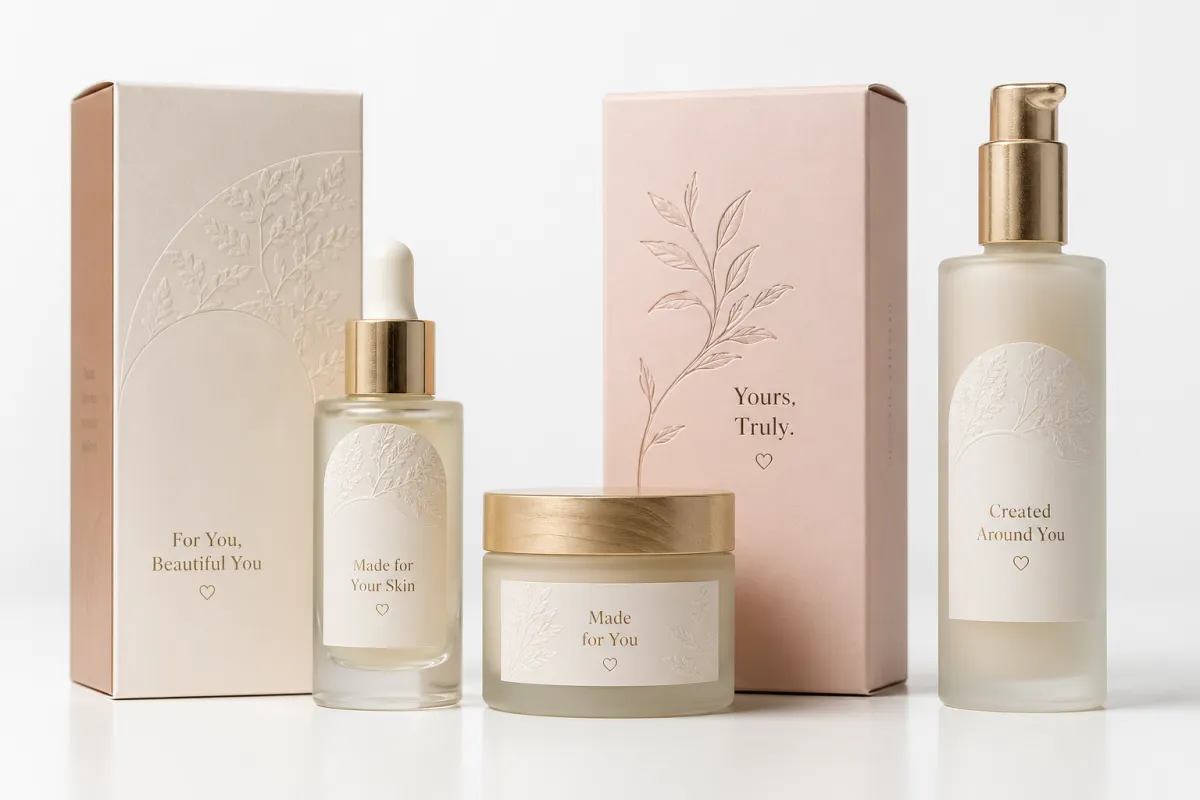
At its simplest, personalized packaging for cosmetic line means the box, insert, label system, and finish choices are built around one specific product instead of borrowed from a generic stock format. A 30 ml dropper bottle needs different clearance than a 7.5 ml lip gloss tube, and a 50 g face cream jar needs a different stability strategy than a mascara carton with a 16 mm wand. That sounds obvious on paper. In practice, plenty of teams still start with artwork first and only later discover that the footprint is too tight, the insert is too shallow, or the retail display tray will not fit the co-packer line already booked for the week in Los Angeles or Dallas.
Personalization goes way beyond adding a logo. It includes carton structure, the way the product nests inside an insert, the choice between matte and gloss varnish, foil stamping or embossing, the color system across a full SKU family, and how the package opens on camera or in a crowded store aisle. I once worked with a small indie makeup brand that switched from a plain white tuck box to a soft-touch black carton with copper foil and a folded paperboard cradle made from 24 pt SBS. The jump in perceived value was immediate. Wholesale buyers stopped describing it as a sample and started describing it like a line they could actually merchandize, which was the goal.
"We did not change the formula at all. We changed the box, the fit, and the first five seconds of unboxing, and the whole line felt more expensive."
That is why personalized packaging for cosmetic line projects have to balance appearance with production reality. Cosmetic packaging lives in a demanding middle ground: it has to look polished enough for retail, protect formulas sensitive to heat or pressure, and still run on equipment that fills, cartons, labels, and ships at scale. Ignore one side and the package may still look great in a mockup, but it will either cost more than planned or fail once real hands, real boxes, and real shipping lanes get involved from Guangzhou to Chicago.
One detail people regularly underestimate is how much package branding depends on structure. A lipstick carton with a square shoulder and a tighter tuck flap reads differently from a rounded-edge sleeve or a rigid gift box wrapped in 157gsm coated art paper. Even before a shopper reads the shade name, they make a judgment about the line. I have watched that happen in seconds at a trade show in Las Vegas. That is why personalized packaging for cosmetic line work is not merely artwork placement with a nice font; it is packaging design, material behavior, and manufacturing discipline doing the same dance.
How Does Personalized Packaging for a Cosmetic Line Move From Brief to Shelf?
The strongest projects I have seen all begin with a discovery brief that leaves little to guesswork. Before a die is drawn or a mockup is printed, the brand should provide exact product dimensions, fill weight, closure type, target retail price, launch channel, and whether the item is headed to e-commerce, boutique shelves, or chains like Ulta or Sephora. For personalized packaging for cosmetic line jobs, that first brief matters because it prevents expensive reversals later, especially when the product family includes multiple shades or sizes and each one wants to be center stage.
After the brief, the packaging engineer or supplier builds a dieline, the flat structural template that defines every fold, score, flap, and glue area. The art team then places branding, regulatory copy, barcode space, ingredient text, and claims like vegan, cruelty-free, or FSC-certified paperboard where they can survive both compliance review and production reality. On a clean project, the brand, printer, and co-packer review the same version at the same time, because a carton can look elegant and still fail if the UPC sits in a poor scan zone or the copy block leaves no room for the batch code. I have seen that movie in a Toronto sample room, and I do not recommend the sequel.
- Discovery brief: dimensions, fill weight, audience, shelf position, and price point.
- Structural dieline: box style, insert geometry, and closure method.
- Artwork layout: logo placement, copy, barcode space, and finish map.
- Proofing: digital proof, printed sample, and color target review.
- Sampling: fit check with the actual bottle, jar, or tube.
- Production approval: final signoff before the press run starts.
- Shipment: finished cartons, inserts, or assembled kits leave the plant.
The timeline stretches in predictable places. Structural design may take 2 to 5 business days for a simple folding carton, and 7 to 10 days for a rigid box with inserts. Color approval usually takes longer than artwork, because a soft-touch black with copper foil can look very different under 5000K shop lights than under daylight at 6500K. A simple carton run might be approved in 10 to 15 business days after proof signoff. A premium rigid package or a package with specialty finishes can run 20 to 35 business days, depending on tooling, finishing, and plant queue in Dongguan or southern California. Packaging is funny that way: the smallest visual detail often eats the most calendar days.
Here is the handoff I explain to new brands all the time: the brand team owns the story, the packaging engineer owns the structure, the printer owns color and finish execution, and the co-packer owns the final filling and pack-out reality. If one group works alone, the project usually pays for it twice. I watched a cosmetics launch in Chicago lose a full week because the insert was designed without confirming the closure torque on the bottle cap, and the carton looked perfect until the product was actually inserted. Then everyone stared at the sample like it had personally betrayed them, which is exactly how a launch slips from 18 days to 25.
Key Factors That Shape the Look, Feel, and Performance
The first material decision usually comes down to the package body. Folding carton is the workhorse for many lightweight cosmetics because it is efficient, printable, and easy to customize across several SKUs. Rigid box construction makes more sense for premium gift sets, influencer kits, and higher-priced skincare because the board is thicker, the assembly is more hand-built, and the perceived value is stronger. I have seen a 12-piece holiday palette line move from folding cartons to rigid presentation boxes in a New Jersey facility and gain stronger wholesale response, even though the unit cost rose by nearly $0.94. Nobody loved the higher cost line item at first, yet everyone loved the shelf response.
Paperboard choice matters too. Common options include 18 pt and 24 pt folding board, 350gsm C1S artboard for crisp print reproduction and cleaner interiors, recycled content board, and FSC-certified stock for brands that want to align packaging with responsible sourcing. If sustainability messaging is part of the story, FSC certification can support that claim, and you can confirm current certification language at FSC. For some lines, that single detail becomes part of the brand identity as much as the logo itself. I have seen buyers pick up a box, notice the certification mark, and then treat the brand with a little more trust, especially when the carton also lists a 70% post-consumer fiber claim.
Finishes change how personalized packaging for cosmetic line feels in the hand and how long it survives on a shelf. Soft-touch coating gives a velvety surface, foil stamping adds sparkle or metallic contrast, embossing lifts key elements for tactile impact, debossing pushes them inward, and spot UV creates contrast between matte and gloss zones. Windowing can showcase the actual product and works well for lip gloss or eyeshadow, but it also exposes the interior to fingerprints and light, so it is not the best fit for every formula. A shiny window can be seductive, yes, but it can also turn into a little fingerprint magnet after 40 touches at a demo table.
Product-specific concerns matter as much as visual finishes. Glass serums need more shock protection than plastic tubes, heavy jars need bottom support, and liquid products need closure and leak risk reviewed before the box design is locked. Shade variation is another real-world issue; if a foundation range has 18 shades, the package system has to keep naming, barcode structure, and color family cues consistent so shoppers can find the right tone fast. That is the practical side of personalized packaging for cosmetic line work that rarely appears in polished boards but appears instantly in warehouse handling in Atlanta or in a return report.
Brand alignment is the final piece. A luxury skincare line may need restrained typography, wide margins, and one dominant foil color, while a teen makeup line might need brighter blocks, bolder type, and faster shelf readability. Neither is wrong. What matters is whether the package looks intentional beside the product promise and can be produced at required speed without color drift across the run. I still tell clients that a package should look like it belongs to the formula, audience, and price tag, not just a mood board someone saved on a Friday afternoon after three espresso shots.
For transit durability, think beyond the shelf and into the shipping lane. If the package moves through distribution centers, parcel carriers, or subscription kits, ask your supplier about drop tests and compression performance. The International Safe Transit Association publishes recognized test methods at ISTA. I also ask for the packaging spec they used to judge vibration and edge crush, because those tests are often invisible in a presentation room but visible during the first returns cycle. If your run includes eye-care or high-value actives, a stress-tested structure is not optional.
Important note: Regulation language differs by market. In the U.S., cosmetic labeling often aligns with FDA expectations; in the EU, CLP and related product-composition disclosures may apply differently. The safest route is to run claims and ingredient blocks through a compliance review early and keep a legal or regulatory reviewer in the loop during proofing so your personalized packaging for cosmetic line launch does not pause at the border or in-channel inspection.
Personalized Packaging for a Cosmetic Line: Cost and Pricing Basics
Cost is where a lot of promising packaging ideas either get sharpened or get shelved, so I like to break it into layers. The biggest drivers are box size, board grade, print coverage, finish complexity, insert design, order quantity, and whether tooling or special dies are required. A compact lip balm carton can be straightforward, while a magnetic rigid box with custom foam or paperboard inserts introduces multiple setup steps that move price quickly. That is normal, not a sign that the supplier is inventing fees just to test your patience in Shenzhen or Milan.
One thing I explain in every personalized packaging for cosmetic line estimate review is the difference between setup cost and unit cost. Setup covers proofing, plates, cutting dies, finishing adjustment, and sometimes a structural sample. Unit cost is the per-piece expense once the line is running. A short run of 2,000 cartons can look pricey because setup is spread across fewer pieces, while 20,000 cartons can bring unit price down sharply even if total spend is higher. That is why two quotes that look similar on paper can behave very differently in real budgeting. Packaging math has a way of being polite until it is not.
| Package Type | Typical Order Size | Approx. Unit Cost | What Drives the Price |
|---|---|---|---|
| Simple folding carton, 18 pt SBS, 4-color print | 5,000-10,000 units | $0.18-$0.32 | Board grade, print coverage, and die complexity |
| Folding carton with soft-touch and foil | 5,000-10,000 units | $0.28-$0.55 | Special finish, foil area, and tighter quality control |
| Rigid box with paper wrap and insert | 1,000-5,000 units | $1.10-$2.40 | Hand assembly, thicker board, and insert complexity |
| Custom printed box with window and specialty stock | 3,000-8,000 units | $0.42-$0.88 | Window die-cut, specialty paper, and finishing waste |
| Paperboard insert or divider set | 5,000-20,000 units | $0.06-$0.24 | Cut pattern, folding steps, and pack-out method |
Those numbers are not universal, and I would never pretend they are. A project in a high-volume plant near Guangzhou may price differently from one built by a regional converter in New Jersey with faster sample turnaround and lower freight risk. Still, the table is a realistic starting point for budgeting personalized packaging for cosmetic line launches, especially for brands comparing Custom Printed Boxes against a more premium rigid presentation format. I like concrete reference points because vague budget conversations tend to wander off and never come back.
First-time launches should also budget for samples, artwork revisions, freight, and compliance updates. I usually tell newer brands to reserve 8% to 12% of the packaging budget for revision and contingency work, because something always shifts: a barcode needs resizing, the ingredient deck changes, or the sales team wants a different retail carton height. I learned that during a supplier meeting where a brand team approved the foil color on one shade family and then asked for three alternate versions after seeing the first live proof under store lighting. That extra round was not wasted, but it added five days and a few hundred dollars in change charges. Packaging has a way of reminding you that enthusiasm does not replace math.
To compare quotes fairly, look for what is included and what is not. Does the estimate include plates, die charges, pre-production proofs, finishing, and kitting? Are there charges for color matching, sample shipping, or assembly? Does the supplier support the full range of personalized packaging for a cosmetic line services, or are you also paying a co-packer to assemble cartons separately? Those distinctions can make one bid look 10% cheaper while actually costing more once missing pieces are added back in.
If you are still mapping your product line, it helps to browse Custom Packaging Products and compare what different structures can do for a compact, a serum, or a full cosmetic set. A brand that starts with the right format almost always spends less on rework later, and that is especially true when the launch includes several shades or limited-edition kits. I have seen brands try to save upfront and pay for three rounds of sample corrections, which is an expensive way to learn a lesson.
A Step-by-Step Process for Building the Package
I like to keep the build process practical and visible, because confusion often starts when people assume someone else is handling the next step. For personalized packaging for cosmetic line projects, the sequence should be clear from the first call: gather product data, map the structure, approve the artwork, test the sample, then lock production. That sounds simple, but a lot can go wrong if those handoffs are fuzzy. Packaging teams do not fail because they lack talent; they fail because everyone assumes someone else already checked the measurement.
- Product and brand intake: collect exact dimensions, fill weight, closure style, target shelf price, audience, and launch date.
- Structural planning: confirm carton style, insert needs, opening style, and retail display requirements.
- Artwork mapping: place branding, regulatory copy, barcode, ingredient text, and any claim language.
- Sample creation: print and inspect a structural sample, then test fit with the actual cosmetic product.
- Color and finish approval: compare the live sample against approved standards under daylight and indoor light.
- Production signoff: freeze the final proof, confirm quantities, and release the job to press.
- Pack-out readiness: check carton counts, carton labeling, pallet pattern, and co-packer instructions.
The fit check is where many teams finally see real risk. A lip oil bottle may look fine in a digital drawing, but once inside the insert, a shoulder ridge can catch the flap by 1 mm and prevent clean closure. I saw that happen in a meeting room at a Midwest co-packer in Indianapolis, where three people had signed off on the design and none had physically handled the bottle in the carton. The sample fixed the issue before production, which is the best possible outcome, but it delayed launch by four business days. I remember the silence in that room more than the problem itself.
For personalized packaging for cosmetic line projects, sample approval should include more than just looks. Check whether the carton opens smoothly, whether corners crush under light pressure, whether the product rattles inside, whether print alignment stays clean at the fold, and whether the finish smears after handling with slightly oily fingers. Cosmetic products get touched, photographed, repacked, shipped, and displayed more times than most people realize, so one clean photograph is not enough proof that the package will survive the full path to retail.
On a well-run project, the supplier will also coordinate with the co-packer or fulfillment partner. That includes carton count per shipper, case pack configuration, pallet height, and any kitting instructions for sample cards, promotional inserts, or decorative sleeves. I have seen personalized packaging for cosmetic line jobs run much smoother when the printer and packer agree on pack-out details before the first press sheet is printed, because nobody wants to discover a label placement issue after 25,000 units are already in motion. That kind of surprise is a terrible gift.
If your launch involves multiple SKUs, build a launch calendar with at least three buffers: one for artwork revisions, one for sample review, and one for freight. A tight calendar with no slack is how brands end up paying express freight on a Friday because a proof is held up by a missing allergen statement on Wednesday. I have seen that exact scramble more than once, and every time it comes down to the same root cause: the package was treated like the final touch, not a core part of the product.
For teams that want to compare options side by side, I often recommend using an internal checklist against the packaging formats catalog so the structure choice is evidence-based, not mood-board-based. A clean checklist can show whether a folding carton, Custom Printed Box, or rigid presentation package actually fits the formula, the budget, and the production calendar. That is less glamorous than a mood board, but far more useful when the launch date is staring you down.
Common Mistakes That Hurt Personalized Packaging for a Cosmetic Line
The most expensive mistake I see is designing before final product dimensions are locked. A jar can change by 1.5 mm, a cap can change by 2 mm, and suddenly the insert no longer holds the product securely. That mismatch is especially painful in personalized packaging for cosmetic line projects because the brand may already have approved artwork, sales samples, and influencer kit photos before structure is truly final. I have watched a room full of smart people stare at a misfit sample like it had broken the laws of physics. It had not. The measurements were simply wrong.
Another common problem is choosing a finish that looks stunning in a render but behaves badly in production. Heavy foil, ultra-deep embossing, or dark matte coatings can all create issues if line speed is high or handling is rough. I remember a matte black carton with silver foil that looked gorgeous under showroom lights, but the corners started showing rub marks after only a few hundred passes through a manual pack-out line in Pennsylvania. The team loved the look, but the finish was too delicate for the way the product was being handled. Beauty is nice. Durability pays the bills.
Shipping performance is another area that gets ignored far too often. If the package is going to a retail distribution center or moving through parcel networks, it should be tested for compression, drop resistance, and insert stability. That is where personalized packaging for cosmetic line work needs real-world grounding, not just presentation. A carton can be beautiful and still fail if the base buckles, the insert shifts, or the product breaks loose during transit. Nobody wants a box to arrive looking like it had a bad week.
Regulatory copy is another late-stage trap. Ingredient statements, country of origin, net contents, barcode placement, warning copy, and claims all need space early in the design process. Cosmetic lines with multiple shades or fragrance variants are especially vulnerable, because the template may need room for batch codes, shade names, or regional language changes. If copy is left until the last minute, the art team shrinks type, moves logos, or reworks a whole panel, and that becomes a costly way to discover a planning problem. I have seen people bargain with copy space as if the box were gonna stretch on command. It does not. Not even by 1 mm.
One more issue I see in personalized packaging for cosmetic line launches is not planning for shelf continuity across the line. A cleanser, toner, serum, and moisturizer may all sit together in a routine-driven display, and packaging should look related without becoming repetitive. Strong package branding does that through consistent typography, a controlled color system, and one or two repeatable structural cues. If every SKU looks like it came from a different company, retail buyers notice immediately, and they usually stop there.
Honestly, the best teams treat packaging as part of the product specification, not decoration. They measure it, test it, track it, and approve it with the same seriousness they give the formula. That mindset keeps personalized packaging for cosmetic line programs from turning into expensive cleanup work after launch.
Expert Tips and Next Steps for Your Launch
If I were advising a brand starting fresh, I would compare at least three options side by side: a simple folding carton, a premium custom printed box, and a rigid presentation style if the budget supports it. Put board grade, finish, lead time, unit cost, and assembly method into one line each. That view makes personalized packaging for cosmetic line decisions much easier, because the team can see where money is going instead of arguing from personal taste. I have sat through enough of those arguments to know taste is useful, but data keeps the meeting from drifting off the edge.
I also recommend ordering two samples whenever possible: one structural sample for fit and one color-accurate proof for visual review. The structural sample tells you whether the bottle rattles, whether the insert holds, and whether the flap closes cleanly. The color proof tells you whether the brand red is truly the brand red under daylight, warm retail lighting, and a phone camera at 6 inches. Those are different tests, and both matter. A box that photographs well but crushes in transit is not a success; it is a prettier failure.
A launch calendar should include art approval, sample review, production, freight, and a buffer for revisions. If the carton needs 12 business days, the foil setup needs 3 more, and freight adds 5, build the calendar as if the job needs 20 days, not 12. I have seen brands schedule so tightly that one missing supplier email forces an overnight shipment worth more than the freight on the whole carton run. That pain is avoidable with better planning, and the fix is usually boring: more visibility, more lead time, fewer assumptions.
For teams looking at personalized packaging for a cosmetic line across a full range, I suggest setting a standard material system for the first launch and then customizing selectively. Maybe the serum gets a rigid box, the cleanser gets a folding carton, and the trial-size kit gets a simple sleeve with a paperboard tray. That keeps the line coherent while controlling cost. It also gives the brand a structure it can repeat later, which makes reorders much easier. Repetition is not always exciting, but in packaging, it is often what keeps the line profitable.
Use trusted references for the technical side, not just social media mood boards. Packaging printing, transit testing, and fiber sourcing each have their own standards and practical limits, and those limits show quickly once production starts. A supplier who can discuss substrate choice, finishing tolerance, and test methods in plain language is usually worth more than one who talks only about visuals. I trust the person who can explain tradeoffs without sounding like they are reading from a brochure, especially if they can quote a real lead time like 12 to 15 business days from proof approval.
Before you sign anything, run this quick check on your own: 1) Is the structure proven with the exact product? 2) Is the color match tested under realistic light? 3) Are all claims and legal copy finalized before file lock? 4) Has freight risk been tested for your route and not just assumed? That final sanity pass is the closest thing to a safety net you get when you are in a launch sprint.
If you want the package to do more than look good, make sure it tells the same story as the formula, the price, and the channel. That is where personalized packaging for a cosmetic line becomes a real brand asset. It protects the product, supports shelf price, and gives customers a small but memorable moment the first time they lift the carton lid or slide out the tray. That moment matters more than people admit. A good box can make a customer feel like they picked up something worth keeping, especially when tactile finish and structural fit work together.
At Custom Logo Things, I treat the package as part of the launch plan from the first sample, not the last. The strongest personalized packaging for cosmetic line projects I have seen all shared the same traits: clear dimensions, realistic timelines, sensible materials, and a finish strategy that looked rich without fighting the pressroom. Build it that way and the package works harder, the line runs cleaner, and the brand story lands where it should: in the hands, in the basket, and in repeat purchase behavior.
FAQ
What is personalized packaging for a cosmetic line?
It is packaging designed around product size, brand identity, and customer experience instead of a generic stock box. In practice, personalized packaging for cosmetic line usually includes custom structures, inserts, finishes, and compliance-ready labeling that match the exact formula and retail channel. I think of it as the packaging version of tailoring a suit: the difference is obvious the second it shows up, especially when the carton uses a 350gsm board and a custom insert made for a 30 ml bottle.
How long does personalized packaging for a cosmetic line usually take?
Simple carton projects may move in about 10 to 15 business days after proof approval, while new structures, rigid boxes, and specialty finishes often need 20 to 35 business days. The biggest timeline drivers are sampling, revisions, color approval, and production scheduling, especially on personalized packaging for cosmetic line programs with multiple SKUs. If the calendar feels too tight to breathe, it probably is, and a plant in Guangdong or New Jersey will not magically speed up a foil-stamped run.
What affects the cost of personalized packaging for a cosmetic line most?
Size, board thickness, print coverage, special finishes, insert complexity, and order quantity usually have the biggest impact. Setup, tooling, proofing, and freight can also move the final price up or down in a meaningful way, particularly when the job includes personalized packaging for cosmetic line components such as rigid boxes or assembled kits. The box is never just the box; it is the result of many decisions, and a quote for 5,000 pieces at $0.18 per unit can behave very differently from a 1,000-piece rigid run at $1.50 per unit.
Which materials work best for personalized cosmetic packaging?
Folding carton works well for many lightweight products, while rigid boxes suit premium gifting or luxury lines. Recycled paperboard and FSC-certified stocks are strong options when sustainability is part of the brand story, and both can work well in personalized packaging for cosmetic line projects if the structure is matched to product weight and handling. I have a soft spot for sturdy board that still prints beautifully, especially 24 pt SBS or 350gsm C1S, because it saves everyone a headache later.
How do I make sure the packaging matches my cosmetic brand?
Start with a clear brand brief that covers audience, price point, product type, and shelf setting, then review samples under realistic lighting. Compare color, texture, finish, and structure against the rest of the product line so your personalized packaging for cosmetic line system feels intentional from first glance to final unboxing moment. If the package feels like it belongs to another brand, trust your instinct and keep refining, even if the sample looks flawless in a studio photo taken on a sunny afternoon in Los Angeles.