Buyer Fit Snapshot
| Best fit | Custom Tamper Evident Tape projects where brand print, material claims, artwork control, MOQ, and repeat-order consistency need to be specified before quoting. |
|---|---|
| Quote inputs | Share finished size, material target, print colors, finish, packing count, annual reorder estimate, ship-to region, and any compliance wording. |
| Proofing check | Approve dieline scale, logo placement, barcode or warning zones, color tolerance, closure strength, and carton packing before bulk production. |
| Main risk | Vague material claims, crowded artwork, missing packing details, or unclear freight terms can make a low unit price expensive after revisions. |
Fast answer: Custom Tamper Evident Tape: Costs, Uses, and Setup should be specified like a repeatable production item. The safest quote records material, print method, finish, artwork proof, packing count, and reorder notes in one written spec.
Production checks before approval
Compare the actual filled-product size with the drawing, then confirm tolerance on folds, seals, hang holes, label areas, and retail display edges. Reserve space for logos, QR codes, warning copy, and material claims before decorative graphics fill the panel.
Quote comparison points
Review material grade, print process, finish, sampling route, tooling charges, carton quantity, and freight assumptions side by side. A quote is only useful when the supplier can repeat the same color, closure quality, and packing count on the next order.
A carton can look perfectly sealed from ten feet away and still tell on itself the second someone tries to pry up the flap. That is the whole point of Custom Tamper Evident tape. It is not just tape with a logo slapped on top. It is a security cue, a brand marker, and a practical way to make interference visible without turning your packing line into a science project.
I have seen teams treat tape like an afterthought, then act surprised when a box arrives opened, resealed, and impossible to explain. That gets old fast. A well-chosen custom tamper evident tape spec can save time, reduce disputes, and make a receiving check a lot less vague. It can also support package branding without making the box look like it wandered out of a compliance binder.
If you already use Custom Packaging Products for branded packaging, this is one of the cleaner upgrades to fold into the system. It works on outbound cartons, service parts, subscription boxes, returns, and secondary packs where the receiver needs a clear signal if someone opened the shipment and tried to fake it closed again.
What Custom Tamper Evident Tape Is and Why It Matters
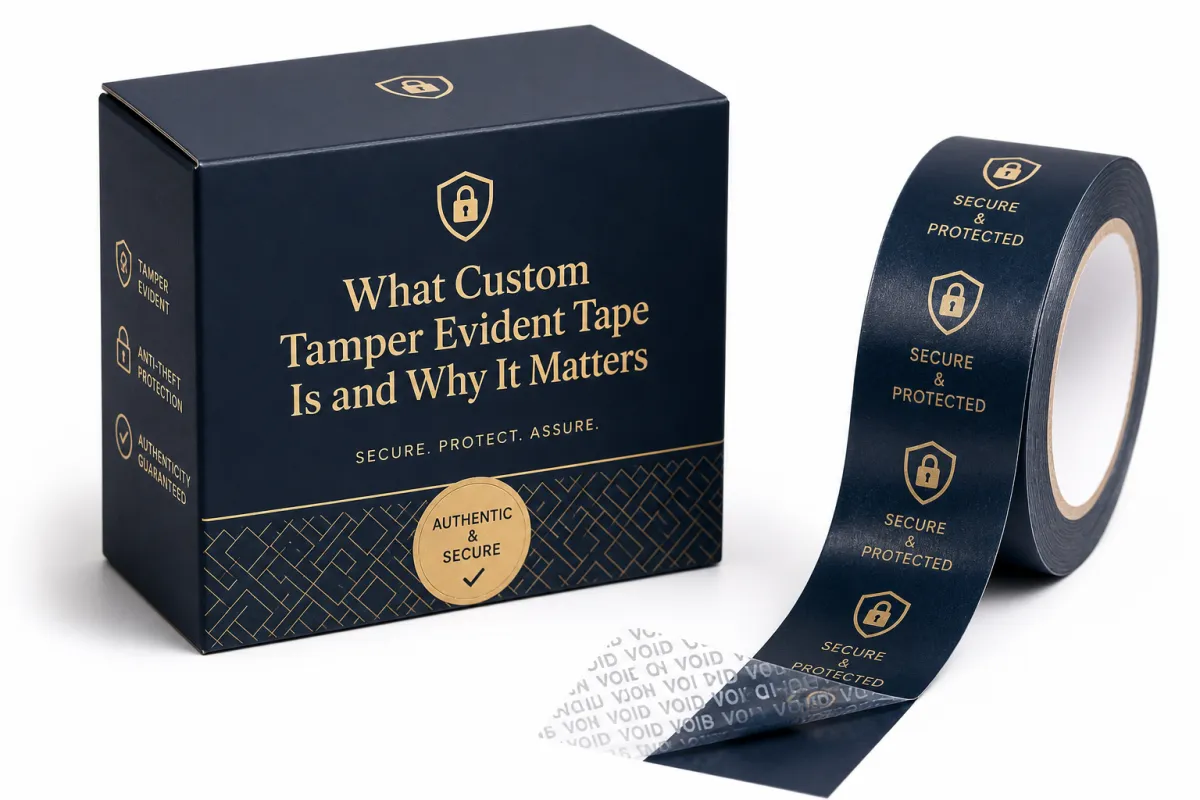
Custom tamper evident tape is pressure-sensitive tape designed to show visible evidence of opening, lifting, or attempted resealing. The evidence may appear as a VOID message, leftover adhesive, a broken film, or a torn pattern that makes the damage obvious. Different builds use different tricks, but the job is the same: tell the next person in the chain that the package was disturbed.
That distinction matters. Tamper-resistant packaging makes opening harder. Tamper evident packaging makes tampering easier to spot. Those are not the same thing, and teams sometimes mix them up. A determined person can still open a carton. The question is whether the tape leaves a signal that says, very plainly, "someone has been here." That is usually the more useful outcome.
In the real world, the tape shows up in a few predictable places. E-commerce brands use it to reassure customers that the box has not been messed with between the warehouse and the porch. Distributors use it on high-value parts, replacement components, and sensitive inventory moving through multiple hands. Subscription brands use custom tamper evident tape to reinforce trust before the customer even gets to the product. Warehouse teams use it on internal transfers where fast visual checks matter more than paperwork that nobody wants to read twice.
The catch is that custom tamper evident tape is not a security strategy all by itself. It works best as part of a wider packaging setup: carton style, closure pattern, storage conditions, receiving procedures, and staff training. A great VOID pattern will still underperform if the carton surface is dusty, the tape is applied badly, or nobody knows what to do once the evidence is triggered.
If a carton can be opened and resealed without anyone noticing, the packaging system failed the basic job. A good custom tamper evident tape program closes that gap with a visible signal that is hard to argue with.
That is why the tape gets attention beyond security teams. Brand managers like it because it supports package branding. Operations teams like it because it creates a clean checkpoint. Buyers like it because it can add real value without forcing a move to heavier or more expensive packaging. For a lot of programs, that balance is exactly what they need.
How Custom Tamper Evident Tape Works on Real Packages
The mechanics are straightforward, but the materials are where things get interesting. A typical custom tamper evident tape construction includes a face stock, a printed security layer or hidden message, and an adhesive matched to the carton or film it needs to bond to. If someone peels it back, stretches it, or tries to lift and reset it, the structure changes in a way that leaves a visible sign behind.
Several constructions show up over and over. VOID transfer tape leaves a message on the carton and often on the tape itself. Residue transfer tape leaves behind a pattern or film that cannot be cleaned off and put back nicely. Destructible film breaks apart into fragments, which makes neat removal nearly impossible. Some breakaway formats split along a built-in weakness. They all work a little differently, and that difference matters once the cartons start moving through a real facility.
Surface behavior is where the testing starts. Corrugated board usually gives the adhesive a decent anchor, but recycled liners can be dusty, weak, or a little uneven. Coated cartons and glossy retail packaging look good on a shelf, but they sometimes need a stronger adhesive because the tape is bonding to a slick finish instead of a porous one. Poly mailers, textured cartons, and cold-chain shippers each bring their own headaches. Packaging always has one more weird variable than you expected. Usually three.
Custom tamper evident tape also depends on application discipline. If the box is dirty, the line moves too fast, or the operator applies the tape with light pressure, the adhesive may not fully wet out before the package leaves the station. A spec sheet cannot fix that. Neither can a prettier print. I have watched solid security tape fail because somebody rushed application and never gave the adhesive a real chance to bite.
Some packages need tape alone. Others need a little more structure. If the shipment is low risk and the goal is simple opening evidence, custom tamper evident tape may be enough on its own. If the goods are high value, regulated, or politically awkward to replace, buyers often add serialized labels, inspector initials, or a documented chain-of-custody step. For transit-focused programs, it helps to compare your package against the same style of stress it will see in the field, not just in a clean office sample. Standards groups such as the ISTA testing community are useful references for that kind of reality check.
The difference between a decent tape and a useful control is usually the system around it. Custom tamper evident tape should fit the box, the line, the warehouse, and the receiving process. If it does not, the security feature starts looking nice on paper and a little shaky in practice.
Custom Tamper Evident Tape Pricing Factors That Change the Quote
Pricing for custom tamper evident tape usually comes down to material choice, adhesive chemistry, print complexity, width, roll length, and order volume. A simple one-color security message on a standard roll will price very differently from a serialized run with a specialty adhesive and a more detailed brand panel. That is normal. The tape is doing more than standard Carton Sealing Tape, so the quote reflects that.
As a loose but practical range, many buyers see simple printed security tape land around $2.50-$5.50 per 110-yard roll at volume, while more specialized constructions can climb higher depending on the security features and the quantity ordered. Smaller programs often pay more per roll because setup costs get spread over fewer units. If you only need a few hundred rolls, the unit economics are going to look different than a recurring order for several thousand.
Custom tamper evident tape almost always costs more than plain Printed Carton Sealing Tape, and that makes sense. You are paying for a tighter adhesive system, a security feature that has to show evidence consistently, and often a more controlled print process. The real value is not only in the roll. It can also reduce manual inspections, lower the odds of disputed deliveries, and save the hidden cost of replacement shipments and customer service time. That is where the math gets interesting.
Buyers usually want a quick comparison, so here is one:
| Construction | Typical Use | Relative Cost | Best Fit |
|---|---|---|---|
| Printed acrylic security tape | General carton sealing with visible branding | Lower | High-volume programs that need a clear message and basic evidence |
| VOID-transfer tamper tape | Boxes that need unmistakable opening evidence | Medium | E-commerce, retail packaging, and service parts |
| Destructible security film | Surface destruction on removal | Medium to higher | Applications where clean resealing must be difficult |
| Serialized or specialty security tape | Traceability and investigation support | Higher | High-value goods, audits, and controlled distribution |
A few budget levers matter more than people expect. Standard widths usually cost less than custom widths because they fit existing converting setups. Reducing colors helps. Cleaner artwork helps. Larger runs lower unit cost because the setup gets divided across more rolls. In many cases, the jump from a basic to a premium version of custom tamper evident tape comes down to whether you need a warning, a visible change, or a more advanced security footprint.
Premium features are worth the extra spend when shipment risk is higher. That includes cold-chain lanes, rough parcel networks, retail returns, and product families that are often counterfeited or tampered with. If the tape has to survive temperature swings, warehouse handling, and repeated human touch, a stronger adhesive and a more durable construction can be money well spent. If your packaging program also cares about certified materials, paper and fiber-based options are worth comparing against current sourcing standards from groups like FSC.
One more thing: the tape itself may be a small line item, but the system around it is not. Custom tamper evident tape can lower total packaging cost if it reduces damage claims, manual checks, and repeat shipments. That is the right frame for the quote. A slightly higher roll price can still be the cheaper program if it prevents recurring problems. I've seen that more than once, and the spreadsheet usually catches up later.
Custom Tamper Evident Tape Timeline From Proof to Production
A smooth custom tamper evident tape project usually follows a pretty simple path. First define the use case. Then confirm the package surface, share the artwork, review the proof, approve samples if needed, and move into production. That sounds obvious. It is also where a lot of delays begin, because someone skipped one of the obvious steps and hoped nobody would notice.
Proofing is often the quickest stage, especially when the artwork is already clean and the logo exists in a print-ready format. Production timing depends on whether the order uses standard constructions or a specialty adhesive, whether plates or tooling are required, and how busy the converting queue is. As a rough rule, simple orders are often finished 12-15 business days from proof approval, while more specialized custom tamper evident tape runs can stretch to 15-25 business days before freight is added.
What slows things down? Artwork revisions, for one. Missing details about the carton surface are another common culprit, especially if the package is glossy, recycled, refrigerated, or oddly textured. Compliance reviews can add time if the customer wants specific warning language or traceability marks. Special adhesives sometimes need extra validation because the supplier needs to know whether the tape is going onto corrugate, film, or coated retail packaging. None of that is exotic. It is just the part people forget to mention until the order is already in motion.
A pilot run is worth the effort. Run the tape on filled cartons, not empty samples. Check whether the dispenser feeds correctly. Watch the line at normal speed. Let the cartons sit in the real warehouse environment for a while, then recheck adhesion and the security response. That small test usually tells you more than a shiny proof ever will, especially for custom tamper evident tape headed into rough shipping lanes or temperature-unstable storage.
A supplier should lay out checkpoints clearly so the buyer knows what is happening and when. I like to see three clear moments: proof approval, production start, and ship date. If samples are required, that should be called out before the order is placed. The best custom tamper evident tape programs feel orderly because everyone knows the next step and nobody is guessing about artwork, quantities, or carton fit.
Common Mistakes When Specifying Tamper Evident Packaging Tape
The most common mistake is choosing custom tamper evident tape before understanding the surface it has to bond to. A carton that looks identical on a screen may behave very differently in the real world if one version is heavily recycled, another is coated, and a third is stored in a damp warehouse. Adhesive selection should start with the substrate, not the logo. A pretty proof will not save the wrong construction.
Another common miss is artwork that looks good but makes the security message too small or too busy. Fine type on a narrow roll is hard to read once it is printed and wrapped around a carton. If the message is supposed to warn a receiver, it has to be visible at a normal glance. That means bold copy, good contrast, and a layout that does not fight the tamper-evident design. In practice, custom tamper evident tape works better when the message is simple and direct.
Buyers also get into trouble when they ignore the dispenser and the line speed. A manual packing station, a semi-automatic case erector, and a high-volume carton sealer all place different demands on the tape. If the core size, unwind direction, or roll width does not match the dispenser, the tape may chatter, tear unevenly, or slow the line down. That creates labor waste. Labor waste is expensive. Packaging teams learn that one the hard way.
Adhesive strength is another place where shortcuts show up fast. Heavy cartons, rough recycled board, and glossy packaging usually need more attention than a standard retail box. If the bond is too weak, the tape lifts at the edges. If the bond is too aggressive for the surface, the carton fibers can tear on removal and create a different kind of mess. Either way, the right version of custom tamper evident tape should be chosen after testing, not guesswork.
These are the mistakes worth avoiding:
- Specifying the tape before the carton finish is confirmed.
- Using weak print contrast on a narrow width.
- Skipping tests on cold, humid, or dusty cartons.
- Ignoring the dispenser or the line speed.
- Ordering one construction for very different shipping conditions.
One more issue gets overlooked a lot: real handling. Warehouse teams may apply tape with gloves, in a hurry, or on a line where cartons are not perfectly square. Carrier handling adds more variation. If the box is likely to see compression, abrasion, or multiple scans, the tape should be validated under those conditions. A lot of buyers only discover the weakness after the first complaint arrives. By then, the expensive part is not the roll price; it is the loss of confidence in the custom tamper evident tape program.
Expert Tips for Better Custom Tamper Evident Tape Results
Keep the security message obvious. That sounds basic because it is. A bold VOID pattern, a clear warning line, or a strong brand-specific seal message helps staff, carriers, and recipients recognize the feature instantly. With custom tamper evident tape, clarity beats cleverness almost every time. Fancy wording is nice until nobody can read it from an arm's length away.
If traceability matters, add it in a controlled way. Batch codes, sequential numbers, and QR codes can help with receiving checks, recalls, or investigations. The key is not to crowd the tape with so much information that the tamper message disappears into the background. A good layout gives the security feature priority first, then adds the traceability data in a neat, readable field. That balance matters even more for higher-value or regulated shipments.
Test worst-case conditions, not just a warm sample in a conference room. Recycled corrugated board, refrigerated product, dusty surfaces, and heavily textured cartons can all change how the adhesive performs. If your packaging design includes custom printed boxes or branded packaging across several product families, test the tape against each family instead of assuming one build will work for all of them. Packaging design choices are connected whether the team likes it or not.
Do not overlook the small mechanical details. Core size affects dispenser fit. Unwind direction affects how cleanly the roll feeds. Roll diameter affects how often operators swap rolls on a busy line. Those details sound minor until they slow production. Good custom tamper evident tape should feel easy to use, because a security feature that irritates the line will eventually get blamed for every problem in the building.
For buyers trying to tighten the packaging workflow, it helps to think of the tape as one element in a broader system:
- Carton structure and closure pattern.
- Security message and branding layout.
- Line application method and dispenser setup.
- Warehouse receiving checks and exception handling.
- Carrier or customer inspection process.
That broader view is what makes custom tamper evident tape genuinely useful. It supports package branding, but it also supports the operational habits that keep shipments moving without mystery. If your team already buys brand-ready packaging options and wants to tighten the presentation, this is one of the cleaner upgrades to evaluate. If the goal is to bring more discipline into retail packaging or product packaging without making the process awkward, the tape earns its keep pretty quickly.
Next Steps for Ordering Custom Tamper Evident Tape
Start by auditing the package formats you ship most often. List the carton sizes, surface finishes, storage conditions, and handling risks. Then decide which lanes actually need custom tamper evident tape instead of a standard closure tape. That keeps the program focused on the shipments where evidence matters most and avoids buying a specialty spec just because it looks nice.
Ask for two or three sample constructions using the same artwork. That comparison will tell you a lot about adhesion, print clarity, and cost. One construction may look strong but be too expensive for volume use. Another may price well but fail on coated or dusty board. Side-by-side testing gives you a better read than a single sample ever will, especially if you are balancing branded packaging with durability requirements.
Run a small trial on the real packing line. Watch how the tape applies, how it looks under warehouse lighting, and how the tamper message appears after transport. Inspect the seals for peel resistance and message clarity. If the box goes through cold storage, humidity, or a rough parcel network, test that too. A custom tamper evident tape program is only as good as the conditions it survives in the field.
Use the trial to settle the practical details: print layout, adhesive strength, roll format, and reorder quantity. Then write those choices into your purchasing process so future orders stay consistent. This is especially helpful if multiple people buy packaging across different product lines, because standardization keeps the tape from drifting every time a new project opens up. Nobody needs to re-decide the basics every quarter.
Use this buyer checklist before you place the order:
- Confirm the carton surface and finish.
- Choose the security method that matches the risk.
- Test on filled cartons, not just flat samples.
- Verify dispenser fit and line speed.
- Set the reorder spec so future runs match the approved build.
Used this way, custom tamper evident tape becomes more than a seal. It becomes part of the way your packaging communicates trust, protects the shipment, and supports the look and feel of the brand from warehouse to customer. The practical takeaway is simple: choose the adhesive for the surface, the message for the handling risk, and the rollout based on a real line test. Get those three right, and the tape stops being a guess.
Frequently Asked Questions
How does custom tamper evident tape show if a box was opened?
Most versions reveal a hidden message, leave residue, or break apart when someone peels them up or tries to reseal them. The exact effect depends on the construction, so one style of custom tamper evident tape may be a better fit for cartons while another works better on mailers or coated boxes. Testing on the actual package surface is the safest way to confirm that the evidence stays visible after real handling.
What materials work best for custom tamper evident tape on corrugated cartons?
Standard corrugated board often works well with pressure-sensitive security tape, but recycled, dusty, or rough cartons may need a stronger adhesive. If the carton has a coating or gloss finish, sample testing matters because the same custom tamper evident tape can behave very differently on a slick surface. For cold or humid storage, ask for a construction that keeps bond strength after temperature cycling.
How much does custom tamper evident tape usually cost?
Cost depends on width, length, print complexity, adhesive type, security features, and order size. Smaller runs usually cost more per roll because setup is spread over fewer units, while larger runs lower unit cost. A simple printed tape is usually cheaper than a highly secure construction with serial numbers, special messages, or extra-durable materials. That is why buyers should compare the full program cost, not just the roll price.
How long does custom tamper evident tape take to produce?
Lead time usually includes proof approval, any setup work, production time, and shipping. Simple orders move faster, while custom constructions, artwork revisions, or special adhesives can add time. The quickest way to stay on schedule is to approve artwork early and provide exact package dimensions and surface details up front. For many programs, custom tamper evident tape moves from proof to ship within a couple of working weeks once the details are locked.
Can custom tamper evident tape include logos or serial numbers?
Yes, many programs use logos, warning copy, batch codes, or sequential numbering for brand recognition and traceability. The key is keeping the security message readable and not overcrowding the tape with too much small text. If serial numbers matter for audits or investigations, confirm the numbering format and reset rules before production starts. That keeps the custom tamper evident tape spec clean and avoids avoidable changes later.

