Buyer Fit Snapshot
| Best fit | Carton Sealing Tape Without Wasting Money projects where brand print, material claims, artwork control, MOQ, and repeat-order consistency need to be specified before quoting. |
|---|---|
| Quote inputs | Share finished size, material target, print colors, finish, packing count, annual reorder estimate, ship-to region, and any compliance wording. |
| Proofing check | Approve dieline scale, logo placement, barcode or warning zones, color tolerance, closure strength, and carton packing before bulk production. |
| Main risk | Vague material claims, crowded artwork, missing packing details, or unclear freight terms can make a low unit price expensive after revisions. |
Fast answer: Carton Sealing Tape Without Wasting Money: Board, Finish, Dieline, and Unit Cost should be specified like a repeatable production item. The safest quote records material, print method, finish, artwork proof, packing count, and reorder notes in one written spec.
Production checks before approval
Compare the actual filled-product size with the drawing, then confirm tolerance on folds, seals, hang holes, label areas, and retail display edges. Reserve space for logos, QR codes, warning copy, and material claims before decorative graphics fill the panel.
Quote comparison points
Review material grade, print process, finish, sampling route, tooling charges, carton quantity, and freight assumptions side by side. A quote is only useful when the supplier can repeat the same color, closure quality, and packing count on the next order.
How to Choose Carton Sealing Tape Without Wasting Money
If you are trying to figure out how to choose carton sealing tape, start with the seam, not the sales pitch. Most box failures do not happen because corrugated board suddenly gives up. They happen because the tape was wrong, the carton surface was dusty, or the package got handled like nobody had to answer for it. That is the part people skip, then act surprised when a box opens itself halfway through transit. Funny how that keeps happening.
Carton sealing tape has one job: keep the carton closed from pack-out to delivery. Sounds simple. It is not. The right tape has to grab when it touches the box, stay put through stacking and vibration, and keep doing its job through heat, cold, humidity, and the occasional drop that makes everyone look at the floor. That is why how to choose carton sealing tape is not really about roll price. It is about the box, the route, the storage conditions, and the way your team actually packs.
The cheapest tape gets expensive fast the moment it fails on a loaded carton.
Think about it this way: if a light carton pops open because the adhesive could not bite into recycled board, the tape was not cheap. It was wrong. Wrong tape creates rework, tape waste, returns, and the joyless scene of someone re-taping boxes on the floor. That is not a savings plan. That is a mess with a purchase order attached.
How to Choose Carton Sealing Tape: Start With the Failure Point
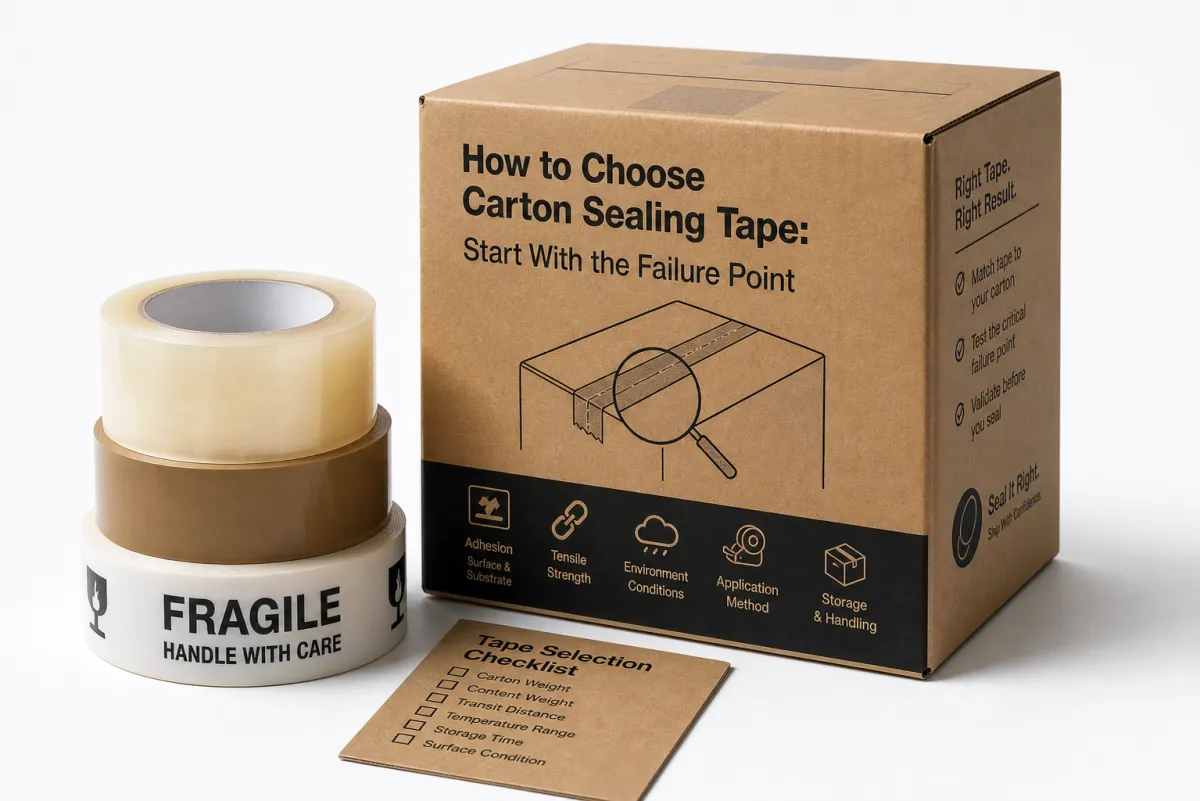
Most shipping failures happen at the seam, not because the box itself is weak. That is why how to choose carton sealing tape should start with the failure point, not the catalog photo. A carton can be structurally fine and still fail if the tape has poor tack, the adhesive is too stiff for the surface, or the application pressure is inconsistent. A box is only as secure as the line holding it shut.
Strip away the packaging jargon and tape performance comes down to three things: adhesion, tack, and holding power. Adhesion is the bond to the box surface. Tack is how fast the tape grabs. Holding power is whether it stays put after the carton gets stacked, vibrated, dropped, or chilled. If you are learning how to choose carton sealing tape, this is the part that keeps you from buying by brand color or a shiny product sheet.
Kraft board is usually more forgiving than dirty recycled board. Recycled board often has more surface variation, which means the adhesive has to do more work to make a stable bond. Coated board can be slick. Dust is dust; it acts like a tiny release layer. A tape that feels strong in your hand can still fail on a carton if the board is rough, cold, or contaminated with fiber dust. Real boxes do not care about marketing claims.
A common mistake is treating every carton like it lives the same life. A light ecommerce box moving across a local route is not the same as a heavier outbound carton crossing multiple hubs. A small box with a clean kraft surface does not behave like a dusty recycled carton fresh off a pallet. If you want to know how to choose carton sealing tape without wasting money, think in failure modes: edge lift, seam split, carton blowout, and tape shear. That is the real shortlist.
Start with four questions:
- How heavy is the loaded carton?
- What is the box surface: kraft, recycled, coated, or dusty?
- Will the carton face heat, cold, humidity, or long dwell time?
- Is the tape applied by hand, with a dispenser, or on a machine line?
That is the beginning of how to choose carton sealing tape. Not the end. Just the part where you stop guessing.
How Carton Sealing Tape Works on Real Boxes
Once you pull away the packaging language, tape performance still comes back to the same basics: how fast it grabs, how well it bonds, and how long it holds. A roll can look fine on a desk and still fail on a carton if the box surface is dusty, rough, cold, or slightly contaminated. That is the annoying truth. Boxes do not reward good intentions.
Temperature and humidity matter more than most buyers expect. Adhesives change behavior with the environment. A tape applied in a warm packing room may look perfect, then hit a cold dock and lose tack before it reaches the customer. Dwell time matters too. Some tapes grab fast. Others get stronger after a short set period. If your cartons move immediately after sealing, you need strong initial tack. If they sit before shipping, holding power matters more. That difference is real, even if nobody wants to budget for it.
Application pressure is another sneaky variable. Hand-applied tape depends on the operator pressing it down consistently across the seam and flap edges. A machine can do a cleaner, more even job, but only if the settings are right and the rollers are maintained. Poor pressure means poor contact, and poor contact means weak bond. Simple. Annoying. True.
If you want a real reference point, check packaging testing guidance from the ISTA and material resources from the Packaging Machinery Manufacturers Institute. Those groups will not pick your tape for you, but they will remind you that transit testing costs less than shipping failures. How to choose carton sealing tape gets a lot easier when you test against reality instead of faith and a supplier PDF.
I have seen buyers spend weeks debating a few cents per roll, then lose the whole margin because the tape failed on cold recycled board. That is not theory. It is Tuesday in a warehouse.
How to Choose Carton Sealing Tape by Cost and Budget
Price is where people get sloppy. How to choose carton sealing tape by cost and budget means looking past the roll label and asking what each sealed carton actually costs. A cheap roll that needs double taping, extra rework, and a second pass at the packing table is not cheap. It is a slow leak.
Roll price matters, but only as a starting point. Real cost per carton includes adhesive performance, roll length, width, labor time, waste, and failure rate. If one tape takes 8 seconds to apply and another takes 12 because the operator keeps fighting stringing or edge lift, the so-called cheaper roll can cost more in labor alone. Add a few returns and the math gets rude very quickly.
Here is the honest version: if you are sealing ten cartons a day, a small performance gap might not wreck your budget. If you are sealing thousands, it will. The higher your volume, the more the tape spec matters. I know, thrilling stuff. Still true.
| Type | Typical bulk roll price | Best fit | Tradeoff |
|---|---|---|---|
| Acrylic pressure-sensitive tape | $1.20-$2.40 per 2 in x 110 yd roll | Light cartons, dry storage, longer shelf life | Lower initial tack on cold or dusty surfaces |
| Hot melt tape | $1.50-$3.00 per 2 in x 110 yd roll | Fast pack lines, general shipping, better grab | Can age less gracefully in very hot storage |
| Natural rubber tape | $2.50-$5.50 per 2 in x 110 yd roll | Rough surfaces, tough handling, wider conditions | Higher unit price |
| Water-activated paper tape | $4.00-$10.00+ per roll or case equivalent | Security, tamper evidence, heavy-duty sealing | Needs dispenser and process discipline |
That table is not a shopping list. It is a reminder that how to choose carton sealing tape depends on what you are buying it to avoid. If you are sealing light cartons that never leave a dry warehouse, a mid-grade acrylic tape may be enough. If you are shipping heavier boxes, recycled cartons, or product that travels through inconsistent climates, the budget option may be the most expensive choice on the floor.
Break pricing into the pieces that actually matter:
- Adhesive type: acrylic, hot melt, natural rubber, or water-activated paper tape.
- Film thickness: thinner film can save money, but may tear or stretch under stress.
- Width: 2 inches is common, but wider tape or dual strips can be worth it on heavier cartons.
- Roll length: a longer roll lowers changeover frequency, but the tape still has to perform.
My buying rule stays the same: sample first, then scale. One bad pallet costs more than a better roll. That is not a dramatic statement. It is arithmetic. If you are trying to master how to choose carton sealing tape without wasting money, stop comparing only the sticker price and compare the cost of failure instead.
A roll that costs 60 cents less can become the most expensive choice on the dock.
How to Choose Carton Sealing Tape for Your Packing Process
The best tape for a carton line is the one your team can apply the same way every time. That is the part most buyers miss. How to choose carton sealing tape is tied to labor setup, pack speed, box mix, and whether the seal happens by hand or by machine. If the tape is technically strong but constantly misapplied, it fails in practice. Packaging is not a lab bench.
Map the tape to the workflow. A small operation packing 100 cartons a day does not need the same setup as a line sealing 1,500 boxes before lunch. If operators are hand-taping, the tape should dispense cleanly, cut neatly, and stick without a wrestling match. If a machine applies the tape, the roll must match the dispenser, the tension settings, and the box dimensions. Process fit matters just as much as adhesive choice.
A good trial does not need to be fancy. It just needs to be honest. I like trials that use the same cartons, the same packing table, the same people, and the same rush that the real line sees. Anything less is kind of a dress rehearsal for a different play.
- Shortlist two or three tape types that fit the carton load and environment.
- Request samples in the actual width and roll length you would buy.
- Run a trial shift using your normal boxes, not a special demo carton.
- Check seal quality after packing, after staging, and after transit or drop testing.
- Standardize the winning spec and train everyone to use it the same way.
That workflow looks basic because it is. The discipline is the hard part. If you want to be serious about how to choose carton sealing tape, use a short trial that tracks failure rate, application speed, and cleanup time. Measure how many cartons need a second strip, how many edges lift after 24 hours, and how often operators pause to fight the tape. If the tape slows the line, that is a cost. If it sticks too aggressively and makes tear-off awkward, that is a cost too.
One case where changing the process makes more sense than forcing the tape to compensate is water-activated paper tape. It can be excellent for security, recycled cartons, and tamper evidence, but it usually needs a dispenser, training, and cleaner process control. If your team wants a peel-and-go roll with no behavior change, do not pretend a specialty tape will fix the line. It will not. It will just expose the line.
For buyers comparing shipping performance, think like an auditor. Ask whether the seal meets your transit expectations, not whether it “looked okay” on the packing bench. ISTA-style transit thinking helps because it pushes you to test vibration, drop, and handling, not just first-contact adhesion. That is the real lesson behind how to choose carton sealing tape: choose for the process you actually run.
How to Choose Carton Sealing Tape by Box Type and Shipping Conditions
If the box is wrong, the tape has to work harder. If the tape is wrong, the box gets blamed. That is why how to choose carton sealing tape should always start with the carton itself: weight, seam length, board grade, and what the parcel will face in transit. A 2-pound cosmetics box and a 40-pound parts carton are not asking for the same thing, no matter how friendly the spec sheet looks.
Heavier cartons need stronger adhesion and often wider tape. Long seams create more leverage on the closure, so a narrow strip may not be enough if the contents shift. Recycled board can be tricky because its surface is less uniform and sometimes more porous. Coated cartons can resist initial grab. If the carton is already overpacked, the seal has to fight internal pressure too. The tape does not get to complain. It either holds or fails.
Shipping conditions are the other half of the decision. Cold storage, humid warehouses, dusty packing rooms, long freight lanes, and rough sortation all change the requirements. In cold rooms, adhesives can stiffen. In humidity, cartons can swell and the surface can change under the tape. Dust can block contact entirely. If the shipment is going into long-distance freight or multiple handoffs, you need a tape with better holding power and less risk of edge lift. A safe spec is usually safer than a bargain one.
Special cases deserve special tape:
- Frozen or cold-chain cartons: choose a tape rated for low temperatures and test after cold soak.
- Recycled cartons: favor stronger tack and check for fiber lift or seam bounce-back.
- Overpacked boxes: use wider tape, dual strips, or a stronger adhesive class.
- Long transit lanes: look for stable holding power and lower edge-lift risk.
- Dusty packing areas: clean the seam if possible, because no adhesive likes powdered cardboard.
This is where people ask for a universal answer. I get why. It would be easier. It would also be nonsense. How to choose carton sealing tape depends on what the box is carrying and where it is going. If the route is mild and the carton is light, a standard acrylic or hot melt tape may be enough. If the carton is heavier, colder, or more abused, use a stronger adhesive system and verify it with testing instead of optimism. Optimism is not a sealing specification.
If sourcing matters, paper-based tape can be worth a look. FSC-certified options may matter if you are buying paper tape and want a responsible sourcing story. You can review certification basics at FSC. That does not change the sealing mechanics, but it does matter for brands trying to balance performance with sourcing goals. Packaging choices rarely live in a single lane.
Common Mistakes When Choosing Carton Sealing Tape
The most common mistake is buying by price alone. How to choose carton sealing tape gets derailed fast when someone sees a lower roll price and stops thinking. The box does not care what procurement saved per roll. It cares whether the seam stayed shut. If the seal fails, the savings disappear into labor, spoilage, damage claims, or returns.
Another classic mistake is using one tape for every carton size, every surface, and every climate. That sounds efficient until you realize your light cartons and your heavy cartons have different needs. The same tape may do fine on a clean kraft mailer and fail on a dusty recycled carton. One size fits all is a retail slogan, not a packaging strategy.
Skipping surface prep is another easy way to create headaches. If the cartons are dusty, cold, or stored in a damp area, even decent tape can underperform. Wiping off debris, keeping cartons dry, and applying tape to the center seam with proper pressure can prevent a lot of problems. You do not need perfection. You need repeatable contact.
Watch for the physical signs of a bad choice:
- Edge lift: the tape starts peeling at the corners or along the seam.
- Split seams: the carton opens even though the tape is still attached.
- Snap-back or bounce-back: the flaps push the tape off after packing.
- Residue or gumming: the adhesive is leaving a mess where it should be holding.
A drop test helps, but do not treat one clean drop as victory. Stress the carton the way it will actually be stressed: stacked, shifted, and handled more than once. If you want a sanity check, run a few cartons through an ISTA-style transit profile or a simple in-house simulation with vibration and handling. That is more honest than tapping the seam and declaring it “fine.”
The wrong width is a mistake too. Two-inch tape is common, but if the box is long, heavy, or likely to flex, a wider tape or dual-strip setup can make more sense. The answer to how to choose carton sealing tape is rarely “buy the cheapest 2-inch roll and hope.” Hope is not a spec.
What to Do Next After You Choose Carton Sealing Tape
Once you have a strong candidate, do not rush into a bulk order because the sample looked decent. How to choose carton sealing tape ends with validation, not with a product page. A three-roll trial on your worst-case carton will tell you more than a month of sales claims. Your worst-case carton is the one that is heavy, slightly dusty, awkward to close, and likely to travel the farthest. Test that one first. The easy carton is a liar.
Track the basics during the trial: box weight, room temperature, surface condition, packing speed, and failure rate. Note how many cartons need a second pass, how long operators take per box, and whether the tape behaves differently at the beginning of the shift versus the end. If line speed improves and the seals stay tight, you are close. If the tape gums up dispensers, lifts at the corners, or needs extra pressure to grab, keep looking.
Here is a practical decision path that keeps people out of trouble:
- Pick three tape types that fit your box and climate.
- Run them on the exact carton you ship most often.
- Stress-test the worst carton in the group.
- Review failures after packing and again after transit.
- Lock the spec only after the tape survives the real workflow.
Standardize the winning choice before you place a larger order. That means locking in width, adhesive type, and application method. It also means teaching the team how to use it correctly. A good tape applied badly is still a bad seal. Packaging buyers love to blame the tape and ignore the process. Convenient, but not especially useful.
After rollout, keep a few transit samples and recheck them under real shipping conditions. If edge lift appears in cold weather, or if recycled cartons start failing after a pallet change, adjust the spec. That is normal. Good packaging is not frozen in place; it gets tuned. If you are serious about how to choose carton sealing tape, treat the first order like the beginning of a controlled standard, not the end of the decision.
The takeaway is simple: pick tape based on the carton, the climate, and the actual packing process, then prove it on the worst box you ship. If it survives that, you have a real spec. If it does not, you just saved yourself from buying a problem in bulk.
What is the best carton sealing tape for heavy boxes?
Use a stronger adhesive class such as hot melt or natural rubber for heavier cartons, and go wider if the seam is long. A 2-inch tape can work on moderate loads, but a heavier box often does better with a wider strip or dual-pass seal. Test on a fully loaded carton and check whether the seam opens after handling, stacking, or a short transit run. That tells you more than the roll label ever will.
Is cheap acrylic tape good enough for shipping cartons?
It can be fine for light boxes in dry, mild conditions. It is a weaker choice for cold rooms, humid storage, dusty surfaces, or longer transit lanes. The right question is not “is it cheap?” It is “does it hold after the carton gets handled?” Compare total cost, not just roll price, because failures turn a bargain into a mess.
What tape width should I use for carton sealing?
Two-inch tape is common for standard cartons, and it handles a lot of everyday shipping. Use wider tape or dual strips for heavier boxes, longer seams, or cartons that flex under load. Match the width to the box size instead of forcing one width across every job. That is how people end up taping the same box twice and pretending it was planned.
How do I know if carton sealing tape will work in cold storage?
Test it after the carton has spent time in the cold, not just at room temperature. Choose an adhesive rated for low temperatures and check for edge lift, weak tack, or seam failure after the box warms back up. Cold changes adhesive behavior. If you do not test cold conditions, you are guessing. Guessing is not quality control.
How many sample rolls do I need before buying carton sealing tape in volume?
Test at least two or three tape options so you can compare performance, not just claims. Run each one through a full packing shift and include your worst box, not just the easy one. Watch for failures on the longest transit lane before you commit to bulk ordering. A small test now beats a pallet of regret later.
Related packaging resources
Use these related guides to compare specs, costs, quality checks, and buyer decisions before making the final call.


