Buyer Fit Snapshot
| Best fit | Custom Thank You Card Inserts projects where brand print, material claims, artwork control, MOQ, and repeat-order consistency need to be specified before quoting. |
|---|---|
| Quote inputs | Share finished size, material target, print colors, finish, packing count, annual reorder estimate, ship-to region, and any compliance wording. |
| Proofing check | Approve dieline scale, logo placement, barcode or warning zones, color tolerance, closure strength, and carton packing before bulk production. |
| Main risk | Vague material claims, crowded artwork, missing packing details, or unclear freight terms can make a low unit price expensive after revisions. |
Fast answer: Custom Thank You Card Inserts: Material, Print, Proofing, and Reorder Risk should be specified like a repeatable production item. The safest quote records material, print method, finish, artwork proof, packing count, and reorder notes in one written spec.
Production checks before approval
Compare the actual filled-product size with the drawing, then confirm tolerance on folds, seals, hang holes, label areas, and retail display edges. Reserve space for logos, QR codes, warning copy, and material claims before decorative graphics fill the panel.
Quote comparison points
Review material grade, print process, finish, sampling route, tooling charges, carton quantity, and freight assumptions side by side. A quote is only useful when the supplier can repeat the same color, closure quality, and packing count on the next order.
Custom Thank You card inserts do more than offer a polite nod. They arrive at the exact moment the customer is already touching the product, opening the package, and deciding whether the brand feels careful or forgettable. That makes custom thank you card inserts one of the few packaging touches that can encourage a repeat order, a review, or a follow on social media without sounding forced. Put another way, they are tiny pieces of print with an outsized memory effect. If they are thoughtful, they feel like part of the product. If they are clumsy, they read like leftover marketing scrap.
That is why brands keep returning to thank-you notes, insert cards, and mailer inserts even when budgets are tight. A small piece of paper can shape the post-purchase experience in a way a website banner never will. Retaining a buyer is usually far less expensive than finding a new one; many marketers still use the rough five-to-one comparison as a shorthand, and the exact ratio varies by industry. So a card that helps keep the conversation going is not decoration. It is one of the lowest-cost tools in branded packaging.
A good insert is not a mini brochure. It is a small, focused piece of branded packaging that earns its place in the box.
Packaging buyers usually land in the same practical middle ground. Custom thank you card inserts cost far less than custom printed boxes, yet they still shape how the customer remembers the order. They can soften the experience for premium packaging, add warmth to mailers and subscription kits, or reinforce retail packaging programs without changing the structure of the box itself. The real question is not whether inserts matter. It is what they should say, how they should look, and how much budget they deserve before the card starts behaving like a tiny billboard.
What Do Custom Thank You Card Inserts Actually Do?
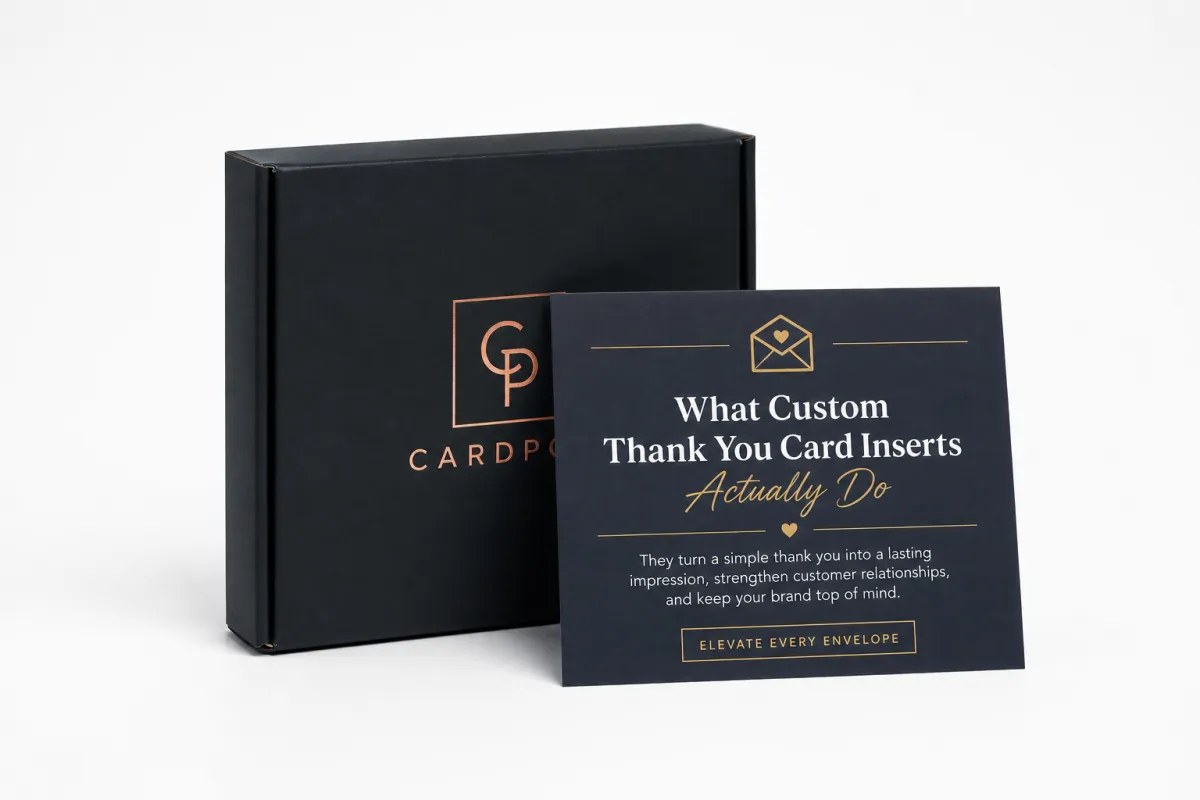
Custom thank you card inserts are printed cards, notes, or folded pieces placed inside an order before it ships. The job sounds simple: thank the customer. That is the opening line, not the whole script. A strong insert reinforces the brand, reminds the buyer why they chose you, and nudges them toward one action that helps the business. A review request. A reorder. A QR scan. A follow on Instagram. The best custom thank you card inserts do all of that while still sounding human.
The timing is what gives the card its power. The customer is no longer browsing a website or scrolling past ads. They are holding the box, examining the product, and making a judgment based on the full experience. That moment is more honest than a banner ad and more intimate than an email footer. A buyer who has paid, waited, unboxed, and touched the product is much more open to a direct thank-you note than to another generic discount blast. That is why custom thank you card inserts can pull more weight than a coupon code buried in a campaign nobody remembers opening.
They also work like a compact brand manager. If shipping ran late, the insert can calm the temperature. If the item is premium-priced, it can make the purchase feel justified rather than merely expensive. If the product is handmade, custom thank you card inserts can add warmth without adding clutter. If the order sits inside a larger packaging system, the insert becomes the final sentence. The closing beat matters. People remember endings more than brands like to admit.
The format shifts with the package. Rigid boxes often have room for a folded card. Mailers may only allow a postcard-sized insert. Tissue-wrapped goods usually take a single card tucked on top. Subscription shipments can rotate messages by month or campaign. Size, shape, and placement all affect how the insert lands, which is why the same message can feel premium in one box and awkward in another.
Bottom line: custom thank you card inserts are part thank-you message, part conversion tool, and part brand reminder. Weak copy or flimsy stock makes them disposable. Tight design, clean wording, and the right material turn them into a piece of packaging that earns attention instead of borrowing it.
How Custom Thank You Card Inserts Work in Packaging
Follow the customer journey and the logic becomes obvious. They place the order. The confirmation email arrives. Fulfillment begins. The package reaches the doorstep. The box opens. The product comes out first, but the insert is usually the next thing the customer notices. That sequence matters. Custom thank you card inserts work because they catch attention before it drifts. The buyer is already handling the order, which makes the message feel personal rather than promotional.
That timing gives the card more than one job. In e-commerce, it can support reviews or a second purchase. In handmade goods, it can make the transaction feel less transactional. In luxury or high-touch product packaging, it can reinforce value without crowding the product. In event kits and wholesale samples, it can tell the recipient exactly what to do next. A paragraph is usually too much. One clear nudge is usually enough.
Common message types tend to fall into a few buckets:
- Gratitude-only notes that keep the focus on appreciation.
- Branded inserts with QR codes that direct buyers to a landing page, reorder page, or social channel.
- Care instructions that reduce support questions and product misuse.
- Review requests that ask for feedback after the product has had time to earn it.
- Referral or reorder prompts that support repeat purchase behavior.
Custom thank you card inserts need to match the rest of the packaging system. A calm, premium brand should not suddenly sound like a clearance flyer. Clean typography should stay clean. Reserved color should stay reserved. This is where package branding either feels deliberate or slips into chaos. Random flyer energy has no place inside a box that is trying to feel considered.
In brands building a stronger packaging design system, inserts can sit alongside tissue paper, sticker seals, and custom printed boxes to create one continuous unboxing sequence. The customer should feel one idea, not four design moods fighting for attention. Even a low-cost insert can elevate the whole package if the container, the copy, and the offer are pulling in the same direction.
If you want a practical comparison, look at a small insert beside a larger branded card. The larger card may look more impressive on a table. The smaller one may fit better, cost less, and ship more efficiently. The better choice depends on the package and the order flow, not on some vague internet rule pretending all boxes behave the same way.
For brands that need other packaging pieces as well, the same planning logic applies across Custom Packaging Products. A good insert rarely stands alone. It is part of the system.
Design and Material Factors That Change the Result
Size comes first because it shapes everything else. Common custom thank you card inserts often use postcard dimensions, small note card sizes, or folded formats around 3.5 x 5 inches, 4 x 6 inches, or 5 x 7 inches. Smaller cards keep costs down and sit neatly inside mailers. Larger cards give more room for copy, a QR code, or a stronger visual layout, but they also increase material use and handling complexity if the insert ships separately. In compact packaging, size is not a decorative choice. It is a production decision.
Stock matters just as much. A 14pt cover stock often fits the brief when the goal is to stay light and economical. A 16pt or 18pt stock feels firmer in the hand and usually reads as more premium. Coated stock sharpens color and keeps photography crisp. Uncoated stock feels warmer, absorbs ink differently, and can suit handmade goods or eco-focused retail packaging. Soft-touch lamination can make custom thank you card inserts feel high-end, though it only makes sense when the brand can defend the extra expense. Otherwise you are paying for velvet on a business card.
Print method changes the tone. One-color printing works well for minimalist brands and lower budgets. Full-color printing makes sense when the insert relies on photography, gradients, or a visual promotion. Foil stamping adds a premium cue, but it needs restraint. Spot UV can highlight a logo or short phrase, although it is easy to overuse. Duplex printing, with content on both sides, helps when one side holds the thank-you note and the other carries a code or care details. Clarity wins. Decoration is only useful when it supports clarity.
Copy length is another pressure point. Short copy usually performs better when the package is small or the order is straightforward. Three clean lines often beat a full paragraph because people actually read them. Larger cards can support a little more story, but they still need one main action. If the goal is a review, say that. If the goal is a reorder, say that. If the goal is a social tag, say it once and stop talking.
Technical details decide whether the finished piece feels sharp or sloppy. Bleed needs to be set correctly. Trim lines need to stay clean. QR codes need to be large enough to scan after printing and folding. Ink should not vanish into textured stock. If fulfillment staff handle the cards in stacks, the finish should resist scuffing. For larger shipments, packaging teams often borrow transit checks from ISTA methods; if you need that sort of reference, the ISTA standards site is a useful starting point. For paper sourcing, FSC-certified stock still carries weight when buyers want a cleaner materials story without making the insert sound preachy.
I have watched a plain matte card outperform a more expensive foil version simply because the QR code scanned faster and the message was easier to read. That is kinda the whole point: the best-looking option is not always the best-performing one. Packaging buyers sometimes learn that the hard way after a glossy proof gets approved and then refuses to behave in real light.
Custom Thank You Card Inserts: Cost and Pricing Drivers
Pricing for custom thank you card inserts comes down to the usual variables: size, stock, print coverage, finish, quantity, and whether the job needs a custom shape or special folding. Small changes in any one of those areas can move the unit cost more than buyers expect. A plain one-sided card on standard cover stock lands in one range. Add full color on both sides, a soft-touch finish, and a custom die line, and the quote climbs. Not because printers enjoy drama, but because each step adds setup time, material, or finishing labor.
Volume changes the math in a way many buyers underestimate. At low quantities, setup costs get spread over fewer pieces, so the unit price stays higher. As quantity increases, the per-piece cost usually falls. That only helps if the design stays useful long enough to justify the run. A large order of custom thank you card inserts is wasteful if the offer changes next month or the QR code points to a landing page that will be replaced in two weeks. Cheap inventory that cannot be used is not cheap.
A practical range helps. A very basic insert can sit in the low-cost bracket, while a premium version with specialty finishing rises quickly. Most brands are not asking, "How fancy can this get?" They are asking, "What level of finish still supports the sale?" If the insert only needs to say thank you and encourage a reorder, better paper may matter more than foil. If the product itself sits in a higher price band, a cleaner stock and more careful print may be worth the lift.
| Option | Typical Specs | Typical Unit Range | Best Fit |
|---|---|---|---|
| Economy insert | One-color print, standard cover stock, simple trim | $0.08-$0.18 at moderate volume | Basic thank-you note, reorder reminder, simple mailer insert |
| Standard branded insert | Full color, 14pt-16pt stock, print on both sides | $0.14-$0.28 at moderate volume | Most e-commerce orders, review requests, QR code campaigns |
| Premium insert | 16pt-18pt stock, soft-touch, foil, or spot UV | $0.28-$0.65+ depending on finish | Luxury product packaging, gift orders, high-touch branded packaging |
Those numbers are directional, not a promise. Real quotes shift with artwork prep, shipping, rush timing, and whether the vendor includes proofing or bills for it separately. Setup fees, plate charges for certain processes, packaging for the finished inserts, and design revisions can all push the final cost above the headline unit price. That is why comparing vendors only by "price per piece" leaves money on the table. Compare the whole job.
Value becomes easier to judge when you think in outcomes. If custom thank you card inserts lift repeat order rate by even a small amount, or generate a steadier flow of reviews, the cost can pay back quickly. I cannot promise that every brand will see the same result; shipping speed, category, and customer base all matter. But in programs I have reviewed, the card rarely needed a dramatic lift to justify itself. If the insert looks nice but never drives action, it becomes decoration. Decoration has a place. Just do not pretend it is the same thing as strategy.
For brands already buying packaging components, inserts are often one of the easiest line items to test because the upfront spend stays manageable. A cleaner message, a stronger offer, or a more premium stock can be tested without rebuilding the entire packaging program.
Custom Thank You Card Inserts: Process and Timeline
The fastest way to order custom thank you card inserts is to lock the decisions early. Start with the goal. Choose the size. Finalize the copy. Then choose the stock and finish. If the offer keeps changing after proofing starts, the schedule slows. That is not the printer being difficult. That is production doing what production does.
A typical workflow looks like this:
- Define the single action you want the customer to take.
- Pick the format: flat card, folded card, or postcard-style insert.
- Choose the stock and finish based on budget and package size.
- Set the artwork, including bleed, safe area, and QR code placement.
- Review the digital proof carefully.
- Approve production.
- Print, trim, pack, and ship.
Simple digital jobs can move fast once the proof gets approved. More complex orders take longer, especially if they include specialty finishes, Custom Die Cuts, or a larger run that needs additional press time. If the inserts need to ship with a product launch, do not wait until the week before the boxes arrive. That is how people end up asking for miracles in email threads.
Most delays are boring, which is part of the problem. The copy is vague. The QR link is not final. Someone wants three different calls to action on one card. Another person decides the insert should "feel more premium" after the proof is already approved. Each change sounds minor until it reaches production and stalls the schedule. Custom thank you card inserts are simple compared with many packaging jobs, but they still need a clean approval chain.
Plan inventory around a real campaign window. A run that works for a seasonal promotion may become stale halfway through the stack if the offer changes. That is especially true for promo codes, event dates, and social campaigns. A better approach is to print a quantity that matches fulfillment velocity and a message that stays useful for as long as the stock will sit in the warehouse.
For brands refreshing a packaging system, it helps to test the insert alongside the rest of the package. Compare the card against the label, the box, and the internal wrap. If the brand is also updating Custom Packaging Products, keep the same tone and visual rules across everything. That way the insert supports package branding instead of drifting away from it.
A realistic schedule includes proof review, a physical sample when the job matters, and at least one test insert inside a real box or mailer. Flat artwork can mislead. Real packaging tells the truth quickly.
Common Mistakes That Make Inserts Feel Cheap
The quickest way to weaken custom thank you card inserts is to crowd them. Too many words. Too many offers. Too many logos. The card starts behaving like a sales sheet and loses the one thing it needs most: clarity. If the customer has to squint, decode, and hunt for the actual message, the insert has already lost the room. Packaging buyers know the feeling. Nobody wants to explain a cluttered insert after the boxes have already shipped.
Weak design causes the same damage from another angle. Thin fonts on low-contrast backgrounds are hard to read. Overused stock graphics make the piece feel generic. Awkward spacing makes the card look rushed. Even good custom thank you card inserts can feel disposable if the layout looks like it was assembled in five minutes by someone who thought alignment was optional. It is not.
Mismatch is where brands really trip. A premium product in a high-end box with a flimsy insert creates a strange disconnect. Handmade products can benefit from simpler stock and a warmer, less polished layout, but that only works when the choice feels intentional. The material should match the product and the price point. Luxury does not require ornate decoration. Rustic does not require sloppy execution. Customers notice the difference faster than some brands expect.
Offer fatigue is another quiet problem. If every order includes the same coupon code, customers learn to wait. That is not loyalty. That is training. A better plan rotates the purpose of custom thank you card inserts: one batch for reviews, one for reorder reminders, one for referral prompts, one for content collection. The design can stay consistent while the goal shifts.
Operational mistakes can cost as much as design mistakes. A wrong trim size means the card does not fit in the package. A QR code printed too small turns into a dead square. A finish that scuffs in the packing line makes the cards look aged before they are used. Warehouse teams do not care how clever the copy is if the stack jams in the carton.
Watch for these red flags:
- More than one primary CTA on a small card.
- Unreadable text on textured or dark stock.
- Codes or links that were not tested on a phone.
- Colors that shift badly between proof and final print.
- Cards too large for the mailer or box.
The cleanest custom thank you card inserts are usually the simplest ones. One message. One next step. One visual system. No one ever complained that a thank-you note was too easy to read.
Expert Tips and Next Steps for Better Inserts
Start with one goal. Not three. If you want more reviews, make the insert about reviews. If you want repeat orders, make the insert about the reorder path. If you want user-generated content, ask for a tag or upload. Trying to force every business objective onto one card usually creates a muddled insert that does nothing well. Custom thank you card inserts work best when the action is obvious and the ask is small.
Test two versions if you can. The experiment does not need to be complicated. Print one version with a review request and another with a reorder offer. Track response across a few hundred orders, then keep the one that performs better. That is a better use of time than guessing based on whichever stakeholder likes the blue version more. Small brands can run this test without much risk because the cards are inexpensive relative to the order value.
Copy should sound human. Short helps. Specific helps more. A line like "Thanks for supporting our small studio" feels real. "We appreciate your purchase" feels acceptable. "Please scan this code for an exclusive experience" sounds like a hostage negotiation with a marketing team. The first line matters most. If the gratitude does not sound genuine, the rest of the insert has to work harder.
Before you order a full run, ask for a pilot quantity or a physical proof. Put the card into the actual box or mailer. Check how it sits beside the product, tissue, and packing slip. Look at the card under warehouse lighting, not just on a calibrated screen. If the finish is reflective, test the QR code with a few different phones. If the insert is going into premium packaging, hold it next to the product and decide whether it feels equal to the price.
It helps to think in systems rather than isolated parts. If the box structure, label language, and insert are aligned, the customer receives one coherent brand story. If one piece is rustic, one is glossy, and one reads like a coupon flyer, the unboxing loses focus. That is why custom thank you card inserts should follow the same visual rules as the rest of the pack.
For teams building or refreshing their packaging line, the easiest path is straightforward: choose the size, choose the stock, write one useful message, request a proof, place a test order, and scale after you see how the insert performs in real product packaging. If you already use branded packaging, custom printed boxes, or subscription inserts, keep the design language consistent so the card feels like part of one system instead of an afterthought.
Custom thank you card inserts are one of those small packaging choices that look simple until they go wrong. Then everyone has an opinion. The safest approach is clean, specific, and tied to one measurable outcome. Print the pilot, put it in the actual box, and keep the message to one clear action that matches what you want the customer to do next. That is how custom thank you card inserts earn their place in the box instead of turning into expensive paper clutter.
What size are custom thank you card inserts usually?
Common sizes include postcard formats, mini note cards, and folded cards, depending on how much room the package allows. A 4 x 6 card is a practical middle ground for many brands because it leaves space for a short message, a QR code, and a clean brand mark. If the insert has to sit inside a small mailer, choose a size that will not curl, bend, or cover the product.
How much do custom thank you card inserts cost per piece?
Cost depends on size, stock, print coverage, quantity, and finish. Simple one-color inserts are usually the cheapest, while thicker stock, full color, and premium finishes push the price higher. The fastest way to lower the unit cost is usually a larger quantity, but only if you can use the full run before the message gets stale.
Are custom thank you card inserts worth it for small brands?
Yes, if the insert supports a clear goal such as repeat orders, reviews, or email sign-ups. Small brands often benefit because the card makes the package feel more personal without adding much cost. The key is to keep the message focused and avoid paying for fancy features that do not improve results.
What should I put on custom thank you card inserts?
Start with a real thank-you, then add one next step such as a review request, reorder link, or QR code. Keep the insert readable by limiting it to one main offer or action. Match the tone to the brand: clean and direct for premium products, warmer and more playful for handmade goods.
Can custom thank you card inserts include QR codes or promo codes?
Yes, and they are often useful when the next step is a review, reorder, or social follow. Make sure the code is large enough to scan and test it before printing the full run. Use one clear destination so the insert does not confuse people with too many links or offers.

