Buyer Fit Snapshot
| Best fit | Custom Die Cut Stickers Branding projects where brand print, material claims, artwork control, MOQ, and repeat-order consistency need to be specified before quoting. |
|---|---|
| Quote inputs | Share finished size, material target, print colors, finish, packing count, annual reorder estimate, ship-to region, and any compliance wording. |
| Proofing check | Approve dieline scale, logo placement, barcode or warning zones, color tolerance, closure strength, and carton packing before bulk production. |
| Main risk | Vague material claims, crowded artwork, missing packing details, or unclear freight terms can make a low unit price expensive after revisions. |
Fast answer: Custom Die Cut Stickers Branding: A Practical Playbook should be specified like a repeatable production item. The safest quote records material, print method, finish, artwork proof, packing count, and reorder notes in one written spec.
Production checks before approval
Compare the actual filled-product size with the drawing, then confirm tolerance on folds, seals, hang holes, label areas, and retail display edges. Reserve space for logos, QR codes, warning copy, and material claims before decorative graphics fill the panel.
Quote comparison points
Review material grade, print process, finish, sampling route, tooling charges, carton quantity, and freight assumptions side by side. A quote is only useful when the supplier can repeat the same color, closure quality, and packing count on the next order.
Custom Die Cut Stickers Branding: A Practical Playbook
Custom Die Cut stickers branding can change the feel of a package in roughly the time it takes someone to lift the lid. The box arrives, the surface is plain, and then a sharply cut sticker on the flap or insert changes the story. That tiny object is often the first branded item a customer touches, which explains why custom die cut stickers branding keeps earning real estate in serious packaging plans. For ecommerce teams, it is also one of the cheapest visible layers in the box, which is why you see it in scrappy startup kits and national rollouts alike.
Die cut stickers are simple in concept and a little more precise in practice: the sticker is trimmed to the exact outline of the artwork, logo, mascot, icon, or product shape instead of being boxed into a rectangle. That custom edge does a lot of work. It creates cleaner negative space, a tighter silhouette, and a more deliberate look on branded packaging, shipping cartons, laptop lids, retail packaging, and inserts. For buyers trying to strengthen brand identity without blowing up costs, Custom Die Cut stickers branding stays one of the few tools that is both visible and affordable.
The strange part is how long stickers keep working after the package is gone. Boxes get recycled. Tissue paper gets torn. A sticker lands on a laptop, notebook, water bottle, or storage bin and keeps doing its job for months. In one product sample review I watched last year, the sticker generated more comments than the outer mailer, which tells you something about how memory works. People keep stickers. Most packaging gets one glance and disappears into the trash.
The practical questions are straightforward: how are the stickers made, what changes the price, and what design choices make them look polished instead of crowded? You also need to know where Custom Die Cut stickers branding sits inside the wider packaging design system, because a sticker should support the rest of the product packaging, not fight it for attention. Used well, it adds polish. Used badly, it feels like a logo slapped on in a hurry. Customers can smell that shortcut a mile away.
Practical rule: if the sticker cannot read clearly from arm's length, it is too busy, too small, or both.
How does custom die cut stickers branding improve packaging?
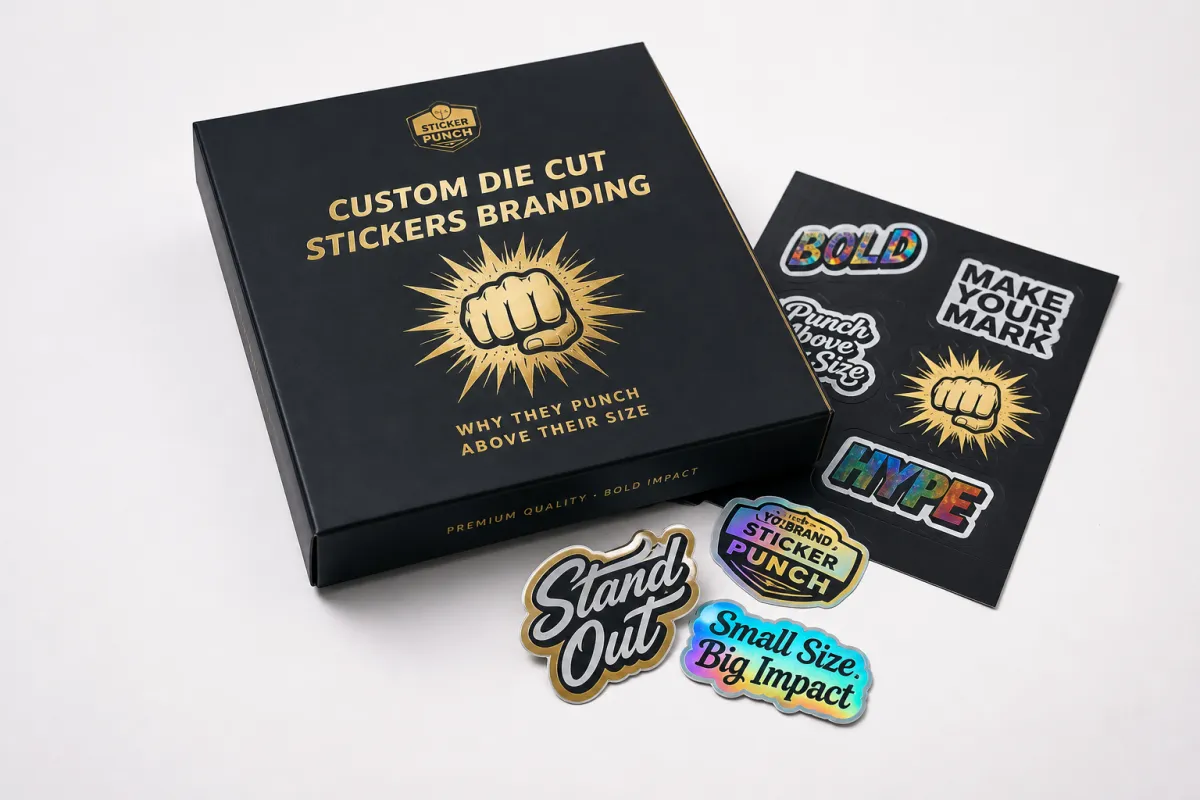
Good custom die cut stickers branding works because the format is compact, quick to notice, and easy to deploy. The customer does not need to decode a complicated insert, inspect a premium box finish, or parse a long message to understand who shipped the order. The sticker does the identification work. That is the assignment, and it is a useful one.
There is also a cost angle that gets missed in a lot of packaging meetings. A well-made sticker can sit on a kraft mailer, poly bag, folded carton, or thank-you card for a fraction of what a fully printed box costs. For many brands, custom die cut stickers branding becomes the least expensive way to keep package branding consistent across an entire line. It works for launch kits, sample packs, event giveaways, and subscription shipments without forcing a redesign of every carton in inventory.
The best use cases stand out once you start comparing surfaces. A clean logo sticker can seal tissue wrap inside a box. A mascot-shaped sticker can make a children's brand feel friendlier and less generic. A bold icon can turn a plain envelope into something that looks intentional rather than accidental. In each case, custom die cut stickers branding does more than decorate the package. It anchors the brand identity.
Small stickers sometimes outperform expensive packaging on repeated exposure. A custom printed box may impress once. A sticker gets peeled off and kept. A shipping label gets ignored. A well-cut brand sticker gets seen again every time someone opens a laptop or grabs a water bottle. That is not dramatic. It is effective. Packaging teams tend to respect things that keep working after the first impression fades.
For brands that sell through retail packaging and direct-to-consumer orders at the same time, custom die cut stickers branding can keep both channels visually aligned. Use the same artwork on a box seal, a counter display handout, and an insert. That kind of repetition matters more than most teams admit. Customers may not know the terminology, but they do register the pattern. And if the pattern is good, they remember it.
Another advantage is speed of iteration. Stickers let small brands test visual identity before investing in custom printed boxes or a heavier packaging system. If the shape, color, or icon does not land, the sticker can be corrected in a day or two. Ten thousand cartons do not need to be scrapped. That is a much smarter starting point for teams still refining package branding. It is also why early-stage founders are often weirdly attached to stickers; they are cheap, flexible, and kinda forgiving.
If you want adjacent packaging context, label and tag work often overlaps with Custom Labels & Tags, especially for products that need both presentation value and handling information.
How custom die cut stickers branding works from file to final sheet
The production flow is not mysterious, but there are enough small steps to trip people up. Custom die cut stickers branding usually begins with artwork upload, then proofing, contour creation, print setup, cutting, finishing, and packing. If the supplier is organized, the process feels tidy. If not, expect email back-and-forth and a proof that looks rushed.
The first thing to understand is the difference between kiss-cut, die-cut, and sheeted stickers. Kiss-cut stickers are cut through the top sticker layer but left on a larger backing, which makes them easier to peel and package in sets. Die-cut stickers are cut all the way to the outline of the sticker shape, so the sticker itself becomes the finished shape. Sheeted stickers are arranged in rows or on larger sheets for easier storage, handout, or fulfillment. For custom die cut stickers branding, die-cut and kiss-cut are the formats that matter most.
Artwork prep matters more than most people expect. Clean vector files save time because the cut path can follow crisp curves and straight edges without guesswork. Logos exported as blurry raster images create odd corners, jagged edges, and slow proofing. If the design has a mascot, outline, or icon with tiny details, the contour should leave enough breathing room so the knife does not clip important lines. That is one of the simplest ways to avoid ugly cut errors in custom die cut stickers branding.
The cut line is the outline the cutter follows. In most jobs, the artwork sits inside a safe area, with a bleed extending beyond the cut path so the final trim does not leave white slivers where color should be. If the supplier asks for a contour layer or spot color line, do not ignore it. That path is not decoration. It is production logic.
Proof approval is the point where a small mistake turns into a real cost. A good proof should show size, cut shape, colors, and any special finishing details. If the proof looks wrong, fix it then. A few minutes spent here can prevent a reprint later, and reprints are where budgets start leaking for no good reason. Custom die cut stickers branding stays economical only when the proof is correct the first time.
Timelines vary, but a practical range for many orders is a proof in 1-2 business days, production in about 3-7 business days after approval for simpler runs, and shipping after that depending on the carrier and destination. Complex contours, specialty finishes, or rush scheduling can stretch the project. If a supplier promises everything in a single afternoon, ask which part of the process they skipped. Nobody should be that lucky.
For brands comparing production choices across a broader packaging lineup, it helps to view the whole system instead of only the sticker. Custom Packaging Products can provide the context for how a sticker, box, mailer, and insert should work together rather than look like four unrelated purchases from different vendors.
Custom die cut stickers branding costs: what affects pricing
Pricing surprises usually happen because the quote request leaves out too many details. Custom die cut stickers branding costs depend on quantity, size, shape complexity, stock choice, finish, color coverage, and turnaround speed. That is not a vague list. Each piece moves the number in a real way.
Quantity usually has the biggest effect on unit price. A small run often costs more per sticker because setup work gets divided across fewer pieces. Larger runs bring the unit price down, though not always enough to justify over-ordering. I have seen teams chase a lower per-unit number and then sit on boxes of outdated stickers after a brand refresh. Cheap stops being cheap the moment the logo changes.
Material matters just as much. Paper stickers are often fine for indoor use, light handling, and some retail packaging needs. Vinyl costs more, but it handles moisture, scuffing, and repeated contact better. Matte lamination gives a softer, more premium feel. Gloss adds brightness and more punch. Clear stock can look clean and minimal, but it also exposes design flaws with brutal honesty. If the art is weak, clear vinyl will not rescue it. It will just reveal the problem sooner.
Shape complexity affects labor too. A simple oval or rounded icon is easier to cut than a shape with hairline points, nested cut-outs, or a jagged mascot outline. That is why custom die cut stickers branding can swing from straightforward to frustratingly expensive without the customer changing much at all. The cut path is part of the product.
Here is a practical pricing snapshot. These are typical market-style ranges, not promises from every supplier, because suppliers differ and print specs can move the numbers quickly. If your vendor quotes outside these bands, there may be a good reason. Ask for it.
| Option | Typical Use | Durability | Typical Price Impact | Notes |
|---|---|---|---|---|
| Paper die cut sticker | Indoor inserts, short-lived mailers, handouts | Light | Lowest | Good for low-abuse packaging and test runs |
| Matte vinyl die cut sticker | Premium brand seals, laptops, boxes, retail packaging | Medium to high | Moderate | Popular for a quieter, more elevated look |
| Gloss vinyl die cut sticker | Bold color, high-contrast logos, retail display | High | Moderate | Often reads well from a distance |
| Clear vinyl with white ink | Minimal branding, glass, bottles, modern packaging | High | Higher | White ink and careful proofing add setup complexity |
| Waterproof laminated vinyl | Shipping, drinkware, outdoor use, heavy handling | Very high | Highest | Worth it only if the sticker will get abused |
For many orders, a 2-inch to 3-inch die-cut sticker on standard vinyl may land somewhere around $0.10 to $0.35 per piece in larger quantities, while smaller runs can climb well above that depending on setup and finishing. Specialty coatings, white ink, or oversized shapes can move the cost into a different category. The smarter move is not to chase the cheapest quote. It is to match the sticker to the job.
That is where smart buyers use the smallest size that still reads clearly. A 1.5-inch sticker can work beautifully for a simple icon, but text-heavy artwork needs more room. Paying for a larger size because the logo was not designed for tiny reproduction is a design problem, not a pricing problem. Solve the design first.
If you are building a broader branded system, compare the sticker budget against label and insert spend. For some products, custom die cut stickers branding gives more perceived value than a slightly fancier print finish elsewhere. For others, the sticker should stay in the supporting role. That depends on the product packaging and how much handling the item will face.
Key design factors that make custom die cut stickers branding work
Design is where custom die cut stickers branding either looks crisp or falls apart. The best stickers are not crowded. They are legible. A sticker has seconds, not minutes, to communicate. Contrast, hierarchy, and shape all need to do visible work.
Start with contrast. Dark logo on light stock. Light logo on dark stock. Color that separates the mark from the package surface. If the sticker sits on a brown kraft mailer, low-contrast beige tones will vanish. If it sits on a white carton, pale gray or washed-out color can look accidental. Packaging design is not the place for timid color choices unless the entire brand system is built around restraint.
Then look at hierarchy. If the logo is small, the brand name should be larger. If the shape is bold, the text should stay simple. Do not cram a tagline, website, QR code, and social handle into a 2-inch sticker unless tiny regret is part of the strategy. Custom die cut stickers branding works best when one idea carries the load.
The shape should support the mark, not fight it. A mascot-shaped outline can work well if the illustration has clean edges and enough silhouette. A logo with a lot of fine text may not benefit from a complex die cut at all. Sometimes the smartest shape is a clean contour around the mark with a generous border. Weird for the sake of weird usually reads as amateur.
Bleed and safe area are the practical details that protect the final trim. Keep critical text away from the cut line. Leave enough margin so the border does not look pinched. If the artwork includes a dark edge, make sure that edge has room to breathe. A sticker cut too tight looks rushed, and rushed packaging makes a brand feel smaller than it is.
Material and finish send their own signal. Matte suggests a quieter premium feel. Gloss adds punch. Clear stock creates a minimal effect and lets the package surface show through. Vinyl performs better in damp, rough, or high-contact settings. For some brands, custom die cut stickers branding on matte vinyl feels more credible than a flashy gloss finish, especially on premium retail packaging or calm, understated brand identity systems.
The surface underneath matters too. A sticker can look excellent on a white carton and disappear on dark corrugate. It can feel neat on smooth coated paper and less stable on textured kraft. Test the sticker against the real package before finalizing the run. That sounds basic, yet people still skip it and then act surprised when the result is uneven.
For better packaging design decisions, it helps to study standards and industry references rather than guessing. The Institute of Packaging Professionals has useful packaging education and general industry context, and FSC is a solid reference if you are choosing paper-based materials with responsible sourcing in mind. Neither replaces supplier guidance, but both help you ask sharper questions.
In practical terms, custom die cut stickers branding should fit the way the package is handled. A sticker on a mailer flap needs enough adhesion and visual clarity to survive shipping. A sticker on a retail label needs shelf presence. A sticker for an event handout needs immediate recognition. One format can do all three jobs only if the design is disciplined.
Step-by-step custom die cut stickers branding process and timeline
A clean order process saves time and cuts down on mistakes. Custom die cut stickers branding usually goes smoother when it is treated like a packaging project, not a casual print order. That means deciding the job before files are uploaded.
- Define the goal. Is the sticker sealing a box, promoting a product line, supporting an event, or acting as a handout?
- Pick the use case. A shipping carton, sample pack, retail display, and laptop giveaway all need different choices.
- Finalize the artwork. Clean vector files, outlined fonts, and simplified cut shapes make production faster.
- Choose the specs. Decide on size, stock, finish, adhesive, and whether you need white ink or waterproof material.
- Review the proof. Check the contour, colors, border, and the relationship between artwork and cut path.
- Approve production. Once approved, the run moves into print and cutting.
- Track delivery. Build in shipping time so the stickers arrive before the launch date, not after it.
Realistic timelines depend on complexity. A basic order with print-ready files may move from proof to production in under a week. Add revisions, specialty lamination, or a custom shape with tight contours, and the schedule stretches. Shipping can add another few days, more if the order is traveling far or crossing borders. For planning purposes, a 7-14 business day total window is a safer expectation than any overpromised rush estimate. That applies to most custom die cut stickers branding jobs unless the supplier has fast-turn inventory and you have clean files ready.
The fastest orders usually share the same traits. The artwork is prepared in vector format. The shape is simple. The proof is approved quickly. The supplier understands packaging standards and does not need hand-holding over every line. The slow orders are the opposite: missing fonts, blurry logos, contour changes, color revisions, and a last-minute request to shrink everything by 30 percent. That kind of scramble always costs more time than it should.
If the sticker will live on shipping cartons or other abused surfaces, think about transit testing as part of the plan. The ISTA standards are worth reviewing for handling and shipping context, especially if the sticker is part of a larger system that needs to survive drops, vibration, and warehouse handling. A sticker is not a transit test by itself, but it still belongs to the package's real-world performance.
Here is the rule I would give any buyer: if the sticker supports a launch date, add buffer time. Do not build a plan around a perfect rush order. That is how teams end up paying for overnight shipping because someone approved the proof late on a Friday. Custom die cut stickers branding is a simple product, but the process still deserves lead time. Planning for that lead time is boring, yes, but it beats panic.
Common mistakes that weaken custom die cut stickers branding
The worst sticker mistakes are usually basic. Too much text. Too little contrast. A logo that looks fine at screen size but turns muddy in print. Custom die cut stickers branding exposes weak design quickly because the format is small and unforgiving.
One common error is trying to fit the entire brand story onto the sticker. That is not branding. That is panic in a circle. A sticker should not hold the mission statement, three taglines, a social handle, and a URL that nobody will type. If the message is dense, strip it back to one mark and one clear idea. The rest belongs on the insert, the box, or the website.
Another problem is ignoring the actual surface. A design can look sharp in a mockup and disappear on a brown corrugated box, textured envelope, or dark pouch. The fix is simple: test the artwork against the real material before production. Custom die cut stickers branding has to work in context, not in a polished mockup alone.
Bad file prep is a budget killer. Raster logos, missing cut paths, open vector shapes, and unapproved color builds all trigger delays. Some suppliers clean files for you, but they should not have to rebuild the art file from scratch. The cleaner the handoff, the fewer surprises in proofing.
Overordering is another classic mistake. Brands sometimes order a giant run because the unit price looked attractive, only to discover the product line shifted, the logo changed, or the packaging size was updated. A smaller test run usually makes more sense for a first order. If the sticker performs well, reorder with better information. That is how you avoid boxes of obsolete inventory sitting in a corner until somebody asks why they are still there.
- Too much text: Cut the copy down to the mark and a short support line, if needed.
- Low contrast: Adjust colors so the sticker stands apart from the package surface.
- Weak file prep: Use vector art, outlined fonts, and a clear cut path.
- Wrong size: Test against the actual package before placing a full order.
- Overbuying: Start with a pilot run and scale after the design proves itself.
Another quiet issue is finish mismatch. A glossy sticker can feel too loud for a calm premium brand. A matte sticker can feel too flat for a playful, high-energy identity. Custom die cut stickers branding should match the tone of the rest of the product packaging, not only the logo color palette. Packaging is a system. Treat it like one.
Expert tips and next steps for custom die cut stickers branding
Start small and build from a pilot. That is the cleanest way to test custom die cut stickers branding without wasting budget. Pick one hero product, one sticker size, and one finish. Let that combination tell you whether the shape reads well, whether the material feels right, and whether the sticker actually supports the unboxing moment.
For many brands, the sweet spot is a simple die-cut logo sticker on the outer box, plus a second sticker on the tissue wrap or thank-you card. That gives the packaging a more complete feel without turning the order into an expensive reprint circus. The sticker becomes part of the unboxing experience, not just a badge stuck somewhere random.
You can also use custom die cut stickers branding to tie multiple packaging items together. Put the same icon on inserts, seal stickers, and event handouts. Pair it with a consistent type style and a limited color palette. That level of repetition strengthens brand identity faster than a dozen disconnected design ideas. Repetition is underrated because it feels ordinary, and ordinary is often what customers trust.
One practical cost-control move is to standardize sizes. If your boxes, mailers, and cards can all use one or two sticker dimensions, the reorder process gets easier and setup friction drops. The supplier spends less time managing unique specs, and your team spends less time deciding whether every order needs a new format. Ordinary? Yes. Effective? Also yes.
Spend more only where the use case justifies it. Waterproof or scratch-resistant stickers make sense for drinkware, outdoor use, hand soap bottles, and packages that get handled hard. Standard paper stickers may be fine for inserts or short-lived promotions. That is where custom die cut stickers branding can stay efficient or become pointless overkill.
If you want a broader packaging roadmap, compare stickers with the rest of the system: boxes, tags, inserts, and sleeves. A sticker can be the most visible piece, but it should not have to carry every job by itself. That is what Case Studies are useful for: seeing how other packaging decisions were handled in the real world, not in a sales pitch.
One thing I would add from experience: the best packaging teams keep a sample board. A physical sheet with the sticker, the box stock, the insert paper, and the finish lets people judge tone instead of guessing from a monitor. Screens lie. Paper does not. That little habit saves more bad decisions than most software ever will.
Next steps are straightforward. Audit your current packaging. Choose one SKU to pilot. Request a proof. Check the sticker against the actual box, pouch, or insert. Then scale custom die cut stickers branding only after the first run proves the design, material, and size are doing their job. That is a far better process than guessing, ordering big, and hoping the package looks expensive by accident.
If the goal is a cleaner brand identity, a stronger retail presentation, or a more memorable unboxing experience, custom die cut stickers branding is one of the simplest upgrades available. Use it with restraint, choose specs that fit the surface, and keep the artwork honest. That is the practical takeaway: pick the right material, size it for the real package, and test Before You Buy deep. The sticker should support the brand, not distract from it.
FAQ
What makes custom die cut stickers branding different from regular stickers?
Die cut stickers are trimmed to the exact shape of the artwork, so the outline becomes part of the design instead of leaving a plain rectangle around it. That custom edge usually feels more intentional and more premium than a standard sticker. For logos, mascots, and icons, custom die cut stickers branding also gives better shelf presence on packaging, laptops, and inserts.
How much do custom die cut stickers branding orders usually cost?
Price depends on size, quantity, material, finish, and cut complexity. Smaller runs cost more per piece because setup gets spread over fewer stickers, while larger runs usually bring the unit cost down. Specialty options like matte lamination, waterproof vinyl, or rush production increase the total, so it pays to compare specs instead of chasing the lowest quote and pretending the rest does not matter.
How long does custom die cut stickers branding take to produce?
The timeline depends on proof approval, print queue, cutting, and shipping distance. Simple orders can move fast if the artwork is ready and the proof gets approved quickly. If the design needs revisions or the contour is complex, build in extra buffer time so the sticker does not become the reason a launch slips.
What file format is best for custom die cut stickers branding artwork?
Vector files are the safest choice because they keep edges crisp and make cut paths easier to set up. Use outlined or embedded fonts, clean paths, and separate layers for artwork and contour lines if possible. If the file is not print-ready, expect delays while the supplier sorts it out, which is a polite way of saying the setup team gets to do extra work you could have avoided.
What size works best for custom die cut stickers branding on packaging?
The right size depends on where the sticker will go and how much detail the design contains. Small sizes work for simple logos, but text-heavy artwork needs more space to stay readable. Test the sticker against the actual box, mailer, or insert before placing a full run, because custom die cut stickers branding only works if the final piece fits the surface and still reads cleanly.

