Buyer Fit Snapshot
| Best fit | custom tissue paper price list for packaging buyers comparing material specs, print proof, MOQ, unit cost, freight, and repeat-order risk where brand print, material, artwork control, and repeat-order consistency matter. |
|---|---|
| Quote inputs | Share finished size, material target, print colors, finish, packing count, annual reorder estimate, and delivery region. |
| Proofing check | Approve dieline scale, logo placement, barcode or warning zones, color tolerance, and any recyclable or compostable wording before bulk production. |
| Main risk | Vague material claims, crowded artwork, or missing packing details can create delays even when the unit price looks attractive. |
Fast answer: Custom Tissue Paper Price List: Materials, MOQ & Value should be specified like a repeatable production item. The safest quote includes material, print method, finish, artwork proof, carton packing, and reorder notes in one written spec.
What to confirm before approving the packaging proof
Check the product dimensions against the actual filled item, not only the sales mockup. Ask for tolerance on folds, seals, hang holes, label areas, and retail display edges. If the package carries a logo, QR code, warning copy, or legal claim, reserve that space before decorative graphics fill the panel.
How to compare quotes without losing quality
Compare board or film grade, print process, finish, sampling route, tooling charges, carton quantity, and freight assumptions side by side. A lower quote is only useful if the supplier can repeat the same color, closure quality, and packing count on the next order.
If you are comparing a Custom Tissue Paper price list, the first number on the page is rarely the number that lands on your invoice. I have watched buyers chase a low sheet price like $0.15 per unit for 5,000 pieces, only to get pinned down by a $120 setup charge, a $45 proof revision, a $28 export carton fee, and freight from Shenzhen to Los Angeles that added another few hundred dollars before the pallet even cleared receiving. The cheap line item looks tidy until the order is built out on the factory floor in Dongguan or Yantian, where the real cost starts showing its edges. I still remember one sourcing call where everyone was celebrating a beautiful per-sheet rate, and then the freight quote walked in like an uninvited relative and wrecked the mood.
Custom tissue is one of the most misunderstood pieces of branded packaging. The material seems simple from a distance, yet the minute you change sheet size, print method, paper weight, or color count, the Custom Tissue Paper price list shifts with it. Serious packaging teams compare price per sheet, price per ream, and landed cost before they sign off, because the quote that looks best on a spreadsheet is not always the one that behaves best in production. A 17gsm white sheet with one Pantone spot color printed in Dongguan is a very different job from a 22gsm pink sheet with a full-bleed four-color repeat coming out of a plant in Wenzhou, Zhejiang, even if both samples sit on the same table.
If you are also sorting through labels, inserts, or Custom Packaging Products, the same rule applies: define the spec first, judge the price second, and only then look at the total landed cost. A carton built on 350gsm C1S artboard, a 157gsm insert, and a 17gsm tissue sheet are not interchangeable line items, even if they all sit inside the same retail kit. That sequence saves far more money than haggling over a headline rate that still has half the work missing from it. I have seen teams argue for twenty minutes over a $0.02 difference, then forget to ask whether the quote even included proofing, which is how the invoice grows teeth later.
Why the Custom Tissue Paper Price List Can Surprise Buyers
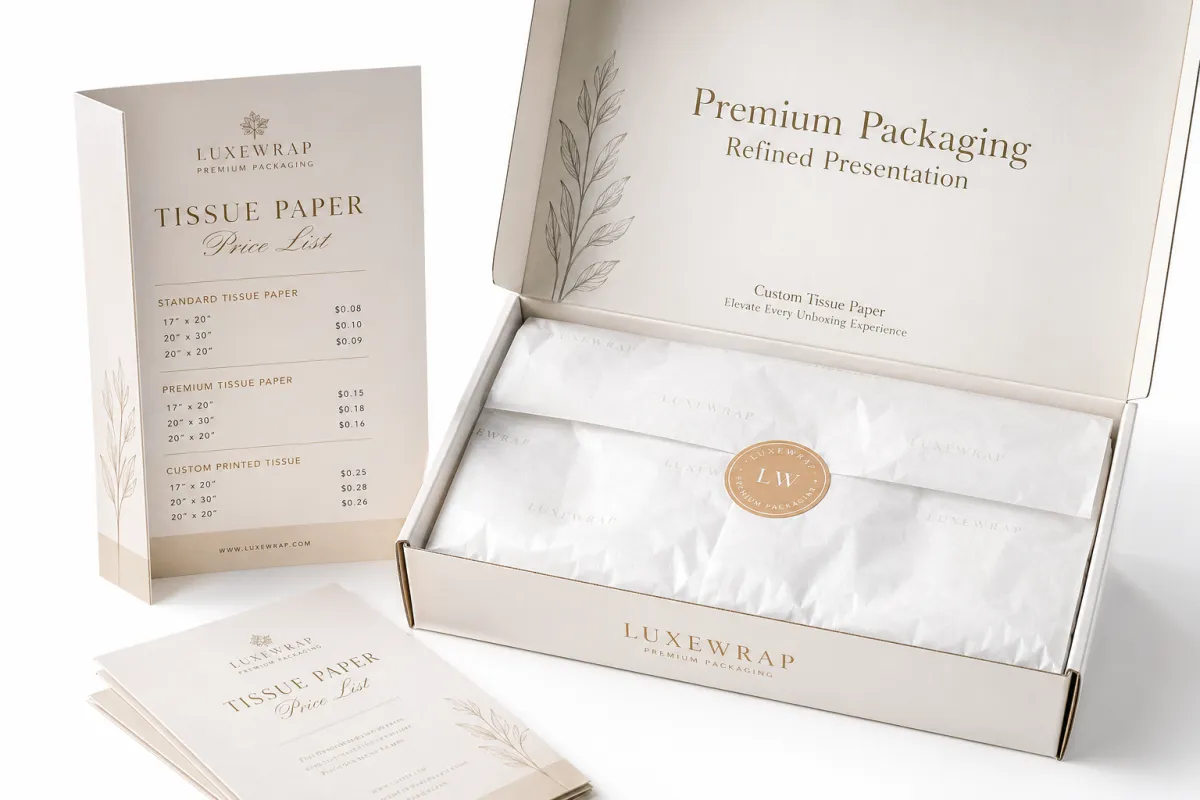
The first time I saw a tissue quote blow past budget, I was standing beside a press line in Shenzhen while a buyer from a mid-sized apparel brand studied three nearly identical samples under the same fluorescent light. The lowest quote was for a simple one-color repeat on 17gsm white tissue. The next quote looked only slightly higher on paper, but the factory in Dongguan had built it around a full-bleed four-color pattern with tighter registration and heavier ink coverage. That second version cost more to run, more to inspect, and more to ship because the packed cartons weighed 11.2 kg instead of 8.4 kg. The custom tissue paper price list had looked clean in the inbox. The production floor told a different story.
That gap is where most confusion starts. Buyers assume sheet size drives the custom tissue paper price list, yet the real cost picture includes print method, paper grade, folding method, carton count, and freight mode. A small logo repeat on 17gsm white tissue can price very differently from a dense pattern printed on 22gsm colored tissue. A 20 x 30 inch sheet might run at one rate, while a 24 x 36 inch sheet pushes paper usage up by roughly 44 percent before the press operator even starts registration checks. The visual change may feel minor to a brand team reviewing mockups. The press operator sees two different jobs with two different sets of handling requirements.
The other place where budgets drift is the quote itself. A low unit price can still become the expensive order if the supplier has tucked setup fees, plate charges, proof changes, or special handling into later lines. I saw this during a client meeting with a boutique gift brand that wanted a premium unboxing moment with crisp folds and a soft finish. Their first custom tissue paper price list came back with an appealing per-sheet number of $0.13 at 10,000 sheets, but the supplier had left out plate prep, two extra proof rounds at $35 each, and export cartons packed 500 sheets per case. Once those pieces were added, the total stopped looking competitive. It was one of those moments where everyone at the table got very quiet, because nobody enjoys discovering the real number after they have already fallen in love with the sample.
Price per sheet helps. So does price per ream, especially when a ream contains 480 sheets and the carton holds 10 reams for a total of 4,800 sheets. Neither one gives the full answer by itself. Packaging teams need landed cost because that captures the real purchase decision: paper, setup, packing, freight, and the time spent getting the job approved. If the tissue is only one element in larger retail packaging or package branding work, the broader estimate matters even more. A brand may accept a slightly higher tissue cost if the visual return improves shelf presence or the presentation inside the box feels more deliberate.
Another common mistake is asking for “tissue paper pricing” without stating print coverage or final sheet dimensions. A serious supplier cannot build a useful custom tissue paper price list from that kind of request. The cleaner the spec sheet, the cleaner the quote. That holds true whether the order is 3,000 sheets for a test run or 300,000 sheets for a recurring retail program. I know that sounds obvious, but you would be amazed how often a buyer sends a two-line email and then acts personally offended when the pricing comes back with questions.
“We thought we were comparing the same thing,” one client told me after a reorder review in Chicago. “Then we realized one quote covered only the tissue at $0.11 per sheet, while the other included artwork prep, packing, and freight to our warehouse in Illinois.”
If you want a more accurate quote, ask for line items. Ask whether the tissue is printed on one side or both. Ask whether the repeat pattern is small, standard, or full-bleed. Ask whether the freight figure is EXW Shenzhen, FOB Yantian, or delivered to your distribution center in Dallas. Those questions do not slow a project down; they keep the custom tissue paper price list honest and useful. My opinion? A supplier who gets annoyed by those questions is probably not the supplier you want handling a branded packout.
Custom Tissue Paper Price List Basics: What You Are Buying
A good custom tissue paper price list starts with a clear definition of the product. You are not just buying paper. You are buying a combination of sheet dimensions, basis weight, opacity, print coverage, ink count, packing format, and quality tolerance. Once those parts are spelled out, the numbers stop feeling random and start behaving like a real manufacturing quote from a plant in Dongguan, Foshan, or Suzhou.
Most custom tissue projects begin with sheet size. Common dimensions include 20 x 30 inches, 24 x 36 inches, and smaller formats used for jewelry, cosmetics, and promotional inserts. A larger sheet can reduce folding labor during pack-out, but it also increases paper consumption and shipping volume. That is one reason the custom tissue paper price list can move in ways that do not feel intuitive at first glance. For a 20 x 30 inch sheet folded once, the packed case may weigh 6.8 kg; for a 24 x 36 inch sheet folded twice, the carton can climb past 9 kg and change the freight quote by a meaningful margin.
Paper weight matters just as much. Lightweight tissue around 17gsm works well for decorative wrapping and gift presentation, while 22gsm or 28gsm can stand up better in apparel packaging or higher-end unboxing programs. I have seen a luxury accessory brand move from 17gsm to 20gsm after the pack-out team in Shenzhen complained that the lighter sheet tore too easily when folding silk scarves. Their custom tissue paper price list went up by $0.02 per sheet, yet damaged presentation dropped sharply and the shipment arrived looking far more polished. That kind of trade-off is exactly why I prefer to talk about value instead of chasing the lowest number like it is some kind of prize.
Opacity is another quiet cost factor. A more opaque sheet often uses more fiber or a different finishing approach. That improves presentation, especially when the tissue carries a bold brand mark, but it can raise the price. A 17gsm sheet with 68 percent opacity behaves differently from a 22gsm sheet with 82 percent opacity under retail lighting, especially inside a white matte box or a 350gsm C1S artboard carton. For products that depend on a clean reveal, such as fragrance sets or premium gift packaging, opacity earns its keep. For secondary wrap inside corrugated shipping cartons, the extra expense may not buy much.
Print format has its own effect on cost. Some buyers want a simple one-color logo repeat. Others want a dense patterned background that covers nearly the entire sheet. The second option usually pushes the custom tissue paper price list higher because it consumes more ink, requires more setup time, and calls for tighter inspection on the press. I have always thought that tissue printing looks easy right up until you see how unforgiving it is when a repeat drifts by a hair. Tiny mistakes on tissue show up with annoying confidence, especially on a 6-inch repeat where the logo lands too close to the fold.
A practical buyer checklist helps separate one offer from another:
- Sheet size in inches or millimeters, such as 20 x 30 in or 508 x 762 mm
- Paper weight in gsm, such as 17gsm, 20gsm, or 22gsm
- Print method and number of colors, usually 1, 2, or 4
- Single-sided or double-sided printing
- Pattern repeat size and coverage percentage, such as 30 percent or full bleed
- MOQ and tiered pricing, often 5,000, 10,000, or 20,000 sheets
- Packaging format: ream, bulk carton, or poly-wrapped
- Lead time from proof approval, usually 12 to 15 business days
- Freight term and destination, such as EXW Dongguan or DDP Chicago
If a supplier cannot answer those points, the custom tissue paper price list is not ready for decision-making. It may be a teaser. It may be a rough estimate. It is not yet a procurement tool, and it should not be treated like one.
For brands that are refining packaging design across boxes, inserts, and wrap, I like to compare the tissue quote to the rest of the stack. A tissue upgrade may create more visible value than a slightly glossier carton. In a complete product packaging system, the smallest sheet sometimes carries the strongest brand signal because it is the last thing a customer touches before the product appears. That little moment matters more than a lot of teams admit, especially when the outer carton is only 350gsm C1S artboard and the tissue sits on top like the final layer of polish.
Custom Tissue Paper Price List: Specifications That Change Cost
The quickest way to read a custom tissue paper price list is to identify the variables that change production time. Sheet size is one. Paper thickness is another. After that, the print layout becomes decisive. A simple one-color repeat on 17gsm stock is usually less expensive than a multi-color design on 22gsm stock, and a tight alignment requirement can add cost even if the artwork looks minimal on the screen. A factory in Qingdao may quote the same logo at one rate on a 4-inch repeat and another rate on an 8-inch repeat because the larger pattern forces slower running speed and more waste.
Large repeat patterns often need more careful plate setup, especially when the logo or motif has to land in a precise field. Full-bleed printing can be even more demanding because it stretches ink coverage across the entire sheet. That is where the custom tissue paper price list climbs. The press runs slower, the waste allowance rises, and the supplier may need a longer proofing cycle to lock color accuracy. I have stood next to enough presses in Dongguan and Wenzhou to know this part is not glamorous; it is a lot of checking, adjusting, and muttering over samples under harsh light.
Color count matters in a way many buyers underestimate. One Pantone spot color is not the same as three spot colors. Four-color process printing is a different production conversation entirely. If your art uses gradients, photographic effects, or multiple tones, expect the custom tissue paper price list to reflect the extra setup and registration work. It is not just ink cost. It is the labor of keeping the design clean across thousands of sheets without drift, shadowing, or uneven registration, and it is why a factory may quote 12 to 15 business days from proof approval for a one-color run but add 3 to 5 more business days for a full-coverage design.
Finishing decisions affect both price and usability. Custom folding can make pack-out easier, but it adds handling time. A sheet folded from 24 x 36 inches down to 12 x 18 inches usually needs one extra machine pass and more careful stacking. Die-cut sizes may be needed for specific product packaging programs, yet those custom dimensions can create more waste from the parent sheet. Specialty packing, such as branded outer wrap or premium ream presentation, can also add a few cents per unit. On a small run, those cents are visible. On a large run, they still matter because they multiply fast.
Here is a useful comparison for common quote scenarios. These are typical market examples from factories in Shenzhen, Dongguan, and Ningbo, not universal rates, because paper grade, freight lane, press room capacity, and ink system all move the number.
| Option | Typical Spec | MOQ | Example Unit Price | Best Fit |
|---|---|---|---|---|
| Entry-level repeat | 17gsm, 1-color logo repeat, single-sided, 20 x 30 in | 5,000 sheets | $0.15 per sheet | Gift wrap, light retail packaging, seasonal promotions |
| Mid-tier branded sheet | 20gsm, 2-color repeat, standard opacity, 24 x 36 in | 10,000 sheets | $0.12 per sheet | Apparel, boutique brands, custom printed boxes add-ons |
| Premium full-coverage | 22gsm, 3-4 colors, high ink coverage, tight registration | 20,000 sheets | $0.09 per sheet | Luxury unboxing, branded packaging programs |
| Special format | Custom size, folded, packed in branded reams, poly-wrapped | 10,000+ sheets | $0.18 per sheet | Retail presentation, controlled pack-out, premium gifting |
The table shows something useful: the lowest visible unit price is not always the best value. If you need 5,000 sheets for a seasonal gift program, a cheaper per-sheet rate may not be available because the setup burden is too high. If you need 30,000 sheets for recurring retail packaging, the higher-volume tier can push the custom tissue paper price list into a much better zone and free up budget for the carton or insert program. That is the kind of boring math that saves real money, even if it does not sound exciting at lunch.
When I visited a supplier line that printed tissue for fashion brands in Guangzhou, I noticed a simple truth. The jobs that looked easiest on the sample table were not the cheapest in production. A centered logo on a small repeat can take less ink, but if the brand insists on an exact color match to Pantone 186 C, the printer may spend more time pulling proofs than running the press. That is why a useful custom tissue paper price list always separates artwork complexity from basic material cost and does not hide setup behind a neat unit line.
For sourcing teams, the cleanest comparison is to ask whether the supplier priced against a standard spec or a custom one. If a quote is built around 20 x 30 inches, 17gsm, one-color repeat, and bulk pack, then you can compare it directly. If the quote is loosely worded, it is really a starting point. A reliable custom tissue paper price list should read like a procurement document, not a marketing flyer dressed up as one.
At this stage, I also check whether the supplier can support claims tied to sourcing and shipping discipline. For paper-related sustainability claims, I like to see clear documentation and chain-of-custody language from FSC. For transport durability, especially if the tissue is packed with other retail packaging materials, I look at testing principles from ISTA. Those references do not change the unit price directly, but they do change the reliability of the overall program and the confidence level behind the quote.
Pricing, MOQ, and Volume Breaks in the Custom Tissue Paper Price List
MOQ is where many buyers first feel the pressure of a custom tissue paper price list. Minimum order quantities exist because setup, proofing, plate work, and press adjustment have to be spread across enough sheets to make the job viable. A small order can absolutely be produced, but the unit price usually rises because those fixed costs are shared across fewer sheets. A plant in Jiangsu might be happy to print 3,000 sheets for a test program, yet the per-sheet figure can be 25 to 30 percent higher than the 10,000-sheet tier.
That is why one quote might show $0.20 per sheet at 5,000 pieces, while another drops toward $0.12 or even lower at 20,000 pieces. The run is not eight cents better by magic. The supplier is allocating setup across more output. I have seen teams reject a higher MOQ too quickly, only to reorder within six weeks and discover they would have saved money by committing to the larger tier the first time. The custom tissue paper price list rewards planning, especially when the artwork is likely to stay the same for multiple seasons.
Typical quote components include:
- Artwork setup - prepress work, file cleanup, and color separation, usually $25 to $75 depending on file condition
- Plate or print preparation - screens, plates, or digital setup depending on method, often $60 to $180
- Production - paper, ink, press time, inspection, and trimming, which changes most between 17gsm and 22gsm stock
- Packaging - bulk cartons, reams, or branded wrapping, commonly $8 to $30 per carton
- Shipping - freight from the factory to your warehouse or distribution center, such as Yantian to Long Beach or Ningbo to Seattle
When buyers look only at the production line, they miss half the picture. A quote can feel inexpensive until the supplier adds artwork work, special packing, and delivery to your door. That is why a dependable custom tissue paper price list must be read line by line. The number that matters is not the press rate. It is the total acquisition cost from the factory gate to the receiving dock. I have watched perfectly sensible teams get seduced by a great production line only to be mugged by shipping, and nobody likes that kind of surprise.
Here is a quick way to compare pricing tiers without getting lost in the details:
- Small run - 5,000 sheets or fewer, good for test markets, holiday launches, or one-off campaigns; higher unit cost is normal
- Mid run - 10,000 to 20,000 sheets, often the best balance for growing retail packaging programs
- Bulk run - 30,000 sheets or more, best for repeatable branded packaging with stable artwork and predictable demand
One client in the cosmetics sector came to me after receiving three wildly different quotes. The lowest looked attractive, but it excluded freight and used a slower print method. The mid quote included the same sheet size, the same 20gsm paper weight, and the full delivered cost to their warehouse in Atlanta. In the end, the mid quote won because the landed difference was only 2.8 percent, and the lead time was six business days shorter. That is the kind of comparison the custom tissue paper price list should support instead of obscuring. It is also the kind of result that makes procurement people look quietly satisfied for the rest of the meeting, which is always fun to witness.
Be careful with “free” items in a quote. Free proofs are good. Free freight is sometimes real, but often it is buried somewhere else. Free setup can also be a marketing line that disappears once the job changes. Ask for the same scope across every supplier before you judge value. If you need to compare tissue against labels, sleeves, or inserts used in a broader package branding system, the same discipline prevents false savings and keeps the budget honest.
For buyers with strict budget thresholds, I recommend asking for three quote scenarios at once: a low-volume run, a mid-volume run, and a bulk run. That gives you the shape of the custom tissue paper price list and shows where the real value break begins. In many cases the difference between the middle and top tier is smaller than people expect, especially once freight and setup are spread over more sheets. A shift from 10,000 sheets to 20,000 sheets can move the per-sheet rate from $0.12 to $0.09, which is a meaningful change on a 40-foot container plan.
Freight can dominate the outcome as well. In one negotiation I handled, the tissue itself was inexpensive, but air shipment from Shenzhen to California nearly doubled the total cost because the buyer needed the goods in less than a week. The lesson was blunt. A good custom tissue paper price list is not complete until transit is included and the delivery term is stated in plain language. Otherwise you are comparing half a quote to a full one, which is not really comparison at all.
Process and Timeline for a Custom Tissue Paper Price List Order
People like to ask for a custom tissue paper price list as if it were a static document sitting in a folder. In practice, it is tied to process. The faster your artwork is approved and the clearer your print spec, the faster the order moves. Most delays are not caused by the machine. They are caused by missing files, late color changes, or a buyer who changes sheet size after proofing has already started. I have seen that happen more times than I care to admit, and it never gets less annoying.
The usual workflow is straightforward. First comes the inquiry. Then the supplier reviews the artwork, sheet size, paper type, and quantity. Next comes the quote and, if needed, a pre-production proof. Once the proof is approved, the order moves into production scheduling, printing, inspection, and packing. Delivery follows by air, sea, or ground depending on the destination. For many buyers, the real timeline looks like this: 24 to 48 hours for quote response, 1 to 2 business days for file checks, 2 to 4 business days for proofing, 12 to 15 business days for production from proof approval, and 3 to 5 business days by air or 18 to 24 days by sea. The custom tissue paper price list should make room for that sequence rather than pretending the whole order turns around in a day.
If the order is simple, with a repeat logo and standard paper grade, the process is faster. If it uses full coverage, multiple colors, or a special fold pattern, the proofing cycle expands. I have seen a project stretch by a week because the brand wanted a slightly deeper navy after the first proof. That kind of color correction is common, but it needs time, especially if the printer is matching to a Pantone reference and the paper stock has a warm cast. A factory in Ningbo may hit a better match on the second proof if the requested blue is PMS 295 C instead of a generic “dark navy.”
There are four classic delay points:
- Artwork arrives in the wrong format, such as a low-resolution JPG instead of a vector file
- Color references are unclear, so the supplier keeps revising proofs
- Sheet dimensions change after quoting, which forces the quote to be recalculated
- The buyer needs a sample first, but that sample was never built into the original timeline
A realistic planning frame protects a launch. If tissue is going into a retail packaging refresh, build in enough time for sample approval and freight. If the tissue sits inside custom printed boxes, remember that both components must align on color, dimensions, and delivery date. A packaging delay often starts with one missing proof, not a broken machine, and that missing proof usually comes down to a file that was rushed at the beginning. The same is true whether the outer box is 350gsm C1S artboard from a plant in Suzhou or a rigid setup box from Dongguan.
For seasonal programs, I tell buyers to work backward from the shelf date rather than forward from the order date. Holiday or promotional packaging windows get crowded quickly, especially around Lunar New Year, when many factories in Guangdong close for 7 to 10 days. If you need 50,000 sheets in a fixed window, the custom tissue paper price list is only part of the decision. Lead time may be the real constraint, especially when the factory is balancing multiple print runs on the same paper line.
One more practical point: ask whether the supplier quotes from proof approval or from PO receipt. Those are not the same. A supplier can promise a quick turnaround, but if they do not receive final art for three days, the clock starts later than the buyer expects. Clear communication keeps the custom tissue paper price list tied to a real schedule rather than a hopeful one.
Why Choose Us for a Custom Tissue Paper Price List
Clients usually come to Custom Logo Things after they have seen enough vague quotes to become skeptical. I respect that. A trustworthy custom tissue paper price list should show what is included, what is optional, and what changes the cost. No fog. No surprise add-ons after the buyer has already invested time in proofing and artwork approval.
We focus on clear line items because that is how packaging should work. If the sheet size is 20 x 30 inches, the quote says that. If the paper is 17gsm or 22gsm, the quote says that too. If the print uses one color repeat rather than full coverage, the difference is visible before production starts. That level of clarity matters for brand teams managing retail packaging, subscription kits, and seasonal promotions that need consistency from one shipment to the next, whether the final destination is Miami, Toronto, or London.
I also think consistency matters more than people admit. The first order is easy to sell. The second order is where reliability gets tested. Can the supplier match the original print? Can they hold the same shade on repeat production? Can they keep the same pack count and carton configuration? When the answer is yes, the custom tissue paper price list becomes a planning tool instead of a guessing game. When the answer is no, well, everyone gets to pretend they are “just reviewing options” while quietly starting over.
We support buyers with file review, sizing advice, and spec checks before production begins. That reduces waste. It also prevents the common mistake of approving artwork that looks good on screen but fails at print scale. A logo that sits perfectly in a PDF can shift badly once repeated across a 20 x 30 inch sheet. Good packaging design needs production reality, not just brand instinct, and that is where many projects save money before the press even starts.
Responsiveness is another part of value. If a buyer needs clarification on paper weight, color count, or shipping terms, they should not have to wait days for an answer. In my experience, the Best Packaging Suppliers behave like project partners. They keep records. They answer directly. They explain trade-offs rather than hiding them. That is what buyers actually need from a custom tissue paper price list and from the people standing behind it.
We also pay attention to quality control at the press stage and during final packing. Tissue is thin by nature, which means small process errors can show up fast. A slight misregistration or uneven fold can undermine the whole order. Strong inspection habits matter whether the tissue is going into a gift box, an apparel bag, or a premium shelf display where the customer notices every detail. In factories around Dongguan and Qingdao, that usually means line checks every 500 sheets and a final carton audit before pallets leave the dock.
If your program includes branded packaging across multiple items, we can help you compare tissue against other format options so the money goes where customers will notice it most. Sometimes tissue is the hero. Sometimes a box upgrade makes more sense. Honest guidance on that choice is worth more than a quote padded with impressive language and loose assumptions.
Next Steps for Comparing Your Custom Tissue Paper Price List
Before you request another quote, lock down the basics. Confirm the sheet size, paper weight, artwork format, quantity target, ink coverage, and delivery deadline. That simple checklist turns a vague inquiry into a usable custom tissue paper price list. Without it, quotes drift apart and you end up comparing different products as if they were identical.
If your demand is uncertain, ask for at least three scenarios. A low-volume option will show the floor. A middle-tier option will show the likely working price. A bulk option will show where the savings start to become meaningful. I have seen buyers save thousands simply by Choosing the Right tier rather than the cheapest visible number. The custom tissue paper price list is most useful when it shows volume breaks clearly and does not hide the step-down in the fine print, such as $0.15 at 5,000 sheets, $0.12 at 10,000 sheets, and $0.09 at 20,000 sheets.
Ask for proofing details as well. Who checks the file? How many proof rounds are included? Is color matching approximate or controlled against a reference? If the supplier gives a landed-cost estimate, ask what freight mode they used and whether customs charges are included. The more exact the answer, the more dependable the quote. A supplier in Shenzhen that can promise 12 to 15 business days from proof approval is giving you something measurable; a supplier that says “soon” is not.
A good rule is to compare at least two suppliers using the same spec sheet. Same dimensions. Same gsm. Same print coverage. Same quantity. Only then does the custom tissue paper price list become a fair comparison. Anything less is noise, and noise is where budgets slip away.
When buyers follow that process, they usually make better decisions on the first pass. They avoid re-quoting. They avoid waste. They pick the format that matches the product instead of chasing the lowest headline number. That is how tissue becomes a controlled part of the packaging budget rather than a surprise expense that keeps growing after approval.
If you are ready to narrow the options, use the custom tissue paper price list to shortlist the right format, then request a tailored quote based on exact specs, exact quantity, and exact delivery point. That is the practical path to better value, and it works whether the order supports boutique retail packaging, apparel wrap, or a larger branded packaging rollout. For a buyer in Texas, that might mean DDP Dallas; for a buyer in California, FOB Shenzhen plus ocean freight to Long Beach may be the better starting point.
And if you are building a broader launch package, compare tissue against the rest of your decision tree, your insert strategy, and your box program together. I have seen too many teams optimize one line item and miss the total package effect. The smartest buyers do the opposite: they design the full experience, then buy the components to fit it.
My practical takeaway is simple: the best custom tissue paper price list is the one built from exact specs, transparent line items, and a landed-cost view that includes freight before you sign. If a quote cannot tell you what is printed, how it is packed, how many sheets are in the run, and where it is delivered, it is not ready for a real buying decision. Get those four answers first, and the rest of the pricing conversation gets a lot easier.
What Should You Know About a Custom Tissue Paper Price List?
What affects a custom tissue paper price list the most?
Sheet size, paper weight, print coverage, and number of colors usually move the custom tissue paper price list the most. MOQ and setup charges matter too, especially on smaller runs. Shipping often changes the final landed cost more than buyers expect, particularly when the factory is in Shenzhen or Dongguan and the destination is on the other side of the Pacific. A 17gsm one-color sheet at 5,000 pieces will not price the same as a 22gsm four-color sheet at 20,000 pieces.
Is there a minimum order on custom tissue paper pricing?
Yes. Most suppliers use an MOQ because prepress, proofing, and print setup need to be spread across enough sheets. On a small order, the custom tissue paper price list usually looks higher per sheet. Ask for low-, mid-, and high-volume tiers so you can see where value improves and where the curve begins to flatten. A common range is 5,000 sheets for entry pricing, 10,000 sheets for a mid-tier rate, and 20,000 sheets or more for the best production economics.
How do I compare two custom tissue paper price list quotes?
Compare the same sheet size, paper grade, print coverage, and quantity before you judge price. Check whether artwork setup, proofs, and freight are included or billed separately. The fairest comparison uses landed cost, not just the unit line on the custom tissue paper price list, because the unit rate alone can hide the real difference. If one quote is EXW Ningbo and the other is DDP Chicago, the lower unit price may still be the more expensive purchase.
How long does a custom tissue paper order usually take?
Timeline depends on proof approval, production queue, and shipping method. Simple repeat designs usually move faster than full-coverage or multi-color jobs. Build extra time into the custom tissue paper price list plan if your artwork is not final or if you need a sample first, since those steps can add several days before the press ever starts. A realistic schedule is 12 to 15 business days from approved proof to finished goods, plus 3 to 5 business days for air freight or 18 to 24 days for ocean freight.
Can I get a custom tissue paper price list for a small business order?
Yes, but small runs usually carry a higher per-sheet cost because setup is spread across fewer sheets. You can still compare options by asking for multiple quantity tiers and keeping the spec clean. A well-prepared custom tissue paper price list helps small businesses avoid paying for unnecessary extras and makes reorder planning much easier. Even a 3,000-sheet test run can be worthwhile if the artwork is final and the supplier can quote the same 17gsm or 20gsm stock you plan to reorder later.