Buyer Fit Snapshot
| Best fit | Custom Tissue Paper Wholesale Pricing projects where brand print, material claims, artwork control, MOQ, and repeat-order consistency need to be specified before quoting. |
|---|---|
| Quote inputs | Share finished size, material target, print colors, finish, packing count, annual reorder estimate, ship-to region, and any compliance wording. |
| Proofing check | Approve dieline scale, logo placement, barcode or warning zones, color tolerance, closure strength, and carton packing before bulk production. |
| Main risk | Vague material claims, crowded artwork, missing packing details, or unclear freight terms can make a low unit price expensive after revisions. |
Fast answer: Custom Tissue Paper Wholesale Pricing: Material, Print, Proofing, and Reorder Risk should be specified like a repeatable production item. The safest quote records material, print method, finish, artwork proof, packing count, and reorder notes in one written spec.
Production checks before approval
Compare the actual filled-product size with the drawing, then confirm tolerance on folds, seals, hang holes, label areas, and retail display edges. Reserve space for logos, QR codes, warning copy, and material claims before decorative graphics fill the panel.
Quote comparison points
Review material grade, print process, finish, sampling route, tooling charges, carton quantity, and freight assumptions side by side. A quote is only useful when the supplier can repeat the same color, closure quality, and packing count on the next order.
A boutique can spend more on filler, inserts, and void fill than on tissue paper, yet the first branded surface a customer touches is often the wrap itself. That makes Custom Tissue Paper wholesale pricing worth a real buying analysis, not a quick guess based on retail packs. From a packaging buyer’s point of view, the right quote can lift branded presentation without pushing the unit economics of the box out of range.
There is a practical reason tissue paper keeps showing up in packaging plans: it sits between product packaging, presentation, and cost control. The material is light, visible, and flexible enough for apparel, cosmetics, gifts, and subscription mailers. Since the base paper cost stays relatively low, the bigger question is not whether tissue is affordable. The real question is how custom Tissue Paper Wholesale pricing shifts once sheet size, print coverage, paper weight, and order volume start changing.
That is the lens used here. No hype. No vague claims. Just the numbers, the specs, and the order details that actually shape landed cost. If a quote sounds too tidy, it probably is.
Why Custom Tissue Paper Wholesale Pricing Beats Retail
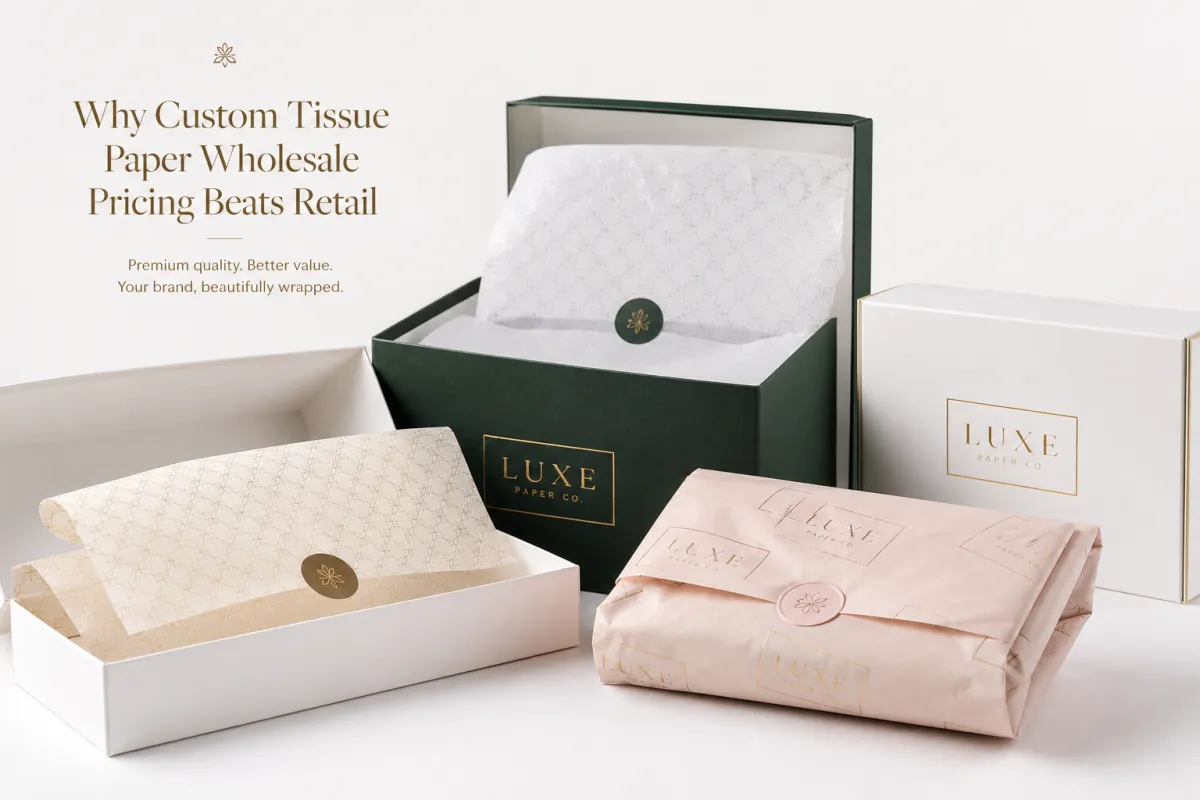
Retail tissue packs are handy, and that convenience usually carries a markup. Small bundles, limited color choices, and shelf-friendly packaging all add cost that a wholesale buyer does not need to absorb. With custom tissue paper wholesale pricing, setup spreads across larger quantities, which brings the cost per sheet down and makes branded presentation workable at scale.
That gap matters more than many teams expect. A boutique shipping 300 orders a month can move through retail packs quickly, especially when each package uses several sheets. As volume rises, printed tissue becomes a recurring expense that deserves the same attention buyers give labels, cartons, or tape. The pattern is straightforward: larger runs dilute repeat setup fees, and repeat setup fees are where small orders usually feel expensive.
Custom tissue paper wholesale pricing also changes the branding calculation. Tissue is one of the lowest-cost ways to place a logo inside the box, yet it still delivers a premium visual effect. Apparel teams use it to frame folded garments. Gift packaging uses it to create the first reveal. Cosmetics brands use it to soften a shipment that might otherwise feel cold or industrial. In each case, the tissue is doing brand work before the customer sees the product itself.
Another point buyers sometimes overlook is that tissue paper does more than decorate a box. It can reduce scuffing, organize contents, and make the packing process feel more deliberate. Customers notice orderliness. Clean folds and consistent print patterns tell a different story than loose filler or unbranded wrap. I have seen a plain box feel more expensive just because the tissue folded properly and held the logo in the right place.
“If the tissue looks off, the whole box feels off.” Packaging teams say that after a bad sample run for a reason. Tissue is thin, but the brand judgment attached to it is not.
Before requesting quotes, identify the variables you can control. Sheet dimensions. Paper weight. Print coverage. Number of colors. Quantity tier. Finish expectations. Those are the levers behind custom tissue paper wholesale pricing, and they matter more than any headline discount.
If you need broader support across packaging formats, comparing tissue with other branded components in your kit helps keep the order grounded. Our Custom Packaging Products page is a useful starting point for seeing how tissue paper sits alongside boxes, bags, and finishing pieces. For larger-volume buyers, the Wholesale Programs option can help align multiple packaging purchases under one sourcing plan.
What Custom Tissue Paper Includes: Materials, Print, and Finish
Accurate custom tissue paper wholesale pricing starts with knowing what sits inside the quote. Tissue paper is not really one product category; it is a combination of base stock, print method, and finishing expectations. Two samples that appear nearly identical can price very differently once the buyer asks about opacity, ink coverage, or repeated logo placement.
The base material is usually a lightweight decorative paper chosen for foldability and presentation. Sheet dimensions usually get attention first, yet paper grade matters just as much. A denser sheet may resist tearing better and hold color with more consistency. A more translucent sheet can look elegant, although it may show fold lines or contents more easily. That is not a flaw on its own. It depends on the product and the visual effect you want inside the box.
Print options shape the quote too. One-color logo repeats are usually the most economical. Edge-to-edge patterns and dense coverage can raise unit cost because they use more ink, demand tighter registration, and often take more production time. Single-sided printing is common, while double-sided printing can increase cost without adding much functional value unless the tissue is visible from both sides in the final wrap. For many brands, a simple repeat pattern gives the cleanest result for retail packaging without drifting into unnecessary expense.
Finish affects cost as well. Tissue should look premium, yet it still has to fold cleanly. A soft hand-feel, matte appearance, and predictable fold memory usually work best because they help the sheet lay flat and wrap without springing open. In practice, tissue that feels too slick or too stiff can slow packing labor. Across an entire line, that small slowdown turns into a real throughput issue. I have watched teams lose minutes per carton just because the paper fought the fold.
Custom tissue paper wholesale pricing also changes with the intended use case. Apparel buyers often want a larger sheet for wrapping folded garments. Cosmetic brands may prefer a smaller sheet that fits neatly inside rigid boxes. Gift packaging usually calls for richer print coverage and a more obvious reveal. Subscription brands often need repeatable consistency because every shipment becomes part of the same customer experience.
A solid sample review should cover more than color. Check the following:
- Color accuracy against brand standards or approved PMS references.
- Sheet consistency across multiple samples, not just one strong sheet.
- Ink rub-off after folding, stacking, and light handling.
- Tear resistance during the wrap process and at the corners.
- Fold memory so the sheet stays neat inside the package.
Sample approval matters for a reason. A buyer may accept a low paper price and then discover that the wrap feels flimsy or prints unevenly inside the box. It is better to test the paper on real products, under real lighting, before placing an order tied to a launch or packaging reset. A screen mockup can be useful, but it never tells the full story.
For buyers who want consistency standards in a larger supply chain, a few external references can help frame better questions. The ISTA testing framework gives useful guidance on transit performance, while the FSC system helps buyers think through certified fiber sourcing. Neither one replaces supplier due diligence, though both can improve how a team evaluates material claims.
Specifications That Change Cost, Color, and Presentation
Most of the movement in custom tissue paper wholesale pricing comes from a short list of technical decisions. Sheet size, paper thickness, number of print colors, coverage area, and packaging format all affect the final quote. A supplier can price a simple logo repeat quickly, while a buyer asking for custom dimensions and heavy coverage should expect the number to shift.
Sheet size is one of the easiest places to control cost. Smaller sheets reduce material usage and can lower waste if the product being wrapped is compact. Larger sheets cost more on paper alone, though they may save labor if a single sheet covers the item cleanly. Bigger sheets also work better for oversized apparel, gift sets, or presentation styles where the wrap is part of the reveal instead of a purely protective layer.
Paper thickness affects both feel and print outcome. A thinner sheet may look elegant, though it can be more delicate during folding. A slightly heavier grade can improve handling and reduce show-through, which is helpful for bold patterns or darker inks. That said, not every brand needs added thickness. A light, translucent tissue can still look refined when the print and fold are handled correctly.
Color choice matters more than some buyers expect. Exact brand matches usually require more careful setup, especially when the print needs to align with existing packaging design assets. Spot colors keep logo repetition crisp and controlled. Metallic inks, pastel tones, and very light colors can behave differently on translucent stock, so a physical sample is the right place to judge them rather than a screen preview.
Artwork prep can either stabilize or inflate custom tissue paper wholesale pricing. Vector files print more cleanly than low-resolution artwork. Repeat patterns need a defined tile size. Safe zones keep logos from getting cut off near folds and edges. Simpler layouts often print better at scale because they leave less room for registration issues. Good packaging design is not only about style; it also affects yield and rework.
For a buyer comparing quotes, the question is not “How fancy can the artwork get?” A better question is “How does the artwork behave when it is repeated hundreds or thousands of times?” A small error in pattern spacing can make the entire run feel off, especially in a premium box where the tissue is visible before the product.
Here is a practical comparison that shows how specs affect both cost and presentation:
| Spec Choice | Typical Cost Impact | Presentation Impact | Best Use Case |
|---|---|---|---|
| Small sheet, one-color repeat | Lower material and setup cost | Clean, simple, efficient | Compact products, high-volume packing |
| Large sheet, one-color repeat | Moderate cost increase from paper usage | More coverage and stronger reveal | Apparel, gift sets, larger boxes |
| Large sheet, edge-to-edge pattern | Higher print complexity and prep | Bold branded look | Premium retail packaging, launch kits |
| Double-sided print | Higher production cost | Useful only in specific presentations | Displays where both sides are visible |
| Heavier paper grade | Often higher per-sheet cost | Better handling and less tear risk | Frequent packing, higher perceived quality |
The cheapest spec is not always the smartest one. A quote that looks favorable on paper can create labor issues, weak presentation, or reprint risk later. For custom tissue paper wholesale pricing, the best spec is the one that keeps both the invoice and the unboxing experience under control.
Custom Tissue Paper Wholesale Pricing & MOQ
This is the section buyers usually want first. Custom tissue paper wholesale pricing is driven by quantity tiers, print coverage, setup complexity, and shipping destination. MOQ, or minimum order quantity, exists because production setup takes time and because printers need enough volume to make the run efficient. That is normal across packaging categories, whether the buyer is ordering tissue, labels, or custom printed boxes.
MOQ is not just a supplier preference. It balances labor, machine setup, and material planning. If the order is too small, setup cost per sheet can become unreasonably high. If the order is large enough, that setup gets spread across more units and the price per sheet usually drops. A buyer who only looks at the lowest printed price may miss that the larger order has a stronger total economics profile.
For practical budgeting, many wholesale tissue quotes fall into broad tiers like these. Exact numbers depend on size, colors, and print coverage, but the ranges below give a useful starting point for custom tissue paper wholesale pricing comparisons:
| Order Quantity | Typical Per-Sheet Range | Setup Notes | Best Fit |
|---|---|---|---|
| 500 to 1,000 sheets | $0.22 to $0.45 | Higher setup burden, fewer economies | Small trials, sample-driven launches |
| 2,500 sheets | $0.12 to $0.28 | Better balance of setup and volume | Growing boutiques and seasonal drops |
| 5,000 sheets | $0.08 to $0.18 | Common wholesale efficiency point | Regular replenishment and multi-SKU brands |
| 10,000 sheets or more | $0.06 to $0.12 | Lowest unit cost, higher inventory commitment | Established programs with stable demand |
Those ranges stay broad on purpose. A simple one-color logo repeat on standard sheets can land at the lower end. Larger sheets, extra colors, special coverage, or premium paper stock move the number upward. Freight matters too. A quote that excludes shipping can look attractive until the freight bill lands. That bill has a way of changing the mood real quick.
That is why a quote comparison should always separate the components. Ask for price per sheet, setup fees, plate charges if relevant, packaging charges, and freight. A lower headline unit price can become more expensive once the hidden pieces are added. For buyers building a real budget, total landed cost is what matters, not the teaser number.
Ask these questions Before You Order:
- What quantity break lowers the unit cost enough to justify the bigger run?
- What artwork changes trigger a new setup fee?
- Are sample fees credited against the production order?
- Does the quote include freight, or is shipping separate?
- How are reprints handled if the color or print quality misses the approved sample?
One more buyer habit makes a big difference: compare quotes side by side. Put the same spec on each line. Same sheet size. Same paper weight. Same print coverage. Same ship-to location. Only then does custom tissue paper wholesale pricing tell you anything useful. If the specs differ, the quotes are not truly comparable.
That discipline separates a strong procurement decision from a costly surprise. A buyer who plans for freight, setup, and a sensible MOQ usually gets a better outcome than the buyer who only chases the lowest printed price.
Process, Timeline, and Lead Time for Wholesale Orders
Even strong custom tissue paper wholesale pricing can turn into a poor buying experience if the timeline stays vague. A reliable order process usually begins with inquiry and ends with delivery, but the steps between those points matter. Quote request. Artwork review. Proof approval. Production. Quality check. Packing. Shipment. Each step can move quickly or slowly depending on how prepared the buyer is.
Lead time is shaped by three things: artwork readiness, production complexity, and shipping distance. First orders almost always take longer because the supplier needs to review files, confirm specs, and often prepare a proof. If the artwork needs color matching, the timeline can stretch further. A simple repeat logo on a standard sheet moves faster than a full-coverage pattern with a custom palette.
In many wholesale packaging programs, production often lands around 12 to 15 business days after proof approval for straightforward runs. More complex orders can run longer, especially when the paper stock is special or the order is large. Add freight time on top of production, and the total calendar window becomes a real planning factor. That is one reason custom tissue paper wholesale pricing should be discussed alongside the schedule rather than after it.
Here is the basic flow buyers should expect:
- Request a quote with sheet size, quantity, logo file, and destination ZIP.
- Review the supplier’s pricing structure and MOQ.
- Approve a digital proof or request a sample if color matters.
- Confirm production once the artwork is final.
- Receive updates during print and packing.
- Plan for shipping and receiving before the launch date.
What usually slows a project down? Missing vector artwork. Unclear brand colors. Late proof feedback. Shipping addresses that change mid-order. Those issues are not dramatic, yet they eat time. Buyers who want faster turnaround should send clean files up front and answer proof questions quickly. That usually removes most avoidable delays.
Seasonal demand needs its own planning window. Tissue paper orders tied to holiday sets, store resets, or promotional launches should be placed well before the final deadline. Rush handling can help in a pinch, although it often adds cost and stress. The stronger move is to reserve production time before the calendar gets crowded.
From a packaging buyer’s point of view, the best suppliers make the process visible. They explain where the quote stands, what the proof changes mean, and how the ship date moves if the artwork changes. That clarity belongs in custom tissue paper wholesale pricing because uncertainty has a cost too.
Why Choose Custom Logo Things for Consistent Wholesale Packaging
For buyers comparing suppliers, reliability usually matters more than the flashiest pitch. Consistent print, repeatable color, and straightforward communication protect margin because they reduce waste and rework. That matters especially in branded packaging, where a small mistake in the tissue can make the entire order feel inconsistent with the rest of the kit.
Custom Logo Things is positioned for buyers who want wholesale packaging decisions to stay grounded in facts. That means clear quote breakdowns, practical guidance on paper options, and production conversations that focus on fit rather than fluff. A strong supplier should answer the basic questions quickly: What is the MOQ? What changes the price? How long will it take? What happens if the artwork needs revision? Those answers tell you more about capability than vague promises about premium quality.
Think about the broader package system. Tissue paper rarely stands alone. It has to work with boxes, inserts, ribbon, hang tags, and sometimes labels or mailers. When the tissue is aligned with the rest of the kit, the brand looks intentional. Suppliers who understand packaging design can add value beyond the paper itself. The right production advice may keep the tissue color closer to the box, or recommend a simpler repeat that prints cleaner inside a tight schedule.
Here is a useful comparison point for buyers evaluating service levels:
- Fast answer time on quantity breaks and file requirements.
- Transparent cost breakdown that separates setup, print, and freight.
- Sample support when color or fold behavior matters.
- Production updates so the launch team can plan receiving.
- Multi-product coordination for brands ordering tissue, boxes, and other packaging components together.
If a supplier can support that list, the buying process usually gets easier. If they cannot, the cheapest quote may become the most expensive choice after delays, reprints, or last-minute substitutions. That lesson shows up often in wholesale packaging: the lowest number is not always the best value.
Custom tissue paper wholesale pricing also improves when the supplier understands the whole package, not just the sheet. A tissue order tied to a subscription box program has different needs than one tied to seasonal gift wrap. A supplier who asks the right questions can often prevent unnecessary specs, which helps the buyer stay on budget and on schedule.
For buyers building a fuller sourcing plan, the broader product mix matters. The tissue order may sit alongside other branded components, so comparing Wholesale Programs and the rest of the Custom Packaging Products range can help keep artwork, dimensions, and production timing aligned across the entire program.
Next Steps for Custom Tissue Paper Wholesale Pricing Quotes
If you want a quote that actually helps, prepare the order like a buyer rather than a shopper. Gather your sheet size, target quantity, logo files, brand colors, and shipping ZIP before you request pricing. That preparation makes custom tissue paper wholesale pricing easier to compare because the supplier can quote the same spec across multiple tiers.
Requesting three versions of the order also helps. Ask for a small run, a mid-tier run, and a larger wholesale tier. That gives you a true picture of how the unit cost changes at scale. Often the best decision is not the cheapest tier. It is the tier where landed cost, inventory risk, and reorder cadence all line up.
Before approval, ask for a digital proof and, if the brand is color-sensitive, a physical sample or a close production reference. Ask for a written breakdown of setup, print, and freight. If the quote includes any artwork revision charges, confirm those before you sign off. That keeps the budget honest and avoids awkward surprises after the proof stage.
Then apply an internal approval process. Review the specs. Confirm the budget. Decide the quantity. Lock the production slot before peak season, not during it. Tissue paper may feel like a small purchase, yet it sits inside a larger brand experience. A mistake here can affect how the entire package feels.
The simplest way to think about it is this: the best order balances look, speed, and inventory discipline. That balance turns custom tissue paper wholesale pricing from a vague quote into a workable packaging plan. If the spec is right, the volume is right, and the lead time fits the launch, the purchase usually pays back in presentation and consistency.
Before you approve anything, compare the quote against the real job it has to do: fit the product, protect the fold, and hold the brand mark clearly enough that the package feels finished the moment it is opened. That is the practical test. If the paper passes that test, the price makes sense.
FAQ
How is custom tissue paper wholesale pricing calculated?
It usually combines sheet size, paper grade, print coverage, number of colors, quantity tier, and shipping location. Ask suppliers to separate setup fees from per-sheet pricing so you can compare quotes accurately. Request pricing at multiple quantity levels to see where the unit cost drops enough to justify a larger order, because that is often where custom tissue paper wholesale pricing becomes most attractive.
What is a typical MOQ for custom tissue paper wholesale orders?
MOQ varies by supplier and print method, though it is often set to cover press setup and material efficiency. If your volume is small, ask whether a stock size, simplified print, or shared production run is possible. Compare MOQ against your reorder cadence so you do not overbuy inventory that sits unused, which can erase the savings from better custom tissue paper wholesale pricing.
How long does custom tissue paper production usually take?
Timeline depends on artwork approval, printing method, quantity, and whether a new color match is needed. First orders often take longer because proofs and setup are part of the process. Ask for the estimated lead time before you approve artwork so your packaging launch stays on schedule, and make sure that lead time is included in your custom tissue paper wholesale pricing comparison.
Can I get a sample before placing a wholesale order?
Yes, and you should ask for a sample whenever print quality, paper feel, or color accuracy matters. Review how the tissue folds, tears, and reads in real packaging lighting, not just on-screen. If a full custom sample is not available, request a material sample or a prior production example with similar specs so the final custom tissue paper wholesale pricing quote is based on a realistic reference.
What should I prepare before requesting a quote?
Have your logo file, preferred sheet size, estimated quantity, brand colors, and shipping destination ready. Decide whether you need a simple logo repeat or full-sheet branding, since that changes pricing. Share your target launch date so the supplier can confirm whether the lead time fits your schedule, then compare each quote on total value rather than unit cost alone; that is the clearest way to judge custom tissue paper wholesale pricing.

