Buyer Fit Snapshot
| Best fit | Custom Tissue Paper Logo Print projects where brand print, material claims, artwork control, MOQ, and repeat-order consistency need to be specified before quoting. |
|---|---|
| Quote inputs | Share finished size, material target, print colors, finish, packing count, annual reorder estimate, ship-to region, and any compliance wording. |
| Proofing check | Approve dieline scale, logo placement, barcode or warning zones, color tolerance, closure strength, and carton packing before bulk production. |
| Main risk | Vague material claims, crowded artwork, missing packing details, or unclear freight terms can make a low unit price expensive after revisions. |
Fast answer: Custom Tissue Paper Logo Print: Material, Print, Proofing, and Reorder Risk should be specified like a repeatable production item. The safest quote records material, print method, finish, artwork proof, packing count, and reorder notes in one written spec.
Production checks before approval
Compare the actual filled-product size with the drawing, then confirm tolerance on folds, seals, hang holes, label areas, and retail display edges. Reserve space for logos, QR codes, warning copy, and material claims before decorative graphics fill the panel.
Quote comparison points
Review material grade, print process, finish, sampling route, tooling charges, carton quantity, and freight assumptions side by side. A quote is only useful when the supplier can repeat the same color, closure quality, and packing count on the next order.
Custom Tissue Paper Logo Print: What Buyers Need to Know
Learn how Custom Tissue Paper logo print works, what drives pricing, how long it takes, and the mistakes that turn a cheap run into a headache.
Custom Tissue Paper logo print does more than cover a product. It tells the customer that the brand cared enough to finish the packaging with intention. Plain tissue can protect an item, sure, but printed tissue starts the unboxing moment before the product is even visible. That matters in retail packaging, e-commerce mailers, gift boxes, apparel, cosmetics, and subscription packaging, where the first layer sets the tone for everything that follows.
From a packaging buyer's point of view, custom tissue paper logo print is not a billboard. It is a soft-surface branding layer. The goal is not to shout. The goal is to make the package feel deliberate. A simple repeat logo usually looks more premium than a busy full-sheet design, because the eye reads pattern, restraint, and consistency as quality. Quiet packaging often feels more expensive than packaging that tries too hard.
There are a few decisions that shape every order: color count, paper weight, print method, minimum order quantity, and turnaround time. Those choices affect not just cost, but how the sheet folds, how the logo reads after handling, and whether the tissue supports the rest of the product packaging or fights with it. If you also use custom printed boxes or branded labels, the tissue should fit the package branding instead of competing for attention.
What custom tissue paper logo print actually changes
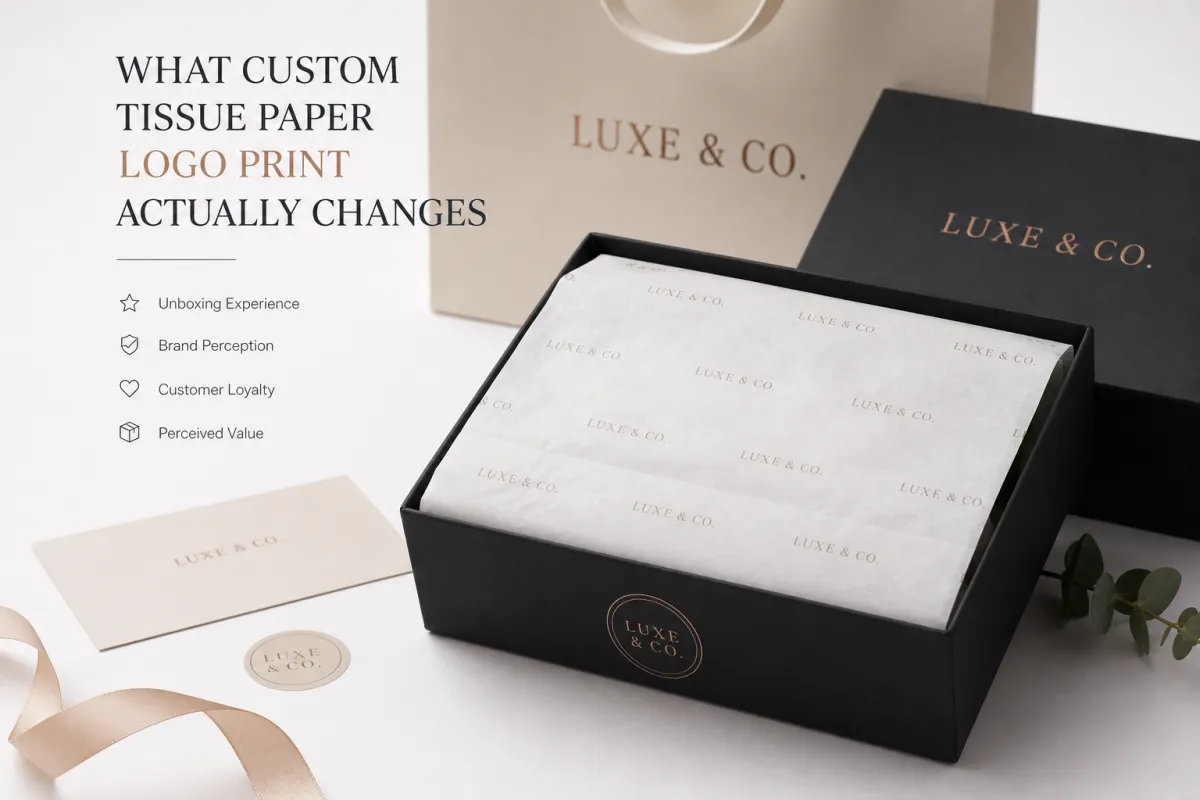
Plain tissue protects. Custom tissue paper logo print sells the moment. That is the real difference. A brand can wrap the same shirt, candle, or beauty kit in plain white tissue and get the job done, but printed tissue adds a signal that the package was considered end to end. It is a small move with a big visual return, which is exactly why so many retail packaging teams keep asking for it.
The effect depends on how the tissue is used. In a boutique bag, a repeat logo peeking out of the fold feels polished. In a subscription box, the same print creates a more memorable opening sequence. In cosmetics, where presentation is part of perceived product value, custom tissue paper logo print can make a compact item feel more expensive without changing the product itself. For apparel, it often becomes the thin line between "shipped" and "wrapped."
There is also a practical side. Tissue is lightweight, so it adds branding without adding much postage weight. That makes custom tissue paper logo print a useful middle-ground between no decoration and more expensive inserts or rigid components. If your brand is still testing package branding, printed tissue is a lower-risk way to move from generic to intentional. In many cases, it is the first branded layer a new product line can afford.
The design language matters more than people expect. A simple one-color repeat can feel more premium than a crowded full-bleed design because it respects the material. Tissue has a soft, translucent look. Force too much information onto it and the sheet starts to look noisy. Good custom tissue paper logo print usually works with the material instead of trying to overpower it.
I've seen that play out on sample tables more than once. A sheet that looked a little plain in a PDF proof turned out to be the nicest option once it was folded around a product and stacked in a box. The reverse happens too: a design that felt clever on-screen can look cluttered in real packaging. Tissue is kind of honest that way.
A good tissue sheet should not need explaining. If the print only looks impressive when it is flat on a desk, it is probably too busy for real packaging use.
Most buyers should think about the tissue as part of the wider packaging design system. If the outer carton is clean and minimal, the tissue can carry a repeating monogram or simple wordmark. If the outer package already has strong graphics, the tissue often needs to be quieter. That is where custom tissue paper logo print earns its keep: it fills the gap between utility and brand story without demanding a huge budget.
If you are still comparing materials for branded packaging, it helps to look at the whole stack. A tissue sheet inside a rigid box is one experience. Tissue inside a poly mailer is another. One is about presentation; the other is more about protection and perceived care. The print treatment should match the job, not just the logo.
How custom tissue paper logo print works
The production flow for custom tissue paper logo print looks simple on paper and turns frustrating fast if the artwork is not prepared correctly. It usually starts with artwork review, then proofing, then plate or screen creation depending on the print method, followed by printing, drying, cutting, folding, and packing. Each step matters because tissue is thin, flexible, and a little unforgiving. If the repeat is off by even a small amount, the pattern reads as sloppy the second it is folded into a box.
Most printers want vector artwork, a clear repeat size, and the exact sheet dimensions. A logo in PDF, AI, or EPS format is usually easier to print cleanly than a raster file that has been stretched by a designer in a hurry. Supply the brand colors too. Pantone references help, but on tissue the final match still depends on ink density, paper absorbency, and the print process. That is normal. Tissue is not a coated carton, and custom tissue paper logo print behaves differently than offset printing on a rigid substrate.
The repeat design matters more than many buyers expect. A tissue pattern is usually built so the logo lands consistently across folds and sheet edges. The best results happen when the repeat is planned around the finished sheet size, not just dropped randomly onto a canvas. If you want a centered logo, a clean diagonal repeat, or a scattered all-over pattern, say that early. Otherwise the printer will make a reasonable choice and you may discover that "reasonable" is not the same thing as "on brand."
There are three common print methods buyers run into: flexographic, screen, and digital printing. Flexographic printing is common for larger custom tissue paper logo print runs because the setup cost gets spread across volume. Screen printing can give a solid, bold look with heavy ink coverage, which works well for one-color logos and sharper brand marks. Digital printing is useful for lower volumes, samples, or artwork that changes often, but it usually costs more per sheet at scale.
Not every printer uses the same workflow. Some will use custom plates. Some will quote through a digital printing line for smaller orders. A few may suggest a tissue-friendly version of offset printing, but on thin tissue that is less common than people assume. The right method depends on quantity, coverage, and how much detail your design carries. If the artwork includes tiny type, hairline icons, or gradients, ask for an honest opinion before you approve the run. That conversation can save you from a disappointing batch later.
| Print method | Typical use | Setup cost range | Best quantity range | What it looks like |
|---|---|---|---|---|
| Flexographic | Simple repeats, higher-volume retail packaging | $120-$350 | 5,000 sheets and up | Clean, consistent, good for straightforward logos |
| Screen | Bold one- or two-color brand marks | $90-$250 | 1,000-10,000 sheets | Heavier ink, stronger solids, less subtle detail |
| Digital | Short runs, samples, changing artwork | $0-$120 | 100-3,000 sheets | Flexible and fast, but pricier per unit at volume |
What should a buyer provide before asking for a quote? At minimum: logo file, brand colors, sheet size, quantity, packaging use case, and target delivery date. If the tissue needs to fit a particular box or bag, say so. A sheet that works beautifully inside one of your Custom Packaging Products may be the wrong size for another. That sounds obvious, but it is one of the most common ways specs get muddled.
For brands that need the whole package system to match, it can help to think beyond the tissue sheet itself. The more your tissue, outer carton, labels, and insert cards agree with one another, the more believable the product packaging feels. Custom tissue paper logo print is only one layer, but it often carries more visual weight than the rest because customers touch it first.
One more point: tissue printing is sensitive to handling. Press pressure, ink load, and drying time all change the result. A printer who understands branded packaging will know how to balance those variables so the logo reads clearly without turning the sheet stiff or blotchy. That balance is why some tissue looks expensive and some looks like office paper with ambition.
Custom tissue paper logo print pricing: what drives cost
Custom tissue paper logo print pricing is driven by the same four things almost every time: quantity, sheet size, number of print colors, and setup complexity. Paper weight matters too, because 17 gsm tissue behaves differently from 22 gsm or 28 gsm stock. A heavier sheet can feel nicer and hide show-through better, but it costs more and may need a different press setup. So yes, the cheapest quote is often cheap for a reason.
Setup fees are the part people underestimate. Even if the tissue itself is inexpensive, the printer still needs to prep the artwork, create plates or screens, run the machine, dry the sheets, and pack them safely. On a small order, that setup cost gets spread across very few pieces. That is why a run of 500 sheets can feel expensive per unit, while a run of 5,000 sheets looks much more reasonable. The math is not mysterious. It is just irritating.
As a rough buying range, many one-color orders at 5,000 sheets land around $0.12-$0.28 per sheet before freight, depending on coverage and paper weight. More colors, full-sheet printing, specialty inks, or custom cutting can push that higher. For smaller runs, the per-sheet cost can easily jump to $0.30-$0.70 or more. That does not mean the quote is wrong. It means the setup cost has not had enough sheets to spread across.
Buyers also forget the extras. Sampling may be billed separately. Rush production can add a charge. Heavier gsm tissue usually costs more. Custom sizes can require more waste. Freight matters too, especially for large-volume orders where tissue ships in bulky cartons. If you are comparing two quotes for custom tissue paper logo print, make sure both include the same paper weight, same number of colors, same sheet dimensions, and same shipping assumptions. Otherwise you are comparing fiction to fiction.
The table below is a practical way to think about pricing strategy rather than just chasing the lowest number.
| Buying option | Typical cost behavior | Best for | Tradeoff |
|---|---|---|---|
| Short run, one-color | Higher per-sheet cost, lower commitment | Test launches, small brands, seasonal packaging | Setup still matters, so price feels less friendly |
| Mid-volume, one- or two-color | Balanced unit price and decent flexibility | Growing retail packaging programs | Needs cleaner forecasting for reorder timing |
| High-volume repeat order | Lowest unit price once setup is absorbed | Stable product packaging and regular promotions | More storage space and tighter color control required |
Here is the practical advice most buyers need: quote the whole spec, not the dream version. If you want custom tissue paper logo print at a low cost, keep the design simple, reduce color count, and choose a standard sheet size. If the tissue is going inside a premium garment box or jewelry box, spend a little more on opacity and print quality. That tradeoff often makes more sense than overbuilding the outer pack and then wrapping it in weak tissue.
For higher-end brands, I also like comparing tissue spend against the cost of the box. A run of custom printed boxes may absorb a larger budget, but the tissue can still do a lot of visual work for a small share of total packaging cost. That is usually the smartest place to save and spend at the same time: keep the outer structure stable, then tune the tissue to match margin and customer expectation.
One final pricing note: if a supplier cannot explain why one quote is lower, that is not a good sign. Honest vendors can tell you whether the lower number comes from thinner paper, simpler print coverage, larger minimums, or a longer timeline. If they cannot, custom tissue paper logo print may be the least interesting item in the order and the most expensive mistake after delivery.
Key factors that affect custom tissue paper logo print quality
Quality starts with opacity. Thin tissue shows more through-print and more shadowing from the fold underneath, which changes how the logo reads. That is not automatically bad, but it means a light gray logo on very thin stock can disappear faster than a buyer expects. Stronger paper opacity usually gives custom tissue paper logo print a cleaner finish, especially for retail packaging where the sheet is handled twice before the customer notices it.
Ink density is the next problem. Dark logos need enough ink to stay legible, but too much ink can make the sheet feel heavy or damp during production. Brand colors are another trap. A deep navy, charcoal, or metallic tone may look sharp on a monitor and slightly off on tissue. That is why color accuracy matters more than people think. The goal is not perfect lab matching. The goal is a repeatable result that looks right inside the box.
Artwork clarity matters more than size. Tiny text, thin lines, and fragile icons can vanish on tissue even if they print well on paperboard or labels. If the logo has a detailed crest or a script wordmark, ask whether it can be simplified for custom tissue paper logo print. Sometimes a stronger monogram does more for package branding than a full brand lockup. The material is doing a soft job. Treat it like one.
Repeat spacing is another quality marker. A good repeat pattern does not look crowded, and it does not leave awkward empty zones where the logo stops appearing in the fold. The pattern should read well after the tissue has been packed, shipped, opened, and refolded by the end user. That means the design must survive real handling, not just a flat proof on a screen. Packaging design that ignores handling is just decoration with a deadline.
Finish and texture also shape perception. Matte tissue feels more refined. Shiny or overly bright stock can look cheaper unless the brand is intentionally loud and colorful. That is why custom tissue paper logo print should be chosen to match the product, not the mood board. A premium scarf brand and a playful accessory brand may both use printed tissue, but the tactile feel should be different.
From an operations angle, there is also the issue of moisture and storage. Tissue stored in a humid warehouse can curl or warp. That can affect printing and folding quality, especially if the sheets sit too long before use. A buyer planning a large seasonal order should think about storage as part of the print specification, not an afterthought. A perfect print job that arrives warped is still a bad buy.
For brands that want stronger sustainability signals, material sourcing matters too. FSC-certified paper is worth discussing if the supply chain is part of your promise. You can review FSC's framework at FSC. That does not make a print job automatically better, but it does help buyers connect custom tissue paper logo print with the broader sourcing story behind the packaging.
Testing standards matter in a different way. Tissue itself is not usually the item being tested, but the finished package often is. If the tissue is going into a shipper or mailer, the overall package may need validation against common distribution tests. ISTA publishes widely used test procedures at ISTA. That matters when the tissue is part of a larger e-commerce packaging system and not just a decorative layer.
Honestly, the biggest quality leap often comes from simplifying the art. A cleaner file, a steadier repeat, and a sensible color count do more for custom tissue paper logo print than any dramatic trick. Fancy usually loses to tidy. Every time. I know that sounds plain, but the press room usually proves it.
Step-by-step timeline for custom tissue paper logo print orders
The buying sequence should start with the use case. Are you wrapping clothing, lining gift boxes, or filling Mailers for Subscription packaging? Once that is clear, choose the sheet size and quantity, then request a quote with the exact spec. That sounds basic because it is basic. Yet half the delays in custom tissue paper logo print come from vague order requests that force everyone to guess.
Artwork prep comes next. Send vector files if you can. Send brand colors. If the printer wants a repeat layout, give them the repeat size and tell them how much bleed or margin you want near the edges. If the logo must sit centered on the sheet, say that plainly. If the design is a simple repeat, confirm whether it should run diagonal, grid-style, or staggered. That level of clarity speeds up custom tissue paper logo print more than any rush fee can.
Proofing usually happens in two steps. First is the digital mockup. That shows placement, scale, repeat, and overall look. Second is a physical sample if the order is large enough or color match matters a lot. For a new brand, I strongly prefer a short run or sample batch before committing to a full volume order. The sample catches issues that screens miss, especially on tissue where texture, opacity, and ink load change the result.
Here is a realistic production timeline for custom tissue paper logo print:
- Day 1-2: Quote review, specification check, and artwork submission.
- Day 2-4: Digital proof sent and revised if needed.
- Day 4-6: Final approval, plate or screen prep, and machine scheduling.
- Day 6-12: Printing, drying, folding or cutting, and packing.
- Day 12-15: Shipment for straightforward orders.
That is a reasonable target for a simple order after proof approval. It can be faster if the artwork is already clean and the printer has stock on hand. It can also take longer if the repeat needs revisions, the paper is special-order, or the run is going through a busy season. Custom tissue paper logo print is not magic. It is production. Production has queues, and queues do not care about your launch date.
For seasonal packaging, launch kits, and event orders, I would build in extra time. A 10-business-day target can become 15 fast if a proof revision goes back and forth twice. If the product launch depends on the tissue, submit the order early and keep the artwork boringly clean. That is the most glamorous advice in packaging, which is to say it is also the most useful.
Shipping and receiving should be checked before the order closes. Tissue often packs flat, but large orders still take space and deserve dry storage. If the cartons are going into a warehouse or fulfillment center, confirm where they will sit and how they will be pulled into production. The more custom tissue paper logo print gets tied to the actual packing line, the fewer surprises show up after delivery.
For brands that use multiple pack formats, coordinate the tissue schedule with the rest of the packaging. If custom printed boxes, inserts, and outer mailers are also in motion, one delayed component can stall the whole launch. A strong packaging buyer keeps the moving parts aligned instead of treating every item like a separate little island.
Common mistakes with custom tissue paper logo print
The most common design mistake is trying to cram too much into the sheet. Tiny type, too many colors, and thin decorative lines all tend to fail on soft paper. A logo that works on a website header or a cardboard carton is not automatically a good fit for custom tissue paper logo print. If the design depends on precision, simplify it. Tissue is not a place for fragile ambition.
The second mistake is ignoring fold lines and repeat alignment. A good pattern can look sloppy if the logo lands awkwardly on the edge of the sheet or gets swallowed by a fold. Buyers sometimes approve a digital proof that looks fine on screen, then hate the packed result because they forgot the sheet will not stay flat forever. That is not the printer's fault. That is a planning issue.
Another common problem is underestimating minimum order quantities. Some suppliers can do low-volume work, but low-volume custom tissue paper logo print is almost always more expensive per sheet. Brands expecting a tiny order at a bargain price usually get frustrated. Better to ask early whether a short run, sample batch, or test size is possible before committing to a bigger volume.
Vague quotes cause a lot of pain. If a supplier gives you one number and nothing else, ask what paper weight, print method, and color count are included. Ask whether freight is separate. Ask whether the quote includes setup. Ask what happens if the proof needs revisions. A clear quote for custom tissue paper logo print should tell you exactly what you are buying, not just what the invoice total looks like.
Storage mistakes are easy to make too. Tissue should be kept dry and flat. If a buyer orders too much before testing it in real packaging, they may discover the sheet size is wrong or the print feels too busy once the product is wrapped. That is why a short run is often the smarter first move. It is cheaper to learn on 1,000 sheets than on 10,000 sheets stacked in the back room.
There is also a brand mismatch problem. A luxury candle line and a playful gift brand can both use custom tissue paper logo print, but the visual treatment should not be the same. If the tissue is too loud for the rest of the package branding, the unboxing feels disjointed. Good packaging is a conversation between layers, not a shouting contest.
And yes, people still overbuy. They think volume always fixes price. Sometimes it does. Sometimes it just creates a warehouse of the wrong thing. If your artwork, product mix, or seasonality is still changing, stay smaller until the system settles. There is no prize for ordering a mountain of tissue that nobody wants to use.
Expert tips and next steps for custom tissue paper logo print
My first recommendation is simple: order a sample or short run first if the brand is new, the artwork is complex, or the tissue will be used in premium customer-facing packaging. Custom tissue paper logo print is cheap enough to test, but expensive enough to make mistakes annoying. A sample proves the repeat, the color, and the visual tone before you commit to volume.
Build a basic approval checklist before you send artwork. Include the logo file, repeat size, color target, sheet dimensions, quantity, delivery date, and final packaging use case. If the tissue needs to fit inside one of your Custom Packaging Products, say so in the first email. The more exact the brief, the less likely the print job ends up as a compromise nobody wanted.
When comparing quotes, judge the total specification, not the line item total. A quote that looks cheaper may use thinner paper, fewer colors, a larger minimum order, or a longer turnaround. That is fine if those tradeoffs fit your schedule and margin. It is not fine if you discover them after approval. Custom tissue paper logo print is one of those categories where the hidden tradeoff is usually the whole story.
Choose one-color art when the logo is simple, the pack needs to feel restrained, or the product margin is tight. Choose fuller color only if the brand value really supports it. In many cases, one-color custom tissue paper logo print does more for perceived quality than a busy multicolor sheet, especially in apparel, gifts, and boutique retail packaging. Clean beats crowded. Consistently.
If you are building a new line, I would also keep the rest of the pack steady while you test the tissue. Pair the sheet with solid outer packaging, then see how customers respond before making the design more complex. That is especially useful when the brand is balancing custom tissue paper logo print with custom printed boxes, inserts, or labels. The best packaging systems do not all scream at once.
One more practical note: ask the printer how the tissue will be packed for shipment. Flat-packed sheets, folded sheets, and tissue in ream-style bundles each affect storage and handling differently. It is a small detail that becomes a big one when the boxes arrive and the fulfillment team has to move fast. A package that is easy to receive is easier to use. Simple, but true.
So the next move is straightforward. Gather the exact spec sheet. Request two or three quotes. Review a sample. Then lock the order with enough lead time to avoid panic. If you do that, custom tissue paper logo print stays on budget, on schedule, and useful inside the packaging system instead of sitting there looking pretty and causing delays.
Done well, custom tissue paper logo print lifts the whole unboxing without forcing the brand into a bigger production budget than it can support. Done badly, it becomes another small item with a large headache attached. I know which version most buyers prefer.
For teams comparing branded packaging options, it also helps to look at the tissue alongside the full packaging stack. A strong box, a clear insert, and a well-printed tissue sheet usually outperform one dramatic component trying to carry the whole experience. That is where custom tissue paper logo print earns its place: not as the loudest part of the pack, but as the detail that makes the rest feel finished.
If you need one clear action from all of this, make it this: choose a simple repeat, confirm paper weight and sheet size in writing, and approve a sample before full production. That single step catches most of the avoidable problems with custom tissue paper logo print and gives the finished packaging a much better shot at looking intentional.
How much does custom tissue paper logo print usually cost?
Cost usually depends most on quantity, paper size, print colors, and setup fees. Small runs cost more per sheet because the setup is spread across fewer pieces. Ask for quotes that list paper weight, color count, and shipping so you can compare them properly.
What is the minimum order for custom tissue paper logo print?
Minimums vary by printer and print method, but low-volume orders often cost more per unit. Some suppliers set minimums based on setup efficiency rather than raw material cost. If you only need a test run, ask whether a sample batch or short run is available before committing.
How long does custom tissue paper logo print take?
Timing usually includes artwork approval, proofing, printing, drying, packing, and shipping. Simple repeat designs move faster than complex multi-color jobs. Rush orders are possible sometimes, but they usually cost more and leave less room for proof changes.
Can custom tissue paper logo print be done in one color?
Yes, one-color printing is common and often the most cost-effective option. It works well when the logo is simple and the goal is clean, premium branding. One-color art also tends to reproduce more reliably on thin tissue than complicated full-color artwork.
What file format is best for custom tissue paper logo print?
Vector files are usually best because they stay sharp at any size. PDF, AI, or EPS files are commonly preferred by printers. If the artwork uses brand colors, send exact color references so the printer can match them more accurately.

