Custom tote bag printing looks simple until the first quote comes back. The cost is shaped by more than the logo: fabric weight, handle construction, print method, setup, finishing, freight, and minimum order quantity all affect the final number.
Two bags with the same artwork can land at very different prices because the bag itself is part of the product. A thin giveaway tote, a retail canvas bag, and a laminated promotional bag each behave differently in production and in use. If the spec is wrong, the brand experience feels off even when the print is clean.
That matters because different programs have different jobs. An event bag only needs to hold handouts for a short period. A retail tote may need to carry products repeatedly, stand up on a counter, and hold its shape after use. Those are different requirements, so they should be quoted and specified differently.
What Custom Tote Bag Printing Actually Includes
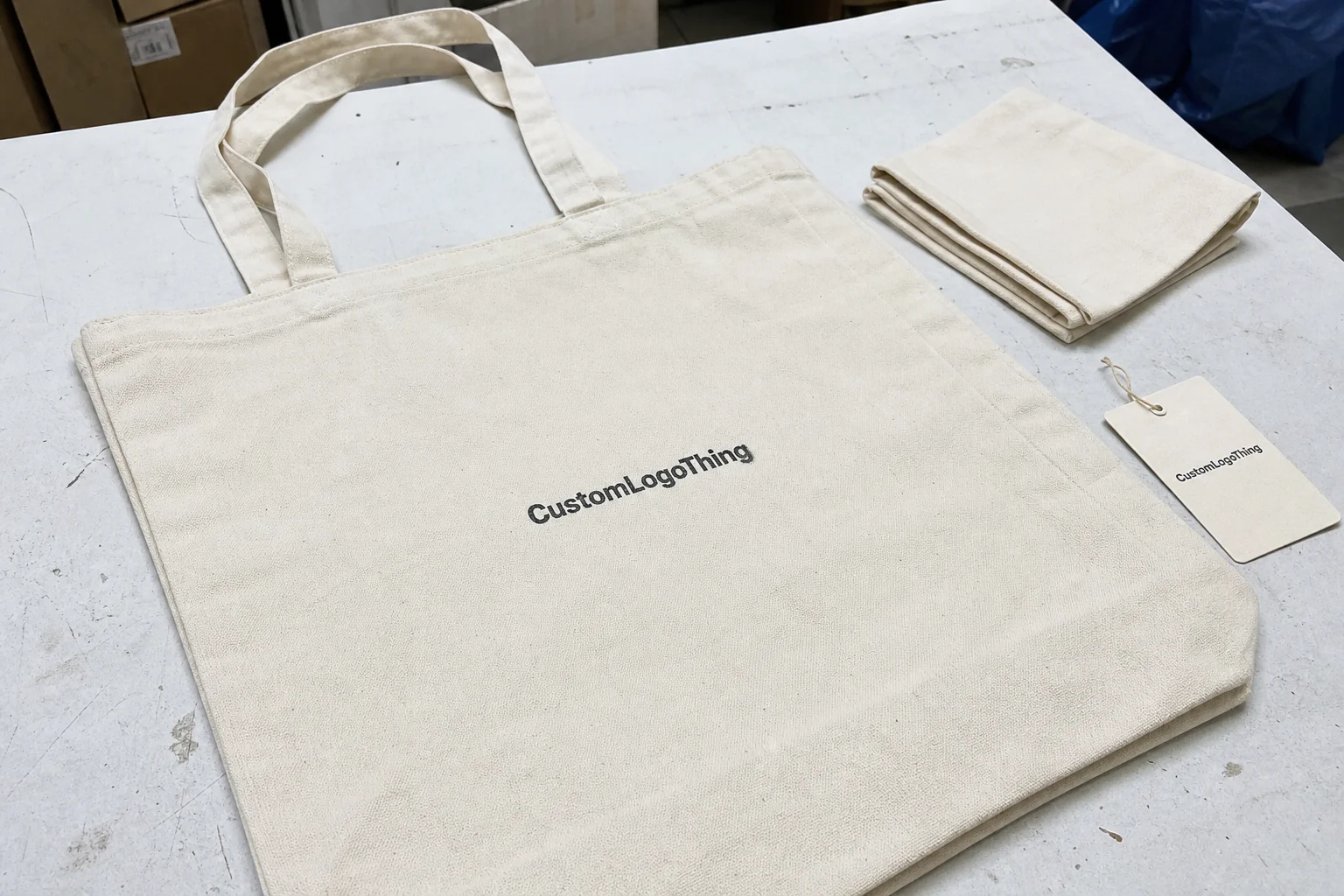
The order starts with the bag body. Material, dimensions, handle style, gusset depth, seam reinforcement, and any coating or lining affect cost before decoration begins. A 10 oz Cotton Canvas Tote is not comparable to a nonwoven polypropylene bag with die-cut handles, even if both carry a one-color logo.
The decoration method is the next choice. Screen printing is usually the best fit for simple logos, bold spot colors, and larger runs. Digital printing works better for detail and gradient-heavy art, but it depends more on substrate behavior. Heat transfer can help with short runs or complex artwork, though it changes the surface feel and may wear differently over time.
Finishing details can move a tote from basic to credible. Reinforced handles, stitched side seams, bottom gussets, inner lining, and coating all influence durability and presentation. A tote that stands upright reads differently from one that collapses flat, especially in retail settings where the bag becomes part of the product experience.
The cheapest tote is rarely the lowest-cost tote. If it stretches, tears, or prints poorly, the brand pays for it in front of customers.
Buyers should compare the spec, not just the logo file. The same artwork can be printed on a lightweight giveaway bag or a heavier canvas tote, and the customer will feel the difference immediately. Packaging branding works the same way across cartons, mailers, inserts, and bags: consistency is what makes the system feel intentional.
A practical rule helps here. If the tote needs to carry product, ask about fabric weight, seam strength, and available print area before discussing color count. The design can be adjusted. A weak structure cannot.
How the Production Process Works
The sequence is usually predictable: artwork arrives, the vendor checks the file, a proof is prepared, the client approves it, setup begins, production runs, finishing happens, and the bags are packed for shipment. The print run is often the shortest step in the whole process.
File review is where many orders slow down. Missing fonts, low-resolution artwork, vague placement notes, and color references that are only described verbally create delay. A logo pulled from a slide deck is usually not production-ready. Vector artwork gives the printer room to work without guessing.
The proof stage is the gatekeeper. Buyers should review dimensions, print placement, color callouts, and carton counts before approval. If a sample is involved, it should match the same decoration method and material as the production run whenever possible. A screen-printed sample does not always predict a digital run, especially on textured fabric.
Different decoration methods change the sequence in practice:
- Screen printing needs screen setup, ink mixing, cure time, and registration checks.
- Digital printing reduces some setup work but still requires substrate compatibility and color control.
- Heat transfer adds transfer prep and adhesion checks, which affect feel and durability.
If artwork changes after setup, the schedule can slip more than the print itself. Printing may take hours, but reproofing, artwork correction, and approval loops can take days.
For suppliers that also handle packaging and merchandising, their broader Manufacturing Capabilities tell you a lot about how they work. Clear answers on material sourcing, finishing limits, and production flow usually mean fewer surprises later.
Packaging standards still matter in the background. If the totes are being shipped in master cartons, transit testing guidance from ISTA is worth understanding. If the order includes paper inserts or printed sleeves, FSC-certified paper may matter for buyers aligning packaging choices with sustainability claims. None of that fixes a weak tote spec, but it does make the program more credible.
Cost, MOQ, and Quote Drivers to Compare
Pricing usually breaks into a few buckets: the bag body, setup costs, ink or plate charges, proofing, freight, and any rush premium. If a supplier only quotes a unit price, the total is not complete yet.
MOQ, or minimum order quantity, matters because fixed work gets spread across the run. A 100-piece order usually carries a higher per-unit cost than a 1,000-piece order even if the base bag is identical. That is not a markup trick. It is simply the economics of setup.
When comparing quotes, line up the same variables side by side:
- Exact bag size and fabric weight
- Handle style and gusset depth
- Print method and color count
- Print area and one-side versus two-side coverage
- Packaging requirements, carton count, and destination
Typical market ranges help frame the conversation. They are not fixed prices, and they move with quantity, freight, and stock availability.
| Option | Typical Use | Indicative Unit Cost | What Drives the Cost |
|---|---|---|---|
| Nonwoven polypropylene, 1-color screen print | Events, giveaways, light retail handouts | $0.45-$1.10 at 1,000 pieces | Low material cost, simple setup, limited print coverage |
| Cotton canvas, 1-2 color screen print | Retail packaging, branded merchandise, repeat use | $1.20-$3.50 at 1,000 pieces | Heavier fabric, stronger construction, longer print and finishing time |
| Laminated woven PP, full-color digital print | Promotions, premium displays, brighter visual impact | $1.00-$2.80 at 1,000 pieces | Surface prep, ink coverage, and more complex finishing |
| Heavy canvas, larger print area, reinforced handles | Premium retail packaging and resale programs | $2.50-$5.50 at 1,000 pieces | Material weight, sewing time, reinforcement, and higher QC expectations |
Those ranges move quickly when the order gets more specific. Add two-sided print, special folding, split deliveries, or a short ship window, and the quote changes. A number that looks low on paper can become expensive once freight, palletization, or rework enter the picture.
For sustainability-minded buyers, the broader packaging context still matters. If the tote is replacing disposable carriers, source reduction is part of the value argument. The EPA’s packaging guidance is a solid reference point: EPA packaging materials management.
Key Specs That Decide Print Quality and Use
Material choice shapes the whole order. Nonwoven polypropylene is common for lower-cost runs and trade show handouts. Cotton and canvas feel more premium and usually hold up better under repeated use. Laminated or coated finishes can sharpen color and improve wipeability, but they also change the hand feel, which is not always desirable.
Size is not just a capacity question. It affects print placement, perceived value, and how the tote behaves once filled. A narrow tote can work for brochures and small inserts. A deeper gusset can be the difference between a bag that stands on a counter and one that collapses into itself. In retail packaging, that difference shows up immediately.
Handle style should match the load. A short die-cut handle is fine for lightweight items. A stitched webbing handle is better for heavier product carry and longer distances. If the bag is expected to move products from store to home, handle comfort becomes part of the brand experience.
Print area and color count affect both cost and appearance. A large front graphic can look strong, but it raises the risk of visible registration issues or uneven coverage. One-color artwork on a high-contrast bag is efficient and usually easier to control. Multi-color art, gradients, and edge-to-edge coverage require tighter production discipline.
Some buyers treat a tote like a small billboard. That can work, but it can also create a bag that looks good from across a room and weak up close. The better approach is to balance shelf appeal, carry strength, and unit cost. A tote should fit the use case, not just the concept board.
This is where packaging and product presentation overlap. A tote used in a retail environment sits beside Custom Printed Boxes, labels, tissue, and inserts as part of the same system. If the visual language is inconsistent, people notice, even if they cannot name why.
Step-by-Step Ordering Checklist
Start with the use case. Where will the tote be handed out? What should it carry? How many times should it survive use? If those answers are fuzzy, the quote will be fuzzy too. A clear brief saves time and prevents spec drift.
Then lock the structure. Choose material, dimensions, handle style, gusset depth, and any reinforcement before asking for pricing. Once the bag spec is fixed, the artwork can be matched to the available print area and color limits. Many buyers do this in reverse, forcing the bag around the logo instead of matching the logo to the bag.
- Define the end use. Event giveaway, retail packaging, trade show handout, or product carry bag.
- Choose the bag spec. Material, size, handle type, gusset, and reinforcement.
- Prepare the artwork. Vector files, outlined fonts, and known color references.
- Request the proof. Check dimensions, placement, and any print limitations.
- Confirm logistics. Quantity, shipping address, carton requirements, and target delivery date.
Artwork prep deserves discipline. Send vector art when possible. Outline fonts. Specify Pantone references or another defined color standard. If the printer has to guess at color, the proof stage becomes a negotiation instead of a check.
Before approving the order, ask whether the material is actually in stock and whether the production line has room for your target ship date. A vendor can promise quick turnaround only if the line is available. If a special fabric or custom color is involved, lead time can stretch quickly. That is normal, and it is why deadline pressure creates bad decisions.
Keep one reusable spec sheet for every tote program. Include size, material, handle style, print colors, quantity, delivery zip code, and event date. That single page cuts quote revisions and makes reorders much cleaner.
Common Mistakes That Create Reprints
The first mistake is comparing quotes without matching specs. A lower number may simply reflect a thinner bag, a smaller print area, or fewer decoration steps. If the spec is not identical, the comparison is mostly noise.
The second mistake is sending weak artwork. Low-resolution files can look fine on a laptop and fail on press. Unoutlined fonts are another common cause of delay. So are colors described in casual language instead of a usable standard. That becomes more risky if the tote must sit inside a broader packaging system with labels, cartons, and inserts.
The third mistake is assuming the sample and the production run will behave exactly the same way. Sometimes they do. Sometimes they do not. Ink absorption, fabric variation, and finishing differences all affect the result. A sample reduces risk, but it does not eliminate it.
Freight causes another round of problems. A quote that excludes shipping, palletization, or split deliveries can look attractive until the actual bill arrives. Carton count matters too, especially if the bags are going to multiple stores or event sites. Logistics can change the landed cost more than the print ever does.
Timing errors are common as well. Buyers often assume the print schedule is the whole schedule. It is not. Proof review, artwork corrections, material procurement, packing, and dispatch each take time. If the event date is fixed, build a buffer. A deadline with no buffer is just a risk statement.
Expert Tips and Next Steps Before You Request Quotes
If the finish, texture, or color of the bag matters to the brand, ask for a physical sample or at least a detailed photo proof. A tote can look perfect in a spec sheet and feel wrong in hand. Texture changes perception quickly. Smooth canvas, coarse canvas, laminated woven material, and nonwoven polypropylene all communicate different things before the logo is even noticed.
Build a one-page brief before contacting suppliers. The best version includes size, material, handle style, print area, color count, quantity, target date, and ship-to zip code. Once those details are fixed, quotes are easier to compare and assumptions stop slipping through.
Keep a reorder-ready artwork package too. Store vector files, approved color references, and notes from the last proof. That way, the next run does not start from zero. For recurring programs, this is one of the easiest ways to shorten lead time without giving up control.
One practical sourcing point: a supplier that handles tote bags alongside Custom Packaging Products may be able to coordinate materials, printing, and packing more efficiently than a vendor treating every item as a one-off. That does not make them the right vendor automatically. It just means the workflow is worth asking about.
Judge custom tote bag printing by fit, unit Cost, and Lead Time together, not by the lowest headline number alone. If those three line up, the order usually lands well. If one of them is vague, the job probably is too.
How does custom tote bag printing work from file to delivery?
Pick the bag spec first, then submit print-ready artwork so the vendor can build an accurate proof. Approve the proof before production starts, because changes after setup can add time and cost. The final timeline depends on decoration method, quantity, and whether the bags are already in stock.
What affects tote bag printing cost the most?
Material weight, print colors, and bag size usually move the price more than the logo design itself. Lower quantities tend to have a higher unit cost because setup is spread across fewer bags. Shipping, rush fees, and carton requirements can change the final number more than buyers expect.
What file format is best for custom tote bag printing artwork?
Vector files such as AI, EPS, or PDF are the safest option for clean edges and scalable artwork. Outline fonts and include exact color references so the proof matches brand expectations. Avoid low-resolution JPGs or screenshots unless the artwork is extremely simple and the printer approves it.
How long does tote bag printing usually take?
A straightforward order can move quickly after proof approval, but lead time rises with custom materials or larger runs. Proofing and setup often take longer than the actual print run, especially if colors need correction. If the bags are needed for a fixed event date, ask the vendor to separate approval time from production time.
What should I ask for before approving a custom tote bag printing quote?
Ask whether the quote includes setup, proofing, freight, carton charges, and any reprint policy. Confirm the exact bag dimensions, material, handle style, print colors, and minimum order quantity. Request a sample image or proof so you can compare every offer on the same basis.
For buyers who want a controlled process, the best approach is simple: lock the spec, verify the workflow, and compare landed cost before approving the run. That is how you avoid surprises and end up with a tote that actually earns its keep.