Buyer Fit Snapshot
| Best fit | Custom Tuck End Boxes That Protect Brand and Product projects where brand print, material claims, artwork control, MOQ, and repeat-order consistency need to be specified before quoting. |
|---|---|
| Quote inputs | Share finished size, material target, print colors, finish, packing count, annual reorder estimate, ship-to region, and any compliance wording. |
| Proofing check | Approve dieline scale, logo placement, barcode or warning zones, color tolerance, closure strength, and carton packing before bulk production. |
| Main risk | Vague material claims, crowded artwork, missing packing details, or unclear freight terms can make a low unit price expensive after revisions. |
Fast answer: Custom Tuck End Boxes That Protect Brand and Product should be specified like a repeatable production item. The safest quote records material, print method, finish, artwork proof, packing count, and reorder notes in one written spec.
Production checks before approval
Compare the actual filled-product size with the drawing, then confirm tolerance on folds, seals, hang holes, label areas, and retail display edges. Reserve space for logos, QR codes, warning copy, and material claims before decorative graphics fill the panel.
Quote comparison points
Review material grade, print process, finish, sampling route, tooling charges, carton quantity, and freight assumptions side by side. A quote is only useful when the supplier can repeat the same color, closure quality, and packing count on the next order.
Custom Tuck End Boxes can look like a small line item on a quote, then turn into a labor decision once they hit the packing table. That shift surprises a lot of teams. The art is usually the easy part. The friction comes from folding, tucking, checking, and repeating that motion thousands of times. If each unit takes even a few extra seconds, the math gets ugly fast. A ten-second delay across 5,000 units is nearly 14 labor hours gone. That is not a design problem anymore; it is an operations problem.
I usually treat custom tuck end boxes as part of the larger product packaging system, not as a decorative choice. The carton has to fit the product, support the brand, and behave on the line without making people mutter under their breath. If you are comparing formats, our Custom Packaging Products page is a practical place to start, because structure should follow the item’s weight, shipping path, and shelf role.
For one brand, these cartons become polished branded packaging with a clean front panel and a quick close. For another, they sit between rigid mailers, clamshells, and heavier corrugated cartons: enough structure for handling, enough surface for strong package branding, and enough flexibility to avoid overbuilding the box just to make it feel expensive.
Overview of custom tuck end boxes and why production teams notice them fast
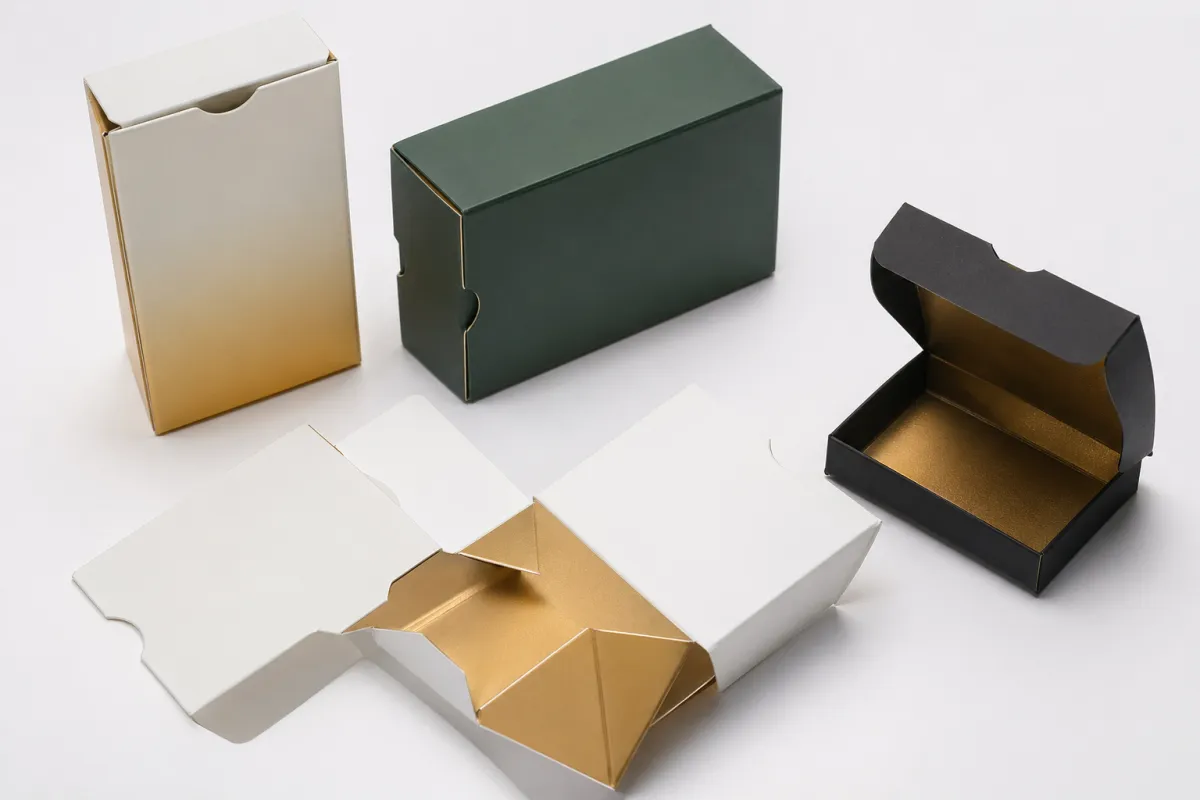
Most buyers notice custom tuck end boxes first because they give a strong retail face. That front panel is valuable real estate for logos, ingredients, barcodes, compliance copy, and finish effects. Production teams notice something else after the first run: if the geometry is tuned badly, the carton can slow the whole line. Pretty boxes are great. Pretty boxes that fight the operator are not.
From a buyer’s standpoint, custom tuck end boxes sit in a useful middle ground. They are usually less expensive than rigid packaging, easier to print than some specialty structures, and more refined than a plain shipping carton. Compared with mailer boxes, they often have a tighter retail profile. Compared with a folding carton that needs a glued bottom, they can move faster through packout if the closure suits the product. Compared with a clamshell, they usually feel warmer and less industrial, which is why they work well for Custom Printed Boxes that need an approachable brand tone.
The best use cases are driven by handling, not by category labels. custom tuck end boxes work well for electronics accessories, candles, supplements, kitchenware, cosmetic kits, sample sets, and assembly kits with small parts. One pattern keeps showing up: the product needs a clear exterior, a predictable opening and closing motion, and board strength that holds up under normal warehouse handling without drama.
They are not the right answer for everything. Heavy products that need structural support across every shipment may call for corrugated packaging or a rigid insert. A luxury unboxing brief with thick walls and a magnetic closure belongs in rigid packaging. A tamper-evident retail shell may point toward a different structure entirely. custom tuck end boxes are a disciplined choice, not a universal one.
For teams building a packing workflow, the value is practical. The format can reduce assembly friction, standardize shelf presentation, and cut down on the number of decisions an operator makes during packout. That matters more than it sounds. A carton that behaves well in CAD can still slow a line if the tuck tension is off or the board is too soft for the closure. I have seen that happen more than once, and it never impresses the floor supervisor.
A box that looks efficient on a drawing can still slow a line if the tuck angle fights the operator’s hand. Good custom tuck end boxes disappear into the workflow; poor ones announce themselves all shift long.
When you compare custom tuck end boxes with other options, process should come before appearance. The best package protects the product, supports the brand, and avoids extra labor in the warehouse. That order of operations is the part many packaging decks skip, and it is usually where the trouble starts.
How do custom tuck end boxes improve packout reliability and launch timing?
custom tuck end boxes improve reliability when teams treat them as a repeatable packaging structure, not a placeholder for artwork. The real question is whether the fold sequence stays stable at volume. If the answer is yes, operators build confidence faster, errors fall, and launch timing becomes less fragile. If the answer is no, the carton becomes one more process risk that somebody has to babysit.
Think of a busy fulfillment line as a series of micro-decisions. Every extra motion adds friction. A stable closure angle, a clear fold direction, and predictable score-line behavior reduce cognitive load. That is why teams with tight quality targets often see fewer first-pass defects when they move to a tuned custom tuck end box rather than a generic folding carton that was never really designed for the job.
There is also a human factor here. Operators can tell within a few units whether a carton is pleasant to build or a nuisance. They may not use the same language an engineer would, but they know when a tab is catching, when a crease is cracking, or when a panel keeps springing open. That feedback is worth gold because it shows up long before a formal defect report does.
In plain terms, custom tuck end boxes help launch timing when they reduce the number of moving parts. Fewer tape steps. Fewer fold corrections. Fewer re-works at the table. That kind of predictability matters most during a launch window, when the team is already juggling artwork approvals, vendor lead times, freight bookings, and inventory release. Packaging is supposed to lower stress, not add another fire drill.
How custom tuck end boxes work from sheet to shelf-ready package
The mechanics of custom tuck end boxes are straightforward once the sequence is laid out. A flat sheet is printed, scored, and die-cut into a blank. The blank is folded along its creases, then erected at the pack station. The top and bottom closures rely on tuck flaps, sometimes with a lock tab or friction notch, so the carton closes without a full layer of tape. When the geometry is right, the closure feels deliberate instead of forced.
Each step depends on the one before it. Grain direction affects how cleanly the board folds. Score depth determines whether the panel opens neatly or splits at the fold. Caliper changes the amount of pressure the tuck flap needs before it locks. Two boxes may look nearly identical on a spec sheet, but on the line one opens with a controlled snap and the other springs back, crushes a corner, or pops open after a few cycles. The difference is usually smaller than people expect and more expensive than they want.
For custom tuck end boxes, the closure is the detail most teams underestimate. A tuck tab folds inward at a controlled angle and interlocks against the receiving panel. A tab that is too short can fail under vibration. A tab that is too long forces operators to push harder, slowing packout and damaging the fold. A notch that is too shallow allows drift during transport. A score that is too aggressive can split after repeated opening or after a humidity shift in storage.
Material choice shapes that behavior as much as the artwork does. Paperboard boxes made from SBS or coated artboard usually give a cleaner print surface and sharper scores, while corrugated or flute-based versions add crush resistance but change the fold feel. In custom tuck end boxes, fit is rarely just about outside dimensions. Internal clearance around the product, the height of any insert, the room for cushioning, and the way the item settles under vibration all matter. A candle in a snug paper insert behaves differently from a glass bottle held by an anti-slip tray, and the carton should be built around that reality.
Print-readiness matters too. Full-bleed graphics can look excellent on custom tuck end boxes, but folds, glue zones, and score lines create registration-sensitive areas. The art team should know where those folds live before layout is finalized. Strong packaging design does more than look good; it respects the path the board takes from sheet to shelf-ready package.
For shipping validation, it helps to look beyond a bench test. The ISTA test methods give a useful frame for drop, vibration, and distribution simulation. Not every SKU needs a formal test program, but parcel and distribution testing will tell you far more than a tabletop shake test, especially when the box moves through multiple carriers or warehouse nodes. A carton can feel fine in a conference room and then act completely different in a truck. That part is kinda annoying, but it is real.
In practical terms, custom tuck end boxes work when three elements are tuned together: fit tolerances, closure geometry, and the environment where the box gets assembled. Separate them and the design may still look strong while producing irritating failures. Treat them as one system and the carton starts acting like a dependable packaging component instead of a recurring exception.
Key factors for choosing materials, specs, and graphics for custom tuck end boxes
Material choice sits at the core of custom tuck end boxes. For lighter retail items, coated paperboard in the 250-400 gsm range is often enough, especially when the carton carries more visual weight than structural load. Heavier items may call for thicker board, a lined board, or a design that shifts part of the load into the insert. I have watched teams chase a premium look and forget that stiffness is part of the experience. A structure that caves at the corners stops feeling premium very quickly.
When buyers compare substrates, they should look at burst strength, edge crush, caliper, and coating behavior, not just headline thickness. Matte stock can feel more refined. Gloss can brighten color and make imagery pop. UV coating can improve scuff resistance. Kraft stock can signal a more natural tone. Recycled content can support sustainability claims, especially when the sourcing is verified through a program such as FSC certification. That matters for brands trying to connect custom tuck end boxes with a cleaner supply story without pretending every board behaves the same way.
Graphics and structure need to be planned together. A bold, fully inked background can look striking on these boxes, yet high coverage can add drying time, raise rub risk, and make scuffing more visible at fold points. Foil and embossing add presence, but they also add setup complexity and can push the price sharply upward when the run is small. Spot colors are useful when a brand wants consistent identity across a family of products, while four-color process often fits photographic retail packaging better.
Die-line details are where a lot of trouble starts or ends. Tuck tab width, notch depth, seam allowances, panel overlap, and fold direction all matter. On a fast pack line, a stubborn tab angle can add seconds to each unit. Multiply that by a few thousand custom tuck end boxes and you have labor cost that never showed up in the mockup. If the line is staffed in a consistent right-handed or left-handed pattern, opening side and fold direction can create a measurable difference in comfort and speed.
Insert compatibility should be reviewed early, not after the artwork is nearly locked. Corrugated separators, molded pulp trays, foam-free cushions, and anti-slip inserts each interact differently with the closure. Glass, polished metal, coated jars, and candles in thin glass may need more support than a paperboard insert can provide. Accessory kits and sample kits may only need a well-scored inner tray. custom tuck end boxes can handle many options, but the structure must be selected with the product’s center of gravity in mind.
| Board or structure option | Typical use | Approximate unit cost at 5,000 pcs | Notes |
|---|---|---|---|
| 250-300 gsm coated paperboard | Light cosmetics, sample kits, accessories | $0.18-$0.26 | Best for compact custom tuck end boxes with lighter loads and strong print coverage. |
| 18-24 pt SBS paperboard | Retail packaging, supplements, candles | $0.22-$0.34 | Balanced stiffness, good print quality, common for custom tuck end boxes with premium branding. |
| Recycled or kraft board | Natural look, sustainability-led products | $0.24-$0.36 | Good for earthy branding, though print consistency may be less uniform than bright white stock. |
| Heavier board with insert | Fragile glass, kitchenware, mixed component kits | $0.30-$0.48 | Higher material cost, but can reduce damage and improve shelf confidence for custom printed boxes. |
Before sign-off, I like to see three checkpoints: a digital proof, a board sample, and a quick assembly simulation with the actual product weight. That is where custom tuck end boxes stop being an idea and start acting like a production part. If the closure force feels off, the score cracks, or the printed panel rubs against an insert, those problems should be caught before the press run, not after the first pallet ships.
One practical note: the strongest options are usually the ones that can be repeated without drama. A buyer can add foil, soft-touch lamination, or a special insert later. It is much harder to recover from a carton that opens badly, prints beautifully, and still slows the entire fulfillment operation. Cheap-looking can be fixed with ink. A bad closure usually cannot.
Step-by-step guide and process timeline for custom tuck end boxes
Launches move faster when the team treats custom tuck end boxes like a small engineering project instead of a quick artwork approval. The process does not need to feel complicated, but it does need sequencing so the carton is built around the product, the line, and the shipment path.
- Discovery and constraint mapping. Start with SKU dimensions, product weight, target shelf feel, expected parcel destinations, and unit economics. For custom tuck end packaging, this is where the team decides whether the carton is protecting a single item, a nested kit, or a display-ready retail pack.
- Concept and dieline development. Choose the carton architecture, closure direction, and tolerance allowances. If the product has sharp corners, a bulge, or a fragile finish, the dieline should account for that before artwork is locked. In many cases, half an inch of internal discipline matters more than one more logo treatment.
- Prototype and fit validation. Build samples and test closure force, corner clearance, stack behavior, and openability after temperature or humidity changes. For custom tuck end boxes, this is usually the first point where you learn whether the carton closes with a clean motion or needs awkward finger pressure.
- Art and prepress alignment. Confirm color, registration, bleed, folds, and every no-print zone. Clear instructions here reduce revisions later, especially if the packaging design includes matte varnish, foil, or a specific finish on the front panel.
- Pilot run and process freeze. Run a short batch to see how the line behaves. Watch for score cracking, slow closing, misfolds, and insert-loading problems. Small changes to knife setup or glue points can make a large difference in custom tuck end boxes.
- Production and timeline planning. Plan press time, finishing, quality sampling, and shipping buffers. A realistic schedule is often 2 to 6 weeks depending on revisions, print complexity, and order size, with the sample loop often taking the longest share of the lead time.
- Post-launch review. After the first 500 units and again after 5,000, collect feedback from fulfillment, QA, and customer service. That is where the next round of improvements should come from: maybe a tab angle, maybe a board upgrade, maybe a narrower tolerance, but usually not all three at once.
The timeline usually depends more on decision speed than on press speed. A brand can lose a week waiting on art approval and then blame the printer for a delayed launch. Clean ownership matters. Keep one person responsible for structural decisions, one for artwork, and one for logistics. That simple discipline helps custom tuck end boxes move from concept to warehouse without a pile of split email threads.
Another detail is easy to miss: sample reviews should use the real product, not a substitute weight block if the item has odd balance or a soft exterior. A bottle with a narrow neck behaves differently from a brick-shaped carton filler. With this format, those details decide whether the package feels easy or irritating during packout. That is the kind of thing people only notice after they have had to do it a hundred times.
If the goal is stronger shelf presence, a smoother assembly process, and fewer line adjustments, the smartest move is to freeze the structure earlier than most teams expect. That gives the art team enough room to refine the print while keeping the physical carton stable.
Custom tuck end box cost: the pricing drivers and where savings happen
The cost of custom tuck end boxes makes more sense once it is broken into parts: setup, material, printing, finishing, and logistics. Unit price is only one line in the quote. If a buyer compares only the per-piece number, the landed cost can creep upward through die charges, sampling, revision time, rush fees, or freight on a heavier carton.
Setup costs usually include die creation, press adjustments, and any prepress work needed to position folds and closures correctly. Printing costs rise with more colors, larger coverage, special inks, and tighter color matching. Finishing costs increase when the project includes soft-touch film, spot UV, foil, embossing, or a specialty coating. For custom tuck end boxes, those details matter because each extra finish can affect appearance and throughput at the same time.
Volume is the strongest savings lever. A short run often sits near the top of the price curve because setup is spread across fewer units. As the order size rises, unit cost falls more predictably. Dead stock is the counterweight. Order too much and savings can disappear into storage. I have watched teams save three cents a carton and then lose the advantage because pallets sat for months while a label changed or a formula shifted. That is a painfully ordinary mistake.
There are hidden cost drivers that buyers miss all the time:
- Reprints caused by artwork that ignores fold lines or live areas.
- Rejected samples because the closure force is wrong on custom tuck end boxes.
- Freight changes when a thicker structure moves the shipment from parcel to LTL.
- Long lead times that force a rush production slot.
- Revision loops between marketing, operations, and procurement.
Savings usually come from restraint. Standardize panel dimensions across SKU families where possible. Keep ink systems stable so the press team does not reset color behavior for every product. Avoid unnecessary finish changes from one line to the next. Use a single structural family if the products are close in weight and footprint. That is one of the simplest ways to keep custom tuck end boxes pricing predictable without flattening the brand.
For buyers comparing options, the easiest rule is to request a quote that separates per-unit cost, setup cost, proofing cost, and revision charges. If the vendor will not itemize those pieces, the quote may look attractive while leaving plenty of room for surprises. Strong procurement on custom tuck end boxes is mostly about asking better questions before the order is approved.
Here is a practical checklist for pricing reviews:
- Ask for board grade, caliper, and coating specifics.
- Confirm whether the quote includes dieline changes.
- Check the cost impact of any foil, emboss, or special coating.
- Clarify the approval count before production begins.
- Ask how freight changes with pallet count and carton weight.
If you are also comparing other structural families, keep in mind that custom tuck end boxes often win not because they are always the cheapest carton on a spreadsheet, but because they reduce assembly friction and look polished enough for retail packaging. That operational value is easy to miss until labor minutes are measured across several thousand units.
For brands that want a simple route into custom printed boxes, the best savings often come from restraint: one strong finish, one stable board choice, one clean closure. That is usually enough to create a premium result without adding cost in every direction.
Common mistakes with custom tuck end boxes that cause returns and rework
The most common failure in custom tuck end boxes is a mismatch between the product and the interior tolerance. If the fit is too tight, corners pinch and flaps split. If the fit is too loose, the product shifts, the package looks soft, and the closure may not hold as intended. On a busy line, even a small fit error becomes a repeatable annoyance instead of a one-time problem.
Another mistake is choosing board that looks fine on a sample sheet but behaves badly after humidity changes or transport vibration. Thin board can split at the score line. Aggressive scoring can weaken the edge and create a tear point. A carton that survives a short bench test may still fail after a few days in a warehouse with changing moisture conditions. For custom tuck end boxes, the board and scoring setup have to reflect the real distribution environment, not just the design room.
Pack-line ergonomics matter more than many teams expect. If operators are opening, loading, tucking, and closing 5 to 20 units per hour at a table station, awkward geometry builds fatigue fast. One difficult corner or one stubborn tab can slow the whole flow and raise defect rates. I have seen teams blame the operator when the real issue was a carton that demanded too much hand force. Good custom tuck end boxes should feel predictable from the first unit to the hundredth.
Transport reality is another trap. Compression, tilt, and vibration do not show up in a clean studio photo, but they show up immediately in trucks and parcel networks. If the box is shipping through mixed carriers, it should be validated for stacking and movement, not just appearance. A design that performs on the bench can still fail under actual handling cycles, especially if the product has a high center of gravity or a polished finish that cannot tolerate rubbing.
Skipping a pilot is one of the most expensive shortcuts. A render or 3D visualization helps, but it is not the same as putting real product into a real box, on a real table, with real hands. That is where closure issues, glue point issues, and artwork margin issues surface. When a team approves custom tuck end boxes without that check, the correction cost can spread across tooling, print, assembly, and sometimes launch timing too.
The cheapest mistake is the one caught in sample phase. The most expensive mistake is the one found after pallets have shipped, because then custom tuck end boxes become a logistics problem, not a packaging problem.
One more issue shows up late in the process: approvals that bounce between manufacturing and marketing after structural sign-off. A logo may shift a few millimeters, a barcode may move too close to the fold, or a claim panel may drift into a no-print area. Those are small changes in a meeting and large changes in production. Clear ownership keeps custom tuck end boxes from being reworked for reasons that should have been settled in the first proof cycle.
Most of these mistakes are preventable. They just require patience and a willingness to test the carton the way it will actually be used. That is not glamorous, but it protects budget and brand at the same time.
Expert tips and practical next steps for your custom tuck end box rollout
If I had to narrow the rollout strategy to one sentence, it would be this: treat custom tuck end boxes as a system, not a graphic file. The carton, the product, the line, the freight path, and the brand story all have to agree. That sounds obvious until a packaging team is under a deadline and someone tries to solve a structural problem with a prettier print file.
Here are the most useful steps I recommend for a controlled launch:
- Test three structural variants. Try one change at a time, such as lock depth, tab angle, or board gauge. A small validation set can reveal a lot about how custom tuck end boxes behave under real conditions.
- Build a spec card. Include final dimensions, artwork tolerances, closure force targets, acceptable board grade, and packing instructions. Share it with the vendor and the fulfillment team so nobody is guessing.
- Use a stage-gate review. Check the first 500 units with a line supervisor, then review returns and handling notes around 1,000 units, and freeze the design only after the feedback stays stable.
- Keep one owner for the structure. When too many people edit the dieline, the packaging can drift away from the original purpose.
- Confirm freight and storage assumptions. Even a modest increase in board weight or finished carton size can change pallet counts, truck fill, and storage space.
There is also a useful discipline many teams skip: write down what success looks like before production begins. If the goal is fewer assembly errors, define the acceptable error rate. If the goal is better shelf presence, define the visual criteria. If the goal is stronger brand recall, define the print requirements. That is how custom tuck end boxes become an objective packaging decision instead of a subjective one.
From a procurement angle, I would suggest three next moves. First, finalize the SKU-to-pack matrix so every product has a defined box style. Second, request at least two vendor quotes with the same assumptions for board, finish, and timeline. Third, schedule a production kickoff with QA and logistics in the room, because those teams often spot the weak points before the carton is released. If you want a broad reference point while you compare options, our Custom Packaging Products page can help frame the structure choices.
My honest view is that custom tuck end boxes work best when teams respect the material. Paperboard has limits. Scoring has limits. Tuck friction has limits. Stay inside those limits and test the carton with real product, and the result is usually clean, efficient, and dependable. If the prototypes pass fit, sealability, and damage resistance, scale in lots. If they do not, change one variable at a time and test again. That measured approach keeps custom tuck end boxes useful for both branded packaging and practical warehouse operations.
For brands that want strong shelf appeal without overbuilding the structure, custom tuck end boxes remain one of the most practical choices in packaging design. They can look refined, they can pack quickly, and they can protect the product when the board, print, and closure are engineered as one working unit. That is the real takeaway: start with the product, lock the structure early, and let the artwork follow the mechanics instead of fighting them.
What makes custom tuck end boxes a better choice than rigid mailers for some products?
Choose custom tuck end boxes when shipping weight, shape consistency, and visual branding matter more than absolute rigidity, and when you need efficient hand assembly without adhesive on every closure. They work well for products that can tolerate moderate compression and benefit from a flat-front, printable structure with controlled tuck-lock behavior.
How long does it take to launch a run of custom tuck end boxes?
A realistic timeline is often 2 to 6 weeks, depending on print complexity, revision count, sample approval speed, and quantity. The fastest path is to lock the spec early, approve the dieline and proof quickly, and keep one clear decision owner for design and manufacturing changes.
Can custom tuck end boxes hold heavy or awkward products safely?
Yes, but only if board grade, closure geometry, and internal support are matched to the product’s center of gravity, peak weight, and vibration exposure. A real-weight fit test is the best starting point, and a pull test on each lot helps catch closure wear before it turns into a field problem.
How is the cost of custom tuck end boxes calculated and controlled?
Pricing is built from die and setup complexity, quantity, print colors, board choice, finishing, and revision handling, not just the unit sheet cost. You can control it by batching artwork changes, simplifying folds and slots where possible, and confirming minimum order and change-management terms before release.
What mistakes should I avoid when specifying custom tuck end boxes for fulfillment operations?
Avoid vague tolerances and unclear product photos; provide exact dimensions, insertion sequence, and closure force expectations so production and fulfillment interpret the carton the same way. Also avoid late changes after pilot sign-off, because tweaks to tabs, scores, or print areas often trigger re-cutting or reprint costs that are easy to avoid earlier.

