Ordering 25 stickers instead of 2,500 should not hold up a launch. That gap is exactly why Custom Vinyl Stickers no minimum order matter so much for small brands, pilot runs, event kits, subscription inserts, and packaging changes that need to happen without committing to more inventory than a project can actually use.
For packaging buyers, stickers often solve a problem faster than any other printed component. The carton may already be in storage, but the formula changed. A seasonal offer may need a short run. A startup may want to validate one SKU before moving into full-scale custom printed boxes. In each case, Custom Vinyl Stickers No Minimum order are not just convenient. They help control inventory, reduce waste, and keep the work moving.
Vinyl is usually the right starting point because it holds up better than basic paper labels under normal handling. It resists scuffs, moisture, and everyday abrasion well enough for many packaging and promotional uses. Pair that durability with clear proofing and consistent specs, and even a small batch of custom vinyl stickers no minimum order can support a clean launch now while making future reorders simpler.
Why custom vinyl stickers no minimum order solve small-batch packaging problems
Small-batch businesses keep running into the same friction: suppliers are built for volume, while the buyer needs precision. A sample release may only need 40 logo decals. A weekend market might call for 75 promotional seals. A retail trial could require 120 bottle labels. Traditional minimums push buyers toward overordering, and that usually means cash tied up in packaging that may become outdated before it is used.
Custom vinyl stickers no minimum order solve that mismatch by letting real demand set the quantity. If you only need enough for one event, one mailer campaign, or one pilot production run, you can order to the job instead of padding the order just to satisfy a factory threshold.
That flexibility works across a wide range of uses:
- Product labeling for short-run jars, bottles, pouches, and sample kits
- Promo packs added to branded mailers or event handouts
- Laptop and merch decals for creator brands, clubs, and pop-up retail
- Seasonal campaigns where artwork changes quickly and leftover stock loses value fast
- Packaging updates that temporarily modify existing retail packaging without reprinting the full carton
There is also a practical testing advantage. A short run gives you room to check whether the sticker is the right size on the actual package, whether the finish reads correctly under store lighting, and whether customers handle it as intended. You are not trying to predict everything months in advance. You are learning from a smaller run, then reordering with more confidence once the design proves itself.
Practical value: short-run sticker buying lowers upfront spend, shortens approval cycles, and reduces the chance of sitting on obsolete packaging components.
That matters even more for brands still refining their packaging design. With custom vinyl stickers no minimum order, you have room to test logo scale, promotional bursts, compliance updates, or message hierarchy before committing to larger quantities.
For many buyers, the appeal is not only the low commitment. It is the speed of adjustment. A short-run sticker program can bridge the gap between concept and shelf-ready packaging, especially if your business is still adjusting artwork, claims, or product naming. That is a practical reason custom vinyl stickers no minimum order continue to be useful for startups, makers, and established brands running limited campaigns.
Vinyl sticker materials, finishes, and adhesive options that matter
Not every sticker performs the same way once it is applied. Vinyl stands out because the face stock is flexible, durable, and generally built for tougher use than paper. Many common vinyl sticker constructions fall somewhere around 2.5 mil to 4 mil, though exact builds vary by supplier. That thickness helps the sticker resist scuffing and routine handling better, especially on items that travel, sit in coolers, or get packed and unpacked repeatedly.
Finish selection changes both the look and the function. Three options cover most everyday needs:
- Gloss vinyl for brighter color, stronger contrast, and a more vivid retail appearance
- Matte vinyl for lower glare and a softer, more understated look
- Clear vinyl for “no-label” effects where the package or surface should remain visible
Gloss works well for colorful promotional decals and designs that need visual pop. Matte usually suits text-heavy layouts, muted branding, and situations where overhead lighting can create harsh reflections. Clear vinyl can look especially sharp on glass, acrylic, and some smooth plastic containers, though contrast becomes a real issue. On darker surfaces or tinted contents, a logo can disappear unless white ink or a spot-white layer is built into the file.
The adhesive matters just as much as the printed face. Permanent adhesive is the standard choice for longer-term labeling and general package branding. Removable adhesive makes more sense for temporary promotions, event graphics, or surfaces that should stay clean after the sticker comes off. Even then, surface type changes the result. A sticker that bonds well to glass may not behave the same way on low-surface-energy plastics such as HDPE or polypropylene.
Cut style affects storage, application speed, and how the stickers are handed out:
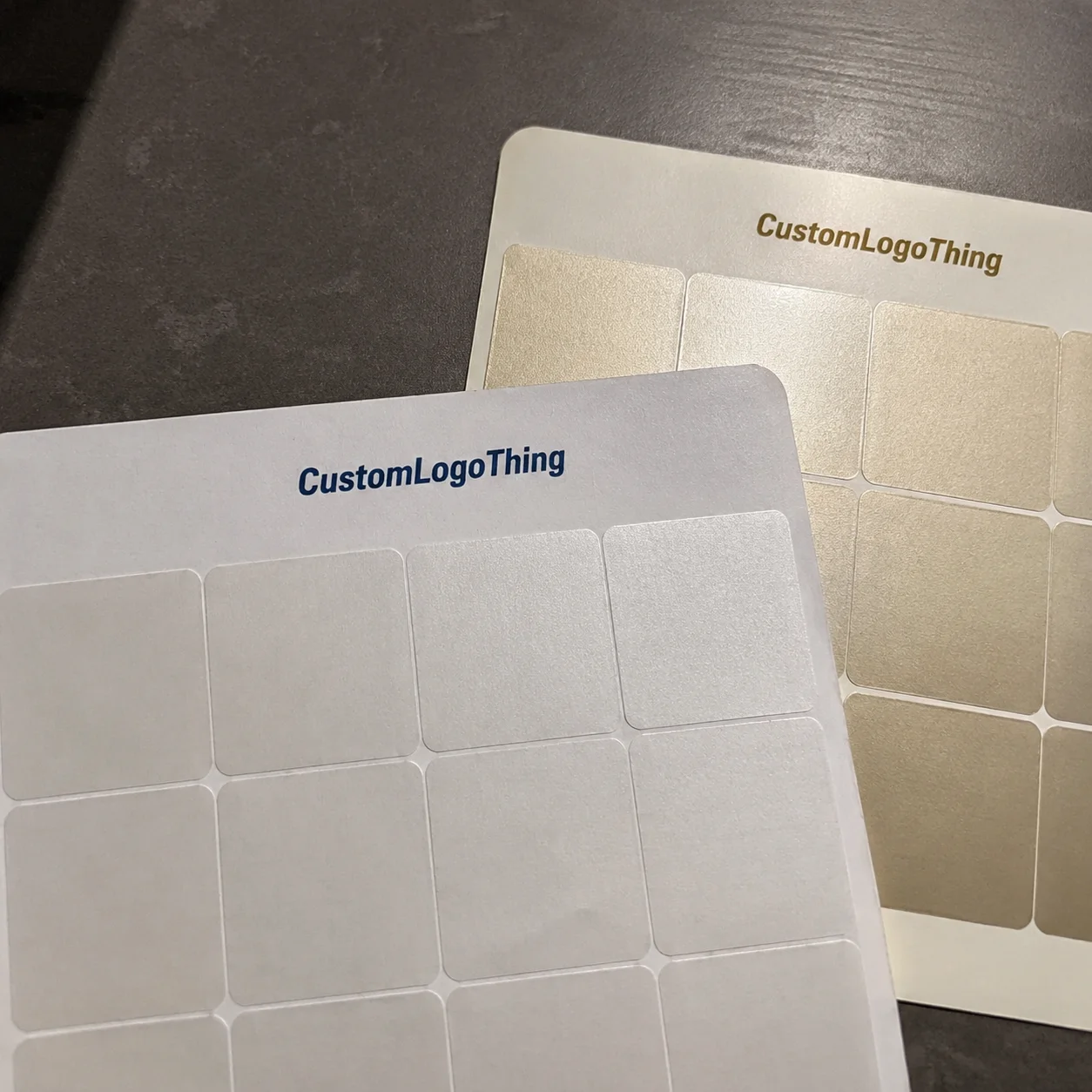
- Kiss-cut sheets are easy to store and useful for small hand-applied runs
- Individual die-cut stickers work well for merch packs, inserts, and giveaways
- Roll format fits repetitive application and can be the better choice for higher-volume labeling
The best material is not the one that simply looks nicest on a monitor. It is the one matched to the real conditions: moisture, handling, sunlight, surface texture, and application method. If you are comparing custom vinyl stickers no minimum order with other short run stickers, ask whether the construction includes a laminate, what kind of adhesive is used, and whether the print is intended for indoor or outdoor exposure.
If you are pairing stickers with Custom Labels & Tags or other Custom Packaging Products, keeping the finish and print character aligned across components usually creates a more consistent branded presentation. The visual match between cartons, labels, and decals is often what makes a small order feel polished rather than temporary.
What should you check before ordering custom vinyl stickers no minimum order?
Short-run orders move faster when the technical details are settled before the quote turns into a production file. Many delays start with artwork that looks complete but is still missing one production detail that affects fit, print quality, or price.
Before placing an order, confirm these basics:
- Size: exact width and height in inches or millimeters
- Shape: square, rectangle, oval, circle, or custom die-cut
- File format: AI, EPS, or press-ready PDF are preferred; high-resolution PNG can work for simpler jobs
- Bleed: often 0.125 inch beyond the cut line
- Safe area: keep text and important logo elements at least 0.0625 to 0.125 inch inside the trim
- Color mode: CMYK for most print workflows, with Pantone references if brand color matching matters
- Quantity: exact count needed now, plus likely reorder pattern
Dimensions have a bigger effect than many buyers expect. A 2-inch circle and a 2.5-inch circle can look nearly identical on screen, yet feel very different on a jar lid, mailer flap, or pouch. That small change affects fit, readability, and cost. If the sticker is extending existing branded packaging, the proportions need to feel intentional rather than improvised.
Use conditions deserve the same attention. Ask whether the sticker will face direct sun, condensation, repeated moisture, or friction during shipping. A standard vinyl construction may work indoors but fade faster outside if there is no protective laminate. Curved surfaces create another challenge. Tight bottle radii, textured coatings, and certain plastics can all lead to lifting at the edges if the construction is not suited to the surface.
Artwork details become even more important as the sticker gets smaller. Fine strokes under 0.25 pt can break up or fill in, depending on scale and print method. Reversed text on dark backgrounds can lose legibility below roughly 6 pt, though the actual threshold depends on the font and the press. Transparent materials add one more variable because low-contrast artwork may disappear after application.
If the design includes gradients, QR codes, thin outlines, or exact brand colors, ask for a proof and read it carefully. A useful proof should confirm more than the artwork image. It should show the cut line, orientation, material, finish, and any laminate or white-ink details tied to production. For custom vinyl stickers no minimum order, that proof stage is especially important because small batches are often ordered on a tight timeline and there is less room for a do-over.
For packaging systems that need to hold up through shipment and handling, broader transit guidance from ISTA can also be useful when the sticker is part of a larger pack-out.
Pricing, quote, and MOQ considerations for short-run orders
No minimum order quantity sounds simple, but the pricing still follows real production costs. File setup, print time, cutting, packing, and shipping exist whether you buy 20 stickers or 2,000. That is why short runs usually cost more per piece, even when the supplier allows complete flexibility on quantity.
Four factors usually shape the price first:
- Size — larger stickers use more material and reduce yield per sheet or roll
- Finish — matte, gloss, laminate, or specialty coatings can raise the cost
- Shape complexity — simple circles and rectangles are easier than intricate custom die-cuts
- Quantity — more pieces spread setup cost over a larger run
Print method plays a role too. Digital production is often the best fit for custom vinyl stickers no minimum order because it avoids much of the plate or tooling overhead that makes tiny orders hard to justify. That also makes quick reorders easier. Specialty films, multiple versions, unusual effects, or white-ink work can still increase the cost.
Here is a realistic comparison for standard full-color vinyl stickers. These are broad market ranges, not fixed rates, and actual pricing depends on the material, supplier, shipping zone, and artwork complexity.
| Order Example | Spec | Typical Unit Cost | Typical Total | Best Use |
|---|---|---|---|---|
| 25 pieces | 3" die-cut, gloss vinyl, permanent adhesive | $0.80-$1.60 | $20-$40 | Samples, launch kits, events |
| 100 pieces | 3" die-cut, gloss or matte vinyl | $0.35-$0.75 | $35-$75 | Small campaigns, promo inserts |
| 500 pieces | 3" die-cut, laminated vinyl | $0.18-$0.38 | $90-$190 | Short retail runs, product labeling |
| 1,000 pieces | 3" standard shape, laminated vinyl | $0.10-$0.24 | $100-$240 | Repeat programs, wider distribution |
A useful quote should spell out more than the final number. At minimum, it should identify:
- Face material and thickness, if available
- Finish or laminate
- Adhesive type
- Print method, if relevant
- Cut style and final dimensions
- Whether proofing is included or billed separately
- Shipping method and whether freight is included
Cost control usually comes from simplifying the job, not chasing unrealistic discounts. Standardizing sticker sizes across multiple SKUs helps. Choosing a circle or rectangle instead of a very irregular contour helps. Grouping related designs into one workflow may help as well, though pricing structures vary from one supplier to another.
The comparison that matters most is not short-run unit cost against the cheapest large-volume rate. The better comparison is short-run sticker cost versus wasted inventory, storage space, delayed launches, and obsolete packaging. A $55 test order that prevents a much larger packaging mistake is often money well spent. For that reason alone, custom vinyl stickers no minimum order can be a highly efficient buying option even when the unit price is higher.
Production process and turnaround from artwork to shipment
A clean production process matters more than ambitious promises. Most sticker orders follow a straightforward sequence, and buyers who understand that sequence usually move through it faster.
- Submit artwork and specifications
- Review dimensions, material, finish, and adhesive
- Receive a proof
- Approve or revise the proof
- Print and cut
- Quality check
- Pack and ship
For standard digital sticker jobs, production after proof approval often falls in the 3 to 7 business day range, with shipping added on top. More involved work, such as clear vinyl with white ink, multiple versions, or outdoor laminated builds, may stretch closer to 7 to 12 business days. Reorders from a saved spec can move faster. Rush service may be possible, though it rarely helps if the file still needs corrections.
The proof stage is where most delays start. A buyer opens the proof a day late, then asks for a size change, then notices the cut line needs adjustment, then starts reconsidering the finish. Those are normal revisions, but each one adds time. A print-ready file with exact dimensions and a same-day response to the proof can move through production much more quickly.
Digital workflows are what make custom vinyl stickers no minimum order practical. The setup burden is lighter than older volume-driven methods, so a supplier can handle small quantities without building the whole job around a large minimum. Once the file, cut path, finish, and adhesive are locked, repeat orders usually require much less back-and-forth.
Quality control should cover more than color alone. Good production checks also look at cut registration, edge quality, laminate alignment, piece count, and packaging condition before the order leaves the shop. If the stickers are part of a broader package branding system or sold alongside larger printed components, consistency becomes part of the customer experience.
For repeat programs, it helps to keep a simple internal spec record after the first run:
- Final art file name and revision
- Sticker dimensions
- Material and finish
- Adhesive type
- Cut style
- Approved proof date
- Order quantity and lead time
That small record can remove a surprising amount of friction from future reorders or from expansion into related lines through Wholesale Programs. It also helps preserve consistency if your team is ordering custom vinyl stickers no minimum order on a recurring basis for events, test launches, or regional packaging variations.
What separates a reliable sticker supplier from a risky one
Price gets attention quickly, but repeatability is what builds trust over time. A dependable supplier should be able to tell you what vinyl is being used, what finish is applied, and how the adhesive is expected to behave on your target surface. Vague answers are usually a warning sign.
Proof accuracy is another major separator. Small orders still deserve the same attention to detail as large ones. The supplier should verify size, cut, orientation, material choice, and any special print treatment before production begins. If a vendor treats a 50-piece order like it hardly matters, that same attitude tends to show up again on the reorder.
Strong communication is not about polished sales language. It is about useful technical guidance. Matte may be the better option if your packaging sits under strong lights. Removable adhesive may fail on certain textured paperboards. Clear vinyl may need white backing so the artwork reads correctly. Those are the kinds of details that distinguish a real production partner from a company simply taking orders.
Reliable vendors are also direct about limitations. Outdoor durability is a good example. Vinyl handles moisture well, but long-term exposure to sun depends on the ink set, laminate, and the conditions where the sticker will live. A trustworthy supplier will state that plainly instead of promising universal performance. The same honesty should apply to color matching, very small type, and difficult surfaces.
Buyers with sustainability goals should ask specific questions too. Sticker constructions are often mixed-material products, so recyclability depends on the full package system rather than the face stock alone. For broader sourcing standards, the FSC remains a useful reference for paper-based packaging components that may sit alongside a sticker program.
The best supplier for custom vinyl stickers no minimum order is usually the one that can reproduce a previous order accurately, explain tradeoffs clearly, and keep the process simple. Flashy claims do not matter much if the specs drift from one run to the next. Consistent output does.
Next steps to order custom vinyl stickers no minimum order
If you are ready to order custom vinyl stickers no minimum order, gather the production details before requesting pricing. That means your logo or artwork file, target dimensions, preferred shape, finish, adhesive needs, and the exact surface where the sticker will be applied.
A few practical questions will clarify the job early:
- Does the sticker need to be removable or permanent?
- Does it need to be waterproof for coolers, condensation, or daily handling?
- Will it be used outdoors and need better UV resistance?
- Is the surface smooth, curved, textured, or made from low-energy plastic?
- Will the sticker support existing retail packaging or serve as a standalone promotional decal?
If the design is new, start with a test run. Fifty or 100 pieces is often enough to evaluate appearance, adhesion, readability, and fit on the actual package. That first run can reveal whether the size should change by a quarter inch, whether gloss feels too reflective, or whether clear vinyl needs a white underprint to make the artwork readable.
Send vector art if you have it. AI, EPS, and print-ready PDF files with outlined fonts usually produce the cleanest result. If raster artwork is the only option, make sure the file is high resolution at final size. Then request a proof and review it carefully. Check dimensions, spelling, cut line, transparency, and color expectations before approval.
Once the proof is approved, the workflow gets easier to manage. Reorders move faster. Cost planning becomes clearer. Your packaging system stays more stable as volumes grow. If the sticker program is part of a broader update to branded packaging, that consistency helps the visual system hold together while the business scales.
The simplest path is still the most effective one: request pricing, review the proof, approve the specs, and place the order. For brands that need flexibility without overcommitting inventory, custom vinyl stickers no minimum order remain one of the most practical tools in the packaging mix. They offer a workable middle ground between a one-off sample and a large production commitment, which is why demand for custom vinyl stickers no minimum order continues across packaging, merchandising, and promotional use.
Are custom vinyl stickers no minimum order more expensive per piece?
Usually, yes. Setup and handling costs are spread across fewer pieces, so the unit price tends to run higher on very short orders. The tradeoff is lower waste, less storage pressure, and an easier way to test a design before committing to a larger reorder.
What file format should I send for custom vinyl stickers no minimum order?
Vector files are the strongest option when available, especially AI, EPS, or PDF files with outlined fonts. High-resolution PNG files can work for simpler artwork if the file is built at the final print size and has enough resolution for clean output.
Are vinyl stickers waterproof and suitable for outdoor use?
Vinyl handles moisture far better than paper in many applications, so it is a common choice for packaging, bottles, and decals. Outdoor performance depends on the full construction, including the ink, laminate, and adhesive, along with how much sun, weather, and abrasion the sticker will face over time.
Can I reorder the same design later without starting over?
Yes, as long as the approved art file and production specifications are saved from the first run. Reorders are usually faster when the size, finish, adhesive, and cut style stay the same.
How do I choose between matte, gloss, and clear vinyl stickers?
Gloss gives stronger color pop and a brighter retail look. Matte reduces glare and often fits premium or text-heavy designs better. Clear vinyl works best when you want the background surface to show through, though white ink support may be needed so the artwork stays visible.