Buyer Fit Snapshot
| Best fit | Custom Void Fill Peanuts projects where brand print, material claims, artwork control, MOQ, and repeat-order consistency need to be specified before quoting. |
|---|---|
| Quote inputs | Share finished size, material target, print colors, finish, packing count, annual reorder estimate, ship-to region, and any compliance wording. |
| Proofing check | Approve dieline scale, logo placement, barcode or warning zones, color tolerance, closure strength, and carton packing before bulk production. |
| Main risk | Vague material claims, crowded artwork, missing packing details, or unclear freight terms can make a low unit price expensive after revisions. |
Fast answer: Custom Void Fill Peanuts: Material, Print, Proofing, and Reorder Risk should be specified like a repeatable production item. The safest quote records material, print method, finish, artwork proof, packing count, and reorder notes in one written spec.
Production checks before approval
Compare the actual filled-product size with the drawing, then confirm tolerance on folds, seals, hang holes, label areas, and retail display edges. Reserve space for logos, QR codes, warning copy, and material claims before decorative graphics fill the panel.
Quote comparison points
Review material grade, print process, finish, sampling route, tooling charges, carton quantity, and freight assumptions side by side. A quote is only useful when the supplier can repeat the same color, closure quality, and packing count on the next order.
A carton can feel snug in the hand and still leave a fragile product free to slide, tilt, and smack from side to side once it starts moving through the shipping network. That gap between how a box looks on the bench and how it behaves in transit is exactly why Custom Void Fill peanuts still matter: they turn empty space into controlled support, and they do it without forcing every item into a rigid tray or a one-off molded insert.
Brands that juggle branded packaging, retail packaging, and package branding often end up searching for a middle path between bubble wrap and rigid inserts. Custom Void Fill peanuts fit that middle ground well. If cartons or inserts are also part of the project through Custom Packaging Products, the same practical logic applies: protect the product first, then build a packout that operators can repeat without guesswork. I have seen plenty of nice-looking packouts fail because they were designed for the shelf, not the shipping lane.
Custom Void Fill Peanuts: What They Are and Why They Matter
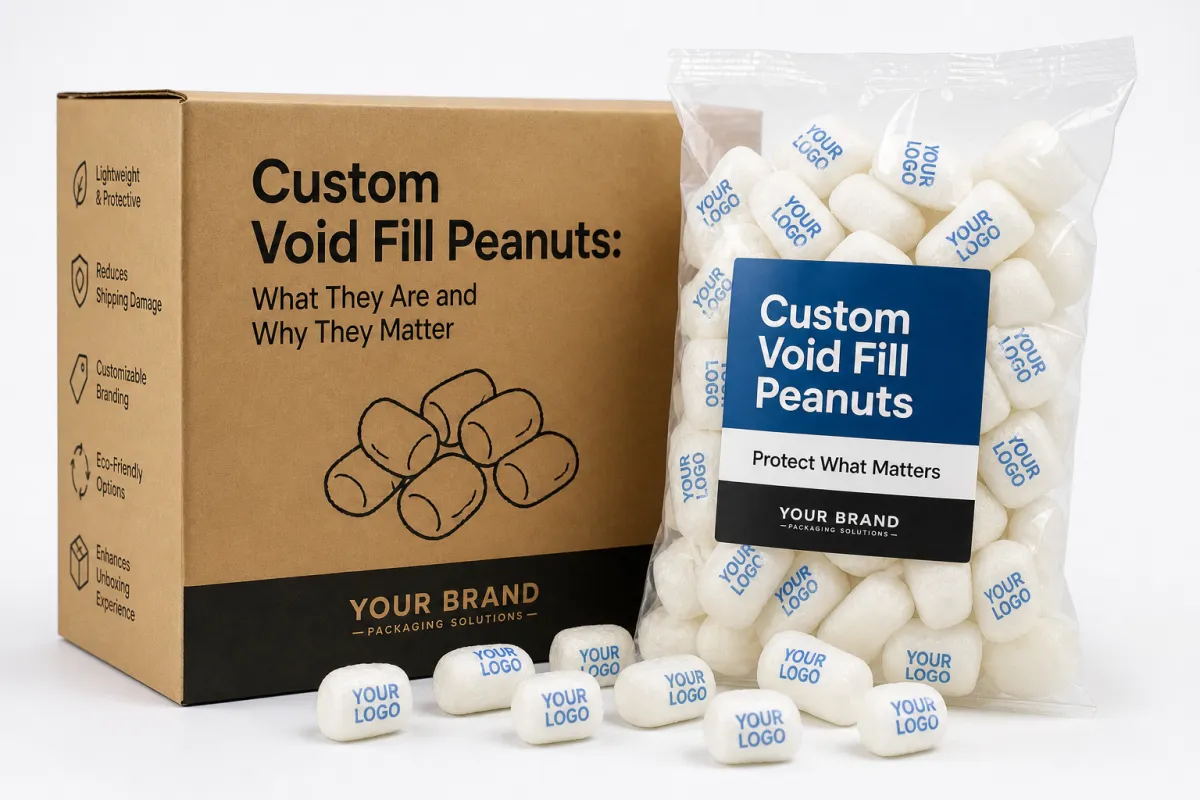
Custom void fill peanuts are loose-fill pieces designed to reduce movement, absorb impact, and make packouts more consistent than generic filler. They are not decoration and they are not just a way to make a box feel full. In product packaging, they are a working part of the protection system, the same way a corner pad or insert would be, only with more flexibility around irregular shapes and changing carton sizes.
The value becomes obvious once a box leaves the packing table and starts riding conveyors, trucks, parcel hubs, and final-mile routes. A product that sits still on the bench can still pick up momentum inside the carton if there is open space around it. Custom void fill peanuts help close that gap by filling the voids around the product and keeping the shipment from acting like a loose instrument case rattling across the road.
- They help stop product shift without forcing every SKU into the same insert design.
- They pair well with custom printed boxes when the outside needs to support the brand and the inside still needs to stay practical.
- They can reduce damage claims, lower repack labor, and make operator performance more predictable from shift to shift.
Off-the-shelf peanuts, bubble wrap, and molded inserts each solve a different problem. Standard loose fill moves quickly but can be inconsistent, bubble wrap is stronger for surface protection, and molded inserts shine when a product needs hard positioning. Custom void fill peanuts sit between those choices when the main challenge is motion control across open space rather than rigid restraint or surface cushioning alone.
For a buyer weighing custom void fill peanuts against other parts of a packaging system, the real question is not whether they are flashy. The useful questions are simpler: will they keep shipments safer, can they keep the line moving, and do they avoid overbuilding the package with a tray or insert that the product does not actually need?
How Custom Void Fill Peanuts Stabilize a Shipment
A solid packout works because custom void fill peanuts flow around irregular shapes and block empty space on more than one side, not only at the bottom of the carton. That matters because impact is rarely a neat, straight hit. It usually arrives as vibration, tilt, or a sudden slide that turns empty space into momentum.
Compression and spring-back
The filler has to compress enough to take the force of a drop, then recover enough to keep the product suspended instead of drifting into a corner. Density changes everything here. A light fill can settle after vibration, while a denser packout resists corner-to-corner movement and gives custom void fill peanuts a better chance of holding position through the whole shipping lane.
Manual pack stations usually need a dependable scoop size or dispenser target because operators have to repeat the same volume without slowing the line. Semi-automated setups can tighten variation even further, but only if the hopper, chute, or air-assist keeps the custom void fill peanuts moving cleanly instead of bridging and dumping unevenly. That part sounds small, but it can make or break throughput on a busy shift.
Where the method shines
This approach fits mixed-size cartons, odd-shaped products, and programs that need a fast, flexible packout without building a custom die-cut insert for every size. It also works well in retail packaging programs that use one filler logic across several SKUs, since the same custom void fill peanuts can stabilize a candle, a bottle, or a boxed accessory without changing the carton structure each time.
The limits deserve attention too. A product with sharp corners, a heavy point load, or a finish that scratches easily may need help from corner pads, bags, or a more rigid insert. I would not push custom void fill peanuts into a setup where surface protection is the main concern and motion control is secondary.
A packout that looks perfect on the table can still fail after a truck ride, because vibration, stacking pressure, and temperature changes do not care how neat the sample looked at approval.
Key Material, Shape, and Performance Factors
Material choice is where custom void fill peanuts stop being a generic packaging part and start becoming a real specification. EPS, starch-based blends, recycled-content formulations, and plant-based mixes all react differently under compression, humidity, and repeated handling, so the right choice depends on the product and the route, not just the sustainability label.
Shape and bead profile matter just as much as resin. More interlocking surfaces usually mean less settling, while smoother shapes may flow more easily but drift more after the carton closes. Density changes whether the filler feels springy or flat, and that changes how well custom void fill peanuts hold the load in place after the packout leaves the station.
The product itself sets the baseline. Weight, fragility, finish sensitivity, center of gravity, and the amount of open space left in the carton all affect performance. A tall bottle with a narrow base behaves very differently from a boxed accessory, which means one formula rarely covers every SKU in a catalog.
Route conditions can undo an otherwise good sample. Parcel shipping brings more individual drops, while LTL usually adds longer vibration exposure. Temperature swings and humidity affect starch-based or plant-based materials, and static can become a real nuisance if the filler dusts or clings to film. That is why custom void fill peanuts should be tested in the same lane the shipment will actually travel.
Operational details matter too. Dust, static, storage space, and how the filler feeds during a busy shift all shape line performance, and a material that looks fine in a catalog can become a daily frustration if it bridges in the hopper or leaves debris on the product. In a high-volume pack area, those issues show up as extra seconds on every box, then the delays pile up faster than anybody wants to admit.
I also tell teams to look at recovery after compression, not just first-contact feel. Some materials cushion well on the first hit and then stay mashed, which is not much help if the carton gets stacked or handled more than once. A filler that keeps its shape after a few cycles usually performs better in the real world.
Custom Void Fill Peanuts Cost, Pricing, and MOQ Drivers
Custom void fill peanuts are often judged too narrowly. Unit price matters, but the real budget question is what each shipment costs after the filler is in the box, because damage, repack labor, and customer service time can erase a cheap line item quickly.
For planning purposes, many programs see custom void fill peanuts add about $0.08 to $0.25 to a small parcel box at light fill and roughly $0.20 to $0.60 to a larger carton with more void space, before freight and handling. That range moves with material, density, and whether the supplier is building a custom profile or modifying an existing one. Those figures are directional, not a promise; freight class, order size, and regional supply conditions can move the number around.
A true custom run can also introduce tooling or setup charges, especially if the supplier needs new screens, dies, or a dedicated forming pattern. Minimum order quantities often begin in the 2,500 to 10,000 piece range, and first orders usually cost more than reorders because samples, adjustments, and approval steps have to happen before production settles in.
| Material option | Best fit | Typical cost behavior | Practical notes |
|---|---|---|---|
| EPS-based loose fill | Low-cost protection for stable SKUs | Usually the lowest unit cost, especially at higher volumes | Light, springy, and effective, but sustainability claims need careful review |
| Starch-based blend | Brands that want a compostable story | Often a moderate price uplift versus standard foam | Can soften with moisture; test storage and shipping humidity before scaling |
| Recycled-content blend | Programs balancing cost and waste reduction | Usually lands between EPS and premium plant-based options | Good middle ground if the supplier can hold density and consistency |
| Plant-based blend | Retail launches and sustainability-led branding | Often the highest material cost, but not always the highest total cost | Check compression recovery, dust, and route behavior under real conditions |
A strong cost model compares custom void fill peanuts against damage claims, return shipping, and the labor needed to rework a crushed carton. If the filler lets you downsize the box or eliminate a second pack step, the landed cost can improve even when the unit price appears higher on paper. That is the part that often gets missed in the first spreadsheet pass.
Broader program planning helps here too. If the shipper is changing in other ways, compare the filler against Custom Packaging Products that may reduce carton footprint, simplify assembly, or align the outside of the box with the inside protection plan. Sometimes a small change in box size makes the filler perform better and saves more money than squeezing a lower unit price out of the material itself.
Step-by-Step Process and Timeline for a New Packout
A new packout starts with a basic audit. Measure product dimensions, weight, and damage points, then photograph the current failure mode so the team can see whether custom void fill peanuts need to address movement, corner load, or both.
From there, build samples and define acceptance criteria before any production order goes out. I like to write down the acceptable movement range, the target fill level, the closure feel, and the line speed operators can sustain without rushing or overstuffing the carton. That simple list keeps the conversation grounded when a sample is sitting on the table and everybody wants to trust their gut.
The real test is always the actual carton, the actual product, and the actual shipping route. Bench checks help, but they do not replace a drop sequence, vibration exposure, and a short pilot run using the same taping, labeling, and stacking pattern the order will see in production; ISTA test methods are a practical way to frame that work.
- Audit one SKU and document the current damage pattern.
- Build sample packs with the intended carton size and closure method.
- Test fill volume against movement, closure ease, and pack speed.
- Run a pilot shipment through the real distribution lane.
- Lock the spec, train operators, and release the packout to production.
Once a sample passes, map the schedule from approval to pilot to full production. Stock materials can move in roughly a week, while a custom formulation or modified density often needs 2 to 3 weeks for sample review, operator sign-off, and the first controlled run. If a supplier needs new tooling or a special blend, give the program more breathing room so the first release does not feel rushed.
Documentation closes the loop. A one-page SOP should state how much to use, how the box should close, what a bad packout looks like, and which QC checks matter on shift; that keeps custom void fill peanuts from turning into tribal knowledge that only one experienced packer remembers.
Common Mistakes to Avoid When Specifying Fill
The first mistake is buying on unit price alone. If custom void fill peanuts save twenty cents but the carton still arrives crushed once every few hundred orders, the real cost is much higher than the filler line suggests.
The second mistake is approving a sample that looks tidy on the table but settles too much after vibration. A few minutes of shaking, a small drop test, and a full-close check can show whether the filler stays where it belongs or slides until the product touches a wall.
A sample that looks perfect in a ten-minute bench check can still fail once a parcel rides a conveyor, picks up vibration, and sits in a truck for hours.
The third mistake is testing in a lab setup that does not match the shipment. Real product weight, real carton size, real tape pattern, and real shipping lane are the only conditions that matter; if the lane is humid, long-haul, or handled by multiple carriers, custom void fill peanuts need to prove themselves there instead of just under fluorescent lights.
The fourth mistake is ignoring ergonomics. A messy hopper, a slow scoop, or a dispenser that sheds dust can make operators overpack, underpack, or skip the fill entirely, and that is how a good material ends up being blamed for a line problem it did not create.
The fifth mistake is forgetting the customer experience and the disposal path. If the outer pack says one thing and the filler says another, the brand can sound careless; if the sustainability claim does not match the actual material, the issue becomes both a packaging problem and a trust problem. The EPA’s waste reduction guidance at EPA is a useful reminder that material claims should be grounded in reality, not wishful wording.
One more trap shows up during rollout: changing too many variables at once. If you switch the carton, the tape, the filler, and the pack sequence all in the same week, nobody can tell which change fixed the problem or caused a new one. Keep the test clean if you want a useful answer.
Expert Tips and Next Steps for a Better Rollout
My strongest advice is to match the filler to the product, not the other way around. Custom void fill peanuts should control movement without forcing the carton to become overbuilt, because good packaging depends on balance rather than over-specifying every component.
Pilot the highest-risk SKUs first, especially the ones with the most complaints, the most freight exposure, or the most awkward geometry. Once those pass, the team can roll the same logic across other packaging components and keep the changes focused instead of trying to redo the whole line at once.
Ask for samples in the exact carton dimensions you plan to use, with the same operators and the same packing bench that will handle production. If you are also refining Custom Packaging Products such as cartons or inserts, get all of those parts to behave like one system so the filler, the box, and the brand presentation work together. That keeps the whole packout honest, which is a lot better than chasing one neat-looking sample that falls apart in transit.
A simple one-page spec goes a long way. Include the approved material, the target fill amount, the acceptable movement limit, and the pass or fail checks, then give that sheet to receiving, operations, and customer service so everyone speaks the same language about custom void fill peanuts.
- Audit one SKU before you touch the whole program.
- Request samples in the real carton, not a close substitute.
- Test with the real product, the real lane, and the real operators.
- Revise the spec based on what actually happens in transit.
- Scale only after the pilot proves the packout can hold up shift after shift.
Handled that way, custom void fill peanuts become a controlled part of the packaging system instead of a one-off purchase. That is the point: stable shipments, cleaner packouts, and a product presentation that still feels intentional when the box reaches the customer.
If the next shipment is a high-risk one, start by testing a single SKU, in the real carton, with the real filler volume and the same packing crew that will use it in production. That one disciplined trial usually tells you more than a stack of catalog pages ever will.
Are custom void fill peanuts better than bubble wrap?
Use custom void fill peanuts when you need to stop product movement across the whole carton, especially for irregular shapes or mixed-size shipments. Use bubble wrap when the product needs more surface protection from scuffing, abrasion, or corner contact. The better choice depends on product shape, carton size, and whether the bigger risk is impact, movement, or surface damage.
How much do custom void fill peanuts cost per box?
The answer depends on material type, density, carton size, and whether tooling or custom shaping is required. A smaller box with light fill can cost very little per shipment, while larger cartons or higher fill volumes push the cost up quickly. The smartest comparison is total cost per shipment, including damage reduction, labor savings, and fewer replacement orders from custom void fill peanuts.
Can custom void fill peanuts be made from recycled or compostable material?
Yes, many suppliers can produce recycled-content or plant-based options, but each material has different crush resistance and moisture behavior. Compostable or recycled choices should be tested in the actual shipping environment before switching at scale. If the route is humid, hot, or long-haul, performance testing matters just as much as the sustainability claim, especially with custom void fill peanuts.
How do I know the right amount of custom void fill peanuts to use?
Start by filling enough space to stop vertical and lateral movement without crushing the product or making the carton hard to close. Run drop tests and shake tests with the real product, real carton, and real shipping setup. Adjust fill amount until the packout stays stable through handling but still packs quickly on the line.
How long does it take to launch custom void fill peanuts for a new packout?
Stock materials can move quickly, but custom shapes, samples, and approval cycles add time before launch. Build in a timeline for prototype review, operator testing, and a pilot shipment before full rollout. If tooling or custom production setup is required, plan for extra lead time so the first production run is not rushed, and the finished custom void fill peanuts packout can hold up from day one.

