Buyer Fit Snapshot
| Best fit | Custom Void Fill Paper Branded projects where brand print, material claims, artwork control, MOQ, and repeat-order consistency need to be specified before quoting. |
|---|---|
| Quote inputs | Share finished size, material target, print colors, finish, packing count, annual reorder estimate, ship-to region, and any compliance wording. |
| Proofing check | Approve dieline scale, logo placement, barcode or warning zones, color tolerance, closure strength, and carton packing before bulk production. |
| Main risk | Vague material claims, crowded artwork, missing packing details, or unclear freight terms can make a low unit price expensive after revisions. |
Fast answer: Custom Void Fill Paper Branded: Material, Print, Proofing, and Reorder Risk should be specified like a repeatable production item. The safest quote records material, print method, finish, artwork proof, packing count, and reorder notes in one written spec.
Production checks before approval
Compare the actual filled-product size with the drawing, then confirm tolerance on folds, seals, hang holes, label areas, and retail display edges. Reserve space for logos, QR codes, warning copy, and material claims before decorative graphics fill the panel.
Quote comparison points
Review material grade, print process, finish, sampling route, tooling charges, carton quantity, and freight assumptions side by side. A quote is only useful when the supplier can repeat the same color, closure quality, and packing count on the next order.
Most buyers focus on the product inside the box. Fair. That is the thing they sold, after all. Still, the first thing a customer often touches is the paper sitting on top of everything else, which is why custom Void Fill Paper branded deserves more attention than it usually gets. That sheet is doing three jobs at once: filling empty space, protecting the contents, and speaking for the brand before the item itself shows up. Not a bad resume for a piece of paper.
What custom void fill paper branded really is
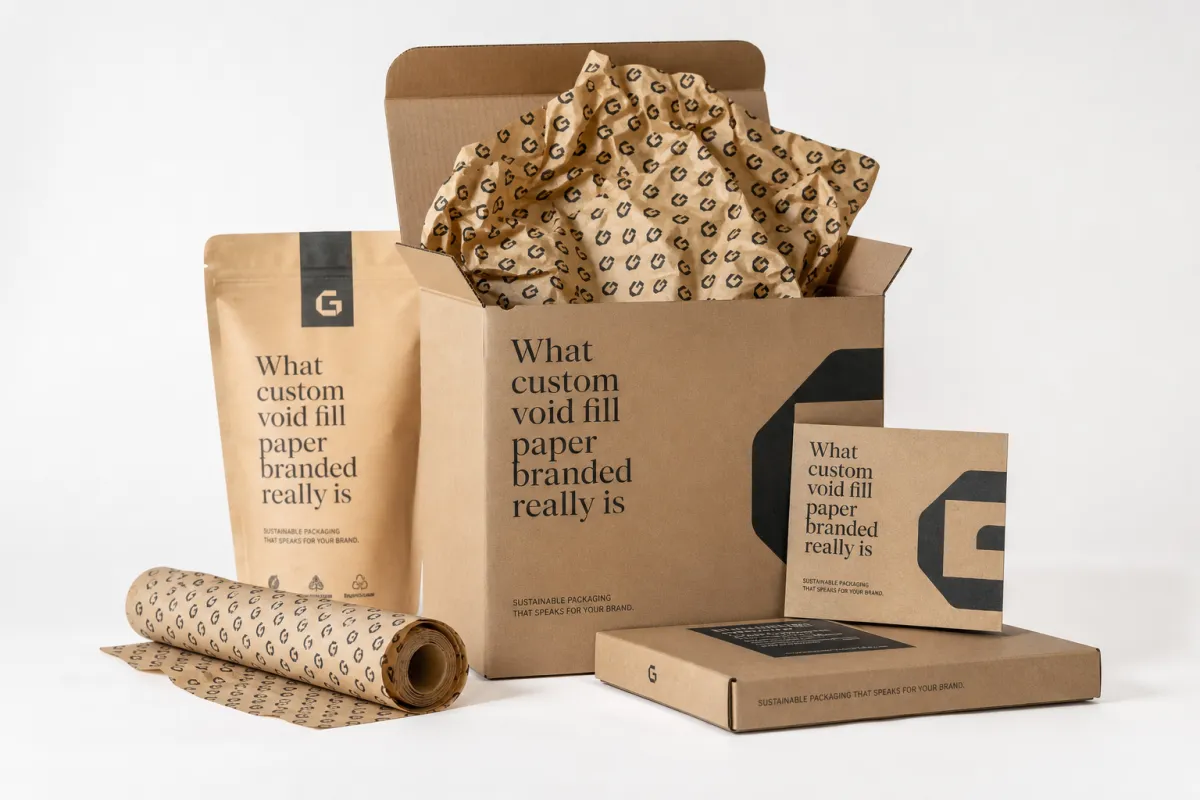
Custom Void Fill Paper branded is printed packing paper made to take up empty space inside a carton so products do not slide, tip, or collide in transit. Simple idea. Real-world use, not so simple. It sits right between product packaging, retail packaging, and package branding. Pick the right stock and the box feels thought through. Pick the wrong one and the packing station gets annoyed while the customer gets a sad, half-baked unboxing.
Void fill, cushioning, and presentation are not the same thing, even if some spec sheets pretend they are. Void fill controls movement. Cushioning absorbs impact. Presentation shapes the feel of the opening moment. Custom Void Fill paper branded can do all three, but only when the paper weight, print contrast, and pack-out method fit the shipment. A lightweight candle order needs a different setup than a rigid gift set. A subscription box with a dozen small pieces needs a different interior build than a single premium item in a mailer.
For packaging buyers, the appeal is easy to see. Plain kraft paper fills space, sure. Custom Void Fill Paper branded turns that space into part of the brand story. The inside of the carton stops looking accidental. It looks intentional. That matters for direct-to-consumer shipments, boutique retail orders, cosmetics, specialty food, and gift packaging where the customer opens the box slowly and notices the details. Even if the outer carton stays plain, the interior can still carry the brand's visual language.
I see teams waste this opportunity all the time. They argue over custom printed boxes, labels, tissue, and inserts, then treat void fill like a boring leftover. That is a miss. Custom Void Fill paper branded can support the whole unboxing sequence without adding another loose component to manage, which makes it handy for brands trying to keep pack-out clean without making it look stripped down. If you want more examples of how this plays out in real packaging programs, our Case Studies page is a useful place to compare approaches.
Set expectations with a little honesty. Custom void fill paper branded is not magic, and it will not solve every shipping problem by itself. Heavy glass, fragile electronics, and awkwardly shaped products may still need inserts, partitions, or molded protection. Even then, for a large share of everyday shipping lines, branded paper is a smart way to combine product packaging protection with package branding in one material that gets handled once at the packing station and then seen again by the customer at opening.
How custom void fill paper branded works in the box
The mechanics are plain enough. The paper is folded, crumpled, layered, or dispensed into the carton so the empty spaces around the product shrink and the contents stay centered. That is the core function of custom void fill paper branded. A good pack-out uses just enough material to stop movement without making the box hard to close or turning the shipper into a bulky waste problem. A bad one either uses too little paper and lets the product rattle around, or uses too much and creates pressure on the item while slowing down the line.
Three methods show up over and over. Manual pack-out is the simplest: a packer pulls, crumples, and places the paper by hand. Semi-automated systems feed paper to the station, often with perforation or cut-to-length control, which helps speed and consistency. Higher-throughput setups are built for repeatability and make sense when the same carton sizes run through the line all day. Custom void fill paper branded can work in all three settings, but the print layout and roll format need to match the method. A design that looks great on a mockup may behave very differently once it is torn, folded, and tucked into a live packing station.
Print visibility still has to survive compression. Strong contrast, repeated marks, and larger logo elements usually hold up better than thin linework or delicate taglines. That is why custom void fill paper branded usually performs best with bold graphic systems instead of crowded artwork. A repeated icon, a clear logo, or a patterned brand field still reads well when the paper is not lying flat. Same reason some branded packaging programs keep the decoration simple and high-contrast: the material gets manipulated, and the artwork has to survive the abuse.
Product fit matters just as much. Custom void fill paper branded works especially well for fragile items, irregular shapes, and premium goods that benefit from a tidy interior presentation: candles, cosmetics, wine accessories, gift sets, specialty foods, small home goods, and subscription shipments with multiple components. The paper can make a box feel orderly even when the items inside are varied. For shoppers, that order signals care. For the shipper, it reduces rattling, corner damage, and the ugly moment when a product arrives with a mess inside the carton.
"The best void fill disappears into the workflow, but branded void fill should still make the box feel intentional the moment the carton opens."
Custom void fill paper branded also has a limit buyers should respect. It is a stabilizer, not a miracle cushion for every product weight. If the item is heavy, dense, or breakable, the team may need dividers, inserts, or more formal protective packaging too. That is not a flaw. That is packaging doing its job. The right material in the right role usually beats forcing one component to carry the entire load. If you are comparing adjacent materials, our Custom Packaging Products page can help you think through the rest of the system, not just the filler.
Design and production factors that shape results
Start with the substrate. A typical custom void fill paper branded job may use recycled kraft, white top kraft, or another printable paper grade chosen for opacity and handling. Paper weight matters because lighter stock folds easily but can look flimsy, while heavier stock carries better body and feels more premium in the hand. Many buyers end up somewhere in the 35 lb to 60 lb kraft range, or a similar gsm range, then adjust based on how much void needs to be filled and how the product behaves inside the carton. Surface finish matters too. A smoother face improves print clarity. A more natural kraft look gives the interior a warmer, more handmade feel.
Logo size and placement are not decoration decisions. They affect visibility. On custom void fill paper branded, the print has to survive folding, compression, and the quick tearing that happens at the packing station. Large repeated marks usually work better than one oversized hero logo hidden in the center of the sheet. Too small and the artwork disappears once the paper is crumpled. Too soft on contrast and the brand message sinks into the texture of the material. Good packaging design assumes the paper will be handled roughly and still read clearly afterward.
Operational variables change the spec more than many marketing teams expect. A carton shipping a single candle needs less paper than a carton carrying a bottle, a jar, and an insert card. Box size, product weight, pallet pattern, and the amount of void all affect consumption. Custom void fill paper branded should be specified with actual carton dimensions and a real fill estimate, not just a logo and a vague hope that it "works." The more SKUs in play, the more useful it becomes to standardize widths and repeat patterns so the same material can serve several pack lines without making the interior look chaotic.
Machine compatibility is where a lot of projects go sideways. Roll width, core size, perforation, unwind direction, and storage handling all matter in a live warehouse. A dispenser may prefer a specific roll diameter or tension level, and that should be known before artwork gets the green light. Custom void fill paper branded can be built for manual stations or higher-throughput systems, but the format has to respect the packing environment. A roll that jams, curls, or feeds awkwardly will frustrate workers fast, and once that happens even a good print job becomes a morale problem at the station.
Sustainability goals belong in the brief from the start. If the brand wants recyclable paper and simple end-of-life messaging, the material selection needs to support that claim without hand-waving. In the United States, the EPA's recycling guidance is a useful reminder that local acceptance varies, so the packaging message should stay accurate instead of promotional. Some teams also ask for FSC-certified fiber, which is a reasonable procurement request when chain-of-custody documentation matters. In other words, custom void fill paper branded should support both the visual story and the environmental story without overselling either one.
Custom void fill paper branded pricing and value
Pricing is almost never just about the paper. The real cost of custom void fill paper branded depends on paper grade, print coverage, number of ink colors, order volume, roll format, setup needs, and freight to the facility. A simple one-color pattern on a standard roll, reordered at steady volume, usually lands in a much friendlier place than a short run with dense artwork and a custom width. That is why experienced buyers ask for quotes using actual carton sizes and average fill volume. Otherwise the number on the page has little relationship to what the pack line actually consumes.
| Option | Best use | Typical rough cost impact | What it does well | Tradeoff |
|---|---|---|---|---|
| Plain kraft void fill | Basic shipping and low-visibility cartons | About $0.03-$0.08 per filled carton at scale | Lowest material cost and simple sourcing | No branding value and a more generic unboxing |
| Custom single-color printed paper | Most DTC and retail packaging programs | About $0.08-$0.18 per filled carton at scale | Good brand visibility and manageable setup | Artwork needs to be bold enough to survive compression |
| Multi-color branded paper | Premium gift packaging and higher-touch product packaging | About $0.14-$0.30 per filled carton at scale | Stronger visual identity and more premium presentation | Higher print complexity and more proofing time |
| Paper plus insert structure | Fragile or heavier items | About $0.18-$0.40 per carton, depending on the build | Improved protection with branded presentation | More components and more pack-out steps |
The table is a planning tool, not a quote. Still, it gives a useful picture of where custom void fill paper branded fits. The value is not only in the per-unit number. It is also in the fact that one material can replace or reduce multiple loose components, keep the carton interior cleaner, and create a better first impression. If a customer opens the box and sees a tidy branded interior, the unboxing feels intentional. That can matter as much as the outer carton, especially for branded packaging programs built around repeat orders and social sharing.
There is also a labor story hiding behind the material cost. A pack line that uses plain paper plus a label plus tissue may show a lower materials budget and a higher hidden labor cost. Custom void fill paper branded can pull more than one job into a single step, which often simplifies the station and reduces handling time. That does not mean the branded option is always cheaper in absolute dollars. It means the real comparison should include labor minutes, SKU complexity, presentation quality, and damage reduction, not just the sheet price. Buyers who compare only raw material cost often miss the bigger savings in workflow efficiency.
Volume matters. Higher order quantities usually lower the unit price, while short runs tend to carry a larger setup burden. If the artwork is simple and the paper format is standard, the startup cost is easier to absorb. If the design has several colors, special repeats, or a unique roll width, the setup and proofing steps deserve more attention. Custom void fill paper branded becomes more attractive as order volume grows and the brand starts using it across multiple SKUs or seasonal programs. At that point, the material is not just a shipping supply; it is part of the wider packaging design system.
For a solid quote, send the carton dimensions, average product weight, approximate fill depth, target monthly volume, and the pack speed the warehouse needs to maintain. If the supplier knows whether the paper must work by hand or through a dispenser, the pricing will be much closer to reality. That kind of detail moves a project out of guesswork and into a usable commercial plan, which is where custom void fill paper branded starts to make sense as a repeatable packaging decision instead of a one-off experiment.
Custom void fill paper branded process and timeline
The usual workflow starts with discovery. A decent supplier will ask what the product is, how it ships, how much void exists, and what kind of presentation the brand wants. From there, custom void fill paper branded usually moves into size and performance specification, artwork prep, proof review, sample approval, production, and delivery. That order matters because the paper has to behave correctly before anyone gets picky about where the logo sits. A beautiful proof that fails in a real carton is not a finished solution.
Lead time depends on complexity. Simple one-color custom void fill paper branded projects with an existing width and a straightforward repeat pattern can often move from approved artwork to production in roughly 10-15 business days after proof sign-off, assuming material is available and review stays on schedule. Add more customization, change the paper width, or ask for multiple proof rounds, and the timeline stretches. A more realistic planning window for a larger or more custom job is often 3-5 weeks, not counting internal approvals on the buyer side. Those approvals always take longer than anyone wants to admit.
Physical samples are worth the time. A file that looks crisp on screen can behave differently once the paper is crumpled, layered, and moved by hand. Custom void fill paper branded needs to be tested inside the actual carton with the actual product, because the way it fills dead space can change how the top flap closes, how the product settles, and how much of the print remains visible. A shelf-ready look and a messy one can come down to a paper weight change or a repeat size adjustment. That is why sample approval is not a formality.
Before a full rollout, build in warehouse testing and a small pilot. The packing team should use the new paper in a normal shift, not in a polished demo where everyone behaves better than they do on a Tuesday afternoon. Watch for worker feedback, box-close behavior, product movement, and whether the branded print still looks good after rough handling. If the setup works well, custom void fill paper branded can roll out one SKU family at a time, which keeps disruption low and gives the team room to adjust. That helps a lot for brands with many box sizes or seasonal spikes, where pack-out discipline matters as much as the material itself.
For broader packaging standards, it is worth checking test expectations against organizations such as ISTA, especially if the shipment profile includes parcel transit and repeated handling. The exact protocol depends on the product and distribution path, so there is no single answer that fits every brand. Still, thinking in terms of transit performance keeps custom void fill paper branded grounded in real shipping conditions rather than only in visual preference. That is usually the difference between a nice sample and something that actually survives day-to-day operations.
Common mistakes when specifying branded void fill paper
The first mistake is trying to cram too much into the artwork. Tiny logos, thin lines, and dense taglines often disappear once custom void fill paper branded is folded or compressed. The paper is not a billboard. It is a working shipping material that gets handled fast. If the design depends on fine detail to read correctly, the final result can look muddy or uneven. Bold repeats, strong contrast, and clean spacing usually perform better, especially on natural kraft stocks where the paper tone already brings visual texture.
The second mistake is under-specifying paper strength for the product load. If the stock is too light, it may not hold shape well enough to stabilize heavier contents, which means extra fill or a second protective layer. That raises cost and slows packing. Custom void fill paper branded should be selected with actual product weight and carton size in mind, not just branding goals. A nice-looking sheet that fails in transit is not a win. It is a prettier way to lose.
Another common problem is approving a design from a digital file alone. Screen renders hide all kinds of trouble, including contrast loss, repeat awkwardness, and poor behavior once the paper is crumpled. Teams that skip real carton testing often find out too late that the artwork looks cramped or the fill pattern interferes with closure. Custom void fill paper branded should be judged in the carton, not just in a PDF. The production sample, the pack line, and the shipping environment tell the truth in a way a mockup never will.
Operations and branding need to talk early. A beautiful pattern can still fail if it slows the pack rhythm, requires awkward tearing, or jams a dispenser. That is one reason the better branding programs treat custom void fill paper branded as part of the workflow, not as a standalone marketing asset. The material has to be easy to grab, easy to place, and easy to repeat across shifts. If the team cannot use it naturally, the artwork just becomes another source of friction.
Finally, some teams forget that repeat placement and width consistency matter. If the artwork lands unpredictably from sheet to sheet, or the roll width misses the carton size, the whole presentation can look accidental. That is the opposite of what most brands want from custom void fill paper branded. Good package branding feels tidy, intentional, and repeatable. The system should look designed, not improvised.
Expert tips for stronger branding and better pack-out
Keep the graphic system simple and strong. Large shapes, repeated marks, and a limited color palette tend to survive compression better than busy artwork. For custom void fill paper branded, that usually means thinking less like a poster designer and more like a packaging engineer with a branding instinct. The design should read in motion, under pressure, and from a partial view through folded material. A little restraint often looks more premium than stuffing every inch of paper with information.
Match the paper format to the rhythm of the station. If the packer reaches, crumples, and places paper every few seconds, the material should support that motion instead of interrupting it. Perforation spacing, roll diameter, and storage location can all affect speed. Custom void fill paper branded performs best when it feels like a natural extension of the pack line. The moment workers have to stop and fight the material, productivity drops and quality gets less consistent from order to order.
Test more than one product type. A layout that works well for a candle may not work the same way for a bottle, jar, or rigid insert pack. If the brand ships across several categories, custom void fill paper branded should be validated against the hardest carton as well as the easiest one. That helps avoid the classic mistake of designing for the prettiest SKU and then discovering the awkward SKU needs a different fill volume or a different width. Real shipping programs live on edge cases, not the ideal box.
Think about the inside of the box as part of the story. The interior should feel tidy, intentional, and consistent with the rest of the brand. That is where custom void fill paper branded has more value than people assume. It sits in the same family as branded tissue, custom printed boxes, inserts, and confirmation cards, but it has its own job: protect the product while quietly reinforcing the visual identity. For many brands, that is exactly the sort of detail that makes an order feel complete instead of merely shipped.
Use sustainability messaging carefully and only when the material supports it. Recycled kraft paper can be a credible choice, but claims still need to match the actual stock and local recycling behavior. If the team wants to talk about responsible fiber sourcing, FSC documentation can support procurement language; if the team wants to talk about recyclability, the message should stay aligned with regional guidance and the paper's actual construction. That is the honest way to frame custom void fill paper branded in a market where customers notice both presentation and environmental claims.
Next steps for rolling out custom void fill paper branded
Start with a packaging audit. Measure current box sizes, average product weights, and how much void fill is being used per order. Without that baseline, custom void fill paper branded gets specified by instinct instead of data. That might be fine for a tiny test run, but it is not the right move for a real rollout. A basic tally of box dimensions, pack speed, and damage history usually shows where the biggest gains are hiding.
Then put brand requirements and operations requirements in the same brief. Include logo files, brand colors, print placement preferences, dispenser limits, carton sizes, and the throughput the warehouse needs to maintain. The clearer the brief, the better custom void fill paper branded can be matched to the real use case. If your team needs to compare other packaging components while building the rollout, it usually helps to look at the broader packaging system first instead of staring at the paper in isolation.
Ask for samples or a short pilot run, then watch the line closely. Check product movement, fill consistency, worker feedback, and how the paper looks after normal handling, not just after the first perfect trial. If the pilot performs well, roll the material out by SKU or box size so the team can learn without disrupting the whole operation at once. That phased approach is one of the safest ways to introduce custom void fill paper branded into an established workflow without creating chaos during busy shipping days.
One more practical note: use the pilot to compare the material against the whole pack-out experience, not just the interior look. Does it close cleanly? Does it slow down the station? Does it improve the first impression enough to justify the change? Those questions matter because custom void fill paper branded works best when protection, presentation, and speed all pull in the same direction. It is a packaging choice, yes, but it is also a small piece of operations design.
That is the real point. Custom void fill paper branded works best when it is treated as a working part of branded packaging, not as a decorative extra. Get the paper weight, print system, and pack-out method aligned, and the material can protect the product, support package branding, and make the inside of the box feel like part of the brand experience from the first touch. If you skip the testing and hope the pretty version behaves itself, well, good luck with that.
What is custom void fill paper branded used for in shipping?
It fills empty space inside cartons so products stay centered and do not shift during transit. It also turns the inside of the box into a visible brand touchpoint instead of a plain packing material. For fragile, premium, and gift-ready shipments, custom void fill paper branded is a practical way to combine protection with presentation.
Is custom void fill paper branded strong enough for fragile products?
Yes, when the paper weight and format match the product weight and the amount of void that needs to be filled. It should be tested with the actual product, carton size, and shipping method before full rollout. For heavier or more delicate items, custom void fill paper branded may still need to be paired with another protective structure.
How much does custom void fill paper branded usually cost?
Pricing depends on paper grade, print coverage, colors, order size, and roll format. Larger orders generally reduce the per-unit cost, while short runs and complex artwork usually cost more. The best quote comes from sharing box dimensions, pack rate, and average void-fill usage so custom void fill paper branded is priced against real operating conditions.
How long does it take to produce custom void fill paper branded?
Simple projects can move quickly if the artwork is ready and the format matches existing production needs. More custom projects take longer because of proofing, sample approval, and any setup changes to the roll or dispenser. A pilot run is smart before switching all SKUs so you can confirm both appearance and packing performance for custom void fill paper branded.
What should I send when ordering custom void fill paper branded?
Send your logo files, brand colors, target carton sizes, and any print placement preferences. Include product weight, shipping profile, and whether the paper must work manually or with a specific dispenser. If possible, share photos of the current pack-out so the supplier can recommend the right paper format for custom void fill paper branded.

