Buyer Fit Snapshot
| Best fit | Custom Window Folding Cartons projects where brand print, material claims, artwork control, MOQ, and repeat-order consistency need to be specified before quoting. |
|---|---|
| Quote inputs | Share finished size, material target, print colors, finish, packing count, annual reorder estimate, ship-to region, and any compliance wording. |
| Proofing check | Approve dieline scale, logo placement, barcode or warning zones, color tolerance, closure strength, and carton packing before bulk production. |
| Main risk | Vague material claims, crowded artwork, missing packing details, or unclear freight terms can make a low unit price expensive after revisions. |
Fast answer: Custom Window Folding Cartons: Board, Finish, Dieline, and Unit Cost should be specified like a repeatable production item. The safest quote records material, print method, finish, artwork proof, packing count, and reorder notes in one written spec.
Production checks before approval
Compare the actual filled-product size with the drawing, then confirm tolerance on folds, seals, hang holes, label areas, and retail display edges. Reserve space for logos, QR codes, warning copy, and material claims before decorative graphics fill the panel.
Quote comparison points
Review material grade, print process, finish, sampling route, tooling charges, carton quantity, and freight assumptions side by side. A quote is only useful when the supplier can repeat the same color, closure quality, and packing count on the next order.
Custom Window Folding Cartons: Smart Design Basics
A clear window can make a carton feel more trustworthy than a fully printed box, simply because shoppers can see the product before they decide whether it belongs in their basket. That is the practical strength of custom window folding cartons: they help a brand build confidence, move quickly on shelf, and show the item itself without giving up structure or print space.
If you are comparing retail packaging options, the build has to do two jobs at once: pull attention from a few feet away and protect the product through shipping, stocking, and display. For a wider starting point, browse our Custom Packaging Products, then come back to the details that shape custom window folding cartons, from structure and print to pricing and production timing.
I have seen this play out on crowded shelves more than once. A carton that looks flat and ordinary on a screen can suddenly feel credible the moment the product shows through, even if only a corner or a color band is visible. That little bit of proof changes the conversation fast.
Why custom window folding cartons stand out fast
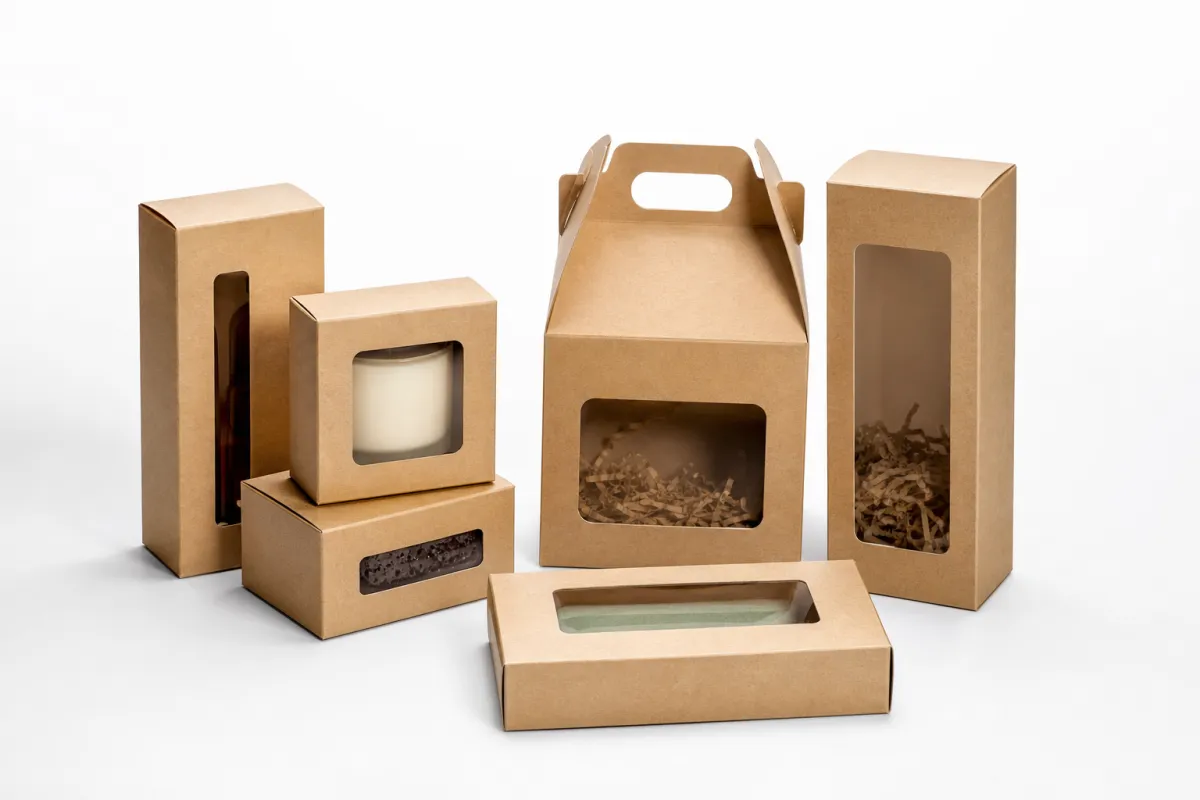
Walk past a shelf with ten similar items and the difference becomes obvious. The fully printed cartons can make promises, but custom window folding cartons let shoppers see the actual product, and that direct view often shortens the decision. Cosmetics, confectionery, hardware, gift items, and specialty products tend to benefit most, especially when color, texture, shape, or fill level should be visible right away.
For a packaging buyer, the window is not only a visual choice. It is a confidence choice. A well-placed opening can reveal the exact shade of a cosmetic stick, the finish on a candle vessel, the count inside a confectionery set, or the size of a hardware kit without forcing the shopper to read every line of copy first. In branded packaging, where the package has only a moment to do its work, custom window folding cartons combine product proof with printed storytelling instead of asking one element to carry the whole message.
That honesty matters more than many teams expect. A clear panel or die-cut opening signals that the brand is not hiding the product behind artwork. In categories where buyers want proof, not just polish, custom window folding cartons can do a lot of quiet selling. I have seen them used to strong effect on items that would otherwise disappear inside opaque custom printed boxes, because the window breaks up the front face and gives the carton a more immediate, tactile presence.
A window should reveal the product, not explain away weak construction.
The balance is what matters. Custom window folding cartons play three roles at once: part display piece, part structural pack, part logistics item. If the board is too light, the carton may crush. If the opening is too wide, the face can lose strength and leave too little room for legal copy. If the window is too small, the product disappears and the package loses its reason for being. The best custom window folding cartons solve all three problems together, and that is where careful packaging design matters more than decoration alone.
There is also a small but real retail effect here. Buyers can spot a window carton from the aisle faster than a fully opaque box because the eye naturally stops on a visible object, not just an illustration of one. That is why custom window folding cartons often feel a bit more immediate, even when the artwork is modest.
How custom window folding cartons are built
Most custom window folding cartons begin with paperboard selection. The board sets the tone for print quality, stiffness, fold performance, and the way the finished pack survives handling. Common stocks include SBS, CCNB, kraft, and recycled board, and thickness often falls in the 14pt to 24pt range depending on product weight and the look the brand wants. A light cosmetic item may work well on a thinner sheet, while a heavier gift set or hardware kit usually needs more board to resist edge wear and panel bowing.
The build itself is straightforward once the jargon gets out of the way. The carton is printed flat, then die cut, creased, glued, and shipped flat for efficient storage. At filling, the carton folds around the product, and the window exposes the portion the brand wants customers to see. Custom window folding cartons may use an open die-cut window, a film window, or a partially covered opening, and each version changes the balance between visibility, dust protection, and product security.
- Open window: best when the item is stable, clean, and meant to be seen directly.
- Film window: adds protection from dust and handling while still showing the product.
- Partial window: gives a controlled reveal and preserves more panel strength around the opening.
The film itself can be PET, RPET, cellulose-based film, or another spec that fits the product and the buyer's sustainability goals. For brands asking for certified fiber, FSC chain-of-custody paperwork can matter as much as the visual design, so it helps to check FSC certification guidance early in the quoting stage. Custom window folding cartons can also be finished with matte or gloss aqueous coating, soft-touch lamination, foil, embossing, or spot UV when the face needs more shelf presence without overwhelming the window.
One detail that gets missed often: the way the carton folds is not a side note. Glue flap position, score depth, product insertion direction, and closure style all affect how efficiently the line runs. A carton can look simple on screen and still create trouble if the die line fights the filling method. That is why custom window folding cartons are usually better when the structural design is settled before the art is finalized, not after. Good product packaging respects the machine, the worker, and the customer in that order.
When a supplier says a structure is "simple," I always ask how it behaves during folding and pack-out, not just how it looks in a mockup. That is where the real test lives. A pretty layout that jams a line will cost more than a clean, slightly quieter build that runs the way it should.
Key factors that affect performance and appearance
Before a team approves custom window folding cartons, the product should drive the structure. Size and weight matter, but the real issues usually run deeper: does the item have a cap, a handle, a closure, a fragile surface, or an unusual silhouette that changes the internal fit? Custom window folding cartons perform best when window placement, board strength, and internal support are chosen around the product's natural shape instead of a generic template.
Window size carries more weight than many buyers expect. A larger opening shows more of the product, but it also removes material from the front panel and can weaken stacking strength. A smaller opening leaves more room for branding and compliance copy, but it may hide the feature that helps the item sell. In custom window folding cartons, the best point is usually a careful balance: enough transparency to prove the product, enough board around it to protect the face, and enough print area to carry the message. Thoughtful packaging design almost always beats oversized openings.
Insert choice is another major performance driver. Some custom window folding cartons work well without an insert, especially when the product is centered and stable. Others need a paperboard insert, molded pulp support, PET cradle, or another retention feature to keep the item aligned in the window and protected during transit. Cosmetics, specialty food items, and gift sets often need that extra control because the product can shift inside the pack and make the front view look sloppy.
Regulatory and practical details deserve the same attention. Barcode placement should not sit in glare or wrap across a fold. Ingredient copy, warning text, country of origin details, and tamper-evidence language need clear room on the panel. If the carton is for food or beauty, the supplier should confirm any barrier, grease resistance, or product-contact requirements before the structure is locked. For distribution-heavy programs, the shipper may need to pass ISTA or ASTM-style testing, and that conversation belongs early with the packaging engineer rather than after samples have already been approved. More on that kind of testing is available through ISTA's testing standards.
Appearance still carries real weight. High-coverage dark artwork can make the clear area look even clearer, while very light print can let the window disappear too much. The color story should support the product rather than compete with it. A rich matte black carton with a clean die-cut window can make jewelry or premium giftware feel elevated, while a bright, highly saturated carton may suit confectionery or seasonal retail packaging more naturally. Custom window folding cartons work best when the graphics frame the window instead of crowding it.
The design should keep one practical question in view: what does the shopper need to see, and what does the carton need to survive? Once those two answers are clear, custom window folding cartons usually become much easier to spec. That is also the point where the project stops being a guess and starts being a packaging decision you can defend.
Custom window folding cartons cost and pricing
Pricing custom window folding cartons mostly comes down to material, complexity, and quantity. Board grade is a major factor because SBS, CCNB, kraft, and recycled boards do not print or run through converting the same way. Print coverage matters too. A simple one- or two-color carton with a standard window is easier to produce than a full-bleed, foil-stamped, spot UV carton with an insert and a shaped opening. If the project needs custom window folding cartons with a premium finish, the budget usually shows that quickly.
For a 5,000-piece run, simple custom window folding cartons may land around $0.18-$0.28 per unit, while a film window, heavier board, or a more complex die can move the range to roughly $0.24-$0.38. Premium builds with inserts, foil, embossing, or multiple setup steps can run higher, often into the $0.35-$0.60 range or more depending on quantity and handwork. Those are planning numbers rather than fixed quotes, which gives a buyer something real to compare without guessing. Smaller quantities almost always carry a higher per-carton price because setup, tooling, and press time are spread across fewer pieces.
| Build option | Typical use | Typical unit cost at 5,000 pieces | Main tradeoff |
|---|---|---|---|
| Standard SBS, open window, aqueous coating | Cosmetics, small gifts, light retail product packaging | $0.18-$0.28 | Lower cost, less dust protection |
| SBS with PET film window | Confectionery, beauty sets, retail display packs | $0.24-$0.38 | More material and assembly time |
| Kraft or recycled board, simple die-cut window | Natural brands, gift items, eco-focused branded packaging | $0.20-$0.33 | Less vibrant print in some cases |
| Premium finish with insert and shaped opening | Higher-end retail packaging, specialty kits, premium giftware | $0.35-$0.60+ | More setup, more handwork, tighter tolerances |
Hidden costs can matter as much as the quoted unit price. Freight can be meaningful if the cartons are bulky. Storage can add cost if the buyer does not have room to receive pallets. Waste allowance should be built into the order plan, especially if the artwork runs tight to the edge or the window has a narrow border. Assembly labor is another issue; if the product cannot be packed automatically, the real Cost of Custom window folding cartons may include a manual fill step that a simple price sheet will not show. That is why line-by-line quotes are so useful. Ask the vendor to separate material, tooling, print, finishing, and fulfillment so the comparison stays honest.
When I look at pricing, I also ask whether the spec is being overbuilt. A lot of custom window folding cartons cost more than they should because the window is oversized, the finish is too elaborate, or the board is heavier than the product demands. Good packaging design is not about stripping value out; it is about putting the budget where it changes the shopper's experience or protects the item during the trip. If the spec is too vague, the quote is gonna wander.
Step-by-step process and timeline for custom window folding cartons
The cleanest way to manage custom window folding cartons is to treat the project in stages. Start with the product measurements, then move to the structure, then the artwork, and only after that move into tooling and production. If a brand jumps straight to print without confirming the insert fit or the panel dimensions, the result often turns into an awkward redesign that costs both time and money.
- Measure the product carefully. Capture height, width, depth, closures, and any irregular features that affect the fit.
- Build the structure. Decide the window size, board thickness, flap style, and whether an insert is needed.
- Prepare the dieline. The die line should show folds, glue areas, window cutout, and any special notes for the press or converting team.
- Review the artwork. Prepress checks copy safety, barcode placement, ink coverage, and the way print wraps around the panel.
- Approve a prototype. A mockup shows whether the window reveals the right part of the product and whether pack-out feels practical.
- Make the die and print. Tooling, press setup, coating, and conversion follow the approved spec.
- Inspect final samples. A final check should confirm fit, fold memory, window alignment, and finish quality before full release.
In real production, delays usually show up in a few predictable places. Missing dieline approval can stop everything. Last-minute copy changes can push a press date. Uncertainty about board thickness or insert fit can force a second prototype. Those are common issues in custom window folding cartons, and they are easier to manage when the buyer gives the supplier a complete brief from the start.
A realistic timeline is usually built in layers rather than one single deadline. Sampling and structural approval may take a few business days to a couple of weeks depending on complexity. Production after approval might run another 10 to 15 business days for straightforward custom window folding cartons, while more complex projects with inserts, specialty finishes, or multiple proof rounds can take longer. The exact pace depends on press scheduling, tooling, and how quickly the buyer signs off at each stage.
Design lead time and manufacturing lead time are not the same thing. A carton can be print-ready on paper long before the final production run begins. That distinction matters because many teams underestimate the time needed for structural revisions, sample shipment, internal approvals, and revised artwork. When custom window folding cartons are planned early, the process feels steady. When they are rushed, even small mistakes become expensive.
One habit I recommend is testing pack-out speed on a real line, even if it is only a short run with prototypes. A window that looks perfect on screen can still slow workers down if the fold is awkward or the insert is hard to place. In packaging, the fastest-looking structure is not always the fastest one on the floor. That is one of the reasons custom window folding cartons deserve prototype work before mass production.
If the program has a busy launch window, build a little slack into the schedule instead of pretending every step will land on the first try. That cushion is often what keeps a carton from going from "ready" to "rushed" overnight.
Common mistakes when specifying custom window folding cartons
The biggest mistake is making the window too large. A big opening can look appealing in a mockup, but once the carton is cut, the front panel may lose stiffness, the product can shift too much, and the remaining print area can feel crowded. Custom window folding cartons need enough front-panel strength to survive handling, especially if the carton will be stacked, shipped, or displayed in a busy retail environment.
Another common issue is inaccurate measurement. People sometimes measure only the body of the product and forget the cap, handle, nozzle, tab, or irregular edge that changes the fit. That is where custom window folding cartons can go wrong quickly. If the item is even a few millimeters off from the assumed dimension, the window may frame the wrong feature or the insert may push the product out of alignment.
Board selection can be too light as well. A thin board may look fine in a sample, but if the carton is going to be packed tightly, shipped long distances, or handled often on a shelf, it can crush at the edges or lose its shape. In my experience, custom window folding cartons that are underbuilt tend to show damage first around the corners and glue flap rather than in the middle of the panel. That is usually a sign the structure is working harder than it should.
Finish choices can create surprises too. A coating that is too glossy can create glare around the window, while an overly soft finish can make the clear area feel disconnected from the rest of the panel. In some cases, the window edge looks cloudy because the film or adhesive does not match the finish well. These are small details, but they change how custom window folding cartons read on shelf.
The practical side matters just as much: assembly method, fill direction, and compliance requirements. If the package is folded one way but the line fills it another way, the process slows down. If barcode or warning copy is forgotten until the final proof stage, rework follows. If the brand needs tamper evidence, that should be discussed before the structural quote, not after the samples are already in hand. A good custom window folding carton is planned as a whole system, not just as a front panel with a hole in it.
- Do not oversize the window just to show more product.
- Do not guess product dimensions when closures or irregular shapes are involved.
- Do not choose board weight without thinking about shipping and stackability.
- Do not finalize artwork before the structural fit is approved.
Those four mistakes show up repeatedly, and they are avoidable.
There is a fifth one too: do not assume the carton will "work itself out" on the line. A pack that looks forgiving in a mockup can become fussy in a real production room, especially if the insertion point is awkward or the glue flap gets in the way.
Expert tips for better custom window folding cartons
The cleanest cartons usually begin by following the product's silhouette. If the item has a strong top shape, a shoulder, a label band, or a colorful component, let the window reveal that part first. That way, custom window folding cartons feel intentional rather than generic. The shopper should understand the benefit in one glance, not after reading three panels.
Testing multiple window shapes is worth the time. A rectangle is not always the best answer. A curved opening, a tall slot, a rounded corner, or a step-down reveal can make the product feel more specific and more premium. I like to see at least two mockups before approval, because small shifts in placement can improve shelf appeal far more than another coat of print ever will. That kind of packaging design thinking is where custom window folding cartons become sharper and more useful.
It also helps to keep print and transparency in balance. If the carton becomes mostly clear, it starts to lose branding power. If the graphic coverage is too heavy, the window feels like a token cutout. The best custom window folding cartons still carry the brand voice, the product story, and the required information, while the window adds proof and curiosity. That balance supports both product packaging and package branding without forcing either one to carry the whole load.
A strong window carton should feel like a retail decision, not just a design choice.
Think backward from the warehouse and the truck, not just the design file. Will the pack be nested, tray-packed, shrink-wrapped, or case-packed? Will the carton need to survive long pallet runs or simple local distribution? Will the product be inserted by hand or by machine? Those questions shape custom window folding cartons more than a mood board does. If the structure works in real logistics, it usually works on shelf too.
One more practical tip: prepare the next move before you ask for a quote. Have the product dimensions, target quantity, finish preference, window idea, insert needs, and compliance copy ready. If you can also share a sample, photo, or rough dieline, the supplier can usually recommend a better structure faster. That matters especially when the project involves custom printed boxes in a larger branded packaging program, because the carton has to fit the rest of the line, not just stand on its own.
For teams comparing options, it helps to request two versions: one straightforward build and one premium build. That side-by-side view makes it easier to see how custom window folding cartons change in price, shelf impact, and protection when the board or finish changes. You do not have to guess at value; you can see it.
In practice, the best results tend to come from teams that stay picky about the unglamorous details. A good window shape is nice, sure, but the real lift comes from fit, print safety, and a carton that can be packed without drama.
What to do next with custom window folding cartons
The next step is simple: measure the product, decide exactly what the window should reveal, and write down the non-negotiables. That includes quantity, board preference, finish choice, insert need, and any warning or ingredient copy that must fit on the panel. Once that information is organized, custom window folding cartons become much easier to quote accurately and much easier to build without back-and-forth.
If the shape is unusual, ask for a prototype or a sample run before committing to volume. That is especially smart when the window position is critical to the buying experience or when the product is expensive enough that a bad fit would be a serious problem. A small sample often reveals issues that a digital layout will never catch, from a window that sits too high to a tuck flap that slows the line. In that sense, custom window folding cartons reward careful testing more than flashy renderings.
It also helps to compare a basic spec and a premium spec side by side. The lower-cost version shows you what a simple structure can do, while the upgraded version shows how a heavier board, a film window, or a more polished finish changes the look and the price. That kind of comparison helps buyers make a better decision about retail packaging and keeps the project grounded in real numbers instead of assumptions. If you need more starting points, our Custom Packaging Products page is a helpful place to review other structures and build styles.
When a carton is done well, it should do three things without fuss: protect the product, support production efficiency, and make the item easier to notice and trust. That is the real promise of custom window folding cartons, and it is why they stay relevant across cosmetics, confectionery, gifts, hardware, and specialty retail programs. If you keep the structure honest, the window useful, and the branding clear, custom window folding cartons can do a lot of quiet work for a brand.
The takeaway is straightforward: start with the product, not the artwork. If the window, board, insert, and line-filling method all fit together from the start, the carton usually sells better and runs better too.
What are custom window folding cartons used for?
They are used when a brand wants to show part of the product while still giving it the structure, branding space, and protection of a folding carton. Custom window folding cartons work especially well for retail items where visual proof matters, such as cosmetics, confectionery, gifts, and specialty consumer goods.
Do custom window folding cartons need a plastic film window?
Not always. Some designs use an open die-cut window, while others add a film for dust control, tamper resistance, or product security. The right choice depends on the product, how it is handled, and whether the package needs to protect the item more fully during shipping and display.
What affects the cost of custom window folding cartons the most?
Board grade, carton size, print complexity, finishing, window style, inserts, and order quantity usually have the biggest impact on price. Higher quantities often reduce unit cost, while special structures, premium coatings, and complicated windows raise setup and production expenses.
How long does it take to produce custom window folding cartons?
Timeline depends on artwork approval, structural design, sampling, tooling, and production scheduling, so it is best planned in stages. Simple cartons move faster than cartons that need custom inserts, special finishes, or multiple rounds of prototype approval.
What should I send to get an accurate quote for custom window folding cartons?
Provide product dimensions, quantity, weight, desired board type, finish preferences, window requirements, insert needs, and any compliance copy. A dieline, sample, or clear photos of the product help the packaging supplier recommend a structure that fits correctly and prints well.

