Buyer Fit Snapshot
| Best fit | Cost of Custom Brand Embossing Sleeves projects where brand print, material claims, artwork control, MOQ, and repeat-order consistency need to be specified before quoting. |
|---|---|
| Quote inputs | Share finished size, material target, print colors, finish, packing count, annual reorder estimate, ship-to region, and any compliance wording. |
| Proofing check | Approve dieline scale, logo placement, barcode or warning zones, color tolerance, closure strength, and carton packing before bulk production. |
| Main risk | Vague material claims, crowded artwork, missing packing details, or unclear freight terms can make a low unit price expensive after revisions. |
Fast answer: Cost of Custom Brand Embossing Sleeves: What Affects It should be specified like a repeatable production item. The safest quote records material, print method, finish, artwork proof, packing count, and reorder notes in one written spec.
Production checks before approval
Compare the actual filled-product size with the drawing, then confirm tolerance on folds, seals, hang holes, label areas, and retail display edges. Reserve space for logos, QR codes, warning copy, and material claims before decorative graphics fill the panel.
Quote comparison points
Review material grade, print process, finish, sampling route, tooling charges, carton quantity, and freight assumptions side by side. A quote is only useful when the supplier can repeat the same color, closure quality, and packing count on the next order.
Cost of Custom brand embossing sleeves can look simple on a quote, then shift once board thickness, emboss depth, setup time, and finishing are folded into the math. Two sleeves can look nearly identical in a mockup and still land in very different price ranges on press. One might use a heavier board, tighter registration, and a deeper raised detail that needs more careful calibration. Another may be flatter, lighter, and much easier to run. That gap matters because the sleeve is not a side detail. It shapes shelf presence, reinforces brand identity, and changes the first physical interaction a buyer has with the pack.
Packaging buyers usually choose embossing for a reason. Raised detail adds touch, gives a carton or wrap a more finished feel, and helps product packaging stand apart without redesigning the whole structure. The tricky part is that the cost of custom brand embossing sleeves depends on far more than printed coverage. Tooling, press setup, material behavior, and artwork precision all feed into the final quote. A sleeve that seems basic on paper can still require careful make-ready, and that can surprise first-time buyers. If you want a clearer read on where the money goes, the breakdown below shows the major pricing drivers, MOQ pressure, timing, and the details needed for an accurate estimate.
Why the Cost of Custom Brand Embossing Sleeves Can Surprise Buyers
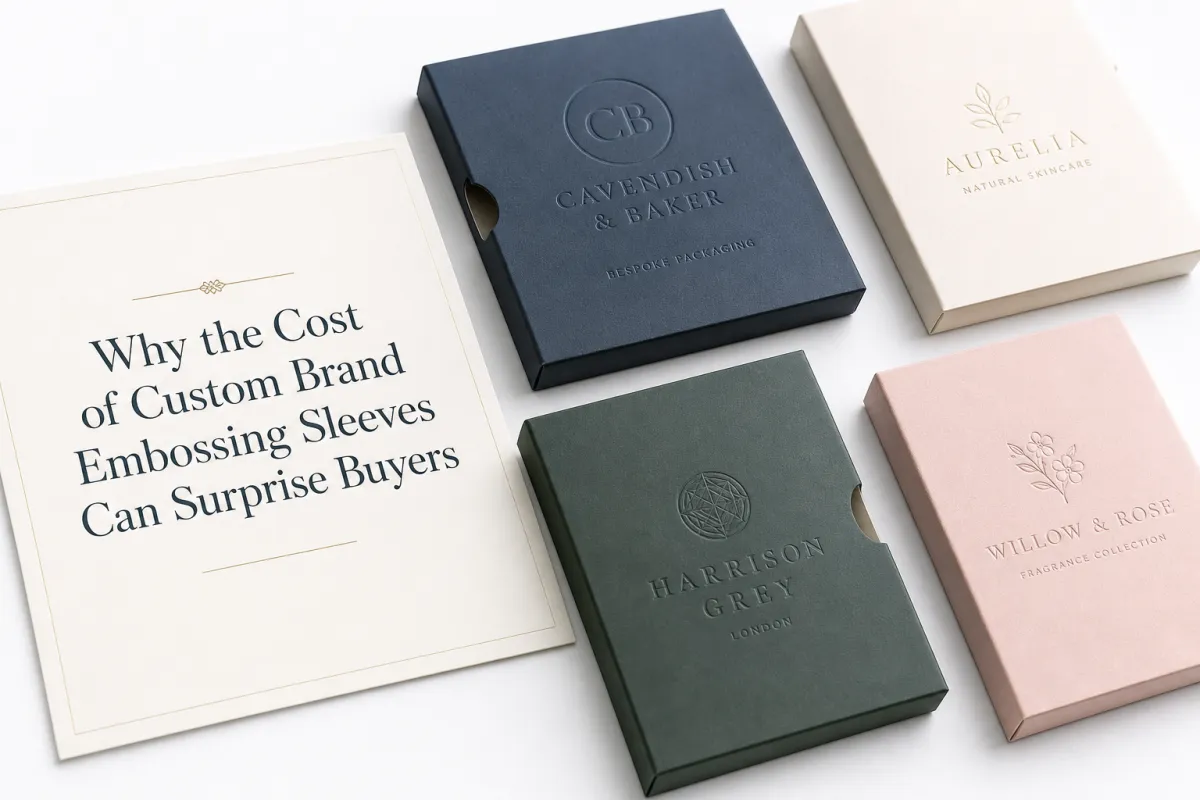
The cost of custom brand embossing sleeves catches buyers off guard because the finished look hides the work underneath. A sleeve on a shelf may read like a simple printed wrap, yet production can involve board selection, die creation, press setup, and alignment checks that never show up in the mockup. That becomes even more obvious when two designs share the same dimensions but use different stocks. A 16pt SBS sleeve and a 24pt stock with a raised logo panel are not close cousins on press. They are different jobs, period.
Embossing is tactile branding, but it is also a mechanical process. The press has to force the board into a matched die and counter-die with enough pressure to build definition without cracking the fibers or flattening nearby print. That means the cost of custom brand embossing sleeves includes more than the visible finish. There is tool setup, press calibration, make-ready waste, and often a tighter approval loop than a flat sleeve would need. Clean emboss work depends on consistency, and consistency takes time.
Many buyers focus on unit price and miss the larger picture. A slightly higher sleeve cost can pay back through stronger shelf presentation, a sharper brand impression, and a more polished unboxing experience. That matters in retail packaging, especially for gift sets, cosmetics, beverages, specialty foods, and premium electronics where the sleeve becomes part of the product story. The better question is rarely, “What is the cheapest sleeve?” It is usually, “What version of the cost of custom brand embossing sleeves gives the best result for this launch, this channel, and this quantity?”
A sleeve can look simple in a PDF and still punish a weak spec on press. Fair pricing only appears after the board, emboss depth, and finish stack are matched to the real job.
I once reviewed two sleeve quotes for a launch set that looked almost identical at first glance. One had a modest embossed logo on a standard board, and the other had the same logo on a softer, coated stock with a tighter fold. The second quote came in higher, not because anyone was padding the number, but because the material and registration were simply fussier. That kind of thing happens a lot. Experienced buyers compare more than a single unit number. They look at tooling, minimum order quantity, proofing steps, freight, and whether the supplier is quoting a plain sleeve or a premium branded packaging component with multiple finishes.
A sleeve going into a launch box, a promo kit, or a seasonal display may justify a higher spend if it lifts the package in the place that matters most: the shelf. That is where the cost of custom brand embossing sleeves starts to make strategic sense rather than just budget sense.
What Is the Cost of Custom Brand Embossing Sleeves?
The cost of custom brand embossing sleeves is usually best understood as a stack of decisions rather than a single price. Start with the board, add the embossing die or tooling, then account for setup, proofing, finishing, and freight. Once those pieces are in place, the quote starts to make sense. A simple sleeve with one raised logo can stay in a lower price band, while a larger sleeve with foil stamping, soft-touch lamination, or tight registration moves higher. Quantity matters too, because fixed setup costs spread more efficiently across larger runs.
That is why one buyer may see a clean, manageable quote while another sees a number that feels inflated. The difference is often not supplier behavior. It is spec detail. The cost of custom brand embossing sleeves rises when the design asks the press to do more, when the board needs more care, or when the approval schedule leaves less room for normal production flow. For featured packaging, the real value is not in the cheapest line item. It is in the sleeve that performs well, looks sharp, and arrives on time.
There is also a trust issue here. A quote that seems unusually low sometimes leaves out tooling, sampling, or freight, then balloons later. Honest suppliers should say what is included and what is not. If that disclosure is missing, the buyer is not comparing apples to apples. They are comparing a finished quote to a partial one, and that is a bad habit to build.
What Custom Brand Embossing Sleeves Are and How They Work
Custom brand embossing sleeves are fitted wraps or covers that sit around a carton, bottle, rigid box, or other package structure and use raised detail to highlight a logo, pattern, message, or visual frame. The sleeve may be the outer branded layer or a secondary wrap that supports the main package. In either role, the goal stays the same: add dimensional, tactile branding without changing the core package design. That is one reason the cost of custom brand embossing sleeves tracks so closely with structural and finish choices.
These sleeves show up often on limited editions, gift sets, retail cartons, subscription packaging, and product launches where touch can carry more weight than more ink. A raised logo on a matte sleeve often feels more deliberate than a flood of color. A fine emboss on clean board can make a line look more exacting, which is why many buyers pair embossing with Custom Printed Boxes or other premium packaging components. The sleeve becomes part of the brand architecture, not just a cover.
Embossing is not the same as debossing, foil stamping, or spot UV, even though buyers sometimes group them together. Embossing lifts the design above the surface, while debossing sinks it below. Foil adds metallic or pigmented shine, and spot UV lays a gloss on top of a matte field. If the goal is touch and relief, embossing is the right move. If the goal is sparkle, contrast, or a metallic accent, foil may be the better fit. The cost of custom brand embossing sleeves changes depending on how many of these effects you combine.
Production starts with artwork and dieline alignment. The press operator needs exact placement, the target relief depth, and a clear read on how the sleeve folds and registers around the structure. A good emboss depends on a clean die layout and a board that can take the impression without crushing. Specification discipline matters here. The stronger the file package, the more stable the quote, because the supplier can estimate the cost of custom brand embossing sleeves without padding for uncertainty.
For buyers who want a broader packaging reference, the Packaging School and industry resources at packaging.org are useful for general terminology and training around folding cartons, materials, and packaging construction. A solid baseline helps when comparing embossed sleeves, printed cartons, and other branded packaging formats.
Materials, Finishes, and Structural Specifications
Material choice is one of the biggest reasons the cost of custom brand embossing sleeves changes from quote to quote. Heavier paperboard usually holds a sharper impression, but it also costs more and can call for different tooling pressure. Common options include SBS, C1S artboard, kraft-lined board, and specialty stocks with recycled fiber content. A 14pt board may be enough for a light sleeve on a lightweight carton. A 20pt or 24pt board may be a better match when the sleeve needs more body or a deeper emboss. The right choice depends on product weight, fold geometry, and the rest of the finish stack.
Emboss depth matters as much as caliper. A deep relief on thin board can crack the fibers or create a weak zone near the fold. Fine-line artwork needs equal care. Small type, tight linework, and micro-detail often vanish if the emboss is too aggressive or the board is too soft. A practical rule is to keep embossed type above 6 pt and avoid cramped counters in letters like “e,” “a,” and “r” unless the die is exceptionally precise. That kind of spec control helps hold down the cost of custom brand embossing sleeves by reducing trial-and-error on press.
Finish choices change both appearance and cost. A matte or uncoated surface usually gives the emboss more visible contrast because the shadows are easier to read. Soft-touch can look premium, but it can also mute the sharpness of the impression if the coating is too heavy. Foil accents add another process and often raise the budget, especially if the layout uses multiple colors or more than one foil zone. Spot UV behaves the same way, adding handling and curing time. For premium retail packaging, a single embossed mark on the right board can be a smarter spend than loading the sleeve with every possible finish.
Structural specs matter too. Score lines, fold direction, grain direction, and glue flap layout all affect how the sleeve fits and how cleanly it holds up in shipping and display. The sleeve should be designed so the embossed area does not sit too close to a hard fold or cut edge, or the relief can distort during assembly. A good packaging design file should also note ink coverage, blank areas, and whether the sleeve ships flat or pre-formed. Those details are not busywork. They are part of what controls the cost of custom brand embossing sleeves and the quality of the finished piece.
If you are comparing substrates for branded packaging, think in terms of use case instead of finish alone. A shelf carton that gets handled constantly may justify a stronger board and a cleaner emboss. A short-run promo item can often work with a lighter stock. The best quotes for the cost of custom brand embossing sleeves are built on those practical needs, not on vague quality language.
- Heavier board usually improves emboss clarity, but it can raise material and setup cost.
- Soft-touch finishes add tactile value, though they often increase handling and can soften fine relief.
- Foil accents make a sleeve stand out, but they add another process line to the quote.
- Grain direction can affect cracking, registration, and fold performance.
What Drives the Cost of Custom Brand Embossing Sleeves
The cost of custom brand embossing sleeves usually breaks into a handful of buckets: tooling, prepress, setup, press time, finishing, inspection, and packing. Tooling covers the die or matched tooling set that forms the raised detail. Prepress includes artwork checks and proof setup. Setup covers the make-ready time needed to align the job, dial in pressure, and run test sheets. Then comes the actual press time, plus any finishing after embossing, such as foil, lamination, or die-cutting. Each step adds labor and machine time.
Quantity has a direct effect on unit price because fixed costs are spread across more pieces. If tooling and setup total $350 on a 1,000-piece run, that fixed amount adds $0.35 per sleeve before material and labor are even counted. On a 10,000-piece run, the same fixed amount adds only $0.035 per unit. That is why small runs of the cost of custom brand embossing sleeves often look expensive at first glance. The press still needs the same calibration whether the order is small or large, and that work has to be paid for somewhere.
Design complexity is another major driver. A sleeve with one small embossed logo is much easier to run than a layout with multiple raised zones, tight registration, foil outlines, and a full printed background. Large solid embossed areas can also create more waste if the board buckles or the impression is inconsistent. Fine detail increases the risk of a remake or proof revision. In plain terms, the more the design asks the press to do, the more the cost of custom brand embossing sleeves climbs.
Rush schedules are a common adder. If the buyer needs a fast turnaround, the supplier may have to reorder press time, expedite material, or compress proof approval. Artwork changes after proofing can raise cost too, especially if the plate or die has already been prepared. Specialty substrates, such as textured papers or FSC-certified boards with limited availability, can affect pricing as well. According to the FSC, chain-of-custody and responsible sourcing requirements matter when buyers want verifiable fiber claims, and that can affect the stock options available for branded packaging.
The print stack matters as well. A simple embossed sleeve with one-color print is usually easier to run than a sleeve with full-coverage printing, spot UV, and foil. Each extra process means another pass, another setup, or another inspection point. From a production buyer’s angle, that is where quotes can diverge sharply even when the sleeve dimensions look identical. To get the clearest read on the cost of custom brand embossing sleeves, ask suppliers to line-item the job instead of giving a single lump sum.
- Tooling and plates - one-time or low-repeat costs tied to the die setup.
- Material - board caliper, fiber content, coating, and supplier availability.
- Press setup - alignment, pressure, and make-ready waste.
- Finishing - foil, lamination, die-cutting, and packing.
- Logistics - freight, storage, and any special shipment handling.
Pricing, MOQ, and the Cost of Custom Brand Embossing Sleeves
Buyers usually get clearer pricing once they compare the cost of custom brand embossing sleeves on the same basis. That means the same dimensions, the same board, the same emboss depth, the same artwork coverage, the same finish stack, and the same delivery location. If one supplier quotes a sleeve on 18pt C1S board and another quotes 24pt SBS with soft-touch lamination, the numbers are not comparable. A clean quote should separate unit price from tooling, sampling, freight, and any storage or packing charges so the money trail is visible.
MOQ exists for a reason. The minimum order quantity is usually tied to press efficiency, material yield, and tooling economics. A shop cannot spend the same setup time on 300 sleeves that it spends on 3,000 sleeves and still make the job efficient. That is why the cost of custom brand embossing sleeves often drops at higher quantities. Lower quantities may still be possible, but the per-unit price usually rises because the fixed work is carried by fewer pieces. A tiered quote is the clearest way to see the break points.
| Option | Typical Quantity | Estimated Unit Price | Tooling / Setup | Best Fit | Notes |
|---|---|---|---|---|---|
| Simple embossed sleeve | 5,000+ | $0.18-$0.30 | $120-$250 | Light premium cartons, retail packaging, launch kits | Best when the design uses one raised logo and limited print coverage. |
| Printed sleeve with emboss | 3,000-5,000 | $0.26-$0.42 | $180-$350 | Mid-premium product packaging, gift sets, branded packaging | Good balance of print detail and tactile branding. |
| Soft-touch, foil, and emboss | 5,000+ | $0.40-$0.78 | $250-$500 | Premium launches, luxury retail packaging, limited editions | Highest visual impact, but also the most handling and registration work. |
Those numbers are practical working ranges, not universal quotes. A short run can land higher, and a repeat order can come in lower if the tooling is already in place. The main point is that the cost of custom brand embossing sleeves should be judged against the exact spec, not against a generic “premium finish” promise. Hidden charges deserve attention too: die fees, plate fees, proof fees, insert packing, pallet charges, and export freight if the shipment leaves the country. If a supplier cannot explain those pieces clearly, the buyer is left guessing, and guessing is expensive.
Comparing landed cost is often more useful than comparing sleeve price alone. A supplier that looks cheaper can end up more expensive once freight and revision fees are added. Buyers who manage branded packaging well usually build a simple comparison sheet that tracks unit cost, tooling, approval fees, and delivery timing side by side. That is often the clearest way to judge the cost of custom brand embossing sleeves without getting misled by a single line item.
If you want to compare sleeve pricing with other package formats, our Custom Packaging Products page is a useful place to see how sleeves, cartons, and related structures fit together in a broader packaging plan.
Process, Timeline, and Approval Steps for Custom Brand Embossing Sleeves
A clean process goes a long way toward controlling the cost of custom brand embossing sleeves. The standard path starts with a spec review, moves into artwork and dieline checking, then continues through proofing, sample approval, production, finishing, packing, and shipment. Each stage depends on the one before it. If the dimensions are wrong at the start, both the quote and the final result suffer. If the proof is approved quickly and clearly, the job moves faster and with fewer surprises.
Typical lead time depends on complexity, but a straightforward run often moves like this: 1-2 business days for specification review, 1-3 business days for proofing, 3-7 business days for tooling, and 7-12 business days for production after approval. If the job includes multiple finishes or needs a more complex die layout, the schedule stretches. That means the cost of custom brand embossing sleeves is not only a money question; it is a timing question too. A rushed schedule may require expedited materials or press priority, and that can add cost fast.
Buyers can help reduce delays by sending complete information up front. Final dimensions, accurate quantity, substrate preference, print-ready files, logo placement notes, and ship-to details all improve quote accuracy. If the sleeve has to fit a specific carton or bottle, the supplier needs the actual outer dimensions, not just a nominal size. If the emboss should sit away from a seam or a fold, that should be marked in the file. Small details like that protect the cost of custom brand embossing sleeves from creeping up through revisions.
For launch planning, I like to work backward from the event date. If the sleeves need to arrive before a product release, a trade show, a retail reset, or a holiday window, the approval calendar should be built before the art file is finalized. That leaves room for proofing, sampling, and any small corrections. Distribution buyers who also test for transit should look at the ISTA test standards, since shipping performance matters when sleeves travel with other branded packaging components.
A quick practical note: the best jobs are rarely the fanciest. They are the ones where the art file, dieline, and quantity are locked before the first proof goes out. That kind of preparation keeps the cost of custom brand embossing sleeves from drifting upward for reasons that were avoidable in the first place.
- Send final dimensions rather than estimated measurements.
- Include print-ready artwork with clear emboss callouts.
- Confirm material and finish before the quote is finalized.
- Provide ship-to details early so freight is accurate.
- Approve proofs quickly to hold the planned timeline.
Why Choose Us for Custom Brand Embossing Sleeves and What to Send Next
Custom Logo Things is built for buyers who want practical packaging support, not vague promises. The value is in clean emboss registration, honest communication, and recommendations that are manufacturable instead of just attractive on a mockup. If the cost of custom brand embossing sleeves is going to make sense, the quote has to reflect the real job: the board, the depth, the finish stack, the quantity, and the timing. That kind of quote helps a buyer make a confident decision.
From a packaging professional’s point of view, the best supplier is the one that asks the right questions early. Does the sleeve fit over an existing carton or bottle? Is the emboss a logo, a pattern, or a full branding panel? Will the sleeves sit in retail packaging, ship through distribution, or support a launch box? Those answers shape the quote, the artwork, and the production plan. They also affect the final cost of custom brand embossing sleeves more than most buyers realize.
If you are comparing options, it helps to review finished work and related structures before requesting a quote. Our Case Studies page shows how different packaging decisions play out in real production, and it can help you judge whether a sleeve should stay simple or carry more finish detail. For many buyers, that context makes the cost of custom brand embossing sleeves easier to understand because the value is visible in the finished piece, not just described in a line item.
Before you ask for pricing, gather a few essentials: sleeve dimensions, estimated quantity, board preference, finish requirements, artwork files, emboss placement notes, and your target delivery date. If you already know the product type, include that too. A sleeve for cosmetics does not behave exactly like one for a rigid gift box, and a sleeve for a beverage launch may need different strength and display considerations than a sleeve for an internal promo kit. That is why the cost of custom brand embossing sleeves is best handled with a spec-driven quote rather than a rough estimate.
If you want the cleanest possible budget for your next run, start with the actual production details and compare one quote against another on equal terms. The more accurate the spec, the fewer surprises later, and the easier it is to protect both margin and brand presentation. In practice, that usually means getting the dieline right first, then choosing the emboss depth and finish stack second. Do that, and the cost of custom brand embossing sleeves becomes a planning tool instead of a moving target.
What affects the cost of custom brand embossing sleeves the most?
The biggest drivers are quantity, board thickness, emboss depth, and the amount of tooling or setup required for the job. Finish choices such as foil, soft-touch, or heavy print coverage usually add cost because they increase press time and handling. A simple sleeve with a small embossed mark will usually price lower than a large-format sleeve with fine detail and multiple branded surfaces, so the cost of custom brand embossing sleeves rises quickly as the design becomes more demanding.
Do custom brand embossing sleeves have a minimum order quantity?
Yes, most production runs have an MOQ because tooling, setup, and press calibration need to be spread across enough units to be efficient. Lower quantities are possible in some cases, but the unit price is usually higher because fixed costs are not diluted across a large run. A tiered quote is the best way to see how the cost of custom brand embossing sleeves changes at different run sizes.
How long does it take to produce custom brand embossing sleeves?
Lead time depends on proof approvals, tooling complexity, substrate availability, and how quickly the artwork is finalized. A fast timeline is easier when the buyer submits accurate dimensions, final quantities, and print-ready files from the start. Rush requests are sometimes possible, but they usually depend on production capacity and may add cost, which means the cost of custom brand embossing sleeves should be planned alongside the schedule.
Can I reduce the cost of custom brand embossing sleeves without changing the design?
Sometimes yes, by simplifying the embossed area, reducing finish coverage, or choosing a more standard board option. Batching orders or increasing quantity can lower the per-unit cost because setup expenses are shared across more sleeves. The most reliable savings usually come from approving clean, final artwork early so there are fewer revision cycles, which helps keep the cost of custom brand embossing sleeves under control.
What should I send for an accurate quote on custom brand embossing sleeves?
Send the sleeve dimensions, estimated quantity, substrate preference, artwork files, finish requirements, and target delivery date. Include any details about emboss depth, logo placement, and whether the sleeve needs to work with a specific carton or bottle size. The more complete the spec sheet, the more accurate the quote will be and the fewer surprises there will be later in production, which is the best way to get a realistic cost of custom brand embossing sleeves.

