Buyer Fit Snapshot
| Best fit | Custom Window Pouches with Logo projects where brand print, material claims, artwork control, MOQ, and repeat-order consistency need to be specified before quoting. |
|---|---|
| Quote inputs | Share finished size, material target, print colors, finish, packing count, annual reorder estimate, ship-to region, and any compliance wording. |
| Proofing check | Approve dieline scale, logo placement, barcode or warning zones, color tolerance, closure strength, and carton packing before bulk production. |
| Main risk | Vague material claims, crowded artwork, missing packing details, or unclear freight terms can make a low unit price expensive after revisions. |
Fast answer: Custom Window Pouches with Logo: Design, Cost & Uses should be specified like a repeatable production item. The safest quote records material, print method, finish, artwork proof, packing count, and reorder notes in one written spec.
Production checks before approval
Compare the actual filled-product size with the drawing, then confirm tolerance on folds, seals, hang holes, label areas, and retail display edges. Reserve space for logos, QR codes, warning copy, and material claims before decorative graphics fill the panel.
Quote comparison points
Review material grade, print process, finish, sampling route, tooling charges, carton quantity, and freight assumptions side by side. A quote is only useful when the supplier can repeat the same color, closure quality, and packing count on the next order.
Custom Window Pouches with Logo: Design, Cost & Uses
A crowded shelf can make a good product vanish into the background, but a pouch with a clean window changes that first impression fast. The shopper sees the contents, the brand still owns the front panel, and the package starts doing two jobs at once. That is the basic appeal of custom window pouches with logo: they show enough product to build trust while still giving the brand room to speak clearly. In coffee, snacks, dried fruit, pet treats, and specialty food lines, that mix tends to sell because it feels honest before it feels decorative.
From a packaging buyer's point of view, that balance is rarely about appearance alone. Seeing the product helps customers judge color, texture, fill level, and consistency before they buy, while the printed face keeps the brand visible and recognizable. Well-built custom window pouches with logo manage visibility and protection together, and that tension drives most of the spec work. Get it right and the pouch feels confident. Miss it and the pack can look thin, crowded, or strangely forgettable.
Brands comparing Custom Packaging Products usually are not asking whether a window has value. The real question is how much product should be visible, how much of the face should stay printable, and what the pack must protect during storage and shipping. Those choices affect shelf appeal, barrier performance, production cost, and even how premium the item feels in hand. The sections that follow break down how custom window pouches with logo work, what drives the price, and how to order them without paying for extras that do not help the product move.
Custom Window Pouches with Logo: What They Are and Why They Sell
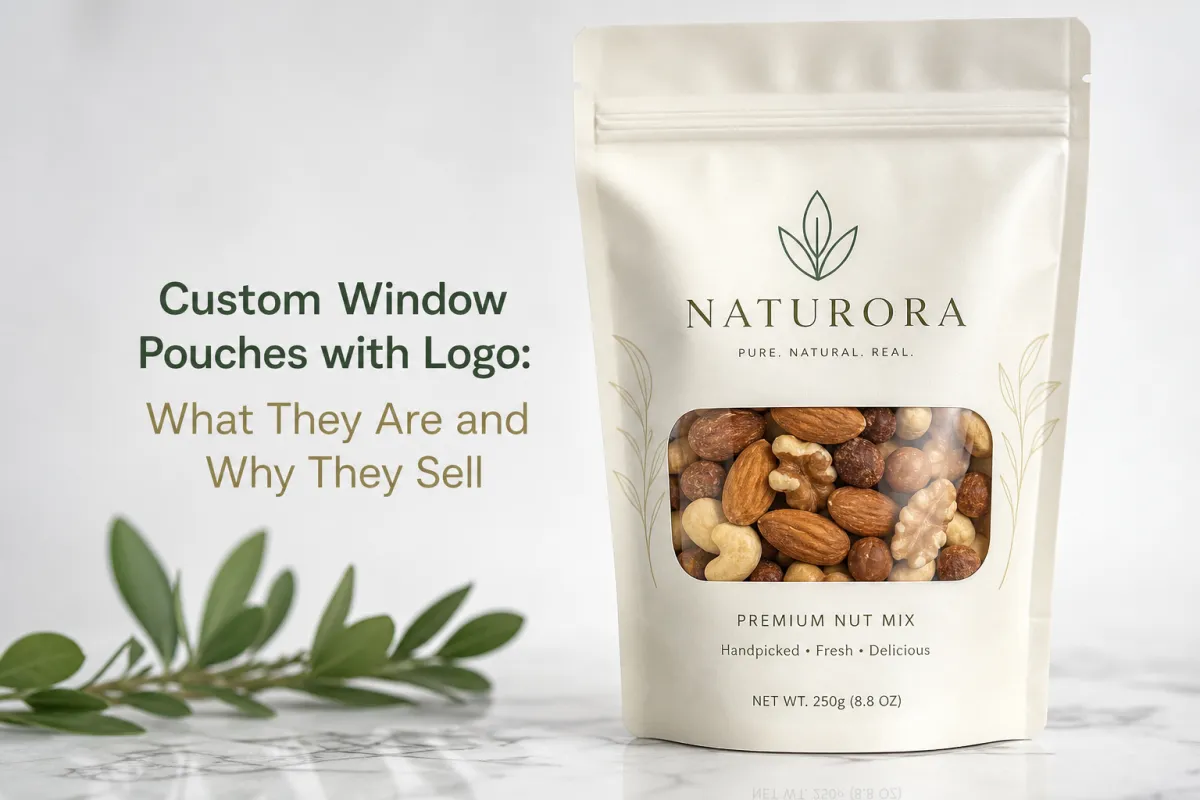
Custom window pouches with logo combine a printed pouch body with one or more transparent sections, usually set into the front or side panel. The format can stand upright, hang from a peg, or sit flat, depending on the product and retail channel, but the purpose stays the same: let the customer see what is inside before opening the package. That matters most in categories where the contents do some of the selling themselves. Coffee beans, granola, candies, dried fruit, tea, supplements, nuts, and pet treats all benefit from that kind of direct proof.
The window works because it reduces hesitation. Shoppers tend to trust what they can inspect, especially when the packaging promises freshness, quality, or consistency. A fully opaque bag asks for faith in the copy. A window asks for a glance. Those are very different buying experiences. Clear visibility often reads as honest, and honesty tends to outperform hype. The logo turns that honest presentation into a branded package instead of a plain utility pouch, which is where the commercial value starts to show up.
Branding also gets stronger when the eye has a place to settle and the memory has a mark to hold onto. A pouch that is all design and no product can feel polished but distant. A pouch that is all product and no design can feel unfinished. Custom window pouches with logo sit right in the middle, and that is one reason they keep showing up in retail packaging. They show enough of the product to build trust while still leaving room for a clear brand story.
"A window should answer one question quickly: is this product what I think it is?"
That simple question shapes a surprising number of buying decisions. A shopper comparing two similar snack packs will often choose the pouch that shows texture, freshness, or consistency more clearly. On the next visit, the logo keeps that choice from fading into the noise. That is why custom window pouches with logo are not just attractive. They can be commercially efficient whenever the product itself looks strong through the film.
There is still a tradeoff worth respecting. A larger window can improve visibility, but it also cuts into printable space and can weaken barrier protection if the structure is not chosen carefully. That is the central push and pull in custom window pouches with logo: visibility against protection, openness against shelf life, and visual appeal against manufacturing complexity. The best specifications handle all three without letting one win by accident.
- Best fit categories: snacks, coffee, tea, dried fruit, pet treats, supplements, specialty foods
- Best selling proof points: freshness, texture, color, fill level, portion size, particle consistency
- Best branding use: logo-led front panel with enough open space to frame the window cleanly
How Custom Window Pouches with Logo Work on Shelf
On shelf, custom window pouches with logo behave like visual evidence. The clear section lets the buyer inspect what is inside, which helps most in categories where the product has a recognizable shape, color, or texture story. Coffee is a good example. A shopper can see bean size and roast tone. Snack buyers can judge uniformity. Pet treat buyers can estimate shape and quantity without touching the pack. That little bit of certainty often shortens the decision process.
Logo placement changes how the package reads from a distance. If the logo hugs the window too tightly, the design can feel cramped. If it sits too low, the brand may lose authority at eye level. A centered, higher placement usually reads fastest, especially in busy aisles, though the right answer still depends on the product, channel, and competitive set. Specialty retail often supports a quieter, more refined layout. Supermarket shelves usually reward bolder branding and simpler hierarchy. That is the difference between a neat package and one that actually helps conversion.
Window shape matters nearly as much as size. A slim horizontal strip can feel restrained and premium. A wide front panel reveals more of the product and suits items with a consistent look. A die-cut window brings a custom feel, though it adds tooling complexity and can reduce printable surface. Some brands use a shaped opening to guide attention toward the best-looking part of the contents. Others keep the window small so the logo and key claims own the front panel. There is no universal rule here, and anyone claiming there is probably is not dealing with the messy reality of retail packaging.
The channel matters more than many teams expect. A pouch sold at a farmers market gets read differently than one photographed for an online listing. At a market table, the shopper can see and handle the item, so transparency does more of the work. Online, the pouch has to look good in photos first, then hold up in physical retail later. Lighting, glare, and reflection control become part of the packaging decision. Custom window pouches with logo should be built around the real buying path, not just the mockup on a screen.
One comparison helps make the point. A strong logo can anchor the package at a glance, yet an oversized or poorly placed window can make the whole thing look unfinished. That small imbalance matters. A customer standing in front of ten similar packs often decides with instinct long before a detailed comparison begins, and visual harmony is one of the first signals they read.
For teams reviewing broader product packaging options, a simple physical test usually reveals more than a long design review. Set the mockups upright, step back six to eight feet, and look at them under real store lighting. Many packs that feel strong on a monitor lose presence in person, and custom window pouches with logo are especially sensitive to that gap.
Materials, Barrier Layers, and Window Placement
The structure behind custom window pouches with logo is where packaging design stops being only visual and starts behaving like engineering. The outer look may appear straightforward, but the base material can be kraft-forward, matte film, glossy film, or a multi-layer laminate built to guard against moisture and oxygen. Products that lose aroma over time need more than a handsome front panel. Crisp foods need moisture control. Even a small amount of exposure can change texture long before the printed date on the pouch says it should.
Window placement changes the barrier equation. A front-panel window gives the best visibility, yet it removes more opaque area from the face of the pouch. Side windows keep more room for branding and can preserve the front composition. Smaller shaped windows, often used in premium launches, can give the shopper enough proof without sacrificing as much protection. The important part is understanding that the window is not only a visual detail. It changes how much oxygen, light, and moisture the pack must block.
The logo, coating, and clear film need to support one another. A metallic or high-gloss treatment may look elegant in a proof, but if the body film is too soft or the laminate too thin, the finished pouch can wrinkle, scuff, or warp in transit. A kraft-style presentation can feel grounded and natural, though an oversized opening can drain away the very authority that made the style appealing. The best custom window pouches with logo usually feel deliberate from every angle, not just from the front.
If the product needs to survive shipping, ask whether the structure should be checked against an ISTA distribution profile. The ISTA standards framework is useful because it keeps the focus on real movement, real compression, and real drops rather than just the studio sample. That becomes even more relevant for e-commerce and direct-to-consumer fulfillment, where a pack can look perfect at packing and still fail before it reaches the customer.
Paper content deserves attention as well. Brands that want a natural tone often look for FSC-certified material, and the FSC system gives buyers a clearer sourcing reference. Paper-forward structures do not automatically outperform film-forward ones, though. High-barrier performance may call for a laminated film build even if the final look is less rustic. The right choice depends on shelf life, storage conditions, and how much the product itself needs to stay visible.
One practical truth keeps showing up in packaging work: a clear patch that looks minor on paper can change the technical spec more than the art file ever will. Experienced buyers treat custom window pouches with logo as a design and performance decision together, because the material choice affects how the package behaves long after the file is approved.
| Build Type | Best For | Typical Notes | Indicative Cost Impact |
|---|---|---|---|
| Kraft-style laminated pouch with small window | Natural snacks, tea, dry goods, artisanal items | Warm visual tone, enough print area for branding, moderate barrier | Lower to mid-range |
| Matte film stand-up pouch with front window | Coffee, supplements, premium snack lines | Cleaner shelf look, better scuff resistance, stronger premium feel | Mid-range |
| High-barrier laminated pouch with zipper and shaped window | Products needing longer shelf life or stronger freshness control | More manufacturing complexity, better protection, stronger retail packaging performance | Mid to higher range |
Cost and Pricing Factors for Custom Window Pouches
Pricing for custom window pouches with logo depends on more variables than many first-time buyers expect. Size matters, of course, but material structure, print coverage, window shape, zipper choice, tear notch placement, and order quantity all play a part. A smaller run can cost several times more per pouch than the same concept at higher volume. That is not a hidden fee. It is the way setup, tooling, plates, and production minimums spread across the order.
For a realistic planning range, many brands see small custom runs land roughly around $0.60 to $1.20 per pouch, while larger runs often sit around $0.18 to $0.42 per pouch depending on structure and finishing. Those figures are broad planning ranges, not promises. A zipper, Custom Die Cut, heavier barrier laminate, or richer print coverage can move the number quickly. If you want a tighter quote, share the exact dimensions, fill weight, product type, and whether the pouch must stand upright or hang on a peg.
Comparing only unit price can lead teams in the wrong direction. A cheaper pouch can cost more if it shortens shelf life, looks weak on shelf, or slows packing operations. A pricier structure may pay for itself if it keeps the product fresher, cuts returns, or improves conversion. That is why the best quote is the one tied to real use, not just visual preference. Custom window pouches with logo should be costed like a business decision, not treated like a decoration order.
These upgrades tend to affect pricing most clearly:
- Resealable zippers: often add convenience and freshness control, especially for multi-use snacks or coffee
- Tear notches: small cost increase, but a major improvement in opening consistency
- Spot finishes or specialty inks: useful for premium package branding, but they can raise both setup and run cost
- Custom die cuts: visually distinctive, yet they increase tooling complexity and usually require tighter production control
- Higher barrier laminates: worth it if oxygen or moisture sensitivity is a real issue
If you are comparing versions, ask for three quotes: budget, balanced, and premium. That makes the tradeoffs visible. A budget pouch might keep the logo simple and the window modest. A balanced version could add a zipper or stronger barrier film. A premium version might include a refined print treatment, improved coating, and a shaped window. For many brands, the middle option gives the best balance of margin and retail packaging performance.
Some buyers also compare these packs with custom printed boxes. That is a smart exercise. Boxes can offer a more rigid feel and a different shelf profile, while pouches often use less material and show the product sooner. Neither format wins every time. They solve different problems, and custom window pouches with logo often come out ahead when the item needs to be seen quickly and the package needs to stay light.
Step-by-Step Ordering and Production Timeline
The ordering process for custom window pouches with logo usually begins with a product brief rather than artwork. That brief should cover fill weight, product dimensions, shelf life expectations, storage conditions, and whether the pack needs to stand, hang, or ship by courier. Once those details are clear, the pouch size can be matched to the product instead of guessed from the logo file. That sounds basic, yet size mistakes still cause a surprising number of delays.
After the brief comes structure selection. Decide on the pouch format, paper or film direction, window size, closure type, and any barrier requirements. Then move into artwork. The design needs enough printable area around the logo so the window does not crowd the front panel. Ingredient lists, compliance notes, usage copy, and nutrition details need space as well. This is where many custom window pouches with logo lose polish: the design looks strong until legal text and product information squeeze the margins.
Proofing matters because digital approval is not the same as physical approval. A mockup helps with placement and color balance, but a sample shows how the window behaves in real light, how the pouch fills, and whether the zipper or seal functions the way it should. For oily, irregular, or delicate products, that sample is even more valuable. A few millimeters of window height or a slight fill adjustment can change the whole character of the pack.
A practical timeline often looks like this:
- Briefing and specification: 2-4 business days
- Artwork setup and proofing: 3-7 business days, depending on revision count
- Sampling or approval sample: 5-10 business days if a physical sample is required
- Production: often 12-15 business days after final approval for many custom runs
- Transit: add several days to a couple of weeks depending on distance and shipping method
That schedule is a planning guide, not a promise. Artwork revisions, low-resolution logos, unexpected claim changes, and late material substitutions can all push a launch back. If the pouch is attached to a seasonal promotion, retail reset, or product rollout, build in margin. Good packaging teams leave room for one round of clarification and one round of small corrections instead of assuming the first proof will land perfectly.
For direct-to-customer shipments, ask whether the final pack should be checked against distribution risk. A supplier familiar with ISTA-style testing can help you think through compression, vibration, and drop stress before the first customer receives a dented carton or a split seam. That kind of planning protects both the product and the brand.
Common Mistakes That Make Pouches Look Cheap
Overusing the window is the first mistake. Too much transparency can make custom window pouches with logo feel underdesigned or even unfinished. It can also expose uneven fill levels, product fragments, or color variation that should have stayed hidden. The window should show the right amount of truth, not every possible detail. Shelf life and shelf appeal are not the same thing.
Poor logo placement comes next. If the logo competes with the window, the pack loses hierarchy. If it sits too small, it disappears. If it gets stretched or compressed to fit a strange shape, it looks rushed. Good branding needs breathing room, especially on smaller pouch formats where every millimeter matters. A compact design can still feel premium, but only if the spacing is deliberate.
Scale errors show up quickly at arm's length. Tiny text, weak contrast, or a crowded layout can make the pouch hard to read. The shopper should understand the product name, variant, and main benefit within a second or two. If they have to squint, the package is losing sales. That is one reason many brands print mockups at actual size and review them on a counter rather than trusting a screen preview. Screen files can flatter the design in ways the finished pouch never will.
Finish mismatch creates another subtle problem. A glossy pouch body paired with a rustic logo system can feel conflicted. A matte, earthy design with highly reflective foil can do the same. The pack should feel like one thought, not three different ideas competing for attention. That kind of mismatch shows up often in custom window pouches with logo because teams approve the artwork separately from the sample. The result may be technically correct but still feel off.
One operational mistake gets missed more often than it should: not testing the pouch with the real product. A pouch can look right while empty and behave very differently once filled. The seal may curve, the window may reveal too much or too little, and the stand-up base may shift under weight. Oily, dusty, or irregular products make this even more obvious. A small run test can prevent a costly reprint.
Honestly, a lot of weak pouch designs fail for the same reason. The graphic gets built first and the product comes second. That order is backwards. The strongest custom window pouches with logo start with the product behavior, then shape the branding around it. That approach is a little less glamorous during the design phase, but it saves money and avoids awkward surprises later.
Expert Tips and Next Steps for a Better Order
Start with the product, not the art. Decide what the window must reveal, then build the logo placement around that decision. If the product has a strong visual identity, let it carry some of the selling load. If the product is uniform or visually quiet, the logo and structure need to do more of the work. That distinction is simple, yet it changes nearly everything about custom window pouches with logo.
Prototype early, even if the first sample is imperfect. A prototype answers practical questions that a rendering cannot. Does the window show enough? Does the pouch stand cleanly? Does the zipper feel right for the price point? Does the branding read clearly from six feet away? Each question looks small on its own. Together, they decide whether the pouch feels polished or rushed.
Request two or three costed directions before locking the order. One can be the most economical version, one the balanced option, and one the premium build. That comparison shows where the money is going. You may find that a better film or cleaner finish adds more value than an expensive decorative treatment. You may find the opposite. The point is to see the tradeoff before production starts, not after.
It also helps to review print files, seal specs, and shipping timelines together. Too many teams treat those as separate tasks, and that is where trouble starts. A logo that looks great in art review can still fail if the seal area is too tight. A beautiful pouch can arrive late if the shipping buffer was too thin. For branded packaging, timing and structure are part of the design story.
If your portfolio includes several formats, compare custom window pouches with logo against your broader custom printed boxes and other product packaging choices. Boxes, pouches, and cartons all send slightly different signals. The right one depends on how the product should be perceived, stored, and opened. Many brands find that a pouch with a window gives the strongest mix of visibility, portability, and cost for the exact item they sell.
The cleanest next step is straightforward: audit your current packaging, list the three product details the window must reveal, and decide what barrier performance the product actually needs. Then brief suppliers with that information instead of asking them to "make it look premium." The stronger the brief, the stronger the result. That matters especially for custom window pouches with logo, where the distance between a decent concept and a strong one is often just a few millimeters of window placement and a few smart decisions about material structure.
What products work best in custom window pouches with logo?
The best fit products are visually appealing or texture-driven items such as snacks, coffee, tea, dried foods, pet treats, supplements, and small specialty goods. Use custom window pouches with logo when the product itself helps sell the item, because the customer can judge freshness, color, shape, or portion size at a glance. Avoid oversized windows for products that can look inconsistent or fade over time if too much of the contents are exposed.
How much do custom window pouches with logo usually cost?
Price depends on pouch size, material structure, print coverage, window shape, zipper or tear notch options, and the order quantity. Smaller orders generally cost more per pouch because setup and tooling are spread across fewer units. Barrier upgrades and specialty finishes raise the price, but they may be worth it if the product needs shelf-life protection or premium positioning. For many buyers, the real comparison is not just unit cost; it is how well the pack performs in retail packaging and how long the product stays saleable.
How long does it take to produce custom window pouches with logo?
Timeline depends on artwork approval, proofing, sampling, production queue, and shipping distance. Simple projects move faster when files are final and materials are standard; custom structures or multiple revisions add time. Build extra buffer if the pouch launch is tied to a seasonal promotion, retail deadline, or product rollout. A common planning range is about 12-15 business days after final approval for production, plus transit time.
What size window should I choose for custom window pouches with logo?
Choose the smallest window that still shows the product clearly and supports the selling point you want customers to notice. Match the window size to the product's visual strength; colorful or uniform items can handle more transparency, while inconsistent products may need less. Keep enough printable space for the logo, claims, and regulatory text so the pouch does not look crowded. That balance is what keeps custom window pouches with logo readable and commercially useful.
Do custom window pouches with logo need special barrier materials?
Yes, if the product is sensitive to oxygen, moisture, aroma loss, or light exposure, the pouch structure should be selected carefully. The window reduces the fully opaque surface area, so the rest of the pack may need stronger barrier layers to protect quality. Ask for material recommendations based on the product's shelf life, storage conditions, and shipping environment. For many brands, that is the difference between a pouch that looks good on day one and one that still performs after weeks on shelf.
For teams planning the next packaging run, the safest move is to treat custom window pouches with logo as a product decision first and a graphic decision second. That sequence usually produces better shelf appeal, fewer production surprises, and packaging that actually earns its keep. Start with the product behavior, lock the barrier needs, then shape the window and logo around those facts. That is the part that holds up in real use, not just in a polished mockup.

